
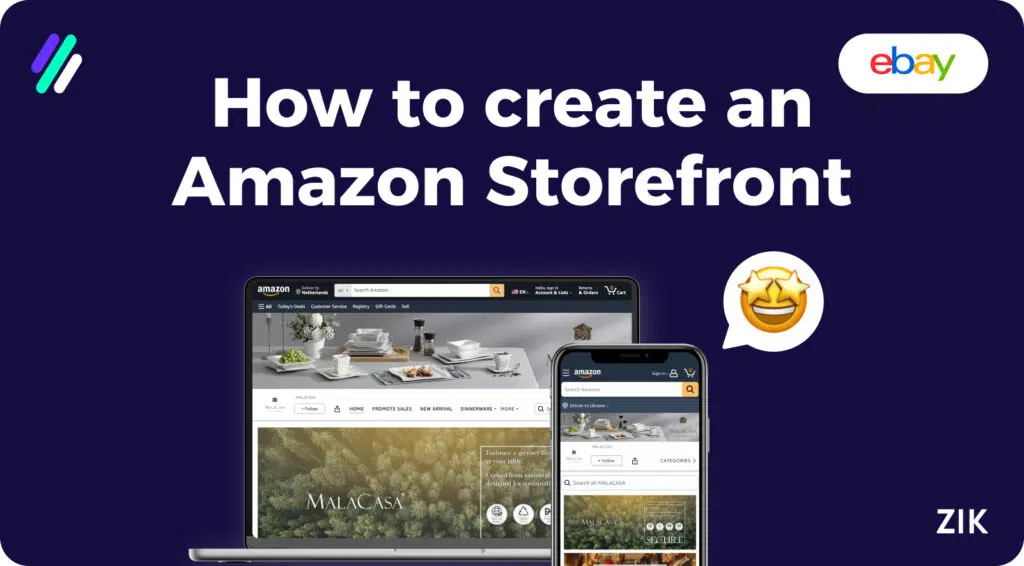
To create an Amazon storefront as a seller, you need three things before you can open the builder: a Professional selling account, Amazon Brand Registry enrolment, and a registered Amazon Ads account. Then you build and submit the store in five steps.
If you sell your own brand on Amazon, a storefront gives it a dedicated home on the site, but the builder stays locked until three requirements are in place. Two are well known: a Professional selling account and Amazon Brand Registry. The third, a registered Amazon Ads account, is the one most guides leave out. This guide covers all three, the five steps to build and submit your Brand Store, and how to manage and promote it after launch, checked against Amazon’s own current documentation. It also clears up the name, because an “Amazon storefront” can also mean an influencer’s page.
What Is an Amazon Storefront?
“Amazon storefront” means one of two things. A Brand Store is a free, dedicated space on Amazon where a brand showcases its own products. An Influencer storefront is a page where a creator recommends products from many brands and earns commission.
Amazon itself makes this distinction. Its documentation says the phrase “could refer to two different online destinations where customers can connect with products in the Amazon store”, and the two are built in different places, by different people, for different reasons.
- A Brand Store is for a brand that owns its products. It is free, it lives inside the Amazon store, and it shows only your own catalogue. This is what sellers mean by an Amazon Store or an Amazon storefront, and it is what the rest of this guide covers.
- An Influencer storefront is for a member of the Amazon Influencer Program. A creator curates products from many brands, their audience buys through the page, and the creator earns commission on qualifying purchases. The brands whose products appear there are not involved in building it.
The short version: brands sell their own products directly to customers, and influencers earn commission by recommending other people’s. If you are a creator looking to build a page of recommendations, you want the Amazon Influencer Program rather than the Brand Store builder, and the requirements below do not apply to you.
Amazon Storefront Requirements
An Amazon Brand Store has three requirements: a Professional selling account at $39.99 a month plus selling fees, enrolment in Amazon Brand Registry, which needs a pending or registered trademark, and an Amazon Ads account, which is what unlocks the Brand Store builder.
The Brand Store itself costs nothing. What costs money is the Professional selling plan you have to be on to qualify. Work through all three before you try to open the builder, because the builder will not open without them. Setting up an Amazon store is mostly this part, not the design work that follows.
Every requirement, fee and step in this guide comes from Amazon’s own guide to building a Brand Store, dated 6 March 2026, and from Amazon’s Brand Registry requirements page. Where Amazon does not publish an answer, this guide says so instead of guessing.
1. A Professional Selling Account
A Professional selling plan lets you sell in the Amazon store for $39.99 a month, plus selling fees based on what you sell. It also gives you the tools for managing orders and inventory that a growing catalogue needs.
If you do not have one yet, you register at Amazon’s seller signup with your business details, bank account and tax information. If you had an account that is no longer usable, you will need an active Amazon seller account again before anything else here applies.
2. Amazon Brand Registry
Amazon Brand Registry is free, and it is the program that unlocks brand-building tools including the Brand Store. To enrol, Amazon asks for two things:
- A pending or registered trademark. A pending application counts, which is worth knowing, because a great deal of older advice says you need a granted registration first.
- A logo that includes your brand name on your products or your packaging.
Amazon is specific about the kind of mark it accepts: a text-based word mark, or an image-based design mark containing words, letters or numbers, issued by an approved government intellectual property office. The list of approved offices changes, so check it against Amazon’s own Brand Registry requirements page rather than any article, including this one. If you do not have a trademark yet, Amazon’s IP Accelerator connects you with legal providers who can file one and speed the application up.
Brand Registry is also what gives you the listing and protection tools that make a store worth having, such as A+ Content and the ability to report counterfeit listings. It is a prerequisite for selling branded products on Amazon properly.
3. An Amazon Ads Account
This is the requirement most guides leave out, and it is the one that stops people. In Amazon’s words, you go to Amazon Ads and create a sponsored ads account “for the ability to access the Amazon Brand Store builder”.
You are not obliged to run or pay for any advertising. The account exists because the Brand Store builder lives inside Amazon’s advertising console: when you open Manage Stores in Seller Central, Amazon prompts you to sign in with your Amazon Ads credentials. Without those credentials there is nothing to sign in with, however complete your Brand Registry enrolment is.
How to Create an Amazon Brand Store: the 5 Steps
Once you meet the three requirements, you set up a Brand Store in five steps: open the Brand Store builder from Seller Central, design your pages, add your products, test the layout on mobile and desktop, then submit it for publishing.
Step 1: Open the Brand Store Builder
In the main menu of Seller Central, hover over Stores, then select Manage Stores. You will be asked to sign in with your Amazon Ads account credentials, and then you land on the Brand Stores main page. Select Create Brand Store.
If you prefer to start from the advertising console instead, go to Brand Content in the left panel, then Brand Stores, then Create Brand Store. Both routes reach the same builder.
You will see a list of the brands you have enrolled in Brand Registry. Pick the one you are building for, then fill in three pieces of information that are harder to change later than they look:
- Brand display name. Use your brand’s customer-facing name. This appears in your store’s URL and in its navigation bar.
- Brand logo. A high-quality image of at least 400 x 400 pixels. You choose whether it shows in the header.
- Meta description. A short summary of the page. Amazon recommends doing keyword research before you write it, because it affects how your store surfaces in search results.
Step 2: Design Your Brand Store
Amazon gives you templates and widgets. Templates are pre-built page layouts with adjustable tiles you fill with images, text and video. Widgets populate themselves, so a featured deals widget appears only while you actually have deals running. There is also a blank template if you would rather design from scratch.
Amazon recommends building at least three levels of pages, with your homepage as the first level. Use Page Manager, then Add a page, give each new page a name, a description and a template, then add and arrange tiles: shoppable images, lifestyle video, call-to-action buttons. You can copy pages or tiles between each other to save time.
Amazon has also added AI generation inside the builder. You can ask it to create new pages, update existing ones, or produce a seasonal version of your store, either from a preset prompt or one you write, and it will generate layouts and text and pull in relevant products.
Step 3: Add Your Products
Show your full catalogue. Amazon’s own advice is that a complete catalogue maximises product discovery, and the store gives you several ways to arrange it:
- Product grids and collections organised by category across subpages, so customers can work through the whole range.
- Best sellers and new releases in high-visibility tiles on the homepage. If you are not sure which of your products qualify, Amazon Best Sellers Rank: What It Means & Why It Matters explains the signal to read first.
- Shoppable images that let customers click a product inside a lifestyle photo and add it to the cart.
- Product selector, a quiz that guides a customer to the right product for them.
- Automated widgets such as “best selling” and “recommended for you”, which choose what to show each customer from their browsing behaviour.
A product has to exist as a listing in the Amazon store before you can add it to your Brand Store. On a Professional plan you can create those listings one at a time or in bulk. How you fulfil them is a separate decision, and worth understanding before you scale the catalogue: see What is FBA on Amazon? for the trade-offs.
Step 4: Test It on Mobile and Desktop
The builder has a preview feature that shows your store on both mobile and desktop. Use it throughout, not just at the end. Amazon asks you to watch for technical issues, typos, blurry or low-quality images, inconsistent branding and inaccurate product information.
Take the time to fix what you find. This is the last point at which changes are free, and a store that reads as careless undoes the credibility a Brand Store exists to build.
Step 5: Submit for Publishing
Select Submit for publishing. You can either make the store live as soon as Amazon’s moderation team approves it, or request a specific date. Amazon says the review process “usually takes under 24 hours, but may take longer”.
The scheduling option works for your first publish and for every later update, which is more useful than it sounds. You can prepare a seasonal or launch version of your store and have it go live for a brand announcement or an event like Prime Day, without disturbing the version that is live in the meantime.
Why a Brand Store Is Worth Building
Amazon reports that customers who visit a Brand Store purchase 53.9% more frequently, have a 52.1% higher add-to-cart rate, and a 71.3% higher average order value than customers who do not visit one.
Those are Amazon’s own figures for its own feature, published on its seller blog in March 2026, so read them as a vendor’s case for its product rather than as independent research. Amazon does not publish the sample behind them. The direction is at least what you would expect: a shopper who has gone to the trouble of browsing one brand’s full range is further along than one who landed on a single product page.
Beyond the numbers, a Brand Store does a few things an ordinary product listing cannot:
- It is the one place that is only yours. In Amazon’s words, a Brand Store “includes content only from your brand”, which is what makes it useful for upselling and cross-selling your own range.
- It gives you a URL you own. You can send ads, social posts and email campaigns to a branded destination rather than to a product page.
- It lets you tell the brand story with lifestyle imagery, video and product education, which a listing template has no room for.
- It reports back. You get an analytics view of sales, page views and traffic sources, covered below.
How to Manage Your Amazon Store After Launch
A Brand Store is not finished when it publishes. Amazon gives you two places to measure it, the Insights dashboard and the quality page inside it, and they answer different questions.
- The Insights dashboard reports metrics like views, sales and traffic sources. Traffic sources are the useful part: they tell you whether your ads, your social posts or Amazon’s own search is doing the work.
- The Brand Store quality page, inside the Insights dashboard, evaluates your content on its structure and performance. It also shows dwell time, the average time customers spend with your store, along with sales performance and customised recommendations. It is the closest thing Amazon offers to a scorecard for the store you built.
Alongside that, the ordinary disciplines apply. Keep your product information accurate, keep navigation simple enough that a customer can find a category without thinking about it, answer customer questions in the Messages tab, and manage inventory levels so the products on your homepage are actually in stock. A best-seller tile pointing at an unavailable item is worse than no tile.
How to Promote Your Amazon Store
Amazon notes that customers find Brand Stores through search results, sponsored ads, and the Amazon website and app. Its own suggestions for driving traffic, plus the ones that work in practice:
- Use the store as your ad landing page. Sponsored Brands campaigns can point at your store’s homepage or any subpage inside it, which is usually a better destination than a single product.
- Share the URL everywhere you already speak. Your store has a unique address, so it works in social posts, email campaigns, packaging inserts and anywhere else you would otherwise link to a product page.
- Run deals. While a deal is active, the featured deals widget surfaces it inside your own store automatically, so a promotion you are already running does double duty.
- Treat it as a page that can rank. Amazon explicitly suggests using SEO to grow organic traffic to your products, which is what the meta description in step 1 was for.
- Use the channels you already run. If you sell across platforms, the same playbooks apply: connecting social media to a Shopify store and email marketing for Shopify sellers both translate directly.
- Work with Amazon influencers. This is where the two kinds of storefront meet. Creators in the Amazon Influencer Program can feature your products on their own storefronts and earn commission, which puts your catalogue in front of their audience without you building anything new.
Knowing what your competitors are doing helps here too, and the habits transfer across marketplaces. Our guide to eBay Competitor Analysis Tips: Outsell Rivals with Data covers the method, and the method is the part that carries over.
Conclusion
Creating an Amazon storefront is mostly a question of clearing the three requirements. The build itself is an afternoon in a drag-and-drop editor, but the Professional plan, the Brand Registry enrolment and the Amazon Ads account each take their own time, and Brand Registry depends on a trademark you may not have filed yet.
So start with the requirements rather than the design. Once the builder opens, work through Amazon’s five steps, publish, and then let the Insights dashboard tell you what to change. If you have not registered your brand yet, that is the step to begin today.
Build Your Brand Store the Smart Way
If you’re figuring out how to create an Amazon storefront, why not apply those insights to your own brand too? The Shopify AI Store Builder helps you instantly launch a polished storefront—complete with product pages, design layouts, and conversion-ready features. Whether you’re mirroring your Amazon setup or creating something unique, this tool gives you full control, zero coding required.
Frequently Asked Questions on How to Create an Amazon Storefront
How do you create an Amazon storefront?
Get a Professional seller account, enrol in Amazon Brand Registry, and register for Amazon Ads. Then in Seller Central go to Stores, then Manage Stores, then Create Brand Store. From there you set up the store itself: design your pages, add your products, preview them on mobile and desktop, and submit for publishing.
Can anyone have a storefront on Amazon?
No. A Brand Store is only for brand-registered sellers on a Professional selling plan, which means you need a pending or registered trademark for your brand. An Amazon Influencer storefront is a separate thing with separate rules, and it is open to creators rather than to sellers.
Do you have to pay to make an Amazon storefront?
The Brand Store is free to build, and Brand Registry is free to join. What you pay for is the Professional selling plan it requires, at $39.99 a month plus selling fees. The Amazon Ads account needed to open the builder does not oblige you to spend anything on advertising.
How many followers do you need to have an Amazon storefront?
None, for a Brand Store. A seller building a Brand Store needs a Professional selling plan and a trademark, not an audience. Followers are only relevant to the Amazon Influencer Program, which is the other kind of storefront, and Amazon does not publish a public follower threshold for it.
Is Amazon influencer the same as storefront?
No. The Amazon Influencer Program is how a creator gets an Influencer storefront, where they recommend other brands’ products for commission. A Brand Store is where a brand shows its own products. Both are custom Amazon pages, which is why the single word “storefront” causes so much confusion.
What is the difference between an Amazon Store and a storefront?
For a seller they are one thing under three names. Amazon’s current term is Brand Store, its older material and most sellers say Amazon Store or storefront, and all three describe the same custom brand page with its own Amazon URL. Only “storefront” is ambiguous, as the question above explains.
How long does Amazon take to review a Brand Store?
Usually less than a day, according to Amazon, and it does not publish a maximum. The same review applies to updates, not only to your first publish, so build the extra time into any launch you are scheduling around a date.
Is an Amazon Storefront worth the effort?
If you already clear the requirements, yes: it is free, and it is the only place on Amazon where a customer sees your range without your competitors beside it. If you do not have a trademark yet, the real work is the Brand Registry application, and the store is the easy part that follows.