
Eyeing Australia for launching or expanding your dropshipping business?
We get it. With a record $69 billion spent online in 2024 and the market expected to hit $107 billion by 2027, you have a feeling that this is a market worth tapping into.
But in order to succeed, you need suppliers who can deliver high-quality products quickly and reliably across different parts of the country.
To help get you started, I’ve compiled a list of the best Australian dropshipping suppliers.
Here are my findings:
| Supplier | Best For | Pricing/Fees |
| Dropshipzone | Bulky and high-ticket items | Free |
| Simply Wholesale | High-volume sellers needing variety | Free |
| Kogan | Premium electronics and appliances | $99/month + 10-20% commission |
| iDropship | High-ticket furniture and lifestyle goods | Free, pay per order |
| Colourblocker | Trendy gadgets and home accessories | Free |
| Ozdingo | Certified essentials and pet care | Free |
| CJ Dropshipping | Scaling and private labeling | Free, pay per order |
| Spocket | High-margin curation and boutique branding | $39.99/month |
| SaleHoo | Finding vetted Australian wholesalers | $67/year |
| Factory Fast | Bulky, high-ticket items | Free |
| Printful | Custom branded apparel | Free, flat-rate shipping |
1. Dropshipzone
- Best for: Dropshipping bulky and high-ticket items
- Delivery Time: 3-7 days
- Pricing/Fees: No monthly subscription fees
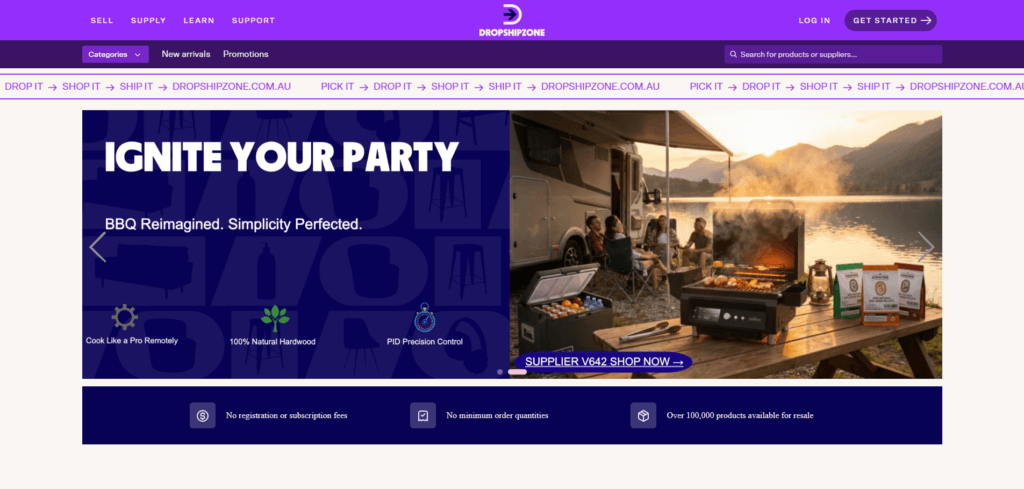
Dropshipzone is recognized as one of Australia’s top dropshipping and wholesale platforms. It offers more than 100,000 high-quality products across categories such as tools, fitness, furniture, and kids’ apparel. Most of its supply partners have warehouses in Australia and use reliable local carriers, such as Australia Post and Aramex Toll, for fast domestic shipping.
Pros
- Provides a dedicated infrastructure that makes shipping large items domestically affordable
- Ships items with a 12-month warranty so you can easily meet refund and repair obligations
- Provides live stock updates to help prevent out-of-stock cancellations
Cons
- Supplier prices can change without notice, meaning there’s a risk of selling at a loss
- Cannot easily include custom-branded packaging or thank-you notes
- High competition due to items being cross-listed by hundreds of other sellers
2. Simply Wholesale
- Best for: High-volume sellers needing a variety of trending products
- Delivery Time: 2-10 days
- Pricing/Fees: Free to join without any subscription fee
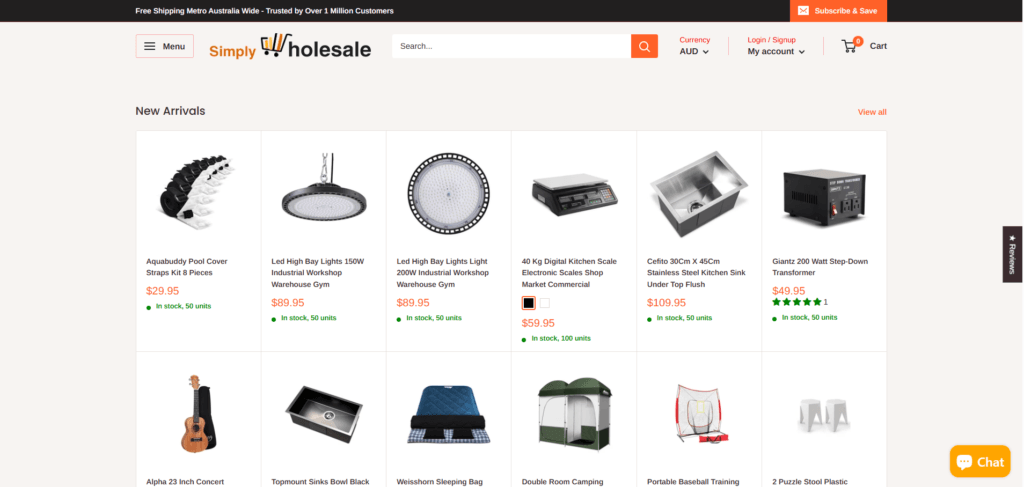
Simply Wholesale has one of the biggest catalogs among Australian dropshipping suppliers. Its catalog includes over 500,000 items across dropshipping categories like beauty, fashion, tools, and pets. As a trusted and experienced wholesaler, Simply Wholesale’s dropshipping program is one of the best for those beginning their e-commerce journey.
Pros
- Stocks over 500,000 SKUs located locally (the largest variety for an Australian generalist)
- Offers specialized logistics routes to reach regional NSW, QLD, and VIC
- Has the lowest barrier to entry with a free dropshipping account and no monthly fee
Cons
- High domestic wholesale prices on popular items make it difficult to enjoy higher margins
- Items often arrive in standard wholesale packaging, which lacks a premium feel
- Inventory levels for hot items can sync slowly, resulting in out-of-stock orders
3. Kogan
- Best for: Established retailers selling premium electronics and appliances
- Delivery Time: 1-3 days
- Pricing/Fees: $99 AUD monthly seller fee plus 10%–20% commission per sale.
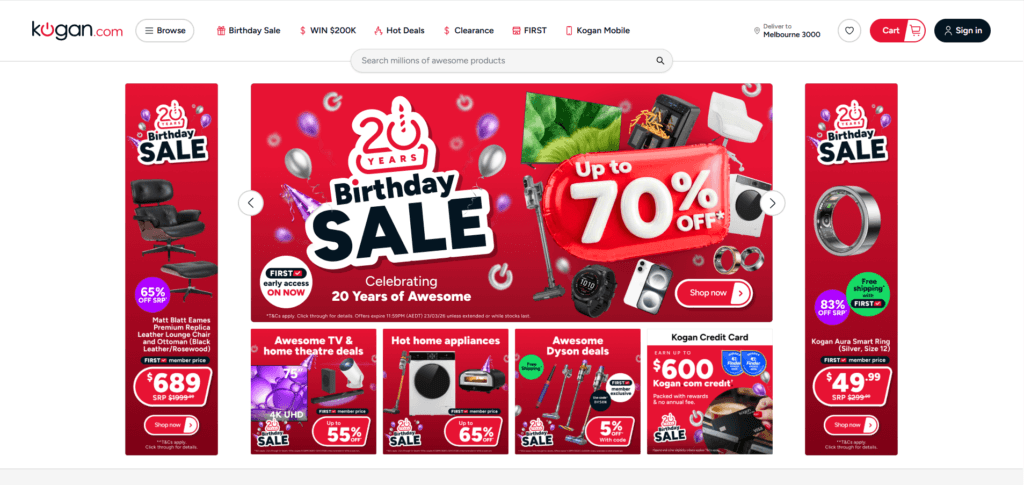
Kogan maintains a large inventory of high-quality items in local warehouses to ensure fast, reliable nationwide shipping. Some people call it the “Aussie” Amazon due to its competitive pricing and membership programs that offer perks like free shipping and exclusive discounts. Kogan can also integrate with Shopify to enable automated order management and inventory updates.
Pros
- Offers the Kogan First loyalty program, known to drive repeat purchases from over 1 million members.
- Provides immediate access to in-demand private labels like Kogan, Ovela, and Fortis
- Makes Australian dropshipping store owners feel safer as they know they are buying from a renowned brand
Cons
- High monthly seller fee of $99 AUD can cut into margins, especially for smaller or newer sellers
- Commission rates of 10%–20% per sale are relatively steep compared to other marketplaces
- The strict approval process makes it harder for beginners to get accepted as a seller
4. iDropship
- Best for: High-ticket dropshipping furniture and premium Australian-made lifestyle goods.
- Delivery Time: 2-5 days
- Pricing/Fees: No monthly fees, pay per order
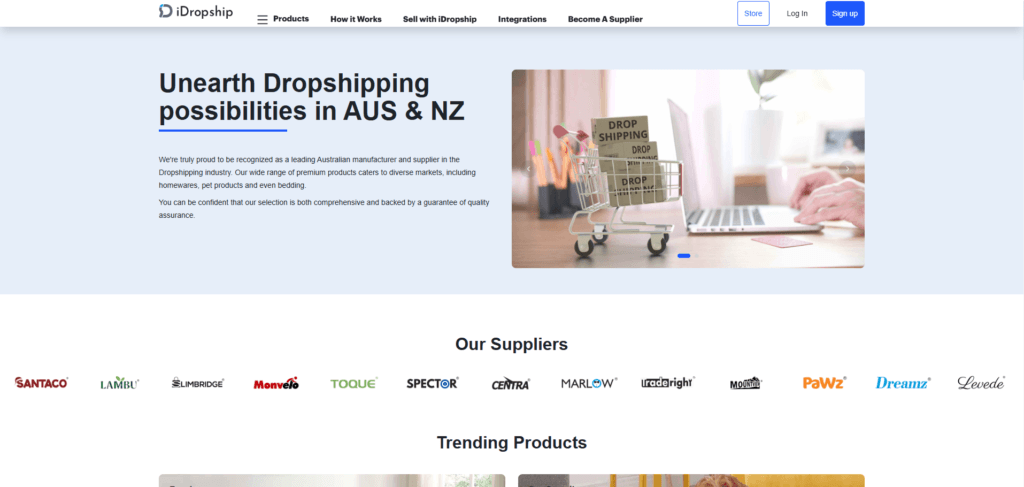
iDropship provides fast, nationwide shipping for high-ticket dropshipping goods. All items are dispatched from local Australian warehouses and thoroughly inspected by the supplier’s QC team to ensure quality. You also get the option to request white-label packaging, where the items go out in neutral packaging to help you maintain your brand identity.
Pros
- Offers genuine white-label packaging to protect your brand identity.
- Manually inspects every item before dispatching it to the customer to protect your reputation
- Offers a proprietary Shopify integration to automate pricing updates and inventory syncing
Cons
- Product variety can feel limited compared to larger wholesale suppliers like AliExpress
- Shipping costs for heavy items like furniture can be high for remote locations
- High-ticket items demand a higher upfront capital investment from dropshippers
5. Colourblocker
- Best for: Dropshipping trendy lifestyle gadgets and home accessories
- Delivery Time: 2-10 days
- Pricing/Fees: No monthly subscription fees
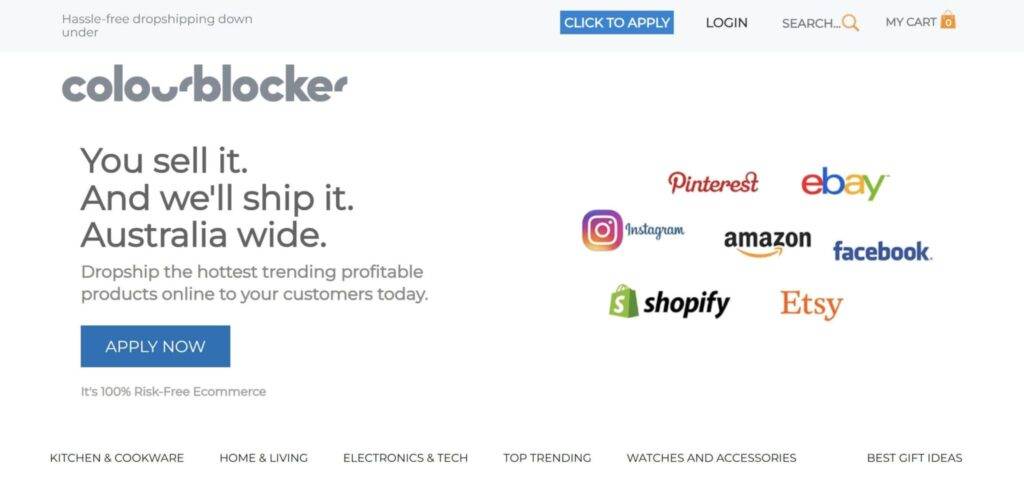
Hailing from Sydney, Colourblocker offers a wide range of items across electronics, accessories, and kitchen and homeware niches. It doesn’t charge a monthly subscription fee and processes most orders within 48 hours. This Australian supplier also integrates with Shopify, WooCommerce, and Amazon to make it easy for dropshippers to manage their inventory.
Pros
- Curates items based on Australian seasonal trends (e.g., EOFY office gadgets)
- Offers blind dropshipping with no invoices or Chinese-branded flyers included
- Offers raw data feeds for pushing inventory to Catch.com.au and other marketplaces
Cons
- It can lead to heavy price wars, as many store owners use it to dropship products to Australia
- My have less competitive rates for shipping bulky homewares than other suppliers
- Signal-item dropshipping margins are quite thin compared to wholesale margins
6. Ozdingo
- Best for: Certified essentials and high-trust dropshipping niches
- Delivery Time: 1-3 days
- Pricing/Fees: No monthly subscription or signup fees
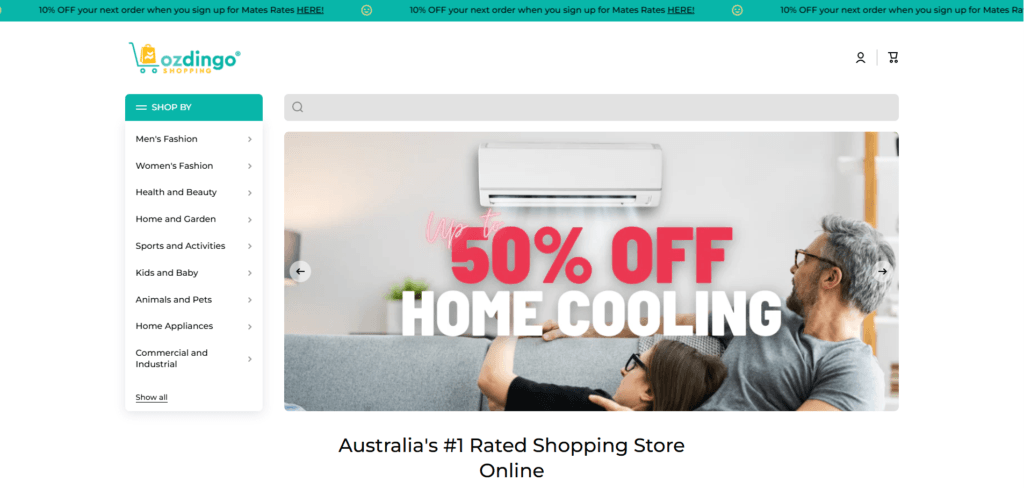
Ozdingo offers over 8,000 items across home decor, fitness, pet supplies, and fashion categories. All of its dropshipping products are high-quality and certified, so you can be sure that they will meet the local safety and quality standards. As a Brisbane-based dropshipping supplier, Ozdinago offers a more personalized service than many overseas dropshippers due to its local presence and understanding of the Australian market.
Pros
- Protects you from legal liability by vetting every good against Australian standards
- Practices blind dropshipping to ensure no ozdingo-branded tape or invoices reach your customer
- Offers some of the fastest delivery times with same-day dispatching via its Brisbane Warehouse
Cons
- Is significantly smaller than marketplace-style suppliers like AliExpress
- Has higher per-unit costs than imports from China due to quality certifications and local warehousing
- There’s heavy competition on eBay Australia and Catch.com.au for its best-selling items
7. CJ Dropshipping
- Best for: Scaling and private labeling
- Delivery Time: 3-7 days via AU warehouses
- Pricing/Fees: No setup fee, only charges for item + shipping
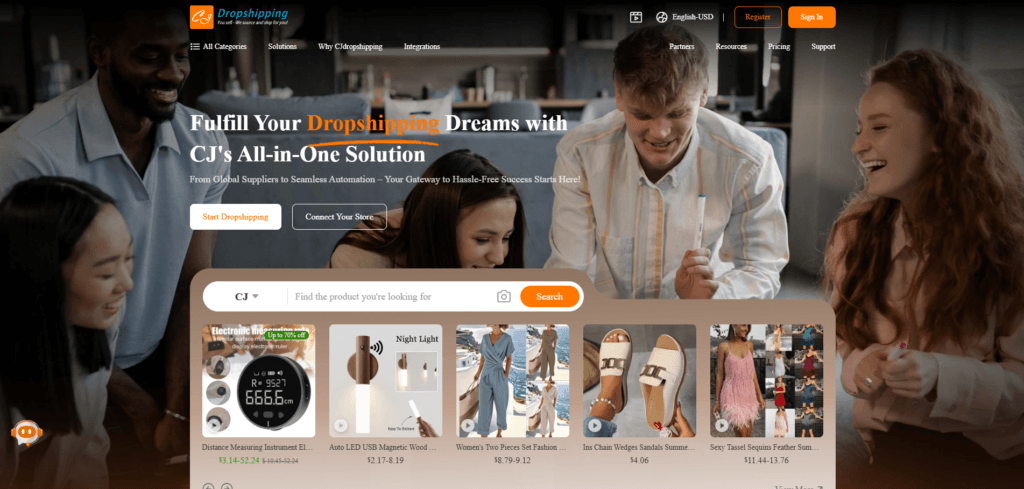
CJ Dropshipping is compatible with various online selling platforms, including Shopify, Etsy, WooCommerce, and eBay. You can choose products from its large catalog or post a sourcing request if the item you want is not available. CJ also lets you design your own label or packaging to help you provide a cohesive brand experience.
Pros
- Offers on-demand product sourcing, where it gets your desired item directly from a factory
- Allows you to add your own logo to boxes, bags, and “thank you” cards
- syncs seamlessly with almost every platform, including Etsy, eBay, and Shopify
Cons
- Popular items in its Australian warehouses often sell out fast
- Calculates its shipping rate by volumetric weight, which can be confusing for beginners
- Doesn’t have the most user-friendly dashboard with ads and pop-ups a regular sight
8. Spocket
- Best for: High-margin curation and boutique branding
- Delivery Time: 2-5 days
- Pricing/Fees: $39.99 per month
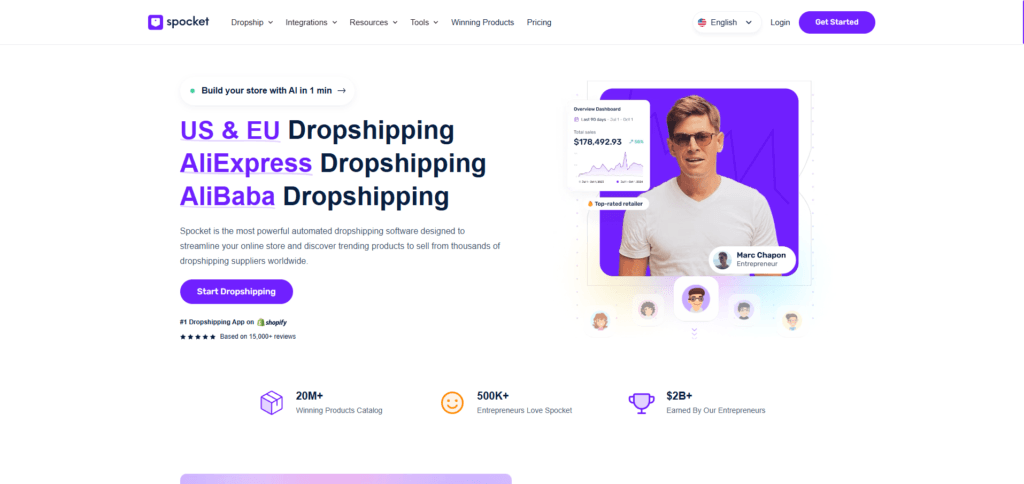
Spocket offers a curated list of 8,000+ pre-vetted suppliers, including options from Australia and New Zealand. Products sourced from Aussie and Kiwi suppliers take just 2-5 business days to deliver compared to the long shipping times of overseas vendors. Sprocket also enables you to generate custom invoices featuring your own store branding to increase customer trust and loyalty.
Pros
- Allows you to exclude international sellers so you only see fast local shipping options for Australia
- Gives the option to generate invoices featuring your store’s logo and a personalized note
- Has a built-in “Order Samples” button to help you inspect product quality in real-time and take your own marketing images
Cons
- The total volume of items physically shipped from Australia is quite small compared to what can be shipped from the US or EU.
- Premium items are available at a higher cost, meaning you will have to set high retail prices to make a profit
- Requires you to go through its support to communicate with the supplier
9. Salehoo
- Best for: Finding vetted, legitimate Australian wholesalers
- Delivery Time: 1-5 days
- Pricing/Fees: $67 per year
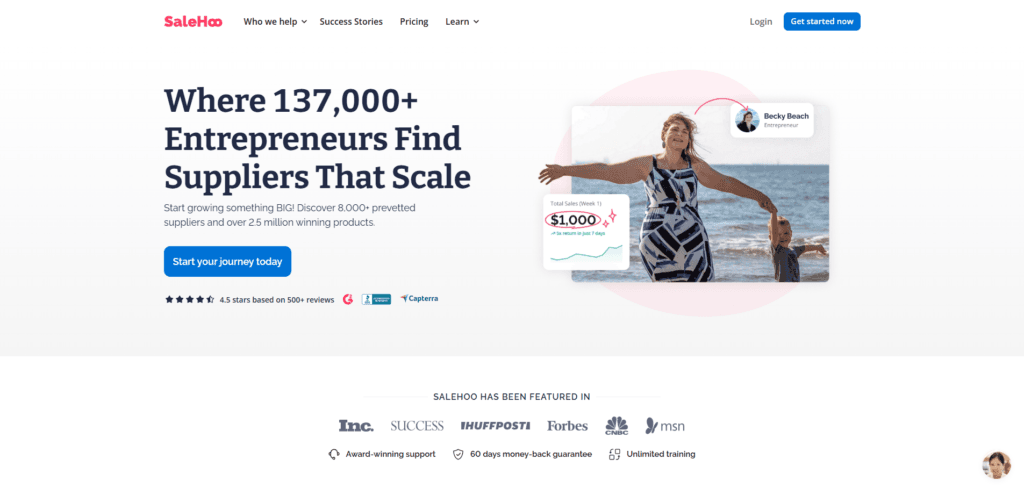
SaleHoo offers a curated, vetted directory of over 8,000 trusted suppliers, including many from Australia. Many listed suppliers have low minimum order quantities (MOQs) and offer fast shipping via local carriers. SaleHoo’s website is designed to be accessible for beginners, meaning it’s easy to search, filter, and save suppliers for quick analysis.
Pros
- Manually verifies every supplier before letting them into its directory
- Include a tool that analyzes eBay and Amazon sales data to show you which items are trending
- Offers direct contact information along with filters to find Australian dropshippers with no MOQs
Cons
- No automation unless using the separate SalehHoo Dropship plugin
- Many smaller AU businesses may have outdated catalogs or slow response times
- Some information can be found via deep Google searching for free
10. Factory Fast
- Best for: Dropshipping bulky, high-ticket items
- Delivery Time: 1-3 days
- Pricing/Fees: The reseller program is free to join
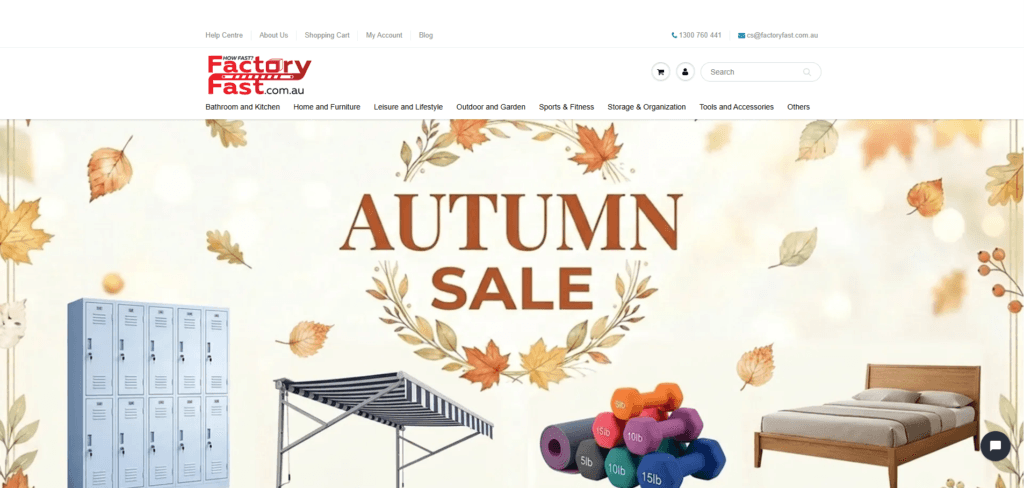
FactoryFast is famous for its dedicated reseller program, where it handles the logistics while dropshippers focus on marketing. Its pricing is also highly competitive, with the supplier charging around 80 percent less than traditional retailers. To maximize efficiency, FactoryFast allows you to store up to 1,000 customer shipping addresses, making repeat orders and fulfillment much easier.
Pros
- Handles logistics for oversized items (beds, BBQs, trampolines) impossible to dropship from overseas
- Offers reliable shipment tracking via local carriers like Allied Express and Australia Post
- Makes it easy to process repeat orders with the option to save customer addresses
Cons
- Lacks a direct app for Shopify, so orders have to be placed on the site manually
- Bulky items often arrive at the customer’s doorstep in boxes with Factory Fast branding
- Return shipping can cost more than the product if the customer changes their mind
11. Printful
- Best for: People wanting to sell branded apparel like custom tees
- Delivery Time: 2-5 days
- Pricing/Fees: No monthly fees, flat-rate shipping charged to customers
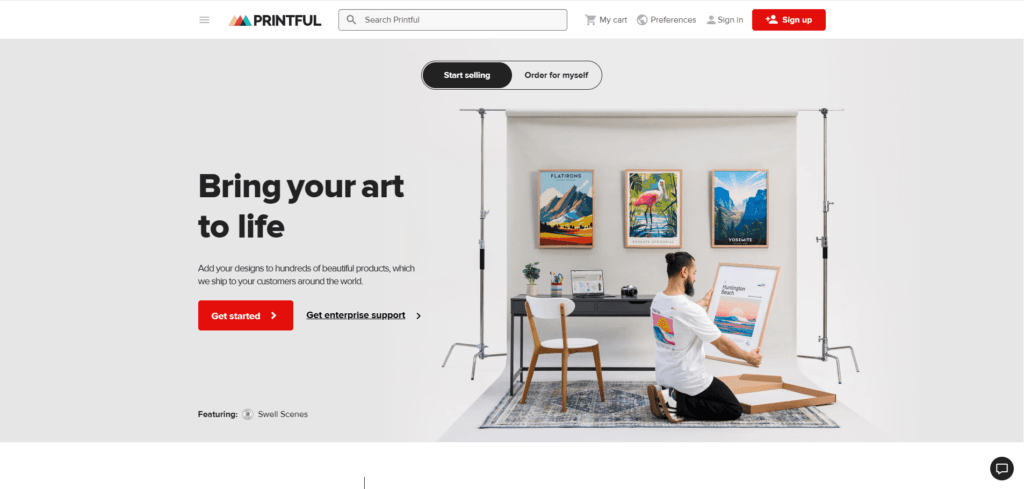
Printful uses its partner facilities in Brisbane and Melbourne to reduce shipping times for Australian consumers. This print-on-demand dropshipping supplier allows for custom labels and branded packing slips that help in building a private-label clothing business. You’ll also find it easy to automate orders courtesy of Printify’s seamless integration with Shopify and other e-commerce platforms.
Pros
- Offers Australian-made quality and fast shipping speeds via production hubs in Melbourne and Brisbane
- Gives the option to add branded packing slips and custom inside labels
- Automatically starts printing orders in the closest AU city and ships them to the customer
Cons
- Australian printers come with high costs and give less room for higher margins
- Many products from its global catalog are unavailable for AU fulfillment
- Charges general sales tax on orders fulfilled in Australia
Why Choose Australia Dropshipping Suppliers?
Now for the main question: why should you pick an Australian supplier over an overseas wholesaler on Alibaba or AliExpress?
Well, local suppliers from Australia offer benefits that you may not be able to get through other options. For example, Australian suppliers are able to ship orders within 2-8 business days. If your target audience is primarily located in Australia, that can give you an edge over competitors still relying on AliExpress.
If you’re targeting Australian buyers, it’s worth understanding the local marketplace and seller requirements before launching your store. This guide on how to sell on eBay Australia covers the essentials for getting started and growing your business in the Australian market.
You also get peace of mind in terms of compliance with local regulations. Australian suppliers understand local laws like the Australian Consumer Law better than overseas wholesalers. When sourcing products from them, you can be sure that items meet local safety standards and certification requirements.
Returns and customer service are simpler, too. You can offer a local return address, and there are no language barriers or timezone gaps when issues come up.
Finally, working with Australian suppliers gives your store more credibility. Orders arrive quickly via familiar couriers, making your business feel like a legitimate local operation rather than a typical dropshipping store.
How to Find and Vet Australia Dropshipping Suppliers
If you’d like to expand your pool of dropshipping suppliers, here’s how you can find and vet them:
Finding Suppliers
- AI tools: AI tools can help you find Australian dropshipping suppliers by analyzing winning products and then revealing the sources behind those products. For example, ZIK Analytics offers AI dropshipping tools to help you research the Australian market, track competitor best sellers, and find suppliers who operate locally or ship to Australia in a week or two.
- Google &Chatbot search: You can also try searching for Australian dropshipping suppliers on Google or in AIs. Try phrases like “dropshipping wholesaler Australia” or “[niche] Australia nationwide dropshipping” to see if you come across anything useful. Even though some suppliers may have outdated websites, a little more research can help you find potential partners for your business.
- Australian trade shows: Attending trade events is the best way to negotiate directly with local manufacturers. The Reed Gift Fairs in Sydney and Melbourne are Australia’s premier retail buying events for home, decor, and fashion. Other specialized shows like Interiors Australia and the Global Sourcing Expo Australia connect you with hundreds of suppliers from different industries.
- LinkedIn & ABN verification: With LinkedIn, you can search for sales managers or business development representatives at Australian manufacturing firms. When you find a potential partner, verify their legitimacy via the Australian Business Register using their Australian Business Number (ABN) to ensure they are a registered, law-abiding entity.
Vetting Checklist
- Business registration verification (ABN Lookup): Every legitimate Australian dropshipper should have an Australian Business Number (ABN). You can verify their status by using the ABN Lookup tool provided by the Australian Government. This allows you to confirm their legal name, entity type, and whether they are currently active or registered for GST (Goods and Services Tax).
- GST and tax validation: If a supplier has an annual turnover of $75,000 or more, they are legally required to register for GST. You can check a supplier’s GST status via the Australian Taxation Office (ATO) records or the ABN search mentioned above. Having a GST-registered entity is often a sign of a more established and stable operation.
- Test order and logistics assessment: You can’t be sure that a supplier claiming to ship products fast will keep on their promise. Placing a test order can help you evaluate whether they stay true to their claims. A supplier based in Sydney or Melbourne should ideally reach most major coastal cities within 3–5 business days.
- Check reviews and references: See what others have to say about the supplier you intend to work with. Search for the supplier’s name on sites like G2 and Trustpilot, which are b2b platforms aggregating reviews about companies. Community-based sites like Reddit and Quora may also contain discussions about the supplier’s way of doing business.
Red Flags to Avoid
- Vague local addresses: Be wary of suppliers who claim to be from Australia but do not have a verifiable office address or P.O. Box in a residential area. These suppliers are likely “ghost companies” or middlemen trying to make money from those aiming to dropship in Australia. A reputable local supplier won’t hesitate to share their contact details or ABN when requested
- Extremely low prices: If the product they are selling is priced significantly lower than the Australian market price, it is likely a knockoff or counterfeit that can get you in trouble with the authorities. If you’re not sure, order a sample to verify the quality and authenticity before listing it on your store.
- Inconsistent shipping and tracking: Another red flag is when the supplier promises to deliver products in 2-5 days within Australia, but consistently takes 2-4 weeks to do so. That kind of timeframe implies that they are an overseas supplier pretending to have a presence in Australia. It’s also good to steer clear of suppliers who fail to share valid Australian tracking numbers, or if the tracking status hasn’t changed from “pre-transit” for several days.
- No proper returns process: Australian Consumer Law (ACL) requires that items have a guarantee of acceptable quality, and in dropshipping, the seller is responsible for providing refunds and replacements. Suppliers who are vague about returns can leave you with a bunch of frustrated customers and financial losses. If you work with a supplier, confirm their return policy in writing and verify that they have a local return address in Australia.
Find Australian Winning Dropshipping Products With ZIK Analytics
ZIK Analytics has a suite of tools to help dropshippers find and validate products to sell in the Australian market.
However, three tools make Australian product research and validation easier:
- Shopify Product Finder is your Dropshipping product research tool for finding what’s selling in Australia. Search keywords and filter by sales to identify trending ecommerce products, then match them to suppliers with automatic profit calculations.
- Shopify Market Insights gives you a real-time view of trending products across Australian Shopify stores. See which products sold the most in the last 6 months and monitor niches by revenue to spot opportunities early.
- Shopify Store Finder helps you discover successful Australian dropshipping stores by filtering for country, revenue, and marketing channels. Analyze their product catalogs and see which items resonate with Aussie buyers.
Get your ZIK Analytics trial today and start finding winning dropshipping products for the Land Down Under.
Frequently Asked Questions About Australian Dropshipping Suppliers
In this section, I’ll answer the questions people frequently ask about Australian dropshipping suppliers.
Who is the best dropshipping supplier in Australia?
Dropshipzone is often considered the best overall supplier for Australian dropshipping. It offers a vast selection of home goods and electronics with fast local fulfillment from Australian warehouses. Other good options include Printify for print-on-demand dropshipping and Factory Fast for selling bulky goods without inventory.
Is $500 enough for dropshipping in Australia?
$500 should be enough to launch a basic store and run some Meta campaigns, dropshipping in Australia. However, it can be a stretch if you’re looking to get your first few sales fast. Working within this budget means using free trials of software where possible and promoting your store via organic marketing methods.
Where do most dropshippers fail in Australia?
The majority of dropshippers fail in Australia due to long and unreliable shipping times. Using overseas suppliers like AliExpress results in 20-40-day delivery times, which turn off consumers who expect fast, reliable shipping. Ignoring local competition and preferences, plus neglecting customer service, are some other reasons behind the failure of dropshippers in Australia.