
Wondering whether to start an affiliate marketing or dropshipping business in 2026?
You’re not alone. These two business models are immensely popular, and people often get confused about which one to pursue.
To make the choice easier, we’ve broken down how each model works and what to expect when getting started.
When to Use Affiliate Marketing vs. Dropshipping
Affiliate marketing is a business model where you promote someone else’s products and earn a commission each time a customer makes a purchase through your unique link.
Dropshipping, on the other hand, involves selling physical products through your own online store without holding any inventory. A supplier ships the product directly to your customer after they place an order.
The main differences come down to involvement and profit structure. Affiliate marketing is hands-off and low-risk with smaller commissions, while dropshipping gives you more control over pricing, branding, and customer experience with higher earning potential.
Choose affiliate marketing when:
- You want a low-risk, low-maintenance income stream
- You don’t want to handle customer service or fulfillment
- You already create content or have an audience
- You prefer earning commissions over managing store operations

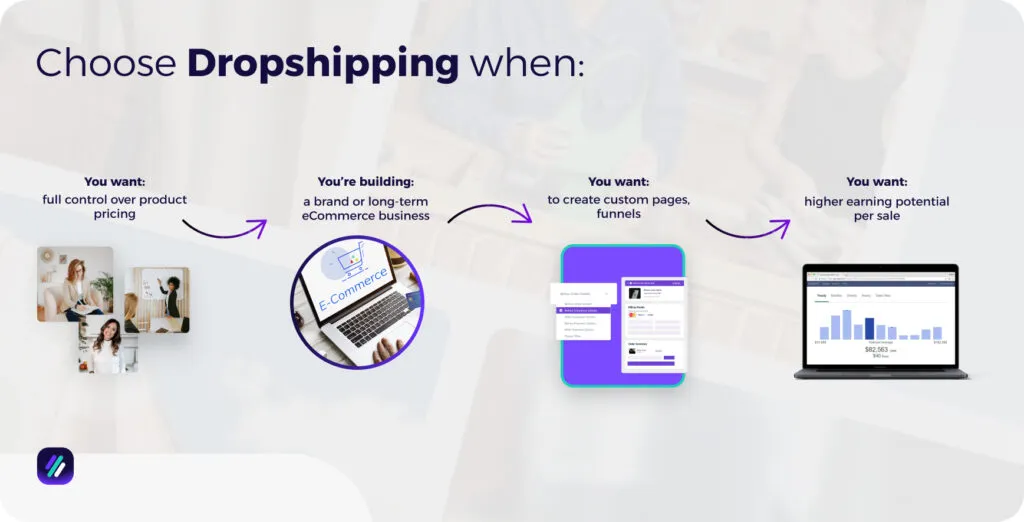
Choose dropshipping when:
- You want full control over product pricing and profit margins
- You’re building a brand or long-term eCommerce business
- You want to create custom pages, funnels, and offers
- You want a higher earning potential per sale
Affiliate Marketing vs Dropshipping: Head-to-Head Comparison
| Factor | Affiliate Marketing | Dropshipping |
| Startup Costs & Investment | Costs $20 to $40 to start, then $3 to $30 monthly | Costs $80 to $200 to start, then $29 to $70 monthly |
| Profit Margins & Revenue Potential | Earns 5 to 15% per sale, merchant sets the rate | Earns 20 to 40% per sale, you control pricing |
| Time Investment & Learning Curve | Takes 4 to 8 months to see real income | Takes 2 to 3 months to get going |
| Control & Ownership | You promote someone else’s products | You run your own store and own the customer data |
| Scalability & Growth Potential | Growth depends on merchant program staying active | You can add products and build on existing customers |
| Branding, Reputation & Trust | Hard to build a brand since customers leave your site | You create your own brand and keep customer relationships |
| Flexibility & Niche Pivoting | Easy to switch niches by creating new content | Harder to pivot since your store is built around a niche |
| Risk Exposure & Fragility | Low risk, but merchants can change terms anytime | Higher risk since supplier problems hurt your reputation |
| Exit / Monetization / Sellability | Harder to sell since buyers have less control | Easier to sell since buyers get a brand and customer list |
Startup Costs & Investment
Affiliate marketing has very low startup costs. You only need a website, basic content tools, and a place to publish your offers.
Here’s how much you typically spend:
- Domain name: $10–$15 per year
- Website hosting: $3–$10 per month
- Content tools: $0–$20 per month (AI writing tools, keyword tools, or design apps)
Total affiliate startup cost: $20–$40 to get started, and $3–$30 per month to keep things running.
Dropshipping needs a bit more spending up front. You’ll need an e-commerce platform, a domain name, and some initial ad spend to test products.
Here’s what it typically costs to start :
- Shopify or similar platform: $29–$39 per month
- Domain name: $10–$15 per year
- Apps and tools: $0–$30 per month
- Initial ad testing: $50–$150 for your first product trials
Total dropshipping startup cost: $80–$200 to launch, plus $29–$70 per month for store software and optional tools.
To be more specific, especially when you are running a ton of ads, use a ROAS calculator to have clear visibility on your potential.
Profit Margins & Revenue Potential
Affiliate commissions vary widely depending on what you’re promoting. Physical products typically pay 5–15%, while SaaS and digital products often range from 20–50% or higher. Some software companies pay $100+ per signup because their customer lifetime value justifies it. Your earnings depend on the merchant’s payout structure and how many people convert through your links.
Dropshipping offers a wider earning window. Many stores operate within the 20–40% margin range once they find a strong product and set effective pricing. Since you decide the retail price, your revenue potential expands as your branding and customer experience improve.
Time Investment & Learning Curve
When it comes to learning, you’ll pick up the basics of dropshipping faster than affiliate marketing.
Dropshipping gives you a quicker start because you can set up a store in a few days and learn through product testing or simple ads.
Affiliate marketing takes longer because real progress depends on building an audience and creating content people trust.
Here’s how the timeline usually plays out:
Affiliate Marketing:
- Day 1–10: Set up your website and join affiliate programs
- Week 3–6: Publish first pieces of content
- Month 2–4: Start seeing consistent traffic
- Month 4–12: Earn your first meaningful commissions
Dropshipping:
- Day 1–7: Build your store and test products
- Week 2–4: Run initial ads and validate offers
- Month 2–3: Find winning products and stabilize fulfillment
- Month 4–6: Scale through pricing, bundles, or new products
Control & Ownership
Dropshipping gives you far more control because you run your own store and decide how the brand looks and feels. You choose the profitable products you sell and set the prices, which gives you more ownership over the way the business grows.
Affiliate marketing works with less control since you promote another company’s offer and earn whatever commission they set. You don’t own the customer relationship, and you don’t influence pricing or messaging once the visitor leaves your site.
Scalability & Growth Potential
A dropshipping business has more potential to grow because you control the brand and decide how far you want to scale it. You can introduce new products, improve your pricing, and keep building on the customers you already have.
Affiliate marketing can also scale, but the ceiling is lower. If the merchant changes their offer or closes the program, your income can drop without warning.
Dropshipping also:
- Gives you full control over how your store runs
- Let’s you adjust your offer as demand changes
- Helps you build value through returning customers
Affiliate marketing meanwhile:
- Depends on how stable the merchant’s program is
- Limits your earning power to fixed commissions
- Keeps the customer relationship with the brand you promote
Branding, Reputation & Trust
Affiliate marketing and dropshipping offer different things in terms of branding and customer trust. Here’s how each model works in practice.
Branding
Affiliate marketing limits how much you can build your own brand. You can promote yourself as an expert or trusted voice, but you’re also relying on the strength of the brands you recommend.
Dropshipping gives you more control over branding, though it’s still limited in some aspects. You can design your store the way you want, but the products you sell are branded by someone else (unless of course, you decide to go for private labeling).
Customer Relationship
Affiliate marketing passes the customer to the merchant as soon as they click your link. You don’t get their data, and you can’t follow up later with your own offers.
Dropshipping keeps the relationship in your hands. You collect the customer’s information, handle support, and have the chance to bring them back for future purchases.
Trust & Reputation
It’s harder to build trust with affiliate marketing since you don’t have control over the end product. You can only share your recommendation and hope the merchant delivers a good experience.
Risk Exposure & Fragility
Affiliate marketing carries low financial risk. Since you don’t handle products or shipping, there are no upfront costs tied to inventory. The only real threat appears if the merchant changes commissions or removes the offer you rely on.
Dropshipping comes with higher operational risk. As you rely on suppliers for stock and delivery any lapse on their part directly affects your business reputation. Not being able to control packaging or product quality adds another layer of risk because you can’t fix issues before the order reaches the customer.
Exit / Monetization / Sellability
If you want to make an exit later, you’ll usually find it easier to sell a dropshipping business than an affiliate site.
That’s because people prefer businesses they can control and customize based on their own preferences.
Dropshipping lets you build a brand and keep the customer relationship you work hard to build.
Dropshipping also:
- Gives the buyer freedom to change pricing or product mix
- Offers a customer list that they can keep growing
- Provides a store structure that’s easier to scale
This makes dropshipping more attractive to anyone looking to buy and grow an online business.
What Is Affiliate Marketing?
Affiliate marketing is a business model where you earn a commission by promoting someone else’s product. You share a link to the item or service, usually through your website or social channels. When someone buys through your link, the merchant tracks the sale and pays you a percentage of the revenue.
How Affiliate Marketing Works
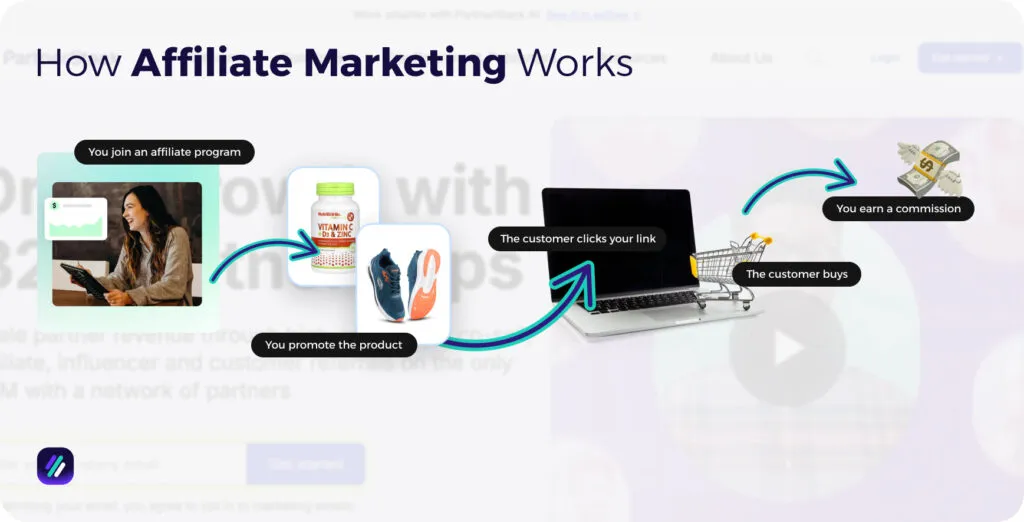
Affiliate marketing runs on a simple partnership between three groups: the merchant who offers the product, the affiliate who promotes it, and the customer who takes action.
It works like this:
- You join an affiliate program and get your unique tracking link.
- You promote the product through your website, videos, or social posts.
- A customer clicks your link, and a tracking cookie records the referral.
- The customer buys, and the merchant confirms the sale.
- z, based on the program’s payout terms.
Popular Affiliate Marketing Platforms
If you want to start with affiliate marketing, here are the top platforms to consider:
- Awin: Offers a wide range of physical products and global merchants.
- PartnerStack: Works well for SaaS brands and high-ticket software offers.
- Levanta: Helps ecommerce brands and creators manage partnerships with fewer steps.
- Amazon Associates: Covers almost every product category with high visitor trust.
- Walmart Affiliates: Provides good commissions in select categories and longer cookie windows.
- Rakuten Advertising: Connects you with well-known brands and reliable program management.
- CJ Affiliate: Gives access to many established merchants and helpful tracking tools.
- ClickBank: Focuses on digital products, online courses, and niche offers.
Real Affiliate Marketing Examples
Affiliate marketing becomes easier to understand when you look at people who’ve actually built income from it.

One example is Lori Ballen. Lori is a digital marketer who started teaching real estate agents how to build websites in 2015. She stumbled upon affiliate marketing when the software company she was using asked her to become an affiliate. Her first check was $200. She kept at it and today earns over $300,000 annually, with most of that income coming from promoting software tools she already uses.

Another is Elna Cain. Elna is a mompreneur who started freelance writing when her twins were 15 months old. She launched a blog focused on helping work-at-home moms and used Pinterest to drive traffic. Her first $200 from affiliate marketing took 10 months to earn, but the next month she hit $2,000. She grew her blog to 40,000 page views in one month by focusing on Pinterest and creating content moms could use right away. Today, she earns around $1,700 per month from affiliate marketing.
The successes of these individuals make it clear that affiliate marketing is a legitimate business model that can generate income when pursued properly.
When Affiliate Marketing Works Better (and Why)
Here are a few things that make affiliate marketing better than dropshipping:
Less capital needed
Affiliate marketing doesn’t require you to invest in any product. You promote items sold by other companies and earn a commission on each sale. Your only real costs are your website and the content you produce to drive traffic.
Low operational friction
You don’t manage orders or handle customer issues. Once you send traffic to the merchant, they take care of the rest. This makes affiliate marketing a good fit when you prefer focusing on content or traffic generation.
Passive income potential
Affiliate marketing can bring in ongoing income once your setup is running. You earn whenever someone buys through your link, and those commissions can stack over time. You can also add more offers as you grow to build multiple income streams for your venture.
Brand partnerships
Affiliate marketing helps you build relationships with the companies you promote. As trust grows, they may offer perks like discounted products or early access to new launches. These partnerships can also create opportunities for future collaborations.
What Is Dropshipping?
Dropshipping is an ecommerce business model where you sell products without keeping stock. You build an online store and list items from suppliers who can ship on your behalf. After you make a sale, the order details go to the supplier, and they send the product straight to your customer.
Get the eBook and learn how to launch your one-product Shopify store right!How Dropshipping Works
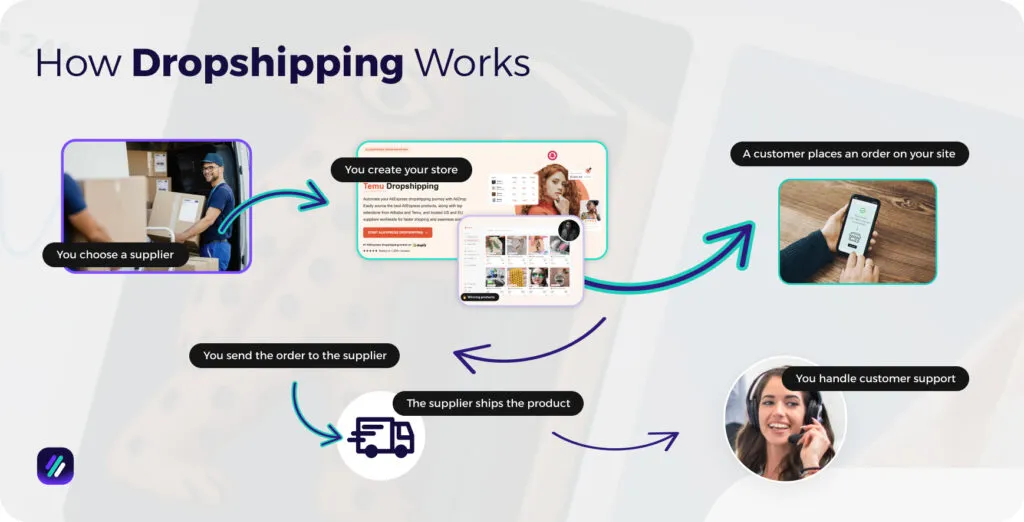
Dropshipping involves three parties that work together to complete every order: you, the supplier, and the customer.
It works like this:
- You choose a supplier who can ship products directly to your customers
- You create your store and list the products you want to sell
- A customer places an order on your site and pays the retail price
- You send the order to the supplier, paying the wholesale price
- The supplier ships the product straight to the customer under your store’s name
- You handle customer support, tracking updates, and any returns
Popular Dropshipping Platforms
If you want to start a dropshipping business, here are the platforms you could use:
- Shopify: Makes it easy to build a branded store and test new dropshipping trends.
- WooCommerce: Works well for WordPress users who want full control and flexible plugins.
- BigCommerce: Supports large catalogs and stable scaling for growing dropshipping niches.
- AliExpress: Offers a massive product range and simple supplier access for beginners.
- eBay: Gives you built-in traffic and quick product testing without upfront inventory.
- Amazon: Lets you tap into high-intent shoppers and list products through third-party sellers.
- Walmart Marketplace: Provides strong visibility and strict supplier standards for reliable fulfilment.
- Etsy: Works for niche handmade or print-on-demand dropshipping.
Dropshipping Success Stories
Seeing how others build their dropshipping empire can inspire you to create your own. These stories come from people who began with doubt, kept going, and eventually built a business they could rely on.
Paul Lipsky

Paul J Lipsky worked as a lawyer in New York and felt trapped. He tested different online ideas until eBay dropshipping finally clicked. After a few slow months, he broke even and kept adding better products. That consistency led to more than $2.5 million in dropshipping revenue. His story shows that a steady routine can turn into something big over time.
Mohammed Kamil Sattar

Mohammed “THE ECOM KING” left college with no clear plan and lost money early on because he tested too many products. He slowed down, focused on items with real demand, and built a Shopify store that crossed $1 million in revenue. His journey proves you can start lean and still build a profitable store if you choose products carefully and learn from your initial mistakes.
When Dropshipping Works Better (and Why)
There are a few areas where dropshipping performs better than affiliate marketing:
Margins & upselling
Dropshipping offers higher earning potential because you set your own prices. Many stores aim for margins around 20–40%, and you can add upsells at checkout to increase each order. Affiliates can’t do that because the merchant sets the pricing and controls the sales process.
Brand control & customer data
Dropshipping is the better fit when you want full control over your brand. You manage the store design, the product pages, and the entire shopping experience. You also keep customer data and emails, which helps you build repeat sales and grow an audience over time.
High volume scalability
Dropshipping handles growth better than affiliate marketing. When sales increase, your supplier fulfills the extra orders while you focus on driving more traffic. Affiliates don’t benefit from higher volume in the same way because their income is tied to fixed commission rates.
Best niches / scenarios
Dropshipping fits niches where you can set your own margins and adjust prices based on demand. It also works well when you want to test multiple products quickly without holding inventory. Affiliate marketing depends on the merchant’s offer, which limits how much you can adjust or experiment.
Grow Your Dropshipping Business with ZIK Analytics
Now that you know that dropshipping offers more benefits than affiliate marketing, you can start building your business with ZIK Analytics.
ZIK Analytics offers the tools you need to make informed decisions. Our dropshipping product research tool lets you use powerful filters and marketplace insights to find high-demand items to sell.
With our dropshipping database, you get a list of trending product ideas that improve your chances of resonating with consumers
And if you want to analyze competitors and understand what drives their sales, you can use our dropshipping spy tool to see their volume, best sellers, and other helpful data.
Don’t prolong the decision to build something of your own. Click here to start your dropshipping journey with ZIK Analytics.
Frequently Asked Questions about Affiliate Marketing vs Dropshipping
In this section, I’ll answer the frequently asked questions about affiliate marketing vs dropshipping:
Which is better, affiliate marketing or dropshipping?
Dropshipping is generally the better choice if you want higher earning potential and control over pricing. Affiliate marketing is simpler to start, but you’re limited to fixed commissions and the merchant’s rules. Dropshipping lets you keep more per sale and build something you fully own.
Can I do both dropshipping and affiliate marketing?
Yes, you can. Many store owners run dropshipping for the products they want full control over, then use affiliate links on their blog for items they don’t want to manage. It’s a simple way to earn from two income streams without adding a lot to your plate.
How long does it take to deliver the end product?
Affiliate marketing delivers instantly because customers buy directly from the merchant. Dropshipping fulfillment takes longer since the supplier needs time to process and ship the order. Most deliveries fall within standard ecommerce timelines set by each supplier.