
Dropshipping. You have come across this term several times while browsing Reddit and speaking to people on Facebook.
But you are not really sure how it works and whether it can be a profitable business.
This guide covers everything you need to know about the dropshipping business model. From how it works to the benefits, drawbacks, and alternatives, we cover it all in one place.
What is Dropshipping?
Dropshipping is an online business model in which you sell products to customers without physically owning the products; instead, you forward those orders to suppliers or other stores to fulfill the order, and you keep the profit between your product price and the supplier price.
You create an online store and link it to a supplier who can ship products directly to the customer. Then you get the word out about your shop and wait for customers to arrive.
Once a customer places an order, their details get forwarded to the supplier (who can be a manufacturer, wholesaler, or even another store), who then picks, packs, and ships the product on your behalf.
How Does Dropshipping Work?
Dropshipping has three main parties that perform certain activities to make the process work. These include the seller, the customer, and the supplier.
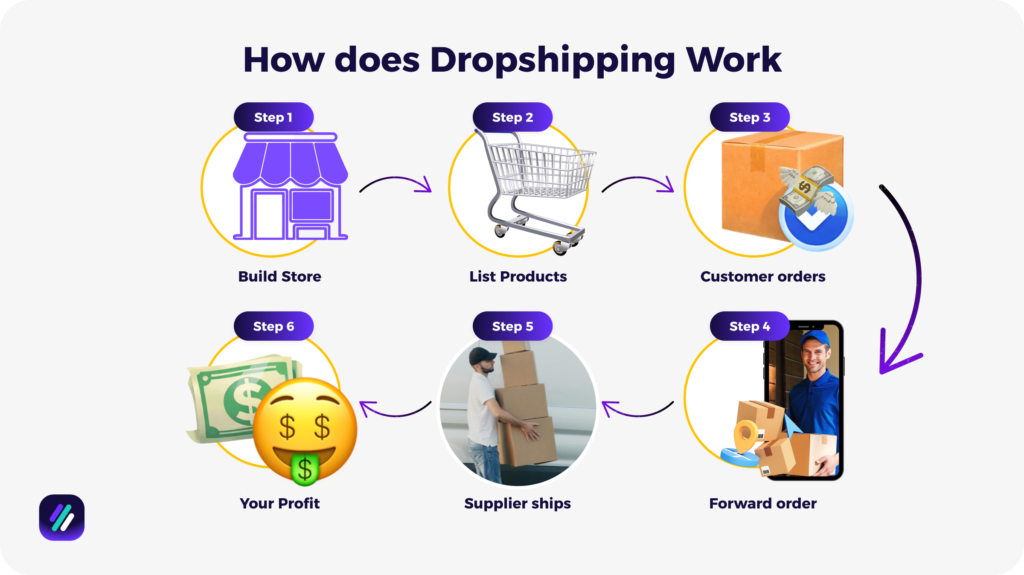
Here’s how dropshipping works:
- You (the seller) build a dropshipping website and connect it to the supplier’s platform..
- You import products and list them on your store at a certain price.
- The customer visits your website, chooses a product, and pays for it.
- You receive the payment and forward the order details + customer’s address to the supplier
- The supplier packs the product and ships it directly to your customer, often with a packing slip that has your store’s name on it
- You keep the difference between the retail price you charged the customer and the price the supplier charged you for the product (minus any advertising or website fees)
Important note to point out that the supplier can be anywhere in the world. Dropshipping is so popular that almost any country has a local dropshipping supplier across major niches.
You also don’t need your own ecommerce store to use this business model. If you’d rather sell through marketplaces first, check out our guide on dropshipping without a website to learn how to get started on platforms like eBay, Amazon, and TikTok Shop.
And some, like the US, have suppliers for almost any niche.
Grab your Shopify dropshipping eBook and find winning suppliers fast!What are Dropshipping Suppliers?
Dropshipping suppliers are third-party companies that store, pack, and ship products directly to customers on behalf of the dropshipper.
They mainly comprise wholesalers and manufacturers who handle dropshipping fulfillment on your behalf, taking over the responsibilities after you make an online sale.
Dropshipping suppliers may have warehouses in their home country or worldwide, depending on their size and years in business.
Benefits and Drawbacks of Dropshipping
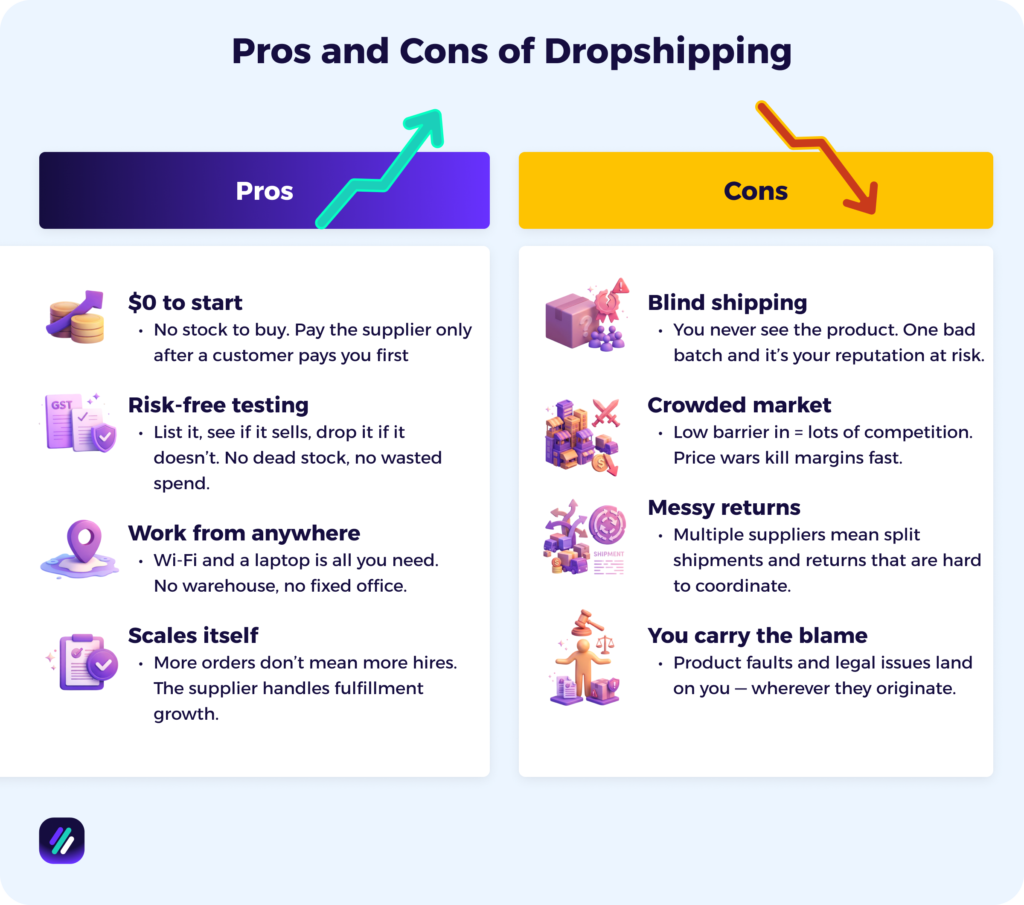
So what can you gain (or lose) by starting a dropshipping business? Here’s a look at its main benefits and drawbacks.
| Pros | Cons |
| Low startup costs with no inventory needed | No way to inspect products before they reach the customer |
| Test new products without financial risk | Low barrier to entry means a lot of competition |
| Run the business from anywhere | Using multiple suppliers can complicate shipping and returns |
| Easy to scale without hiring staff or renting warehouse space | All legal and product issues fall on you, regardless of where they originate |
Pros of Dropshipping
Here are some of the biggest benefits of dropshipping:
- Minimal startup costs: Due to a third-party handling the inventory, you do not need to invest a large amount of capital to get your business started.
- High flexibility: You can easily test new product ideas without the risk of incurring a financial loss; if a product doesn’t sell, you can simply remove it from your catalog.
- Location independence: You can run a dropshipping business from virtually any place in the world with an internet connection.
- Easy to scale; As you get more orders, you don’t need to worry about hiring more staff for logistics or expanding warehouse space, making scaling relatively simple.
Cons of Dropshipping
And here are some of the biggest negatives of dropshipping:
- No quality control: You can’t inspect products since they are directly sent to your customers, risking poor quality that harms your customer experience:
- Intense competition: Because of the low barrier to entry, many sellers offer the same items and often force each other into a price war.
- Logistics complexity: Using more than one supplier can result in mixed shipments and dropshipping returns.
- Legal & responsibility: All legal matters and product issues fall on your shoulders, regardless of whether they come from your supplier or you.
Dropshipping Costs and Profitability
Before starting any business, you want to know how much it will cost and what you can realistically make from it.
To help with that, here is a breakdown of the typical expenses and profit margins in dropshipping
Expenses
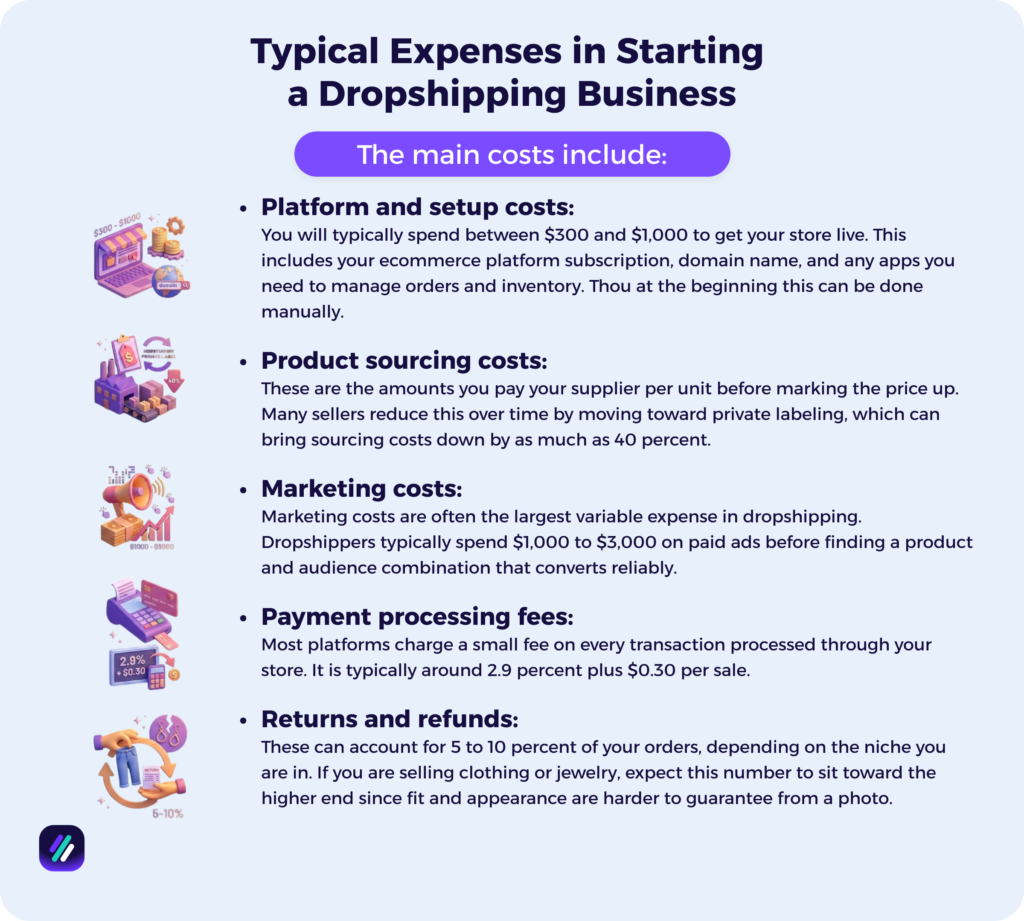
There are several costs involved in running a dropshipping store, and knowing them upfront can save you from some unpleasant surprises down the line.
The main costs include:
- Platform and setup costs: You will typically spend between $300 and $1,000 to get your store live. This includes your ecommerce platform subscription, domain name, and any apps you need to manage orders and inventory. Thou at the beginning, this can be done manually.
- Product sourcing costs: These are the amounts you pay your supplier per unit before marking the price up. Many sellers reduce this over time by moving toward private label dropshipping, which can bring sourcing costs down by as much as 40 percent.
- Marketing costs: Marketing costs are often the largest variable expense in dropshipping. Dropshippers typically spend $1,000 to $3,000 on paid ads before finding a product and audience combination that converts reliably.
- Payment processing fees: Most platforms charge a small fee on every transaction processed through your store. It is typically around 2.9 percent plus $0.30 per sale.
- Returns and refunds: These can account for 5 to 10 percent of your orders, depending on the niche you are in. If you are selling clothing or jewelry, expect this number to sit toward the higher end since fit and appearance are harder to guarantee from a photo.
Revenue and Profit
Dropshipping earnings vary widely depending on what you sell and how well you manage your costs. Here is what the numbers typically look like.
Typical profit margins
Dropshippers typically earn a net margin of 15 to 25 percent on a well-run store. This is after accounting for ad spend, supplier costs, and platform fees. Earnings can vary significantly depending on the dropshipping niche you choose and how competitive it is.
Average order value by niche
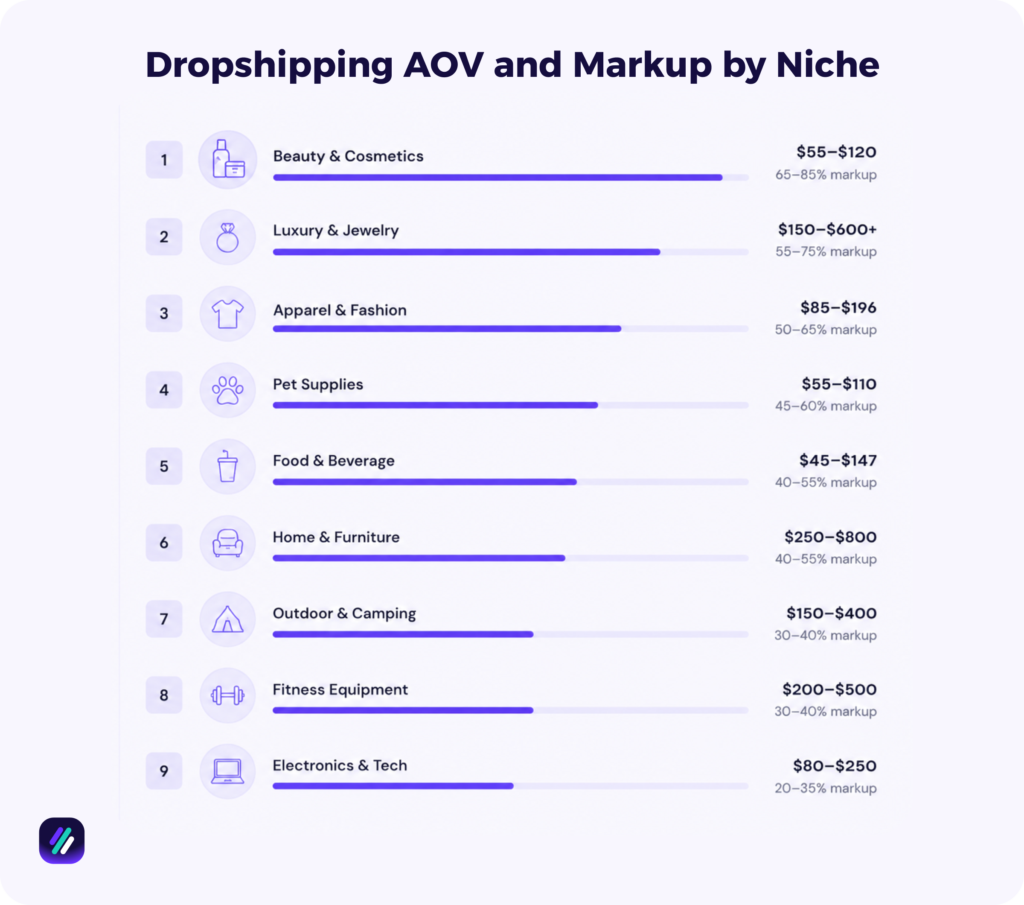
How much a customer spends per order depends largely on what you are selling. Here is a rough breakdown of AOV and typical markup by category:
| Niche | Typical AOV | Typical Markup | Example Products |
| Beauty and Cosmetics | $55 to $120 | 65% to 85% | Serums, skincare sets |
| Luxury and Jewelry | $150 to $600+ | 55% to 75% | Watches, luxury handbags |
| Apparel and Fashion | $85 to $196 | 50% to 65% | Activewear, dresses |
| Pet Supplies | $55 to $110 | 45% to 60% | Pet food, interactive toys |
| Food and Beverage | $45 to $147 | 40% to 55% | Specialty coffee, snack bundles |
| Home and Furniture | $250 to $800 | 40% to 55% | Sofas, smart storage |
| Outdoor and Camping | $150 to $400 | 30% to 40% | Tents, hiking gear |
| Fitness Equipment | $200 to $500 | 30% to 40% | Treadmills, resistance bands |
| Electronics and Tech | $80 to $250 | 20% to 35% | Earbuds, smart home hubs |
Now, just to be clear, this does not mean you will have such AOV right from the beginning, nor is this the cap you can achieve.
It’s really just a ballpark to give you an idea.
ROI Timeline
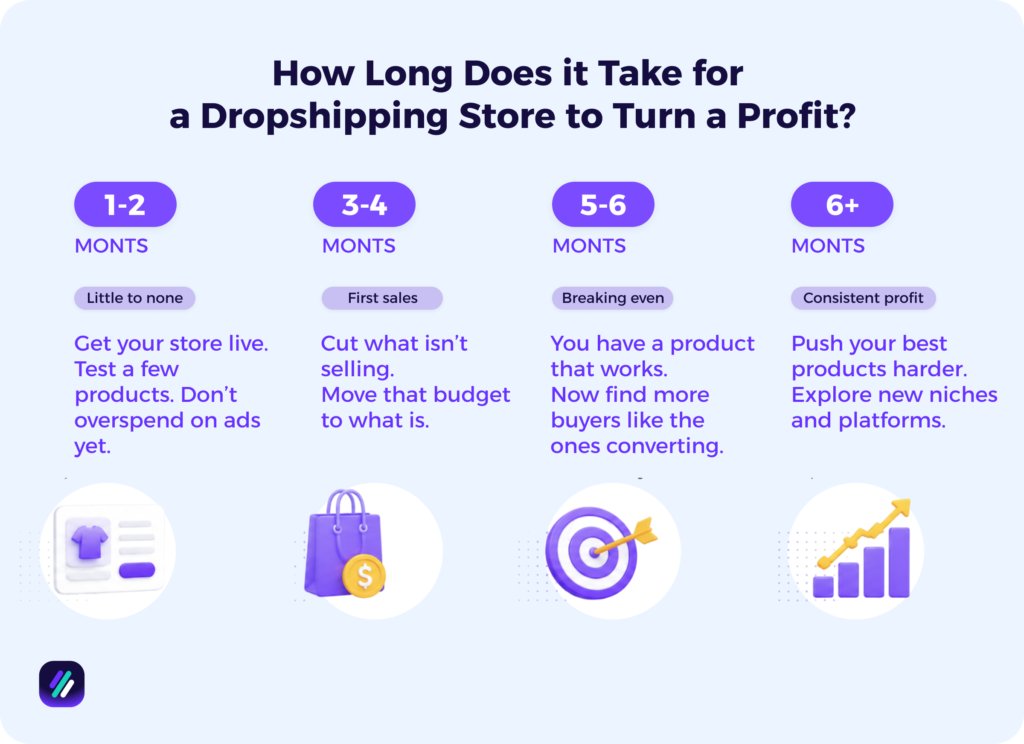
So, how long before you get a return on your investment? Most dropshippers go through a slow start before things pick up, and that is something you should factor into your expectations from day one.
A realistic ROI timeline for a dropshipping store is three to six months. In the first few months, you will be spending on ads and making mistakes, and most of that money will not come back. Then, as you find products that sell, the losses start to shrink, and the profits follow.
Industry estimates suggest that only 10 to 20 percent of stores survive past the early stage. Those who do go on to build profitable ventures that generate them a consistent income over the long term.
| Months | ROI | Steps to Take |
| 1 to 2 | Little to none | Get your store live, test a few products, and do not spend too much on ads yet |
| 3 to 4 | First sales coming in | Stop putting money into what is not selling and put it toward what is |
| 5 to 6 | Breaking even or close to it | You have a product that works, now figure out who is buying it and go after more of them |
| 6 and beyond | Consistent profit | Push your best products harder and start thinking about new products, niches, or platforms |
Dropshipping Alternatives
If dropshipping does not seem like the right fit, you can look into other business models that let you earn money online. Here are a few worth considering.
Amazon FBA
Difficulty level: Moderate to High
| Pros | Cons |
| Access to millions of Amazon buyers | Requires $2,000 to $5,000 or more upfront to start |
| Prime eligibility boosts trust and conversions | Storage and fulfillment fees can eat into margins |
| Amazon handles all packaging and shipping | Unsold inventory means ongoing storage costs |
| Returns and refunds are managed by Amazon | Amazon owns the customer data, limiting brand building |
| Easy to scale within the Amazon ecosystem |
Amazon FBA is a model where you send products to Amazon, and they package and ship them out on your behalf. It is considered a good alternative to dropshipping since it provides you with more control over quality and faster delivery times.
Amazon FBA products also qualify for Prime, Amazon’s membership program that offers buyers free one to two-day shipping. This tends to enhance the customer experience and improve your chances of converting a browser into a buyer.
Affiliate Marketing
| Pros | Cons |
| No customer service or fulfillment to manage | Commissions on physical products typically sit between 3 and 15 percent |
| Can be started for little to no upfront cost | You do not own the customer or their data |
| Content that ranks can generate commissions for years with minimal upkeep | Merchants can cut rates or close programs at any time |
| No financial risk if a product does not sell | Building organic traffic takes three to six months before income becomes meaningful |
Difficulty level: Moderate
Affiliate marketing is an online business model where you promote other companies’ products and earn a commission on every sale made through your link.
Many people prefer it over traditional dropshipping because you do not have to manage orders or partner with suppliers to get started.
Affiliate marketers typically earn between 3 and 10 percent per sale, though promoting software or high-ticket products can push that figure significantly higher.
The main downside is that you are dependent on the decisions of your affiliate program, and if a merchant cuts their commission rates or shuts things down, your income can take a hit.
Also, this only works if you have a big following!
Many entrepreneurs turn to the best affiliate dropshipping programs as an additional revenue stream alongside their ecommerce business.
Learn more in our take on affiliate marketing vs. dropshipping
Print on Demand (POD)
| Pros | Cons |
| Sell products with your own designs rather than generic listings | Tighter margins since each item costs more to produce per unit |
| No inventory and you only pay after a sale | Printing after each order adds to delivery times |
| Easy to target a specific niche or audience | Print quality depends entirely on your provider |
| More branding control than standard dropshipping | Limited to whatever products your POD provider carries |
Difficulty level: Moderate
Print on demand is a model where you sell custom-designed products like t-shirts, hoodies, and mugs without holding any inventory.
It works similarly to dropshipping in that orders are only fulfilled after a customer buys, but the difference is that each item is printed and shipped by a third-party provider on demand.
The main draw is creative freedom. You design the product, set the price, and the provider handles everything else. But POD requires a harder effort to build a brand since the market is crowded with similar stores selling generic designs.
Learn more in dropshpping vs print on demand.
Wholesale Buying
| Pros | Cons |
| Higher margins since buying in bulk lowers your per-unit cost | Requires significant upfront capital to purchase inventory |
| You control shipping speed and can offer one to three day delivery | Unsold stock is your financial responsibility |
| You can inspect products before they reach the customer | You handle all picking, packing, and shipping yourself |
| You can customize your products | Hard to pivot quickly if a product stops selling |
Difficulty level: Moderate to High
Wholesale buying is a model where you purchase products in bulk directly from manufacturers at a discounted price and fulfill orders yourself.
Compared to dropshipping, you have more control over quality and shipping speed, and the margins tend to be higher since buying in bulk lowers your per-unit cost significantly.
However, the main risk is unsold inventory. Unlike dropshipping where you simply stop listing a product that does not sell, with wholesale you have already paid for the stock upfront.
Related read: Dropshipping vs. Wholesale: Which is Right For You?
Dropservicing
| Pros | Cons |
| No inventory or shipping to worry about | If the freelancer delivers poor work, it reflects on you |
| Services like SEO and social media management can bring in monthly recurring income | A missed deadline from your freelancer becomes your problem to fix |
| You do not need to know how to do the service yourself | Clients tend to have higher and more subjective expectations than product buyers |
| Services like SEO and social media management can bring in monthly recurring income |
Difficulty level: Easy to Moderate
Drop servicing works similarly to dropshipping, but instead of selling physical products, you sell services such as website design, content writing, or video editing and outsource the work to a freelancer.
Drop servicers usually earn more per sale, with margins sitting between 30 and 70 percent, but you are fully responsible for the quality of what gets delivered to the client.
Retail Arbitrage
| Pros | Cons |
| You can start with as little as $100 and a smartphone | Physically demanding, involving hours of driving and scanning store aisles |
| Products can sell within 48 hours of reaching an Amazon warehouse | New sellers are restricted from selling major brands like Nike and Disney until they build account history |
| Clearance deals often result in margins of 70 to 90 percent off retail | Income stops growing the moment you stop visiting stores |
| A popular deal can get flooded by other sellers overnight, causing prices to drop before you even ship |
Difficulty level: Moderate
Retail arbitrage is the practice of buying discounted products from retail stores like Walmart or TJ Maxx and reselling them online for a profit. It is a hands-on alternative to dropshipping that gives you more control over product quality since you handle the items yourself before they reach the customer.
But retail arbitrage comes with its own set of challenges. Since you are buying inventory upfront, imagine what happens if the products sit unsold for weeks. It can also be difficult to know what to buy if you are not experienced, as not every discounted item is worth picking up.
Is Dropshipping Worth It in 2026?
Yes, dropshipping is worth pursuing in 2026.
According to Grand View Research, the global dropshipping market is projected to reach $1.25 trillion by 2030. If you start today, you can set yourself up to grow alongside a market that shows no signs of slowing down.
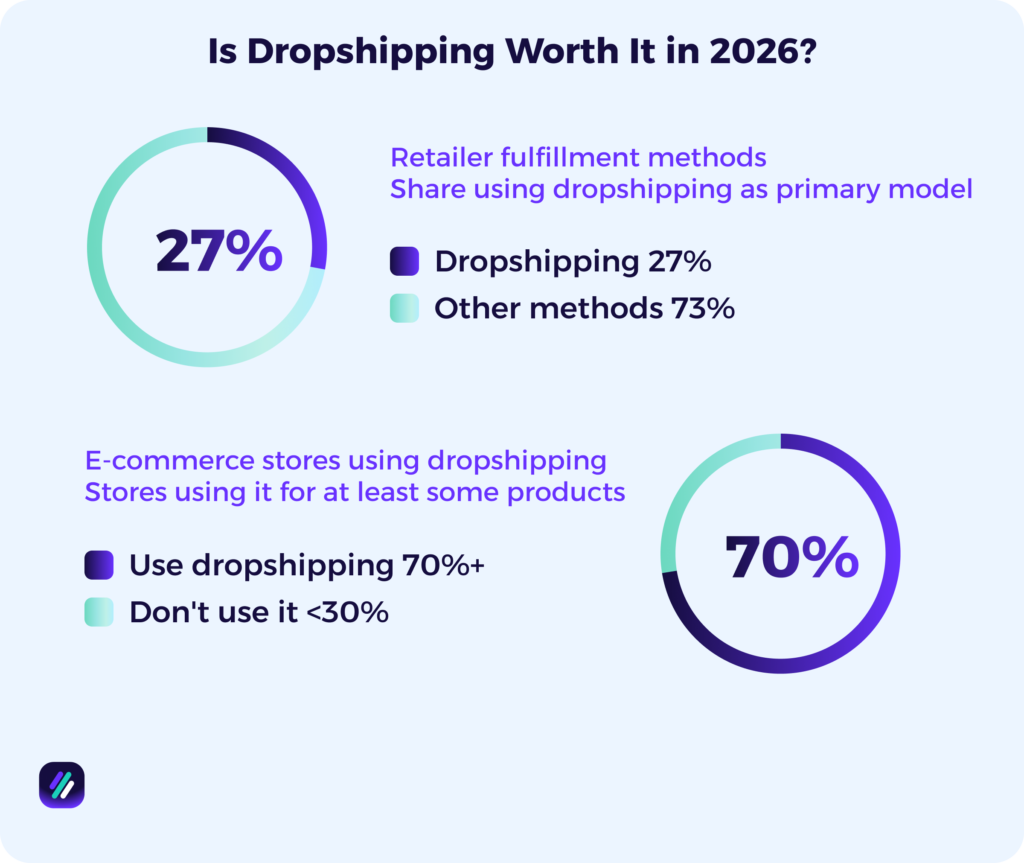
It also has the numbers to back it up. With 27 percent of online retailers already using dropshipping as their primary fulfillment method, you are entering a model that has proven itself at scale.
And over 70% of e-commerce stores are using the dropshipping model for some of their products.
Plus, stores that focus on branding rather than generic listings have been shown to make 50 percent more profit, which means the way you build your store matters just as much as what you sell.
Latest Dropshipping Trends
Dropshipping has evolved in recent times with new technologies and shifting consumer behavior impacting how successful stores are run.
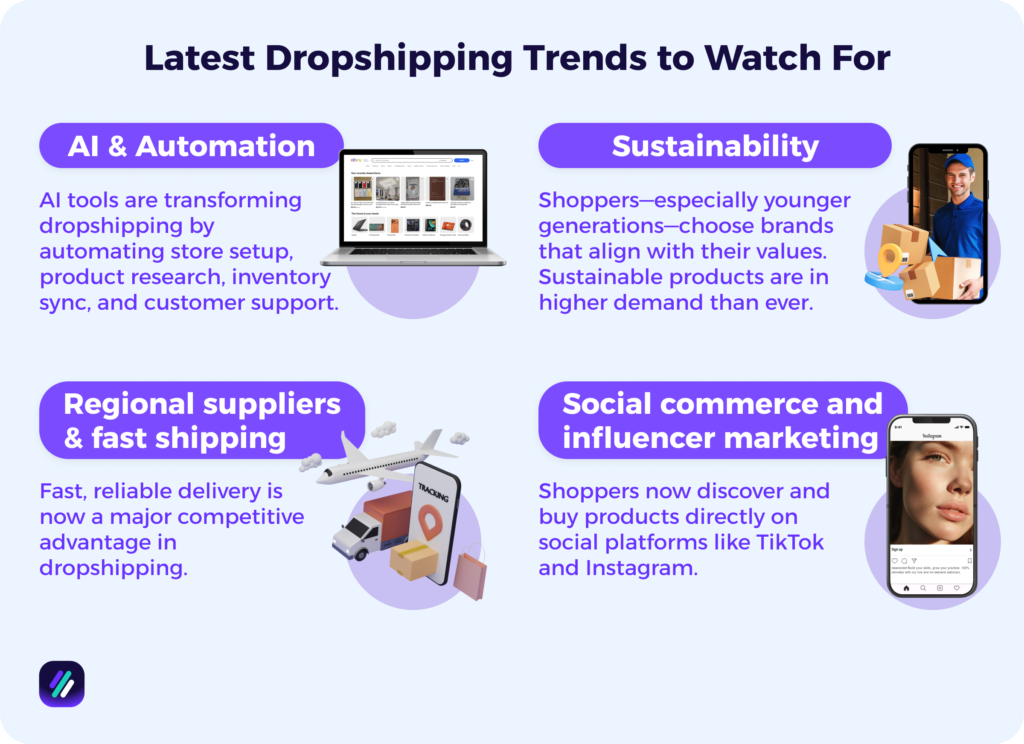
Here are some of the latest dropshipping trends to watch for:
AI & Automation
You are likely seeing AI show up everywhere right now. Dropshipping is no different. You now have AI dropshipping tools that can build your store, sync your inventory, and find winning dropshipping products faster than any manual research could.
For beginners, this means getting started is easier than it has ever been. But you do still need to validate products using data before committing to them. If the supplier behind a product is unreliable, no amount of AI will catch that before it becomes a customer complaint.
The sellers getting the most out of automated dropshipping are using it to handle the repetitive work while making their own calls on supplier quality and product selection.
Sustainability
Sustainable products are expected to grow more and more in demand as younger shoppers make purchasing decisions based on values as much as price.
According to recent data, around 78 percent of US consumers say a sustainable lifestyle matters to them, and products marketed as sustainable grow nearly three times faster than conventional alternatives.
You can capitalize on this by building your store around niches like zero-waste household products or organic personal care.
Regional suppliers & fast shipping
Shipping speed is a competitive advantage that only a few dropshippers currently enjoy.
But you can close that gap by working with the fastest dropshipping suppliers who stock inventory in US or EU warehouses and can fulfill orders within a few days of purchase.
This trend is expected to grow as more shoppers demand an Amazon-like experience from D2C brands, making fast and transparent delivery a competitive necessity.
Social commerce and influencer marketing
The next generation of shoppers will directly visit your TikTok page and buy from there instead of your website. Nearly 24 percent of people now search directly on social channels instead of Google, which gives you a sense of how fast product discovery is changing.
To take advantage of this trend:
- List your products on TikTok Shop or Instagram Checkout so buyers can purchase without leaving the app.
- Post consistently around your niche rather than chasing one-off viral moments. Doing so builds a routine audience that comes back and is more likely to convert over time.
- Keep your content raw and unscripted. Simple videos showing a problem and a solution tend to outperform heavily produced ads on these platforms.
Dropshipping Terms You Should Know
Before starting out, you should also familiarize yourself with some of the key terms that come up regularly in dropshipping.
- Supplier: The manufacturer or wholesaler that holds the inventory and ships products directly to your customer. Common examples include AliExpress and CJdropshipping.
- Fulfillment: The process of packing and shipping an order. In dropshipping, your supplier handles this on your behalf.
- Niche: A specific segment of the market you are targeting, such as grooming tools for exotic pets rather than pet products in general.
- Winning product: An item with strong demand, a clear use case, and low saturation that gives shoppers a reason to buy from you specifically.
- COGS: Cost of goods sold, meaning what you pay your supplier per unit including shipping before you mark the price up.
- AOV: Average order value, which is your total revenue divided by the number of orders. Bundling products is one of the most common ways to increase it.
- Conversion rate: The percentage of store visitors who complete a purchase. A rate between 1.5 and 3 percent is a reasonable target for most stores.
- ROAS: Return on ad spend, calculated by dividing revenue from ads by what you spent on them. A 3 to 1 ratio means you earned three dollars for every dollar spent on advertising.
- UGC: User-generated content, meaning videos or reviews created by real customers rather than the brand. This type of content tends to convert well on platforms like TikTok.
- Cold audience: People who have never heard of your store before and are seeing your ad for the first time. These are harder to convert than people who have already visited your store.
- Retargeting: Showing ads specifically to people who visited your store but left without buying. Since these people already showed some interest, they tend to be cheaper to convert than a cold audience.
- Seller of record: You. Even though the supplier ships the product, you are the one responsible for customer service, returns, and taxes in the eyes of the customer and regulators.
Start Dropshipping the Right Way with ZIK Analytics
Start Dropshipping the Right Way with ZIK Analytics
ZIK Analytics has a suite of tools to help you validate and start a dropshipping business.
However, I want to highlight three tools that make ecommerce product research and store setup easier:
- Shopify Product Explorer is your dropshipping product research tool for finding which products are selling across Shopify stores. Search keywords and filter by sales to identify trending items with proven demand.
- Shopify Market Insights gives you a real-time view of trending products and niches by revenue. See which items sold the most in the last 6 months and spot opportunities before the market gets saturated.
- Shopify AI Store Builder helps you set up your dropshipping store faster by automating store design and product page creation. Tell it which niche you’re targeting, and it creates banners and a homepage based on your selection.
You can also use the ZIK Shopify Sales Tracker to monitor successful stores and the AdSpy Tool to see which ads competitors are running.
Get your ZIK Analytics trial today and start your dropshipping business with tools that show you which products are already generating sales.
FAQs about Dropshipping
In this section, I’ll answer the questions people frequently ask about dropshipping.
How do I start dropshipping?
You start dropshipping by choosing an e-commerce platform such as Shopify. Then you find high-potential items and validate them using tools like ZIK Analytics. The rest of the process involves choosing suppliers who can ship products directly to your customers, marketing your dropshipping store via organic and paid channels, and handling customer service to present a professional image.
Is dropshipping very profitable?
Yes, dropshipping can be very profitable, provided you put in consistent effort and manage to be smart with product selection, supplier relationships, marketing, and customer service. It offers a low barrier to entry so the competition is high, but focusing on a niche and finding ways to differentiate your store can improve your margins.
What are the different types of dropshipping?
There are a few different types of dropshipping based on the platform used. For example, there’s Shopify dropshipping, which involves using the Shopify platform to integrate suppliers and run your e-commerce business. Likewise, there’s Walmart dropshipping and eBay dropshipping that can be pursued by those who want to tap into an existing audience.
Does Amazon allow dropshipping?
Yes, Amazon allows you to dropship from wholesalers and factories. In other words, it expects you to be the seller of the record, meaning the packaging and invoices should contain your info instead of another retailer’s. Sticking to these rules is key to staying compliant with Amazon’s dropshipping policy.
Can I dropship with no money?
Yes, you can dropship with no money by taking advantage of the free trial offered by different tools and platforms. However, you’d need some funds to do things like running ads and ordering samples from suppliers. So while it’s technically possible to dropship with zero funds, it’s mostly going to be testing 1-2 products rather than running a proper dropshipping business.
What are the risks of dropshipping?
The main risk of dropshipping is facing intense competition due to the low barrier to entry. Too much competition can also lead to market saturation, resulting in reduced profit margins for sellers. Dropshippers can also experience issues with quality control and stock shortages due to heavy reliance on third-party suppliers. Other risks relate to legal compliance, ad account suspensions, and challenges in building a unique brand.
Bonus read: Is dropshipping a scam?
Is dropshipping easy to start?
Yes, dropshipping is easy to start. Since you do not need inventory or a warehouse, you can get a store live with a small budget and start selling within days. However, sustaining it can be challenging, as the low barrier to entry means you are often competing with a large number of sellers offering the same products.
Has anyone gotten rich from dropshipping?
Yes, many people have gotten rich from dropshipping. Some notable examples include Cole Turner, who reportedly generated $2 million in sales in just over a year, and Andreas Koenig and Alexander Pecka, who scaled their store to $10 million in annual revenue. This business model can be highly lucrative if you treat it seriously and are willing to put in the work.
What is the best platform for dropshipping?
The best platform is one that fits your budget and skill level. For most beginners, Shopify is the easiest place to start given its straightforward setup and large library of dropshipping apps. If you want to avoid a monthly platform fee, WooCommerce is worth looking into as a more budget-friendly alternative.