
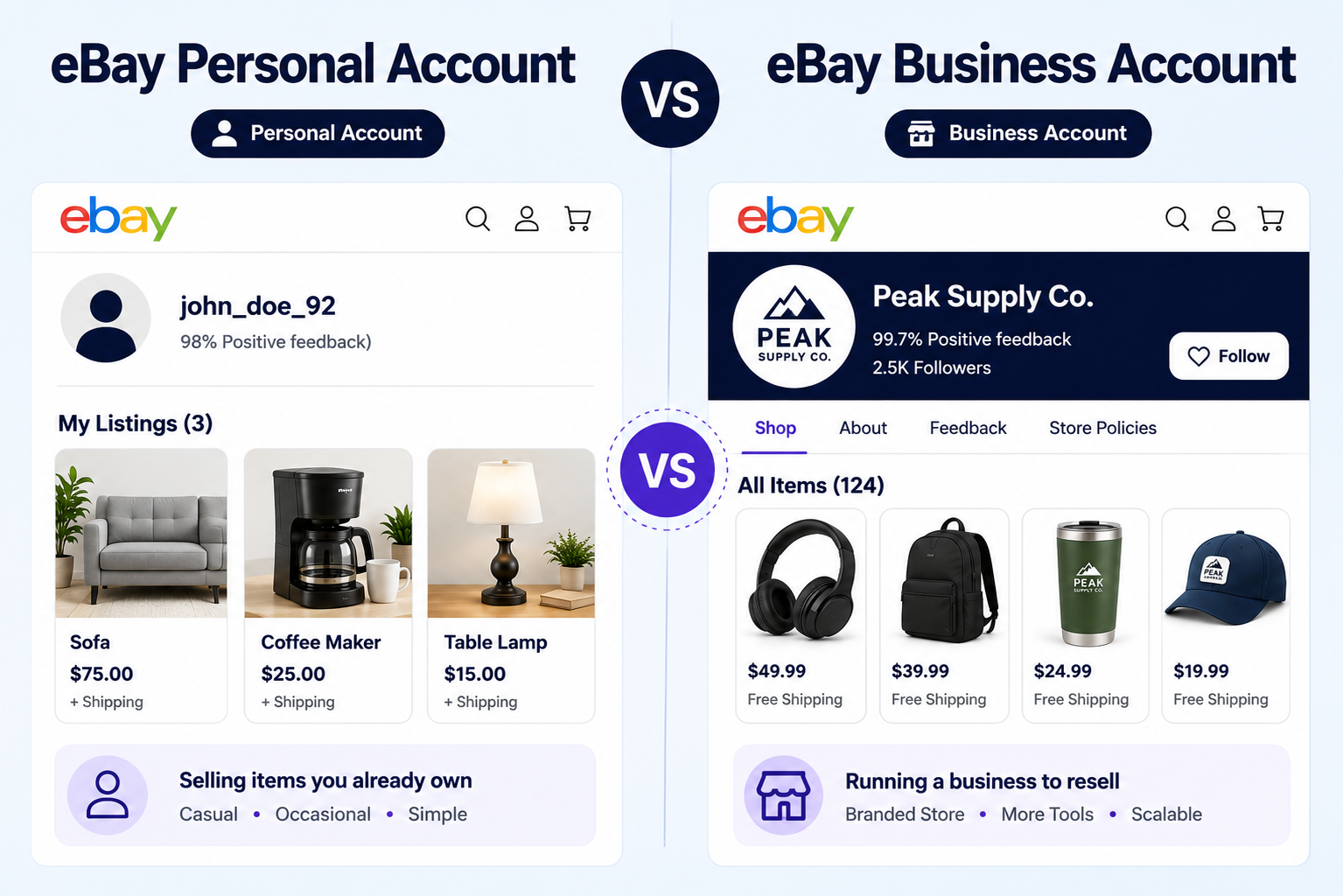
The choice between an eBay business vs personal account trips up almost every new seller, usually for the wrong reason. Most people assume the label sets their fees or their tax bill. It mostly doesn’t.
That myth is expensive: it can lock you into a one-way upgrade, cost you deductions you were owed, or catch you off guard when a weekend hobby crosses into trading.
So here is the short answer: choose by intent, not volume. This guides both accounts up side by side on fees, taxes, branding, limits, and tools, then hands you one clean rule for deciding.
Key Takeaways
- The deciding factor is intent, not volume. If you buy or make items to resell, eBay expects a business account, even when you only move a few a month.
- Your account type does not change your eBay fees. The final value fee is the same for both; only a Store subscription, your category, and your seller performance affect it.
- Taxes follow what you actually do, not the label. For the 2026 tax year, a federal 1099-K only triggers past $20,000 and 200 sales, yet any profit is taxable whether or not you receive the form.
- Upgrading from personal to business is a one-way switch. eBay has no self-service button to go back, so the first choice is worth getting right.
- A business account adds a registered name, an eBay Store, business policies, and bulk tools, while a personal account keeps things simple for casual selling.
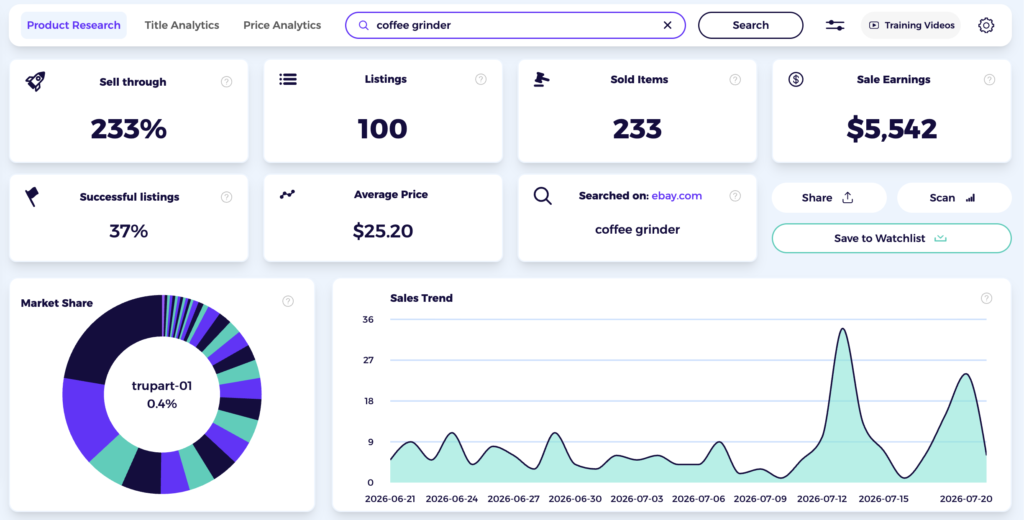
- Whichever you pick, validate demand before you list. The eBay product research tool from ZIK Analytics shows actual sales, sell-through, and competition on any keyword, so your first listing is a decision instead of a guess.

eBay Business vs Personal Account
eBay reports 135 million active buyers and nearly $80 billion in annual sales, and the account you choose decides how you show up to all of them. Here is the full side-by-side:
| Factor | Personal account | Business account |
|---|---|---|
| Best for | Casual sellers clearing out items they already own | Sellers sourcing or making products to resell as an ongoing operation |
| Requirements | A name, address, email, and a payout bank account | A registered business name, business type, address, and verified owners or officers |
| Responsibilities | Standard buyer protections and informal record-keeping | Consumer-law duties, business records, and trader tax reporting |
| Intent and purpose | Selling off clutter with no resale plan | Buying or making goods specifically to resell for profit |
| Seller type | Private individuals and occasional sellers | Sole proprietors, LLCs, corporations, and partnerships |
| Selling volume | Low, irregular volume within new-seller limits | Higher, regular volume that pushes the limit increases |
| Branding | A username only, with no storefront | A registered business name, plus an eBay Store and logo |
| Account name shown | Your eBay username | Your business or store name, with the legal name kept for verification |
| Listing and inventory tools | Core listing flow and a basic Seller Hub | Bulk listing, saved business policies, and heavier inventory tools |
| Store subscription relevance | Rarely earns its fee at low volume | Often pays off through lower fees and more free listings |
| Fees | The same final value fee as any seller | The same base fees, lowered only by a Store, not the account type |
| Taxes and reporting | Casual income, with a 1099-K, only past the threshold | Trader income on Schedule C, with deductions and ongoing reporting |
| Ability to upgrade | Can upgrade to business at any time | The upgrade is one-way, with no self-service path back |
Best for Personal vs Business eBay Account
A personal account fits the person clearing out a closet, a garage, or an old collection. You are selling things you already own, with no plan to restock them.
A business account is built for the opposite: you are buying or making products to sell, and you intend to keep doing it. The line is not how much you list.
Someone flipping ten thrifted jackets a month with the intent to profit belongs on a business account, while someone offloading a hundred personal books once does not. So match the account to why you are selling, not to the size of the pile.
Requirements of Personal vs Business eBay Account
Setup is where the two split hardest. A personal account asks for the basics: your name, address, email, and a bank account for payouts. That is close to the effort of making a buyer account.
A business account asks eBay to verify a business, including a registered business name, your business type, and the identities of the owners or officers behind it. None of it is difficult, but it is a registration step rather than a quick sign-up.
Requirements also vary by country, so treat the US setup here as the common case.
Responsibilities of Personal vs Business eBay Account
Here, the difference is legal weight. As a personal seller, your obligations are light: describe items honestly and follow eBay’s standard buyer protections.
Once you step into a business account, you take on a trader’s responsibilities, from consumer-protection rules to proper records and reporting income as a business. Setting clear eBay business policies for returns, shipping, and payment is part of operating like one.
A casual seller can stay informal, while a business seller is accountable in the same way any small retailer is, which is the trade-off for the tools and credibility that come with the label.
Selling Intent & Purpose Personal vs Business eBay Account
Intent is the single factor eBay actually cares about, and the one most people bury under volume. A personal account assumes no resale purpose: you are not buying stock, you just want to get rid of a few things you have.
A business account assumes the opposite, that you acquire or produce goods to sell them for profit. It is also why a small, deliberate reseller is a business in eBay’s eyes while a high-volume declutterer is not.
If profit was the goal when you acquired the item, your purpose is commercial, and that points to a business account.
Seller Type of Personal vs Business eBay Account
This is the who-you-are question. Personal accounts suit private individuals: hobby sellers, occasional sellers, and people having a house clearance.
Business accounts map to legal seller types, including the sole proprietor, the single or multi-member LLC (limited liability company), the corporation, and the partnership. If you have registered any of those or operate as one in practice, eBay wants the account to match.
You do not need a formal company to sell casually. But the moment you are trading as a structured entity, your account should say so, because the type is meant to mirror your actual standing.
Selling Volume of Personal vs Business eBay Account
Volume is the factor everyone overweights, and it decides less than people think. Both accounts start under the same new-seller limits, often around 10 items and $500 a month until you build a track record.
Volume alone never forces a business account, since you can sell a lot personally and a little commercially. What it does is expose the friction: at scale, personal accounts feel overwhelmed, while business accounts give you higher limits, bulk tools, and Store pricing.
Before you push for higher eBay selling limits, it is worth confirming that what you plan to list actually sells, which is exactly what the eBay product research tool is built to check.
Branding Personal vs Business eBay Account
A storefront is what a business account buys you. A personal account shows your username and little else, with no logo, no shopfront, and no business identity attached.
A business account lets you trade under a registered business name and build it out with an eBay Store, complete with branding, categories, and a professional face for buyers. For a casual seller, none of that matters.
Account Name of Personal vs Business eBay Account
What buyers actually see depends on your account. On a personal account, your eBay username is your public identity, and your legal name stays private.
On a business account, you can present a registered business or store name, while eBay keeps your legal name internally for verification rather than displaying it. For privacy, that favors the business account: you separate your personal identity from your commercial identity.
A casual seller rarely thinks about this until a buyer messages them by their first name. If you would rather trade as a brand than as a person, the business account is the cleaner split.
Listing, Inventory, & Selling Tools of Personal vs Business eBay Account
Tooling is the practical gap you feel day to day. Personal accounts get the core listing flow and a basic Seller Hub, which is plenty for a handful of items.
Business accounts open up bulk listing, saved business policies, promotions, and the heavier inventory features that make managing dozens or hundreds of listings survivable.
If you are listing one item a week, the extra tools are going to be baggage. If you are listing daily, they are the difference between a system and a scramble.
Cost and Subscription Relevance of Personal vs Business eBay Account
Cost is where the Store subscription enters, and it pays to understand it before assuming bigger is better. Neither account costs anything to open.
The optional cost is an eBay Store, a monthly subscription that lowers your per-sale fees and adds free listings. For a low-volume personal seller, a Store rarely earns back its fee.
For a business seller moving steady volume, it usually does, and the eBay store levels run from a cheap Starter tier to high-volume Anchor plans. The account type does not force a subscription either way; it just changes the math depending on how much you sell.
Fees of Personal vs Business eBay Account
Your account type does not change your eBay fees. A personal and a business account pay the same final value fee, which on most US categories runs 13.25% of the sale plus $0.40 per order.
What actually lowers that is a Store subscription, which drops the most-category rate to 12.35%, alongside your category and seller performance. On a $100 sale, that is roughly $13.65 without a Store and $12.75 with one, a modest gap that only adds when you sell at volume..
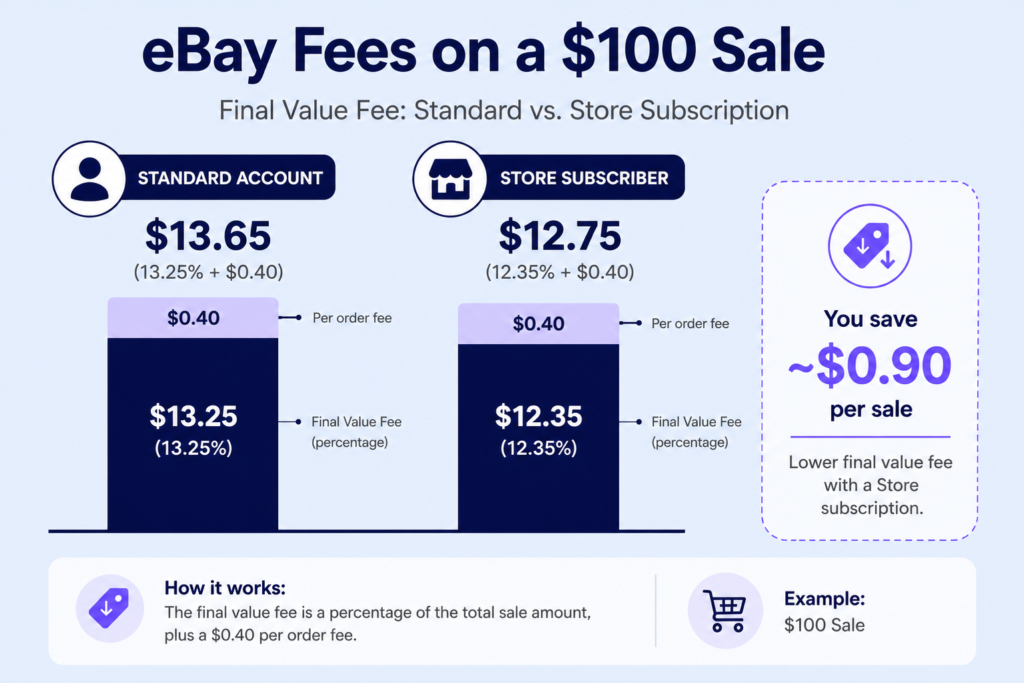
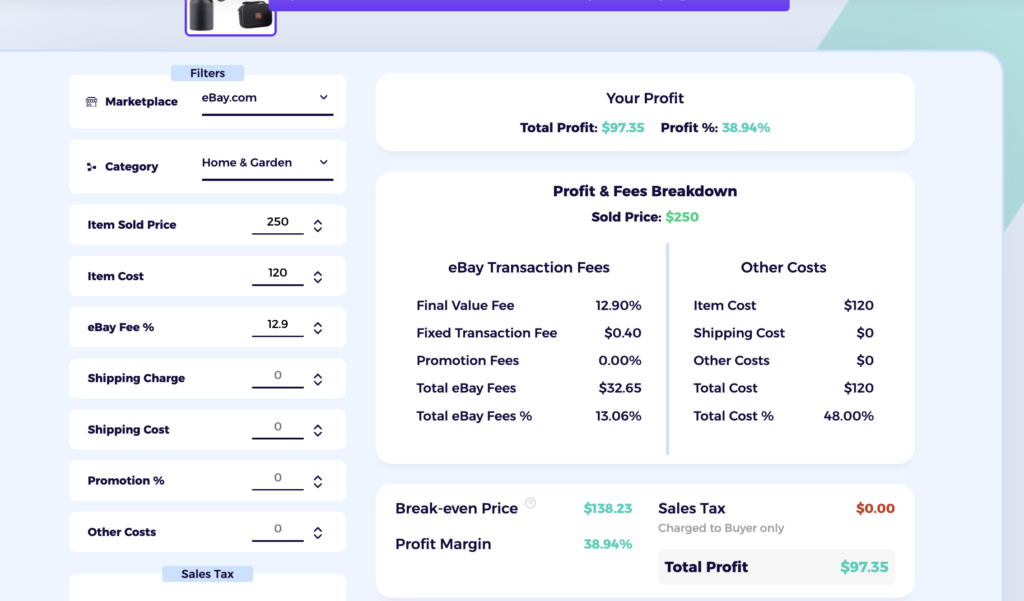
So if a guide tells you to register as a business to pay less, it is wrong. You can run the numbers on any item with ZIK’s eBay fee calculator before you list.
Taxes and Reporting of Personal vs Business eBay Account
Taxes track what you do, not which account you clicked. Both types can receive a Form 1099-K, and for the 2026 tax year, eBay only issues one once you pass $20,000 and 200 transactions, a threshold the One Big Beautiful Bill Act restored after years of a planned drop toward $600.
The catch most casual sellers miss is that profit is taxable whether or not a form shows up. A hobby-level personal seller reports differently from a business seller, who files as a trader, deducts costs, and tracks everything.
Thresholds also vary by state and country, so treat these US figures as the common case. If you are operating like a business, file like one.
Ability to Upgrade Personal vs Business eBay Account
This is the one that bites if you rush it. Upgrading a personal account to a business account is simple and available at any time from your account settings. Going the other way is not.
eBay states plainly that once you upgrade to a business account, you cannot revert it back to personal yourself. There is no toggle and no self-service path, and your only route back is contacting eBay support directly.
So the practical rule is to start personal if you are unsure, then upgrade once your intent is settled, because the door mostly swings one way.
Download this eBook now and learn how to sell on eBay like a pro.What is an eBay Personal Account?
An eBay personal account is the free, standard individual account for casual, non-commercial selling, meant for clearing out items you already own, with no resale intent and no business registration behind it.
It is the default you get when you sign up, and for a lot of sellers, it is all they will ever need.
Benefits of eBay Personal Account
The appeal of a personal account is that it gets out of your way. For casual selling, that simplicity is the entire point:
- Instant setup: you can be listing within minutes, with no business details to verify.
- No running cost: the account is free, and you are not paying for a Store you would not use.
- Privacy by default: you sell under a username without registering a business name.
- Lower stakes: light record-keeping and casual obligations, which is fine for the odd sale.
- An easy on-ramp: it is the natural place to learn how to set up an eBay account and how selling works before you commit.
Drawbacks of eBay Personal Account
The same simplicity becomes a ceiling the moment you try to grow:
- No store branding: you are a username, not a shop, which caps trust and repeat, buyers.
- Fewer tools: no bulk listing or saved business policies, so scaling gets manual fast.
- Fewer fee breaks: without a Store subscription, you miss the lower final value fee and free listings.
- Wrong fit for resale: if you are reselling on eBay at any scale, selling personally clashes with eBay’s own rules.
Limitations of eBay Personal Account
Beyond the trade-offs, a personal account carries some hard limits. Selling allowances start low and only rise as you build feedback and sales history, so you cannot simply list 500 items on day one.
You are also expected to stay within non-commercial selling, and consistent resale activity can prompt eBay to ask you to register as a business.
Because the upgrade is one-way, a personal account is best seen as a starting point you may outgrow, not a permanent home for a serious operation.
When eBay Personal Account is the Best Choice
A personal account is the right call more often than upgrade-happy guides admit. It is the best choice when:
- You are clearing out personal belongings rather than sourcing stock.
- Selling is occasional, with no plan to make it regular.
- You are still learning the platform and want zero setup friction.
- Most of your activity is buying, with the odd sale on the side.
- You are testing whether selling is even for you before committing money.
What Is an eBay Business Account?
A business account is what eBay expects once selling becomes commercial: you source or make products to resell, trade under a business name, and take on the tools, fee structure, and tax and legal duties that come with running an actual operation.
If the personal account is the casual lane, this is the operating system for a growing eBay business.
Benefits of an eBay Business Account
A business account is built for sellers who want to scale without fighting the platform:
- Lower fees at volume: pair it with a Store subscription, and your final value fee drops on every sale.
- Brand identity: trade under a business name with an eBay Store and logo, where the eBay store benefits compound as you grow.
- Higher limits, sooner: business sellers tend to clear new-seller caps and scale listings faster.
- Heavier tools: bulk listing, saved business policies, and promotions for managing serious inventory.
- Buyer trust: a business presence and clear policies reassure buyers and lift conversion.
- Tax-ready: operating as a business lets you deduct costs and keep clean records from day one.
Drawbacks of eBay Business Account
Capability comes with weight, and it is fair to know the downsides before you upgrade:
- More setup: you verify a business identity, not just an email and address.
- Heavier obligations: consumer-protection rules, record-keeping, and tax reporting become your job.
- A one-way door: you cannot self-revert to a personal account once you upgrade.
- Subscription pressure: the fee savings only arrive once you actually pay for a Store.
- Overkill when small: at low volume, the structure is more than a casual seller needs.
Requirements of an eBay Business Account
Setting up a business account is a verification step. eBay asks for a registered business name, your business type, a business address, and the identities of the owners or officers behind the account, plus a linked bank account for payouts.
Depending on where you sell, you will also provide a tax identifier. If you have ever wondered why does eBay need my SSN, this is the reason. Requirements differ by country, so the US setup here is the common case, not a global checklist.
When an eBay Business Account is the Best Choice
A business account becomes the obvious choice the moment selling stops being a clear-out and starts being a cash flow machine. It is the foundation of how to start an eBay business properly, and it is the right move when:
- You buy or make products specifically to resell.
- Selling is regular, and you treat the income as income.
- A branded store and repeat customers are the goal.
- You are scaling past what personal limits and tools comfortably allow.
- You already run a business on eBay and are adding a channel.
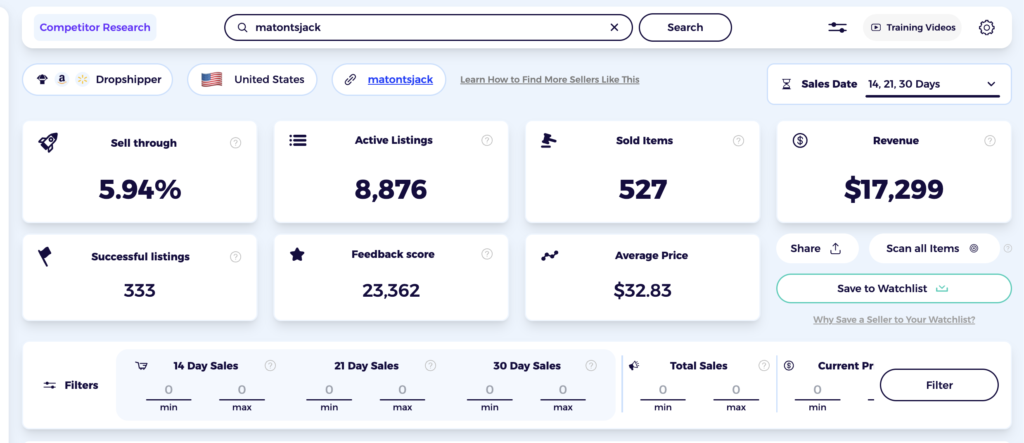
If you are ready to operate like one, study the sellers already winning your niche with the eBay competitor research tool, which shows a seller’s revenue, top products, and sell-through rate so you can model what already works.
How to Decide Which eBay Account You Need
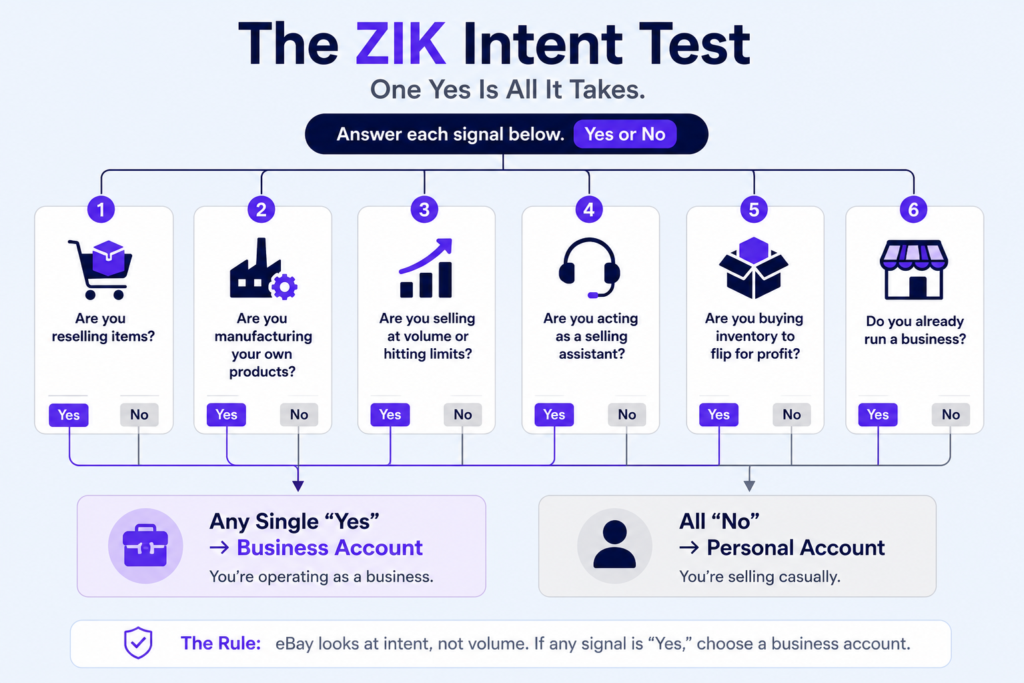
You can skip the agonizing over a personal vs business account on eBay with one test. We call it the Intent Test at ZIK, and it cuts straight through the volume confusion that traps most sellers. The test is six signals, each answered yes or no:
- Are you reselling or sourcing items specifically to resell?
- Do you make or manufacture the products you sell?
- Are you selling at volume, or regularly hitting your selling limits?
- Are you acting as a selling assistant, listing items for other people?
- Are you buying inventory mainly to flip it for profit?
- Do you already run a registered business on eBay?
The rule is simple: a single yes points you to a business account. Even one signal means you are trading with commercial intent, and eBay expects the account type to match that reality.
Common Mistakes of Choosing Between eBay Accounts
Most account-type mistakes come from choosing the wrong signal, then living with the fallout. From our in-house eBay sellers at ZIK, these are the ones that surface again and again:
- Choosing volume: assuming a few sales means personal and many means business, when intent is what counts.
- Believing the fee myth: upgrading to a business account, expecting lower fees than the label alone does not give you.
- Upgrading too early: registering a business before you have any resale intent, adding obligations you do not need yet.
- Waiting too long: running an obvious resale operation on a personal account until eBay forces the issue.
- Ignoring the one-way door: upgrading on a whim without realizing you cannot self-revert.
- Skipping the tax reality: assuming no 1099-K means no tax, when profit is taxable either way.
- Mismatching your legal status: trading as an LLC or sole proprietor while the account still says personal.
- Underusing a Store: paying for a subscription at a volume too low to earn it back, or skipping one when volume justifies it.
- Neglecting business policies: upgrading but never setting clear return, shipping, and payment terms.
- Forgetting privacy: selling under a personal identity when a business name would shield it.
- Copying someone else’s setup: matching a friend’s account type instead of your own selling intent.
- Treating it as permanent: assuming the first choice is forever, instead of revisiting it when your situation changes.
How to Switch Between Personal and Business Accounts
The switch itself is the easy part. Moving from personal to business takes a few minutes in settings, as long as your business details are ready:
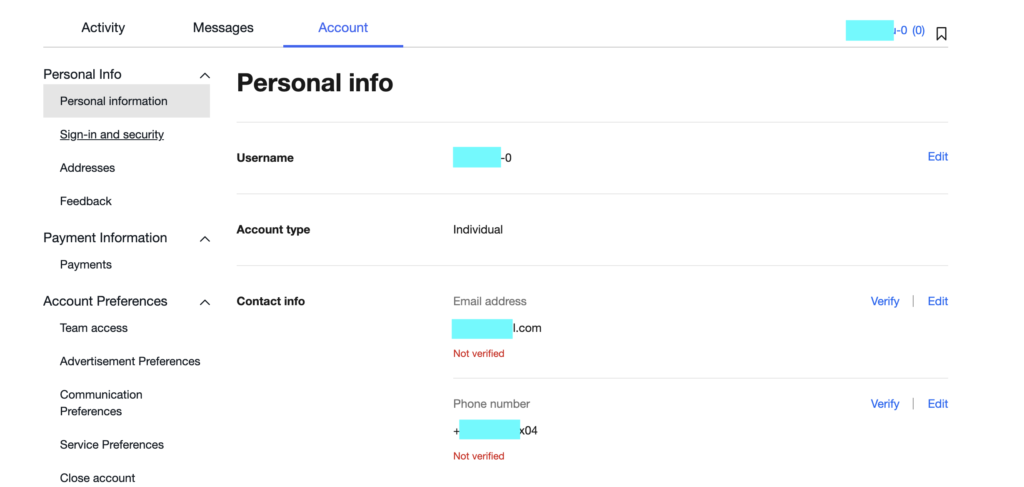
- From your account settings, open the Personal Information section.
- In the Account type area, select Edit next to your current type.
- At the confirmation prompt, choose to upgrade to a business account.
- For business type, pick either a legal entity or a sole proprietor.
- You then enter your business name, address, and contact details.
- You add the owner or officer details eBay needs to verify the business.
- Your business policies for returns, shipping, and payment get set here too.
- A final review and submission send the upgrade to eBay to confirm.
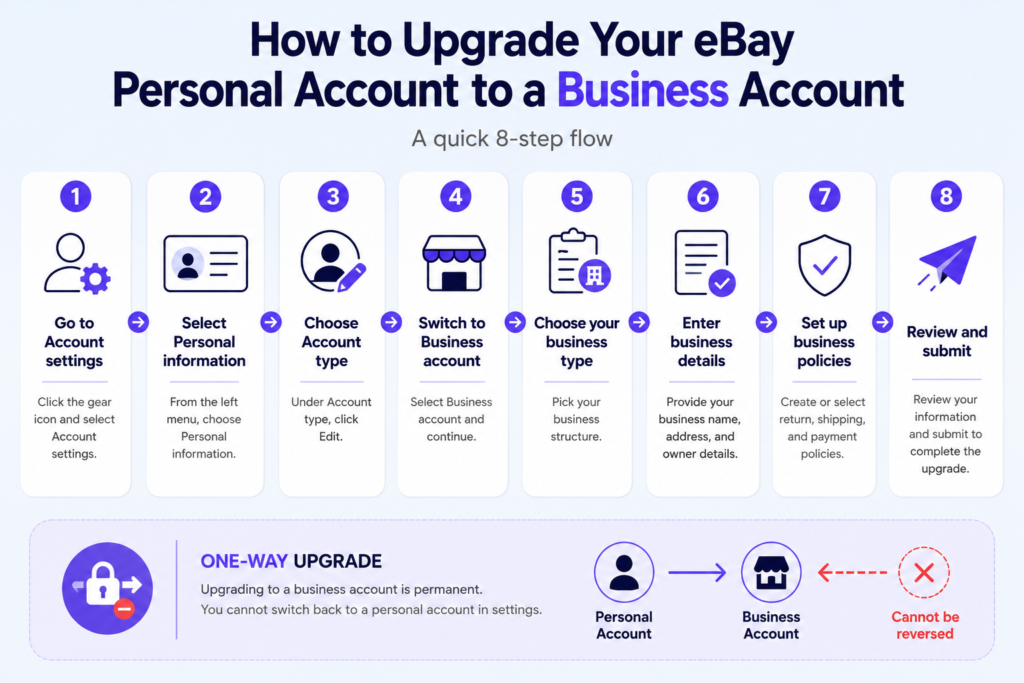
Going back is the hard part. eBay has no self-service way to downgrade a business account to personal, so your only option is to contact eBay support and ask, with no guarantee they will do it.
From our in-house eBay sellers at ZIK, the cleaner path is to get the choice right up front rather than count on reversing it. If you are not certain you are running a business yet, start personal and upgrade later, since that direction always works.
Use ZIK Analytics to Grow Your eBay Account
Whichever account you land on, the habit that actually grows it is the same: decide from data, not hope. That is the part ZIK Analytics is built to handle for you:
- Use the online eBay product research tool to check actual sales, sell-through, price, and competition on any keyword before you list, so you only stock what is already moving.
- Use the eBay competitor research tool to study a seller already winning in your niche, including their revenue, top products, and sell-through rate.
- Use eBay market insights to spot trending keywords and seasonal demand, so you move on the next opportunity before it peaks.
You can try all three on a $1 trial (7-day) and run your first product check today.
eBay Business Account vs Personal Account FAQs
A few quick answers to the questions sellers ask most when picking an account type.
Is an eBay business account free?
Yes, an eBay business account is free to open and free to keep, exactly like a personal account. Neither type charges a setup or membership fee. The only optional cost is an eBay Store subscription, which lowers your selling fees at volume but is never required.
Should I change my eBay account from personal to business?
You should switch to a business account when your selling has resale intent: you source or make products to sell, you sell regularly, or you trade as a registered business. If you are only clearing out items you already own, a personal account is fine. The deciding factor is purpose, not volume.
Does an eBay business account affect taxes?
The account label does not change your tax bill; what you do does. Any profit is taxable whether you sell personally or commercially. A business seller files as a trader and deducts costs, while a casual seller reports hobby income. For the 2026 tax year, eBay issues a 1099-K only past $20,000 and 200 sales.
Does a personal account or a business account pay lower fees on eBay?
Neither. The final value fee is identical for both account types. Lower fees come from an eBay Store subscription, not from being a business: a Store drops the most-category rate from 13.25% to 12.35% plus the same per-order fee. Your category and seller performance also affect what you pay.
Can I switch back from a business account to a personal account?
Not through your settings. eBay’s account upgrade from personal to business is one-way, with no self-service option to revert it. Your only recourse is to contact eBay customer support and request the change, with no guarantee they will agree. It is best to choose a business account deliberately rather than planning to undo it later.