

You’re ready to populate your brand new Shopify store with products and start making sales.
But before you add anything to your catalog, know that not every product is worth selling.
Some products go viral on TikTok and Instagram but don’t generate any revenue for the store owner.
Others seem promising at first, but have razor-thin margins or unreliable suppliers that make them impossible to scale.
So, how to find products to sell on Shopify? I’ve compiled a list of eight methods you can use to identify winning products quickly and easily.
Key Highlights
- Product research tools like ZIK Analytics and Google Trends give you valuable data that becomes the foundation of product selection.
- Analyzing best sellers on marketplaces and leveraging social media trends can further expand your product ideas.
- You can also look into the best sellers and running ads of other US Shopify stores to spot winning items.
- Dropshipping is the cheapest way to source these items, but you can also consider print-on-demand and wholesale options, depending on what fits your needs better
Method 1: Using Product Research Tools
The first method is to use tools designed to help you find and validate winning products.
Shopify product research tools leverage AI algorithms and signal collection to sift through vast amounts of market data, making them invaluable for quickly identifying profitable products.
You can use:
ZIK Analytics
Not to brag, but ZIK Analytics’ Shopify Product Explorer is a solid tool for discovering products that are actually selling across Shopify stores.
It uses data from publicly available Shopify stores to show you how many units of a product were sold in the past month, the average price at which it sold, and other valuable metrics.
For this, create a ZIK Analytics account and choose Shopify as your marketplace from the left sidebar.

Next, search for “Product Explorer” in the same sidebar and click it. Once done, you’ll see the following screen:

Search for any product or niche using filters like language, country, and sales date range. I searched “pet” and ticked dropshipping for the product type. For the country, I selected the United States, as that’s where the majority of my audience is located.

ZIK gave me a list of products with estimated sales over 7 and 30 days, pricing, upload dates, and total revenue.

Do the same at your end and consider the top 3-5 products, as those are the best-performing items over a given period.
Related Reading: Best Products to Sell on Shopify
Google Trends
Google Trends can also be used to validate interest in a product. Type in your product or name in the tool and view the “interest over time.” For the time being, choose the past 5 years for a realistic view, or at least the past 12 months for a realistic view.
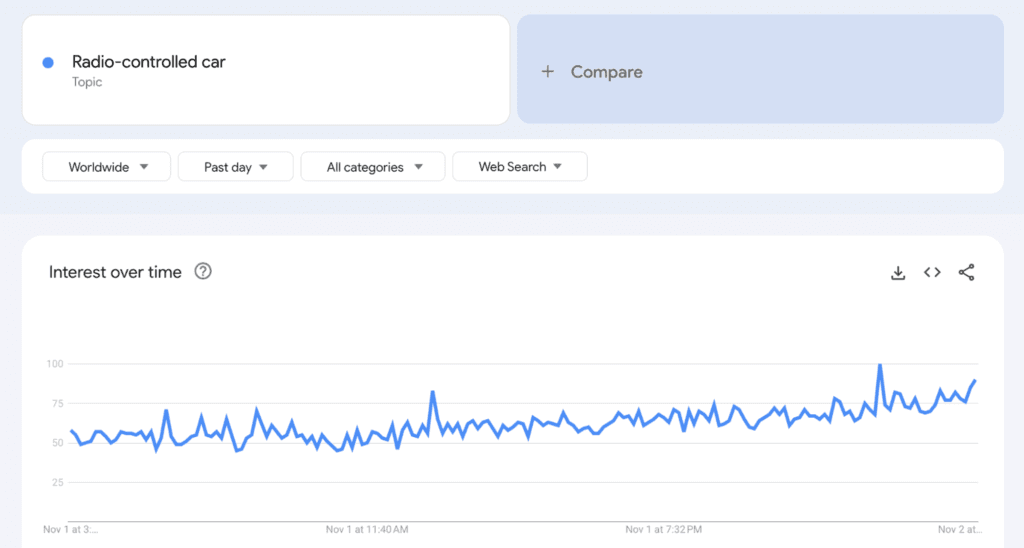
An upward or steady trend indicates that there is enough demand from the market.
To take things further, you type “niche + market size” or “niche + market forecast” in Google Search. These queries should lead to reports that show the industry’s growth rate and future profitability, which can provide further validation for a product idea.

Method 2: Analyze Trending Products on Marketplaces
E-commerce marketplaces are highly competitive, so when a product makes its way to their best-seller list, you should pay attention. Here are the marketplaces that curate these lists:
Amazon
To identify trending products on Amazon, start by utilizing the “Best Sellers” and “Movers & Shakers” lists, which are updated hourly to show rapid rises in sales rankings.
For deeper analysis, use third-party tools like Helium 10 or Jungle Scout to analyze keyword search volume and track seasonal trends.
You can also review customer feedback on popular items to identify potential gaps in the market where existing products can be improved.

eBay
eBay’s top-selling items are showcased in the “Trending” section of the site. You can check this section and use tools like WatchCount.com to see which products are generating the most user interest.
ZIK Analytics also offers an eBay product research tool that lets you analyze recent sales data, including average prices and sell-through rate.
Plus, our eBay competitor research tool lets you uncover the best sellers of other eBay stores, which can inspire your own product sourcing strategy.

Etsy
Etsy’s trending products are often highlighted in the “Etsy Finds” and the “Trending on Etsy” page.
You can check these pages and view the auto-complete suggestions the built-in search bar gives to understand what buyers are currently seeking.
If you want to go even deeper, tools like Marmalead or eRank can help you analyze keyword competitiveness and spot niche items.

Method 3: Explore Supplier Directories
Supplier directories are one of the most reliable sources for finding winning products for Shopify dropshipping. These platforms curate products based on real-time popularity and order information.
Here are the top supplier directories to explore:
- AliExpress (via DSers): Check the “Best Sellers” or “Top Sellers” sections on AliExpress, where items are broken down by popular categories. Make sure to check seller ratings and feedback for reliability and use apps like DSers to import proven items directly into your store.
- SaleHoo: SaleHoo gives you access to over 8,000 pre-vetted suppliers across a wide range of niches. You can use its Market Research Labs to get high-probability product ideas based on real sales data.
- CJ Dropshipping: CJ lists products in its trending section, which often features items curated based on high-volume sales on platforms like 1688 and Taobao. Specialized “US Warehouses” are also available to help you filter for fast shipping.
- Spocket/Syncee: These directories focus on Shopify dropshipping suppliers from the US and EU. You can use their “Best Sellers” categories to find trendy, high-quality items that you can sell through your Shopify store.

Method 4: Leverage Social Media Trends
Social media can be a goldmine for discovering products that are a hit with consumers.
High engagement on product-related posts indicates genuine interest and purchase intent.
Plus, analyzing discussions around popular products can sometimes help you find unique angles or underserved markets to tap into to grow your sales.
Monitor TikTok Hashtags and Creator Content
TikTok is a primary source of e-commerce trends, often turning niche products into viral sensations overnight. Hashtags like #ViralProduct and #SkinTok usually feature items that are currently getting high engagement on the platform.
A tip is to monitor comments for phrases like “Where can I buy this?” as they indicate strong purchase intent. You can use the TikTok Creative Center to filter for top-performing products and ads to see what’s currently converting.

Check Instagram Reels and Reddit
Instagram’s algorithm frequently prioritizes Reels and pushes them to non-followers, meaning they get more eyeballs than other forms of content.
Scroll through your Reels tab for 10-15 minutes each day to see which items frequently get pushed to your feed. Products that appear in multiple feeds and have a “Shop” tab are the ones you should be evaluating.
You can also track conversations on Reddit where people often have discussions on emerging product opportunities. Subreddits like r/entrepreneur and r/dropship can help you find unfiltered insights like pain points and desires that can be fulfilled with a specific item.

Method 5: Source From Local Artisans and Makers
Another way to find items that sell on Shopify is to explore the catalogs of local makers and artisans.
These individuals produce unique, one-of-a-kind products with lots of care and attention to detail.
The items also come with a built-in narrative around the story of the maker or the product’s origin to help you build an emotional connection with consumers.
To find these people:
- Search for local artisan groups (e.g., local potters, woodworkers) on Facebook and Google
- Visit farmers’ markets and craft fairs to see products in person and meet the creators directly
- Use platforms like Faire and Gelato to discover independent makers based on product category, location, and style preference

Method 6: Analyze Shopify Store Products
Sometimes, finding products that actually sell is as simple as analyzing the products of other Shopify stores.
With ZIK Analytics’ Shopify Sales Tracker, you can quickly uncover the best-selling products, marketing strategies, and revenue performance of other Shopify stores.
With Shopify selected as your marketplace inside ZIK, choose Sales Tracker from the list of options:

Now enter the URL of the Shopify store whose products you want to analyze and click Search.

You’ll now see data like the estimated sales, number of products, ad channels, and estimated revenue that the store has generated over a selected period. Clicking View List in the Store Apps section also lets you view the tech stack they are using, which can give you ideas for what apps to use for your own store.

Scroll down, and you’ll arrive at the part where you can see the Recently Sold, New Products, and Best Sellers of that particular store.

Analyze each list to get an idea of which types of products are most likely to sell on your own store.
Method 7: Analyze Shopify Store Running Ads
As with product performance, the ads being run by other Shopify stores can give you an idea of which items have a higher potential for sales.
That’s because most store owners run paid ads for products they know are likely to bring them sales, helping them get a positive ROI from dropshipping advertising.
At ZIK, we offer an AdSpy tool that lets you analyze the running ads of any Shopify store.
To use it, copy the URL of the competitor’s store and paste it into the tool. ZIK will then show you a list of all active Meta ads for that shop.

You can filter the results by demographics, e-commerce type, and even media type to see ads tailored to your ideal customer.

Analyze the following specifics in the AdSpy feed:
- Video hook: How do they capture attention in the first 3 seconds?
- Ad copy: What angles, pain points, or benefits do they highlight in their text?
- Call to Action (CTA): What button are they using? (e.g., “Shop Now,” “Order Now”)
- Active duration: Note how long an ad has been running. Ads running for a long time (e.g., 30+ days) generally indicate a high-converting, profitable “winner”.
Method 8: Analyze Products with Meta Ads Library and the TikTok Ads Library
The Meta Ads and TikTok Ads libraries are public, searchable databases of all active ads running across Facebook and TikTok.
Analyzing them helps you see which products are currently being heavily advertised so you can identify items with strong demand and potential for sales.
Plus, it gives you ideas for video hooks, ad copy, and targeting strategies you can use to run your own campaigns.
To analyze products using these databases:
- Search for “Meta Ad Library” or “TikTok Ads Library” in Google and navigate to the official page.
- Select your target country and wait for relevant ads to appear on your screen.
- Use the “Impressions by date” on Meta to find ads that have run for a long time.
- Analyze the products featured in those ads using tools like ZIK Analytics.
- Note the ad’s format, messaging, and CTA to understand what resonates with audiences.

Why Product Research is So Important?
Product research is important because it helps you identify winning products that are likely to generate consistent revenue for your store.
According to industry data, around 63% of failed stores didn’t spend enough time validating demand before launching. Product research can help you avoid the same fate and even give you an edge in a competitive space.
Plus, choosing products based on data can help you get more sales from day one. Research found that sellers who validate products with research tools see 2x better conversion rates than those who rely on gut feel alone.
As long as you invest time in proper product research upfront, you’re setting your store up for long-term profitability and success.
The Core Criteria of a Winning Shopify Product
Finding a winning product on Shopify requires careful research and validation to ensure long-term success. At the very least, the product you pick should fulfill the criteria as follows:
Market Demand (Is Anyone Actually Buying This?)
Validating market demand is the most crucial step to ensure the product has a ready audience. Products that address a daily frustration or make life easier are in high demand. You can use tools like Google Trends and data from ZIK analytics to check for consistent sales rather than temporary spikes in demand.
It also helps to listen to people on social media and what they are complaining about or asking for. These insights can give you a fair idea of whether it’s a product that worth adding to your Shopify store.
Profit Margins and Pricing Power
For a product to be worth selling, it must allow for a high markup, ideally 3-5x the cost of the item. High-margin products often include unique, specialty, or eco-friendly items that offer high perceived value, enabling you to charge more.
Pricing power, or the ability to raise prices without losing customers, is achieved when you offer a unique, branded product with few close substitutes.
Competition and Saturation
A winning product is not an item that you can easily find at your local supermarket. Rather, it’s something unique with a wow-factor that is scarce and takes a good amount of effort to source. It’s also a product that exists in a niche market where competition is manageable.
To maximize profitability, you must be among the first three people selling the product, or, if entering a saturated market, you must be able to offer a unique angle, such as targeting a specific demographic.
Furthermore, a winning product has a 3-5x markup potential, allowing you to pay for advertising while maintaining a 30-50% profit margin.
Product Logistics & Customer Experience
Winning products are compact and easy to ship. They are also durable and unlikely to break or get damaged during transit. These traits often qualify them for faster, cheaper logistics options like USPS Ground Advantage or regional carriers.
Brandability and Upsell Potential
A winning product can be easily branded to create a unique value proposition (USP). This may involve customizing the packaging, adding private labeling, or creating a unique brand story to justify higher price points.
It also has high upsell potential, meaning the item can be offered in bundles or complementary product sets to increase average order value.
Scalability
Scalability means the product can go from 10 sales to 1,000 sales without causing chaos in your business.
Winning products are often scalable because they have reliable supply chains and can be sourced in bulk at consistent quality.
They also sell in markets with broad demand, so you’re not limited to a tiny customer base as you grow.

Sourcing Models: Where to Actually Get the Products
So, where do you get the items that you narrowed down in your research? There are a few sourcing models available to you:
Classic Dropshipping
Classic dropshipping is a retail fulfillment method where you create a Shopify store and list products for sale. Meanwhile, a third-party supplier (often on AliExpress) holds inventory and ships products directly to your customers. This sourcing model comes with minimal risks since you only pay for the goods after the sale.
Pros:
- You don’t need to buy inventory upfront, so the financial risk of doing business is minimal.
- Creating a Shopify store is simple and requires no prior coding experience.
- You can test multiple niches or products without worrying about unsold inventory.
- You can operate the business from anywhere with an internet connection.
Cons
- High competition and reliance on low-cost suppliers often mean lower margins.
- Products from overseas can take a long time to arrive, and you cannot personally inspect every item, making it difficult to ensure quality.
- If your supplier is out of stock or sends the wrong item, you are still the one answering to the customer.
- When it makes sense: When you have limited funds ($500–$3,000) and want to sell products on Shopify without inventory.
- When it’s a trap: When the supplier refuses to send you a sample, or when there are many competitors selling the same items as you plan to

Print on Demand (POD) for Shopify
Print on Demand (POD) is a specialized dropshipping model where you create designs for white-label products, and then a third-party company prints and ships the items to your customers. Using a POD app, you can connect your Shopify store to a print-on-demand company to automate everything from shipping to order fulfillment.
Shopify connects with:
- Printful: Printful is known for its high-quality, in-house production and a wide variety of branding options (custom tags, pack-ins).
- Printify: Printify has a large network of printing partners and usually charges lower prices than other POD suppliers.
- Gelato: Gelato partners with local printers in more than 30 countries and is an excellent choice for fast, global fulfillment.
Best products for Shopify POD include:
- Apparel: T-shirts and hoodies remain on top due to their universal demand and customization potential. All-over-print items like yoga pants and hoodies offer higher profit potential than standard printable clothing.
- Mugs: These are a low-cost and popular year-round gift item that you can sell to any age group. They also provide good profit margins and can be marketed for holidays or personal milestones.
- Posters or wall art: Wall art is a lucrative print-on-demand niche because of its low production costs and high perceived value. It also provides a way to target specific audiences with themed designs like motivational quotes.
- Accessories: Phone cases, tote bags, and stickers are popular impulse buys and a great way for customers to express their style. Engraved jewelry also offers high profit potential and can be personalized with names and meaningful symbols.
In traditional e-commerce, product research often focuses heavily on sourcing a unique physical product. For POD, the product blank is generic (e.g., a standard t-shirt), so the research emphasis shifts to the design and target audience.
Many POD sellers analyze successful designs on platforms like Amazon and Etsy. This helps them understand the specific fonts, colors, and themes that resonate with the audience. Success then comes from creating original artworks that differ or make better use of those designs.
Wholesale, Private Label, and Custom Manufacturing
If you’re looking for a quick, low-cost entry into e-commerce, wholesale sourcing might be just the thing for you.
This method involves buying items in bulk from established manufacturers like Alibaba at a low price and then reselling them at a higher markup via Shopify.
You can also look into private labeling, where a manufacturer agrees to put your brand name and logo on the products. Search the term “private label” on Alibaba and it will give you a list of suppliers who offer this option for dropshippers.
Some dropshippers also go with custom manufacturing (OEM – original equipment manufacturing). This involves designing a unique item or extensively customizing an existing one, and the factory manufacturers it to your exact specifications.
Specialized sourcing agents can help you find manufacturers with R&D capabilities for sourcing OEM for your business.
Find Winning Shopify Products with ZIK Analytics
ZIK Analytics offers a suite of features that help Shopify store owners to find new winning products in any niche daily.
However, the three top ZIK Analytics features for finding winning products for a Shopify store that I want to mention are:
- Shopify product explorer scans Shopify stores and surfaces products with sales, revenue, and pricing data. See what’s actually selling, match products with AliExpress/Alibaba suppliers, auto-calculate profit margins, and save proven winners into folders for future testing.
- Shopify store finder uncovers Shopify stores by niche, country, or model. Filter by revenue, sales, products, and marketing channels, then open each store’s sales tracker to analyze strategies and swipe product ideas proven to convert.
- Shopify market insights show top Shopify stores and trending products. Track sales, revenue, and demand, compare Shopify vs AliExpress performance, and use image search to source similar items, validate niches, and scale products with clear data behind them.
Of course, there are a lot more features that ZIK Analytics offers to help you with Shopify product research and find winning products to scale your e-commerce store.
So get ZIK Analytics trial today!
Frequently Asked Questions about How to Find Products to Sell on Shopify
In this section, I’ll answer the questions people frequently ask about finding products to sell on Shopify.
How do I choose products to sell on Shopify?
Use product research tools to identify winning items to sell on Shopify. Tools like ZIK Analytics and Google Trends show data like sell-through rate, recent sales volume, keyword interest, and more. With these insights, you can better identify products that are likely to convert and sell more on your store.
What sells a lot on Shopify?
Familiar product categories like pet supplies and t-shirts sell a lot on Shopify. But they aren’t the only options and success often depends on the way you manage costs and scale your business. Shopify also makes it easy to build a business around rentals, courses, digital downloads, and more.,
Is it cheaper to sell on Etsy or Shopify?
Etsy is the cheaper platform as it offers many features for building a store for free and has no monthly subscription cost. However, managing an Etsy store might end up costing you the same as a Shopify store as the business grows and you start getting more orders from customers.