
Canada is a country full of vast landscapes, friendly people, and delicious maple syrup.
Canada is known for its natural beauty, but did you know that it is also one of the most mature ecommerce markets in the world?
Canadians increasingly shop online for everything from daily necessities to fashion and home goods. That is why so many people are interested in learning how to start dropshipping in Canada.
Below, I’ll tell you everything you need to know to tap into this thriving North American market and launch a profitable online business.
Is Dropshipping in Canada Legal?
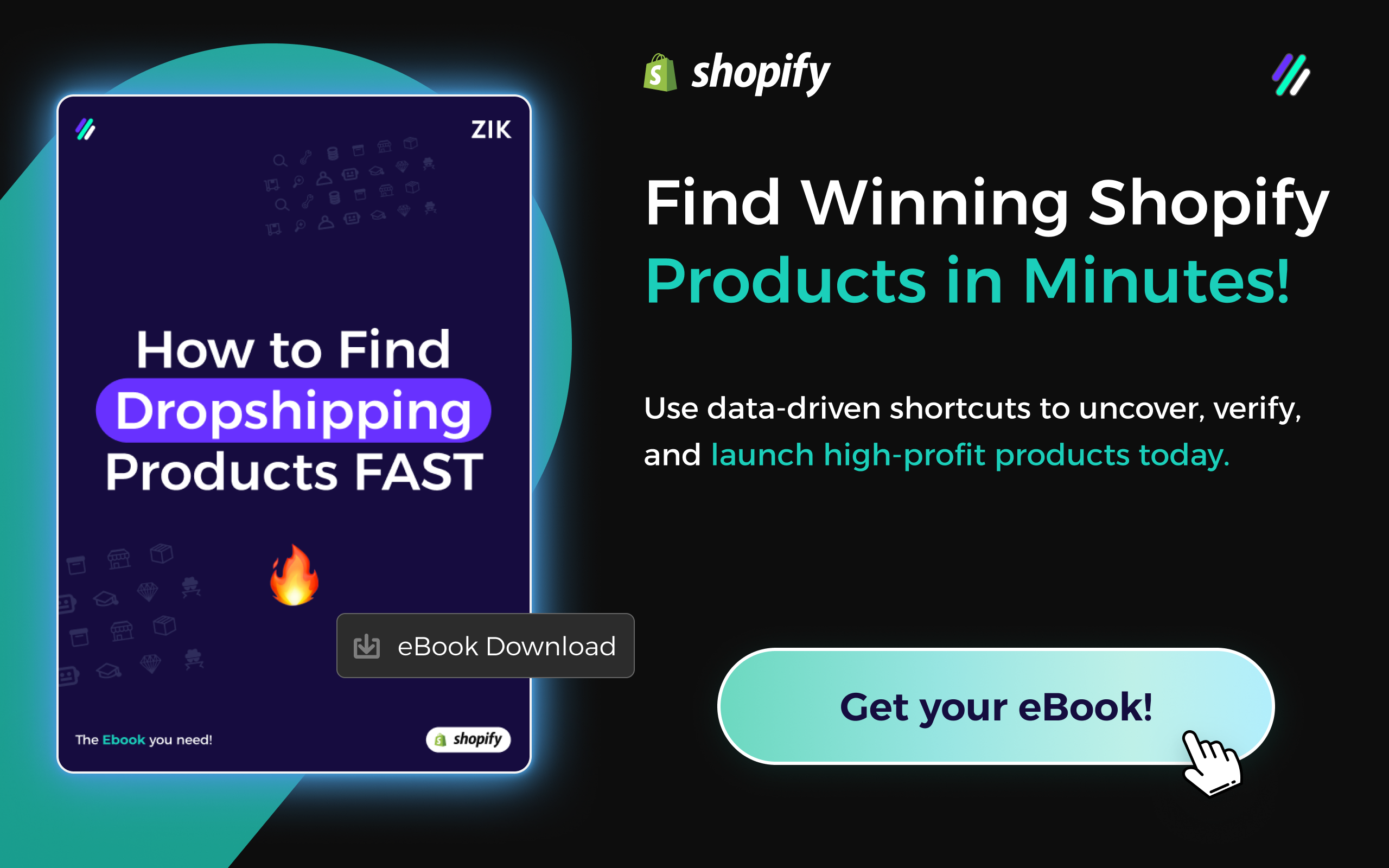
Yes, dropshipping in Canada is legal but subject to local and provincial regulations.
The main thing to know is that you must be registered as a business in Canada. Those registered as sole proprietors under their legal name are exempt, but any other business name requires registration with your provincial or territorial government.
You also need a GST/HST account with the Canada Revenue Agency once your revenue hits $30,000 in a single quarter or over four consecutive quarters. If you work with international suppliers, you must also account for import duties and taxes under CBSA rules.
Plus, Canadian law requires you to advertise with complete honesty and be transparent about dropshipping returns. Sending marketing emails or texts requires express consent from recipients under Canada’s Anti-Spam Legislation.
Canada also has strict privacy laws under PIPEDA that apply to how you collect and store customer data. And if you sell in Quebec, your website and all marketing materials must be available in French under the province’s bilingualism laws.
Is Dropshipping in Canada Profitable?
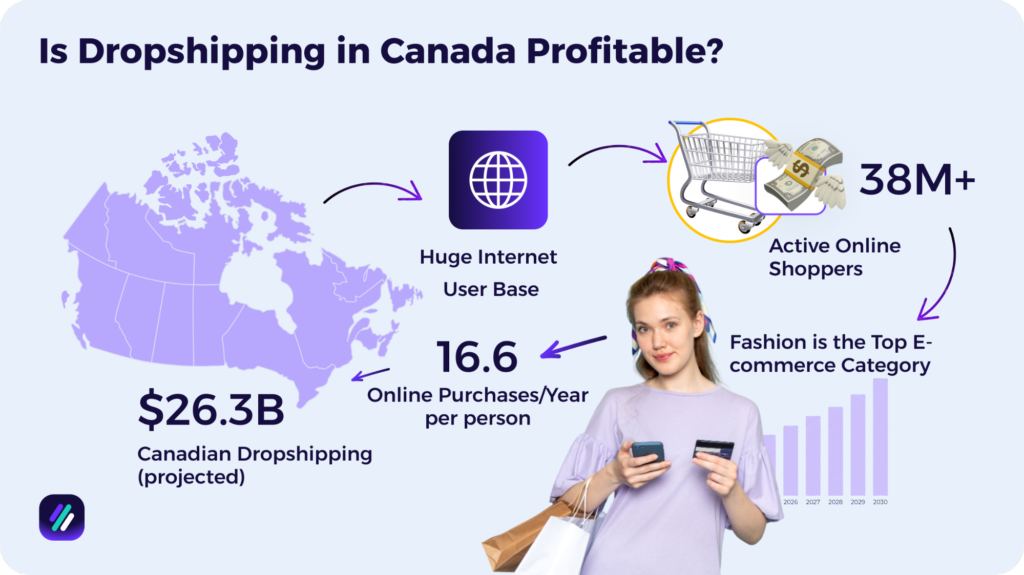
Yes, dropshipping in Canada can be highly profitable due to the growing local demand and a large base of active online shoppers.
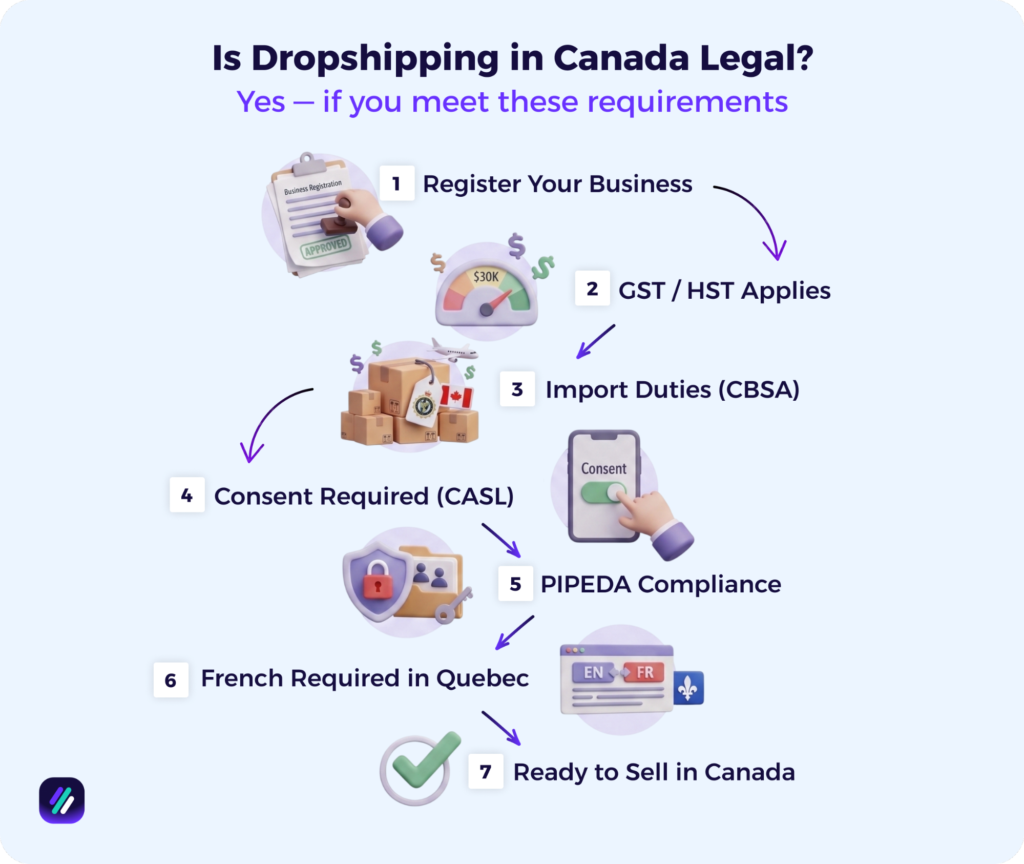
According to Grand View Research, the Canadian dropshipping market is projected to reach USD 26.3 billion by 2030. Driven by factors such as rising e-commerce adoption and mobile shopping, the market is expected to offer plenty of opportunities to new sellers.
Canada also has a high internet penetration rate of 95.2%, and there are over 38 million active online shoppers in the country. Focusing on this market now means you can benefit from a large number of people already shopping across e-commerce stores.
Moreover, fashion ranks as the top e-commerce category in Canada, and Canadians make an average of 16.6 online purchases per year. For a dropshipper selling accessories or apparel, that kind of buying frequency translates directly into repeat sales potential.
Pros and Cons of Dropshipping in Canada
Dropshipping in Canada comes with certain benefits and drawbacks that you must know about before you fully commit to selling there:
Benefits of Dropshipping in Canada
The main advantages of dropshipping to Canada include:
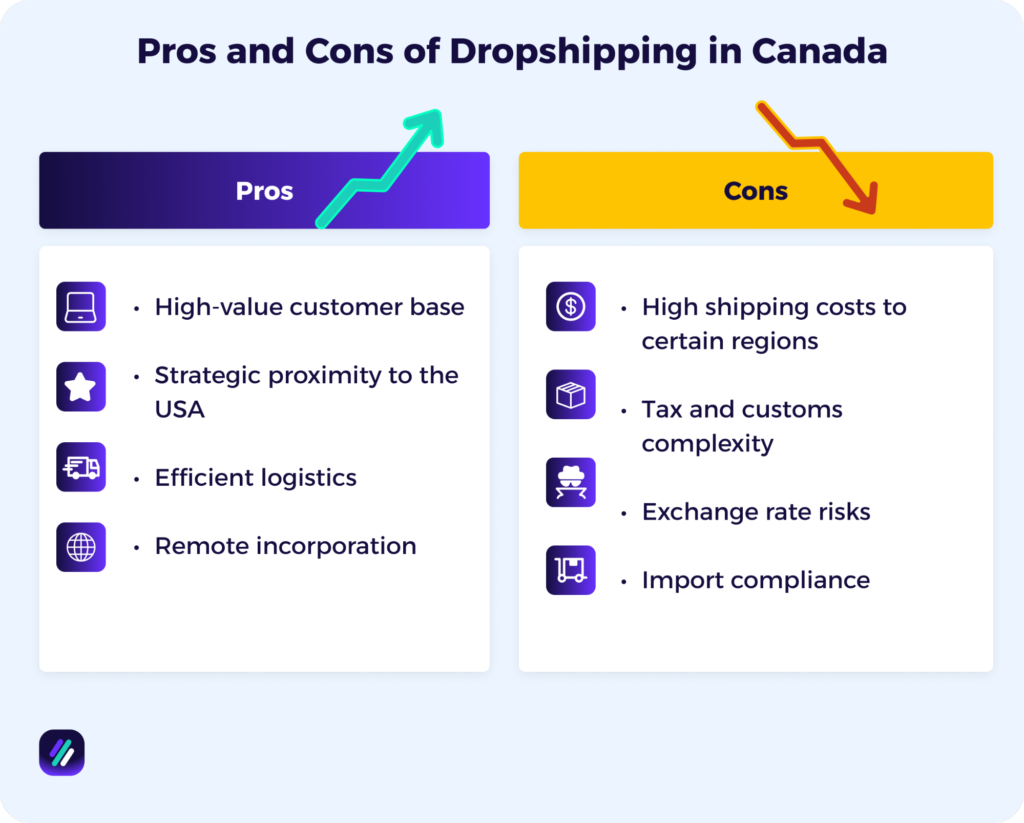
- High-value customer base: With more than 90% internet penetration, Canadians are known to be digitally savvy and comfortable making high-ticket purchases. This means you can see higher average order values even if you are only selling a few units at a time.
- Strategic proximity to the USA: If you plan to dropship to the United States in the near future, Canada can be your testing ground for product demand and marketing strategies. As both countries are located close to each other, many trends and buying behaviors tend to overlap, making it easier to scale into the U.S. market later
- Efficient logistics: Dropshipping to Canada also provides the opportunity to partner with local wholesalers for fulfilling your orders. Since the majority of your customers will be located within the country, it becomes easier to avoid customs and extra fees while improving the customer experience with faster shipping.
- Remote incorporation: You can register a business remotely as well as apply for a BN and related tax accounts online. For dropshippers, an Import-Export (RM) account is essential if you act as the importer of record for goods entering Canada.
Disadvantages of Dropshipping in Canada
But choosing to dropship in Canada also comes with a few drawbacks, including:
- High shipping costs to certain regions: Although you can expect to pay standard rates for shipping to major urban cities like Vancouver or Toronto, shipping to rural or remote provinces, such as the Territories or rural Atlantic Canada, can be expensive and a deal-breaker for new sellers.
- Tax and customs complexity: Canada requires sellers to follow local tax and customs regulations to avoid issues. Shoppers also expect GST/HST to be added at checkout rather than included in the base price, which can confuse international sellers targeting the Canadian market.
- Exchange rate risks: Unless you’re both buying and selling in USD, selling in Canada exposes you to exchange rate risks. Some ways to counter this are partnering with local wholesalers or accepting e-payments via a Canadian fintech.
- Import compliance: As you’ll be officially regarded as the importer of record, there’s a risk of your reputation getting damaged. If the supplier sends a forbidden or restricted item, it may be seized at the border, leaving you with a hefty loss and potential prosecution.
How to Start Dropshipping in Canada
Now that you know why people choose to dropship to Canada, here are the steps you can take to start with the same.
Step 1: Choose Your Niche
Before anything else, you need to choose a niche or product category that allows you gain traction in the Canadian market.
There are a few ways to do this:
- Research using Canadian data: The same tools you use for general product research can be used to find what Canadians are buying. For example, Amazon.ca’s best-sellers can tell you which products are selling the most in the local market, or use ZIK Analytics Market and Product Data insights.
- Evaluate trending product categories: Some product categories sell better than others in Canada. This year, people are expected to spend on eco-friendly goods, pet tech, home office accessories, beauty, and at-home wellness products.
- Account for the Canadian climate: Canada has long, cold winters and short summers. Keeping that in mind, cold-weather gear and thermal accessories are good examples of products that sell for a large part of the year.
Step 2: Find Winning Products
Since you will be a new entrant in the Canadian e-commerce space, you need to find ways to make a good first impression on your target customers.
One of the best ways to do that is to add winning products to your catalog. These are items that have proven themselves to be in demand and offer good margins on sales.
To find winning items:
- Track viral trends on TikTok: TikTok is a great place to spot rare and winning items before they get saturated. Using hashtags like #TikTokMadeMeBuyIt and #AmazonFinds, you can see which products are resonating with TikTok users right now. The TikTok Creative Center also lists products that are currently being advertised, along with data on how well those ads are performing.
- Check Amazon and eBay best-seller lists: Amazon Canada’s Movers and Shakers and eBay’s Trending Deals pages track items with the biggest gains in sales rank over the last 24 hours. Checking these regularly gives you a clear picture of where demand is shifting before it becomes obvious to everyone else.
- Analyze competitor stores: Whether manually or by using a tool like ZIK Analytics, you can dive into competitor data to see which items are selling and the average price others are charging for those products in the Canadian market.
- Analyze demand insights: With tools such as Google Trends and ZIK’s Shopify Market Insights, you can get an idea of the items gaining traction across eBay and Shopify. You can then cross-reference that data with your chosen niche to zero in on products worth adding to your store.
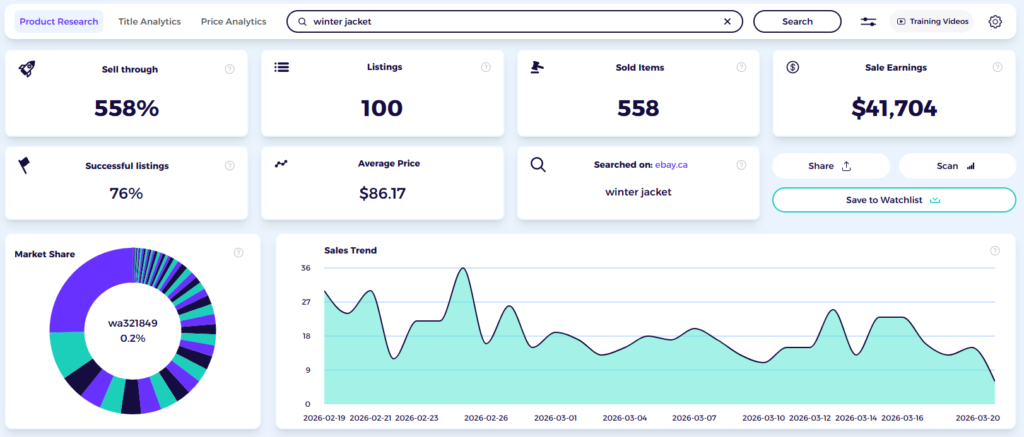
Once you have a product idea, enter it into ZIK Analytics to see if there is real demand for it.
Our tool pulls live data from eBay and Shopify to show you units sold, revenue generated, and sell-through rate.
You can also paste a competitor’s store URL to see their best sellers and match products with suppliers before you commit.
Step 3: Find Reliable Suppliers
Finding reliable suppliers is the most critical step in building a successful dropshipping business in Canada.
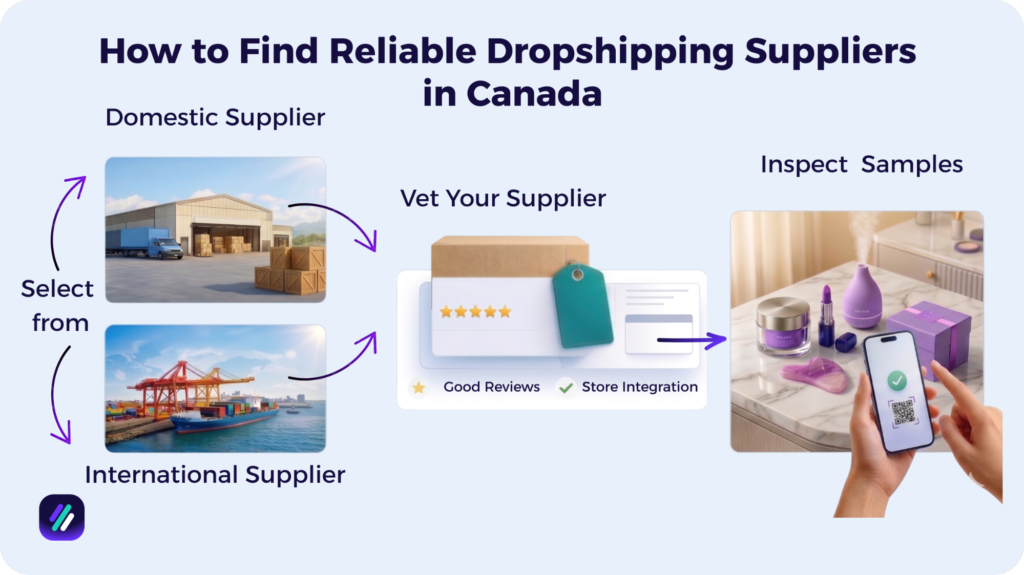
There are both domestic and international options available, with each offering specific advantages to merchants selling in Canada. Domestic suppliers offer fast 2-5 day shipping, whereas overseas suppliers offer lower per-unit costs along with a larger product variety.
You always want to find suppliers based on the products you have found and plan to sell.
You can find them via dropshipping directories, using the ZIK Analytics Item Finder to see available suppliers for the products you find, or by visiting dropshipping marketplaces such as AliExpress or Alibaba. Many sellers also use Alibaba to eBay software and AliExpress to eBay dropshipping software to connect suppliers with their eBay or Shopify dropshipping stores more efficiently.
Later, I will also recommend some of the best Canadian dropshipping suppliers to help you with that.
When choosing a supplier, make sure to check their reviews on platforms like Google Reviews and Trustpilot. Plus, see whether they integrate with your preferred e-commerce platform for automated inventory syncing.
Ordering samples is also mandatory before listing products in your store. It is the only way to accurately evaluate the entire customer experience. Check how the product arrives and whether the packaging reflects the standard your customers would expect.
Step 4: Register Your Business
Even though it is legal to dropship in Canada, you still need to register your business with the appropriate provincial or federal authority before you start selling.
The most popular business structure in Canada for new dropshippers is sole proprietorship. Sole proprietorship means you run the business under your own name and are personally responsible for any debts or liabilities.
You also need to register for a CRA Business Number, which acts as your federal ID for tax purposes. Once your revenue crosses CAD 30,000 in a single quarter or over four consecutive quarters, you are required to register for a GST/HST account.
There are service providers you can use to get this sorted for your business. Companies like Ownr facilitate online registrations of businesses across Canada. Some even offer legal services and automate the filing of taxes for their customers.
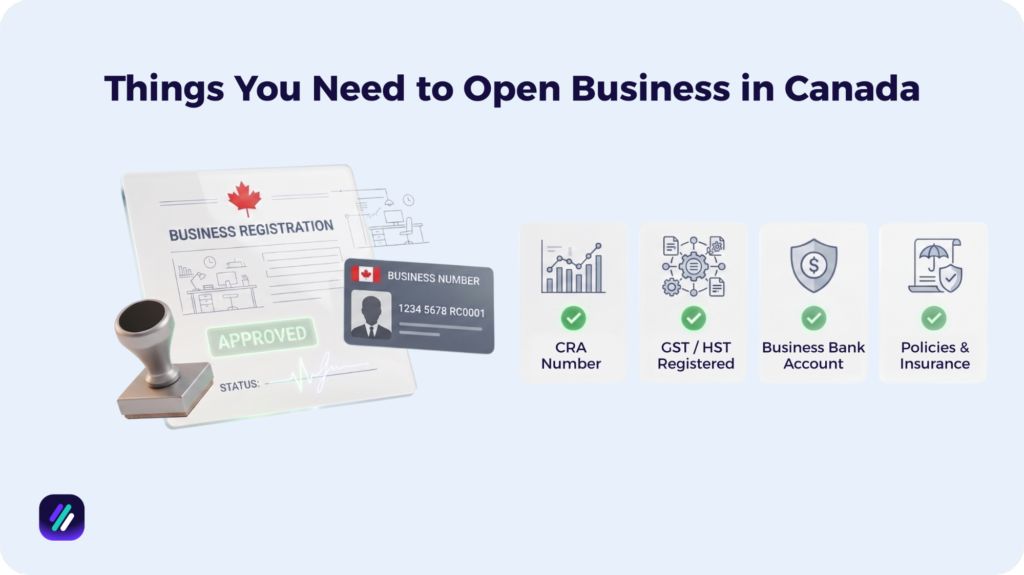
A few other things you’ll want to sort out early:
- Open a dedicated business bank account: A business account keeps your personal and business finances separate. Most Canadian banks offer business accounts that help you manage payments and build credibility with suppliers.
- Get product liability insurance: Product liability insurance protects you if a customer files a complaint or claim against a product they bought from your store. Even though you’re not managing the inventory, Canadian law still holds you accountable for what you sell.
- Set up a Privacy Policy and Terms of Service: Canada’s Personal Information Protection and Electronic Documents Act (PIPEDA) requires any business that collects customer data to have these pages on their site. Platforms like Shopify provide templates that make this straightforward to set up before you launch.
Step 5: Set Up Your Online Store
Now for the part that you have been waiting for: building your online store.
Setting up your store requires you to look into different platforms and see how you can configure things to improve the customer experience. For Canadian dropshipping, here are the steps you will need to work through.
- Choose an ecommerce platform suited for Canadian dropshipping: There is no shortage of dropshipping website builders out there, but Canada has a simple, home-grown option in the form of Shopify. Shopify gives you every tool you need to run your store and offers tons of dropshipping apps that make it easy to connect with suppliers and manage orders.
- Set up your essential store elements: These mainly include shipping and policy pages to help customers understand what to expect before they buy. Shopify offers templates you can customize to get these done quickly.
- Configure tax settings before launch: Canada’s tax system works by province, meaning the rate you charge depends on where your customer is located. GST applies federally, and some provinces charge their own HST or PST on top. Shopify can automatically handle these calculations in your tax settings, so once it’s set up, you don’t need to crunch the numbers.
- Set up a payment gateway that accepts CAD: Since Canadians prefer paying in Canadian dollars, you need a gateway that handles local currency without conversion fees. Shopify’s native payment gateway is one option, and PayPal and Stripe are others. All of these support CAD and are widely recognized by Canadian shoppers.
Step 6: Marketing Your Dropshipping Store
After creating your store, you need to find ways to get the word out about your business.
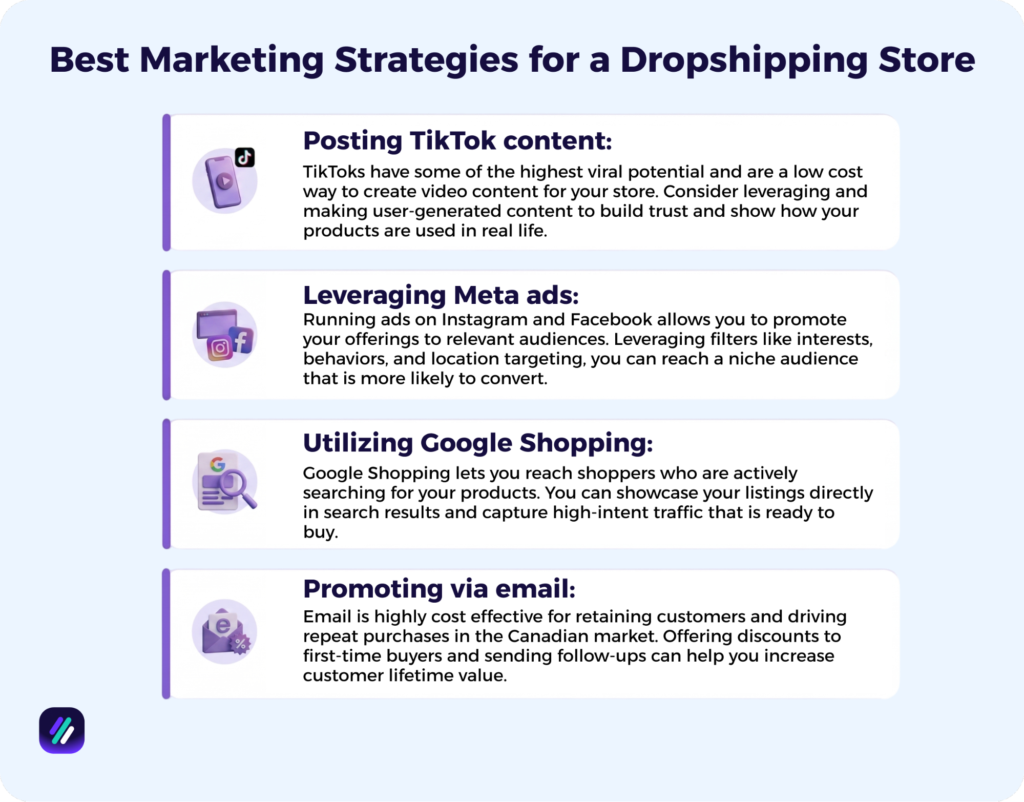
The most effective dropshipping marketing strategies include:
- Leveraging Meta ads: Running ads on Instagram and Facebook allows you to promote your offerings to relevant audiences. Leveraging filters like interests, behaviors, and location targeting, you can reach a niche audience that is more likely to convert.
- Posting TikTok content: TikToks have some of the highest viral potential and are a low cost way to create video content for your store. Consider leveraging and making user-generated content to build trust and show how your products are used in real life.
- Utilizing Google Shopping: Google Shopping lets you reach shoppers who are actively searching for your products. You can showcase your listings directly in search results and capture high-intent traffic that is ready to buy.
- Promoting via email: Email is highly cost effective for retaining customers and driving repeat purchases in the Canadian market. Offering discounts to first-time buyers and sending follow-ups can help you increase customer lifetime value.
Step 7: Scaling Your Store
Once your store generates a few sales, start thinking about the steps you can take to grow it into something bigger.
These might include expanding your ad spend on products that are already selling, or testing retargeting campaigns on Meta and TikTok to bring back visitors who did not buy the first time.
Investing in dropshipping automation with tools like DSers or AutoDS can also free up time by handling inventory syncing and order processing on your behalf.
Moreover, building out your brand through custom packaging and original photography can help turn one-time buyers into repeat customers.
Best Products to Dropship in Canada
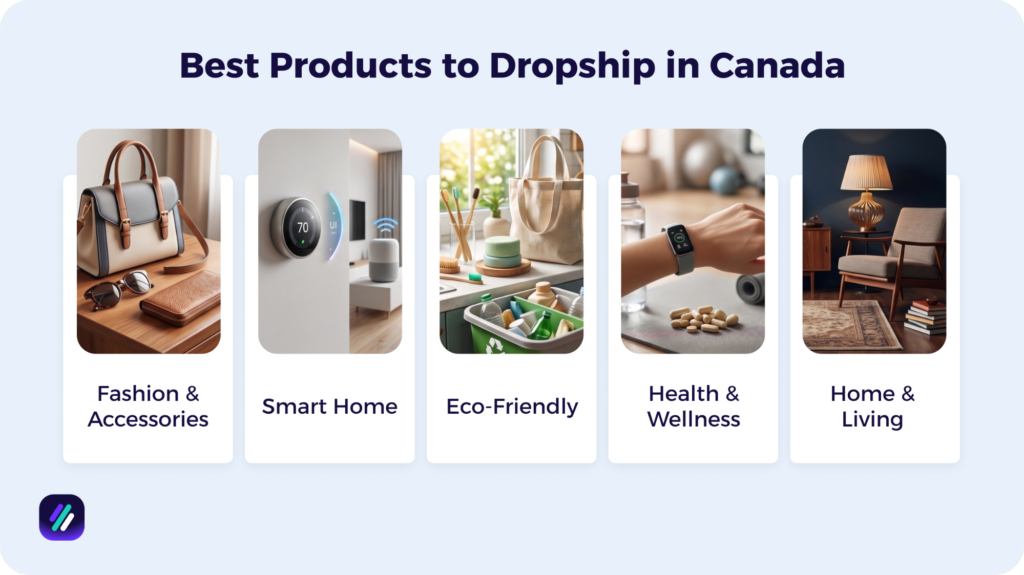
In this section, I’ll list some dropshipping niches that are sure to bring you profits when dropshipping in Canada. I’ll also list a few items you’ll want to avoid to stay compliant with local regulations.
Eco-friendly and Sustainable
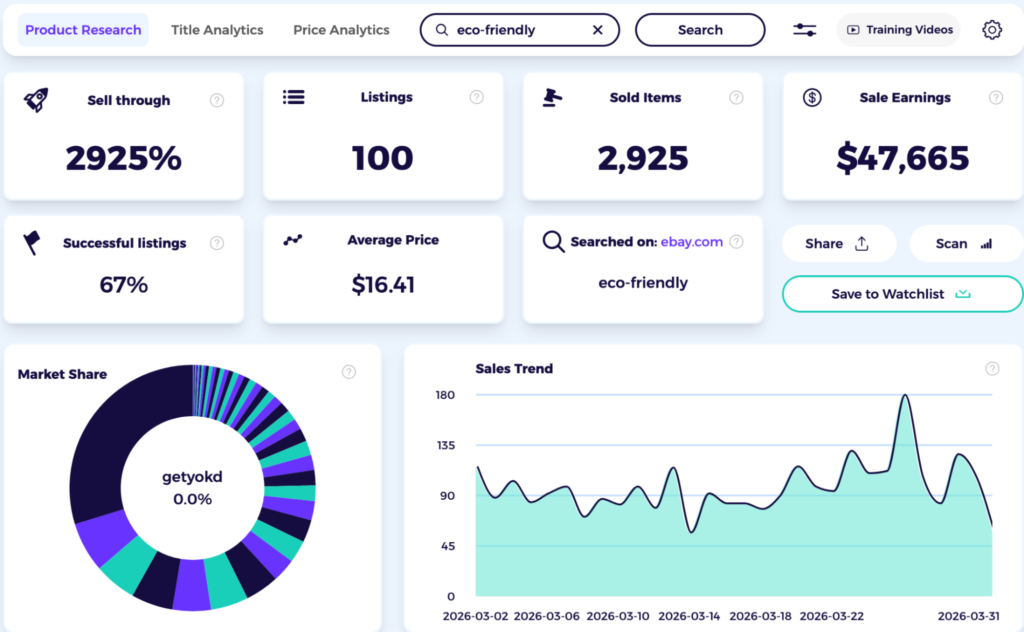
If you are looking for a niche with long-term potential, consider eco-friendly and sustainable products. ZIK’s data shows 2,925 sold items generating $47,665 in sale earnings across 100 listings, with a 67% successful listing rate. With these numbers and8 in 10 Canadians valuing a sustainable lifestyle, selling items like reusable food wraps and bamboo kitchenware can help you build a store that attracts local buyers.
Health and Wellness
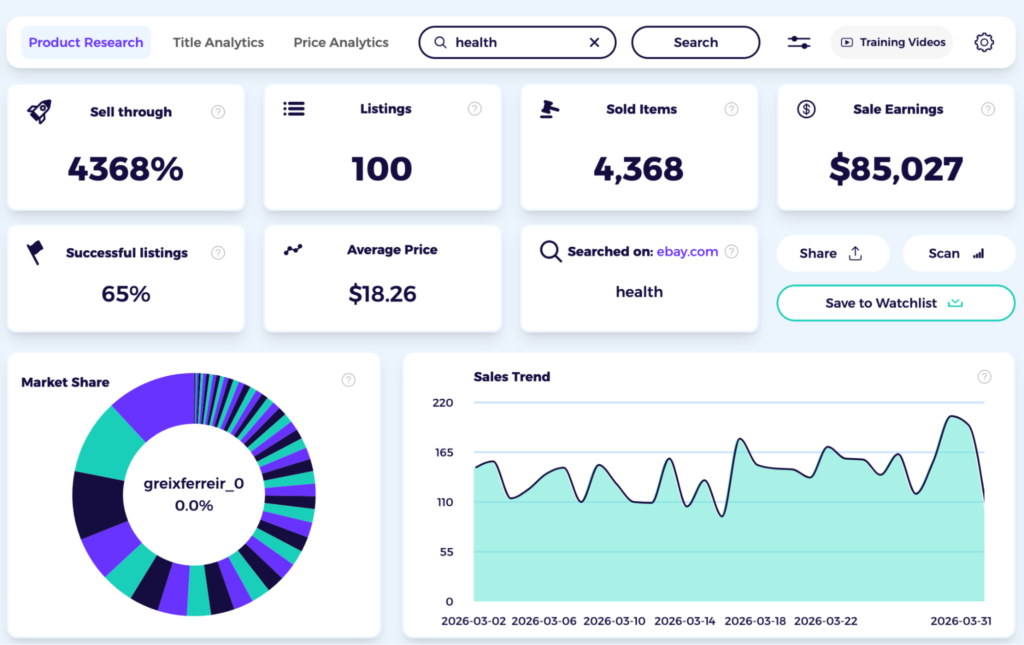
Canadians aged 55 and above are maintaining or increasing their health and wellness spending, with 90% saying this is one of the last areas they would cut back on. ZIK’s data backs this up, showing 4,368 sold items and $85,027 in sale earnings across 100 listings. Adding items like yoga mats and massage guns to your catalog can help you attract a demographic that spends freely in this category.
Smart Home
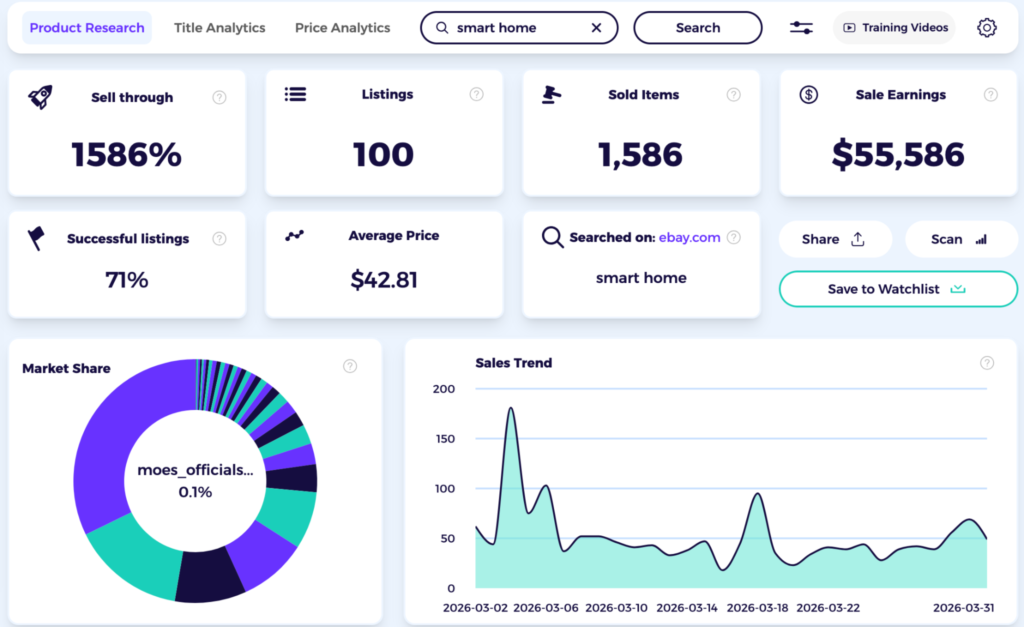
Smart home and IoT products are a growing category in Canada, with the market valued at USD 5 billion. ZIK’s data shows 1,586 sold items generating $55,586 in sale earnings across 100 listings, with a 71% successful listing rate. From smart thermostats and security cameras to automated home lighting, there are plenty of items you can sell from this category to cater to Canadian homeowners.
Fashion & Accessories
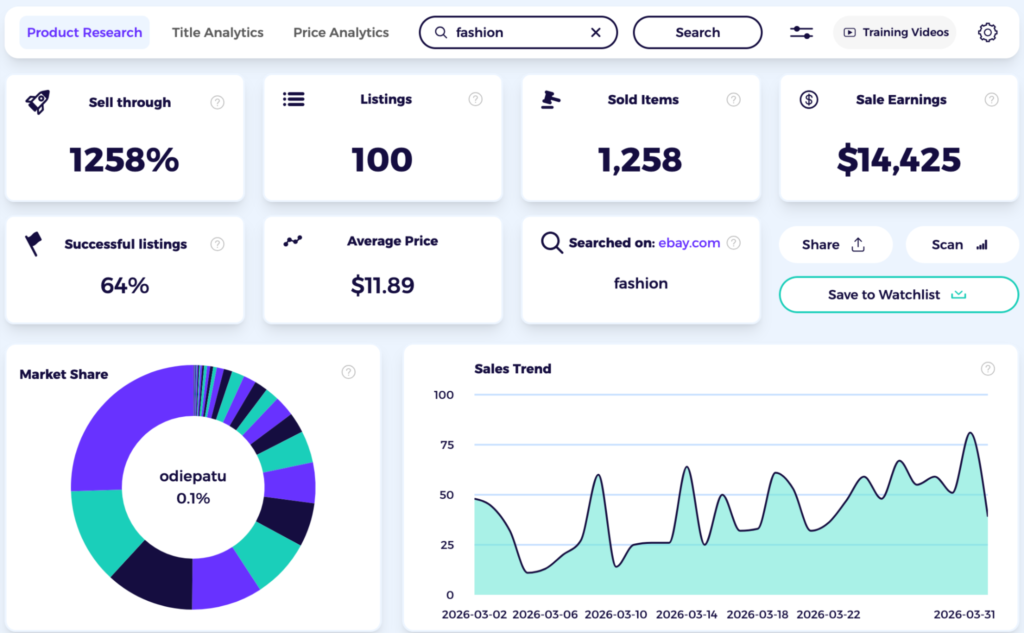
Fashion to Canadians is like coffee to mornings. The average Canadian household spends $2,739 on clothing and accessories a year, and ZIK’s data shows 1,258 sold items generating $14,425 in sale earnings across 100 listings. Having a fair selection of styles in your catalog is a solid way to appeal to buyers across different tastes and budgets.
Products to Avoid
Not all products are a good fit for Canadian dropshipping. Here are some categories to stay away from and why:
- Regulated health and electronic items: Products like children’s toys and medical electronic devices have to meet strict requirements set by Health Canada and ISED. If you dropship items without the required certifications, you risk shipments getting held at customs or facing legal action.
- Generic products: Items like basic phone cases and plain t-shirts are already being sold by a lot of stores in Canada. Dropshipping these won’t provide much benefit much as the margins are thin and the competition makes it hard to get noticed.
- Counterfeit or liability items: Selling knockoffs of well-known brands is illegal and can get your store shut down in Canada. Avoid these products and vet any supplier you work with to make sure their catalog is legitimate.
Best Canada Dropshipping Suppliers
Many dropshipping suppliers offer the option to dropship products to Canada. But you’ll want to partner with someone who’s reliable and can offer high-quality items for your store.
Here is a list of some local and international suppliers that you can use for dropshipping.
DropCommerce
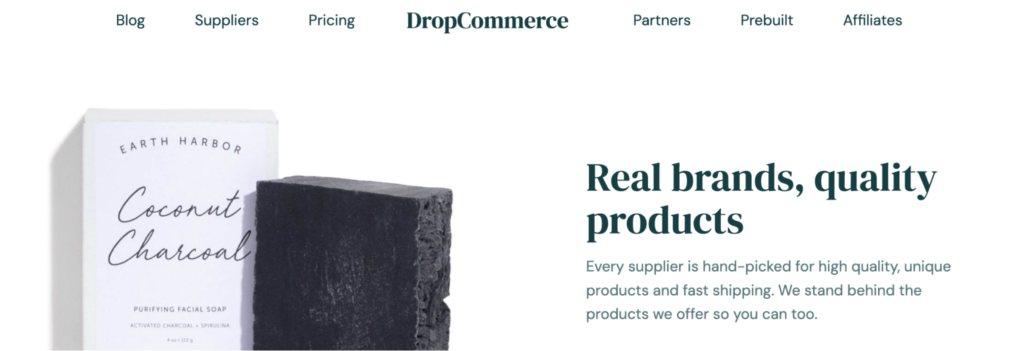
DropCommerce specializes in curated, high-quality products from over 400 North American suppliers. This platform provides 3–5 day shipping within North America and a guaranteed 30% dropshipping high profit margin for retailers.
Wordans

Wordans is a leading Canadian clothing wholesaler that provides dropshipping for blank apparel like t-shirts and hoodies. It has multiple distribution centers across Canada, allowing it to provide supplies for clothing products across the country
Modalyst
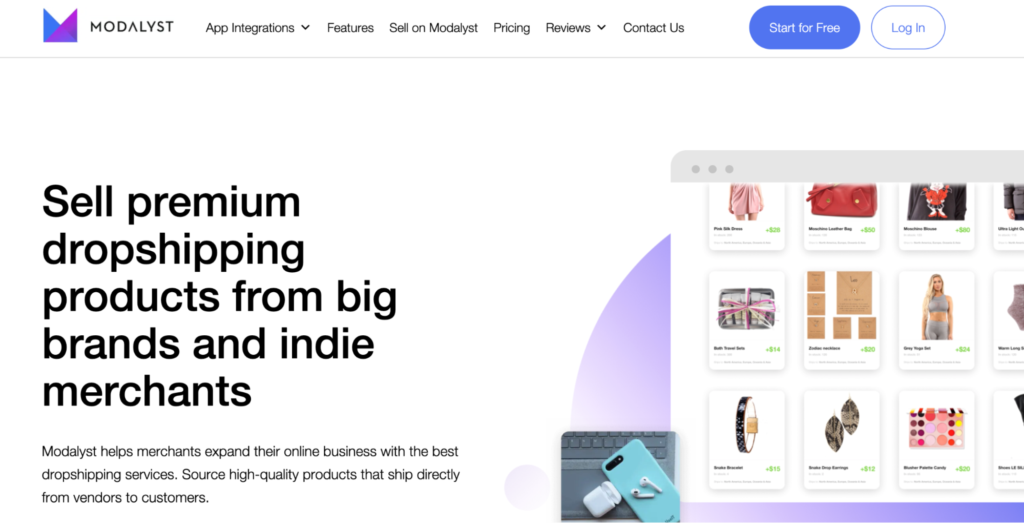
Modalyst is a reliable dropshipping supplier that connects directly to e-commerce platforms such as Shopify. Its inventory consists of US-made and European products, which typically pass through Canadian customs faster and arrive earlier than direct-from-China items.
Spocket
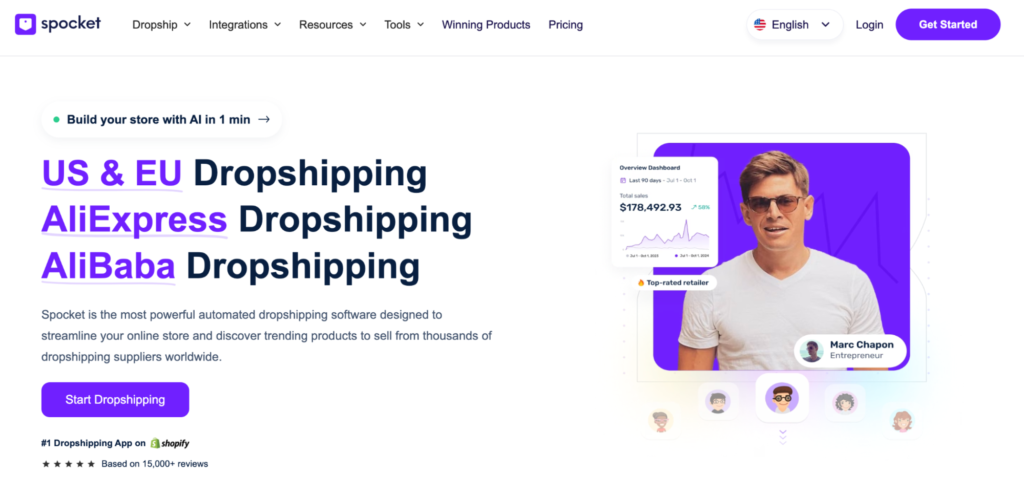
Spocket is a top choice for Canada because it lets you filter for suppliers in the same country or the USA. This ensures faster shipping times (often 2-5 days) and vetted, higher-quality products that help build trust with Canadian customers.
CJ Dropshipping
CJ Dropshipping is a major international supplier with warehouses across different corners of the world. It offers fast shipping options and is the ideal supplier for dropshipping electronics, furniture, home goods, and other items to Canada.
Find Winning Dropshipping Products in Canada with ZIK Analytics
ZIK Analytics has a suite of tools to help you find and validate winning products for the Canadian dropshipping market.
However, I want to highlight three tools that make product research for Canadian dropshippers easier:
- Shopify Product Finder is your dropshipping product research tool for finding which products are selling across Canadian Shopify stores. Search keywords and filter by sales to identify trending items that resonate with Canadian buyers.
- Shopify Store Finder acts as your dropshipping database for discovering successful Canadian dropshipping stores. Filter by country, revenue, and marketing channels to find stores worth analyzing.
- AdSpy Tool shows you which ads competitors are running for Canadian markets on Facebook and Instagram. Filter by country to see campaigns targeting Canada and save winning ads for reference.
You can also use the Shopify Sales Tracker to monitor successful Canadian stores and the ZIK Analytics AliExpress image search tool to match products with suppliers that offer fast shipping to Canada.
Get your ZIK Analytics trial today and start finding products that sell in the Canadian market.
Frequently Asked Questions About Dropshipping in Canada
In this section, I’ll answer the questions people frequently ask about dropshipping in Canada.
Is Canada good for dropshipping?
Yes, Canada is an excellent market for dropshipping. Canadians increasingly shop for things online and have high disposable income, making them a lucrative audience to target. The availability of reliable couriers like Canada Post also means that your products reach customers on time and in good condition.
Is it legal to do dropshipping in Canada?
Yes, it is legal to dropship in Canada as long as you comply with local regulations. These include registering your business at a provincial or federal level and obtaining a Business Number from the Canada Revenue Agency (CRA). Additionally, you must collect GST/HST and adhere to Canadian consumer laws regarding product safety and shipping times.
What is the best dropshipping platform in Canada?
The best dropshipping platforms for Canada are Spocket and CJ Dropshipping. Spocket excels with US/Canadian suppliers for fast shipping, whereas CJDropshipping provides diverse, low-cost options with fast logistics. For print-on-demand (POD) within Canada, Printful is considered the leading choice.