
Ask ten people, "Is dropshipping worth it?" and you get two answers, both wrong. One camp posts the laptop-on-a-beach screenshot and promises easy money by next month. The other camp swears the whole model is dead, saturated, and a scam. Neither is honest, and neither helps you decide whether it fits your money, your time, and your risk tolerance.
In this article, I am going to walk through what dropshipping actually costs, where the profit really comes from, who it suits, and how to test the idea with data before you risk a cent.
Key Takeaways
-
Dropshipping is worth it for sellers who treat it as a genuine business, not a shortcut. The low upfront cost is genuine, but so is the daily work behind every order.
-
Your profit is the gap between what the customer pays and what the supplier charges, minus platform, payment, and ad fees, so thin-margin products rarely justify the effort.
-
The gap between a good pick and a poor one is wide. Across 390,305 exact Amazon-to-eBay product matches in ZIK's index, a quarter sell for at least double their source price while one in eight sells for less than it costs, and which of those you end up with is decided before you list.
-
It suits people with a small testing budget and patience far more than anyone chasing fast or passive income.
-
Most new businesses do not survive their first few years, and dropshipping is not exempt, so validating demand before you list is what separates a genuine income from an expensive hobby.
-
You can de-risk the whole decision with data: the eBay Product Research Tool shows sell-through rate, sold counts, and average price, so you back products buyers already want instead of guessing.
Is Dropshipping Worth It?
Dropshipping is worth it if you treat it as a genuine business you build over months, not a passive-income hack. For sellers who validate demand, protect their margins, and handle customers well, it pays. For anyone expecting fast, hands-off money, it does not.
The opportunity itself is genuine. The global dropshipping market is projected to reach roughly $1.25 trillion by 2030, at a 23.4% growth rate, according to Grand View Research. So demand is not the problem, and the low barrier to entry is not a myth either.
But here is the honest part. The same low barrier that lets you start also lets everyone else start, which is why so many stores never make a second sale. Whether dropshipping is worth it comes down to what you bring to that crowded field, not whether the field exists.
What It Actually Costs to Start Dropshipping
Here is the part the beach-laptop crowd skips: dropshipping is cheap to start and not cheap to run well. You avoid buying inventory upfront, which is the genuine advantage, but "no inventory" is not the same as "no cost."
Now, the good news is that most of these costs are things you control. You can start small, keep your test budget tight, and scale spending only after something proves it sells. If you are working with very little, our guide on starting with almost no budget walks through the leanest version.
Here is how the main starting costs break down, and where you can keep them low while you test:
| What you are paying for | Typical commitment | Can you start small? |
|---|---|---|
| Selling platform fees | Marketplace final-value fees on eBay, or a monthly plan plus transaction fees on Shopify | Yes on eBay, where fees are pay-as-you-sell. A Shopify store adds a monthly plan before your first sale |
| Product testing | A few sample orders so you know what the customer actually receives | Yes, test two or three products before committing to a niche |
| Advertising | Promoted listings on a marketplace, or paid social traffic for a store | Yes, small daily budgets are enough to read early signals |
| Research tools | A product-research subscription so you are not guessing what sells | Yes, ZIK Analytics offers a $1 trial (7-day) to validate before you spend on ads |
So the honest number is a range you decide, not a fixed figure, and the sellers who stay in profit are the ones who spend on testing and research first, and on scaling second. If you want the full setup path, our walkthrough on setting up a dropshipping business step by step covers each step in order.
Is Dropshipping Profitable? Where the Money Actually Comes From
Dropshipping can be profitable, but the profit lives in the margin, not the sale price. After supplier cost, platform and payment fees, ad spend, and refunds, only well-chosen products with room to spare actually clear a worthwhile profit.
Most guides answer this with a tidy margin percentage. But the honest answer is that your margin is whatever survives after the fees, and on the wrong product, that is close to nothing.
So the sale price is a distraction. What matters is the money left over once everything the sale costs you has been paid.
Rule of thumb: your profit is what the customer pays, minus the supplier cost, minus platform fees, payment processing, ad spend, and any refunds. If two of those move against you at once, a "good" margin turns into a loss.
We can measure that gap. ZIK's index tracks the Amazon listings that match products already selling on eBay, and across 390,305 exact matches checked in the four months to September 2026, the distance between a good pick and a poor one is wider than most sellers expect:
| Out of 390,305 matched products | Share |
|---|---|
| Sell on eBay for at least double the source price | 24.9% |
| Clear $10 or more gross, before fees | 40.7% |
| Sell for less than they cost to source | 12.1% |
The median match carries $7.59 of gross spread and the top quarter carries $23.12, so the same catalogue holds products that pay properly and products that lose money on every order. Those are gross figures: eBay's final value fee, payment processing, shipping, and any return all come out before you keep anything, which is worth running through an eBay fee calculator on your own shortlist.
One caveat on that set. These are matches ZIK's engine surfaces as candidates, not a random sample of Amazon, so they sit at the better end of what is available. Even there, one in eight is underwater, which is the clearest evidence of how much the picking matters.
Keep in mind that product choice decides profitability more than anything else. A $12 gadget with a $9 supplier cost cannot absorb fees and a single return. A well-chosen product with room in the margin can. That gap is the whole game, and it is why chasing high-margin products beats chasing whatever is trending this week.
From our in-house dropshippers at ZIK, the sellers who last are the ones who treat margin as a rule they enforce, not a number they hope for. They set a minimum profit per order before they list, and they walk away from products that cannot clear it.
Who Dropshipping Is Worth It For (and Who Should Skip It)
So who actually gets their money's worth from dropshipping? It is less about experience and more about temperament and expectations. The model rewards patience and testing, and it punishes people who need money by Friday.
Here is how it lands for four common seller types, and what a smarter first move looks like for each:
| Seller profile | Is it worth it? | Smarter first move |
|---|---|---|
| The tester with a small budget and patience | Worth it, this is the profile the model actually fits | Validate two or three products with data, then commit to one niche |
| The seller chasing fast or passive income | Rarely worth it, the timeline and the daily work rule it out | Read an honest breakdown of whether it is really passive income before investing |
| The existing eBay or retail seller | Often worth it, you already understand listings, fees, and customers | Add dropshipped products to a channel you already run |
| The brand builder who wants control of product | Worth it only as a testing phase | Use dropshipping to validate demand, then move to private label |
Based on our eBay sellers at ZIK, the people who get their money's worth are rarely the ones chasing a trend. They pick a niche they can research, they check demand before they list, and they treat the first few months as tuition. If you are still choosing a lane, our roundup of the best niches to focus on is a practical place to start.
How to Test Whether It's Worth It Before You Risk a Cent
Now that you know who it suits, the smart move is to test the idea with data before spending on inventory or ads. This is the step that separates sellers who make dropshipping worth it from the ones who quit. We will keep it to four steps, and each one builds on the last.
Start with demand, not a product you like
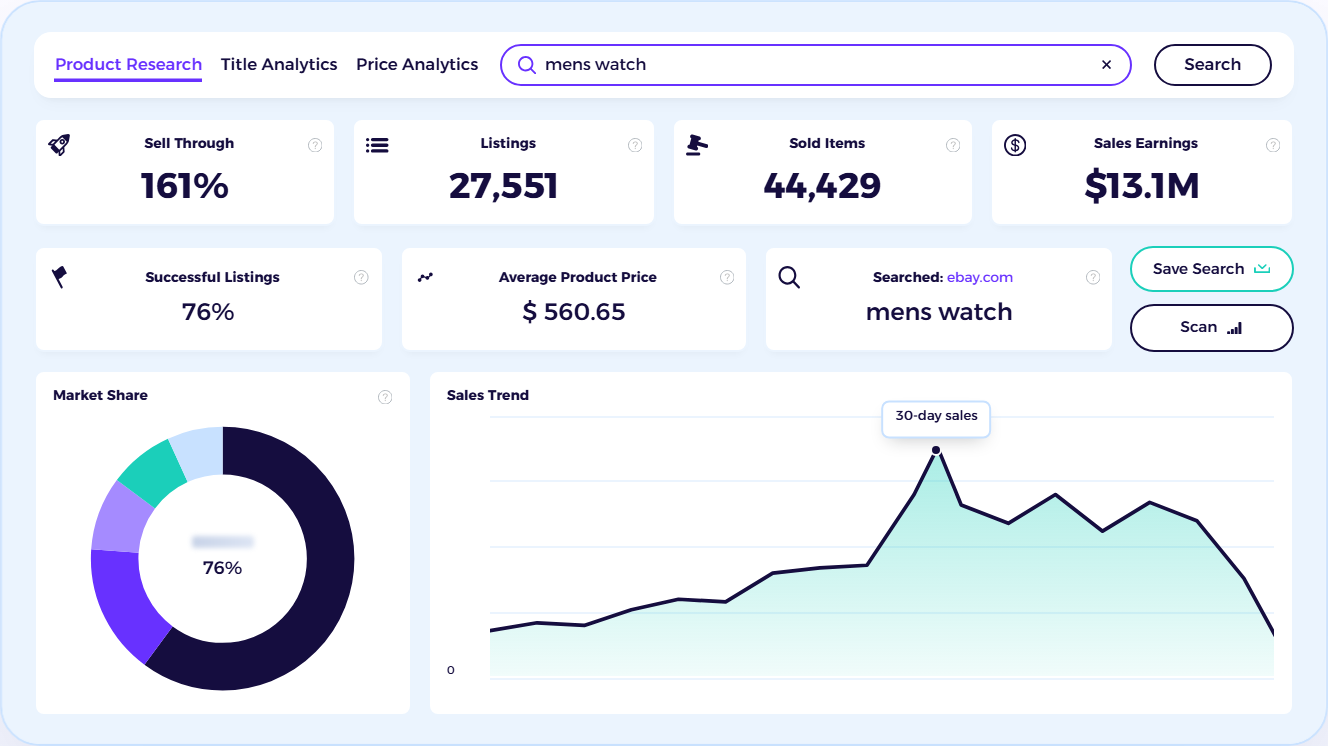
Before anything else, we confirm that buyers are already spending on the product. With the eBay Product Research Tool you can see sell-through rate, how many units actually sold, and the average selling price for a keyword. A practical rule for beginners is to look for items with at least two sales in the last seven days and no more than about five competitors, so you know demand is genuine and the listing is not drowning in sellers.
Size up who you are up against
Once a product shows demand, we look at the competition. The eBay Competitor Research Tool shows seller-level metrics for any store: their sell-through rate, feedback, average price, active listings, and total items sold over recent periods. Keep in mind it reports how a seller performs overall, not the item specifics inside each individual listing, so use it to judge whether strong sellers already own the niche.
Match a supplier and run the margin
As we covered in the costs section, the product only works if the numbers work. The Dropshipping Product Finder matches products to suppliers on Amazon, Walmart, and AliExpress and shows the margin, so you confirm actual profit before you list. For a deeper method, our guide on how to find winning products breaks the filtering down.
Where you source from moves the odds as well. Across 4.4 million dropshipped US eBay listings in our index in September 2026, Amazon-sourced listings sold at least one unit in 79.4% of cases over 30 days and averaged $112.89 in 30-day revenue. Walmart-sourced came in at 73.9%. AliExpress-sourced managed 47.9% and $34.83, close to what a listing with no supplier match behind it does. Slower delivery is the usual explanation, and it shows up in the sales figures, not only in the feedback.
Test small, then decide
With demand, competition, and margin checked, we list a small batch and watch what happens for a week or two. Actual orders tell you what any forecast cannot. If it sells at the margin you planned, it is worth scaling. If it does not, you are out the cost of a test, not a warehouse.
Why Dropshipping Isn't Worth It for Most People
Most people who quit dropshipping did not fail because the model is broken. They failed because they skipped the boring parts.
The odds are steep. Around half of new US businesses close within five years, and only 34.7% of establishments born in 2013 were still operating a decade later, according to the US Bureau of Labor Statistics. Dropshipping is not exempt from those odds.
Our index shows the same shape at the listing level. Of those 4.4 million dropshipped US eBay listings, 21.5% sold nothing over 30 days and another 64.8% sold one or two units. A further 11.4% sold between three and nine, and the 2.2% that moved ten units or more took 20.7% of all the 30-day revenue in that group. The useful part is what separates those groups, because it is not budget and it is not luck. It is whether the product was checked before it went live.
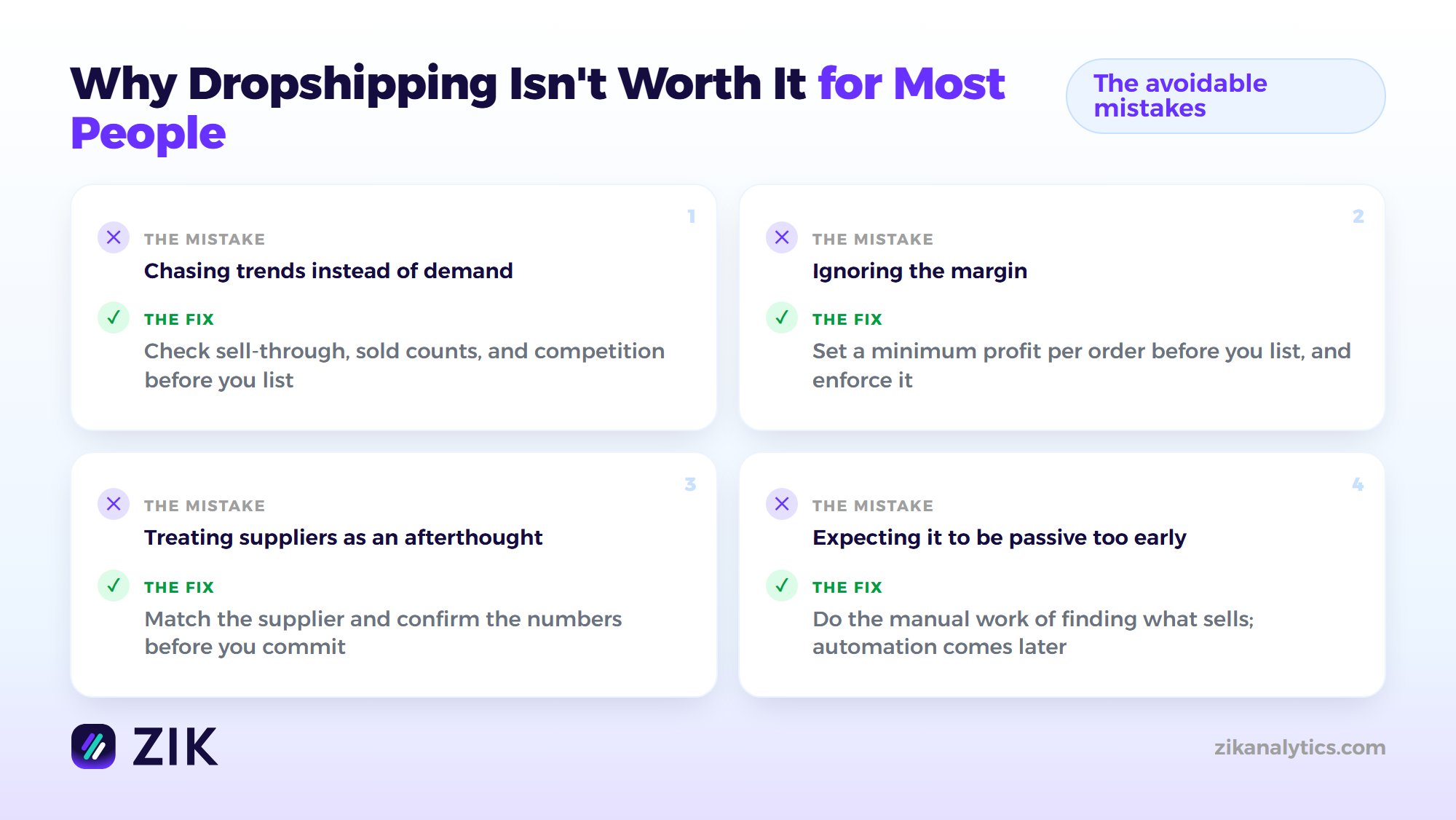
I hate to break it to you, but the version where you add a few products and wake up to money does not exist. The reasons it does not work usually come down to a short list of avoidable mistakes:
- Chasing trends instead of demand: a product that is everywhere on TikTok this week is often saturated by the time you list it (do you remember when everyone was selling the same fidget spinner?).
- Ignoring the margin: selling more units at a loss is not growth, and it is the fastest way to run out of money.
- Treating suppliers as an afterthought: slow shipping and stockouts create refunds and bad feedback, which quietly kill a new store.
- Expecting it to be passive too early: the automation comes later, after you have done the manual work of finding what sells.
From our team at ZIK, the most common reason sellers quit is simple: they skip the validation step and bet on a guess, the exact check the eBay Product Research Tool is built to make quick. If you are weighing the darker headlines, it is worth reading a grounded take on whether dropshipping is dead and whether it is really a scam, because the honest answer to both is more useful than the panic.
Conclusion
So, is dropshipping worth it? For the right person, with the right expectations, it genuinely is, and the market is large enough that a well-chosen niche still has room. The model has not stopped working. What has changed is that the easy version, where you list random products and hope, stopped working a long time ago.
The sellers who make it worth it are not the ones with the biggest budget. They are the ones who validate demand, protect their margins, and treat the first months as a learning cost rather than a payday. If that sounds like more work than the thumbnails promised, that is exactly the point, and it is also why the people who do it well still profit while most give up.
You can start with one product you can actually research. Proving it sells before you spend on ads is what turns a gamble into a plan. The data to make that call is available, and using it is the difference between a guess and a decision.
Start Dropshipping the Smart Way with ZIK Analytics
The fastest way to make dropshipping worth it is to stop guessing and start validating. With the eBay Product Research Tool you can see what is actually selling right now, checking sell-through and sold counts before you commit, and it comes as part of ZIK's eBay dropshipping software.
From there, you can match those winners to suppliers with the Dropshipping Product Finder and a set of proven AI-powered research tools, so the margin is confirmed before you list. And when you are ready to scale, ZIK Autopilot and its automation tools surface supplier-matched winners so research stops eating your day. Start your $1 trial (7-day) and see what is genuinely selling before you risk a cent.
Dropshipping FAQs
A few quick answers to the questions sellers ask most when deciding whether dropshipping is worth their time and money.
Is dropshipping still worth it?
Yes, dropshipping is still worth it for sellers who validate demand and protect their margins, and the market is still growing. What no longer works is listing random products and hoping. The sellers who profit today research what sells, choose products with room in the margin, and treat the first few months as a testing phase.
How much money do I need to start dropshipping?
You can start with a small budget because you do not buy inventory upfront. Your genuine costs are platform fees, a few sample orders, a modest ad budget, and a research tool. The smarter approach is spending on testing and validation first, then scaling ad spend only once a product proves it sells at your target margin.
Is dropshipping worth it for beginners?
It can be, especially on eBay, where marketplace traffic and buyer trust already exist. Beginners do best when they validate demand with data instead of guessing, and our latest dropshipping statistics breakdown shows how much the model has matured. Checking sell-through and competition before listing removes most of the early guesswork that causes new sellers to quit.
Can you still make good money dropshipping?
Yes, but the money comes from margin and volume on well-chosen products, not from any single viral win. Profit is what remains after supplier cost, platform and payment fees, ad spend, and refunds. Sellers who set a minimum profit per order and enforce it are the ones who keep the good months from being erased by the bad ones.
The spread is wide enough to decide the answer for you. In ZIK's index, a quarter of exact Amazon-to-eBay matches sell for at least double their source price while one in eight sells for less than it costs, so the money comes from which products you choose, not from how many you list.
Is eBay or Shopify better for dropshipping?
For beginners, eBay is usually the easier start because demand and buyer trust already exist, so you can validate products without paying for traffic. Shopify gives you more control and branding but requires you to drive your own visitors. Many sellers test on eBay first, then expand to a store once a niche proves it sells.