
Most content about dropshipping passive income gets it wrong in one of two ways.
One side sells the beach laptop thumbnail version: build a store, add a few products, wake up to money.
The other side says dropshipping is dead, impossible, or basically a scam.
Neither version is useful or true, and in this article, I am going to share with you what you should expect from dropshipping and how passive it actually can become.
Key Takeaways
- Dropshipping is not fully passive, but it can become semi-passive with systems, automation, and delegation.
- Most beginners start with active work: product research, supplier checks, customer support, refunds, and pricing decisions.
- The honest passivity ceiling is usually around 65% to 75% after strong automation and delegation.
- SOPs are essential because they make tasks easier to automate, outsource, and improve over time.
- eBay can be easier than Shopify for beginners because demand, trust, and marketplace traffic already exist.
Is Dropshipping Passive Income Possible?
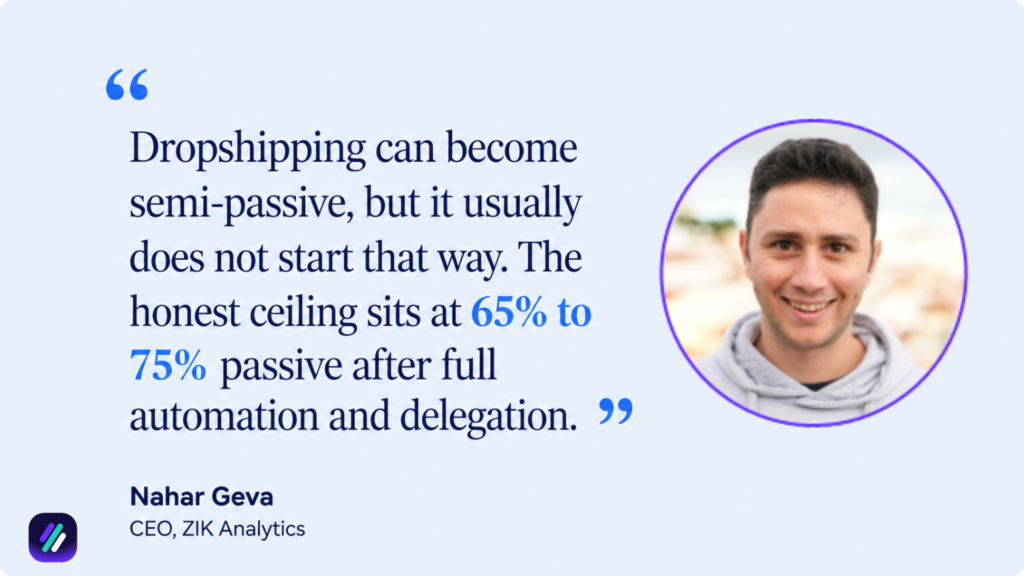
Yes, dropshipping can become semi-passive, but it usually does not start that way.
In the beginning, you are still choosing products, checking suppliers, fixing listings, handling refunds, answering customers, watching margins, and everything in between, and it takes 12 to 24 months of front-loaded work into the right systems before it shows up.
The passive part only grows once those repeatable tasks are handled by systems, automation, SOPs, and eventually, people that you hire.
From our customers at ZIK, we usually see that the honest ceiling sits at 65 to 75% passive after full automation and delegation.
The other 25 to 35% is the part nobody films for YouTube: supplier vetting, ad performance review, the judgment calls automation can’t make for you.
So the better question is not “Can dropshipping be passive?” It is: how much of the work can you remove from your day-to-day without losing control of the business?
At the end, very few businesses are passive in nature.
What is Passive Income?
Passive income is income that keeps coming in with little to no ongoing labor after the initial setup.
Wikipedia defines it as income acquired with “little to no labor” to earn or maintain, with examples like rental income, business activities where you do not materially participate, and investment income such as dividends or interest.
However, what’s important to know is that passive income is not the same as “easy money.” Most passive income still requires something upfront: capital, an asset, a system, an audience, or work that compounds later.
For example:
- Dividend stocks need invested capital.
- Royalties need intellectual property.
- Rental income usually needs a property, and it only gets close to passive when management, repairs, and tenant issues are outsourced.
And that is where dropshipping gets misunderstood.
It might sound passive because a dropshipping store can remove inventory storage, packing, and shipping from your workload, but you are still responsible for product research, supplier reliability, customer support, refunds, pricing, marketing, and profit margins.
Dropshipping vs Other Passive Incomes
So dropshipping is better described as front-loaded active work that can become semi-passive through automation, delegation, and process design.
But what about other “passive incomes”? How do those stack, and what are the efforts they require?
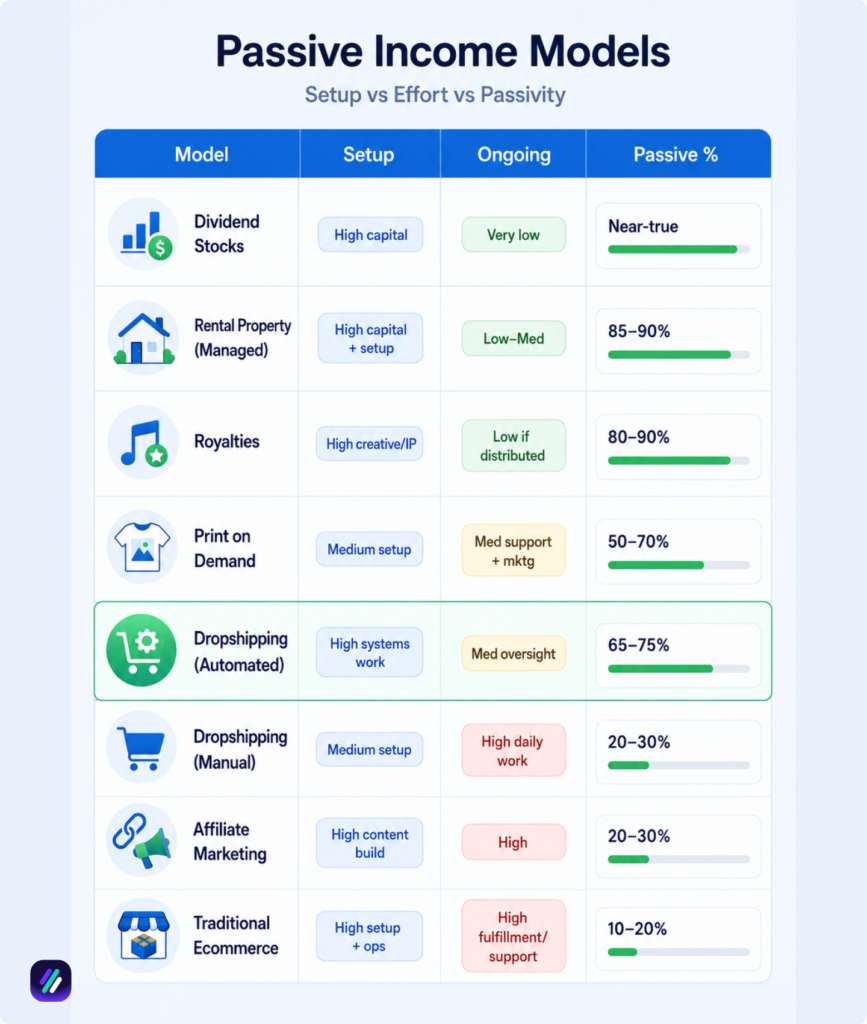
For that, we created a comparison table to show you in a quick and easy way how other passive incomes compare:
| Income model | Setup effort | Ongoing effort | Passivity ceiling |
| Dividend stocks | High capital needed | Very low | Near-true passive |
| Rental property (managed) | High capital and setup | Low to medium | 85 to 90% passive |
| Royalties | High creative or IP work upfront | Low if distribution is handled | 80% to 90% passive |
| Print on Demand | Medium setup | Medium support and marketing | 50% to 70% passive |
| Dropshipping (automated) | High setup and systems work | Medium oversight | 65 to 75% passive |
| Dropshipping (manual) | Medium setup | High daily work | 20 to 30% passive |
| Affiliate Marketing | High content or audience-building effort | High | 20% to 30% passive |
| Traditional ecommerce | High setup and operations | High inventory, fulfillment, and support work | 10 to 20% passive |
At the end, the main difference when it comes to passive income is control versus labor.
The more your store depends on your daily attention, the less passive it is and the more it runs through tested products, reliable suppliers, documented processes, automation, and trained help, the closer it gets to semi-passive income.
But I hate to break it for you. It will never be truly passive investment.
How Dropshipping Works
An important thing to know is that dropshipping is a retail fulfillment model where you sell a product first, then a third-party supplier ships it to the customer for you.
You do not buy inventory upfront, store products, or pack orders yourself.
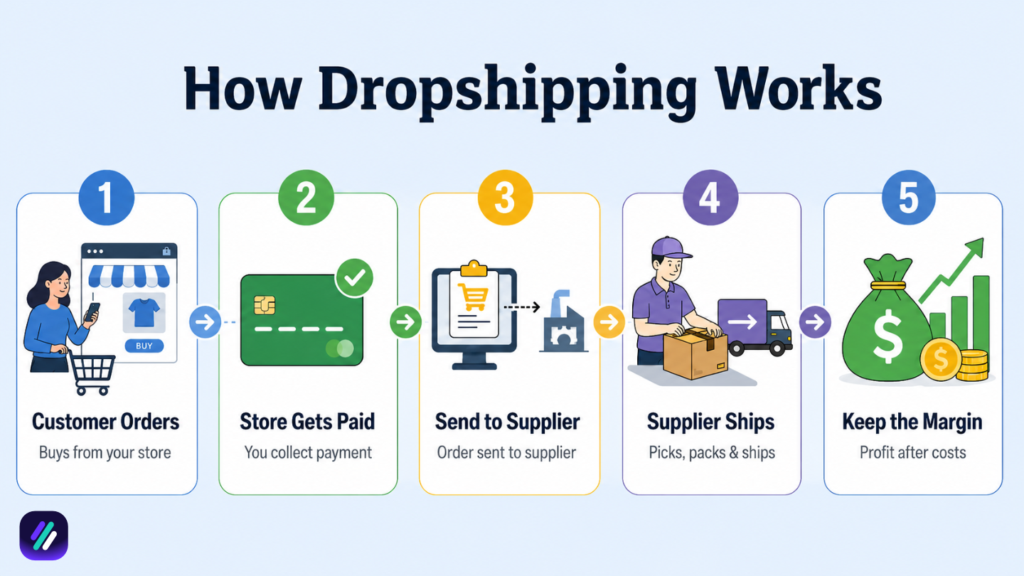
The basic process looks simple:
- Customer places an order: A shopper buys a product from your online store, marketplace listing, or sales channel.
- Your store processes the payment: You collect the customer’s payment, including the product price and any shipping fees you charge.
- You send the order to the supplier: The supplier receives the customer’s order details, either manually or through automation.
- The supplier fulfills the order: The supplier picks, packs, and ships the product directly to the customer.
- You keep the margin: Your profit is the difference between what the customer paid and what you paid the supplier, minus platform fees, payment fees, ad costs, refunds, and other expenses.
This is why dropshipping can look passive from the outside.
You are not touching the product. You are not renting warehouse space. You are not spending your evening printing shipping labels. All that is basically outsourced.
But you are still the business owner and the customer bought from you, not from your supplier, and laws make this clear as you bare the responsibility.
Of course, there are other laws where it helps you in case the supplier fails to deliver, but that’s for another time.
With that, here is where the process can be automated, and where you still need to pay attention:
| Part of the process | Can it be automated? | Where the seller still needs attention |
| Product importing | Yes | Choosing products that actually have demand, margin, and low refund risk |
| Pricing updates | Partly | Setting minimum profit rules so automation does not price you into losses |
| Inventory syncing | Yes | Watching supplier reliability and avoiding repeated out-of-stock issues |
| Order routing | Yes | Checking failed orders, address issues, and supplier processing delays |
| Tracking updates | Yes | Making sure tracking is uploaded on time and customers are informed |
| Customer messages | Partly | Handling refunds, complaints, damaged items, chargebacks, and edge cases |
| Marketing | Partly | Testing offers, improving listings, managing ads, and choosing channels |
| Compliance | No, not fully | Staying aligned with platform rules, consumer protection laws, tax rules, product restrictions, and supplier policies |
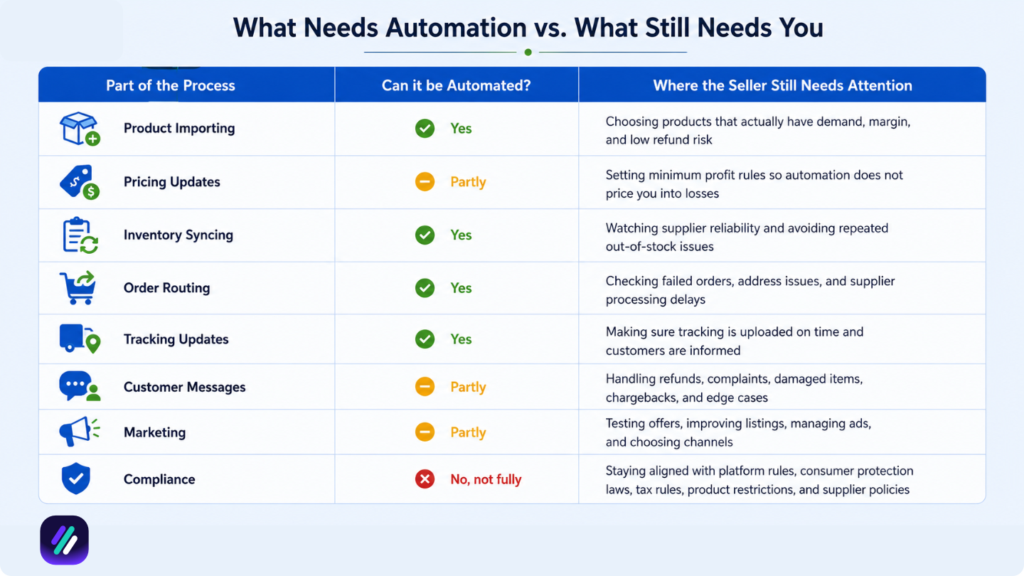
Remember, the biggest mistake is thinking that because you outsourced fulfillment, the responsibility is outsourced too.
It is not!
Get the eBook and learn how to launch your one-product Shopify store right!How to Get Closest to Dropshipping Passive Income
So now that we’ve busted some myths and established clear expectations, I want to steer towards how you can make dropshipping as passive as possible while still earning profit.
But that does not happen because you found a “winning product” once.
It happens because you move through clear stages: manual setup, partial automation, system-run operations, and eventually portfolio-level management.
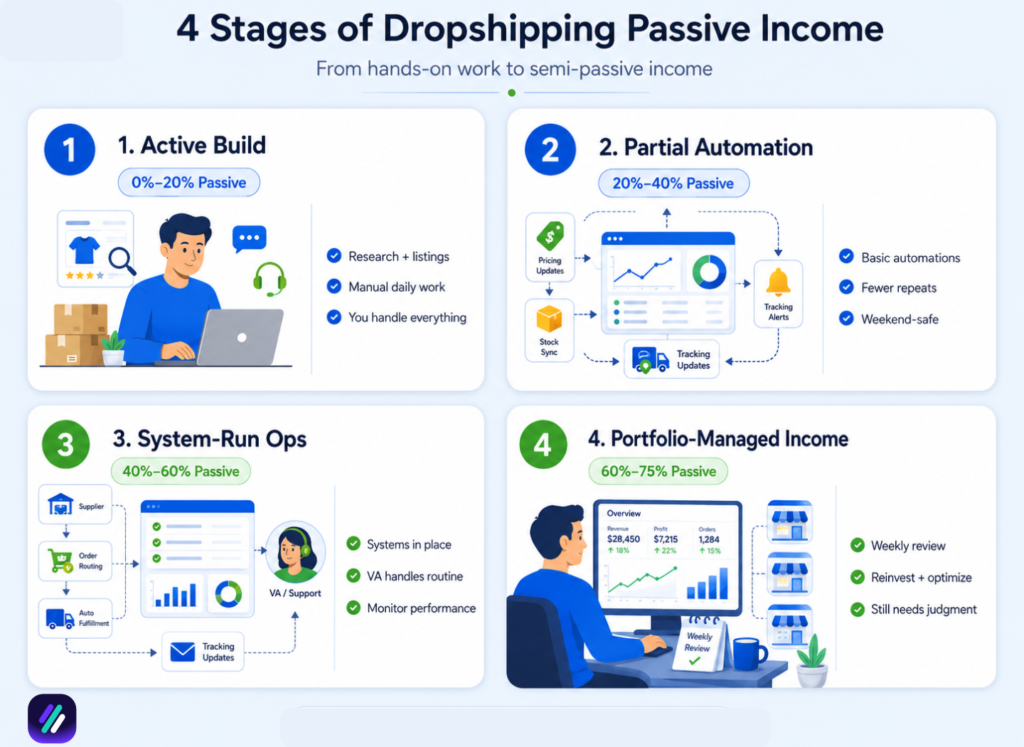
Stage 1: Active Build (0%-20% Passive)
At this stage, dropshipping is not passive. You are building the business from scratch, so almost everything depends on your direct input.
If you’re searching for the lazy part, this part will suck for you!
You choose the niche, research products, compare suppliers, create listings, set prices, answer customer questions, handle refunds, check tracking, fix mistakes, and figure out which products are actually worth keeping.
Even if the supplier handles fulfillment, you are still the person making the business work.
So like I said, this is not the easy part, but it’s also the part where you learn the most, and it will tremendously help you with the other stages.
Stage 2: Partial Automation (20%-40% Passive)
At this stage, the store is still hands-on, but it no longer needs your constant attention.
You usually have at least one validated product, a clearer sense of your margins, and enough manual order experience to understand where the repetitive work happens and how it could be potentially improved.
That is when basic automation starts to make sense.
So the first automations are usually practical, not fancy, such as:
- Inventory sync helps prevent selling products that are out of stock
- Repricing rules help protect your margins, as long as you set a clear profit floor
- Tracking updates and order alerts can also reduce the need to check every order manually
You still review issues, failed orders, supplier delays, customer messages, and products that suddenly stop performing, but the store should now be able to survive a weekend without you watching it hour by hour.
Stage 3: System-Run Operations (40%-60%)
At this stage, you will start feeling that dropshipping is becoming less like daily order management and more like business monitoring.
- Full order automation is usually in place.
- Orders route to suppliers automatically.
- Tracking details update inside the store or marketplace.
- Basic status emails go out without manual copying.
And this is very important because repetitive admin work is exactly where automation performs best.
McKinsey found that while fewer than 5% of occupations can be fully automated, around 45% of paid work activities could be automated with already demonstrated technology.
Also, customer service becomes more systematized. A VA can handle the repetitive 80% of questions using templates, such as “Where is my order?” “Can I return this?”, or “When will tracking update?” You still handle exceptions, but you are no longer the inbox.
A good rule of thumb for this stage is that you can take a two-week trip without revenue collapsing.
Reaching this stage for you can usually take 6 to 12 months from a standing start, and your weekly workload often drops to around 10 to 15 hours, mostly spent reviewing dashboards, margins, suppliers, and exceptions.
Stage 4: Portfolio-Managed Income (60%-75%)
And at the very last stage, dropshipping is no longer treated as one store you personally operate every day. It becomes one asset inside a broader ecommerce portfolio.
The majority of the daily work is handled by systems, automation, VAs, part-time support, or specialist contractors such as dropshipping agents.
Customer service, supplier communication, listing updates, tracking checks, and basic reporting no longer depend on the owner being online, and instead of managing orders daily, you review performance weekly through dashboards.
Also, your focus will change as you’re no longer spending most of your time fixing the same operational problems.
You are deciding where to reinvest profit, which products or niches deserve more testing, which suppliers need replacing, and whether the business is still protected from platform, margin, or competition risk.
This is the version of dropshipping most passive income content tries to sell. The part they usually skip is the 12 to 24 months of building, testing, documenting, automating, and hiring that often come before it.
And even here, dropshipping is not 100% passive as supplier changes, policy updates, customer issues, and market shifts still need the owner’s judgment.
That is why you should assume that 60% to 75% passive is a more honest ceiling in terms of how passive a dropshipping business can be.
How to Build a Low-Maintenance Dropshipping Business
By now, it should be clear to you that a low-maintenance dropshipping business is built by removing avoidable decisions from daily operations.
That means finding stable, nice products with long-term potential before scaling, working with reliable suppliers, which is essential, documenting and enhancing processes, and automating repetitive and time-consuming tasks once you know what the process should look like.
So now, let me share with you how you can build a low-maintenance dropshipping business.
Step 1: Choose a Niche with Evergreen Demand
An evergreen niche is a product category where people buy year-round or with predictable demand.
It’s not based on trending TikTok videos, holiday trends, or that one viral product (do you remember fidget spinners?)
For building passive income with dropshipping, this is really important because stable demand is easier to systemize and build a predictable cash flow.
For example, such niches are:
- pet supplies
- home organization
- baby accessories
- fitness basics
- car accessories
- hobby tools
- office products
- replacement parts
Such categories usually solve ongoing problems that regular people experience on a regular basis, which means customers keep searching for them even when the trend cycle changes.
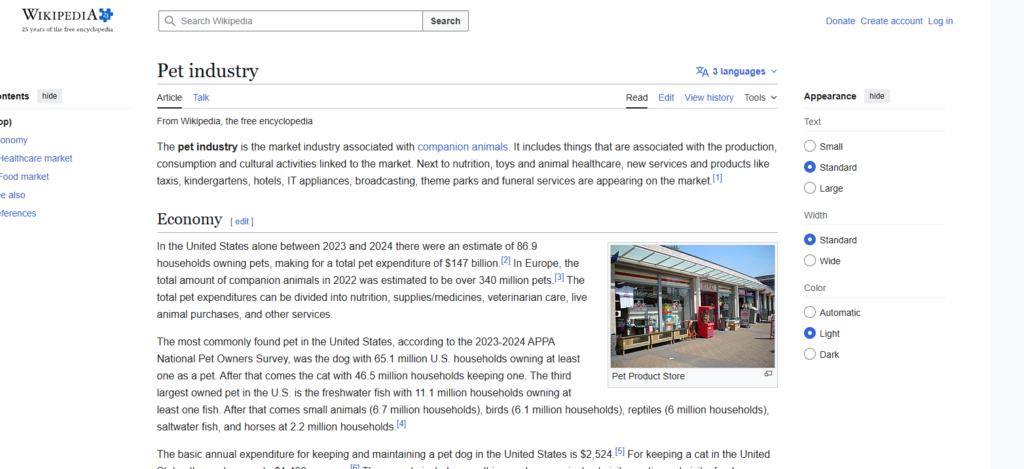
A practical rule: if the niche has been viable for at least three years and has a clear Wikipedia topic or category, it is probably established enough to research further.
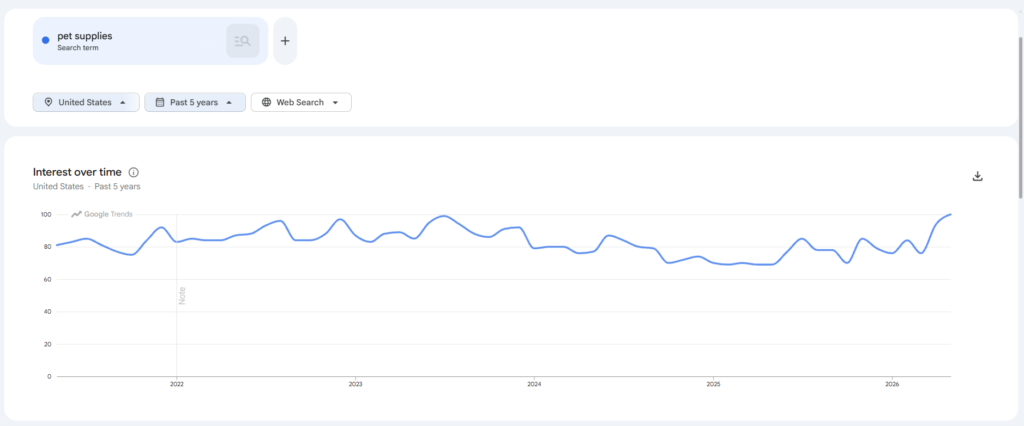
To validate the demand, you can use Google Trends to see how the search demand for it is.
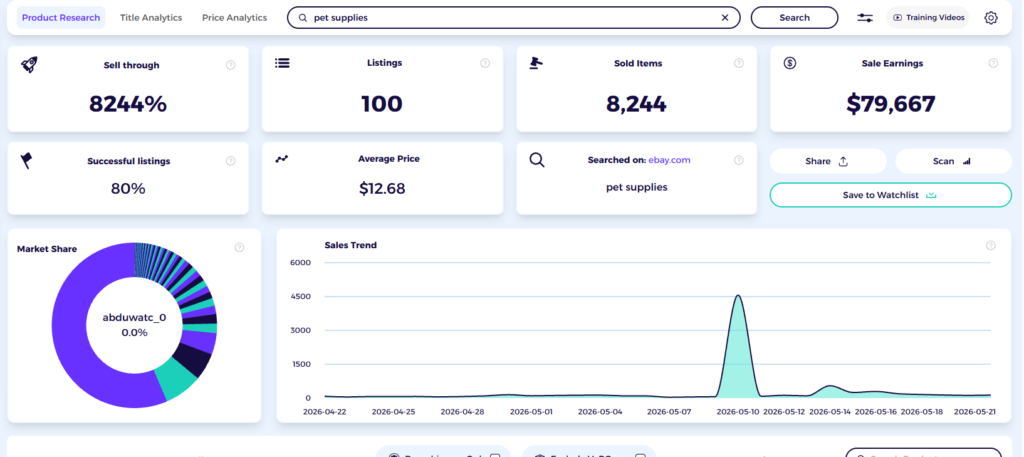
Additionally, you can use ZIK Analytics eBay product research tool to see how the category is selling on eBay. This gives you an excellent data point regardless of what platform you’re selling.
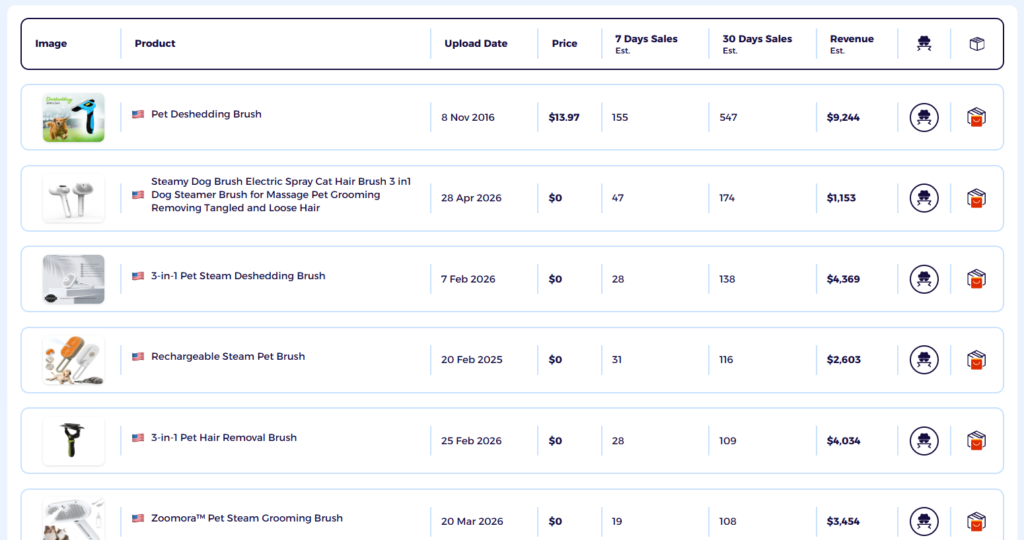
Or you can use the Shopify product explorer, which will give you the exact products that are selling. A wide variety with high sales usually means the niche is doing well.
Step 2: Do Deep Product Research
Before we jump into how you can do this, let me load you with some facts, only 51.6% of new U.S. businesses that opened in the year ending March 2019 were still operating five years later, according to BLS data reported by Axios.
Over 80% of top eCommerce sellers say product research is the most important step in building a successful store and nearly 63% of failed stores admit they didn’t spend enough time validating demand before launching
So how can you do this?
With ZIK Analytics, you can use the Shopify product finder, or eBay product explorer to discover any products in any niche by using keywords and filters such as country, revenue, sales, price, and more.
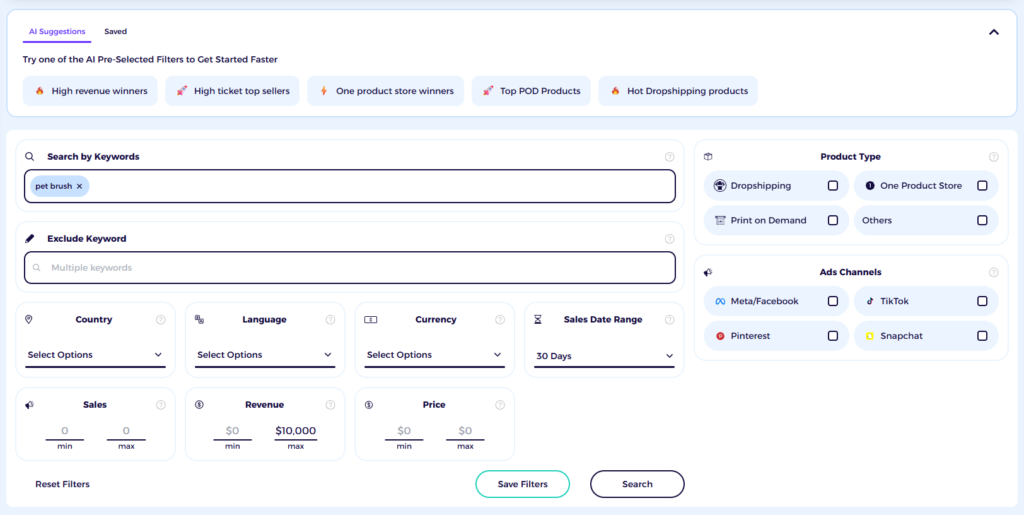
This will give you hundreds of products with data like the price, sales, revenue, total sold, and even the store selling it, and where you can source it from suppliers.
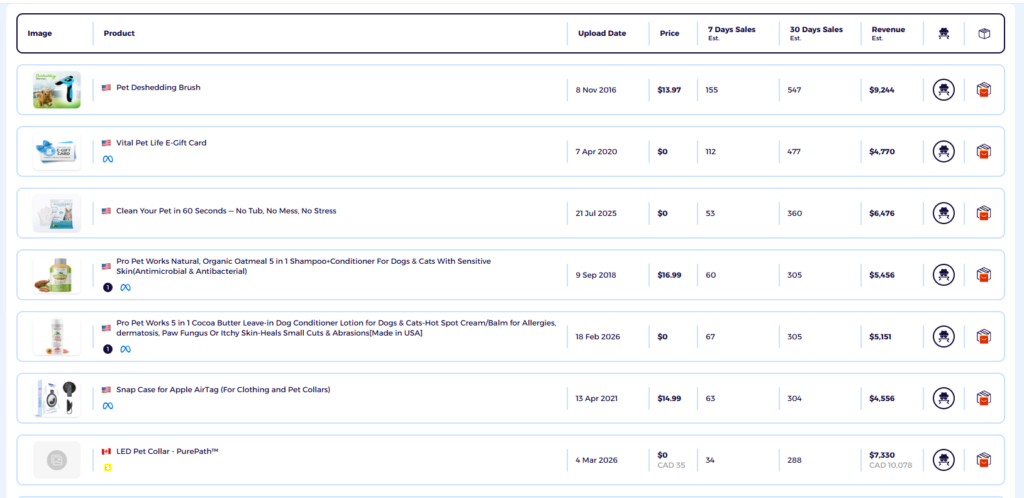
Furthermore, you can use ZIK’s eBay competitor research tool and Shopify tracker to check the store’s best-selling products, revenue, sales, and much more.
And there are many more tools inside ZIK, including AI tools that you can use to research products and even niches, to find winning dropshipping products to scale your business, and move to the next stage.
There are also free methods, but they take longer.
You can check marketplace listings, such as Amazon best sellers, trending on eBay, or again using Google trends.
Additionally, you can check the Facebook ads library or the ZIK Analytics AdSpy tool. Usually, if a competitor is promoting a product for a long period of time, it means it’s profitable.
And there are many more ways how you can do deep dropshipping product research.
Step 3: Find and Vet Reliable Suppliers
Alright, once you have your winning product, the next step is to find suppliers that can produce it for you, while also being a reliable partner for your business.
This matters because supplier mistakes become your customer service problem as NRF estimated that 16% of retail sales are returned, and Ofcom’s parcel data found that 67% of recipients had experienced a parcel issue in the previous six months.
With our ZIK item finder, you can look for supplier matches after finding a product, compare sourcing prices, check potential margins, and avoid products where the supplier cost is too close to the selling price.
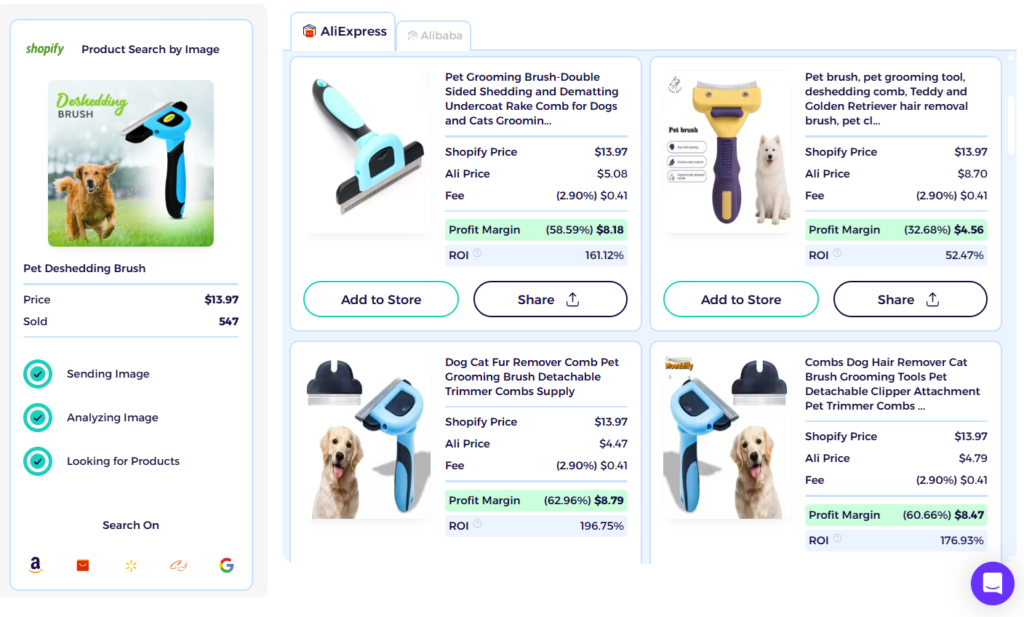
Additionally, you can browse or search on Google or AI for suppliers in your niche and ask them directly whether they can produce your desired product.
Or checking Google Shopping, AliExpress, Alibaba, CJdropshipping, Amazon, Walmart, wholesale directories, and competitor product pages, and using reverse image search to find suppliers.
And once you have your supplier, before listing, vet suppliers with this checklist:
- Shipping time is realistic for your target market
- Stock levels look stable
- Product reviews mention quality, not just low price
- Return and refund terms are clear
- Tracking numbers are provided quickly
- Supplier responds to questions within 24 to 48 hours
- Final margin still works after shipping, fees, refunds, and ads
These are just some of the things you should check. Overall, finding suppliers is the easy part. There are countless of them, almost in every niche. The hard part is to vet them, ensuring your dropshipping suppliers are reliable.
Step 4: Keep Your Catalog to a Minimum (Only Proven Winners)
Now, when it comes to starting, it’s tempting to start with a big catalog like a big e-commerce store or a dropshipping store.
However, A smaller catalog is easier to turn into semi-passive income because there are fewer products to monitor, reprice, update, and troubleshoot.
So you should aim to build around proven winners, not hundreds of random listings.
For beginners, that might mean testing 20 to 50 products, then keeping the 5 to 10 that show steady demand, healthy margins, low refund risk, and reliable supplier availability.
Keep in mind that every weak product adds work: price checks, stock issues, customer questions, return risk, and listing maintenance, and a lean catalog makes automation cleaner and gives VAs fewer exceptions to handle.
Step 5: Start Building SOPs from Day One
SOPs are what turn an e-commerce dropshipping side hustle from “you doing everything” into a store that can actually move closer to dropshipping passive income, at least as close as it can get.
If every task lives in your head, you cannot automate it, outsource it, or fix it consistently, and you just become the bottleneck and reason why dropshipping cannot become passive income for you.
So, to build your SOPs, start simple.
Every time you repeat a task, document the steps, tools, screenshots, decision rules, and what “done correctly” looks like.
Some tools help you to create these processes by recording your screen, transcribing it into text with screenshots, such as Scribe.
Our in-house dropshipping experts recommend that your first SOPs should cover product research, supplier vetting, listing creation, pricing rules, order checks, tracking updates, refund handling, customer replies, and weekly margin reviews.
Like this, it’s not dependent on your memory or skill set. You can easily replicate that with well-built SOPs that VAs can follow.
Furthermore, there are countless SOPs already built by other dropshippers that you can easily access and adapt to your own business and style.
And with AI tools, it has never been easier to build these.
Step 6: Start Implementing Automation (After Process Clarity)
Using dropshipping automation tools is something that starts moving you closer to passive income, but only after you know the process manually.
Oftentimes, automating processes goes along with creating SOPs, as using the tools is part of the overall process, and your VAs or staff will need to use them.
With that, here are the typical dropshipping processes that you can automate and the tools to use:
- Product research and validation: Use ZIK Analytics first to find products with real demand, check sell-through, revenue, competition, keywords, competitor stores, supplier options, and profit potential before listing. ZIK also has tools like Product Explorer, eBay Competitor Research, Shopify Sales Tracker, Autopilot, Bulk Scanner, and supplier sourcing features.
- Product importing: Use 3Dsellers or DSers to import products into your store faster instead of manually copying titles, images, descriptions, and variants.
- Inventory and price monitoring: Use AutoDS to monitor stock and pricing changes, then set rules so products do not sell out of stock or drop below your minimum profit margin.
- Order fulfillment: Use AutoDS for automated order fulfillment or DSers if your workflow is mainly AliExpress-based and you need bulk order processing.
- Tracking updates: Use AutoDS or DSers to sync tracking numbers automatically, so customers get updates without you checking each order manually.
- Store workflows: Use Shopify Flow to automate internal tasks like tagging risky orders, flagging low-stock products, segmenting customers, or triggering alerts when something needs review.
And of course, you can automate so much more, including your backend activities such as bookkeeping. In here, we truly focused on the dropshipping tasks alone.
But like with any business, there are the bureaucratic tasks that are unavoidable for anyone.
Step 7: Start Hiring VAs, Part-Time (What Budget Allows)
Once your SOPs are clear, you can start outsourcing the tasks that are repetitive but still need human judgment.
From what we see online, from our in-house experts, and our customers, you should start with customer support, order checks, tracking follow-ups, refund requests, supplier messages, product listing updates, and basic reporting.
These are usually the first tasks dropshippers hand over because they repeat daily and do not require founder-level decisions.
Remember, the key here is to have strong SOPs!
Without them, hiring a VA just turns into more management work, and with them, you can give clear steps, templates, escalation rules, and quality checks.
In terms of cost, Upwork lists virtual assistants around $10 to $20 per hour, with admin/data-entry VAs around $12 to $20+, and customer support/marketing VAs around $20 to $35+. In comparison, U.S. customer service reps had a median wage of $20.59 per hour. (Source)
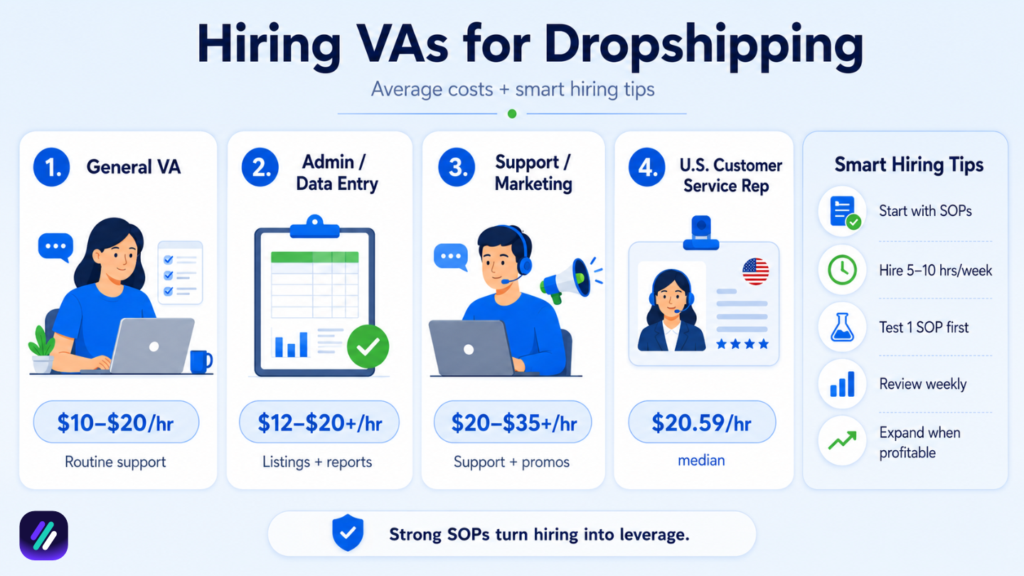
But if you’re hiring VAs on a regular schedule, then you can usually negotiate the price per hour to be lower. Also, hiring from countries like the Philippines, Pakistan, or India can give you better rates.
Practical tip: hire for 5 to 10 hours per week first, test one SOP, review mistakes weekly, then expand only when the task is profitable to remove from your plate.
Step 8: Reduce Dependence on One Marketing Channel
I always hear from entrepreneurs that the most dangerous number in business is one.
One marketing channel you depend on. One product is driving most sales. One supplier keeping your store alive. That is risky because if that one thing breaks, the whole business feels it.
That is why you should diversify your marketing once your core offer is working. Most dropshippers start with one channel, often Facebook ads, eBay promoted listings, TikTok ads, or TikTok Shop traffic. That is fine in the beginning because focus helps you learn faster and keep your expenses lean.
But if you want to scale and avoid sudden revenue drops, you need backup channels.
So you should start by adding one extra channel at a time:
- Marketplace ads: eBay promoted listings, Amazon ads, Etsy ads
- Paid social: Facebook, Instagram, TikTok, Pinterest
- Organic content: short videos, product demos, SEO pages
- Retention: email, SMS, remarketing, abandoned cart flows
Remember, the goal is not to be everywhere but to avoid having your entire e-commerce dropshipping side hustle controlled by one algorithm, one ad account, or one platform policy change.
Why People Think Dropshipping Is Passive
People think dropshipping is passive because the visible work of inventory that people associate with selling online is removed.
You do not store inventory, pack boxes, print labels, or ship products yourself so from the outside, it looks like the supplier does everything while the seller just collects the margin.
And that is the part most “passive income” content exaggerates.
The problem is that many people selling the dream are not really selling dropshipping. They are selling hope.
The FTC warns that online business offers and coaching programs often use phrases like “proven system,” guaranteed income, big returns, or claims that you can make money with little or no experience. In many cases, the real product is the course, coaching, upsell, or business package, not a realistic ecommerce operation.
The same pattern appears in work-from-home scams. The FTC says scammers often promise thousands of dollars per month with little time or effort, then charge people for starter kits, training, or certifications that do not create real income.
That is why “easy passive income” should instantly trigger skepticism.
Recent scam data shows how powerful this pitch is.
Job and task scams promising easy online income caused more than $220 million in reported losses in recent years, with victims often shown fake earnings before being asked to deposit their own money.
While real experts are usually much less exciting.
They talk about product research, supplier vetting, customer support, refunds, platform rules, margins, automation, SOPs, and hiring, and give you the reality of what to expect when you start a dropshipping business.
Why eBay is the Underrated Passive Income Platform
eBay is underrated for dropshipping passive income because it removes a lot of the “build a business from scratch” work.
With Shopify, you usually need to build the store, create trust, drive traffic, test ads, write pages, set up checkout flows, fix always-popping-up issues, and convince strangers to buy from a new brand.
With eBay, you start inside a marketplace that already has buyer intent.
eBay had around 136 million active buyers and $22.2 billion in GMV, which means the traffic problem is partly solved before you even list a product.
Product research and validation are also easier.
Instead of guessing what people might buy, you can check eBay sold listings to see what actually sold, not just what sellers are asking for. You can use our free eBay Chrome extension to simplify the process.
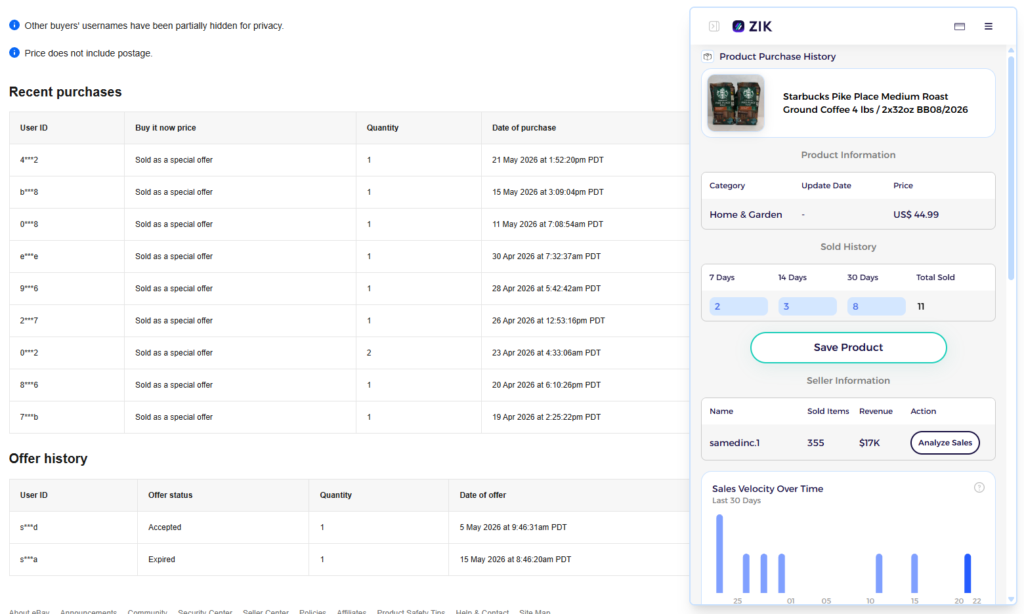
And experienced eBay sellers specifically recommend using the eBay sold items filter because listed prices and real selling prices can be very different.
And with tools like ZIK Analytics, make this faster by helping you find products, check sales, revenue, total sold, competitor stores, and potential suppliers before you list.
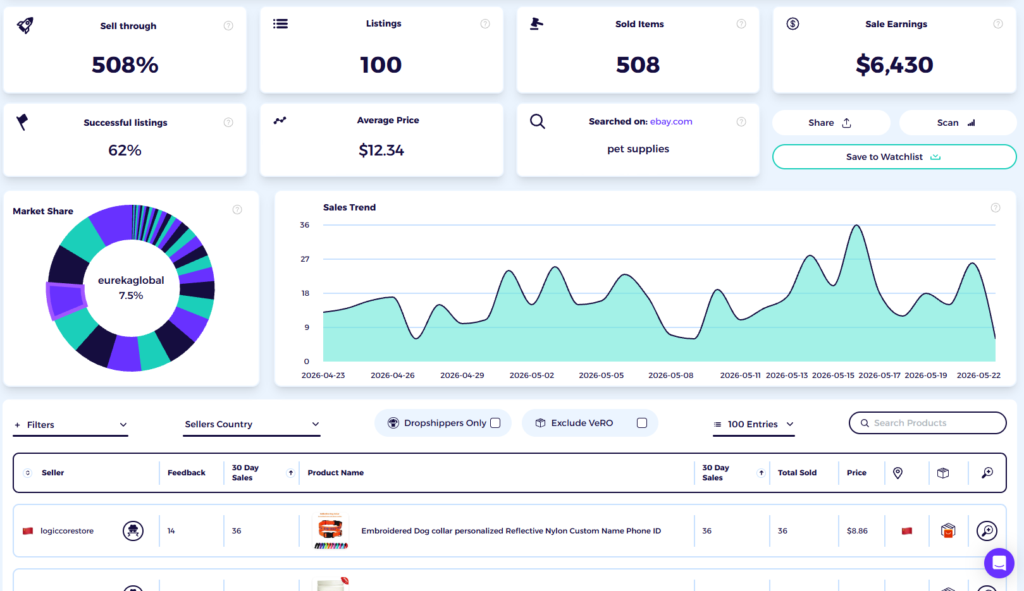
But remember, that does not make eBay fully passive. But it can make sourcing, promoting, and selling simpler because you are using existing demand instead of building every part of the funnel yourself.
Conclusion
Dropshipping passive income is mostly a myth when people sell it as “set it once and get paid forever.”
In reality, it starts as active work, then becomes semi-passive only when product research, supplier checks, customer support, SOPs, automation, and hiring are handled properly.
That said, dropshipping is still one of the lower-friction alternative income sources in ecommerce.
You do not need to buy inventory upfront, rent warehouse space, or pack and ship every order yourself.
Dropshipping Passive Income FAQs
Here are some dropshipping passive income FAQs:
Is dropshipping a good passive income?
Dropshipping can generate income with less upfront investment than traditional retail, but it is not truly passive. You still need to research products, manage suppliers, handle customer service, optimize marketing campaigns, and monitor store performance. While automation tools can reduce daily tasks, successful dropshipping businesses require ongoing involvement to maintain sales, stay competitive, and address operational issues as they arise.
Can I make $10,000 per month dropshipping passively?
Earning $10,000 per month through dropshipping is possible, but doing so passively is unlikely. Most stores that reach this level require ongoing work, including product research, advertising management, customer support, supplier coordination, and conversion optimization. Some experienced entrepreneurs automate parts of the business by hiring staff and using software tools, but building and maintaining a profitable store still requires active oversight and regular decision-making.
How to make $2000 a month in passive income?
Generating $2,000 per month in passive income usually requires either significant upfront capital, valuable assets, or substantial work before income becomes passive. Common options include dividend investing, rental properties, digital products, affiliate websites, YouTube channels, and automated ecommerce stores. Most passive income streams take months or years to build and still require occasional maintenance. The best approach depends on your budget, skills, and how much time you can invest upfront.
Why do so many dropshippers fail?
Many dropshippers fail because they treat it as a quick money-making scheme rather than a real business. Common mistakes when dropshipping include choosing poor products, relying on saturated markets, underestimating advertising costs, neglecting customer service, and failing to build a strong brand. Many beginners also quit too early after a few unsuccessful campaigns. Success typically requires market research, testing, optimization, and consistent effort over time.
Is dropshipping dead in 2026?
No, dropshipping is not dead in 2026. However, it is far more competitive than it was in previous years. Success now depends on finding quality products, building a trustworthy brand, creating effective marketing campaigns, and delivering a good customer experience. Generic stores selling the same products as everyone else often struggle, while niche-focused brands and stores with strong marketing continue to grow and generate sales.
How long does it take to make money with dropshipping?
The time it takes to make money with dropshipping varies widely. Some sellers generate their first sales within days of launching, while others may take several months to become profitable. Success depends on factors such as product selection, dropshipping marketing strategy, advertising budget, competition, and store optimization. Most successful dropshippers spend time testing products and refining their approach before achieving consistent profits.