
You’re new to dropshipping and looking to launch your first e-commerce store.
And you’ve come across two platforms that claim to make that possible: eBay and Shopify.
Ease of use is your biggest priority, and then you want something that offers branding and marketing opportunities while keeping costs manageable.
In this guide, we’ll take an in-depth look at eBay vs Shopify dropshipping to help you choose the right platform to start your dropshipping business.
Summary of eBay vs Shopify Dropshipping
| Criterion | eBay | Shopify |
| Ease of Use | Very easy to get started. You can list products quickly using built-in templates and categories. | Takes more time to set up since you build your own store, but offers more control once running. |
| Startup Cost | Low upfront cost. You can start selling with little or no initial investment. | Requires a monthly subscription, a domain, and often a paid dropshipping app. |
| Ongoing Fees | Final Value Fees on every sale, usually around 12–15%. | No sales commissions, only payment processing fees. |
| Payment Processing | Fees are bundled into eBay’s payment system and deducted from each sale. | Lower processing rates, especially when using Shopify Payments. |
| Branding | Limited branding options. Your store always looks like part of eBay. | Full control over design, layout, and brand identity. |
| Customization | Very little customization beyond basic store settings. | Highly customizable with themes, apps, and code access. |
| Traffic Source | Built-in audience means buyers already come to the platform. | You must bring your own traffic through ads, SEO, or social media. |
| Marketing Tools | Basic internal promotions like eBay ads and listing boosts. | Extensive marketing tools and integrations for email, ads, and automation. |
| Listing Management | Simple dashboard for managing listings, orders, and messages. | More advanced store management with deeper analytics and reporting. |
| Supplier Options | Fewer suppliers support eBay dropshipping directly. | Huge ecosystem of dropshipping suppliers and apps built for Shopify. |
| Shipping & Fulfillment | No built-in eBay fulfillment. You rely fully on suppliers. | Access to Shopify Fulfillment Network and many automated fulfillment apps. |
| Customer Support | Standard seller support, better on higher-tier plans. | 24/7 live support available to all Shopify merchants. |
| Dropshipping Rules | Strict policies. Only allowed with approved wholesale suppliers. | No platform restrictions on supplier type. |
| Profit Potential | Margins usually 20–30% due to higher platform fees. | Margins are usually 20–30% due to higher platform fees. |
What is eBay?
eBay is a global online marketplace where you can buy and sell a wide range of products, both used and brand new.
Items on eBay are typically sold via online auctions or fixed-price Buy It Now listings, meaning the site functions as both a digital auction house and a retail store for consumers. Founded in 1995, eBay has become a major e-commerce powerhouse that serves over 130 million buyers in 190 markets worldwide.
How eBay Dropshipping Works?
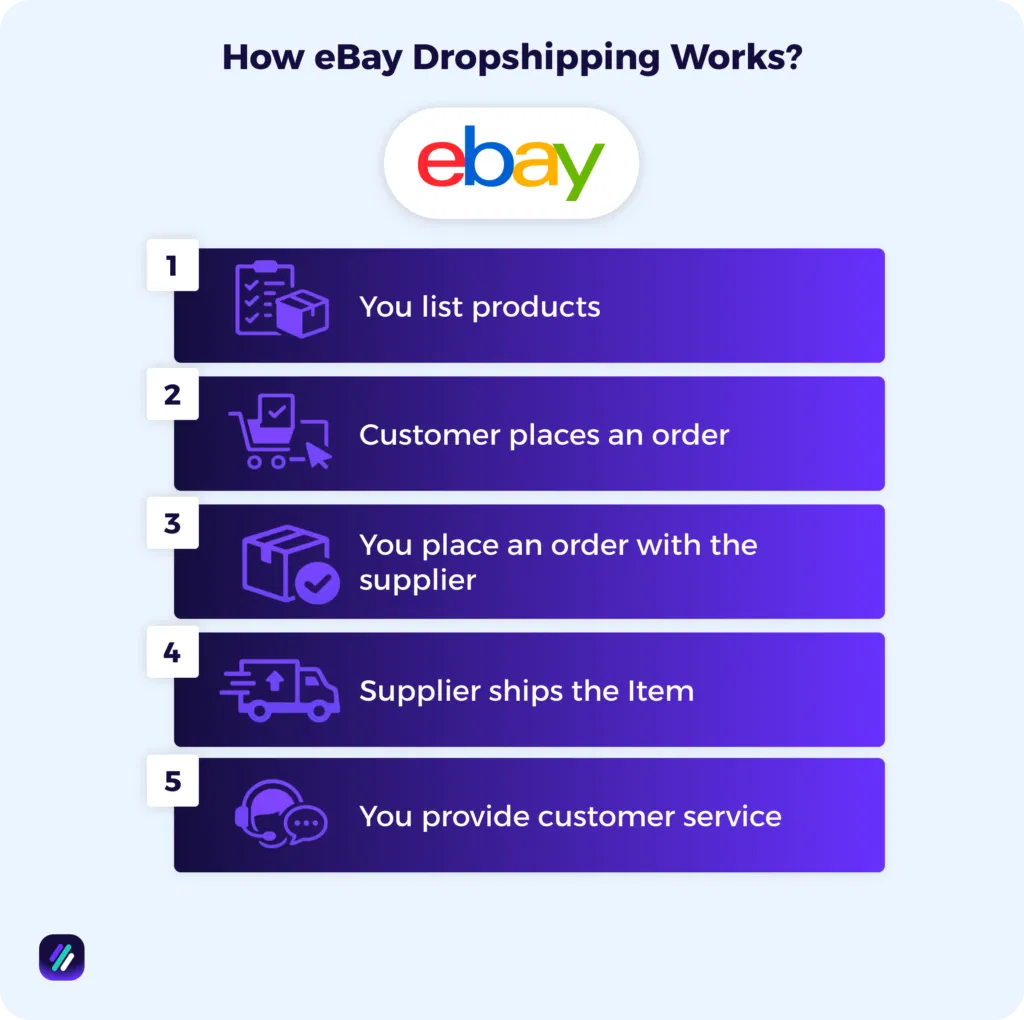
eBay dropshipping requires you to partner with a wholesale supplier who manages inventory and shipping.
Once a customer places an order on your store, the supplier can send the product directly to them, but all packing slips and invoices must clearly mention you as the source (aka the seller of the record)
Here are the steps:
- You list products: You list products from your wholesale supplier’s catalog on your eBay store.
- Customer places an order: A consumer purchases the item from your eBay listing and pays you directly through eBay’s payment system.
- You place an order with the supplier: After receiving payment, you place an order for the item with your wholesale supplier using your customer’s shipping address.
- Supplier ships the Item: The supplier picks, packs, and ships the product directly to the customer.
- You provide customer service: You then offer tracking information and manage all customer inquiries and disputes according to eBay’s seller performance standards.
What is Shopify?
Shopify is an all-in-one e-commerce platform that allows you to build and manage your own independent online store. With over 10 million stores using Shopify, it’s the 3rd largest ecommerce platform globally.
Shopify allows you to sell products worldwide as well as locally via point-of-sale and app integrations. Compared to an online marketplace, Shopify gives you complete control over branding and doesn’t charge any listing or sales commission, and it’s the go-to choice for dropshippers!
How Shopify Dropshipping Works
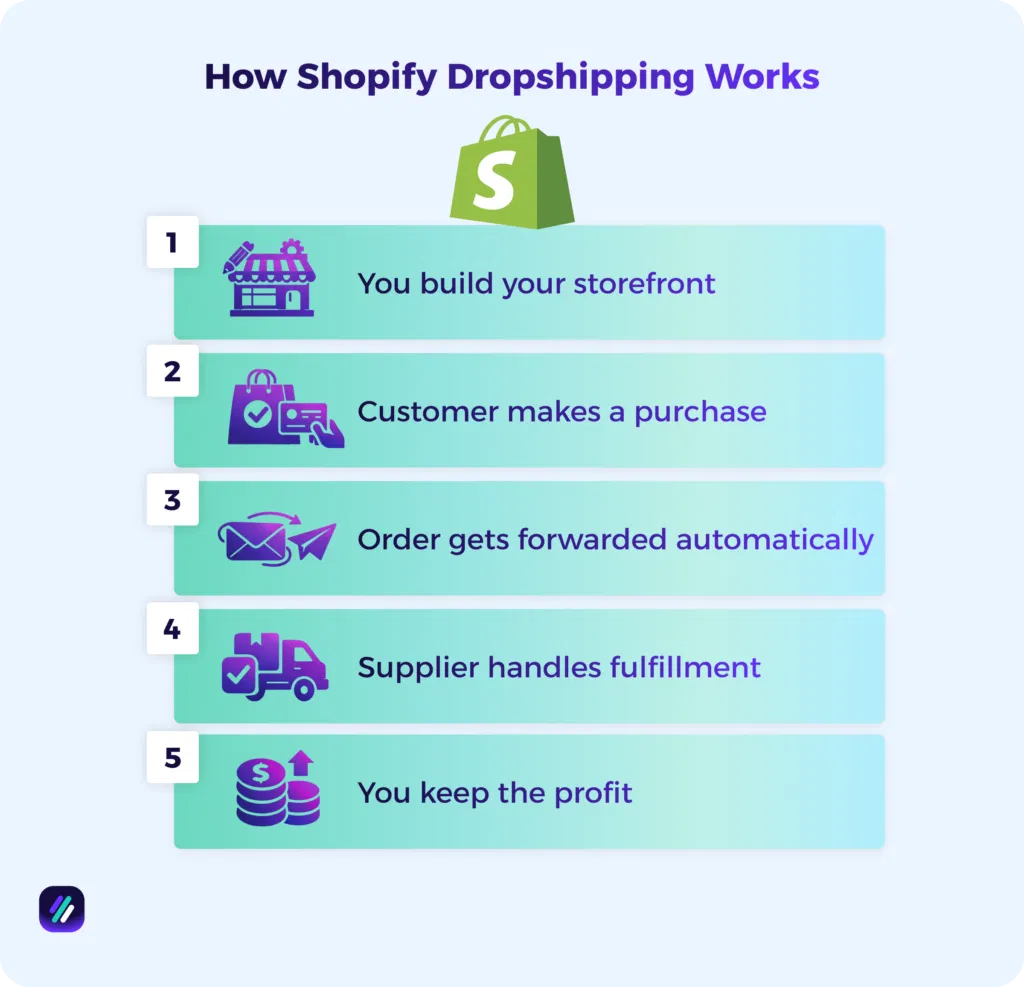
Shopify dropshipping works in the same manner as eBay dropshipping, but there are no restrictions on the type of supplier you can use. You can partner with a wholesaler, retailer, distributor, or even a local business to source products for a dropshipping store.
Here are the steps:
- You build your storefront: You set up your store and connect Shopify dropshipping apps like DSers to find and import products from suppliers.
- Customer makes a purchase: A buyer orders an item from your store at the price you’ve set.
- Order gets forwarded automatically: Once the customer pays you, the dropshipping app sends the order details and payment to your supplier.
- Supplier handles fulfillment: Your supplier prepares and ships the product straight to the buyer, often using your store’s branding.
- You keep the profit: You earn the difference between what the customer paid and what you paid the supplier while managing marketing and customer service.
eBay vs Shopify Breakdown
Now, it’s time to stack up eBay vs Shopify dropshipping to find out which is the better choice for an e-commerce store owner.
Ease of Use
eBay is an excellent option for beginners or those wanting to test product ideas quickly with low upfront costs. The platform’s built-in audience means you can start selling and generating sales without investing heavily in marketing. Setting up an eBay store is also easier because of the simple templates and features available to merchants.
Shopify is ideal for entrepreneurs who want to build a long-term, recognizable brand with full control over the customer experience. However, it requires more effort up front and ongoing work to attract customers to your store.
Winner: eBay.
Startup Cost and Ongoing Fees
eBay generally has lower startup costs. You can list up to 250 items for free each month and are charged an insertion fee of around $0.35 if you exceed the free monthly allowance.
Shopify requires an upfront monthly subscription fee that starts around $39 per month when paid annually, and a small investment for a custom domain costing $10-$15 per year. Other initial costs relate to buying a premium theme (optional) and paying for a dropshipping app (cost around $39 per month) to sync products to your store.
Winner: eBay
Payment Processing
eBay charges dropshippers a Final Value Fee (FVF) on the total sale amount (including shipping). Products in most categories are charged around $13.25% +0.30 per order. Upgrading to the $4.95 per month, annually billed Starter Store subscription reduces these per-sale fees for your store.
Credit card rates on the Shopify Basic plan are typically 2.9% + $0.30 per month using Shopify Payments. If a seller chooses to use a third-party payment provider like Stripe or PayPal, Shopify imposes an additional transaction fee of 0.5% to 2% (depending on the subscription plan) on top of the third-party provider’s own fees. But there are no final value fees or sales commissions on sales.
Winner: Shopify
Branding and Customizability
On eBay, your ability to create a unique brand identity is limited. You can change the name and logo of your store and manage some listing details, but that’s about it. The underlying layout and functionality of your eBay store is fixed under the platform’s system.
Shopify gives you complete control over your store’s name, layout, and user experience. You can use various themes and tools to tailor every aspect of your site to match your brand identity. Shopify also lets you modify your store’s code via HTML and CSS, plus allows you to create custom checkout experiences on higher-tier plans.
Winner: Shopify
Marketing and Traffic
eBay gives you access to a built-in audience of millions of active shoppers who are already in a buying mindset. As such, you do not need to actively generate external traffic and can leverage the platform’s organic reach to improve your store’s visibility. Marketing within eBay involves utilizing a pay-per-sale advertising model that increases the visibility of your products within eBay search results.
Shopify requires you to generate your own traffic. This typically involves marketing your store on social media channels like TikTok and Instagram and running paid advertising campaigns via Meta Ads. Many Shopify store owners also use content marketing and SEO strategies to rank organically in search engines, which requires more time but is highly cost-effective to execute.
Winner: eBay
eCommerce Tools and Integration
eBay integrates with a variety of dropshipping tools like Doba or ZIK Analytics to help manage listings and research products within its marketplace. However, it does not have a dedicated app store as Shopify does and is limited in terms of integrations.
Shopify offers hundreds of integrations for dropshipping and marketing via its dedicated App Store. Tools like ZIK Analytics are also available to help Shopify store owners validate winning products and find gaps in competitor strategies. You can install a variety of apps and use tools to extend your store’s functionality.
Winner: Shopify
Listing and Store Management
eBay makes it easy to create and manage product listings. Pre-defined templates and categories help you list a high volume of products quickly with minimal effort. You manage everything through a centralized dashboard where you can track inventory, monitor sales performance, and handle customer inquiries in one place.
Shopify offers a robust drag-and-drop editor that allows for detailed descriptions, videos, custom sections, and meta descriptions for SEO. This provides more creative control but has a steeper learning curve than eBay’s basic editor. For store management, you get an all-in-one admin panel that lets you handle orders, track stock, and see how your business is doing.
Winner: It’s a tie.
Supplier Availability
eBay isn’t commonly associated with dropshipping, and while there are dropshipping suppliers that claim to cater to eBay sellers exclusively, you may not find as many options as you would when using an e-commerce platform for your business.
Shopify is considered the best platform for starting a dropshipping store. So there are many Shopify dropshipping suppliers to handle logistics and fulfilment for your business. These suppliers also provide apps that allow you to sync orders and inventory between their site and your store.
Winner: Shopify
Shipping and Fulfillment
eBay does not provide an in-house shipping and fulfillment service. Instead, dropshippers are responsible for managing their suppliers and ensuring timely delivery. However, it does offer the eBay international shipping program, where you ship products to the company’s domestic US shipping hub, and its third-party provider manages all the logistics for you.
Shopify gives you the option to fulfill via the Shopify Fulfillment Network (SFN). SFN is a network of fulfillment centers in the US and Canada that integrates directly with your store to store inventory and ship orders on your behalf. Shopify’s App Store also offers tools to connect with suppliers like AliExpress to automate order placement and tracking updates.
Winner: Shopify
Customer Support
eBay has a very active community forum and help center where sellers can ask questions and get advice on running their store. It also provides basic help via phone and chat, with premium support reserved for sellers on higher-tier store plans.
Shopify offers dedicated 24/7 assistance to merchants via email, phone, and live chat. You also get tools to manage your own support across different channels via a single dashboard.
Winner: Shopify
Dropshipping Policy Restrictions
eBay dropshipping policy is that you can only dropship if you have a direct contract with a wholesale supplier or manufacturer.
Purchasing items from another retailer or marketplace (such as Amazon or Walmart) after a sale and having them ship directly to the customer (retail arbitrage) is a key policy violation.
Read more in our answer to Does eBay Allow Dropshipping?.
Shopify doesn’t have internal marketplace rules like eBay. But it does require you to follow general e-commerce regulations and your own terms of service. Tax laws (e.g., sales tax nexus), intellectual property rights, and product safety laws are also applicable and must be followed to do business on Shopify.
Winner: Shopify
Profitability Potential
On eBay, potential profits are impacted by Final Value Fees (FVF), which average around 12.9% + $0.30 per transaction and can go up to 15% in some categories. The average profit margin for eBay dropshipping typically ranges from 20% to 30%, though niche products can reach 40% or more if policies are followed and reliable suppliers are used.
Shopify’s basic plan has a lower transaction fee. As sales volume increases, this model generally results in higher net profits compared to eBay’s higher FVF. Shopify dropshipping businesses can sustain wider profit margins, often ranging from 30% to 70%, with average margins around 30-40%, due to greater control over pricing and an owned sales channel.
Winner: Shopify
When to Choose Shopify or eBay for Dropshipping
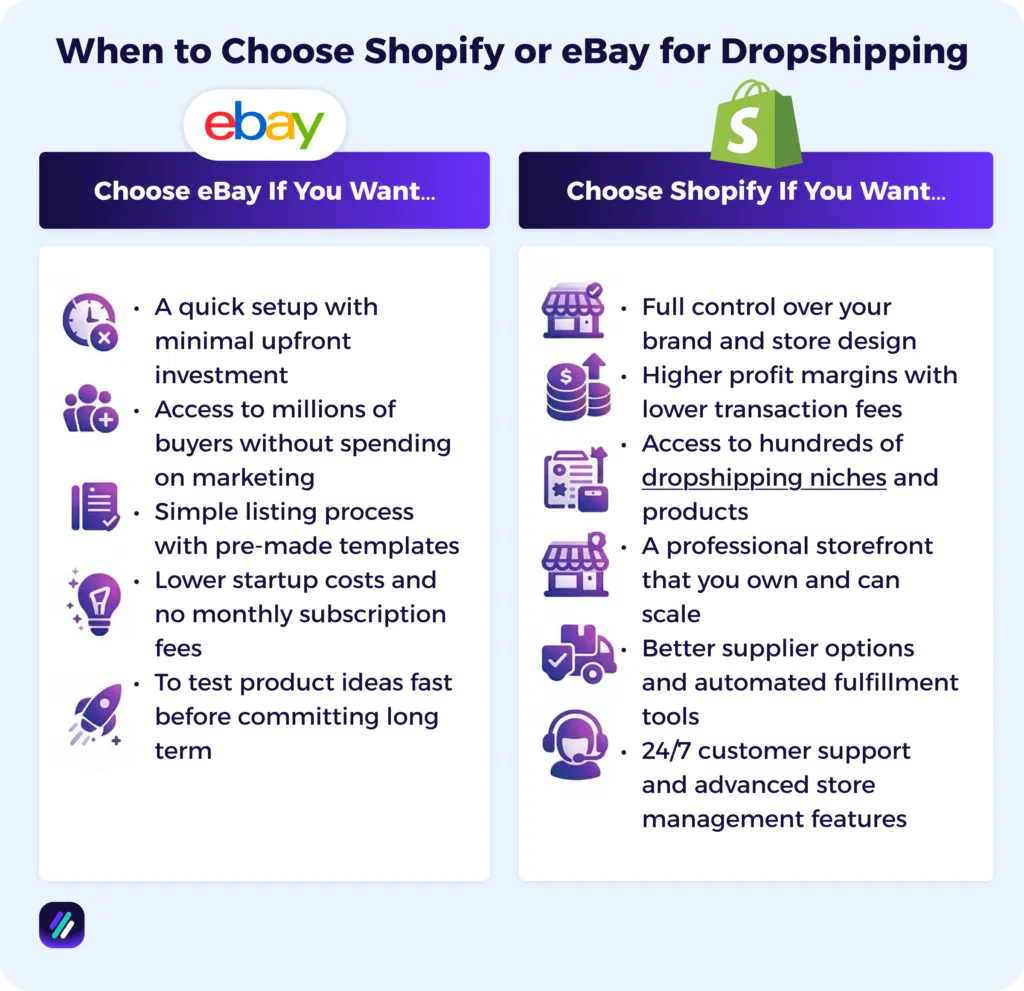
Still wondering which platform to choose for your dropshipping business? Here’s a quick summary to help you decide.
Choose eBay If You Want…
- A quick setup with minimal upfront investment
- Access to millions of buyers without spending on marketing
- Simple listing process with pre-made templates
- Lower startup costs and no monthly subscription fees
- To test product ideas fast before committing to long-term
Choose Shopify If You Want…
- Full control over your brand and store design
- Higher profit margins with lower transaction fees
- Access to hundreds of dropshipping niches and products
- A professional storefront that you own and can scale
- Better supplier options and automated fulfillment tools
- 24/7 customer support and advanced store management features
How ZIK Analytics Helps You Dropship on Both Platforms
ZIK Analytics has a suite of tools to help both eBay and Shopify dropshippers find the best products for dropshipping and scale their stores faster.
ZIK for eBay Dropshippers
People know ZIK Analytics as the best eBay product research tool on the market. Although we have many tools for eBay sellers, I especially want to mention three that make dropshipping easier:
- eBay Product Research Tool shows you which items are selling right now based on sales volume and sell-through rate. Filter by price and condition to find profitable dropshipping products.
- eBay Competitor Research Tool lets you spy on successful dropshippers. Enter their username to see monthly revenue, sold items, and top products. Track their strategy over time.
- eBay Bulk Scanner scans entire competitor stores and matches their listings to Amazon or Walmart. Filter by profit and sales to find the best items to dropship.
We also offer eBay Autopilot to automate product discovery, the eBay Title Builder as your eBay keyword tool for optimized listings, and the 500 Best Selling eBay Items tool to see the latest trending products.
ZIK for Shopify Dropshippers
ZIK also works for Shopify dropshippers who want to validate products, spy on competitors, and find reliable suppliers:
- Shopify Sales Tracker lets you monitor any Shopify store’s revenue performance. Enter a URL to see daily sales, revenue, and top products.
- Shopify Store Finder helps you discover successful dropshipping stores by filtering for revenue, marketing channels, and product categories.
- AdSpy Tool shows you which ads competitors are running on Facebook and Instagram. See engagement metrics and save winning ads for your campaigns.
- Search AliExpress by Image and Search Alibaba by Image let you find suppliers by uploading product photos. Match products to suppliers with pricing and shipping details.
We also offer the Shopify AI Store Builder to help you set up your store faster, and a Shopify Supplier Finder to connect you with verified suppliers across multiple platforms.
Get your ZIK Analytics trial today and start dropshipping on eBay or Shopify with tools that help you find products, analyze competitors, and scale smarter.
Frequently Asked Questions about eBay vs Shopify Dropshipping
In this section, I’ll answer the questions people frequently ask about eBay vs Shopify dropshipping.
Is it okay to dropship on eBay?
Yes, it’s perfectly fine to dropship on eBay. However, the platform has certain rules in place that dropshippers need to follow to stay compliant. The biggest one is that you should be the owner of the product or source it from a wholesale supplier. Buying the item from another retailer (such as Walmart or Amazon) and having it shipped directly to your customer is a violation and is treated as such.
Why are so many people leaving eBay?
Many people are leaving eBay due to increasing fees and intense competition from new platforms like TikTok Shop and Mercari. Many sellers also report that eBay’s policies heavily favor buyers instead of merchants, pushing them away from the platform. Updated IRS rules requiring eBay sellers with lower sales thresholds to fill out Form 1099-K is also a reason why so many people are exploring alternatives to eBay.
Which is better for dropshipping, eBay or Shopify?
eBay is better for dropshipping if you want to get started quickly and promote your products to a massive, high-intent audience. Shopify is the better choice if you want more control over your storefront and want to avoid listing and transaction fees that come with marketplace dropshipping. ZIK Analytics offers tools to help dropshippers find winning products on both platforms.
Is Shopify more profitable than eBay?
Shopify is generally more profitable than eBay because it doesn’t charge any listing or transaction fees. Although eBay works well for casual or low-volume sellers, Shopify’s flat monthly subscription becomes favorable once you grow past a certain earnings threshold. Shopify also enables you to own your customer data, meaning it doesn’t cost much to drive repeat purchases via re-marketing.
What is the disadvantage of Shopify?
Shopify’s main disadvantages are its rising transaction fees and limited customization options. You can customize the theme of your Shopify dropshipping store, but tweaking other things requires knowledge of coding and programming. Despite these shortcomings, Shopify remains the top choice for people looking to start a dropshipping business.