
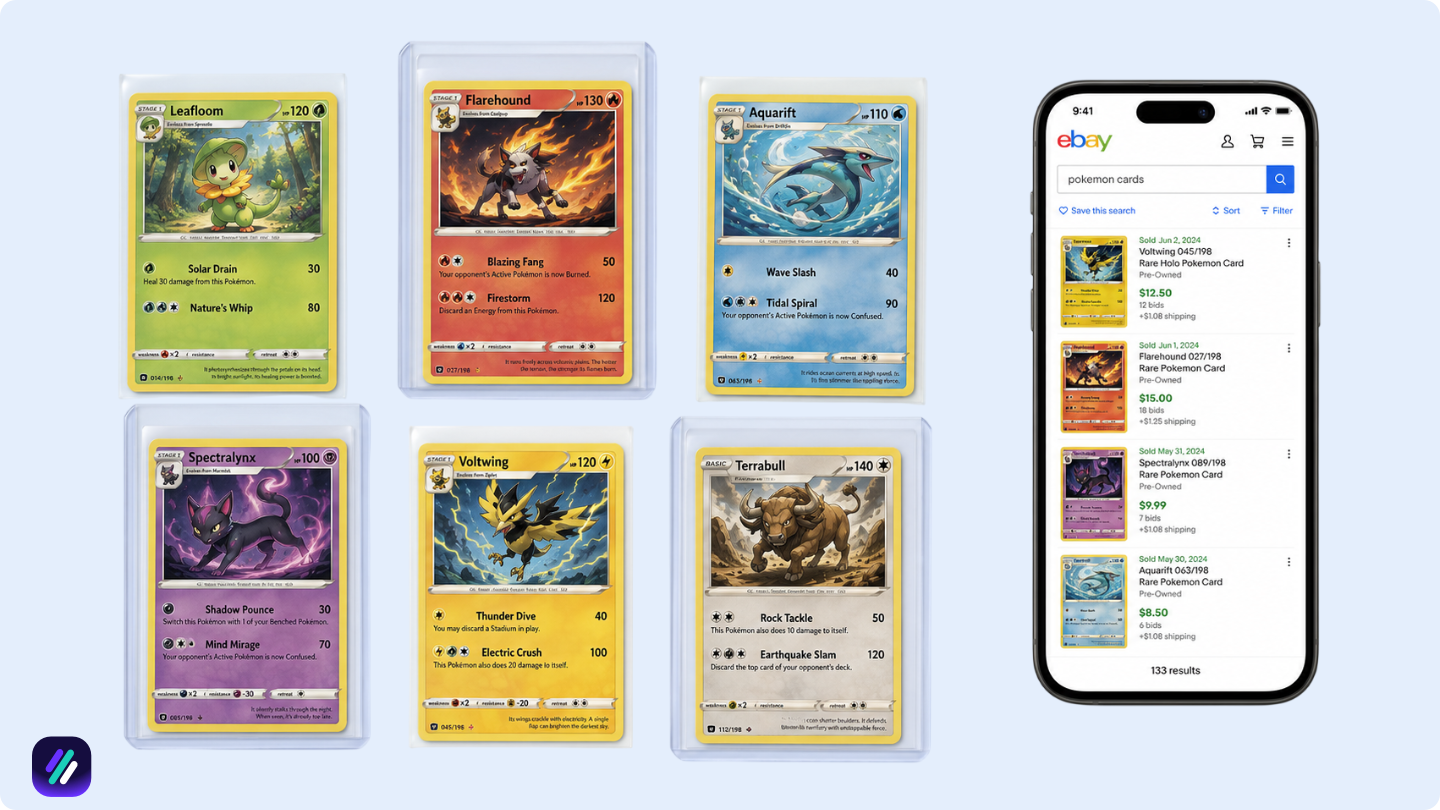
A lot of people sitting on a box of Pokémon cards think the hard part is finding a buyer but tt isn’t.
The hard part is knowing which cards are worth listing on their own, what they should sell for, and how to ship a thin piece of cardboard (not trying to be disrespectful) so it arrives in one piece.
And getting that wrong is how most beginners lose money as they bury a $40 card inside a bulk lot and watch it leave for six dollars, thinking they made a bag!
In this article, I am going to show you how to sell Pokémon cards on eBay, from sorting and pricing to listing, fees, and shipping, using actual sold data instead of guesswork.
Key Takeaways
- The money is in modern singles, not bulk. ZIK Analytics marketplace data shows eBay’s Pokémon market is concentrated in low-to-mid-priced single cards that sell again and again, while generic “mystery lots” mostly race each other to the bottom on price.
- Always check sold listings before you price a card. What a card actually sold for tells you the truth; what other sellers are asking does not.
- List valuable cards on their own and save lots for clearing commons. A single $30 card hidden inside a bulk lot almost always sells for a fraction of its worth.
- Grading only makes sense on a small slice of cards. On anything selling for under roughly ten dollars, the grading and eBay shipping fees usually wipe out the gain.
- Condition accuracy is an account protection. Most “not as described” returns trace back to a seller who called a Lightly Played card Near Mint.
- ZIK Analytics lets you see which sets, artists, and price bands are actually moving before you buy or list, so you build on data instead of hope.

Why Selling Pokémon Cards on eBay Is Worth It
eBay is still the best place to sell Pokémon cards, for one plain reason, and that is the buyers are already there, and so is the price history that tells you what your cards are worth.
The platform reaches around 136 million active buyers and moves roughly $75 billion in goods a year, and trading cards are one of its busiest collectible categories.
For you, that means built-in demand and, just as useful, years of sold-listing data to check before you price anything.
Cards also sit in a sweet spot which most best-selling items on eBay don’t, and three things make them an unusually good fit for the platform:
- They are small, light, and cheap to post, so postage barely dents your margin even on a low-priced card.
- Their prices are transparent because eBay’s sold history shows what a card actually fetched, not what someone hoped.
- Demand repeats, since collectors come back again and again to finish sets rather than buying once and disappearing.
From the data, we can see that the demand is genuine there. After stripping out the bulk and lot noise, ZIK Analytics data on the broad “Pokemon cards” market shows roughly 27,100 active listings from about 3,850 sellers.
Together, they generate close to 34,600 sales and around $300,098 in revenue over a 30-day window, with the median sale near $8.95.
So in our observation, this is a liquid market where cards change hands every day.
That said, the same data carries a warning that most of that money is spread across modest, repeatable sales, not headline-grabbing sales.
Unfortunately, plenty of sellers read “Pokémon is hot” and immediately list a giant mixed lot, which is the one corner of this market where you only ever compete on being the cheapest.
We will come back to why singles beat lots, so hold that thought.
What You Need Before You Start Selling
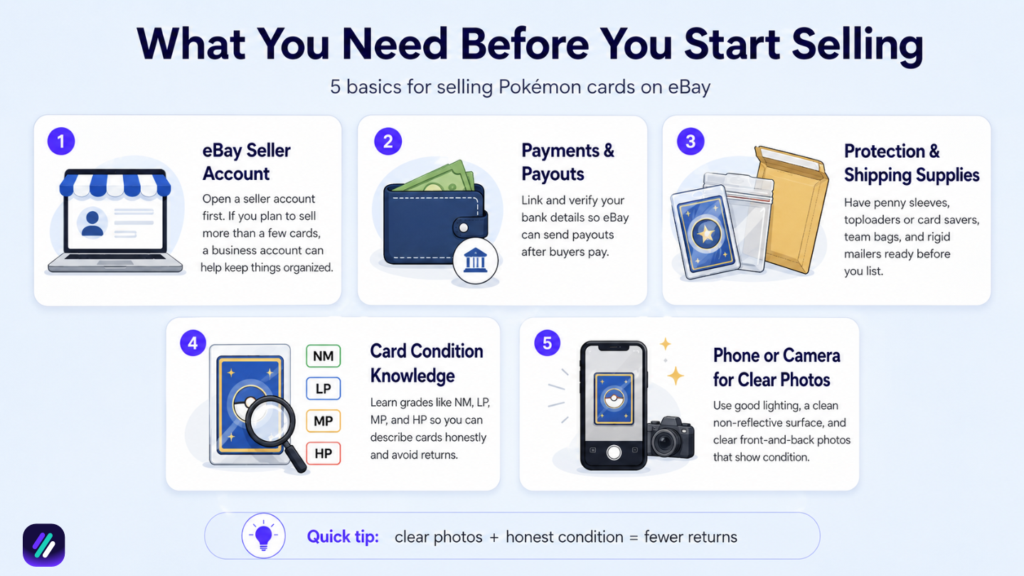
Selling Pokémon cards is not complicated, but a few things need to be in place before your first listing goes live; therefore, sorting these out now means your first sale feels like a routine instead of a stressful situation.
Let me share with you what you need to get started:
An eBay Seller Account
You will need a seller account, which costs nothing to open. If you plan to move more than a handful of cards, you should switch to a business account early, since it is built for higher volume and keeps your bookkeeping cleaner.
If you are brand new to the platform, our how to sell on eBay guide walks through account setup in detail.
Payments and Payouts
eBay handles payments in-house now, so buyers check out on eBay and your money lands in your linked bank account, and you no longer need to plug in a separate PayPal account the way sellers did years ago.
You just need to verify your bank details and identity so eBay can pay you.
Card Protection and Shipping Supplies
Pokémon cards bend, scratch, and crease in the post, so stock up on protection before you sell, not after.
At minimum, you want penny sleeves (thin plastic sleeves), toploaders or card savers (rigid holders), team bags, and stiff cardboard mailers.
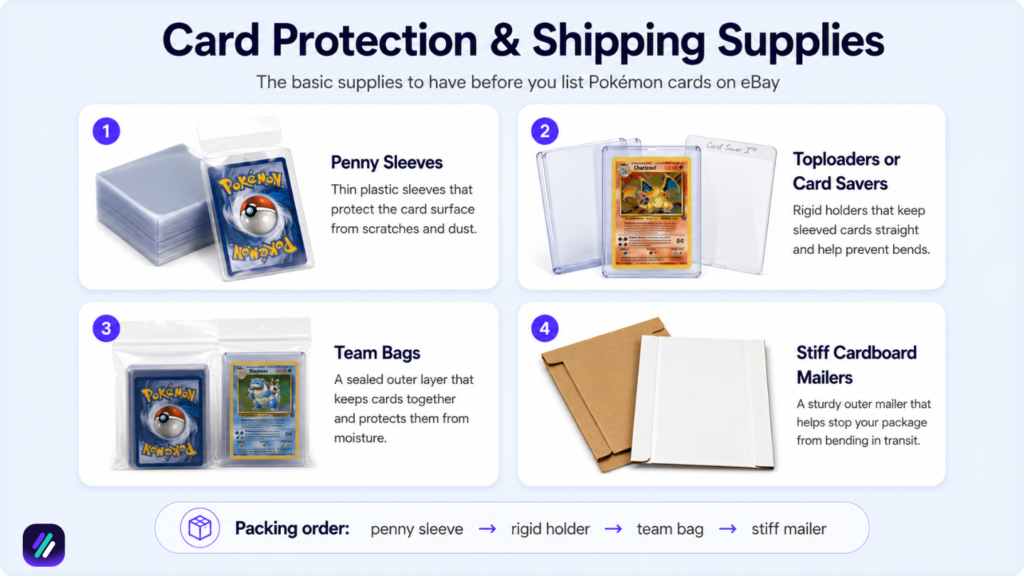
None of it costs much, and it is the cheapest insurance against a damaged-card refund you will ever buy.
A Working Knowledge of Card Conditions
Condition moves price more than almost anything else on a single card, so you need to judge your own cards honestly before you list.
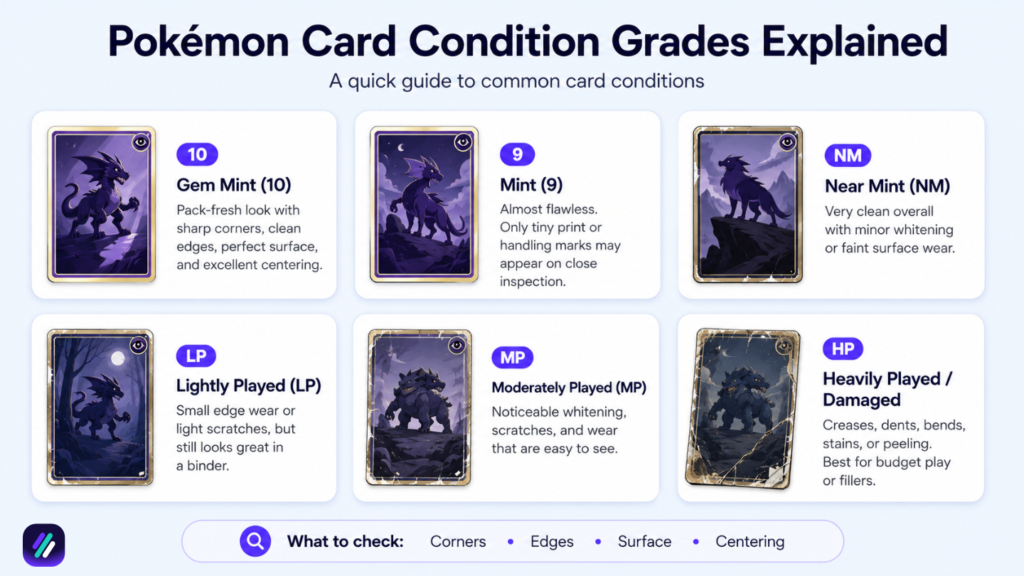
Buyers use shorthand like NM (near mint), LP (lightly played), MP (moderately played), and HP (heavily played), and eBay has its own condition menu for trading cards, too, and you should know that a little edge whitening or one soft corner drops a card a grade, and pretending otherwise is how you collect returns.
A Phone or Camera for Clear Photos
You do not need an expensive camera. A recent phone in good light beats a pricey camera in a dark room every time. A camera light with maybe a photo box to take the pictures can go a long way in helping you get sales.
What you do need is a clean, non-reflective surface and even lighting, because holo and reverse-holo cards throw glare that hides the exact scratches a buyer will notice the second the card arrives.
With those five basics in place, you are ready to work out which of your cards actually deserve their own listing.
Should You Grade Your Cards Before Selling?
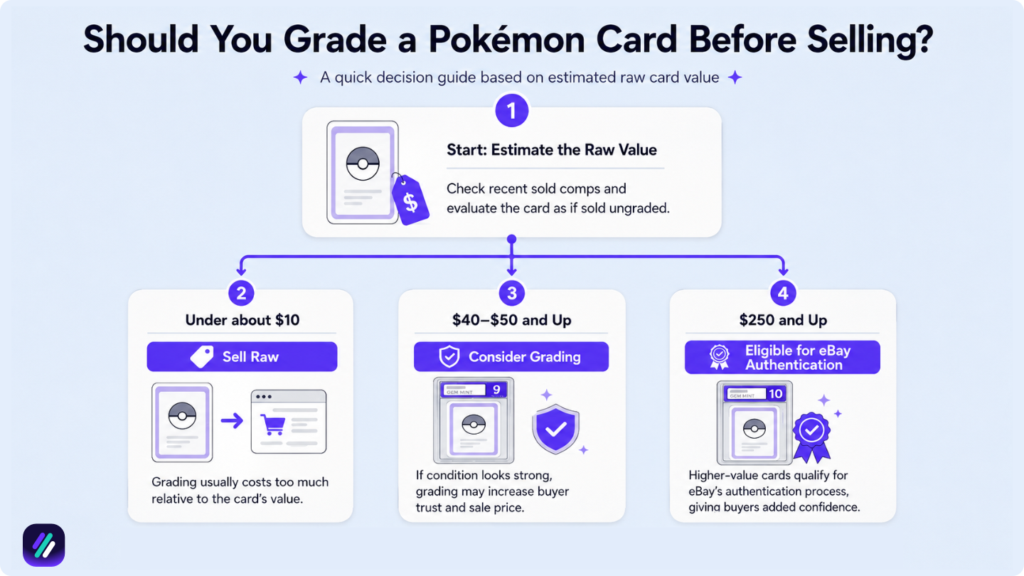
You should only grade a card when its raw value is high enough that a strong grade multiplies it, usually above $40 to $50. For the cheap modern singles that fill most collections, grading fees and wait times eat the gain, so sell those raw with an honest condition description.
Grading means sending a card to a company like PSA, which authenticates it, judges its condition on a 1-to-10 scale, and seals it in a tamper-evident case.
A clean grade on the right card can lift its value sharply, but as you can probably guess, grading costs money per card and can take weeks or months, and a low grade can leave you worse off than selling raw.
So the math only works at the top of the value range.
For example, on a $5 card, a grading fee is bigger than the overall selling price, which guarantees a loss, while on a genuine chase card, the same fee can pay for itself many times over.
There is a trust angle here, too, and it has grown more important. According to the PSA Fraud Report, counterfeit submissions rose sharply year over year, with Pokémon fakes climbing fastest of all, and the fakes are harder to spot than they used to be.
Therefore, for high-value raw cards, the buyer’s nervousness is exactly why authentication helps you.
This is where eBay does some of the work for you.
Through eBay’s Authenticity Guarantee, single cards listed at $250 or more are routed to professional authenticators before they reach the buyer, which builds confidence in expensive listings.
You should keep in mind it covers single cards only, not sealed boxes, packs, or lots, and eligibility and thresholds differ between eBay marketplaces.
From our in-house eBay sellers at ZIK, the most common grading mistake is paying to grade a card that the market simply does not care about.
The card to grade is the one buyers are searching for, not the one you are emotionally attached to.
How to Identify and Sort Your Cards
The first job when you start selling Pokémon cards is separating the few that matter from the pile that doesn’t.
So you should do this once, properly, and every later step gets faster.
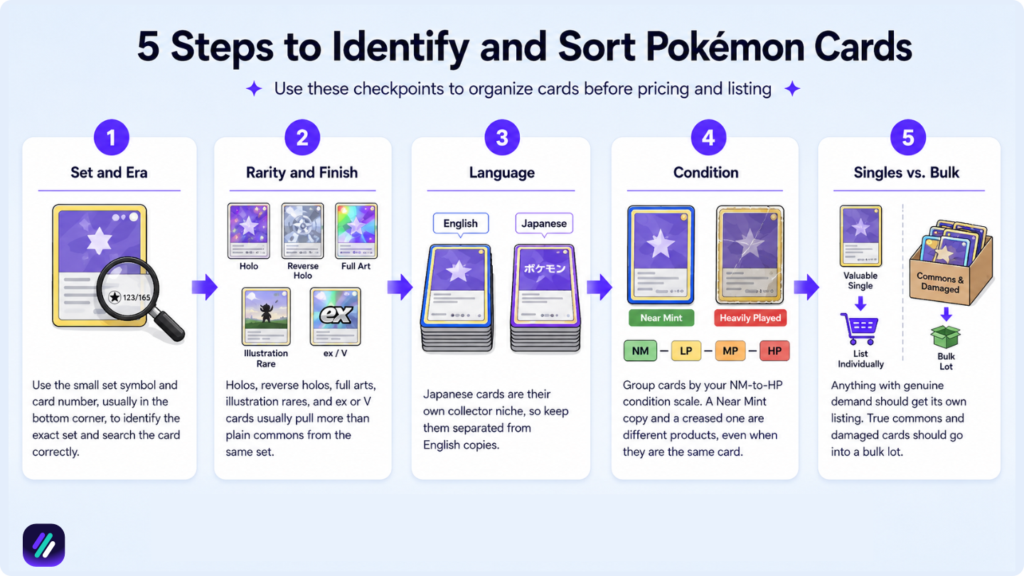
You can sort your cards along the dimensions that actually decide value:
- Set and era: the small set symbol and card number, usually bottom-corner, tell you exactly which set a card belongs to and how to search it.
- Rarity and finish: holo, reverse holo, full art, illustration rare, and ex or V cards pull far more than plain commons from the same set.
- Language: Japanese cards are their own collector niche and often sell separately from English copies, so keep them in their own pile.
- Condition: group by the NM-to-HP scale you set up earlier, because a Near Mint copy and a creased one are two different products, even if they’re the exact same card.
- Singles vs. bulk: anything with genuine demand gets its own listing; true commons and damaged cards go into a lot.
The same sorting logic carries over to other collectibles, so if you also handle sports cards, the workflow in our guide on how to sell sports cards on eBay maps almost one-to-one. Once your piles are sorted, we are ready to price the singles with confidence.
How to Price Pokémon Cards for eBay
One thing I really like about pricing a Pokémon card is that it’s not guesswork, and it is not whatever the highest “Buy It Now” asking price happens to say.
And you can easily find the right price by browsing sold listings of that card, and because Pokémon cards sell a lot on eBay, that shouldn’t be a problem for you.
To check them on eBay directly, you can go to the advanced search, then search for the exact card, including set and number, then filter results to Sold items.
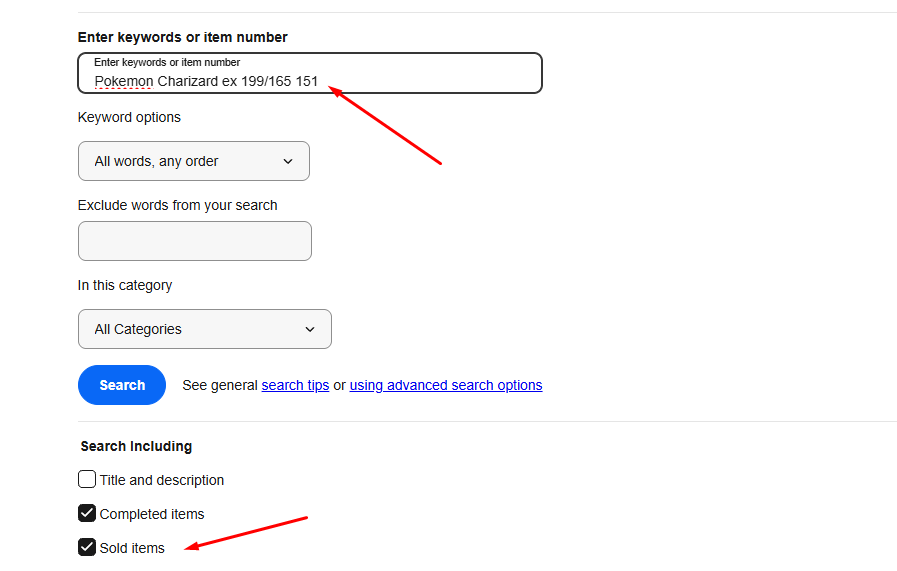
That gives you a list of recent, completed sales rather than hopeful asks. Our walkthrough on how to find sold items on ebay covers the filters in full.
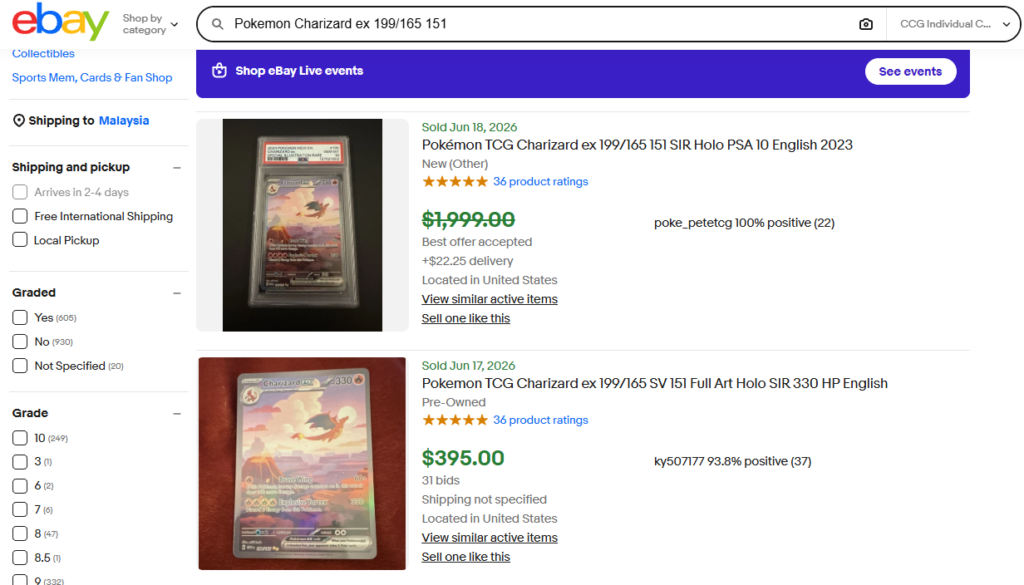
Sold listings tell you the price, but they don’t easily tell you how often a card sells or how much competition you face, so that is where eBay research tools earn their keep.
With the eBay product research tool, you can see a card’s average sold price, its sell-through rate, and how many copies are moving, so you price to actually sell rather than to sit.
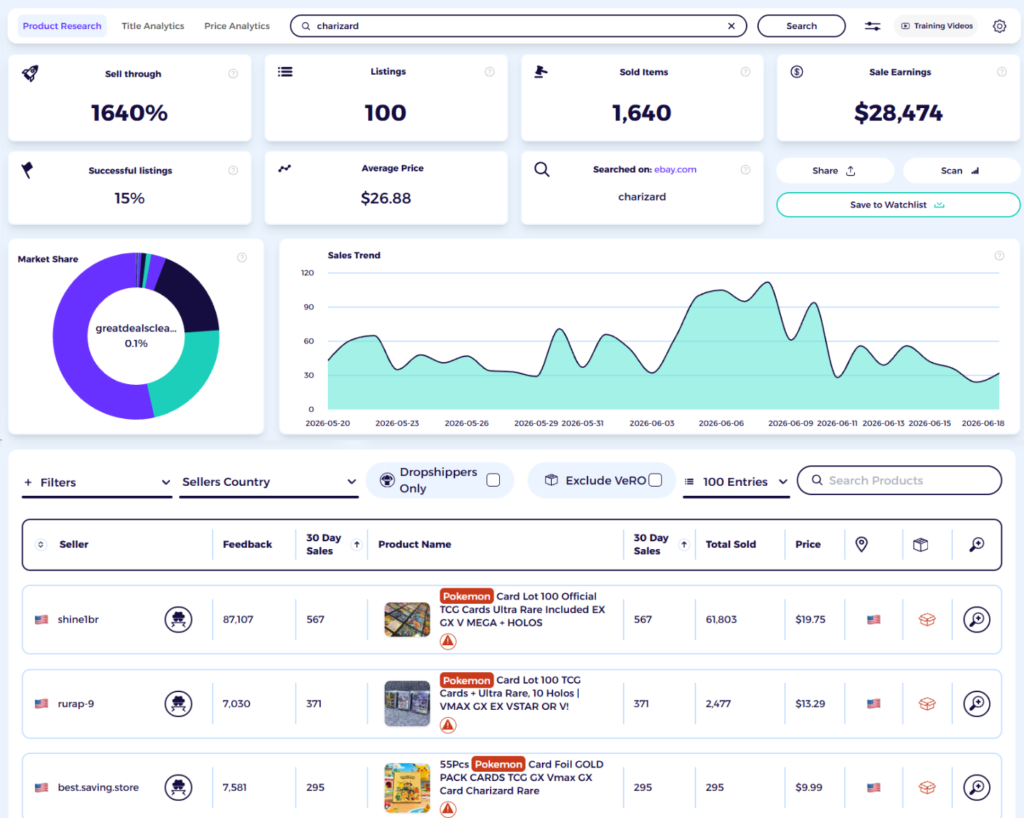
For quick checks while you browse listings, the free tier of the eBay Chrome Extension helps you to quickly find the eBay sold history for all your listings, while with ZIK paid account you’ll get the sales to the sales data.
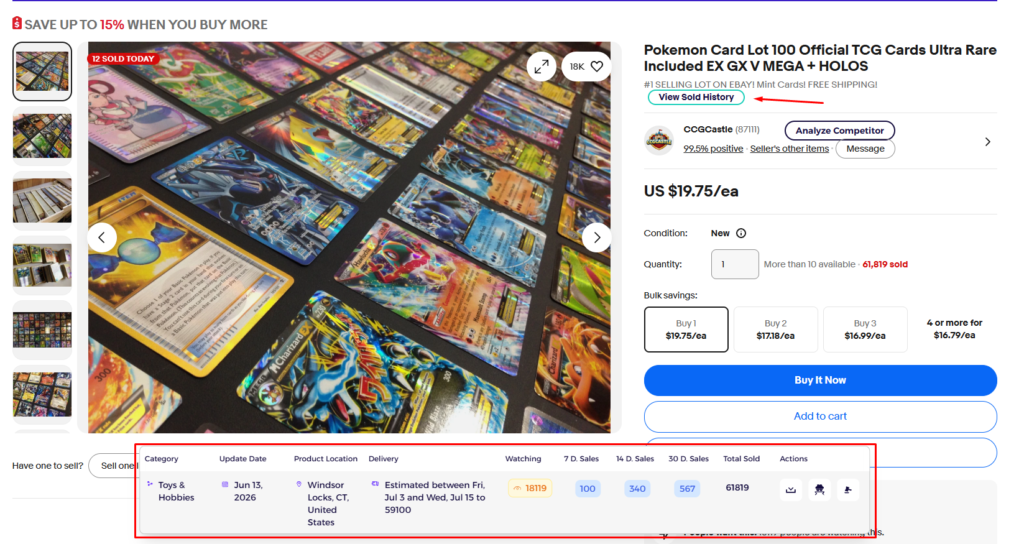
Remember to price against cards in the same condition as yours. A Near Mint sold price means nothing for your Moderately Played copy.
Auction vs. Buy It Now: Which Is Better for Pokémon Cards?
For most cards, use Buy It Now: it lets you set a price from sold data and wait for the right buyer. Auctions are best saved for scarce or hot cards, where competing bidders push the final price past what a fixed listing would get.
A fixed Buy It Now price protects you from selling a good card cheaply on a slow night. Auctions shine only when genuine scarcity sparks competition, which is rare for modern singles.
If you want the full breakdown, our take on ebay buy it now vs auction digs into when each format wins.
How to Photograph Pokémon Cards for eBay
Photos sell the card, especially on singles, where condition is the entire pitch, and a buyer who can see exactly what they are getting is a buyer who does not open a return.
You want even, natural light on a plain, dark, non-reflective background and your own photos, and you definitely shouldn’t use a stock image pulled from Google.
Buyers trust a listing far more when the actual card is staring back at them, so here are a few important things to do to create proper images for your eBay listings.
- Show the front and the back: the back reveals centering and edge wear that the front hides.
- Tilt holo cards slightly: a small angle reveals scratches and lets buyers see the foil pattern honestly.
- Fill the frame: the card should dominate the photo, not float in a sea of carpet.
- Flag any flaw up close: a clear shot of a whitened corner protects you better than a hopeful description.
Honest photos are the cheapest return-prevention tool you have. If you want to go deeper into lighting and framing, our guide on how to take pictures for eBay is a good next stop.
How to Create an eBay Listing for Pokémon Cards
Now that your photos are ready, the listing itself is where buyers find you, and the title does most of the searching work. Buyers hunt for very specific strings, so a strong title packs in the details they type.
A good Pokémon card title front-loads the card name, then the set, the card number, the rarity or finish, and the condition, for example: “Charizard ex 199/165 Scarlet & Violet 151 Special Illustration Rare NM.” Every one of those terms is something a buyer actually searches.
Title formula: card name, then set, card number, rarity or finish, and condition.
And guessing those keywords is where most sellers leave money on the table.
That’s why we have created the eBay Title Builder that shows the actual search terms and competition behind a keyword, so you can optimize an eBay title around what buyers type instead of what you assume.
And ZIK’s eBay title analytics gives you a lot more information, such as best-selling keywords, search volume for relevant keywords, and the eBay title builder to build the title.
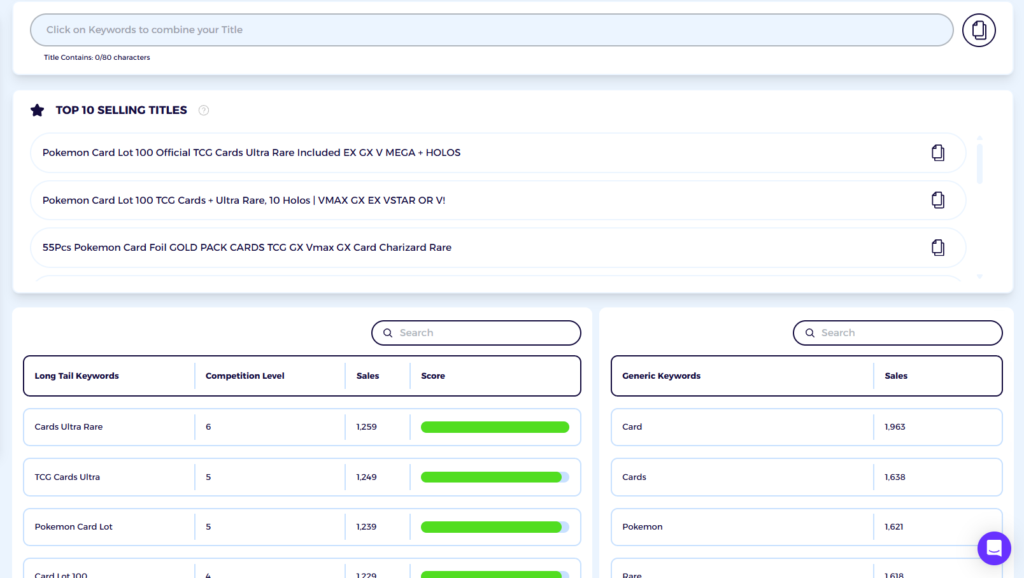
You should also fill in eBay’s item specifics fully, since the card name, set, and grade fields feed search directly.
Your description should stay short and factual: state the condition plainly, mention any flaw you can see, and confirm how you will package and ship.
For more on structuring listings that rank and convert, our guide to eBay listing optimization covers the details.
How to Calculate eBay Fees for Selling Pokémon Cards
On a typical Pokémon card sale, plan to hand roughly 13% back to eBay before you even count postage. Pricing as if the whole sale price is yours is how thin-margin cards turn into losses.
For trading cards, eBay charges a 13.25% final value fee on the total amount of the sale up to $7,500, plus a flat $0.40 per order on orders over $10.
That percentage is calculated on the item price and the shipping you charge, not just the card.
A quick example to better help you understand this:
- A $20 card with $1 shipping means a $21 total. The fee is about 13.25% of $21, near $2.78, plus the $0.40 order fee, so roughly $3.18 goes to eBay.
- Your label still comes out of what’s left, so on a cheap card, the postage and fees together can swallow most of the sale.
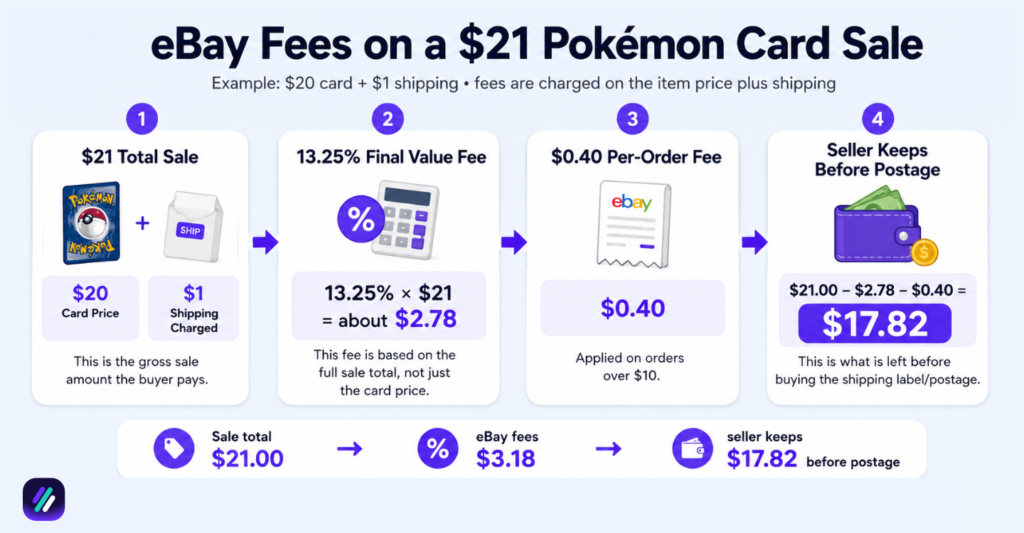
To model this before you list, the eBay fee calculator lets you plug in a price and see your true take-home.
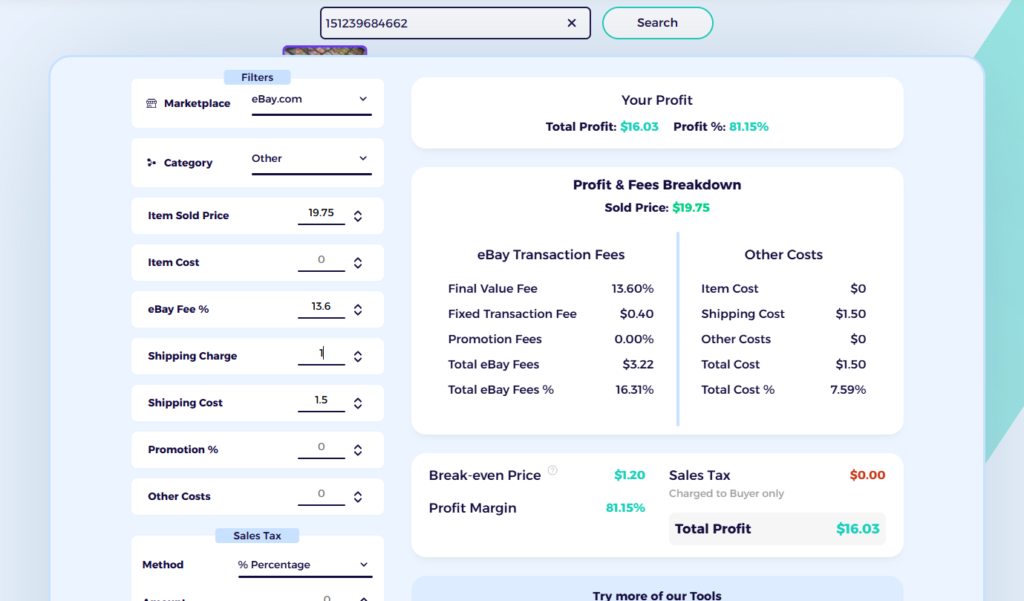
One thing to point out: these figures are for eBay.com in the US and UK, and final value fees, per-order charges, and thresholds vary by marketplace, so check your local eBay fee page if you sell elsewhere.
How to Ship Pokémon Cards Sold on eBay
Shipping is the step beginners underestimate, and it is where a five-star sale turns into a refund request if you cut corners.
The good news is that protecting a card properly costs cents, not dollars, and it greatly reduces returns and buyer complaints, and possibly gives you negative feedback, ruining your eBay profile.
The standard method stacks protection in layers:
- Penny sleeve first: slide the card into a thin plastic sleeve so nothing rubs the surface.
- Then a toploader: drop the sleeved card into a rigid holder, and tape the toploader closed, never the card itself.
- Seal it in a team bag: the resealable bag keeps moisture and tape residue away from the card.
- Finish with a stiff mailer: a rigid envelope stops the package from bending on its way through the post.
For cheaper cards, a plain white envelope keeps postage low, but anything valuable should travel in a bubble mailer with tracking so you have proof of delivery.
You want to ship fast, ideally within one business day, and quick dispatch is one of the simplest ways to earn good feedback.
Our full guide on how to ship on eBay covers labels and tracking options.
How to Avoid Damaged Cards During Shipping
The cards that arrive damaged are almost always the ones that could slide around in the envelope.
So the fix here is relatively simple: the toploader goes between two pieces of stiff cardboard, taped so nothing moves in transit.
A “Do Not Bend” note on the envelope helps, and for valuable cards, pay for tracking and a rigid mailer rather than hoping a thin envelope survives the sorting machines. A buyer who opens a perfectly packed card remembers it, and that is how repeat customers start.
How to Build Your eBay Seller Reputation
Your feedback score is the first thing a nervous buyer checks before paying a stranger for a card they can’t hold.
That’s why a strong reputation lets you charge a little more and sell a little faster, so it is worth protecting from day one.
And the habits that help you to build it are not complicated:
- Describe the condition accurately, even when it costs you a grade, because an honest LP listing beats a disputed NM one.
- Ship quickly and pack well, since fast, undamaged deliveries are what turn into glowing feedback.
- Answer messages promptly, because a quick, friendly reply often stops a problem from becoming a return.
- Handle the rare dispute calmly, as a smooth refund can still leave a buyer willing to come back.
Based on our eBay sellers at ZIK, the fastest way to sink a new card-selling account is a cluster of condition disputes in the first month, when you have no track record to absorb them and eBay will trust the buyer more likely than you.
For more habits that compound over time, our eBay selling tips guide is a useful companion.
Best Pokémon Cards to Sell on eBay
Most guides tell you to chase Charizards, but our data tells a different story.
After filtering out the bulk and lot noise, ZIK Analytics data on a focused Pokémon dataset shows about 27,100 active listings generating roughly 34,600 sales and around $300,098 over a 30-day window, with the median sale near $8.95.
More telling, about 14,700 of those 27,100 listings (54.2%) sit under $10 and 18,600 (68.6%) under $25, and roughly 66.8% showed recorded sales activity.
In other words, this market is won by low-to-mid-priced singles with repeatable demand, not by one expensive listing.
These are the categories where the steady money actually sits:
- Modern singles in “Choose Your Card” format. These multi-variation listings, often priced around $1.49 to $2.99, are the clearest winners in the data because buyers come back to complete sets. They are not high-ticket, but they are the most scalable thing you can sell.
- Current-set illustration rares. Interest is riding the 2025 release cycle. Scarlet & Violet: Journey Together arrived March 28, 2025, and Black Bolt and White Flare launched July 18, 2025 featuring every Pokémon from the Unova region, which feeds strong demand for fresh art-driven singles.
- Artist-themed singles. Names like Tomokazu Komiya, Yuka Morii, and Asako Ito act like keyword niches in the data. Collectors search the artist, so grouping cards by artist beats listing them as generic “Pokémon cards.”
- Character-family singles. Listings built around a line, such as the Dragonite family or the Eeveelutions, pull strong, focused search intent. The Eevee-focused Prismatic Evolutions set, released January 17, 2025, keeps that niche especially active.
- Japanese singles and promos. In the broader dataset, Japanese inventory and promo cards show up repeatedly among top performers, and they often sell separately from their English equivalents at healthy prices.
- Strong set-specific singles. Recognizable sets carry their own search demand, from Scarlet & Violet: 151, released September 22, 2023 around the original Kanto roster, to the Team Rocket-themed Destined Rivals, released May 30, 2025.
- Sealed product, treated as its own business. Booster packs like VSTAR Universe and sealed boxes do generate revenue in the data, but sealed is a different model: higher average order value, lower listing volume, and far more capital tied up per unit.
This is how the main card categories compare at a glance:
| Card category | Typical price band | Why it sells on eBay |
|---|---|---|
| Modern “Choose Your Card” singles | Roughly $1.49 to $2.99 each | Repeat, set-completion buyers; the most scalable volume play |
| Current-set illustration rares | Mid-range, climbs with hype | Ride the newest 2025 releases and art-driven demand |
| Artist and character-family singles | Low to mid-range | Sharp, specific search intent that generic listings miss |
| Sealed product | Higher ticket | Bigger order value, but slower turnover and more capital risk |
This list is not exhaustive, and a couple of niches reward extra attention.
Retailer and prerelease promo cards tied to new launches tend to spike for short, profitable windows, and reverse-holo “complete your set” singles do steady work for collectors filling binders.
One honest caution on vintage and graded cards: they can reach far higher prices, but with counterfeits rising, they demand serious authentication know-how, so they suit experienced sellers more than first-timers.
Download this eBook now and learn how to sell on eBay like a pro.Where to Find Pokémon Cards for Reselling on eBay
Once you know what sells, the next question is where to buy it cheaply enough to start reselling on eBay. The cards are out there, but margin lives in how you source, not just what you list.
The most reliable sources stack up like this:
- Your own collection first, since the lowest-risk inventory is the cards already sitting in a box at home.
- Local card shops and conventions, where you can inspect the condition in person and sometimes negotiate on slower stock.
- Retail restocks at big-box stores are useful for sealed products when a hot set lands, though stock moves fast.
- Collection buyouts from estate sales, garage sales, and local marketplace listings, which are where genuine bargains still hide.
To know which sources are paying off, study what the top card sellers in your niche are actually moving.
You can run a successful seller’s username through the eBay competitor research tool, which shows their revenue, sell-through, and best-selling products, so you can stock toward proven demand.
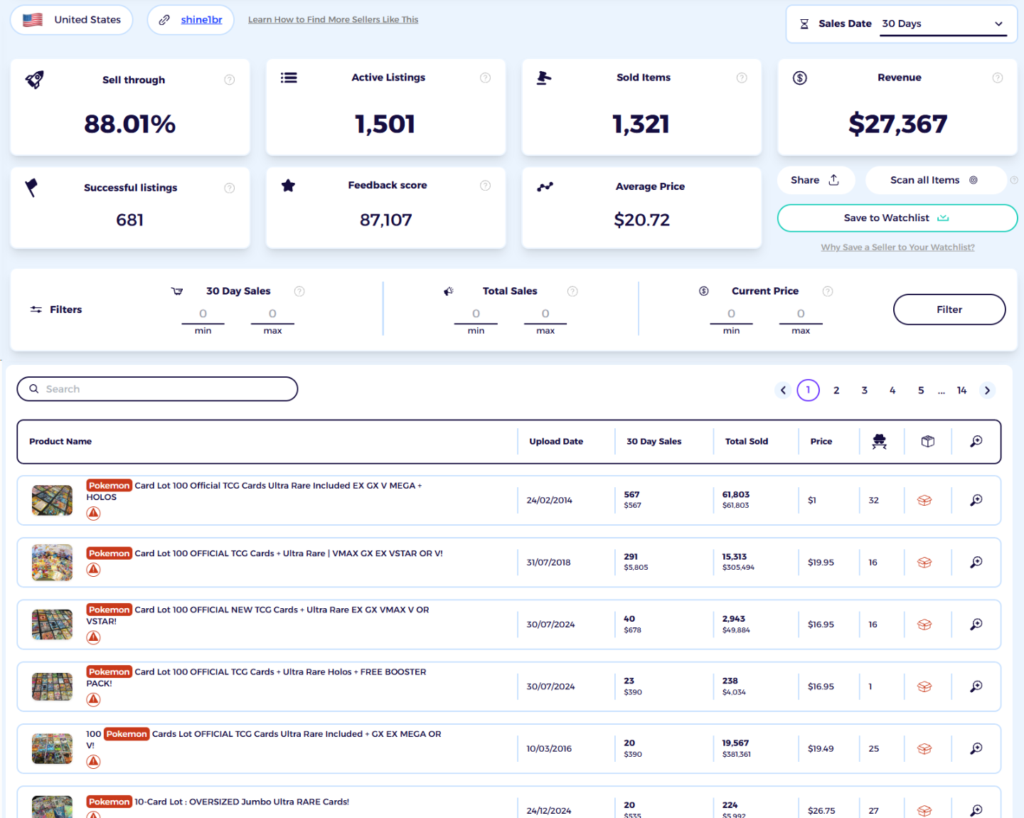
From our in-house sellers at ZIK, the resellers who last are usually the ones buying collections in person, where the best margins survive.
If you want to treat this as a repeatable income stream rather than a one-time clear-out, our guide to flipping on eBay goes further on building a sourcing system, and our breakdown of eBay competitor analysis digs into reading what your rivals stock and how fast it moves.
Conclusion
Selling cards on eBay rewards the patient over the lucky. The seller who sorts carefully, prices off sold data, photographs honestly, and ships like the card matters will out-earn the one chasing a single big hit every time.
The market is liquid and getting more visible to buyers, which cuts both ways: it is easier to sell, and harder to overcharge on something a buyer can price-check in seconds.
So your first dozen sales are really just training. You will learn which sets move in your hands, how buyers in your niche behave, and where your packaging needs tightening.
Once those reps are in and your condition descriptions stay honest, a binder you once thought of as clutter becomes a small, repeatable business you actually control.
Find the Best-Selling Pokémon Cards on eBay with ZIK Analytics
Everything in this guide comes back to one habit: deciding from data instead of hope. That is the part ZIK Analytics handles for you:
- Use the eBay Product Research Tool to see actual sold prices, sell-through, and how often any card, set, or keyword sells before you list it.
- Run a top card seller’s username through the eBay Competitor Research Tool to see their revenue, sell-through, and best-selling products, then stock toward what already works.
- Build keyword-rich titles with the eBay Title Builder using the artist, set, and rarity terms buyers actually search for.
You can try all of it on a $1 trial that runs for 7 days. See what’s actually selling first, then spend on inventory with confidence instead of guesswork.
How to Sell Pokémon Cards on eBay FAQs
A few quick answers to the questions sellers ask most often:
Is eBay a good place to sell Pokémon cards?
Yes. eBay combines a huge active buyer base with transparent sold-listing history, which means genuine demand and easy price checking in one place. Trading cards are one of its most active collectible categories, so single Pokémon cards, especially modern singles and recognizable sets, find buyers quickly when they are priced based on actual sold data.
What is the best way to sell my Pokémon cards?
The best way to sell Pokémon cards on eBay is to list anything with genuine demand as its own Buy It Now listing priced from sold data, and bundle only commons and damaged cards into lots. Singles capture full value; lots are for clearing the rest. Accurate condition and clear photos do the heavy lifting.
What is eBay’s fee for selling Pokémon cards?
For trading cards on eBay.com, the final value fee is 13.25% of the total sale up to $7,500, plus a $0.40 per-order fee on orders over $10. It applies to the item price plus shipping. Fees vary by marketplace, so confirm your local rate and model your take-home with a fee calculator first.
Is it better to sell Pokémon cards individually or in lots?
Sell valuable or in-demand cards individually, and use lots only for low-value commons. A single sought-after card almost always earns more on its own than buried in a bulk lot, where buyers expect a discount. Lots are useful for moving volume you would otherwise never list one by one, but not for hidden gems.
How do I avoid condition “not as described” returns?
You avoid them by describing the condition honestly using standard grades, photographing both sides, and showing any flaws up close. Most disputes come from optimistic grading, not genuine defects. When in doubt, grade a card down rather than up. Our guide to the eBay return policy explains how returns work.
What other items can I sell on eBay?
Wondering what to sell on eBay? We have a few detailed guides that can help you on your way!