

Most answers to whether dropshipping is still profitable fall into one of two camps, and both are wrong. I am going to tell you why.
One side swears it is easy money you can run from a beach with one eye on whatevel else, while the other says it died years ago and only course-sellers profit.
If you trust the first, you waste your ad budget on a dud, and if you trust the second, you skip a model that still pays people every day, with many having it as a full-time income, far exceeding normal salaries.
So the short answer to the question “Is dropshipping still profitable?”, up front: yes, dropshipping is still profitable in 2026, but it rewards operators who treat it like a business.
In this article, I will walk you through the actual margins, startup costs, earnings, and timelines behind it.
Key Takeaways
- Yes, dropshipping still turns a profit, but on thin net margins of 15% to 20%, so volume and cost control decide whether you keep any of it.
- Beginners commonly do $1,000 to $2,000 a month in revenue, and the climb to actual take-home profit comes from systems and repeat products, not one viral win.
- Startup costs are low but never zero. A realistic budget runs $250 to $1,000 a month once tools, product samples, and ad testing are counted.
- Most failed stores die from the same three things: weak product research, a slow or unreliable supplier, and paying for ads before the offer is proven.
- The market itself is still growing at a double-digit clip, so the constraint is execution, not demand.
- Before you list anything, validate demand with a research tool like ZIK Analytics, which shows actual sell-through and competition on a product instead of a hunch.
Dropshipping Market Size in 2026
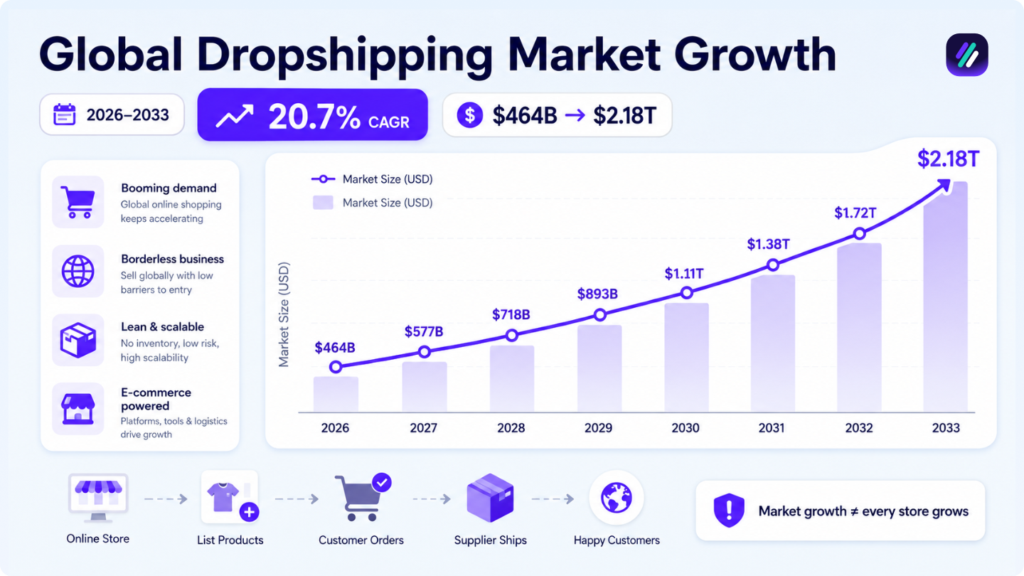
The size of the prize settles one myth on contact. The global dropshipping market is valued at roughly $464 billion and is projected to reach $2.18 trillion by 2033, a compound annual growth rate (CAGR) of 20.7%. A market expanding at 20% a year is not a dying one.
So when someone tells you the model is saturated, what they usually mean is that the lazy version is saturated.
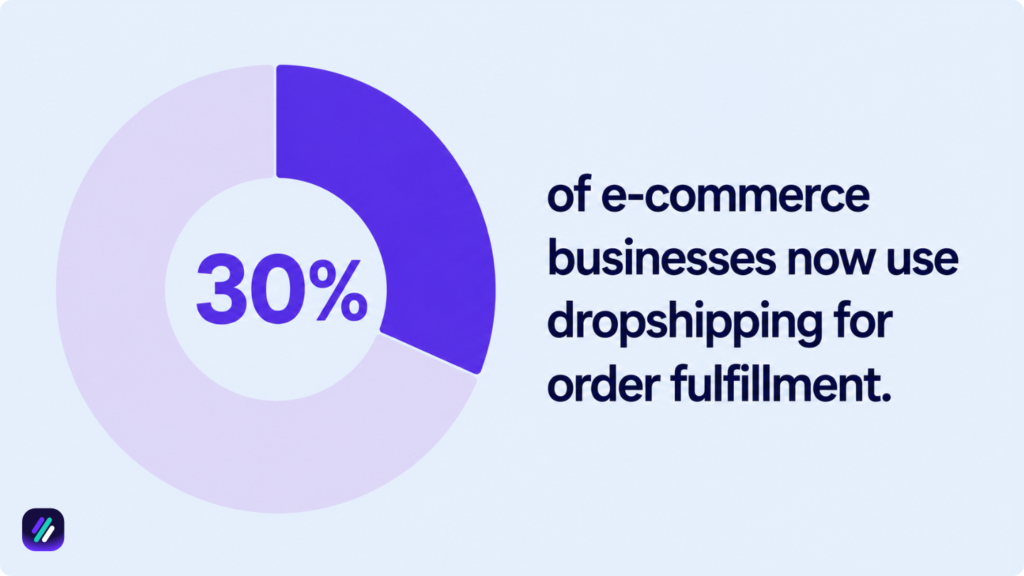
In fact, more than 30% of e-commerce businesses now use dropshipping for order fulfillment.
Demand keeps climbing because more buyers shop online every year, and more suppliers are willing to ship single units on demand.
However, you should realize that market growth does not equal your growth!
A bigger pie pulls in more sellers, too, which is why dropshipping statistics on store survival look nothing like the rosy market chart.
The opportunity is there, and your share of it is earned product by product and through genuine work.
A market compounding north of 20% a year rewards the sellers who pick the right product and out-execute everyone chasing the same trend.
How Much Do Dropshippers Make?
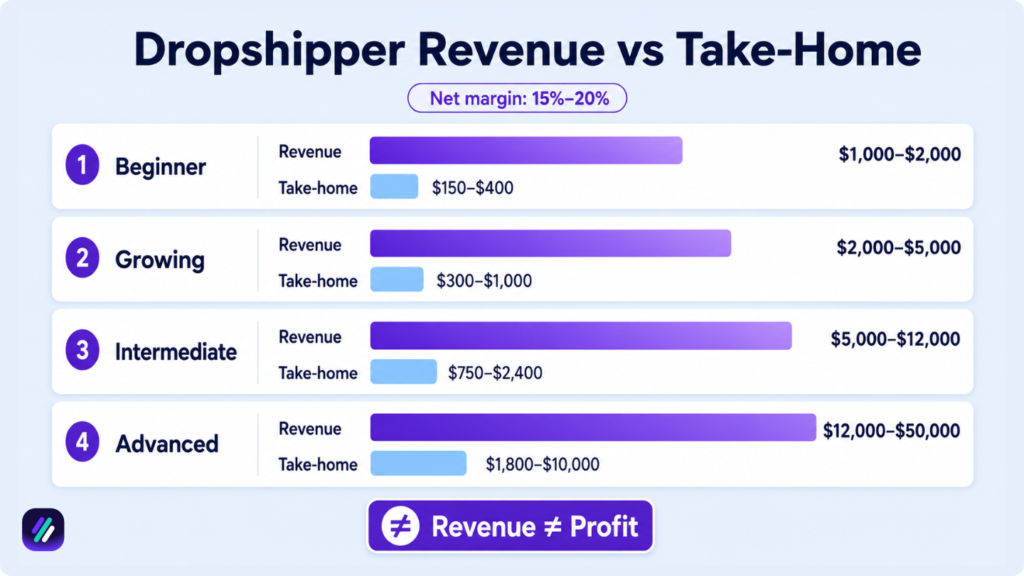
Most dropshippers earn $1,000 to $2,000 a month in revenue as beginners, climbing to $12,000 to $50,000 once they reach an advanced level. But revenue is not profit. After costs, the take-home is the 15% to 20% net margin sitting on top of those numbers.
Income scales in fairly predictable bands. A ZIK Analytics survey and data of store owners maps roughly to this:
| Seller level | Typical monthly revenue | What is usually true at this stage |
|---|---|---|
| Beginner | $1,000 to $2,000 | Still hands-on with product research, supplier checks, and first ad tests |
| Intermediate | $2,000 to $12,000 | A few proven products, basic systems, and most profit getting reinvested |
| Advanced | $12,000 to $50,000 | Multiple winners, automation, often a virtual assistant or small team |
| Small ecommerce store | $100,000 to $1M | A blend of dropshipping and held inventory, with a genuine brand |
| Medium ecommerce store | $1M to $5M | Operations, staff, and negotiated supplier contracts |
| Large ecommerce store | $5M+ | Effectively a company, not a side hustle |
By an e-commerce store here, we mean a mix of dropshipping and traditional stocked-inventory selling, not pure dropshipping.
The jump between Advanced and a small e-commerce store is the next natural stage of every dropshipping store.
That gap is usually where pure dropshipping turns into a blended model, mixing the best dropshipped products with inventory you hold and a brand customers recognize.
Now the part that actually matters. At a 15% to 20% net margin, an intermediate store doing $8,000 a month is keeping somewhere around $1,200 to $1,600, not $8,000.
You should keep that in mind, because the margins section is where this number gets decided.
How Much Does It Cost to Start Dropshipping?
You can start dropshipping on a $250 to $400 a month budget, with $500 to $1,000 a month to buy a comfortable room to test. Most of that budget is ad spend, not tools or fees, which is exactly why undisciplined testing sinks beginners.
A ZIK Analytics survey of 441 sellers landed on those numbers. So here is where the money actually goes:
| Where the money goes | Minimum start | Comfortable start |
|---|---|---|
| Selling platform | eBay listing fees, or a basic Shopify plan | Same, plus a paid theme and a few apps |
| Product research tool (ZIK Analytics) | From $19.9/mo monthly | A PRO or PRO+ plan for deeper data |
| Supplier samples | A couple of test orders | More samples across several products |
| Ads and testing | The largest single cost, kept small and tight | Scaled up only as winners appear |
| Domain, apps, email | Bare minimum | A little more for branding |
| Typical total (ZIK survey of 441) | $250 to $400 / month | $500 to $1,000 / month |
And the read on this table is simple: ads are the line that drains most beginners.
You do not need a big budget, but you do need a disciplined one. That is enough to follow a full how to start dropshipping business plan without cutting corners that get stores banned or burned.
How Long Does it Take to Make Money from Dropshipping?
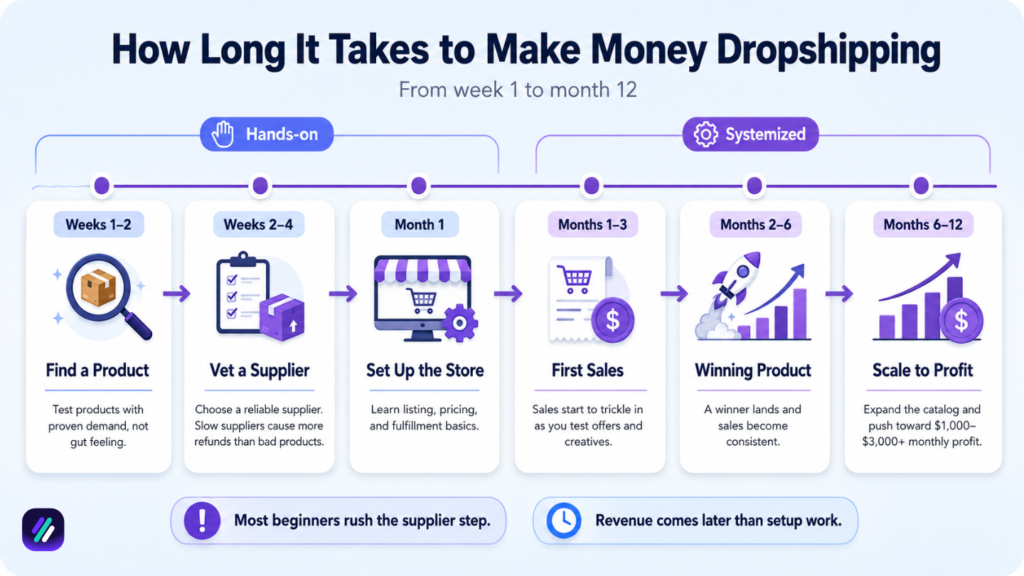
A realistic timeline runs 2 to 6 months to land a winning product with consistent sales, then 6 to 12 months to reach $1,000 to $3,000+ in monthly profit. Anyone promising week-one riches is selling you a course, not a business.
So a ZIK Analytics survey of 870 dropshippers maps the path stage by stage:
- Weeks 1 to 2: find a product worth testing, with proven demand rather than a gut feeling.
- Weeks 2 to 4: find and vet a reliable supplier, the step most beginners rush. Slow dropshipping suppliers cause more refunds than bad products do.
- Month 1: set up the store and learn the basics of listing, pricing, and fulfillment.
- Months 1 to 3: first sales start to trickle in as you test offers and creatives.
- Months 2 to 6: a winning product lands and sales become consistent.
- Months 6 to 12: you expand the catalog and push toward $1,000 to $3,000+ in monthly profit.
From our in-house dropshipping team at ZIK, the sellers who last are the ones who treat supplier vetting as job number one, not an afterthought to patch later.
Remember that the timeline only holds if the supplier behind your winning product can keep up when orders spike.
What are the Average Dropshipping Profit Margins?
The typical dropshipping net profit margin runs between 15% and 20% once every cost is subtracted, based on TrueProfit’s analysis of more than 1,200 stores. Gross margins look far healthier, but ads, fees, and refunds eat most of that gap before the money reaches you.
So the distinction matters. Gross profit margin is what is left after only the product cost. Net profit margin is what is left after everything else gets its cut.
Here is what eats the gap:
| Cost that eats the gap | Why does it add up |
|---|---|
| Product cost (COGS, cost of goods sold) | The supplier’s price, usually your single biggest line item |
| Advertising | For paid-traffic stores, often the largest cost of all; a weak ad swallows the whole margin |
| Payment processing | A cut of every order taken by the payment gateway |
| Returns and refunds | Lost product cost plus shipping, and chargebacks when it goes wrong |
| Platform and app fees | Marketplace final-value fees, or Shopify and app subscriptions |
In contrast, traditional retailers run even thinner.
General retail’s average net margin sits near 5.6%, according to NYU Stern data.
So, a well-run dropshipping store at 15% to 20% is not low-margin by retail standards, but it only feels low because the gross number looked so fat first.
This is also the moment to look at your numbers before scaling. The eBay product research tool shows a product’s actual sell-through and competition, so you can see whether the margin survives once ad costs land on top.
Gross Margin vs Net Margin: Why the Difference Decides Everything
Gross margin flatters you, and net margin pays you. Confusing the two is the single most common way dropshippers and sellers fool themselves into scaling a loser.
Below is an illustrative worked example, not storing data, on a single $30 sale:
| On a $30 sale | Gross view | Net view (reality) |
|---|---|---|
| Revenue | $30 | $30 |
| Product cost | minus $12 | minus $12 |
| Ads | not counted | minus $8 |
| Fees and processing | not counted | minus $3 |
| Returns reserve | not counted | minus $1.50 |
| Left for you | $18 (about 60% gross) | about $5.50 (roughly 18% net) |
If you change one input, the ad cost, a healthy-looking 60% gross collapses toward break-even. A bundle or a second item lifts the average order value (AOV), and trimming the cost per sale moves the net figure fast in the other direction.
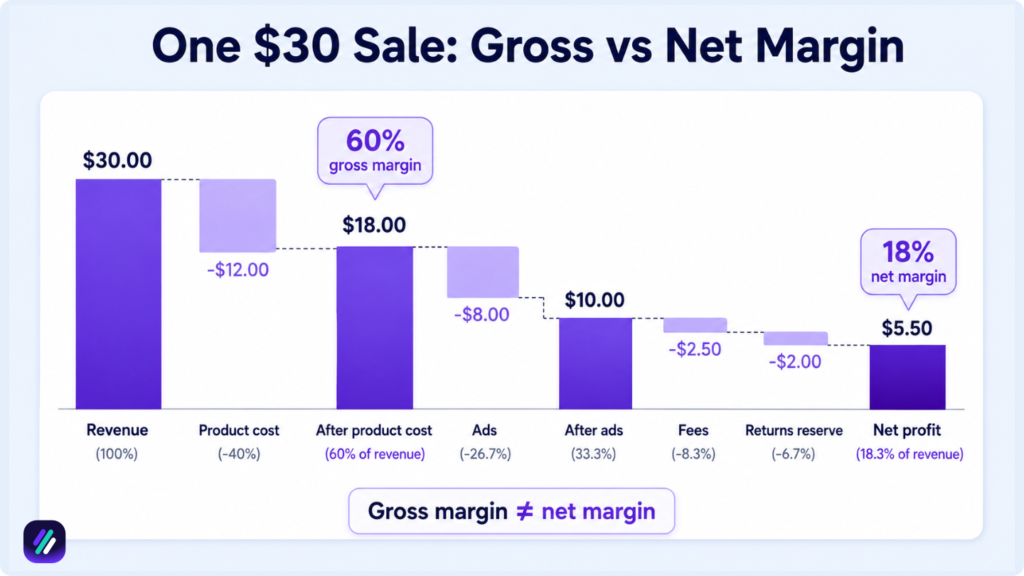
So you should run any product through a profit margin calculator before you trust the gross number, because the gross number is the one that gets people into trouble.
3 Types of Dropshipping Models
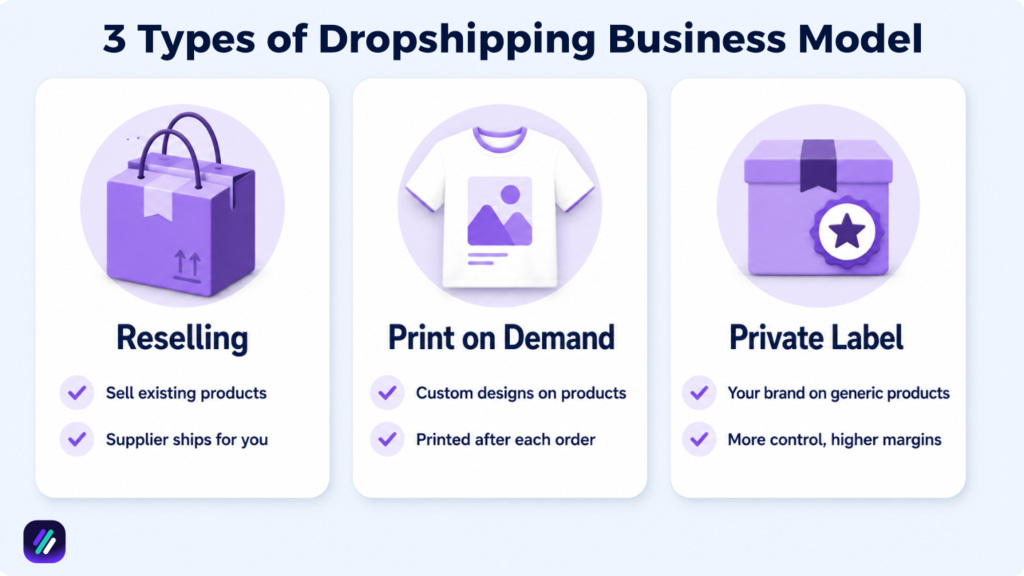
Profitability also depends on which version of dropshipping you are actually running. There are three common models, and they pay and fail in different ways, so let me break them down for you:
Marketplace Dropshipping
You sell on a marketplace that already has buyers, which removes the hardest part, traffic. eBay dropshipping is the classic entry point because demand, trust, and search traffic already exist, so you can validate a product without paying for a single click.
The tradeoff is thinner margins and strict platform rules you do not control. Demand is handed to you, so the game becomes picking products that buyers already search for.
Own Store Dropshipping
Here, you run your own Shopify or WooCommerce site, which hands you full control of branding, pricing, and the customer relationship, but nobody arrives unless you bring them, so Shopify dropshipping lives or dies on paid ads and offering quality.
The ceiling is higher than a marketplace, and so is the risk, since every visitor costs money until your funnel proves itself.
Social Commerce Dropshipping
This model runs on impulse buys from TikTok, Facebook, and Instagram, where a scroll-stopping video sells the product before the buyer ever searches for it. It is creative-led, so the winning skill is making content that converts, not just sourcing.
So validation here means studying what already sells. The AdSpy Tool surfaces the exact ads and advertisers pulling sales right now, so you model proven creatives instead of guessing.
Dropshipping vs Other Ecommerce Models: Where Does Profit Compare?
Dropshipping offers lower margins than print on demand or private label, but the lowest upfront cost and the fastest path to a first sale of any ecommerce model. It is the cheapest place to learn what sells before you commit serious capital.
Most comparisons stop at “dropshipping versus traditional retail,” which is lazy, because that is not what you are actually choosing between.
So here is how it stacks up against the models people genuinely weigh:
| Model | Upfront cost | Typical margin | Control and main risk |
|---|---|---|---|
| Dropshipping | Low | 15% to 20% net | Low control over shipping and stock; easy for rivals to copy |
| Print on demand (POD) | Low | 20% to 40% net | Niche-limited and slower to fulfill |
| Amazon FBA (Fulfillment by Amazon) | High (buy stock) | Roughly 15% to 20% net | Fees plus capital tied up in inventory |
| Affiliate marketing | Very low | 5% to 30% commission | No product to run, but no asset you own either |
| Own inventory / private label | High | Higher gross, capital-heavy | Genuine stock risk if it does not sell |
A few of those numbers deserve their source.
Print-on-demand margins typically run 20% to 40% net. Amazon FBA sellers mostly run above 10% margins, with roughly 28% clearing 20%, per Jungle Scout’s seller survey.
Affiliate marketing pays a 5% to 30% commission with no inventory, but no store you own at the end, either.
So who is each model for?
Dropshipping suits the person who wants to test products fast with little capital, FBA suits someone with cash who wants to build a branded product, and affiliate marketing fits a creator with an audience but no wish to handle customers.
What actually separates them is this: dropshipping is the cheapest place to learn what sells, which is exactly why so many sellers start there and graduate into the others once they know what works, as well as understand the processes.
Grab your Shopify dropshipping eBook and find winning suppliers fast!Dropshipping vs Other Side Hustles Opportunities
Compared with other online side hustles, dropshipping is faster to a first sale than affiliate marketing, more scalable than freelancing, and cheaper to start than holding inventory. The price of that middle ground is product risk and thin margins.
Step away from e-commerce for a second, because dropshipping competes with every “make money online” idea for your time.
So the deciding factors stop being margin alone, and become startup cost, how you actually earn, and how long until the first dollar shows up:
| Side hustle | Startup cost | How you earn | Realistic time to first income |
|---|---|---|---|
| Dropshipping | Low ($250 to $1,000/mo) | Margin on each sale (15% to 20% net) | Weeks to a few months |
| Print on demand | Low | Margin on custom products (20% to 40%) | Weeks to months |
| Affiliate marketing | Very low | Commission (5% to 30%) | Months, audience comes first |
| Drop servicing | Low | Markup on outsourced services (30% to 70%) | Weeks, once you can sell |
| Freelancing services | Very low | You sell your own time directly | Days to weeks |
The standout there is drop servicing, where you resell a service such as design or video editing and pocket a 30% to 70% markup with no inventory at all.
It looks better than dropshipping on paper, but it caps out fast because you are selling hours, not products, and also the quality of a service really varies, even more than with product quality.
Affiliate marketing is cheaper to start, yet beginners often earn $0 to $1,000 a month for months while building an audience first.
And that is the case for dropshipping as a side hustle. It leaves you with a store, a customer list, and data you can grow, rather than a commission you collect on someone else’s platform.
Find Winning Dropshipping Products with ZIK Analytics
Everything above comes back to one habit: deciding from data instead of hope. That is the part ZIK Analytics is built to handle for you:
- Use the dropshipping product research tool to see actual sales, sell-through, and competition on any product before you list, showing what buyers already want.
- Use the dropshipping automation software for scanning supplier catalogs and returning winning, supplier-matched products automatically.
- The ZIK’s dropshipping spy tool points at your niche and surfaces the exact ads and creatives already pulling sales, so you model proven winners.
You can run all three on a $1 trial (7-day) and see what is actually selling before you risk a cent on inventory or ads. Once you decide based on data, the margins above stop being a gamble.
Is Dropshipping Still Profitable? FAQs
A few quick answers to the questions sellers ask most before they commit.
Do dropshippers still make money?
Yes. Plenty of sellers run profitable dropshipping stores in 2026, and beginners commonly reach $1,000 to $2,000 a month in revenue before scaling. The catch is that profit is the 15% to 20% left after costs, not the revenue itself. Money goes to sellers who research demand and control ad spend, not to those chasing one viral product.
Can I make $10,000 per month dropshipping?
Yes, but read it correctly. Ten thousand a month in revenue at a 15% to 20% net margin is roughly $1,500 to $2,000 in actual profit, not $10,000 in your pocket. Reaching even that revenue takes a proven product, a reliable supplier, and disciplined ad testing. It is achievable, and it is a long way from passive.
Why do so many dropshippers fail?
Most failures trace to the same handful of mistakes: no product validation, an unreliable supplier, and spending on ads before the offer is proven. Industry estimates put the failure rate as high as 80% to 90% in the first year, though those figures are anecdotal rather than from controlled studies. Based on our dropshipping team at ZIK Analytics, the stores that fail almost always paid for traffic before the offer earned it.
What sells more in dropshipping?
Products that solve a clear problem, get bought on impulse, or are reordered tend to outperform one-off novelties. The winners change constantly, so the skill is validation, not prediction. Checking demand and competition with a research tool, then reading how to find winning products for dropshipping, beats copying whatever went viral last week, and is already saturated.
Can dropshipping be a full-time job?
Yes, and many sellers run it full-time, but usually only after it supports them on systems rather than a constant hustle. That means automation, a virtual assistant, and repeatable processes. It is closer to running a lean retail business than to dropshipping passive income, so plan for active work until the systems carry the load.
Is dropshipping dead in 2026?
No. The market is still growing at a double-digit, 20%-plus annual clip, so demand is clearly not the problem. What died is the effortless version, where any random product and a cheap ad printed money. If you want the longer argument, our take on whether is dropshipping dead walks through the data. The model is alive, and the lazy version is what is gone.