
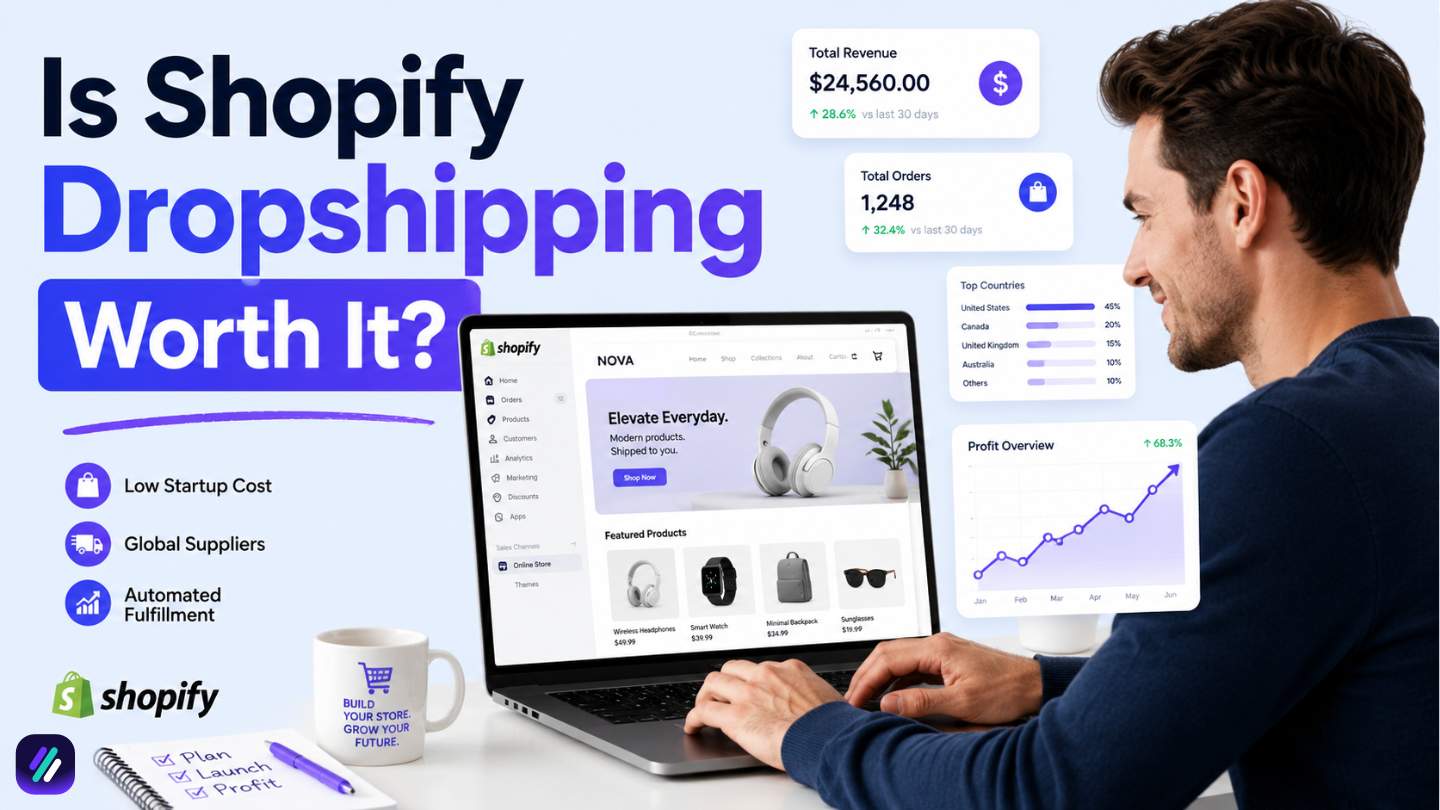
If you ask “Is Shopify dropshipping worth it?”, you tend to get two loud answers. One is a YouTube ad promising a hands-off store that prints money while you sleep, while the other says dropshipping is dead, saturated, and a fast way to torch your money.
If you believe the first, you can burn months and cash chasing a fantasy, and if you believe the second, you write off a model that tens of thousands of sellers still run at a profit and new join every day.
So in this guide, I will give you the honest, data-backed version: when Shopify dropshipping pays off, when it does not, and how to tell which answer is yours.
Key Takeaways
- The honest answer: Shopify dropshipping is worth it as a way to build an owned brand with genuine upside, but only if you can fund traffic and pick products from data. It is not a passive money machine.
- You pay for your own traffic: unlike a marketplace, Shopify sends you no built-in buyers, so your ad budget, not listing fees, is the cost that makes or breaks you.
- Margins are thin and getting tighter: with the de minimis tariff exemption gone, cheap-from-China dropshipping is harder, and the winners are moving to better suppliers and higher-ticket products.
- Most beginners earn little at first: in a ZIK Analytics survey of Shopify dropshippers, finding a winning product took two to six months, and steady profit usually arrived months after that.
- Data beats guesswork: the sellers who make it validate demand before they build, and the Shopify product finder shows what is actually selling across Shopify stores before you commit a cent.
- It is a business, not a side button: plan for six to twelve months of building before it resembles a steady income.
Is Shopify Dropshipping Worth It?
Yes, for the right person. Shopify dropshipping is worth it as a way to build a store and brand you actually own, but it rewards sellers who can fund traffic and choose products from data, and it punishes anyone expecting passive, overnight income with almost no work.
The reason it keeps pulling people in is ownership.
On a marketplace, the platform owns the customer, the inbox, and the relationship, while on Shopify, all of that is yours, which is the whole appeal of Shopify dropshipping for anyone who wants to build something that lasts.
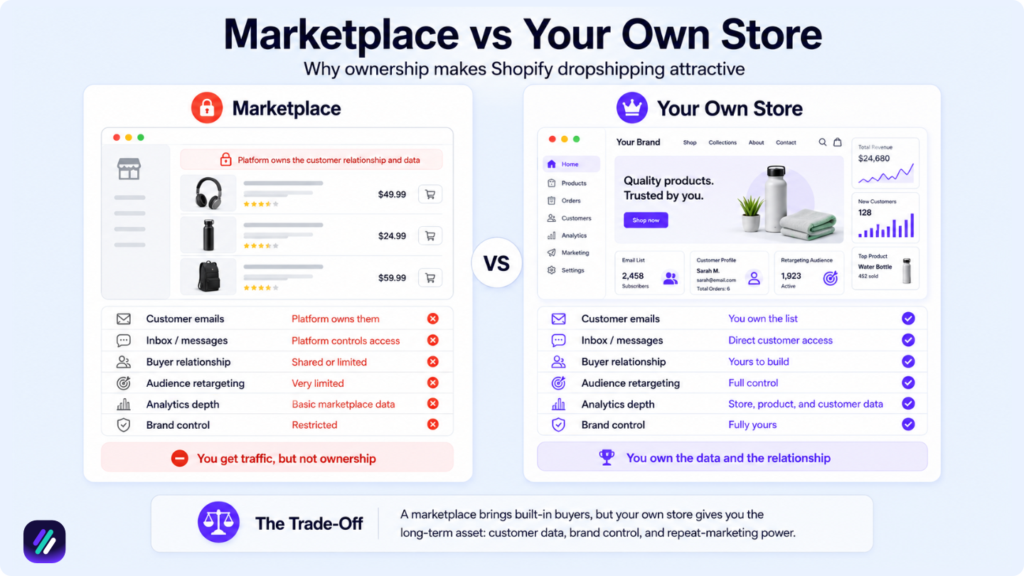
And the platform itself is not some fragile experiment, and it’s clear enough that dropshipping is a big part of their target audience.
Shopify merchants sold $378.4 billion in goods last year, so the checkout, payments, and apps you would build on are tested at serious scale.
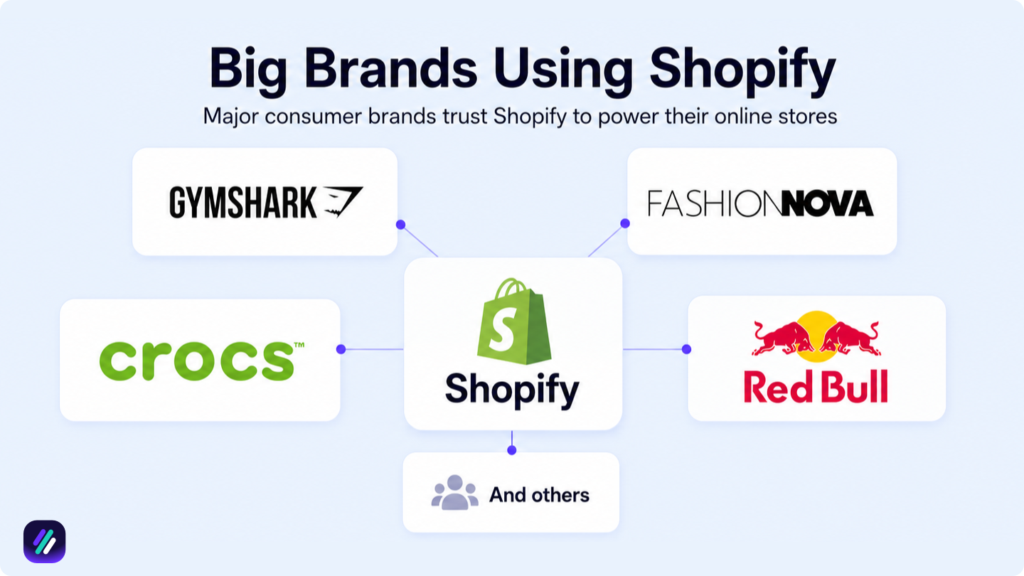
Furthermore, big brands such as Gymshark, Fashion Nova, Crocs, Red Bull, and others are using Shopify for the e-commerce side of their business.
And there are a few things that make Shopify a strong home for a dropshipping business:
- You own the brand and the customer: the store, the email list, and the customer data are yours, so you can build repeat buyers instead of renting attention from a marketplace.
- No inventory, low money down: your supplier ships to the buyer, so you are not buying stock up front or renting a warehouse.
- A deep app ecosystem: importing and order-fulfillment apps plug straight into Shopify, so one person can automate most of the repetitive back-end work.
- You control pricing and margin: nothing caps you at low-ticket marketplace prices, so higher-ticket and bundled offers are on the table.
- It scales with you: the same store that takes your first order can handle your thousandth without you switching platforms.
None of that makes it free money, though, and the ground under dropshippers has shifted in the last year.
The biggest change is the end of the de minimis loophole. The US scrapped the $800 duty-free exemption on small parcels from China and Hong Kong, and that exemption goes away worldwide in 2027.
This is a US rule, but similar pressure is spreading to other markets.
For years, that loophole has been what has let cheap AliExpress products land in US mailboxes duty-free, and with it gone, the lazy version of dropshipping, listing a $5 gadget from China and pocketing the spread, is being squeezed hard.
So the sellers still winning are the ones moving toward faster local suppliers, higher-ticket products, and proper branding.
Should You Start Shopify Dropshipping?
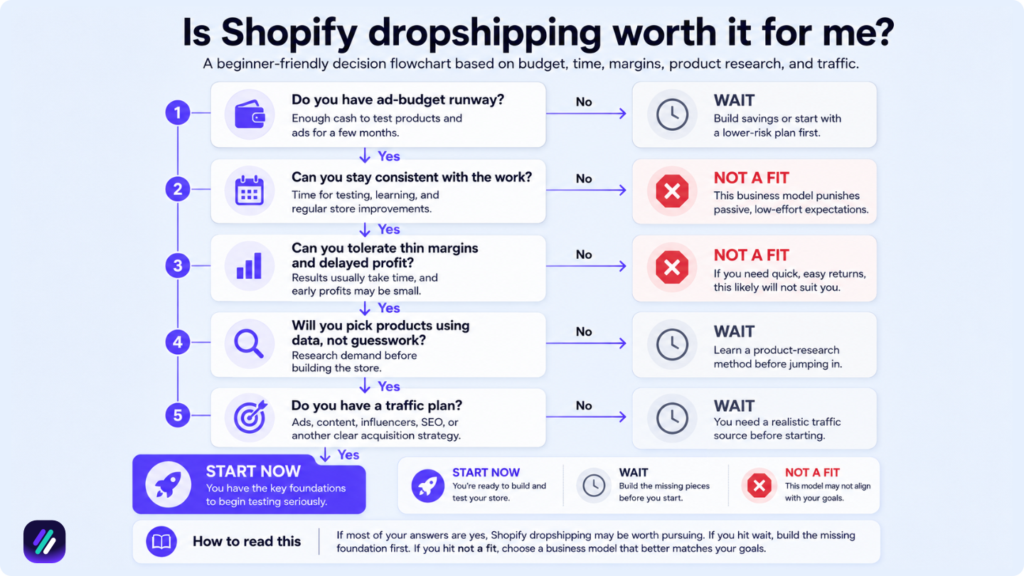
You should start Shopify dropshipping if you can fund a few months of ads while you test, put in steady time each week, and pick products from data. If money is tight or you need fast cash, wait until those pieces are in place.
Worth it in general and worth it for you are different questions, and only the second one pays your bills.
Whether this model fits comes down to a handful of honest answers about your money, your time, and how you choose products.
Before you commit a cent, run through these five questions:
| The question to ask yourself | Lean toward yes if | Lean toward no, or wait, if |
|---|---|---|
| Budget and ad runway | You can fund a few months of testing and ads without needing the profit to live on | Next month’s rent depends on this paying off |
| Time and consistency | You can work in the store a little every week | You want to set it up once and walk away |
| Margin tolerance | You are fine earning a thin slice per sale and winning on volume and repeat buyers | You expect a fat profit on every single order |
| Product method | You will choose items from sales data | You plan to sell what you personally like and hope |
| Traffic plan | You are ready to learn paid ads or content to bring your own buyers | You assume the store will get found on its own |
Now look at where most of your answers landed.
If they sit in the middle column, Shopify dropshipping is very likely worth it for you. Two of these decide the outcome more than the rest, so let us take traffic and product selection head-on.
Question 1: Can You Fund Traffic Until You Find a Winning Product?
If you can fund an ad budget for a few months without needing the profit to live on, yes. Shopify sends you no built-in traffic, so every visitor is one you pay for, and most stores lose money before they find a product that converts.
This is the single biggest difference between Shopify and a marketplace, and it is the one beginners underestimate.
On a marketplace like eBay, buyers are already searching with intent, while on Shopify, you build the shop in an empty mall and then have to bring every shopper to the door.
That door is usually paid ads, as 68% of dropshipping stores get most of their traffic from Facebook ads for dropshipping, and ad platforms charge you per click, whether or not it buys.
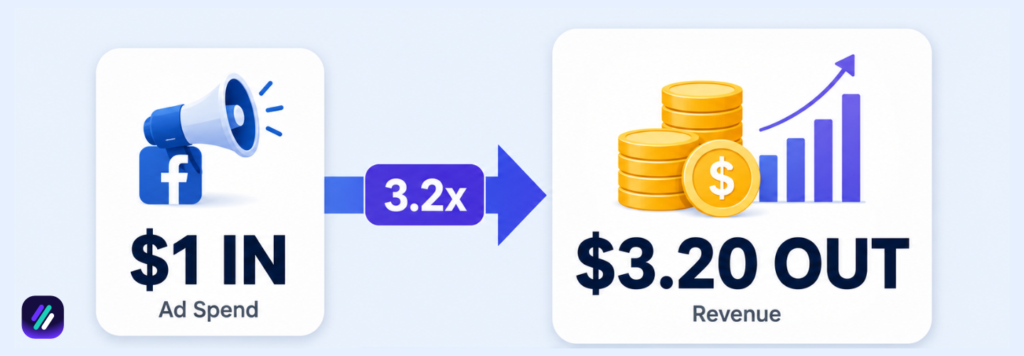
A typical store earns back $3.2 for every $1 ad spend before product cost and fees come out, so the early math is unforgiving.
So the hard part is learning to lose money on ads for a while without flinching, because testing five products to find one winner is normal, and the four that flop still cost you.
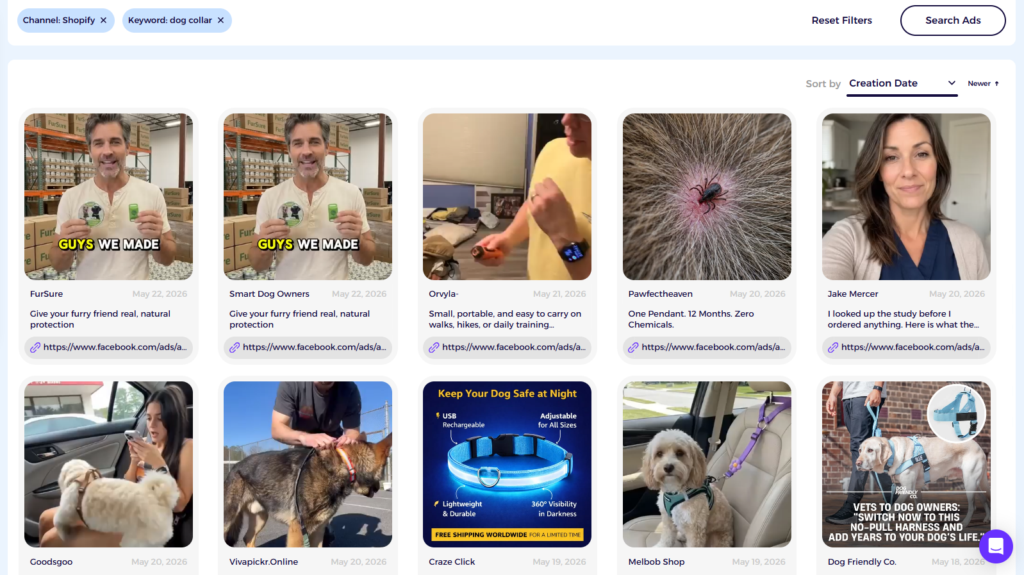
Before you spend, ZIK’s adspy tool lets you see which products already have ads running and converting, so you validate demand instead of hoping.
From our dropshipping team at ZIK, the sellers who survive this stage are the ones who treated the first few months of ad spend as tuition, not as a bet they had to win immediately.
If your next month’s rent depends on the store turning a profit, this is the part that breaks people.
Question 2: Will You Pick Products From Data, Not Guesswork?
This is the biggest predictor of whether Shopify dropshipping works for you. Sellers who validate demand before they build a store consistently beat the ones who sell what they personally like, because the market decides what sells, not your taste.
One of the biggest dropshipping mistakes I am seeing dropshippers do is to think that the store looks like the hard part, so people pour weeks into themes and logos before they have checked whether anyone wants the product.
Pretty stores do not sell unwanted products, simply.
What you actually want lined up before building is three things:
- Genuine demand
- Competition you can realistically beat
- Enough margin left after the supplier, fees, and ads.
Guessing skips all three and hopes for the best, and hoping is not a strategy, my friend.
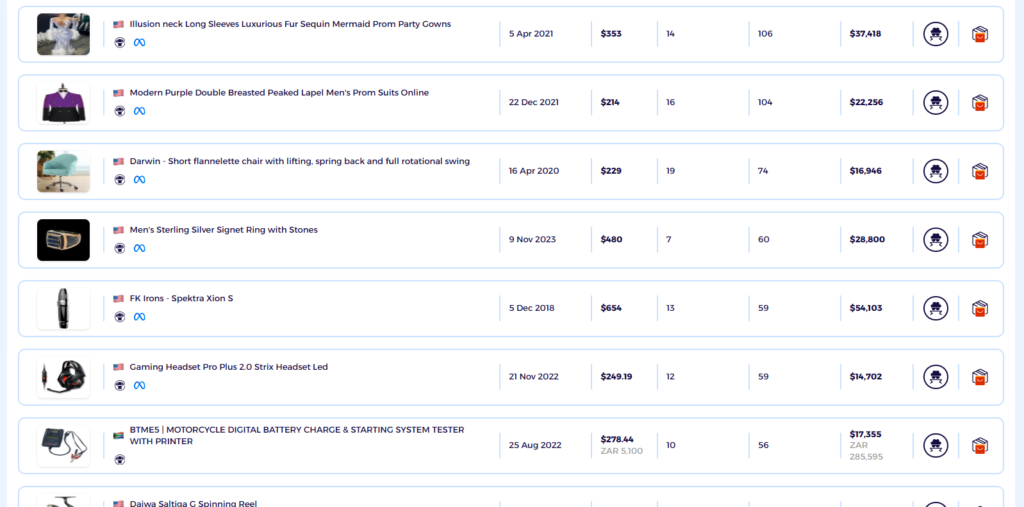
This is where cross-platform data is an edge most Shopify sellers miss. With the Shopify Product Explorer, you can see which products are selling across Shopify stores, with sales and revenue estimates, before you commit to one.
You can also use the Shopify sales tracker to check your competitors’ store sales data and their winning products, giving you an insider look into what’s already working.
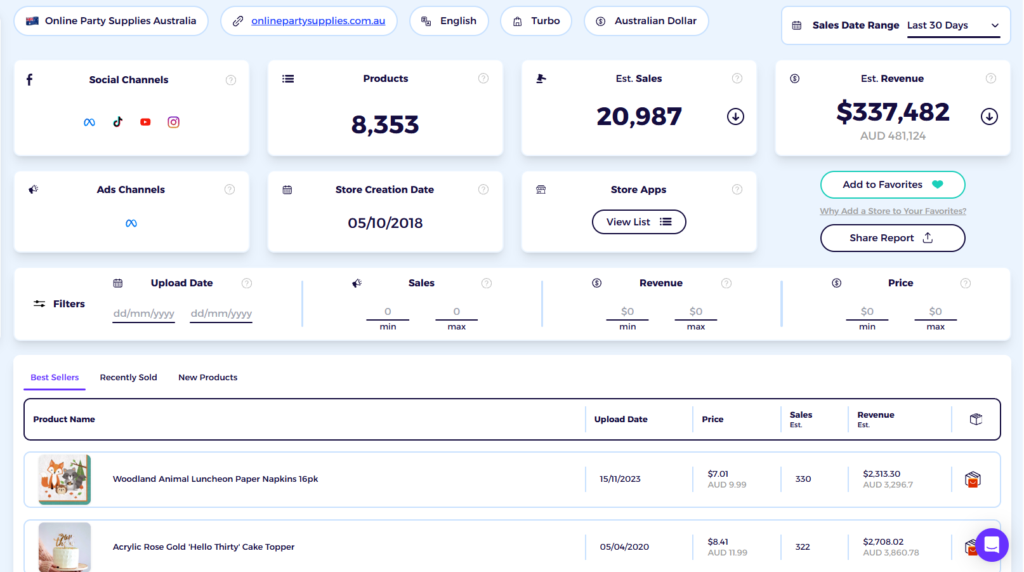
That cross-check is the heart of how to find winning products for dropshipping on Shopify: you stop asking whether you like a product and start asking whether it already sells and people actually want it.
Based on our in-house Shopify sellers at ZIK, the people still standing a year later are almost always the ones who validated demand first and treated Shopify product research as the main job, not an afterthought.
Is Shopify Dropshipping Profitable? How to Calculate the Actual Margin
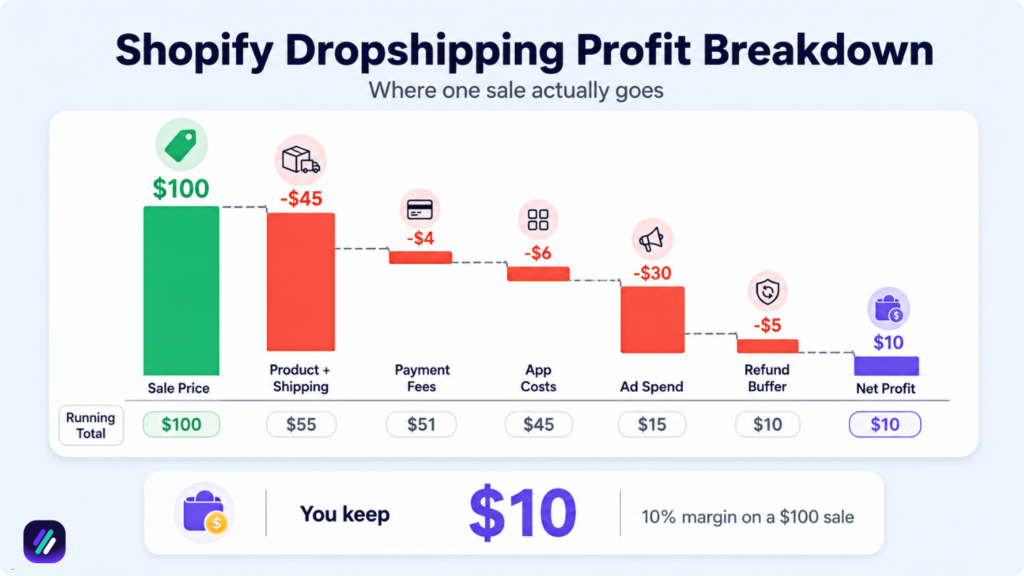
Shopify dropshipping can be profitable, but on thin margins. After product cost, payment fees, apps, and the ads that bring every buyer, what you keep is a small slice, so you must subtract every cost before you set a price.
Margin is where Shopify dropshipping gets misunderstood or where dropshippers lose money.
Gross margin can look great, since a $30 product that costs you $10 reads like 66% on paper but then the ads, the apps, and the payment fees arrive and thin it out fast.
Industry estimates put a healthy dropshipping net margin at around 10% to 20%, with beginners often under 10% until they tighten product selection and ad spend.
Shopify stores tend to sit at the lower end because you pay for the traffic a marketplace would have handed you for free.
To find your actual number, account for every line that comes out of a sale:
| Cost line item | What it takes from a sale | How to protect your margin |
|---|---|---|
| Product and shipping cost | What you pay your supplier is now often higher since the de minimis exemption ended | Use faster local suppliers and pick items that survive the new duties |
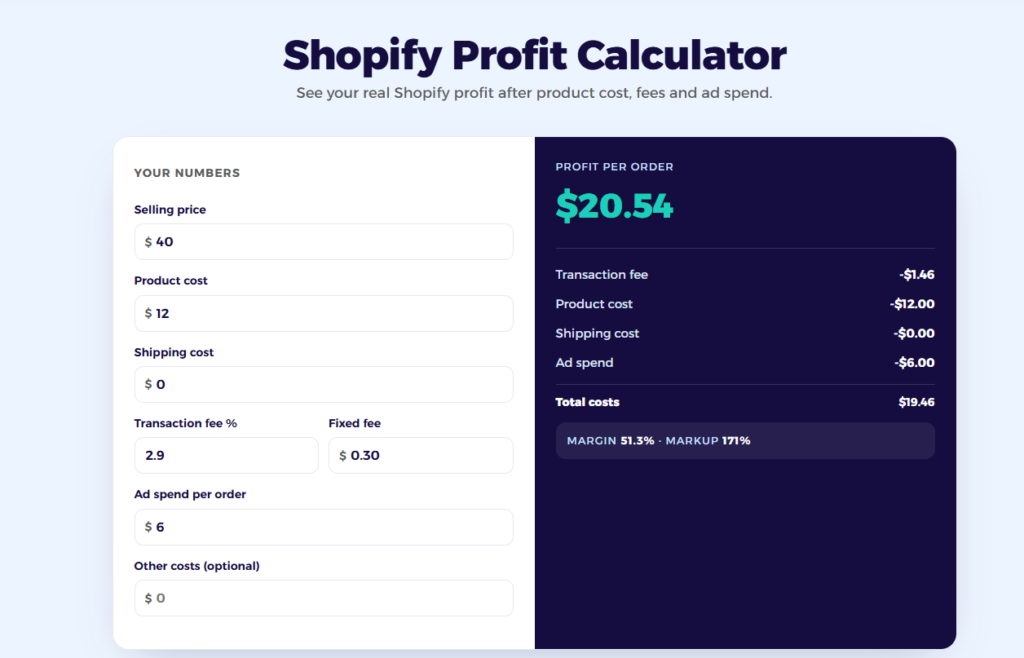
| Payment processing | About 2.9% plus 30 cents per order on Shopify Payments | Price it in, because it never goes away |
| App subscriptions | Importing and automation apps, plus your product research tool | Keep the stack lean and cut any app a winning product is not paying for |
| Advertising | Usually, your single biggest cost, since every visitor is paid for | Kill losing ad sets fast and scale only what is already profitable |
| Refunds and returns | Lost parcels, bad supplier batches, and the occasional unhappy buyer | Hold back a few percent of revenue as a buffer |
You can run any product through a Shopify profit calculator before you list it, then price from what you keep, not the sticker price.
Sale price – product and shipping cost – payment fees – app costs – ad spend – a refund buffer = what you actually keep.
Dropshipping Market Size in 2026
Beyond your own store, the market itself is not shrinking. The global dropshipping market is worth around $583.5 billion and projected to keep growing at a 20.7% compound annual rate through 2033, with the US market close behind.
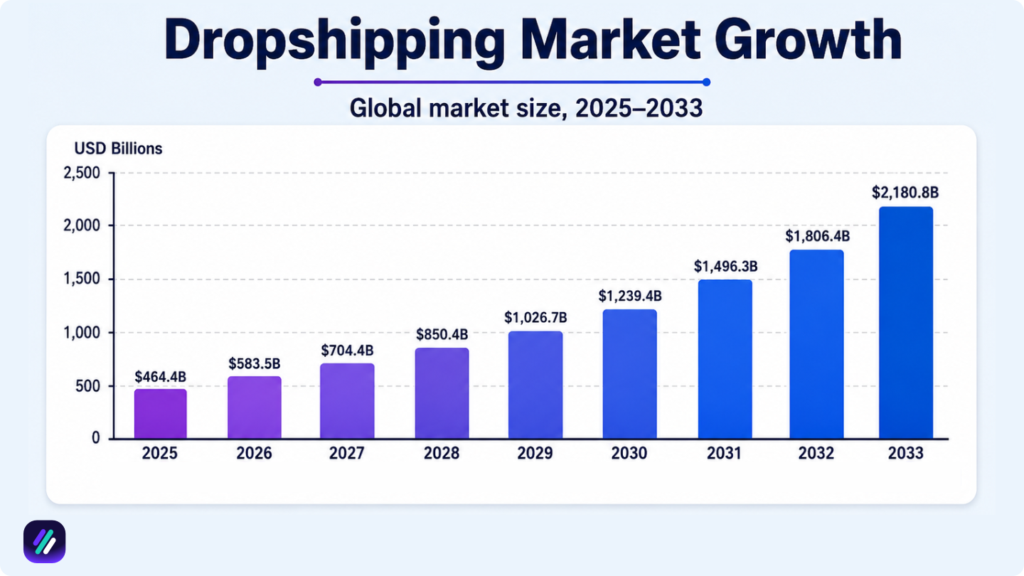
So demand for the model is genuine and rising, as ZIK’s dropshipping statistics lay out in full.
What is changing is who captures it, the squeeze on thin, cheap-import margins sends more of that growth to sellers with better products and stronger brands, not the ones spamming cheap goods with ads.
Get the eBook and learn how to launch your one-product Shopify store right!How Much Can You Make Dropshipping on Shopify?
You can make genuine money with Shopify dropshipping, but most beginners should expect little or nothing at first. A solid early win is low four figures a month in profit, not quit-your-job money, while the top stores prove the ceiling is high.
The ceiling is not really the question, because the data shows it is high.
Based on our ZIK’s internal Shopify data for US dropshipping stores, the top performers pulled between $2.16 million and $43.99 million in revenue over the last 30 days, and many of them run active paid channels, especially Facebook.
If you want to study how stores like that are built, the Shopify sales tracker breaks down any public Shopify store’s products, sales, and estimated revenue over time.
But that is the top of the market, not the typical beginner.
The same pull covered 124,614 products across the segment, a mix of high-ticket stores with few large orders and broad-catalog stores moving steady volume.
The takeaway is that the market is alive and the upside is genuine, but profit depends far more on execution than on simply opening a store.
Revenue is not profit, though, so you should treat profit as an estimate built on margin. Using deliberately conservative planning numbers, this is what different revenue levels turn into:
| Monthly revenue | Net profit at 5% | Net profit at 10% | Net profit at 15% |
|---|---|---|---|
| $5,000 | $250 | $500 | $750 |
| $10,000 | $500 | $1,000 | $1,500 |
| $20,000 | $1,000 | $2,000 | $3,000 |
| $50,000 | $2,500 | $5,000 | $7,500 |
| $100,000 | $5,000 | $10,000 | $15,000 |
Those percentages are cautious on purpose, since a beginner store carrying full ad costs often lands at the low end, and reading down the 10% column, it’s obvious that you have to push serious revenue before the profit starts to feel like a wage.
So a realistic ladder for a new store looks like this:
- Months 1 to 3: often break-even or a loss while you test products and creatives.
- First traction: roughly $500 to $2,000 a month in profit once something starts converting.
- A validated store: $2,000 to $10,000 a month is achievable after you control ad costs and add upsells, though it is not the starting line.
- Top-tier results: much higher is possible, and ZIK’s store data proves it, but that is not a beginner baseline.

The better question is not how much Shopify dropshipping can make in the abstract, but whether you can find one product or offer that gets you to $10,000 to $30,000 a month in revenue at a survivable margin, because that is what turns into a genuine income.
How Long Does Shopify Dropshipping Take to Make Money?
Most sellers need two to six months to find a product that sells consistently, and six to twelve months before profit is steady. In a ZIK Analytics survey of 531 Shopify dropshippers, early sales came within months, but dependable income took most of a year.
That slow timeline is the normal shape of building a store from nothing, not a sign that you are doing it wrong. That’s why betting on the first month’s profit, your savings, and your livelihood is not a smart strategy.
The same survey breaks the early stages into rough windows, which helps you set expectations before you start:
| Stage | Typical time | Why it takes that long |
|---|---|---|
| Finding a product | 1 to 2 weeks | Pulling and validating a shortlist instead of guessing |
| Vetting a supplier | 1 to 2 weeks | Testing Shopify dropshipping suppliers for price, stock, and shipping speed |
| Store setup and basics | About 1 month | Building the store and learning how the pieces fit together |
| First consistent sales | 1 to 3 months | Giving ads and listings time to find buyers |
| Finding a winning product | 2 to 6 months | Testing enough products to find the few that reliably convert |
| Scaling to steady profit | 6 to 12 months | Reinvesting into what works to reach $1,000 to $3,000+ a month |
What actually moves that timeline is product demand, ad efficiency, supplier reliability, and how fast you cut what is not working.
A product people already want, with a supplier who ships on time, can find sales quickly.
From our in-house Shopify dropshippers at ZIK, the people who quit almost always quit in the testing window, right before the work starts to compound. So if you take one thing from this section, let it be that the early months are slow by design, not because you are failing.
How Much Does It Cost to Start Shopify Dropshipping?
You can realistically start Shopify dropshipping on about $250 to $400 a month, and $500 to $1,000 buys a comfortable runway. In a ZIK Analytics survey of 348 sellers, that was the gap between a bare-minimum start and a budget for proper testing.
The startup cost is less about one big upfront sum and more about a steady monthly float for testing, and the breakdown is Shopify-specific: the platform fee is the small part, while the ad budget is the part that actually moves:
| Where the money goes | Typical cost | Notes |
|---|---|---|
| Shopify plan | $39 a month on Basic, or $29 on annual billing | The smallest line on this list, despite all the attention it gets |
| Payment processing | 2.9% plus 30 cents per online order on Shopify Payments | Scales with sales, so it is a cost of success |
| Apps | A free tier like DSers up to paid automation like AutoDS | Start lean, then add paid apps once a product earns them |
| Custom domain | Roughly $10 to $20 a year | A small cost that makes the store look credible |
| Product research tool | ZIK Analytics, from about $14 a month on an annual plan | The line I would never cut, since guessing wastes far more |
| Ad budget | The biggest variable, often the largest monthly cost | Test small, kill losers fast, and scale only proven winners |
You will notice the which shopify plan is best for dropshipping decision barely matters at the start, because the Basic plan is plenty until you are scaling. And pricing changes, so you will want to confirm the current numbers on Shopify’s pricing page before you set your budget.
Good Shopify dropshipping software is the one line I would protect, because picking products from data is what keeps the rest of this budget from being wasted on items nobody wants.
Shopify Dropshipping vs eBay and Amazon: Which Is Worth It?
If your goal is to test cheaply and earn fast, eBay usually wins. If you want to own a brand for the long run, Shopify is the better home. Amazon sits in between: huge reach, but tight control and strict rules on dropshipping.
Most people weighing this are really asking where their first dollar comes from. The honest split is whether you want borrowed traffic from a marketplace like Amazon now, or owned traffic on a store you build yourself later.
The three platforms stack up like this on what actually affects a dropshipper:
| Factor | Shopify dropshipping | eBay dropshipping | Amazon dropshipping |
|---|---|---|---|
| Where traffic comes from | You drive it yourself with ads and content | Built-in buyers are already searching to purchase | Built-in marketplace, but you fight for the Buy Box |
| Startup cost | From $39 a month plus payment and ad costs | Lowest, with up to 250 free listings a month | A Pro plan around $39.99 a month plus referral fees |
| Selling fees | 2.9% plus 30 cents per transaction | About 13.6% final value fee plus a per-order fee | Roughly 8% to 15% referral fee by category |
| Brand control | Full, since the store and customer are yours | Minimal, since eBay owns the customer | Minimal, since Amazon owns the customer |
| Best for | Building an owned, long-term brand | The cheapest way to learn what sells | Reach, if you can meet the strict requirements |
Keep in mind these are structurally different. eBay and Amazon lend you traffic for a cut of every sale, while Shopify is a store you own but have to fill yourself.
For most beginners, the smart play is to learn what sells on a marketplace first, then build the brand on Shopify once you know what people buy. That tradeoff between borrowed and owned traffic is the whole eBay vs Shopify dropshipping decision in one line.
Get the eBook and learn how to launch your one-product Shopify store right!Find Winning Shopify Dropshipping Products with ZIK Analytics
Everything in this guide comes back to one habit: deciding from data instead of hope. That is the part ZIK Analytics is built to handle for you:
- Use the Shopify product finder to see which products are actually selling across Shopify stores, with sales and revenue estimates, before you commit.
- Use the Shopify sales tracker to break down a competitor store’s products, revenue, and best sellers over time.
- Use the AdSpy tool to see which products already have ads running and converting, so you can validate demand before you spend.
Together, that workflow means you stop gambling on products and start picking them from evidence. You can try it on a $1 trial (7-day) and see what is selling before you risk a cent on ads.
Is Shopify Dropshipping Worth It FAQs
A few quick answers to the questions sellers ask most before they start.
Can I make $10,000 per month with Shopify dropshipping?
It is possible, but it is not a beginner outcome. Hitting $10,000 a month in profit usually means tens of thousands in monthly revenue at a healthy margin, which takes a validated product, controlled ad costs, and months of reinvestment. Most sellers reach a steady four-figure profit first, then scale toward five over time.
Does Shopify actually make you money doing the dropship?
Shopify itself is just the storefront and checkout; it does not make you money, your product and marketing do. The platform gives you reliable rails and a deep app ecosystem, but the profit comes from selling products people want at a margin that survives ads and fees. When you pick well, it pays, and when you pick badly, no platform saves you.
Why do so many Shopify dropshippers fail?
Most fail for a short list of reasons: they pick products from taste instead of data, they run out of cash before a product converts, their margins are too thin to survive ad costs, or their supplier lets buyers down. The common thread is quitting in the testing window, often within the first few months, right before the learning starts to pay off.
Is Shopify dropshipping dead in 2026?
No, but the cheap-import version of it is fading fast. Demand is still growing, and the platform is healthy, so the model is far from dead, which is the whole point of our is dropshipping dead breakdown. What changed is that thin-margin, ship-from-China stores are squeezed by new tariffs, while sellers with strong products and branding are doing fine.