
Dropshipping can feel overwhelming when you’re trying to get started with e-commerce in a way that’s actually manageable. On the surface, it looks simple. But the moment you dive in, you’re hit with unfamiliar terms that most beginner guides assume you already understand.
Courses, videos, and guides often introduce dozens of concepts at once—supplier types, pricing metrics, fulfillment models, marketing acronyms, platform tools. If you don’t stop to look up each term, you miss the important parts. If you do stop, learning becomes slow and frustrating.
That’s exactly what this glossary is designed to fix.
This Dropshipping Glossary breaks down the essential terms you’ll face when working with online marketplaces, dropshipping suppliers, ecommerce platforms, and fulfillment processes.
Dropshipping Basics
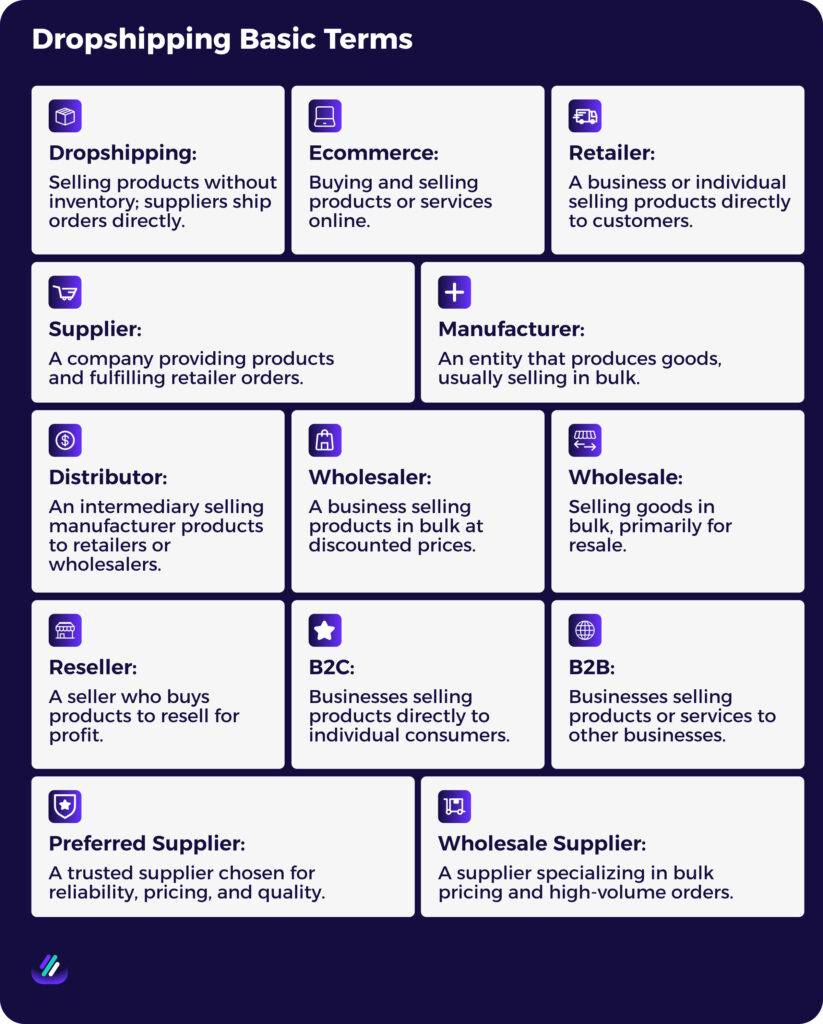
Here are the basics, just basic day-to-day terms that you are going to encounter when you are doing dropshipping:
- Dropshipping: A fulfillment model where you sell products without holding inventory. When a customer places an order, the supplier ships the item directly to them.
- Ecommerce: The buying and selling of products or services online through online selling websites and ecommerce platforms.
- Retailer: The business or individual that sells products directly to the end customer. In dropshipping, this is you.
- Supplier: A company or individual that provides products to retailers. In dropshipping, suppliers handle storage, packing, and shipping.
- Manufacturer: The entity that produces the product. Manufacturers often sell in bulk and usually do not deal directly with consumers.
- Distributor: An intermediary that buys products from manufacturers and sells them to wholesalers or retailers.
- Wholesaler: A business that purchases products in large quantities from manufacturers or distributors and resells them at lower per-unit prices.
- Wholesale: The practice of selling goods in bulk, typically at discounted rates, usually intended for resale rather than direct consumer use.
- Reseller: A seller who purchases products from suppliers or wholesalers and sells them again for profit, either online or offline.
- Business-to-consumer (B2C): A business model where products are sold directly to individual customers. Most dropshipping stores operate under B2C.
- Business-to-business (B2B): A business model where products or services are sold from one business to another, often involving bulk orders or long-term contracts.
- Preferred Supplier: A supplier chosen for consistent product quality, reliable shipping times, or favorable pricing, often used long-term by a retailer.
- Wholesale Supplier: A supplier that specializes in bulk pricing and high-volume orders, commonly used by retailers scaling beyond beginner-level dropshipping.
Dropshipping Platform and Marketplace Terms
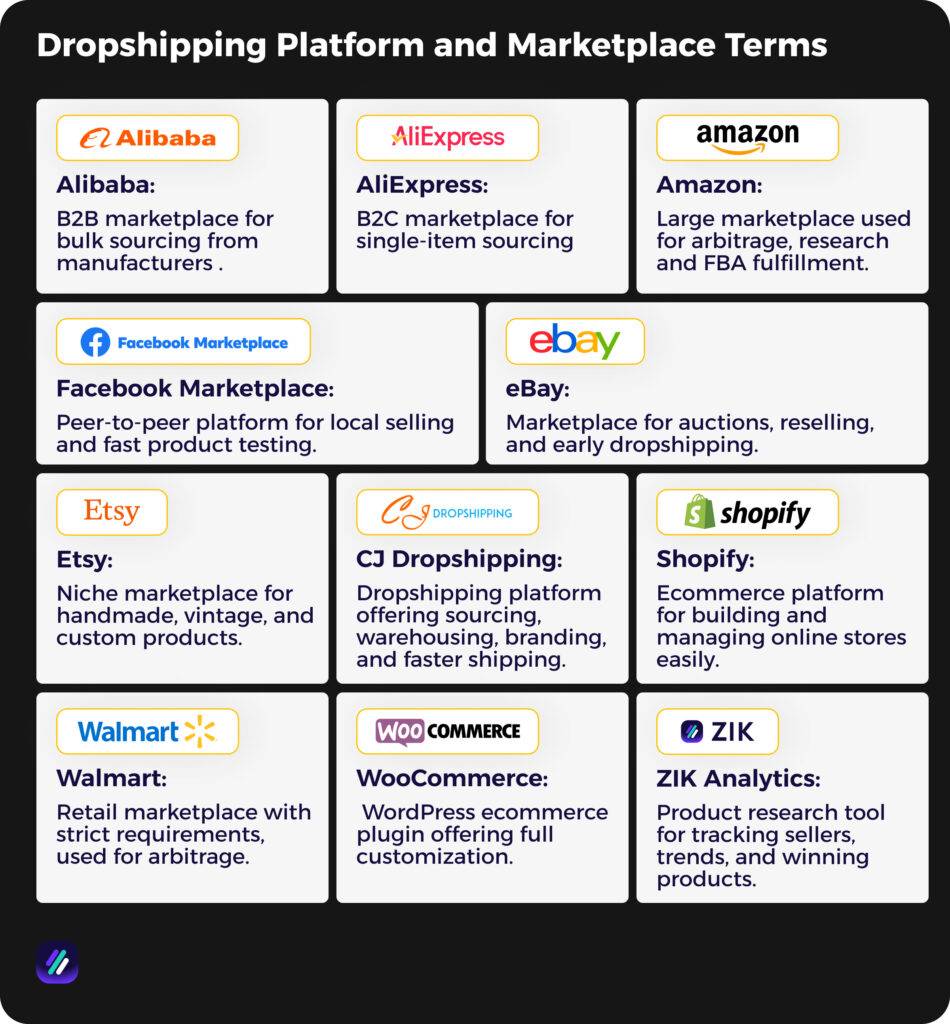
These platforms and tools are where most beginners source products, build stores, analyze competitors, and sell to customers.
- Alibaba: A global B2B marketplace focused on bulk purchasing directly from manufacturers and wholesalers. Commonly used for private label dropshipping and large-volume sourcing rather than single-item orders.
- AliExpress: A B2C marketplace popular for AliExpress dropshipping, allowing sellers to source single products with no minimum order quantity and ship directly to customers.
- Amazon: One of the largest online marketplaces in the world. Dropshippers primarily use it for retail arbitrage, brand research, or fulfillment models like FBA, rather than conventional dropshipping.
- CJ Dropshipping: A dropshipping platform that offers product sourcing, warehousing, branding services, and faster shipping options compared to traditional AliExpress suppliers.
- eBay: An online marketplace offering auction and fixed-price listings, commonly used for product testing, reselling, and early-stage dropshipping.
- Etsy: A niche marketplace focused on handmade, vintage, and custom products. Dropshipping is limited and usually requires custom or print-on-demand items.
- Facebook Marketplace: A peer-to-peer selling platform within Facebook, commonly used for local sales, fast product testing, and social commerce experiments.
- Shopify: A hosted ecommerce platform that allows you to build, manage, and scale an online store without technical setup. One of the most popular platforms for dropshipping beginners.
- Walmart: A major retail marketplace with strict seller requirements. Often used for retail arbitrage or advanced fulfillment setups rather than beginner dropshipping.
- WooCommerce: An open-source ecommerce plugin for WordPress that allows full customization. Requires more setup than Shopify but offers greater control over store operations.
- ZIK Analytics: A product research and competitor analysis tool used for identifying winning products, tracking sellers, and analyzing trends across eBay, Shopify, and other online selling websites.
Dropshipping Product Research and Validation Terms
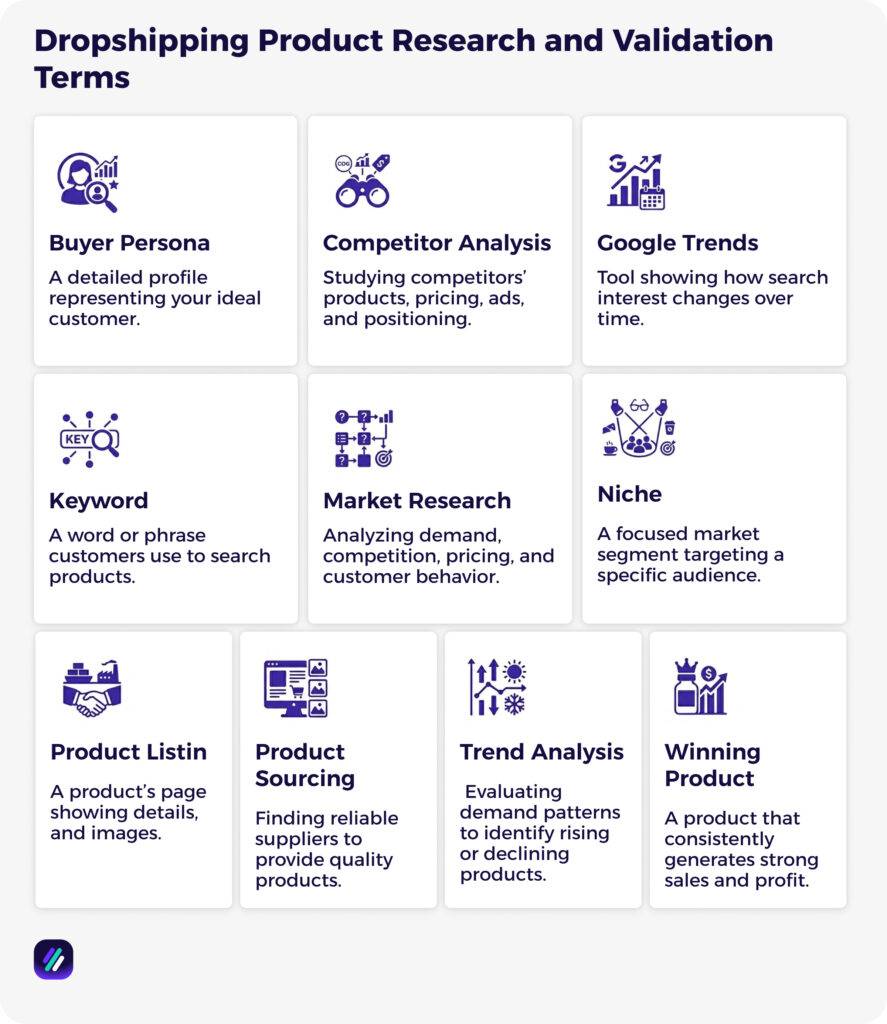
These terms relate to how you decide what to sell and whether a product is worth testing. Product research is critical in dropshipping, as poor research leads to wasted ad spend, slow sales, and failed stores.
- Buyer persona: A detailed profile of your ideal customer based on demographics, interests, pain points, and buying behavior. Buyer personas help you choose better dropshipping niches and write more targeted product listings.
- Competitor Analysis: The process of studying competing sellers to understand their products, pricing, ads, traffic sources, and positioning. Strong competitor analysis reduces guesswork and improves product validation.
- Google Trends: A free tool that shows how search interest for keywords changes over time. Commonly used to confirm whether a product or niche has growing, stable, or declining demand.
- Keyword: A word or phrase customers type into search engines or online marketplaces when looking for products. Keywords influence product titles, descriptions, SEO, and paid ads.
- Market Research: The broader process of analyzing demand, competition, pricing, and customer behavior before launching a product. It helps validate whether a market is worth entering.
- Niche: A specific segment of a larger market focused on a defined audience or product category. Choosing the right niche makes marketing easier and competition more manageable.
- Product listing: The page where a product is displayed on an ecommerce platform or marketplace. It includes the title, images, description, price, and shipping details.
- Product sourcing: The process of finding reliable dropshipping suppliers who can provide quality products, consistent inventory, and acceptable shipping times.
- Trend Analysis: The evaluation of patterns in consumer demand over time. Trend analysis helps identify rising products early and avoid saturated or declining items.
- Winning Product: A product that consistently generates sales, profit, and engagement due to strong demand, clear value, and effective positioning. Winning products are validated through data, not assumptions.
Dropshipping Pricing, Costs, and Profitability Terms
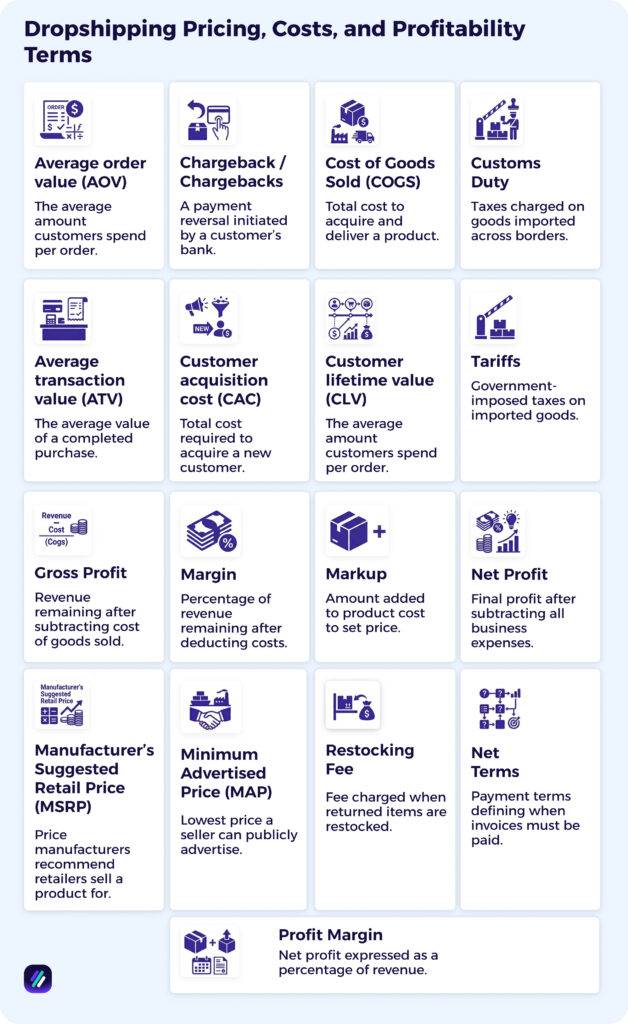
These terms explain where your money goes and how you make a profit. Understanding them is essential for pricing products correctly, managing dropshipping returns, and avoiding hidden costs that can quietly eat into your margins.
- Average order value (AOV): The average amount a customer spends per order. Increasing AOV through bundles or upsells helps improve profitability without increasing traffic.
- Average transaction value (ATV): The average value of a completed purchase. Often used interchangeably with AOV, though ATV may be applied more broadly across payment data.
- Chargeback / Chargebacks: A payment reversal initiated by a customer through their bank or card provider. Chargebacks often result from disputes, delays, or poor customer experience and can include extra fees.
- Cost of Goods Sold (COGS): The total cost to acquire a product, including supplier price, packaging, and shipping from the fulfillment center or supplier to the customer.
- Customs Duty: Taxes imposed on goods imported across international borders. Customs duties can affect shipping costs and delivery times, especially for cross-border dropshipping.
- Customer acquisition cost (CAC): The total cost of acquiring a new customer, including ad spend, marketing tools, and promotional expenses.
- Customer lifetime value (CLV) / Lifetime value (LTV): The total revenue a customer generates over their entire relationship with your store. Higher LTV allows you to spend more on acquisition while staying profitable.
- Gross Profit: Revenue minus COGS. Gross profit shows how much money remains before marketing, operating, and overhead expenses.
- Margin: The percentage of revenue that remains after deducting costs. Margins indicate how efficiently your store turns sales into profit.
- Markup: The amount added to the product cost to determine its selling price. Markup is different from margin and is calculated based on cost, not revenue.
- Manufacturer’s Suggested Retail Price (MSRP): The price a manufacturer recommends retailers sell a product for. MSRP helps standardize pricing across online marketplaces.
- Minimum Advertised Price (MAP): The lowest price a seller is allowed to publicly advertise a product. MAP policies are set by manufacturers to protect brand value.
- Net Profit: The final amount left after subtracting all expenses, including COGS, marketing, fees, refunds, and operational costs.
- Net Terms: Payment conditions that define when an invoice must be paid, such as Net 30 or Net 60. Common in B2B and wholesale relationships.
- Profit Margin: Net profit expressed as a percentage of total revenue. Profit margin is one of the most important indicators of long-term sustainability.
- Restocking Fee: A fee charged when a returned item is restocked. Restocking fees are often used to offset losses from dropshipping returns.
- Tariffs: Government-imposed taxes on imported goods. Tariffs can significantly impact pricing strategies, especially for international dropshipping suppliers.
Dropshipping Marketing and Traffic Terms
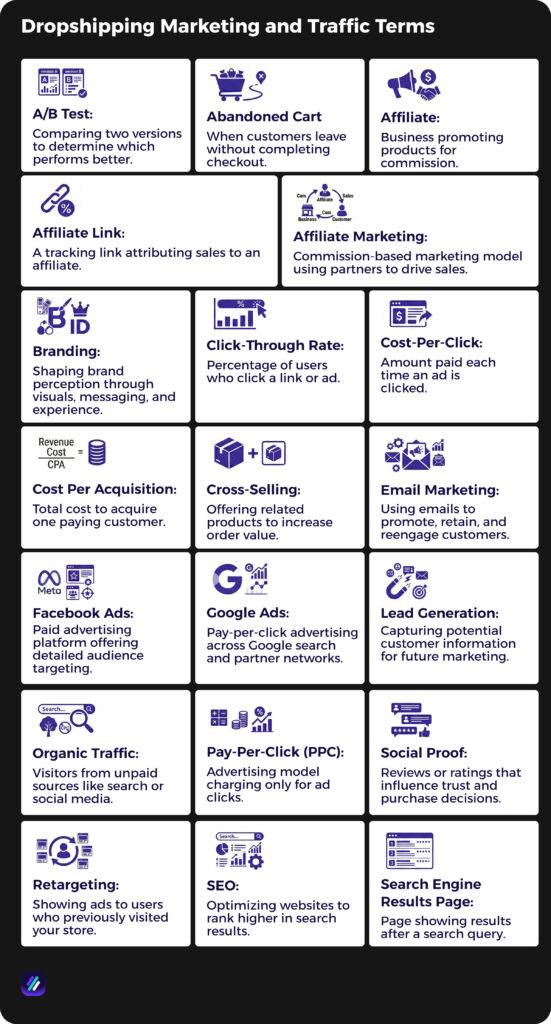
These terms cover how customers find your store and what convinces them to buy. Marketing is where most dropshipping growth happens, and misunderstanding these concepts often leads to wasted ad spend and poor conversions.
- A/B Test: A testing method where two versions of a page, ad, or element are compared to determine which performs better based on user behavior.
- Abandoned Cart / Cart Abandonment: When a customer adds products to their shopping cart but leaves the site without completing the purchase.
- Affiliate: An individual or business that promotes products in exchange for a commission on each sale they generate.
- Affiliate Link: A unique tracking link used to attribute sales or traffic to a specific affiliate.
- Affiliate Marketing: A marketing model where affiliates earn commissions for driving traffic or sales, allowing stores to scale promotion without upfront advertising costs.
- Branding: The process of shaping how a business is perceived through visual identity, messaging, and customer experience.
- Click-Through Rate (CTR): The percentage of users who click on a link or ad after seeing it, used to measure engagement and relevance.
- Cost-Per-Click (CPC): The amount paid each time a user clicks on an advertisement.
- Cost Per Acquisition (CPA): The total cost required to acquire one paying customer through marketing efforts.
- Cross-Selling / Cross-selling: The practice of offering related or complementary products to customers during or after checkout to increase order value.
- Email Marketing: The use of email campaigns to communicate with subscribers and customers for promotions, retention, and abandoned cart recovery.
- Facebook Ads: A paid advertising platform by Meta that allows precise audience targeting based on interests, behavior, and demographics.
- Google Ads: A pay-per-click advertising platform that displays ads across Google search results, partner websites, and YouTube.
- Lead Generation: The process of capturing contact information from potential customers for future marketing or sales efforts.
- Organic Traffic: Visitors who reach a store through unpaid sources such as search engines, social media, or direct visits.
- Pay-Per-Click (PPC): An advertising model where advertisers pay only when someone clicks on their ad.
- Retargeting: A marketing strategy that shows ads to users who have previously visited a store or interacted with its content.
- Search Engine Optimization (SEO): The process of optimizing a website to rank higher in search engines and attract consistent organic traffic.
- Search Engine Results Page (SERP) / SERP Results: The page displayed by a search engine after a user enters a query.
- Social Proof: Indicators such as reviews, testimonials, and ratings that build trust and influence purchasing decisions.
Dropshipping Customer Support, Returns, and Store Policies
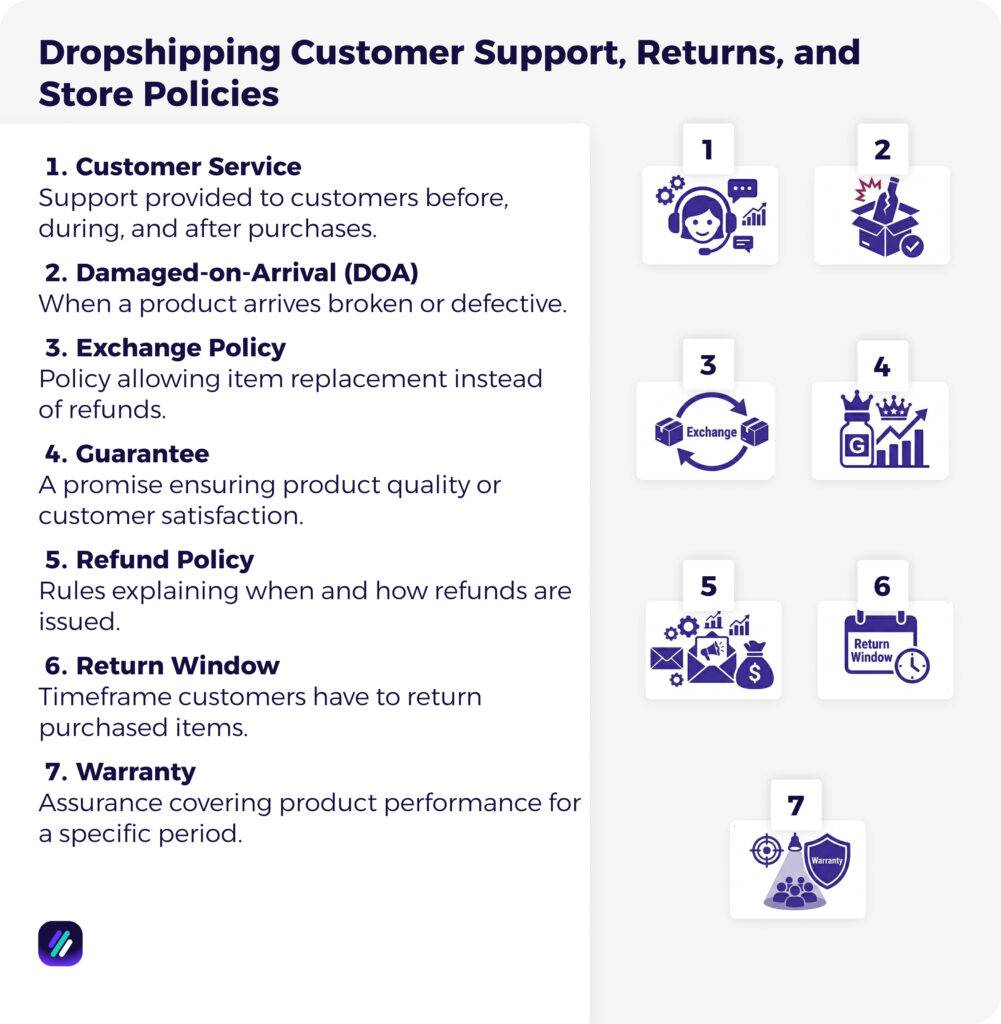
Customer support and store policies define how you handle problems after the sale. Since delays, returns, and damaged items are common in dropshipping, clear policies and responsive support help prevent disputes, protect your reputation, and build customer trust.
- Customer Service: The support provided to customers before, during, and after a purchase. Good customer service is critical in dropshipping, especially when handling delays, complaints, and dropshipping returns.
- Damaged-on-Arrival (DOA): A term used when a product arrives broken or defective. DOA cases usually require immediate replacement or refund through the supplier.
- Exchange Policy: A store policy that allows customers to swap a purchased item for a different size, color, or replacement instead of receiving a refund.
- Guarantee: A promise made by a seller or manufacturer regarding product quality, performance, or satisfaction, often used to reduce buyer hesitation.
- Refund Policy: A clearly defined policy outlining when and how customers can request refunds. Transparent refund policies help build trust and reduce disputes.
- Return Window: The specific timeframe in which customers are allowed to return a product after delivery, such as 14 or 30 days.
- Warranty: A written assurance that a product will function as expected for a certain period. Warranties may be provided by the manufacturer, supplier, or seller.
Dropshipping Order and Fulfillment Terms
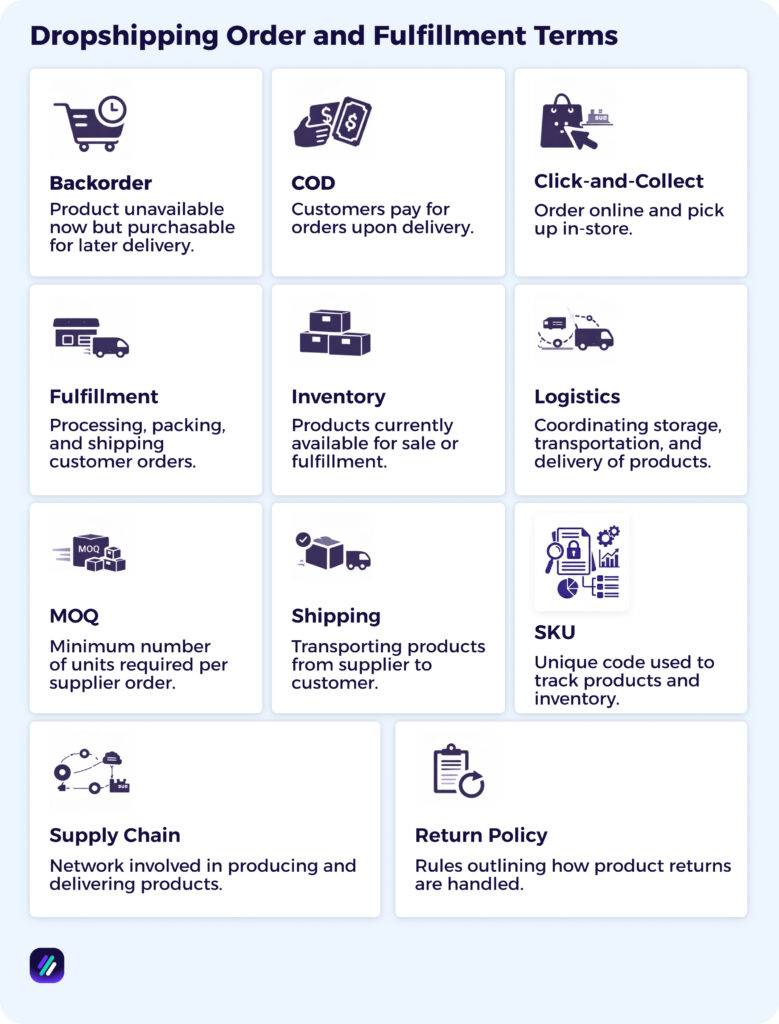
These terms relate to how orders are processed, shipped, and delivered. Understanding them helps you manage expectations, work effectively with a fulfillment center or supplier, and avoid common operational issues.
- Backorder: A situation where a product is temporarily out of stock but can still be purchased, with delivery occurring once inventory is replenished.
- Cash On Delivery (COD): A payment method where customers pay for an order at the time of delivery rather than online at checkout.
- Click-and-Collect: A fulfillment option where customers place an order online and pick it up from a physical location.
- Fulfillment / Order Fulfillment: The entire process of receiving, processing, packing, and shipping an order to the customer.
- Inventory (Stock on Hand): The quantity of products currently available for sale or fulfillment. In dropshipping, inventory is usually managed by the supplier.
- Logistics: The coordination of transportation, warehousing, and delivery involved in moving products from suppliers to customers.
- Minimum Order Quantity (MOQ): The smallest number of units a supplier requires per order. MOQs are common with manufacturers and wholesale suppliers.
- Shipping: The process of transporting products from the supplier or fulfillment center to the end customer.
- Stock Keeping Unit (SKU): A unique identifier assigned to a product to track inventory, variations, and sales performance.
- Supply Chain: The entire network involved in producing, storing, and delivering a product, from manufacturer to customer.
- Return Policy: A documented set of rules outlining how returns are handled, including eligibility, timelines, and conditions.
Dropshipping Store and Operations Terms
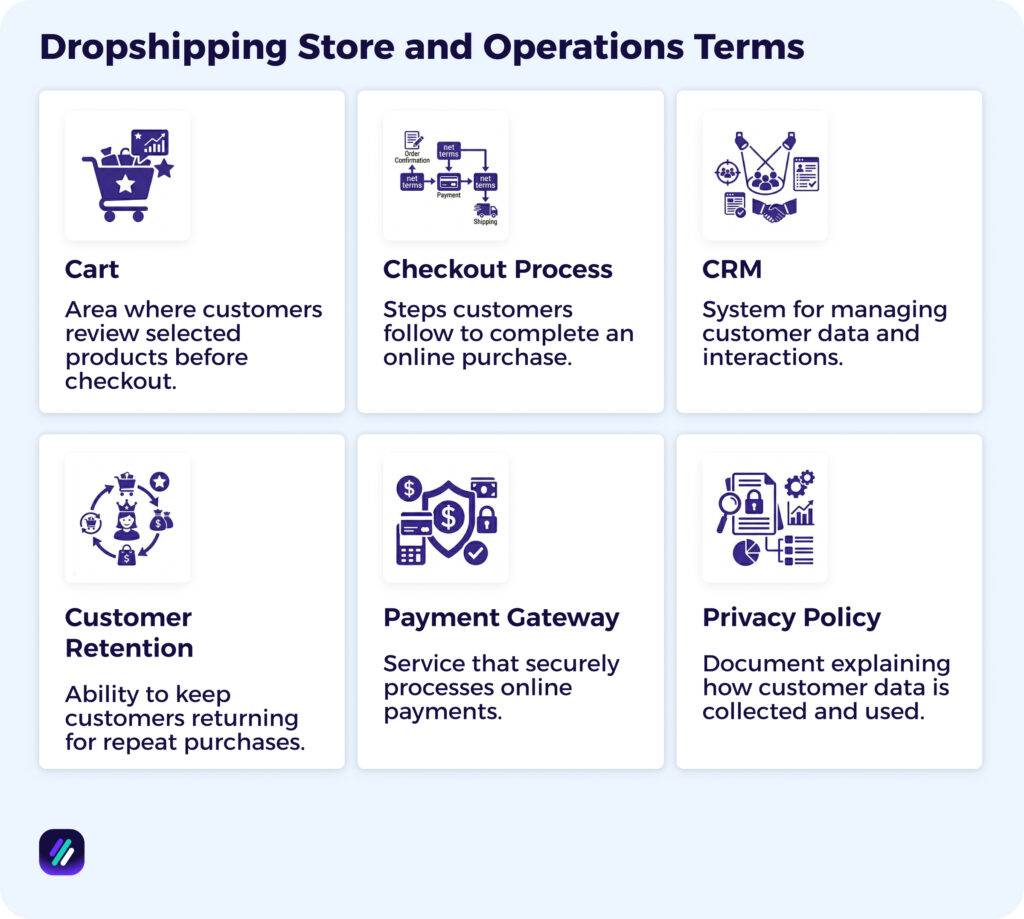
These terms focus on how your store functions day to day, from checkout to customer management. Understanding them helps you improve conversions, manage customers efficiently, and operate professionally on ecommerce platforms.
- Cart / Shopping Cart: The area of an online store where customers review selected products before proceeding to checkout.
- Checkout Process: The sequence of steps a customer follows to complete a purchase, including entering shipping details and payment information.
- Customer Relationship Management (CRM): A system used to manage customer data, interactions, and communication across sales and support channels.
- Customer Retention: The ability to keep customers coming back for repeat purchases. Strong retention lowers acquisition costs and increases lifetime value.
- Payment Gateway: A service that securely processes online payments by connecting your store to credit cards, banks, or digital wallets.
- Privacy Policy: A legal document that explains how customer data is collected, stored, and used. Privacy policies are required on most online selling websites.
Advanced Dropshipping Concept Terms
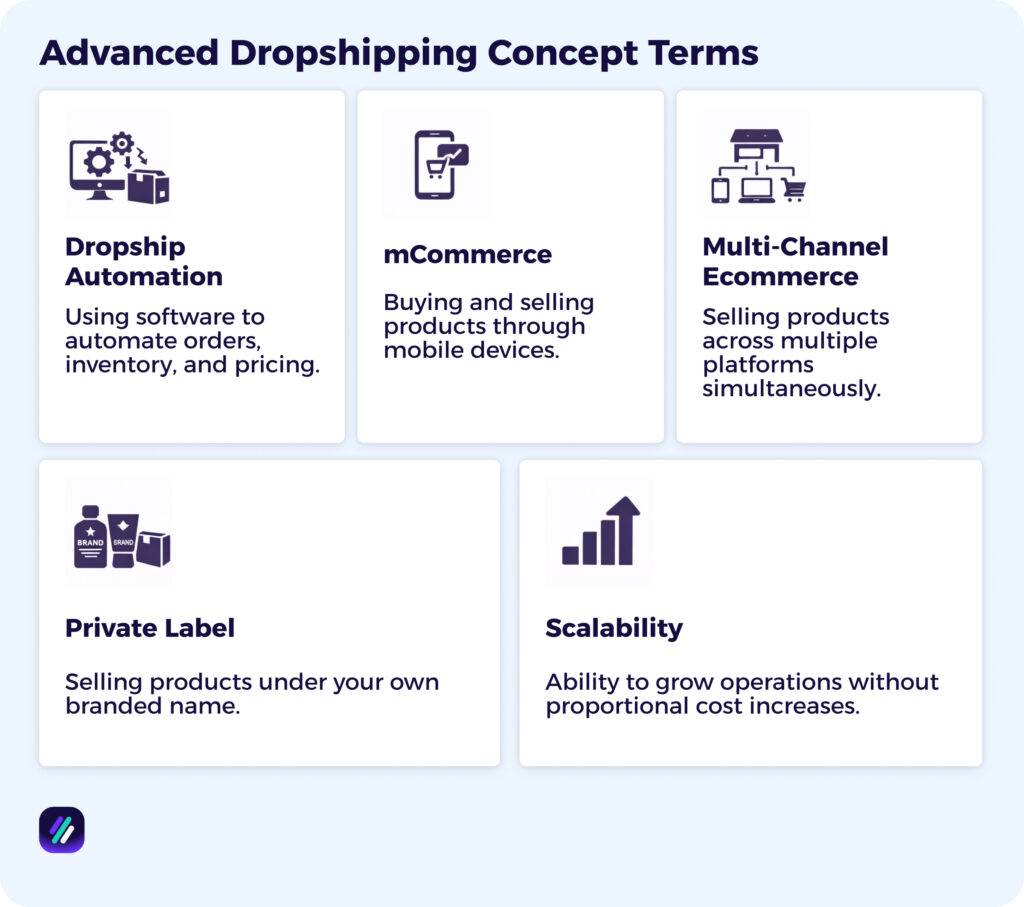
These concepts go beyond the basics and focus on growth, efficiency, and long-term sustainability. Most sellers encounter them once they start scaling beyond their first few products.
- Dropship Automation: The use of software and tools to automate tasks such as order processing, inventory syncing, pricing updates, and customer notifications.
- mCommerce: Short for mobile commerce, it refers to buying and selling products through mobile devices such as smartphones and tablets.
- Multi-Channel Ecommerce: Selling products across multiple platforms at the same time, such as your own store, online marketplaces, and social channels.
- Private Label: A business model where products are sold under your own brand name, often sourced from manufacturers and customized with unique packaging or branding.
- Scalability: The ability of a dropshipping business to grow sales and operations without a proportional increase in costs or complexity.
Frequently Asked Questions on Dropshipping Glossary
Here are some frequently asked questions about the dropshipping glossary:
Which niche is best for dropshipping?
The best niche for dropshipping is one with consistent demand, manageable competition, and products that solve clear problems. Popular options include home improvement, fitness accessories, pet products, and lifestyle items. Validating niches through market research and competitor analysis helps reduce risk before launching.
What is the most profitable item to dropship?
The most profitable items to dropship are products with strong demand, low shipping costs, and healthy margins. Examples include accessories, problem-solving household items, beauty tools, and pet products. Profitability depends more on pricing, marketing, and supplier reliability than on the product itself.
Do I need a license to dropship?
In most cases, you do not need a special license to start dropshipping. However, you may need to register a business, obtain a sales tax permit, or comply with local regulations, depending on your country, payment processor, and ecommerce platform requirements.
What platform is best for dropshipping?
There isn’t one “best” platform for everyone, but Shopify is widely favored for beginner-friendly ecommerce store building and dropshipping integrations. WooCommerce suits those who want more control, while marketplaces like eBay and Amazon help test products without a standalone store. Choice depends on your goals.
How do I handle returns in dropshipping?
You handle returns in dropshipping by setting a clear return policy and coordinating directly with your supplier. Most returns are sent back to the supplier or refunded without return if shipping costs are high. Clear communication helps prevent disputes and chargebacks.
What is the best shipping time for dropshipping?
The best shipping time for dropshipping is typically 5 to 10 business days. Faster delivery improves customer satisfaction and reduces disputes. Longer shipping times can still work if expectations are clearly communicated on product pages and during checkout.
What is the next big thing, like dropshipping?
The next big thing after dropshipping is models focused on faster fulfillment and brand ownership, such as private label, print on demand, and local sourcing. Businesses that combine automation, strong branding, and multiple sales channels tend to outperform simple product reselling over time.
What is the biggest risk in dropshipping?
The biggest risk in dropshipping is a lack of control over suppliers, shipping times, and product quality. Delays, stock issues, or defective items can damage customer trust. Without proper research, clear policies, and reliable suppliers, profit margins and brand reputation can quickly suffer.