
To sell 3D prints, print designs you made yourself or ones whose license allows commercial use, and avoid characters and logos you have no rights to. Then price against filament plus marketplace fees, and check the item already sells on eBay before printing a batch.
Most of the work in selling 3D prints happens before anything goes on the printer bed. The license on the file decides whether you can sell it at all, the marketplace decides your fees and your rules, and sold data decides whether the item is worth a second print.
The demand is there: on eBay.com alone, 3D printed items sold 41,120 times in the 30 days to October 1, 2026. The steps below, with worked fee examples for eBay and Etsy, decide whether your prints get a share of it.
Key takeaways
- Your own designs are always yours to sell. A file under a Creative Commons NonCommercial license is not, however you print it.
- Licensed characters and brand logos are the fastest way to lose listings. eBay bans custom printed goods carrying third-party content without the rights owner's consent.
- Etsy has required 3D printed items to come from the seller's original design since June 10, 2025, so a commercial license to someone else's file no longer qualifies there.
- Filament is the small cost. At $15 to $21 a kilogram it runs about 1.5 to 2.1 cents a gram, while eBay's final value fee is 13.6% of the sale in most categories.
- Before printing ten of anything, look up the item in the eBay Product Research Tool and check its sales, sell-through rate and number of competing listings.
Can you legally sell 3D prints?
Yes, as long as you own the design or its license allows commercial use. Prints of your own models are yours to sell. Prints of downloaded files, licensed characters or brand logos can break copyright or trademark law, and marketplaces remove them on complaint.
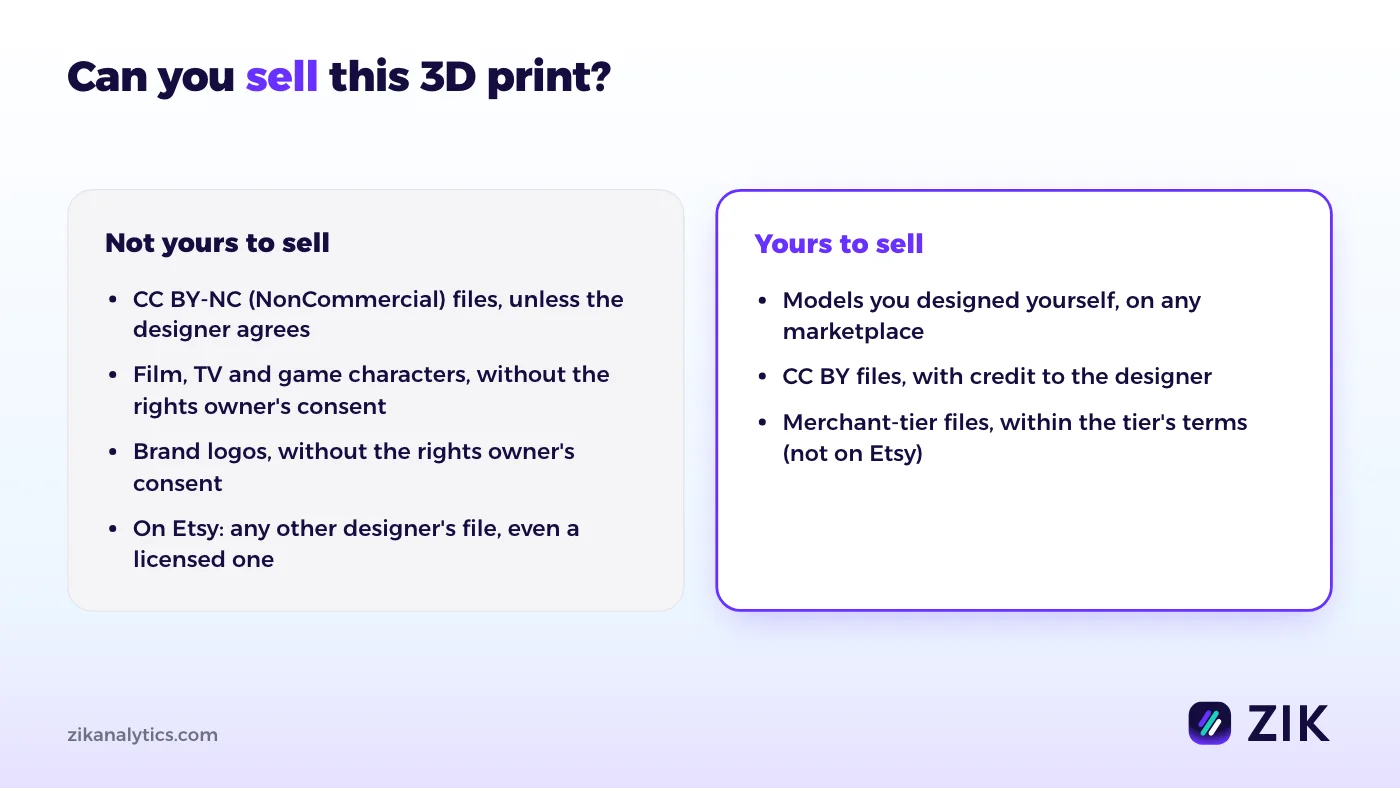
This is not legal advice, and the rules differ by country. These are the three situations sellers actually run into.
Your own designs
A model you designed from scratch carries no license question at all. This is also the only category every marketplace accepts without conditions, and it is the one Etsy now requires (more on that below).
Downloaded files and their licenses
Most free model sites let designers attach a Creative Commons license, and the license tag decides whether you can sell the print.
| License on the file | Can you sell prints? |
|---|---|
| CC BY (Attribution) | Yes, with credit to the designer |
| CC BY-NC (NonCommercial) | No |
| Designer's own terms, such as a paid commercial tier | Only within those terms |
The NonCommercial deed is short and unambiguous: "You may not use the material for commercial purposes," where commercial means "primarily intended for commercial advantage or monetary compensation" (Creative Commons). Selling a print is exactly that.
Check the tag on every file, because the defaults are not on your side. Clever Creations reports that most uploads on Thingiverse use the NonCommercial license, and All3DP notes that designers can add their own restrictions on top, including a ban on selling prints. When a file is NonCommercial, you can still message the designer and ask for permission.
Many designers also sell those rights by subscription. A Patreon or MyMiniFactory Tribes "merchant tier" grants a commercial license to print and sell the designer's models (Snapmaker). Read what each tier allows before you list, and note that Etsy no longer accepts prints of another designer's work, licensed or not (see below).
Characters, logos and fan art
This is where most takedowns come from. eBay's custom printed products policy allows custom goods only "if the materials don't include unauthorized third-party content," meaning images, logos or pictures of people used without the rights owner's consent. Its examples include water bottles printed with cartoon characters copied from a brand's website and T-shirts printed with a company's logo.
The policy is written about printed goods, not 3D printing, but a resin figure of a film character or a lightbox sign carrying a car maker's badge raises the same question: whose content is it?
Rights owners do act on this. In 2023 Games Workshop, the company behind Warhammer, filed 12 claims with the US Copyright Claims Board against one creator, alleging he had extracted models from a Warhammer video game, converted them for 3D printing and sold printed copies for $65 each on Etsy. It sought $30,000 per claim, the board's maximum (Plagiarism Today).
Where to sell 3D prints
Sell functional parts and collector add-ons on eBay, original and personalized designs on Etsy, and a signature product line on your own Shopify store. Local craft fairs and businesses are a low-cost way to test a design or sell a batch.
| eBay | Etsy | Your own Shopify store | |
|---|---|---|---|
| Whose designs | Yours, or licensed for sale | Yours only, since June 2025 | Yours, or licensed for sale |
| Main fee | 13.6% final value fee, most categories, no Store | $0.20 listing + 6.5% transaction + 3% + $0.25 processing (US) | Store plan and payment fees, no marketplace cut |
| Buyers arrive | From eBay search | From Etsy search | Only the traffic you bring |
| Best for | Parts, mounts, collector accessories | Personalized gifts, home decor, original art | One product line with its own brand |
eBay
eBay has a large, steady market for 3D printed items. According to the ZIK Marketplace Index (ZMI), covering 159.9M tracked US eBay listings, pulled 2026-10-26, eBay.com carried 18,971 listings with "3D printed" or "3D print" in the title that sold at least once in the 30 days to October 1, 2026. Together they made 41,120 sales and $827,820 in revenue for 2,556 sellers. Those figures exclude printer supplies, flat and fabric prints, digital files, brand-made goods and restricted items.
The buyers are mostly hobbyists and fixers. In a broader ZMI pull of the same window, 25,412 of 45,166 sales sat in Toys & Hobbies, with Collectibles & Art, Home & Garden and Electronics next. That is diecast truck accessories, model railroad scenery, console stands, replacement knobs and car trim: items a buyer searches for by exact fit.
eBay's final value fee is 13.6% for most categories if you have no Store or a Starter Store, and 12.7% with a Basic Store or above. eBay Motors parts and accessories run 13.6% without a Store and 11.5% with one. A per-order fee applies on top; the eBay fee calculator works out the full amount for your price and shipping. If you are new to the platform, start with how selling on eBay works.
Etsy
Etsy changed its rules for 3D printing on June 10, 2025. Its Creativity Standards used to say items made with computerized tools "may be produced based on a seller's original design, or using a templated design or pattern." The current wording is "These items must be produced based on a seller's original design" (Value Added Resource).
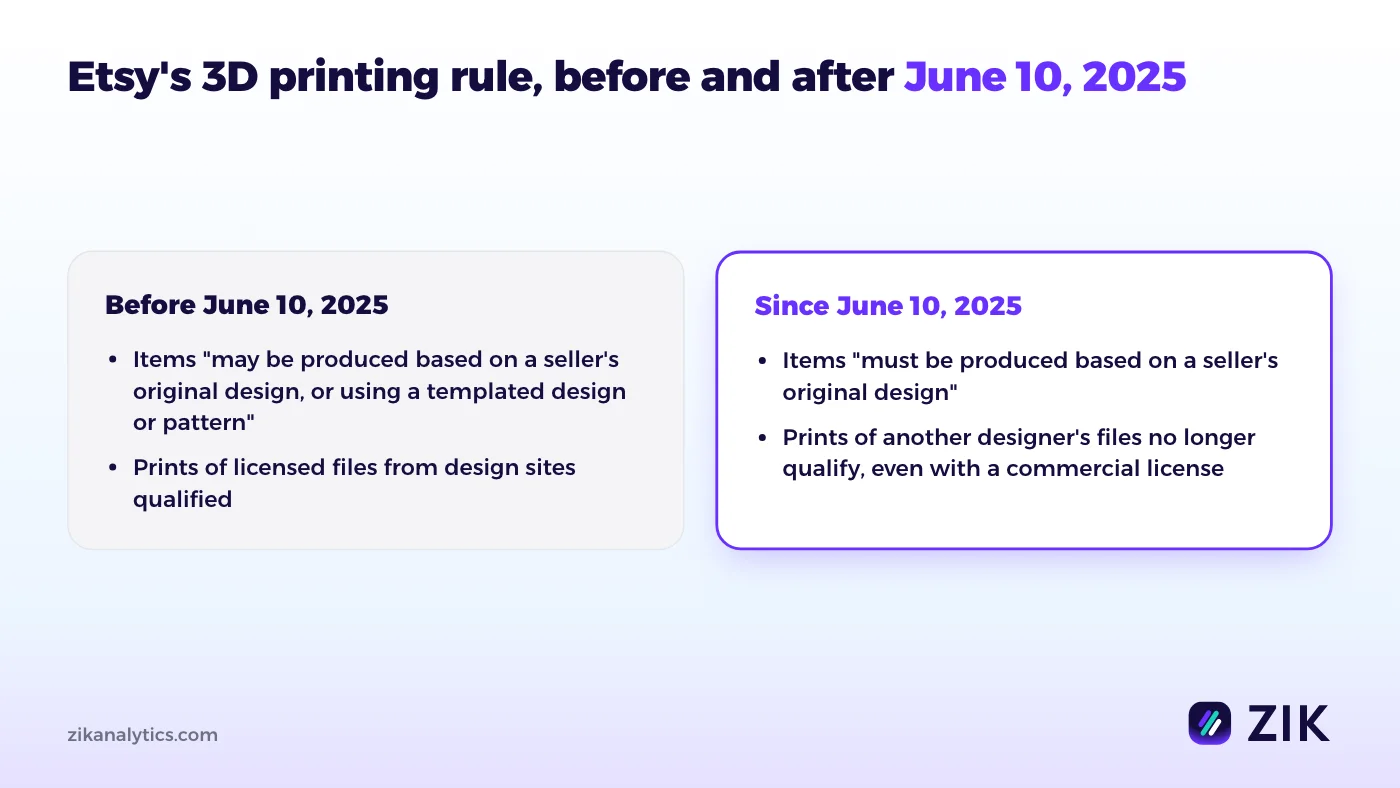
The practical effect, as patent attorney Susan Bradley explains in TCT Magazine, is that a seller with a commercial subscription to a design site can no longer sell prints of those designs on Etsy, even with the designer's permission. If your catalog is built on licensed files, eBay or your own store is the place for it. If your designs are your own, here is what tends to sell among 3D printed items on Etsy.
Etsy charges a $0.20 listing fee, a 6.5% transaction fee on the item price plus shipping, and 3% + $0.25 for payment processing in the US. The Etsy fee calculator adds them up for any price; Offsite Ads, charged only on some sales, are extra.
Your own Shopify store
A store of your own carries no marketplace cut and no marketplace design rules, beyond the law itself. The tradeoff is traffic: nobody finds you through a marketplace search, so every buyer comes from your social posts, ads or repeat customers.
That works best for one product line you can build a brand around, such as a modular toy system or a range of accessories for a single hobby, rather than a mixed catalog of one-off prints. If that is your plan, here is how to start a Shopify store.
Locally and to businesses
Craft fairs, markets and local shops put a design in front of buyers before you pay any marketplace fee, and they show you which prints people pick up and which they put down. Local businesses are customers too: a workshop that needs tool organizers or a store that needs a replacement part may order a batch, and a batch job does not compete with marketplace listings on price.
If you would rather sell printed products without owning a printer at all, that is a different model; see the difference between dropshipping and print on demand.
How much to charge for 3D prints
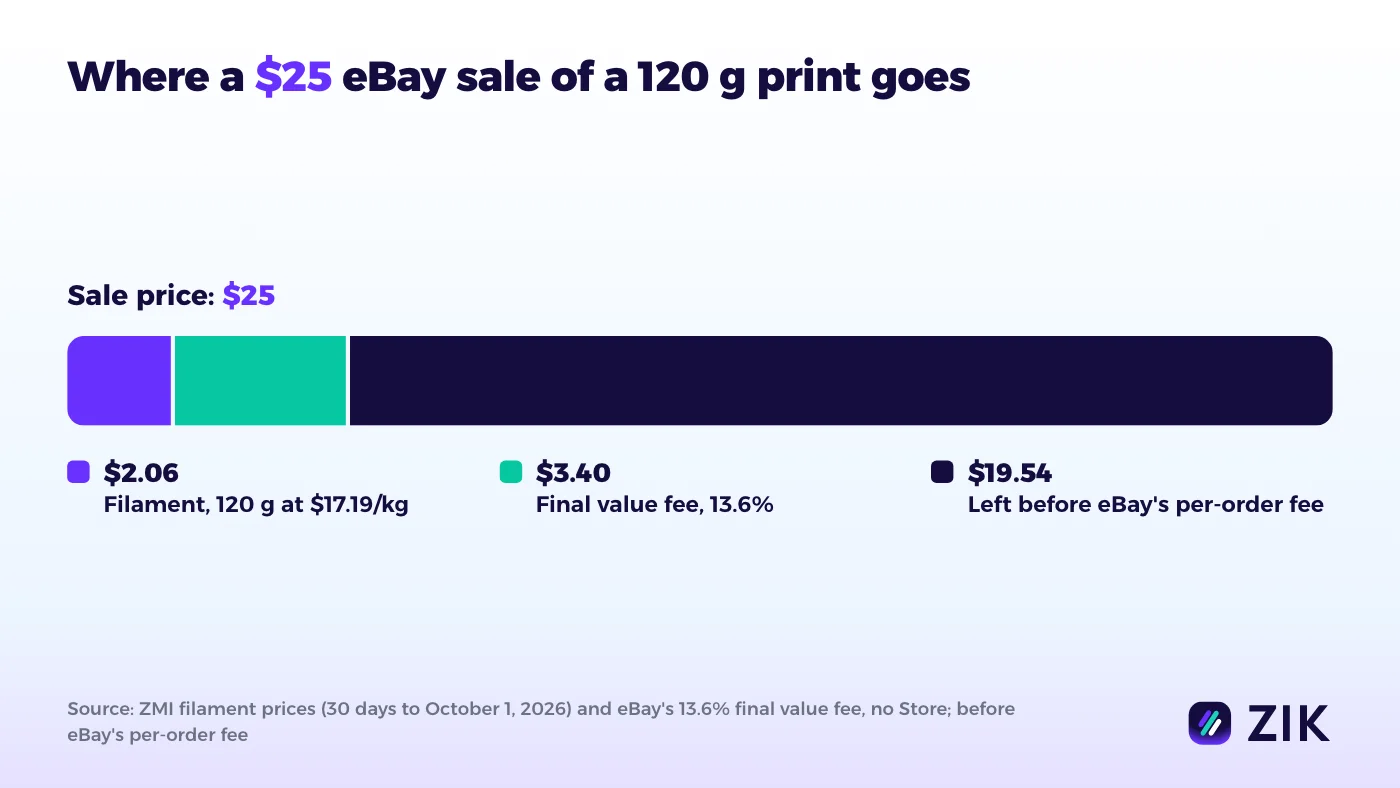
Price from the full cost of a sale, not the filament. Filament runs about 1.5 to 2.1 cents a gram, while marketplace fees take roughly 11% to 14% of the sale price, so fees usually cost more than plastic.
What filament costs
In ZMI, single 1 kg spools of PLA filament on eBay.com sold 1,777 times from 67 sellers in the 30 days to October 1, 2026. The median listed price was $21.01 a kilogram, the most-bought listing sold at $15.39, and the average price weighted by sales was $17.19. That puts PLA at roughly 1.5 to 2.1 cents a gram before shipping. Your slicer reports each model's filament weight in grams before you print, so the material cost of any file is one multiplication.
A worked example
Take a 120 g print listed at $25, which is near the top quarter of 3D printed listing prices in ZMI (the upper quartile is $25.53).
| Cost | eBay (no Store) | Etsy (US) |
|---|---|---|
| Filament, 120 g at $17.19/kg | $2.06 | $2.06 |
| Final value fee, 13.6% | $3.40 | |
| Listing fee | $0.20 | |
| Transaction fee, 6.5% | $1.63 | |
| Payment processing, 3% + $0.25 | $1.00 | |
| Left from $25 | $19.54, before eBay's per-order fee | $20.11 |
Neither figure is profit. You still have to cover electricity, failed prints, packaging, postage if you offer free shipping, and your time at the printer and the packing table. Those costs are yours to measure, and they decide the real price. If this print takes ten hours, $19.54 is a very different result than if it takes ninety minutes.
A simple pricing formula
Snapmaker's pricing guide adds material, electricity, labor and post-processing time, and machine wear into a base cost, then multiplies it by 2x to 4x to reach a retail price (Snapmaker). Run the formula with your own numbers, then test the answer with two checks before you settle on a price:
- Look at what the item actually sells for. The median 3D printed listing in ZMI sold at $15.61, and the middle half of listings sat between $9.64 and $25.53. A price far above that range needs a reason a buyer can see, such as size, painting or personalization.
- Price the time, not the grams. Two prints of the same weight can finish in very different times, and the slow one ties up your printer for the jobs that would have paid.
How to check demand before you print
Look the item up in sold data before you print a batch. On eBay, the useful numbers are recent sales, sell-through and competing listings; ZIK's starting benchmark for beginners is at least 2 sales in 7 days and 5 or fewer competitors.
A print that sold once is a good first sign. A print that sells every week, across several sellers, is a product.
Search the product, not your idea of it
The eBay Product Research Tool takes a keyword, such as "articulated dragon" or "Game Gear stand," and returns sell-through, listings, sold items and sale earnings for it. Filter by price, exclude phrases such as "STL" or "file" that bring in digital listings, and switch the sale date between 7, 14, 21 and 30 days to see whether demand is rising or fading.
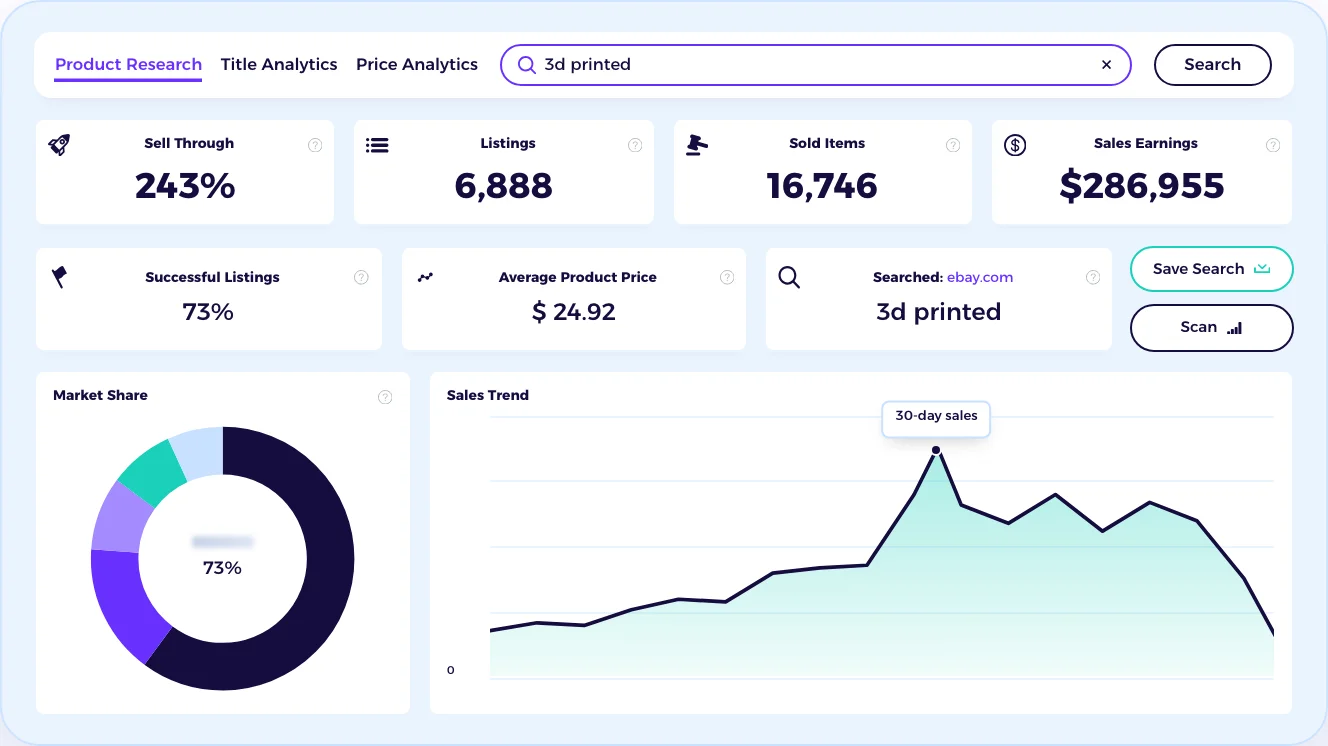
The eBay Product Research Tool searching "3d printed" on eBay.com, run October 27, 2026. One keyword search counts only titles with both words, so its totals are lower than the wider ZMI figures in this guide.
For longer windows, ZIK's guidance asks for 4 sales in 14 days or 6 in 30. Those numbers pick out items that sell quickly without a crowd already listing them.
Study the sellers who are already winning
Sales in 3D printed items cluster around a few sellers per niche. In ZMI, the 10 biggest sellers took 34% of all 3D printed sales on eBay.com in the 30 days to October 1, 2026. The eBay Competitor Research Tool shows any of those sellers' sell-through rate, active listings and sale earnings over 7, 14, 21 or 30 days. Open it straight from a search with Scan Seller when a store keeps turning up.
What you are looking for is the gap: a part they sell for one car model and not the next, a stand for one console and not its successor.
Check sold history while you browse
The free ZIK Chrome extension for eBay shows an item's sold history and a seller's performance directly on the eBay page. It is free to install and does not need a subscription, which makes it the quickest check while you look around eBay for ideas.
Write titles buyers search for
3D printed items sell on fit and function, so the title has to carry the model, size and use. The eBay Title Builder shows search volume for keywords and suggests related terms, so "1:64 fifth wheel hitch for Greenlight trucks" beats "cool 3D printed truck part."
What the eBay numbers say about selling 3D prints
Selling 3D prints on eBay is a long-tail business. Most sellers make a handful of sales a month, and only 69 reached 100 in the latest 30 days. Plan for many listings that each sell steadily, not one item that sells hundreds.
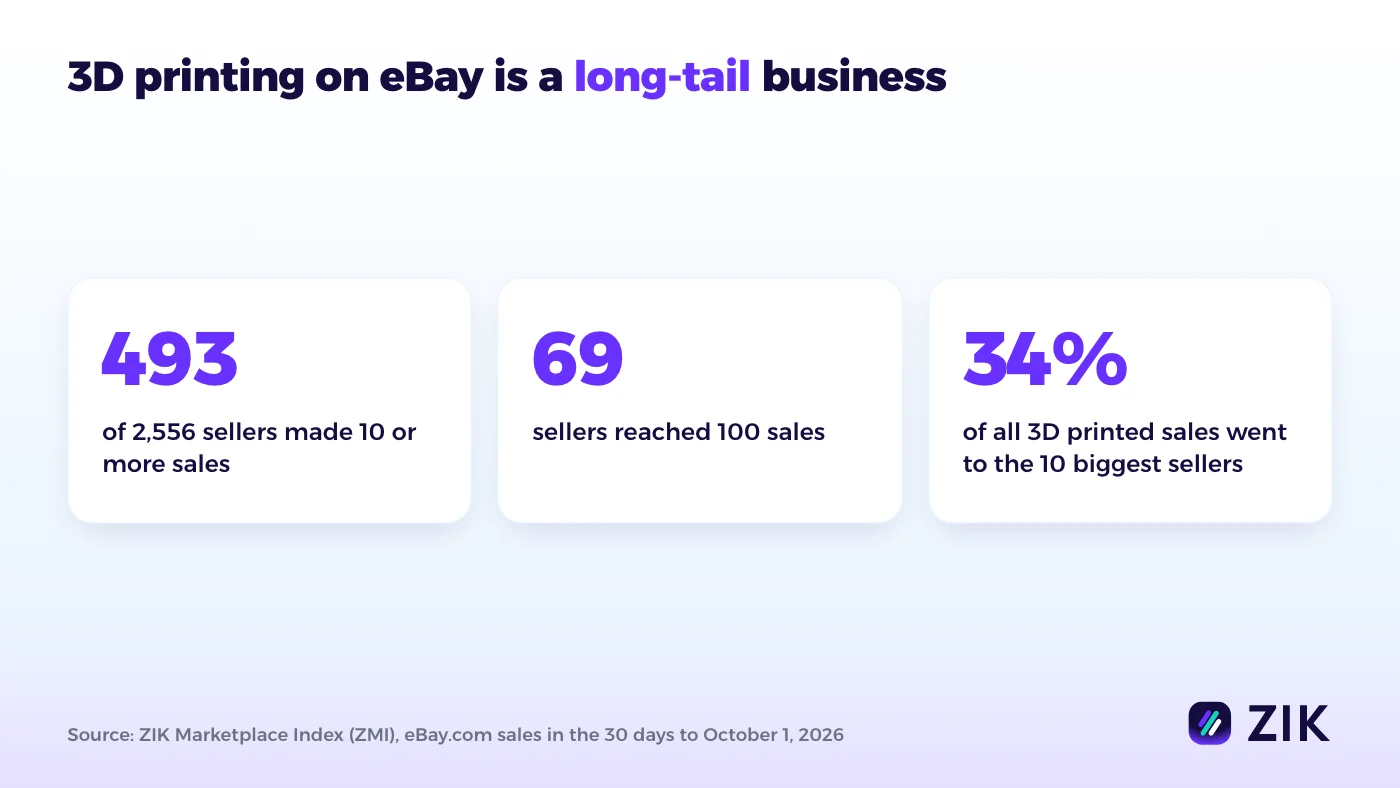
In ZMI, 493 of the 2,556 sellers of 3D printed items on eBay.com made 10 or more sales in the 30 days to October 1, 2026. Only 12 of the 18,971 listings reached 100 sales on their own, and 11,955 sold exactly once.
The product types that earn most at $15 and up are light-up signs and lamps, painted statues and busts, diecast scale accessories, and cosplay masks and helmets. Several of those are exactly where licensed characters and brand logos crowd in, so the opening for a new seller is an original design in a proven type, not a copy of what already sells. The full ranked list of the best selling 3D printed items has the numbers for each.
One limit to keep in mind: ZIK tracks active listings that sold at least once in the last 30 days, so ended listings and items that never sold do not appear. Treat every ZMI total as a minimum. For the wider picture of what moves on the platform, see the best selling items on eBay.
Common mistakes when selling 3D printed items
- Selling a file you only had a personal license to. The print is yours; the design is not. Check the license tag before you list, not after a takedown.
- Pricing from filament alone. A $2 print sold for $6 looks like a 200% markup, but eBay's 13.6% fee, a per-order fee, packaging and one failed print come out of that $4 before your time is counted.
- Copying the top seller's licensed products. The bestsellers that use characters and logos are also the listings most exposed to rights-owner complaints. Copying them copies the risk.
- Printing what everyone already prints. Popular free models are listed by many sellers at once, so they compete on price alone, and most 3D printed listings on eBay sold just once in the latest month. A design of your own, or a fit nobody else covers, is what lifts a listing out of that crowd.
- Printing a batch before checking demand. Ten unsold prints cost you filament, printer time and storage. A search of eBay's sold listings is free and takes minutes.
- Listing on Etsy with someone else's files. Since June 2025 that breaks Etsy's rules even with a commercial license. Move those listings to eBay or your own store.
Check 3D print demand with ZIK Analytics
Selling 3D prints comes down to four checks: the design is yours or licensed for sale, it carries no one else's characters or logos, the price covers fees and time as well as plastic, and the item already sells. The first two keep your listings up. The last two decide whether they earn anything.
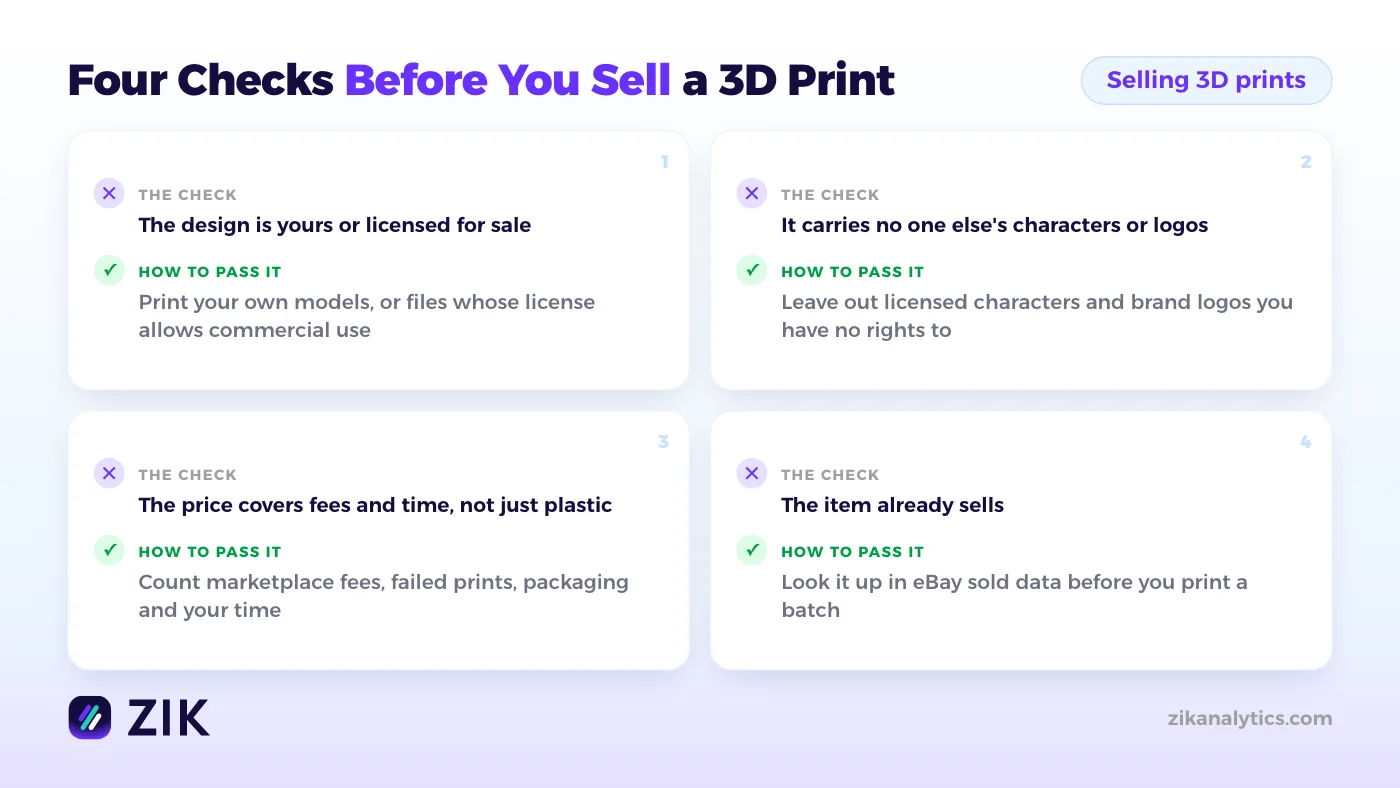
The demand check is the one most sellers skip, and the one ZIK is built for. Look up your next print in the eBay Product Research Tool and see what it sold for, how often, and against how many other sellers. You can try it with a $1 trial for 7 days.
Frequently asked questions
Can you sell 3D prints?
Yes. You can sell prints of your own designs freely, and prints of downloaded files when the license allows commercial use, such as CC BY with credit to the designer. Prints of NonCommercial files, or of licensed characters and brand logos without permission, can be removed and can lead to legal claims.
Is it legal to sell 3D printed items?
It is legal when you have the rights to the design. The risk comes from the design, not the printing: a CC BY-NC license forbids commercial use, and eBay prohibits custom goods carrying third-party images or logos without the rights owner's consent. This is general information, not legal advice.
Where is the best place to sell 3D prints?
eBay for functional parts, accessories and collector add-ons, where buyers search by exact fit. Etsy for original and personalized designs, since it only accepts prints of the seller's own designs. Your own Shopify store for a single branded product line, if you can bring your own traffic.
Is 3D printing 40k illegal?
Selling copies of Games Workshop's Warhammer 40,000 designs without permission can infringe its copyright, and the company enforces it. In 2023 it filed 12 claims with the US Copyright Claims Board against one creator who sold prints made from models taken from a Warhammer game, seeking $30,000 per claim.
Which 3D models sell most?
On eBay.com, the 3D printed types that earned the most at $15 and up in ZMI's latest 30 days were light-up signs and lamps, painted statues and busts, diecast scale accessories, and cosplay masks and helmets. Cheaper accessories for action figures sell more units but earn far less per sale.
Is 3D printing a profitable side hustle?
It can be, but most sellers stay small. In ZMI, only 69 of 2,556 eBay.com sellers of 3D printed items made 100 or more sales in 30 days, and the median listing sold at $15.61. Profit depends on your print time, failure rate and fees, so track them from the first sale.
Can you make money 3D printing?
Yes, if you sell items that already have demand and price them for fees, failed prints and your time, not just filament. Filament is the smallest cost; fees and print time decide the margin. Check sold data before printing in bulk.