
Life becomes a lot easier when you have technology taking care of the repetitive work for you.
Turns out, dropshippers can make their lives significantly easier by automating several key parts of their business.
From product research to order fulfillment, most of these tasks can be handled using tools that cost a fraction of what a virtual assistant would through automated dropshipping.
Below, I walk you through the dropshipping automation strategies I have used for my own store, plus how you can do the same.
What is Automated Dropshipping?
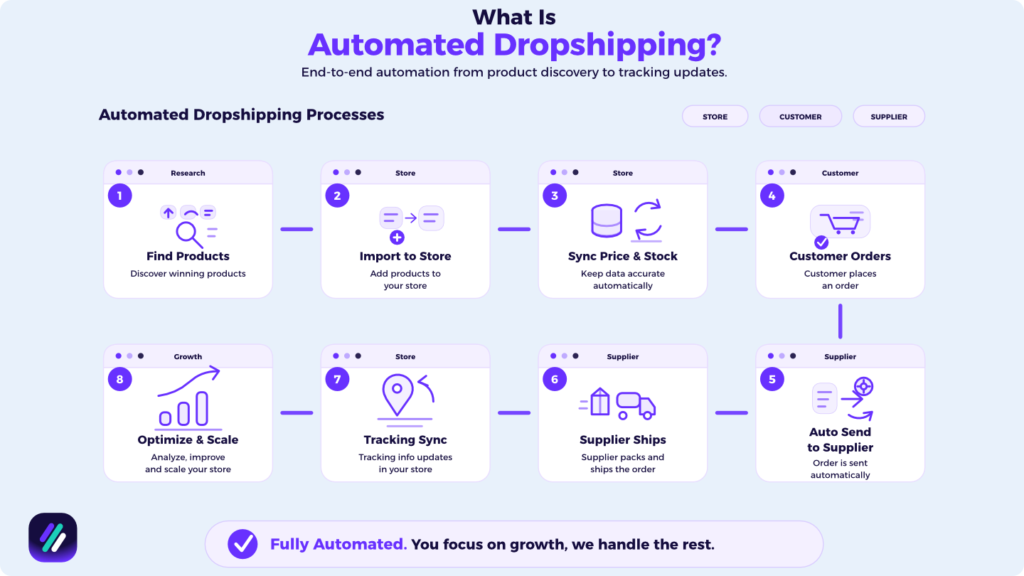
Automated dropshipping is the process of using software to handle tasks like product importing, inventory syncing, and order fulfillment.
You set up your store and connect it to your dropshipping supplier. Once done, the software handles the rest while you focus on growing the business.
Automation can remove most of the manual work that slows sellers down. With the global dropshipping market projected to reach $1.25 trillion by 2030, getting your store running efficiently now can put you in a better position to scale when the demand is there.
Why is Automated Dropshipping Important? Benefits
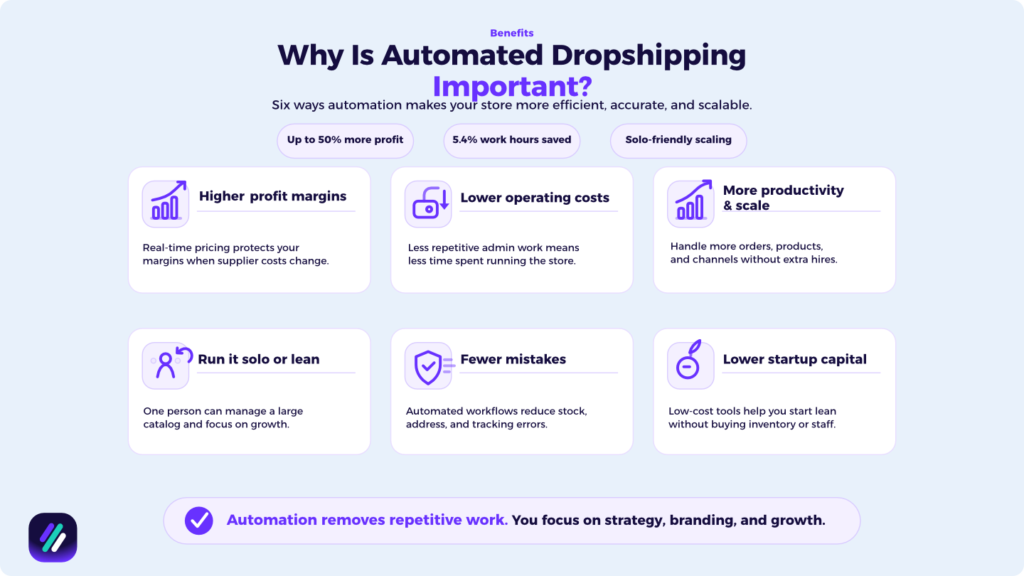
There are several benefits to automating your dropshipping business:
It increases profits
Dropshipping automation protects your margins by updating prices in real time whenever supplier costs change. According to industry data, automated dropshipping stores can generate up to 50 percent more profit compared to traditional inventory-holding retailers.
It decreases costs
Automation also removes the need to buy tools for repetitive tasks. Workers using generative AI reported saving an average of 5.4% of their work hours, making roughly 2.2 hours per week in a 40-hour work week.
It greatly increases productivity and scalability
Dropshipping automation lets you do more in less time by removing the repetitive tasks that pile up as your order volume grows. It also gives you the bandwidth to take on more products, more channels, and more customers without needing to hire additional help.
You can go solo or with a small team
Automation allows even a single person to manage thousands of products independently. By eliminating manual processing and handling repetitive tasks, it frees up time for you to focus on strategic initiatives, such as customer relationship building and store branding.
It makes fewer mistakes than humans
Automation is also more reliable than doing things manually at scale. Imagine processing a hundred orders a day where every one requires copying a customer address and sending tracking details. The odds are that some of those will have errors. Automation removes that risk because the same process runs the same way every time, regardless of volume.
Reduce startup capital
Dropshipping already removes the need for upfront inventory purchases, and automation lowers costs further by eliminating the immediate need for staff or administrative assistants. Many automation tools also have low-cost or free plans that enable you to start with a minimal budget.
Best Automated Dropshipping Strategies
Ever since I discovered tools that help dropshippers automate different operations, I’ve been testing things out and getting wonderful results.
Here are some ways you can leverage automation to optimize your business.
Strategy 1: Automate Your Product Research
Automating your product research means using data to find what is already selling in the market. This approach is a lot more reliable than scrolling social media and hoping something catches your eye.
Using tools like ZIK Analytics, you can search for an item and see how many units have sold, how many sellers are competing for it, and whether demand is trending up or flattening out.
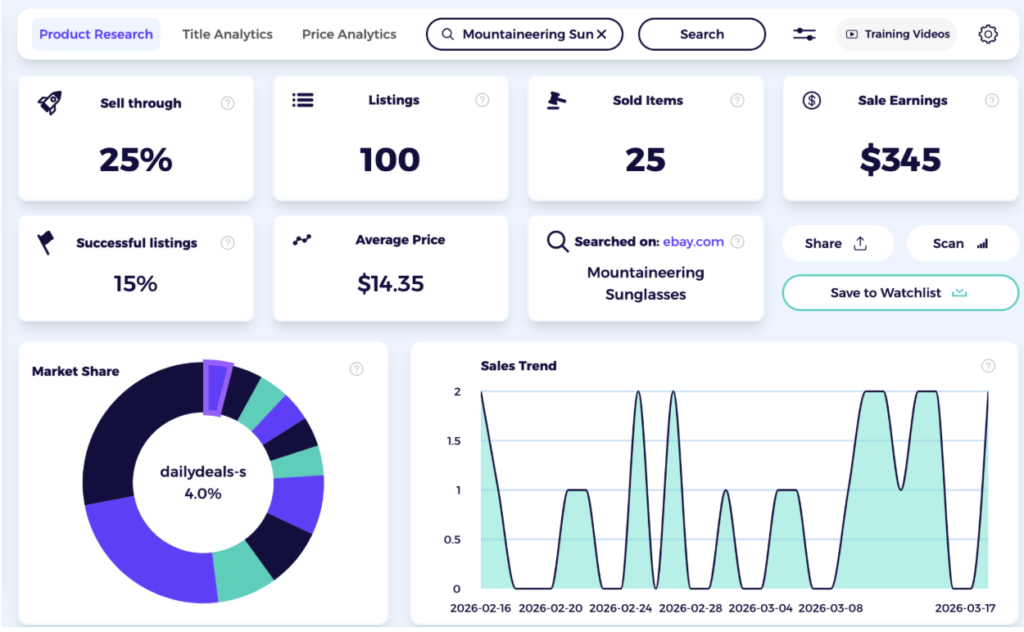
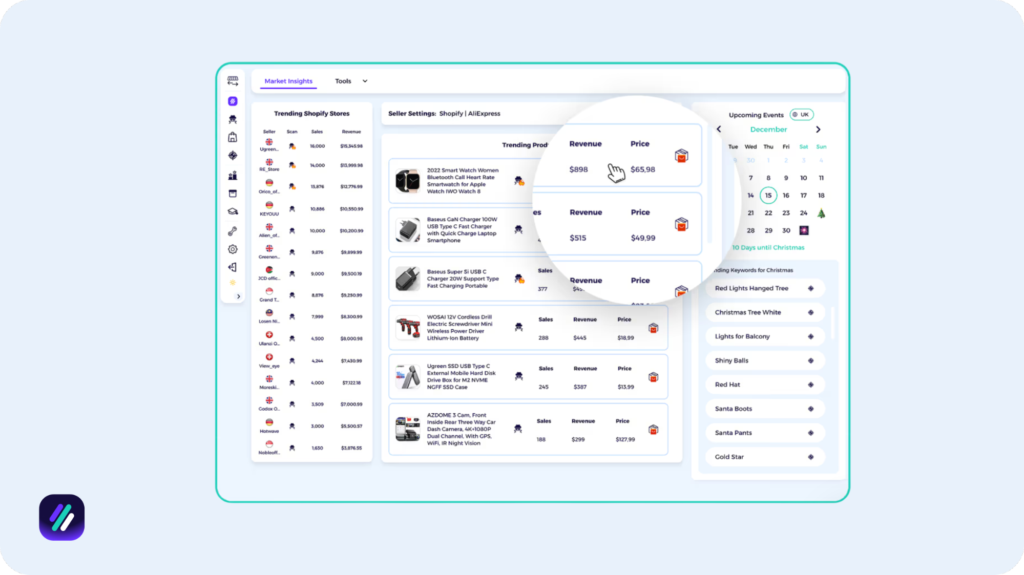
ZIK Analytics also has a market insights feature that lets you look across entire categories rather than searching product by product. So instead of starting with a specific item in mind, you can at the ongoing trends in a niche and work backward from there.
Strategy 2: Automatically Import Listings
You can also automate the next step that comes after finding a product: getting it live on your store.
Doing this requires a listing import tool that connects to your supplier and pushes product data directly to your storefront in one click. DSers and AutoDS are good options, as they handle titles, images, variants, and stock levels across multiple suppliers at once.
Most tools also keep your listings in sync, so if a supplier runs out of stock or changes a price, your store updates automatically.
Strategy 3: Set up Pricing Tracking & Strategy
After importing your listings, you will need to come up with a pricing strategy that covers your costs and leaves you with a profit on every sale.
There are a few different pricing strategies available, such as fixed markup pricing, where you add a set percentage on top of your supplier cost, or dynamic pricing that adjusts based on what competitors are charging.
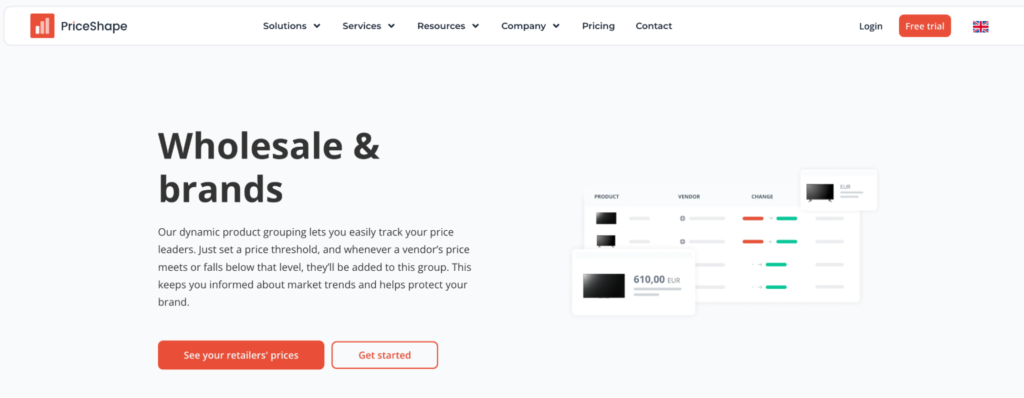
Before, you had to go through each listing individually and update prices yourself whenever anything changed. Now, tools like PriceShape and AutoDS can apply your pricing rules across your entire catalog and keep them current automatically.
Strategy 4: Automate Customer Interactions
Most solo dropshippers stretch themselves thin trying to answer every inquiry manually. Instead, why not leverage automation to handle the bulk of it for you?
Automation tools like chatbots can be set up to run on your website and social media pages around the clock. They can be trained on your specific policies, so responses stay on brand.
Do not step back completely, though. Checking in occasionally to review flagged tickets and make sure the system is handling things the way you want it to.
Strategy 5: Automate Fulfillment
Automating fulfillment means having a system that processes every order from sale to shipment without you manually placing each one with your supplier.
This is one area where a lot of dropshippers hold on to the manual process longer than they should. At ten orders a day it is manageable. At fifty, it starts eating into your time. At a hundred, it becomes unsustainable.
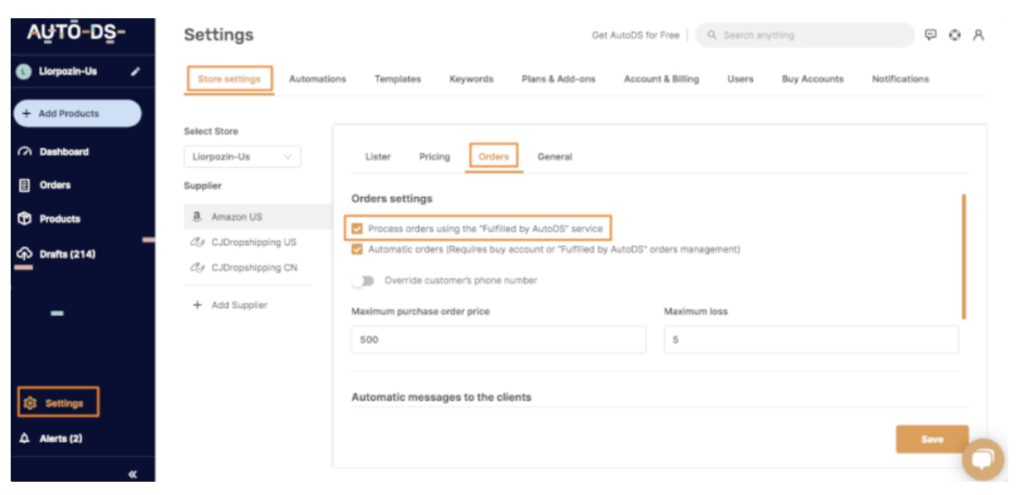
To make this work, you need a tool like AutoDS or Zendrop connected to your store. Once that is set up, a sale comes in, the order goes straight to your supplier, payment is processed, and the customer gets a tracking number without you doing anything.
Strategy 6: Automate Returns
Returns are unavoidable in dropshipping. But they do not have to eat into your time.
Tools like AfterShip and ReturnGo let customers submit a return, get a label, and track the process themselves without emailing you once. The refund gets triggered automatically when the item lands back with the supplier.
A smooth dropshipping returns process also does more for repeat purchases than most people expect. Getting that experience right is worth the initial setup
Strategy 7: Building an Online Store
Store building is something that put a lot of people off dropshipping over the years because the setup process was genuinely time-consuming.
Today, much of that can be handled by AI. Tools have come a long way in making the technical side of launching a store faster and less intimidating.
For example, ZIK’s Shopify AI Store Builder lets you input your niche and brand name and generates a fully functional store with a professional theme and pre-researched dropshipping products already loaded in.
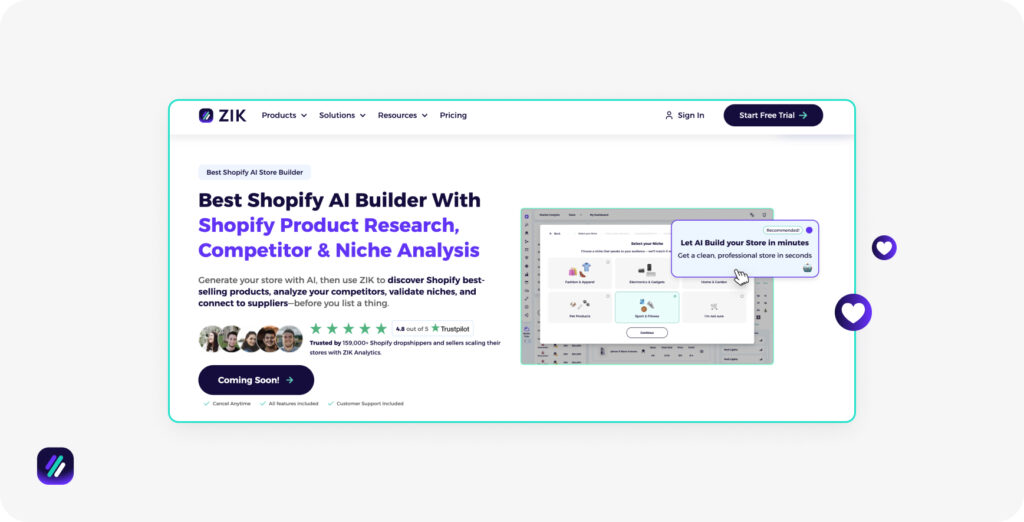
You review the setup, customize where needed, and launch the store.
Strategy 8: Automate Multi-Channel Selling Sync
Many dropshipping stores sell across multiple channels such as eBay, TikTok Shop, and Amazon. Most do it manually though, juggling tabs and updating listings one platform at a time.
You can do a lot better by automating the sync. Tools like AutoDS and Inventory Source connect all your channels so inventory, pricing, and orders update across every platform from one place. Sell something on eBay and your Amazon and Shopify stock adjusts automatically.
Strategy 9: Automate Shipping Notifications & Tracking Propagation
The best stores make customers feel looked after without anyone on the team actually doing the looking. Technology has come a long way in making that possible.
With tools like AfterShip and AutoDS, you can sync tracking numbers from your supplier and trigger branded shipping updates to your customer. Once done, customers can follow their package in real time without ever needing to reach out.
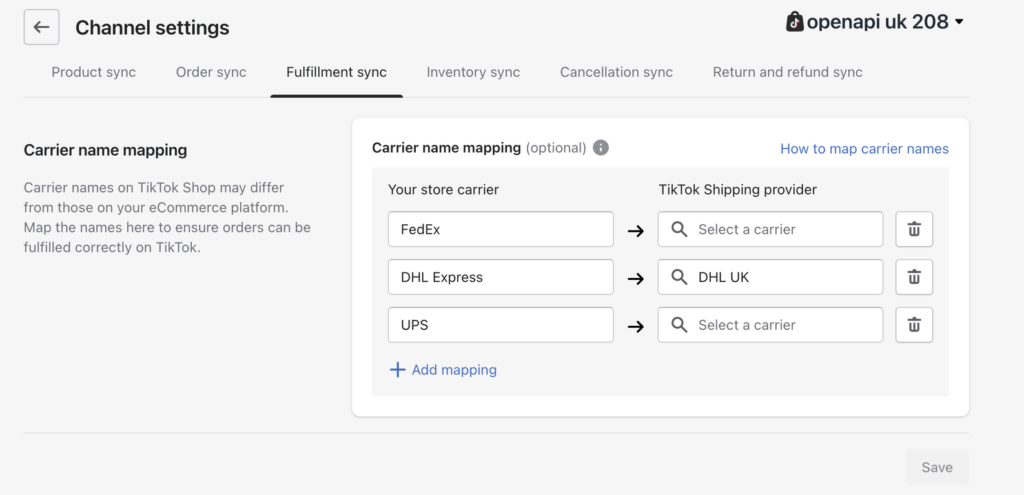
Want to take it further? Many of these tools also enable branded tracking pages that keep customers on your store rather than bouncing them to a supplier page.
Automated vs Manual Dropshipping
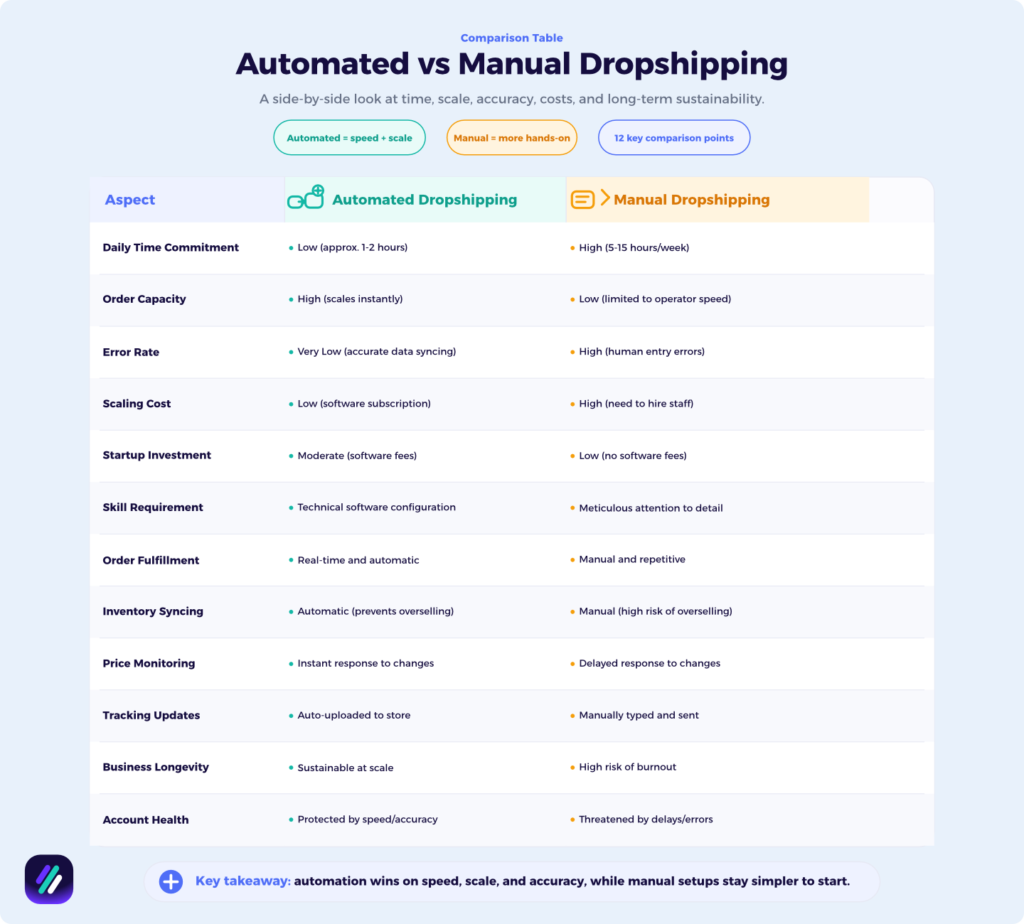
So, how does automated dropshipping compare to manual dropshipping? I pit them agaisnt one another to see how they differ on various fronts.
| Aspect | Automated Dropshipping | Manual Dropshipping |
| Daily Time Commitment | Low (approx. 1-2 hours) | High (5-15 hours/week) |
| Order Capacity | High (scales instantly) | Low (limited to operator speed) |
| Error Rate | Very Low (accurate data syncing) | High (human entry errors) |
| Scaling Cost | Low (software subscription) | High (need to hire staff) |
| Startup Investment | Moderate (software fees) | Low (no software fees) |
| Skill Requirement | Technical software configuration | Meticulous attention to detail |
| Order Fulfillment | Real-time and automatic | Manual and repetitive |
| Inventory Syncing | Automatic (prevents overselling) | Manual (high risk of overselling) |
| Price Monitoring | Instant response to changes | Delayed response to changes |
| Tracking Updates | Auto-uploaded to store | Manually typed and sent |
| Business Longevity | Sustainable at scale | High risk of burnout |
| Account Health | Protected by speed/accuracy | Threatened by delays/errors |
Is Automated Dropshipping Profitable?
Yes, automated dropshipping is profitable, but how much you make depends heavily on your niche and how well you manage your costs.
Most profitable automated stores operate with a net margin of 15 to 20 percent, with well-branded or high-ticket stores reaching 25 to 40 percent.
The stores that struggle are usually those that started undercapitalized or chose a niche with too much competition and too little margin to survive ad costs.
That is also why many small businesses do not automate everything from the start. The recurring cost of tools and advertising can quickly outpace revenue if the store has not yet found a winning product.
The Automation Maturity Ladder
When the way you run your store stops matching the size of your store, your growth stalls. The tasks that worked at $500 a month will slow you down at $5,000 and break you at $50,000. What determines how far you can go is where you stand on the Automation Maturity Ladder.
The Automation Maturity Ladder is a framework I developed to track my own progression as a dropshipper and help others do the same. It contains four levels, each defined by what you have automated, what you are earning, and what is holding you back from progressing in the field.
| Level | Automation | What’s Automated | Typical Monthly Revenue |
| 1 | Manual Operator | Product research or nothing, almost everything is manually copied and pasted | <$1K |
| 2 | Semi-Automated | Product Research, product import, and inventory sync. | $1K-$10K |
| 3 | Mostly Automated | Full order fulfillment, pricing, tracking, product and competitor research. | $10K-$100K |
| 4 | Fully Automated | AI-driven product, competitor, pricing research, dynamic pricing, multi-supplier failover, auto customer service | $100K+ |
Best Automated Dropshipping Tools
Although I’ve suggested a few tools for automating your store, here’s a list that you should find useful:
- ZIK Analytics: ZIK Analytics helps you find products worth selling before using market data and insights. You can also use it to analyze competitor stores and track what’s trending across different niches.
- AutoDS: AutoDS is an all-in-one automation tool that order fulfillment across multiple platforms. One of its best features is the ability to monitor supplier prices and stock levels around the clock and update your listings automatically.
- DSers: DSers is the official AliExpress partner for dropshipping. This tool lets you place hundreds of orders in seconds and automatically syncs tracking numbers back to your store. It is a solid choice if AliExpress is your primary supplier.
- Spark Shipping: Spark Shipping is a tool that streamlines supplier management by automating inventory syncing and order routing. It is helpful if you are working with multiple vendors and need everything connected in one place.
- Inventory Source: Inventory Source syncs your store directly with your supplier catalog to keep stock levels accurate and route orders without any manual input. It works well if you are working with a large number of SKUs and need a reliable connection between your store and your suppliers.
Role of AI in Automated Dropshipping
AI is the technology that enables dropshippers to automate different parts of their business. McKinsey projects that agentic commerce, where AI handles shopping, negotiation, and transactions on behalf of buyers, could generate $3 to $5 trillion in global retail revenue by 2030.
Here are the main ways the best AI dropshipping tools are being used in automated dropshipping today.
- AI product research: AI can speed up product research by processing data that would take hours to go through manually. Using tools like ZIK Analytics, you can evaluate products based on past performance and sell-through rate to validate whether something is worth selling.
- AI listing optimization: This involves using AI to generate the elements that make up a listing. Tools like AutoDS are available to help you generate optimized titles and copy that are more likely to rank and convert.
- AI dynamic pricing: AI can also help you stay competitive on price without checking competitor listings manually. With tools that monitor stock levels and pricing in real time, you can set rules that automatically adjust your prices when a competitor drops theirs.
- AI customer service: AI makes it easy to handle routine customer queries with chatbots that respond around the clock. You can use tools like Tidio to set these up and handle things like order tracking and return requests without needing to be available yourself.
- AI ad optimization: Turns out, you do not need to manually monitor every ad campaign to know what is working. With the right tools, you can detect when creatives are losing traction and generate new ones based on your best-performing ads in a few clicks.
- AI demand forecasting: AI can also automate how you plan for demand shifts and seasonal changes. With the right setup, it becomes easy to know when to increase your marketing spend before a spike hits.
Automate Product, Ads, and Competitor Research with ZIK Analytics
ZIK Analytics has a suite of tools to help you research and automate key parts of your dropshipping operations.
However, I specifically want to mention three tools that streamline product research, competitor analysis, and store setup:
- Shopify Product Explorer is your dropshipping product research tool for finding which products are selling across Shopify stores. Search keywords and filter by sales to identify trending items with proven demand.
- AdSpy Tool shows you which ads competitors are running on Facebook and Instagram. Search keywords to see engagement metrics and save winning ads to reference when building your own campaigns.
- Shopify AI Store Builder helps you set up your dropshipping store faster by automating store design and product page creation. Tell it which niche you’re targeting and it creates banners and a homepage automatically.
You can also use the Shopify Sales Tracker to monitor successful stores and the Shopify Market Insights to see trending products by revenue.
Get your ZIK Analytics trial today and automate the research that would normally take hours of manual work.
Automated Dropshipping FAQs
In this section, I’ll answer the questions people frequently ask about automating their dropshipping business.
Is it possible to automate dropshipping?
Yes, it is possible to automate dropshipping with the best dropshipping automation software. Tools like AutoDS and Sell The Trend handle order fulfillment and inventory syncing automatically. That said, you still need to manage marketing and product research yourself.
How much does it cost to start automated dropshipping?
It can cost anywhere from $200 to $600 to launch an automated dropshipping store. Costs vary depending on the tools you choose and how much you spend on ads. For example, a basic setup covering Shopify and an automation tool like AutoDS will cost you well under $200 per month, but once you factor in paid advertising and a buffer for order fulfillment, the number goes up quickly.
Can you automate dropshipping on Shopify?
Yes, you can automate dropshipping on Shopify using tools such as AutoDS and Syncee. Automation allows you to handle order fulfillment and inventory syncing without manual input. Shopify also works well with these apps out of the box, making it one of the easier platforms to get a fully automated store running on.
Can you automate dropshipping on eBay?
Yes, you can fully automate dropshipping on eBay. Tools like AutoDS and Yaballe are available to handle listing creation, inventory syncing, and order fulfillment automatically. You can set these up once and let them run while you focus on finding products and growing your store.
Can AI fully run a dropshipping store?
No, AI cannot run a dropshipping store by itself, at least not at this time. Although AI handles most of the operational work well, things like legal decisions and complex customer disputes still require your judgment. With that said, AI is expected to keep improving, and the stores using it today already have a significant head start over those that are not.
What are the risks of automated dropshipping?
The main risk of dropshipping automation is working with outdated information that your tools are pulling without you noticing. This can lead to overselling out-of-stock items or placing orders at prices that no longer make sense. Other risks include ad campaigns running unchecked and small errors scaling quickly because no one is reviewing them manually.