

eBay dropshipping in Canada sits in a spot most guides get wrong. They either treat it as a legal grey area or wave it through without a word about the Canada Revenue Agency. Neither helps a working seller on eBay.ca.
The model is legal in Canada and permitted by eBay when you source from a wholesale supplier, and the parts that cost Canadian sellers money are tax registration and customs, not legality.
So this guide covers the full picture: how the model works, what eBay and the CRA each require, how to source and price for Canadian buyers, and how to find products that sell on eBay.ca rather than eBay.com.
Why eBay Dropshipping in Canada?
eBay Canada is worth selling on precisely because it is less crowded: it runs on the same global eBay platform and buyer base as eBay.com, but with far fewer Canadian sellers competing for each listing.
eBay Canada is the quieter room in a busy building. It runs on the same platform as the rest of eBay, which counts 135 million active buyers and moves nearly $80 billion in sales a year worldwide, more than half of it outside the United States, according to eBay’s annual filing.
What changes on eBay.ca is the seller side. Far fewer Canadian sellers compete for the same listings, so a well-built listing surfaces faster for the same effort.
Canada is a tenth of the US by population, and that is the objection worth answering head-on. The market remains substantial: Canadian retail e-commerce generates more than $3 billion a month, and all figures in this guide are in Canadian dollars (CAD) unless otherwise stated.
A Canadian seller account is not limited to Canadian buyers either, so you can list to US and international shoppers from the same account. This is where eBay.ca rewards a Canadian seller:
- Lower domestic competition: the same listing effort ranks faster than it would against the crowd on eBay.com.
- Cross-border reach: you sell to Canadian buyers first, then to US and overseas buyers without a second account.
- Higher order values in some categories: auto parts, tools, and outdoor gear carry prices that absorb shipping better than cheap impulse items.
- Climate and geography demand: winter gear, block heaters, and cottage goods that US-focused sellers rarely think to stock.
Now the honest side, because pretending it does not exist is how beginners get burned. Supplier density inside Canada is thinner than in the US, the customs de minimis threshold is low, and long-haul domestic shipping to remote provinces is slow and expensive.
Those three constraints shape almost every decision that follows if you plan to run dropshipping in Canada at a profit.
How eBay Dropshipping Canada Works
At its core, eBay dropshipping is three parties and one flow of money. There is the eBay.ca buyer, there is you as the seller of record, and there is the wholesale supplier who holds the stock.
Seller of record simply means the business name on the listing and the invoice, which is you: you carry the packing slip, the returns, and the buyer’s satisfaction, no matter who physically ships the box.
The order flow runs the same way every time:
- A buyer on eBay.ca purchases your listing and pays through eBay’s Managed Payments.
- The payment lands in your linked Canadian bank account, minus eBay’s fees.
- You place the same order with your wholesale supplier at their wholesale price.
- The supplier ships directly to your buyer, ideally blind, with your store name on the slip rather than theirs.
- You upload tracking inside your handling window and the payout settles.
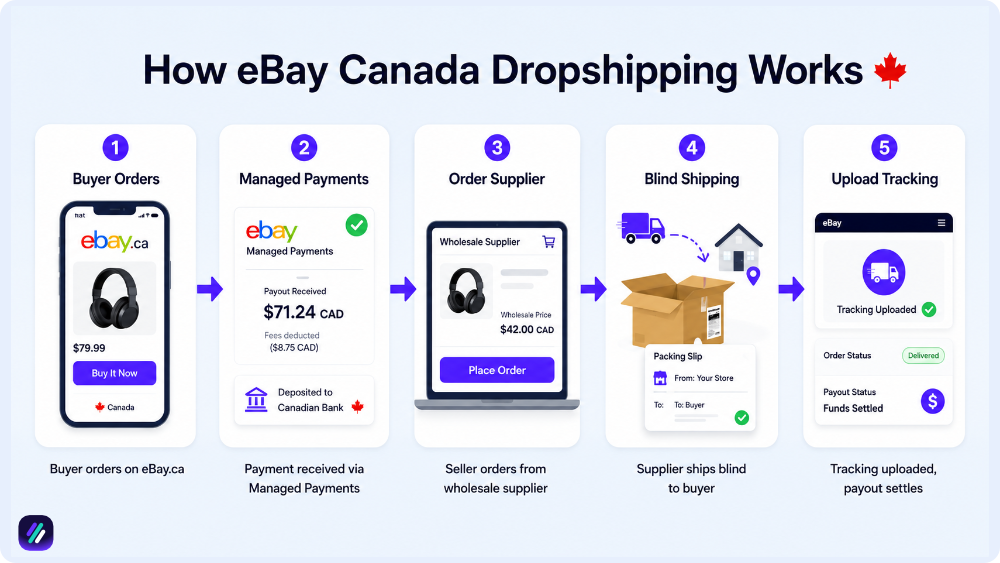
Your margin is what is left after the math: the eBay sale price, minus your landed cost, minus the final value fee, minus the per-order fee.
Landed cost is the part beginners forget. It is the supplier’s price plus shipping plus any duty or currency conversion, in other words the true amount it costs to put the item in the buyer’s hands.
One distinction decides whether the whole model is compliant, and it is worth getting exactly right. Here is how the two approaches compare against eBay’s written policy:
| Question | Wholesale dropshipping (allowed) | Retail arbitrage to your buyer (not allowed) |
|---|---|---|
| Where the goods come from | A wholesale supplier who sells to resellers | Another retailer or marketplace such as Amazon or Walmart |
| Who ships to the buyer | The wholesale supplier, on your behalf | The other retailer, in its own branded packaging |
| What the buyer receives | A plain or blind-shipped parcel with your invoice | A box and invoice from a store they never ordered from |
| eBay’s stated position | Permitted | Prohibited under eBay’s dropshipping policy |
That said, the line is about seller behaviour more than the sourcing label. The accounts that run into trouble, from what our in-house eBay sellers keep seeing, are the ones that quote a delivery date they cannot hit and ship a branded competitor’s box to the buyer, not the sellers who simply used a supplier.
As long as you deliver what you promised, the model holds up.
Is Dropshipping on eBay Canada Legal in 2026?
Yes. Dropshipping on eBay Canada is legal under Canadian law and permitted under eBay’s own policy, on one condition: you source from a wholesale supplier rather than buying each order from another retailer that ships straight to your buyer. Those are two separate questions that almost every competing guide blurs into one, so it helps to take them apart.
Under Canadian law, no statute bans the fulfilment model itself. What the law governs is the tax and business side: the Excise Tax Act sets out how GST/HST (goods and services tax and harmonized sales tax) applies, and your obligations as a business begin once you register or cross a revenue threshold.
Under eBay policy, dropshipping from a wholesale supplier is fine, while listing an item and then buying it from another retailer that ships directly to your buyer is not. That is a point eBay makes explicitly, and one you can confirm on the question of does eBay allow dropshipping.
When a seller does cross the policy, enforcement is graduated rather than instant. eBay can remove the listing, demote it in search, restrict selling, or in repeat cases suspend the account.
Keep in mind that your consumer-protection duties survive regardless of who ships: accurate product representation under the Competition Bureau, the delivery windows you stated, and the return policy you offered. Provincial consumer-protection acts add a second layer on top of the federal rules.
Is dropshipping legal under Canadian law?
Yes. No Canadian statute prohibits dropshipping as a fulfilment model. What Canada does have is a specific set of drop-shipment rules under the Excise Tax Act, spelled out in the CRA’s drop-shipments memorandum, and these govern GST/HST treatment in cross-border supplier scenarios, not the legality of selling.
Your separate obligation is registering for a Business Number once you operate as a business, which we cover in the tax section below.
What is the VeRO Program?
eBay’s Verified Rights Owner (VeRO) program lets trademark, copyright, and patent holders report listings that infringe their rights, after which eBay usually removes the listing and notifies the seller. It matters more to dropshippers than to anyone else, because you often list products you have never physically handled.
There is a Canadian angle here too: brand owners with Canadian trademark registrations file VeRO reports, and a takedown hits your account no matter where your supplier sits. You can keep your account clear of eBay VeRO strikes with a few habits:
- Branded goods are the trap, so avoid them unless you are an authorized reseller with paperwork to prove it.
- Your titles and descriptions should be your own, not copied from a brand’s marketing text or images.
- The eBay intellectual property policy and the VeRO participant list are the places to check before you touch a category full of protected brands.
- Generic, unbranded, spec-driven products keep the counterfeit and IP risk close to zero.
None of this is complicated; it is the discipline of listing only what you can stand behind.
How to Start Dropshipping on eBay Canada in 8 Steps
The eight steps below run in the order eBay itself walks you through, from account to scale. Research is the engine underneath all of it, so treat Step 3 as the one you will return to most, even though the account has to exist first. Each step stands on its own, and we will cross-reference the earlier ones as they come up.
Step 1: Register an eBay Canada seller account
You start on eBay.ca by choosing between an individual and a business account at signup. For a registered dropshipper, the business account is the right call: it supports a legal business name, higher selling limits as you grow, and the tax fields you will eventually need.
The registration itself asks for a Canadian address, a Canadian bank account for Managed Payments payouts, and phone verification. If you are unsure which type fits, the trade-offs come down to how seriously you plan to sell and whether you want to register a business name.
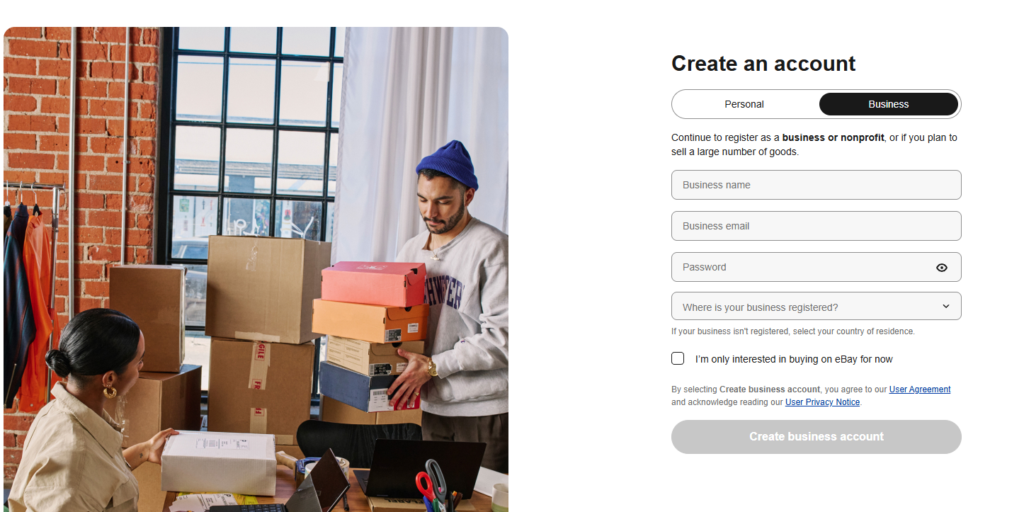
A hobby seller testing the water can start individual and convert later. Most dropshippers who intend to source from wholesalers should open the business account from day one, because the next step is why that matters.
Step 2: Choose a business structure (sole proprietorship or incorporation)
Most Canadian dropshippers start as a sole proprietorship, which is the cheapest and simplest structure to register. Incorporation, either federal or provincial, becomes the scaling step once profit and liability grow enough to justify the extra cost and paperwork.
A CRA Business Number is mandatory once you register for GST/HST, and voluntary before that, but there is a more practical reason to get one early. Many wholesalers will not open a reseller account without a Business Number or a GST/HST number, so plenty of sellers register before they start sourcing.
Here is how the two structures compare on the factors that matter to a new seller:
| Factor | Sole proprietorship | Corporation |
|---|---|---|
| Setup cost and effort | Low, register a business name and a BN | Higher, incorporation fees plus ongoing filings |
| Liability | You are personally liable for debts | Limited liability sits with the company |
| Tax treatment | Profit taxed as personal income | Separate corporate return, more planning options |
| Supplier acceptance | Accepted once you hold a BN | Often preferred by larger wholesalers |
A Canadian accountant can confirm which structure fits your numbers, and it is worth that conversation before you incorporate.
Step 3: Run product research with a Canada-aware tool
US sell-through data does not transfer to eBay.ca, and this is the single most expensive assumption a Canadian seller can make. A product that flies on eBay.com can sit dead on eBay.ca because the buyer pool, the competition, and the shipping economics are all different.
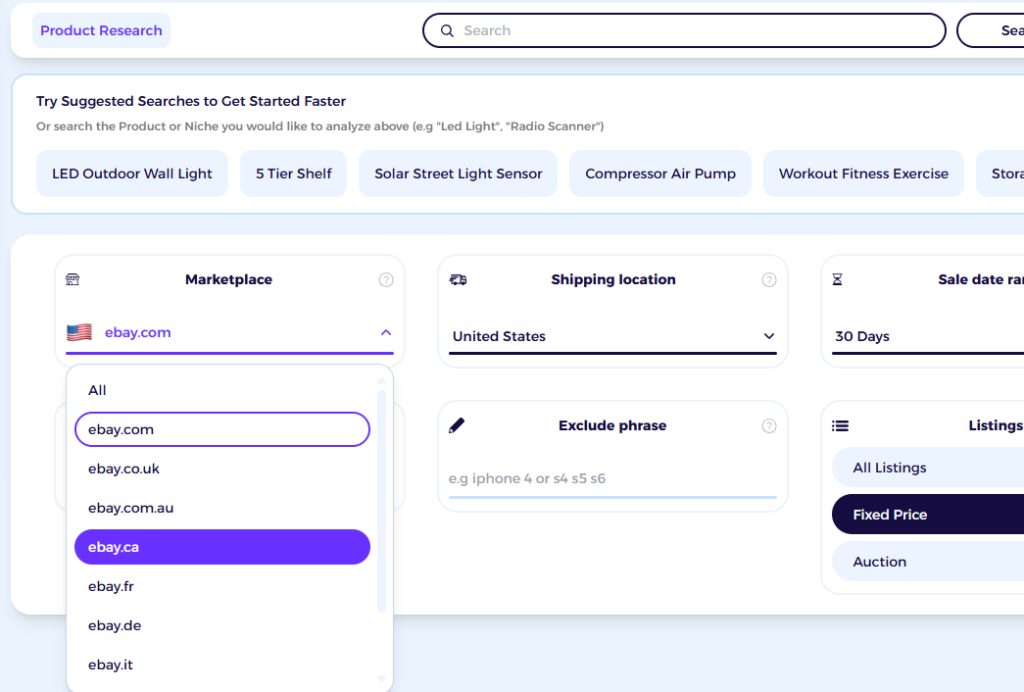
So your research has to be built on Canadian marketplace data, not a US screenshot. The workflow with the ZIK platform for eBay product research looks like this:
- You filter to the Canada marketplace first, so every number reflects eBay.ca, not eBay.com.
- Sold listings matter more than active ones, because sold data shows what buyers actually paid.
- The sell-through rate confirms genuine demand, not just a pile of listings nobody is buying.
- Finally, a Canadian or CUSMA (Canada-United States-Mexico Agreement) supplier has to exist at a price that survives fees, shipping, and any currency conversion.
That last point is where most product ideas die, and it is better to kill them here than after you have listed. When the sold data, the sell-through, and the fee-adjusted margin all point the same way, you have a product worth listing, and we will build its title in Step 6.
Step 4: Vet your Canadian dropshipping suppliers
Before you build a product list, you need a repeatable way to vet the suppliers behind it, because the wrong supplier is what turns a good product into negative feedback. The Canada-specific criteria separate a workable supplier from a risky one, and they rarely appear in US guides.
You can run every candidate through a short checklist:
- Ships from where: a Canadian warehouse, a US warehouse under CUSMA, or overseas, because that decides your delivery time and customs exposure.
- DDP terms: whether the supplier ships Delivered Duty Paid, so your buyer is never surprised by a customs bill.
- Blind shipping: whether they will ship under your store name with no branding of their own.
- Invoicing: whether they can issue an invoice naming you as the seller, which matters for both taxes and disputes.
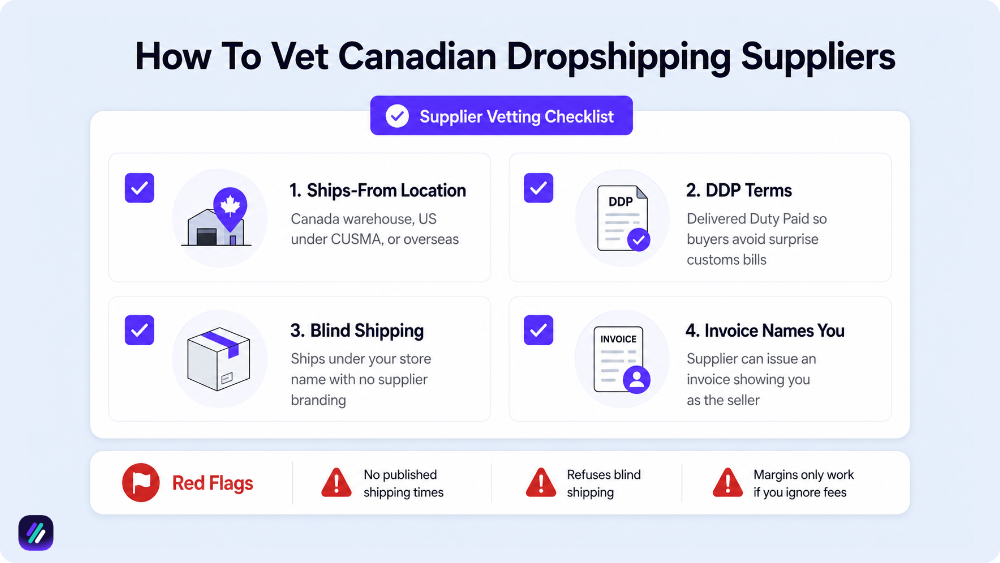
A few red flags should end the conversation early: no published shipping times, a refusal to ship blind, or a per-item price that only works if you ignore fees. From what our in-house sellers say, supplier vetting is the step beginners skip most, and the one that causes the most early failures.
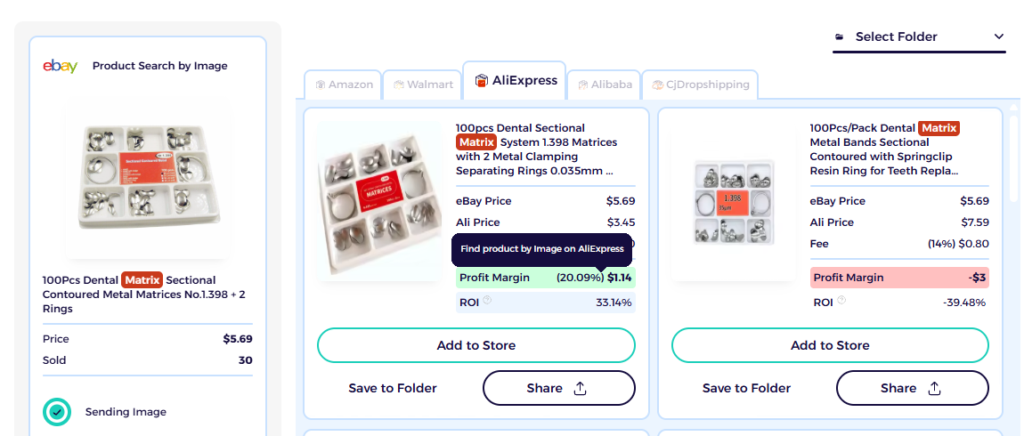
The eBay suppliers finder can match a validated product to a supplier, but nothing replaces ordering one sample to your own address and timing the delivery before you list anything.
Step 5: Set eBay Canada business policies and shipping rates
eBay runs on three business policies, and you set all three before you list: payment, shipping, and returns. The specifically Canadian trap sits in the shipping policy.
It is quoting a handling and delivery window that assumes urban Ontario when your buyer is in Yukon or rural Newfoundland, which turns a “3 to 5 day” promise into a late shipment. Handling time is the gap between the buyer paying and you dispatching, and eBay measures you against it.
The choice between calculated and flat shipping matters more in a country with long-haul zones. Here are the practical options and where each fits:
| Shipping choice | Best for | Watch out for |
|---|---|---|
| Calculated shipping | Heavier or long-distance items | Rates jump for remote provinces and can deter buyers |
| Flat-rate shipping | Light, low-cost, uniform items | You absorb the cost of far-zone deliveries |
| Free shipping in the price | Small items in competitive niches | Build the true Canada Post cost in first |
| eBay International Shipping | Reaching US and overseas buyers | Longer total transit through a Canadian hub |
Your carrier options run from Canada Post to Purolator and UPS Canada. Whichever you quote, set your handling and delivery promise around the slowest realistic zone, not the fastest.
Step 6: Create optimized eBay Canada listings
Your listing title and item specifics are what eBay reads to decide where you rank. Item specifics are the structured attributes, brand, size, colour, material, and the rest, that eBay uses both to rank you and to make your listing eligible for filtered searches.
A complete set is not optional on a lower-competition marketplace, because it is one of the easiest edges to win. The eBay title builder pulls buyer-search data so your 80-character title uses the words Canadian buyers actually type.
Two details almost no competitor covers matter here:
- Listing in French can reach Quebec buyers who filter and search in French, and it interacts directly with how you fill your item specifics.
- When your supplier prices in US dollars, price in CAD deliberately and build in the 3% currency conversion charge, which we break down in the fees section, so a hidden exchange cost does not eat your margin.
Step 7: Fulfil orders and upload tracking on time
The moment a sale comes in, you place the order with your supplier and get valid tracking uploaded inside your handling window. Valid tracking on eBay.ca means an actual carrier number that scans, not a placeholder, and it is what protects you in a dispute.
Missing the window often enough compounds the damage across your seller metrics. Late shipments and transaction defects feed into your seller level, and dropping to Below Standard costs you twice: a lower search rank and an extra final value fee on top of your normal fees, which we quantify below.
eBay’s own seller performance standards set the thresholds: a defect rate at or under 2% and a late shipment rate at or under 7% keep you in good standing. On long-haul Canadian routes, that late-shipment number is easier to breach than sellers expect, which is exactly why Step 5’s honest handling window pays off here.
Step 8: Scale with Promoted Listings and automation
Once a listing is selling steadily, Promoted Listings Standard can push it in front of more buyers, but the ad rate eats straight into a thin dropshipping margin. The rule of thumb our sellers use: if your net margin after fees, shipping, and product cost is already tight, an ad rate above the low single digits turns a profitable item into a break-even one.
You promote the proven winners, not the unproven tests. Automation is the other half of scaling, and the order you automate in matters.
You start with price and stock monitoring so you never sell an item your supplier has dropped or repriced, then automate tracking upload, and leave listing creation for last. Tools such as ZIK’s Autopilot and other dropshipping automation software can source and match winning items in bulk once your manual process is proven, but automating a broken process just breaks it faster.
Optimizing Listings for eBay’s Cassini Algorithm in Canada
Cassini is eBay’s search engine, the system that decides which listings show up first when a buyer searches. On a smaller marketplace like eBay.ca, that pool of competing listings is thinner.
That changes the game: a long-tail title that would be buried on page ten of eBay.com can land on the first page of eBay.ca. That is the structural advantage a Canadian seller can actually exploit.
eBay does not publish exact weightings, so treat the ranking inputs as factors rather than percentages. Ordered by how much control you have over each:
- Item specifics completeness: fully filled specifics make you eligible for more filtered searches and signal listing quality. This is entirely in your hands.
- Title relevance: the words in your 80-character title should match how Canadian buyers search, which is where the title research from Step 6 pays off.
- Sell-through and recent sales velocity: listings that convert and pick up recent sales climb, so price and demand feed rank directly.
- Seller performance: your defect and late-shipment record from Step 7 nudges where you sit up or down.
- Price competitiveness: eBay favours listings priced in line with the market, which is why fee-adjusted pricing is not only a margin question.
Sell-through is the lever a dropshipper can move fastest, because you choose what to list. eBay’s own Best Match guidance says as much: clear titles, complete specifics, competitive shipping, and good service.
The eBay Cassini system also surfaces Canadian sellers to Canadian buyers, which is one more reason to list on eBay.ca rather than trying to reach Canadian shoppers from a US account.
Canadian Rules and Tax Requirements for Dropshipping on eBay Canada
This is the section competitors skip, and it is where a Canadian dropshipping business is actually built or sunk. The federal GST, the combined HST, and the provincial PST and QST all exist, and which one applies follows the buyer’s province under place-of-supply rules, not where you sit.
The good news is that eBay handles most of the collection; the obligation that stays with you is your own registration and income tax. Under the CRA’s rules, you remain a “small supplier” and are not required to register for GST/HST until your taxable revenue crosses $30,000 over four consecutive calendar quarters, or in a single quarter.
Once you cross it, you must register, generally within 29 days of the sale that pushed you over. Registering voluntarily below the threshold can still be worth it, because it lets you claim Input Tax Credits on the GST/HST you pay on eBay fees, ads, software, and samples.
Here is how the combined sales-tax rate lands by province:
| Province or territory | Sales tax that applies | Combined rate |
|---|---|---|
| Alberta, Yukon, NWT, Nunavut | GST only | 5% |
| Ontario | HST | 13% |
| Nova Scotia | HST | 14% |
| New Brunswick, Newfoundland and Labrador, PEI | HST | 15% |
| British Columbia, Manitoba | GST plus PST | 12% |
| Saskatchewan | GST plus PST | 11% |
| Quebec | GST plus QST | 14.975% |
A few obligations round out the picture. Income tax applies to your profit regardless of revenue level, taxed as personal income for a sole proprietor or through a corporate return. On the import side, the Canada Border Services Agency assesses parcels at entry, and Quebec sellers should note that QST is administered separately by Revenu Québec.
This section is general information, not tax advice, and the thresholds here are the common ones rather than an exhaustive account of every Canadian situation, so confirm your own position with a Canadian accountant.
Do you charge GST/HST on eBay Canada sales?
In most cases eBay charges and remits it for you. Since becoming a marketplace facilitator, eBay collects GST/HST, PST, and QST on Canadian-buyer orders and remits it directly to the CRA and provincial authorities, whether or not you are registered, under its tax policy.
What remains yours is registering once you cross the small-supplier threshold, claiming Input Tax Credits if you register, and handling tax on any sales you make off eBay.
What happens at the customs border?
A parcel entering Canada is assessed at the border, and the buyer, not you, usually gets the bill unless your supplier ships Delivered Duty Paid. This is the single largest source of negative feedback for Canadian dropshippers sourcing overseas, and no top-ranking guide explains it.
Country of origin changes everything, because CUSMA gives US and Mexico-origin goods far higher duty and tax thresholds than goods from elsewhere:
| Parcel value (CAD) | From the US or Mexico (CUSMA) | From other countries |
|---|---|---|
| Up to $20 | Duty and tax free | Duty and tax free |
| $20 to $40 | Duty and tax free | Duty and tax may apply |
| $40 to $150 | Duty free, but taxes apply | Duty and tax may apply |
| Over $150 | Full duties and taxes | Full duties and taxes |
The takeaway is blunt: a $30 order from a US supplier clears free, while the same order from China can hit your buyer with tax and a brokerage fee. You either source under CUSMA or ship DDP, or the border becomes your customer-service problem.
eBay Canada vs eBay US for Dropshipping: Which is Better?
If you are physically in Canada, start on eBay.ca and list to US buyers from the same account, because the lower competition and marketplace-collected tax outweigh eBay.com’s larger buyer pool for most new sellers. The right answer is not universal; it depends on your seller profile, and the table makes the trade-offs concrete.
| What you are comparing | eBay Canada (eBay.ca) | eBay US (eBay.com) |
|---|---|---|
| Buyer pool | Smaller national audience, plus cross-border reach | The largest single eBay buyer base |
| Seller competition | Thinner, so listings surface faster | Dense, harder to rank a new listing |
| Fees | Same core structure, plus a 3% currency conversion charge on CAD accounts | Same core structure, no CAD conversion layer |
| Supplier access | Fewer Canadian-warehouse suppliers | Deep US supplier and warehouse network |
| Shipping time | Long-haul domestic zones stretch delivery | Dense courier network, faster average transit |
| Tax complexity | eBay collects and remits GST/HST/PST/QST for you | US state sales-tax nexus and facilitator rules |
So the recommendation splits by who you are. A Canadian beginner should start on eBay.ca, where the thinner competition is the fastest path to a first sale.
A US or UK seller expanding should test eBay.ca as a second marketplace, watching the currency conversion charge on any Canadian-registered account. And a high-volume seller should list on both, using the Canadian account to reach a market most sellers ignore.
eBay Canada seller fees in 2026
Fees decide whether a dropshipping margin survives, so it is worth doing the math in CAD before you list a single item. The core structure is a final value fee plus a per-order fee, charged on the full amount the buyer pays, including shipping and tax.
On top of that sit a few charges specific to a Canadian account. These rates were verified on eBay.ca as of July 2026, and because eBay updates them, the calculator for eBay fees from ZIK is the fastest way to check a live number against a specific sale.
| Fee | What eBay.ca charges | Notes |
|---|---|---|
| Final value fee | 13.6% of the total sale in most categories | Charged on item price plus shipping and tax |
| Per-order fee | $0.30 for orders $10 or less, $0.40 above $10 | Added once per order |
| Currency conversion charge | 3% on converted amounts | On Canadian-registered accounts converting currency |
| International fee | 0.4% for a US buyer, 1% for other countries | When the buyer or delivery address is outside Canada |
| Insertion fee | A free monthly allowance, then a small per-listing fee | Allowance grows with a Store subscription |
| Below Standard surcharge | An extra 6% final value fee, rising to 7% | If your account is rated Below Standard |
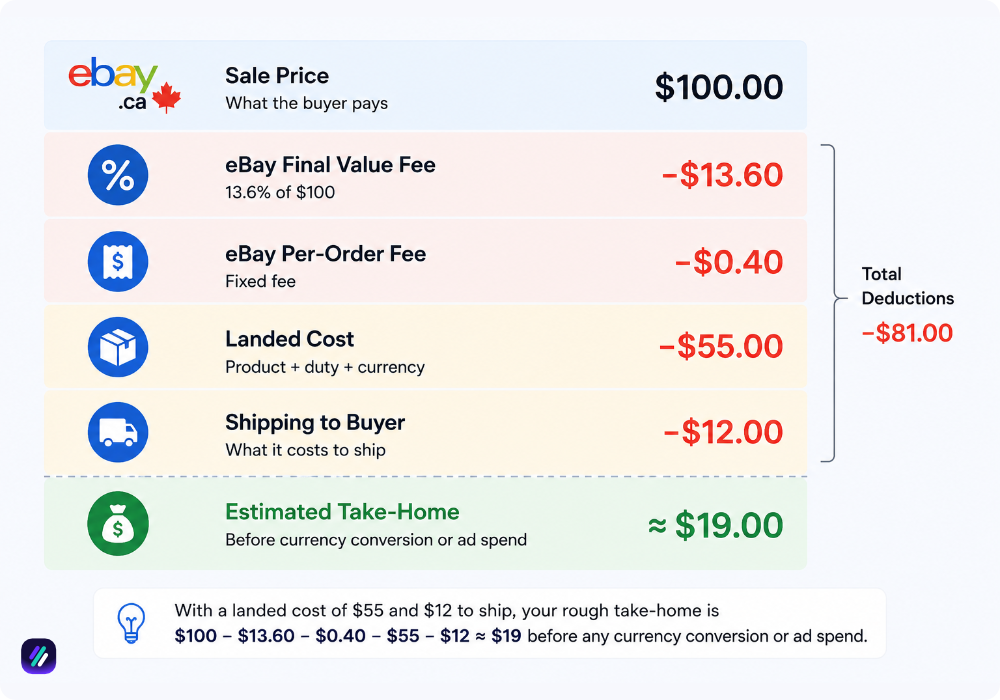
Now the worked example, because a table is abstract until you put a sale through it. On a single $100 sale, the final value fee at 13.6% is $13.60, plus the $0.40 per-order fee, so eBay takes $14.00.
With a landed cost of $55 and $12 to ship, your rough take-home is $100 minus $14.00 minus $55 minus $12, which leaves about $19 before any currency conversion or ad spend. That is the math every product idea has to survive.
A Store subscription lowers the final value fee once your volume clears its monthly cost, which is the point at which upgrading pays for itself. Top Rated Sellers, meanwhile, earn a discount on the standard final value fee, so your service record is a fee lever too.
Best Canadian Dropshipping Suppliers for eBay in 2026
Most supplier lists rank by brand name. For a Canadian eBay seller, the only ranking that matters is where each one ships from, because that is the single variable that changes your delivery time and your customs exposure.
Here is the shortlist, organized by what you are optimizing for:
| Supplier | Ships from | Typical Canada delivery | Integration | Best for |
|---|---|---|---|---|
| Printful | Canadian centre in Mississauga, Ontario | About 2 to 4 business days | eBay, Shopify | Print on demand with no customs |
| Spocket | US and EU, some North American warehouses | About 7 to 10 days | eBay, Shopify | Faster North American branded items |
| Syncee | US, Canada, UK, EU, Australia | Varies by supplier | eBay, Shopify | Choosing suppliers by region |
| CJdropshipping | China, US, plus a Canada warehouse | 2 to 7 days local, 15 to 25 from China | eBay, Shopify | Sourcing with a warehouse choice |
| Wholesale2B | US-based suppliers | Varies by supplier | Native eBay app | Hands-off eBay listing sync |
| Doba | US warehouses | Varies by supplier | eBay | An aggregated US catalogue |
| Modalyst | US-based suppliers | About 5 to 8 days | eBay, Shopify | US domestic delivery windows |
| Avasam | UK and US suppliers | Varies by supplier | eBay, Amazon, Shopify | Automated order and stock sync |
| SaleHoo | Directory, worldwide | Depends on the supplier chosen | Directory, not a fulfiller | Finding and vetting suppliers |
| AliExpress | Mostly China | About 15 to 45 days | Via third-party apps | Widest range, slowest default |
A few of these deserve a note beyond the table. Printful is the strongest Canada-local option because its Mississauga fulfilment centre ships domestically, so a Canadian order never touches customs.
Spocket and Syncee both let you filter suppliers by region, which is how you find genuine North American stock rather than a Chinese warehouse with a US label. CJdropshipping gives you a warehouse choice that directly controls whether your buyer waits a week or a month.
The rest cover specific jobs. Wholesale2B and Doba aggregate US suppliers with eBay integration. Modalyst and Avasam lean on automation and US or UK stock, SaleHoo is a directory for vetting rather than a fulfiller, and AliExpress offers the widest range at the slowest default speed and the highest customs risk.
This is not the whole market, and your niche will surface others. If you sell auto parts, a specialist fitment supplier will beat any generalist here; if you sell print on demand, Printful’s domestic edge outweighs everything else.
ZIK’s eBay dropshipping suppliers research can match a validated product to several of these before you commit. The one arrangement to avoid entirely is any deal where a retailer ships to your buyer, which is a policy violation no matter which country the supplier sits in.
What to Dropship on eBay Canada
The products that work on eBay.ca share a shape rather than a category, so the smart move is to learn the shape and then find products that fit it. What sells well is spec-driven, low on returns, low on intellectual-property risk, and cheap to ship over long distances.
What sells especially well in Canada is the climate and geography demand that US guides never mention: winter gear, block heaters, and ice-fishing and cottage goods that buyers search for in a way American sellers rarely stock.
Here is how a handful of category traits map onto eBay.ca, with the catch for each:
| Category | Why it works on eBay.ca | Watch out for |
|---|---|---|
| Auto parts and accessories | Spec-driven, buyers search exact fitment, low returns | Confirm fitment data and shipping weight |
| Winter and outdoor gear | Climate demand US sellers overlook | Seasonal timing and bulky freight |
| Home and kitchen tools | Small and ships cheaply over long distances | Crowded, so it needs a specific angle |
| Hobby and craft supplies | Repeat buyers and low IP risk | Thin margins on tiny items |
| Pet accessories | Steady demand and easy to search by spec | Avoid anything ingestible or regulated |
Some categories are worth avoiding on sight. Branded apparel and electronics carry VeRO and counterfeit exposure; heavy or oversized goods bleed margin to long-haul freight; and anything on a Health Canada or CBSA restricted list, from certain supplements to regulated goods, is not worth the account risk.
Before you commit to any product, run it through the validation checklist from Step 3: sold listings, sell-through rate, supplier price in CAD, landed cost, and fee-adjusted margin. Season matters too, so line your winter stock up against the Canadian retail calendar rather than the US one.
Our what to dropship on eBay guide breaks that validation method down category by category if you want to go deeper.
Find eBay Best Selling Items in Canada with ZIK Analytics
Nothing makes this concrete like walking one product from idea to listing on the Canada marketplace. This is ZIK’s own blog, so there is no pretending at neutrality here; the point is to show a genuine workflow that happens to use our tools.
Here is the sequence, start to finish:
- You start in eBay market insights, filtered to the Canada marketplace so every trend reflects eBay.ca buyers.
- The sell-through and sales earnings for a Canadian niche confirm the demand is genuine, not just a wall of listings.
- The eBay competitor research tool then breaks down a chosen Canadian seller’s revenue, top products, and sell-through, so you can see exactly what is working.
- From there you match the item to a supplier and check the fee-adjusted margin in CAD, using the fee math from the section above.
- The last step is the title, built from actual eBay.ca search data so your listing speaks the language Canadian buyers type.
That is the whole loop, and it runs the same way whether you are validating your first product or your fiftieth. You can test the entire workflow on a $1 trial (7-day) before committing to anything.
Conclusion
eBay dropshipping in Canada works differently from the US model, with its own edges and its own traps. The edge is a quieter marketplace where a well-built listing ranks faster and long-tail titles still win.
The trap is the part competitors gloss over: the customs bill your buyer eats on an overseas parcel, the currency conversion charge on a USD-sourced item, and the handling window that looks fine until a package has to reach rural Newfoundland.
Getting the sourcing right, pricing with the fees and the border in mind, and treating research as the engine rather than an afterthought, you find that Canada rewards the sellers most people overlook it for. The rules are knowable, the math is doable, and the competition is thinner than anywhere else on the platform.
Scale Your eBay Canada Dropshipping Business with ZIK Analytics
It all comes back to one habit: deciding from Canadian data rather than a US guess. That is the part ZIK Analytics handles for you:
- The eBay product research tool for sellers filters to the Canada marketplace and shows actual sold data, sell-through, and competition before you list.
- The eBay competitor research tool breaks down the Canadian dropshippers already winning a niche so you can reverse-engineer what works.
- eBay market insights surfaces trending eBay.ca products and seasonal demand before the crowd catches on.
That research process is built for the Canadian marketplace specifically, and you can put it to work on a $1 trial (7-day) to see what is actually selling on eBay.ca before you commit a dollar to inventory.
eBay Canada Dropshipping FAQs
A few quick answers to the questions Canadian sellers ask most before they start.
Is dropshipping allowed on eBay Canada?
Yes, with one condition. Dropshipping from a wholesale supplier is allowed on eBay.ca, while listing an item and then buying it from another retailer that ships directly to your buyer is not, under eBay’s dropshipping policy. Crossing that line can lead to listing removal, search demotion, selling restrictions, or in repeat cases account suspension.
Which supplier is best for dropshipping in Canada?
There is no single best supplier; it depends on where the supplier ships from relative to your buyer. Printful is the strongest choice for Canada-local print on demand thanks to its Ontario centre, Spocket and Syncee are good for North American stock, and CJdropshipping suits sellers who want a warehouse choice. The right move is to match the supplier to your product and your delivery promise.
Why do so many eBay dropshippers fail?
Three failures dominate. Sellers source from retailers instead of wholesalers, which breaks eBay policy and the buyer experience. They quote handling and delivery windows they cannot hit on long Canadian routes. And they price without accounting for landed cost and fees, so a “profit” evaporates once the numbers land.
Do you need a licence to dropship on eBay Canada?
No federal dropshipping licence exists. You may need provincial business registration if you operate under a name other than your own, and a CRA Business Number plus a GST/HST account once you cross the $30,000 threshold. Many wholesalers also require a Business Number before they will open a reseller account, so registering early is often practical.
How profitable is eBay dropshipping in Canada?
Profit is a formula, not a headline number: your sale price minus landed cost, final value fee, per-order fee, currency conversion, ad rate, and returns. What is left is your margin. One analysis of more than 1,200 dropshipping stores by TrueProfit put typical net margins in the 15% to 25% range, though on eBay.ca your fees and shipping decide where in that band you land.
Do you pay taxes on eBay dropshipping income in Canada?
Yes. Income tax applies to your profit regardless of revenue level, and you must collect GST/HST once you pass the CRA small-supplier threshold, though eBay remits the sales tax on eBay.ca orders for you. Registering also lets you claim Input Tax Credits on your business costs, which is the reason many sellers register before they have to.
Can you dropship on eBay Canada from outside Canada?
Yes, and this is the group the search results ignore. You can list to eBay.ca from a foreign-registered account, but you will pay the international fee, face a shipping-time penalty reaching Canadian buyers, and may need to weigh non-resident GST/HST registration once your Canadian sales grow. It is a genuine second marketplace for US and UK sellers, not an afterthought.