
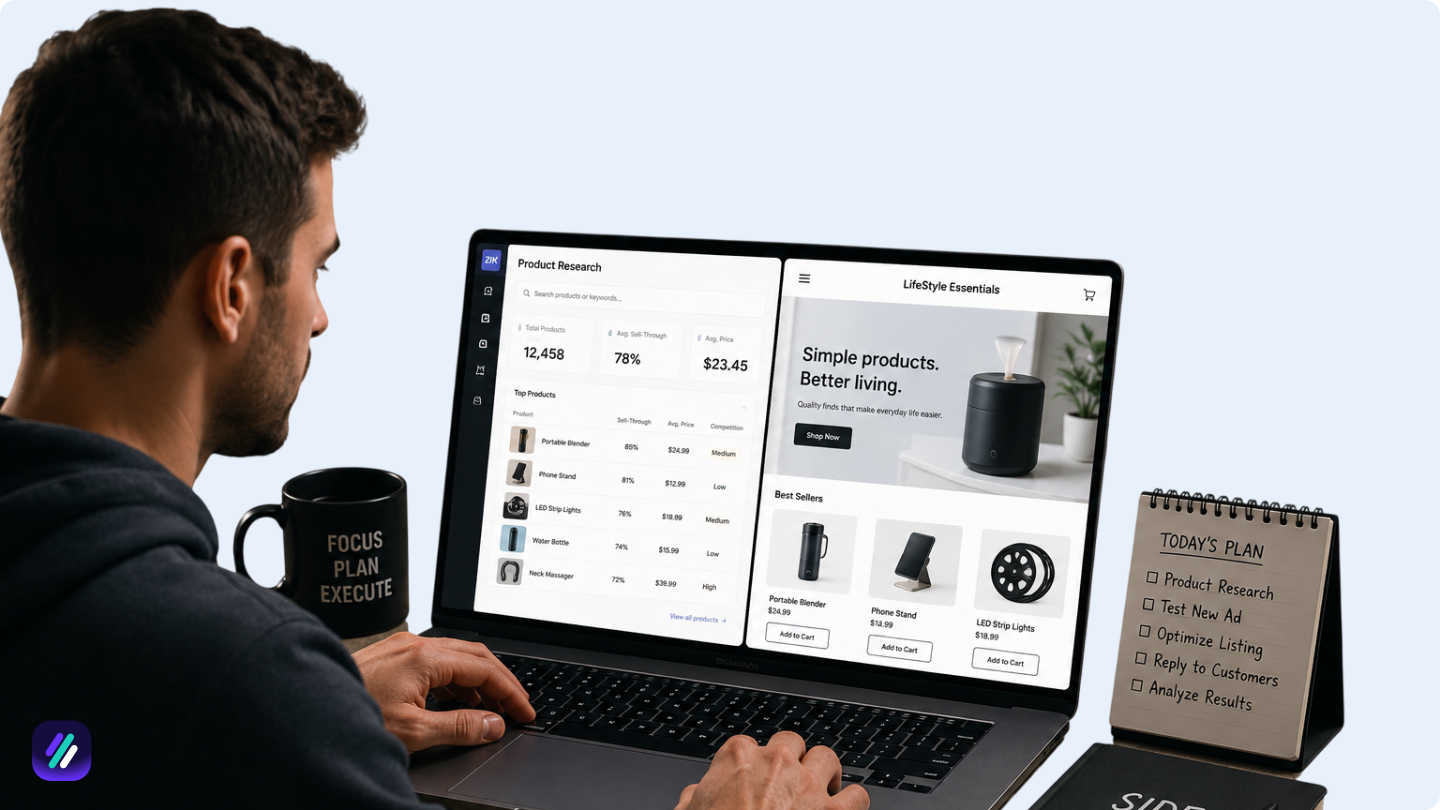
Most advice about a dropshipping side hustle that you can find online lands in one of two camps, and both will cost you.
One camp sells the version where you upload a few products, run an ad, and check your phone for sales between Netflix episodes and chill and relax.
The other camp tells you that dropshipping is dead, saturated, and a waste of your evenings.
Neither one helps you decide whether to actually try it.
What you want is the honest middle: who dropshipping as a side hustle genuinely fits, what it asks of your week, and what it realistically pays.
That is what this article gives you, with the boring parts left in.
Key Takeaways
- A dropshipping side hustle works best for people who can research products, write listings, test ads, and handle customer issues without quitting after the first bad week.
- It is not passive income on day one. The early months are active work, and the “wake up to sales” version only shows up much later, if it shows up at all.
- Most beginners need a realistic starting budget, not a free start. Expect to spend on a platform, sample orders, a small ad test, and a couple of tools.
- Marketplace dropshipping on eBay or Etsy usually gets you to a first sale faster and cheaper than a paid-ads Shopify store, which is why most side hustlers should start there.
- The honest income picture is modest. Most stores never turn a profit in year one, and chasing “winning product” lists with no validation is the fastest way to join them.
- You can skip a lot of the guesswork by validating demand before you list, which is exactly what the eBay product research tool from ZIK Analytics is built for: actual sales, sell-through, and competition data on any keyword.
Is Dropshipping a Good Side Hustle in 2026?
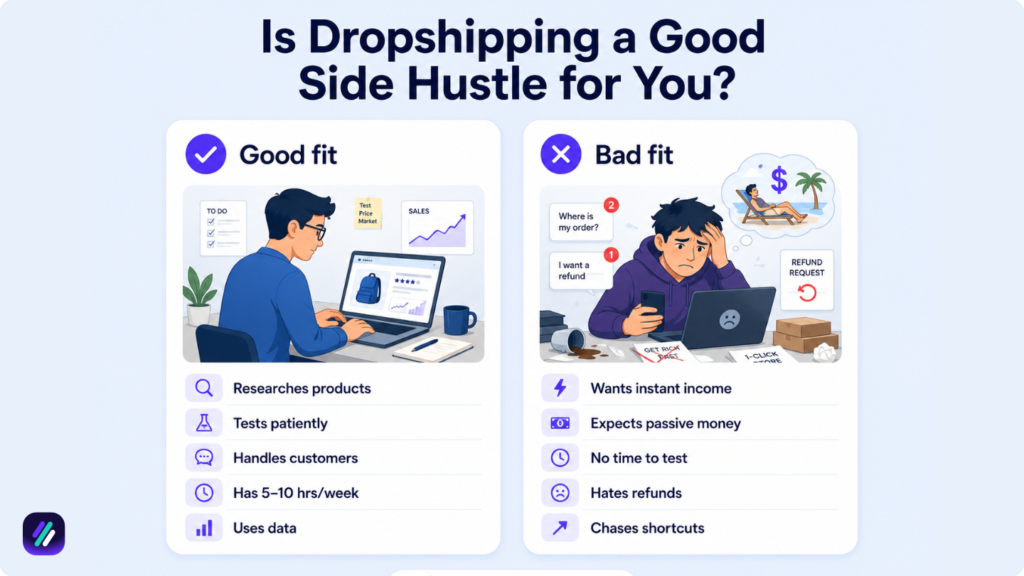
Yes, dropshipping as a side hustle is a good fit for the right person and a bad one for anyone expecting effortless dropshipping passive income. If you can spend a few focused hours a week researching, testing, and handling customers, it rewards that effort. If you want money to appear without any of that, it will frustrate you and drain your card.
The reason it suits side hustlers is structural. You do not rent a warehouse or buy stock upfront, so you can start small, test a handful of products with actual buyers, and validate demand before you commit money.
The whole dropshipping model is built around low startup cost and flexibility, which is exactly what someone with a day job needs.
However, there is a thing that most people skill when they’re talking about dropshipping being a possible side hustle.
The market is more crowded than it looks, and it is easier than ever to enter, which is its own problem.
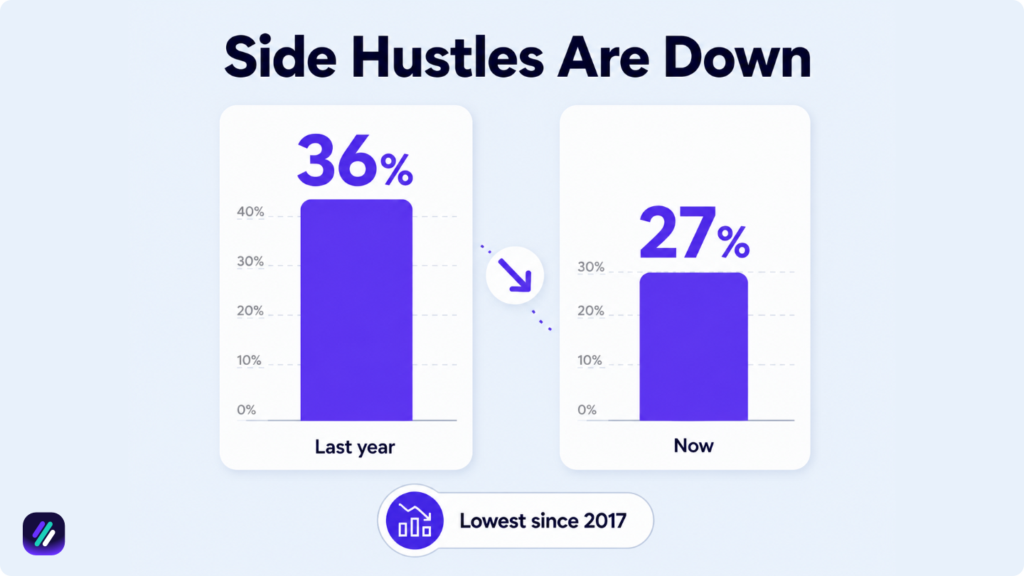
Side-hustle participation in the US actually fell to 27% of adults, down from 36% a year earlier and the lowest share since 2017, yet the people who stayed are competing harder.
Copycats undercut your pricing within days, suppliers run late, ad costs climb, refunds and chargebacks land on you, not the supplier.
So, to be honest with you, it all depends more on temperament than on skill at first.
With that, I created a table that can help you decide whether you’re a good fit or a poor fit for dropshipping.
| Factor | Good fit for dropshipping | Poor fit for dropshipping |
|---|---|---|
| Skills | Willing to learn research, listing, and basic marketing | Wants a done-for-you system with no learning curve |
| Time | Can protect 5 to 15 focused hours most weeks | Cannot commit to a consistent weekly time |
| Budget | Has a small test budget they can afford to lose | Needs the first month to pay for itself |
| Risk tolerance | Comfortable testing products that may flop | Treats every failed test as proof that it does not work |
| Marketing ability | Will test ad creative or build organic traffic patiently | Expects sales without traffic or testing |
From our in-house dropshippers at ZIK, the people who last are rarely the most talented. They are the ones who treat the first few months as paid research instead of a payday.
Who is dropshipping best for?
The ideal beginner is not a marketing genius but someone methodical, able to do five unglamorous things well: research products against actual demand, write a clear listing that answers buyer questions, run small ad or content tests without panicking at a loss, handle customer issues like a genuine shop owner, and read their own numbers to decide what to keep.
If that sounds like you, the learning curve is steep but fair. You are essentially running a tiny retail business, and the people who improve on data tend to keep improving and start amking that dough!
Who should avoid dropshipping?
You should probably skip dropshipping if you want instant income, because the validation and testing phase simply takes time. The same goes if you have no spare hours to test and iterate, or if the thought of processing a refund makes you want to close the laptop.
The most expensive mistake is treating a stranger’s “winning product” list as a shortcut, so unfortunately, most of those lists are sold to thousands of people at once, so by the time you list the product, you are the late entrant in a crowded race.
How Much Time Does Dropshipping as a Side Hustle Require?
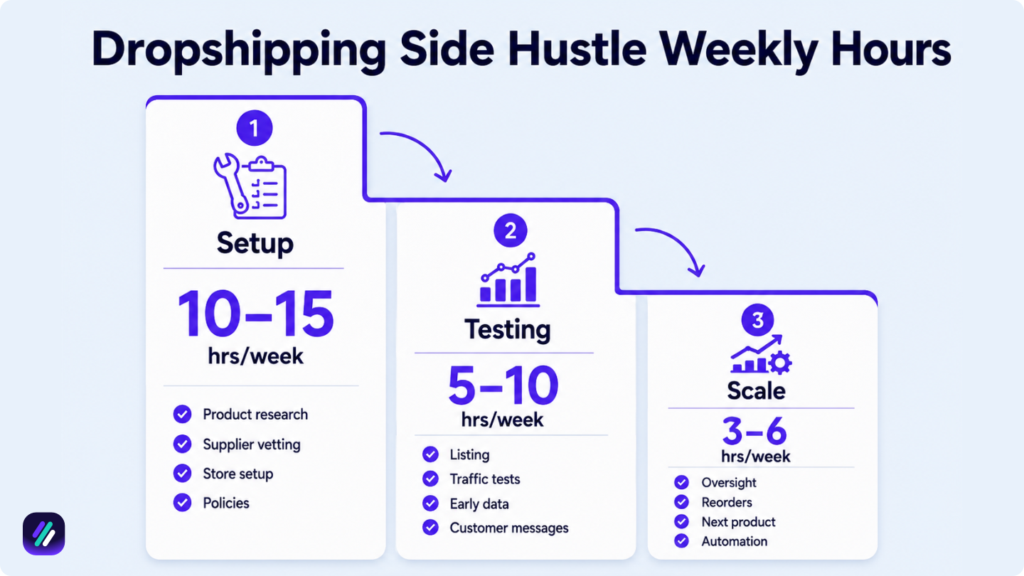
Plan for 10 to 15 hours a week while you set up, dropping to 5 to 10 hours once you are testing products, and 3 to 6 hours a week once a winner is running and partly automated. The work front-loads heavily, so the first month is the hardest.
But isn’t it with everything?
Those ranges are not published statistics, so treat them as practical guidance from running stores, not a number to quote.
What matters more than the exact hours is the shape of the commitment: it shrinks over time, but only if you build the systems that let it shrink.
The hours move through three phases:
- The setup phase, roughly 10 to 15 hours a week. This is product research, supplier vetting, store or listing setup, and policies. It is the heaviest stretch, and the one most beginners underestimate.
- Testing phase, roughly 5 to 10 hours a week. You are listing, running small traffic tests, and reacting to early data and the first customer messages.
- Scale phase, roughly 3 to 6 hours a week. With a proven product and some automation in place, your time shifts to oversight, reorder decisions, and finding the next product. Good dropshipping automation is what makes this drop possible, though it never reaches zero.
For someone holding down a 9-to-5, the trick is batching the work into blocks you can actually defend on your calendar.
For example, here is a sample week that one of our 9-5 employees with zero experience in dropshipping would be able to follow:
| Day | Focus | Rough time |
|---|---|---|
| Saturday morning | Product research and supplier checks, the deep-focus block of the week | 3 to 4 hours |
| Sunday evening | Listing optimization, pricing review, and planning the week’s tests | 1 to 2 hours |
| Weeknights (Mon to Thu) | Customer service, order checks, and tracking uploads in short bursts | 20 to 30 min each |
| Friday | Light review or a deliberate day off | optional |
Keep in mind that the weeknight bursts are non-negotiable even when they are tiny. A customer waiting two days for a reply is how a side hustle quietly earns its first bad review.
Grab your Shopify dropshipping eBook and find winning suppliers fast!How Much Money Do You Need to Start Dropshipping Part-Time?
It depends mostly on your platform and whether you grow through organic traffic or paid ads, but a realistic part-time start sits in the low hundreds to low thousands of dollars. A credible aggregate puts a lean dropshipping start at roughly $500 to $2,000, most of it marketing and setup.
Ignore anyone who says you can start for free.
You can start cheap, especially on a marketplace like eBay, but “free” usually means you are paying with months of unpaid time instead.
So let me show you where the money actually goes, grouped by category:
- Platform fees: Every channel charges to play. Shopify bills a monthly subscription, while marketplaces like eBay and Etsy take listing and final-value fees per sale. Check the official pricing page for each before you commit, because the cost type, subscription versus per-sale, changes your math completely. (Use eBay fee calculator)
- Supplier costs: You will want to place sample orders, so you know what your customer receives. Suppliers such as Spocket and CJ Dropshipping let you order samples and test shipping speed before you ever advertise the product.
- Marketing budget: Organic-first means more of your time and less cash. Paid-first means a genuine test budget, a meaningful ad test, not $20 you abandon after a day.
- Tools: A research tool like ZIK Analytics, an automation tool such as AutoDS, and a design tool like Canva cover most of what a beginner needs.
- Legal and admin: Many sellers start as sole proprietors and form an LLC (limited liability company) later. Sales tax nexus rules vary by state and country, so confirm what applies where you sell rather than copying a tutorial filmed somewhere else.
The biggest fork is your traffic model. An organic-first marketplace store and a paid-ads Shopify store have very different starting costs, and the table below shows where each one front-loads spending:
| Cost area | Organic-first (marketplace) | Paid-ads-first (storefront) |
|---|---|---|
| Platform | Low per-sale fees, little to pay upfront, but you can use their ad solution, like eBay promoted listings. | Monthly subscription from day one |
| Traffic | Time and SEO effort instead of cash | A funded ad test budget is essential |
| Tools | Research tool plus basic automation | Research, automation, plus ad and design tools |
| Sample orders | A few, to verify quality | A few, plus creative assets for ads |
| Realistic floor | The lower end of the range | The upper end, because ads eat budget fast |
So, to give you the honest answer, “how little can I spend,” it is “how much can I afford to test with and lose without it hurting.”
If finding reliable USA dropshipping suppliers and a small ad test would stretch you past your comfort level, you can start with a marketplace like eBay. With their promoted listings, you only pay when you actually make a sale, essentially paying for a sale and not exposure.
Types of Dropshipping for Side Hustle
There are three practical ways to run a dropshipping side hustle, and picking the wrong one early is how people waste their first three months.
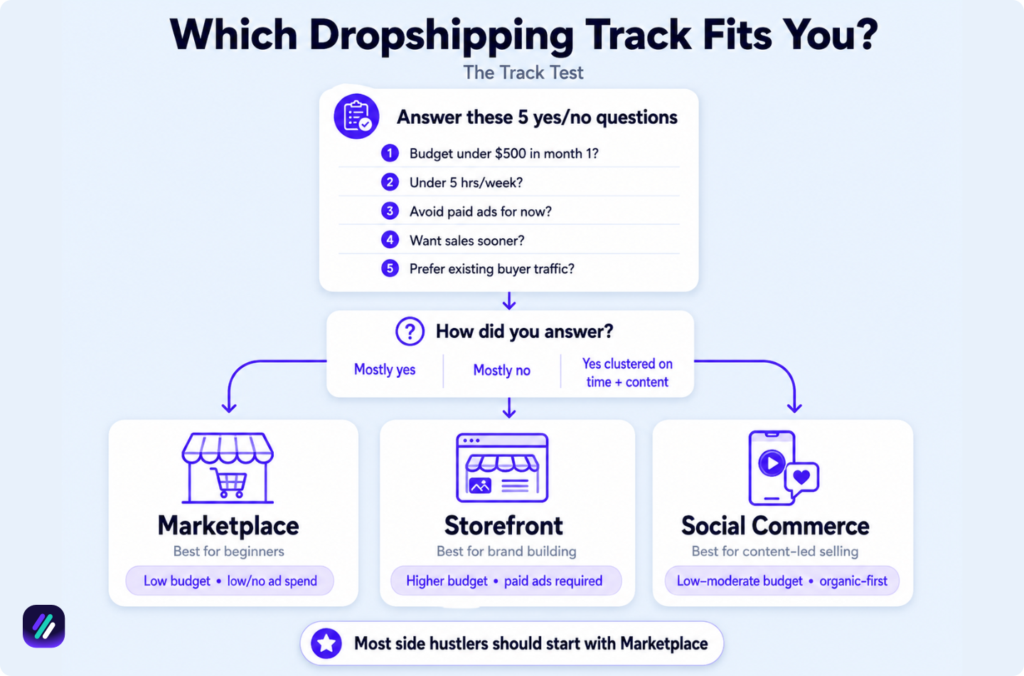
To make the choice simple for you, we use a framework called the Track Test: five quick questions that point you to the track that matches your budget, time, and tolerance for paid ads.
The three tracks are Marketplace, Storefront, and Social Commerce, and they ask very different things of a beginner.
Before the questions, here is how the three stack up on the factors that decide which one fits a side hustle:
| Track | Best for | Time per week | Starter budget | Skill profile | Ad spend required | Time to first sale | Ceiling |
|---|---|---|---|---|---|---|---|
| Marketplace (eBay, Amazon, Etsy) | Fast cash flow with little ad budget | Low to moderate | Lower | Research and listing basics | Little to none | Faster | Lower, capped by a platform |
| Storefront (Shopify, WooCommerce) | Brand building and a higher ceiling | Moderate to high | Higher | Ads, design, and CRO | High | Slower | Higher, if you can drive traffic |
| Social Commerce (TikTok Shop, Facebook Marketplace) | Reaching buyers where they scroll | Variable | Lower to moderate | Content and trend timing | Variable | Variable | Variable, trend-dependent |
Now run the Track Test on yourself, answering each with a yes or no:
- Is your starting budget under $500 in month one?
- Do you have under 5 hours a week to give this?
- Are you uncomfortable spending money on paid ads right now?
- Do you want sales sooner rather than a bigger brand later?
- Would you rather lean on existing buyer traffic than build your own audience?
If you answered mostly yes, your track is Marketplace.
If you answered mostly no, especially on ads and budget, you are built for the Storefront track.
If your yes answers clustered on time and content rather than budget, Social Commerce is worth a look.
Most side hustlers should start on Marketplace and graduate to a Storefront once a product is proven; that’s how we see it at ZIK at least.
Type 1: Marketplace dropshipping (eBay, Amazon, Etsy)
Marketplace dropshipping is the best entry point for a true beginner because the buyers are already there, and you do not have to pay to attract them.
You list on a platform that has its own traffic with actual buyer intent, which means faster first sales and a smaller budget, traded against a lower ceiling and tighter platform rules.
The scale is the appeal; for example, eBay has around 135 million active buyers (per its SEC filing), and Etsy has about 87 million (per its SEC filing).
That is the demand you tap into rather than create, but of course, there are always pros and cons, so here it is:
- Pros: Built-in buyer traffic, faster first sale, low or no ad spend, and a forgiving budget for testing.
- Cons: Marketplace fees per sale, strict policies, limited branding, and a ceiling set by the platform.
- Where it gets competitive: algorithms like eBay’s Best Match and Amazon’s A10 reward sales velocity and good listings, so research and titles matter more than spend.
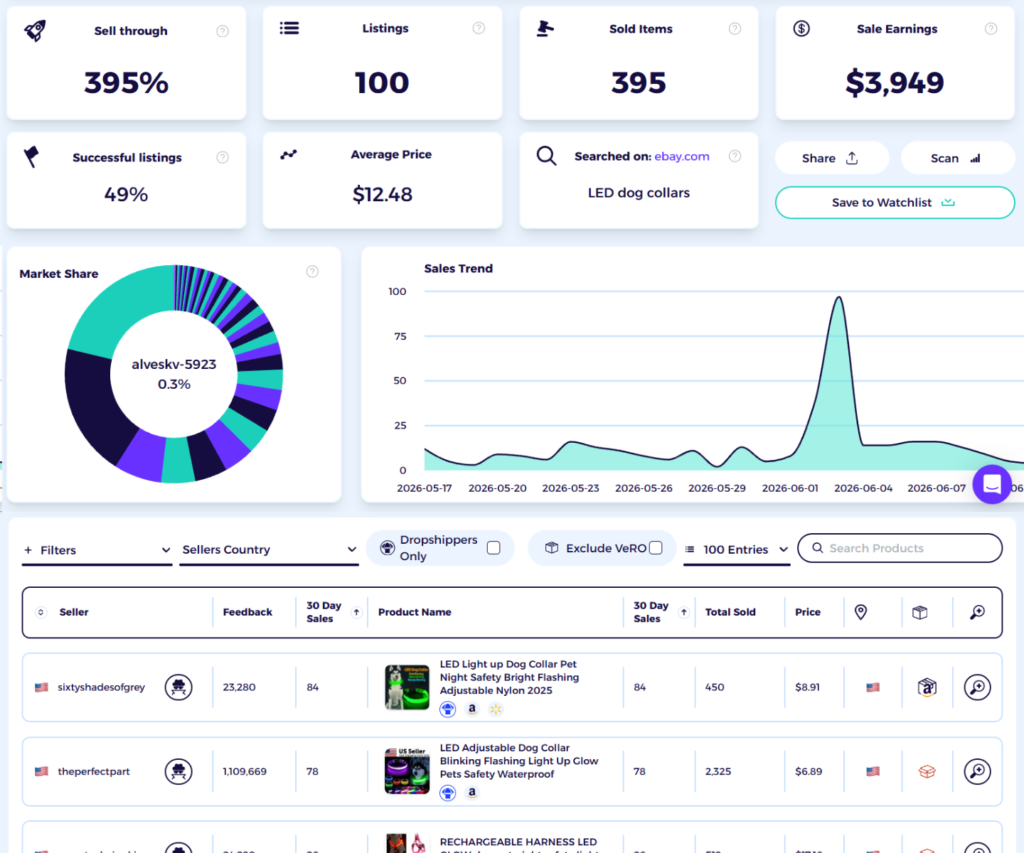
This is the area where ZIK has the deepest experience. With the eBay product research tool, you can filter by products, category, keywords, country, sales, and sell-through to see what is actually selling before you commit to a product, which is how you avoid listing in a dead niche.
Before getting started, it’s worth understanding whether dropshipping on eBay is worth it for your goals, budget, and experience level.
If you want a deeper walkthrough of the platform itself, our eBay dropshipping guide covers the setup end-to-end, including answering the question in your head whether you can dropship on eBay.
Type 2: Storefront dropshipping (Shopify, WooCommerce)
Storefront dropshipping is the track for building a brand with a higher ceiling, and it almost always works better as your second move, not your first.
You control the design, the customer relationship, and the upsells, but nobody arrives unless you bring them, which means paid ads through Meta Ads, TikTok Ads, or Google Ads.
That traffic dependence is the real deal here.
Store conversion rates are humbling: ZIK Analytics data shows Shopify conversion averaging 1.4% to 2.7% by niche, and only about 1 in 10 new stores is still active 90 days after launch.
I will not pretend there is a clean first-year revenue figure to quote, because no credible one exists, but the survival data alone should set your expectations.
So, with that, let me share with you the pros and cons of this type:
- Pros: Full brand control, higher ceiling, better upsell and email options, no marketplace policing.
- Cons: You pay for every visitor, conversion-rate optimization becomes your job, and the failure rate is steep.
- Best sequence: prove a product on a marketplace, then rebuild it as a branded store.
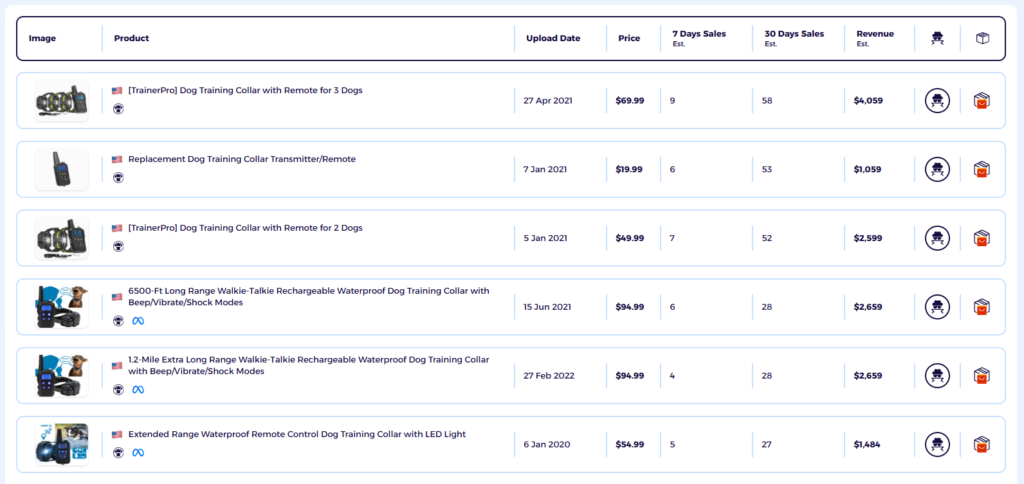
For the storefront route, the Shopify product finder from ZIK helps you discover products with sales and revenue data, plus supplier matches, so you launch a store around demand instead of a hunch.
Our Shopify dropshipping guide walks through the build itself.
Type 3: Social commerce dropshipping (TikTok Shop, Facebook Marketplace)
Social commerce dropshipping is the track for sellers who want to move fast, skip the SEO waiting game, and ride demand while it is still forming.
You are selling where people already scroll, which means discovery happens without a search query, and a single piece of content can do what a paid campaign does on other channels.
And the scale is real: TikTok has over 1.9 billion monthly active users globally, and Facebook Marketplace reaches more than 1.1 billion people each month across 70 countries.
But of course, even this type has pros and cons, so here they are:
- Pros: No storefront needed, low barrier to entry, organic reach can replace ad spend, and viral potential compresses the timeline from listing to sale.
- Cons: Trend-dependent demand, short product lifecycles, content creation is ongoing, and algorithm changes can kill a winning product overnight.
- Where it gets competitive: timing is everything. A product that trends on TikTok Shop in week one is saturated by week three, so research speed matters more than production quality.
For Facebook Marketplace, local pickup expectations and buyer trust signals work differently from a traditional store, so your listing copy and pricing have to do heavier lifting than the visuals.
ZIK’s product research tools help here too. Because both platforms reward recency, you want to validate demand before you invest in content, not after.
If this track appeals, start with our guides on TikTok dropshipping and how to dropship on Facebook Marketplace.
How to Start Dropshipping as a Side Hustle in 90 Days
A 90-day plan is not a promise of profit by day 90, but a structure that stops you from spinning on research forever, and it splits the work into three clear stretches: build, launch, and then optimize or pivot.
There is no credible average for how long the first sale takes, so do not anchor on a number you read somewhere.
You should focus on finishing each stage correctly.
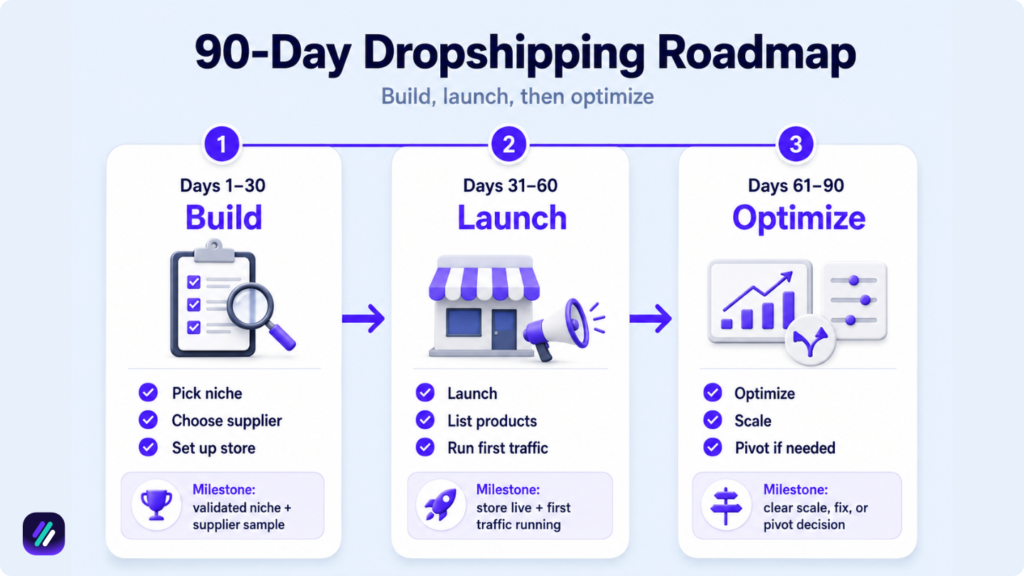
Days 1 to 30: pick a niche, supplier, and store
The first month is four decisions made in order, each one feeding the next.
- Pick a niche grounded in data, not vibes. Use dropshipping niche research to find a category with steady demand and room to enter, and sanity-check seasonality against Google Trends, so you are not building around a fad.
- Choose products inside that niche the same way. Solid dropshipping product research looks at three things together: sell-through rate, competition, and average selling price. A product that sells through fast at a workable price with beatable competition is on your shortlist.
- Lock in a supplier. Source from AliExpress, Spocket, or CJ Dropshipping, order a sample, and confirm shipping times before you trust them with a customer.
- Pick your platform based on your Track Test result, then set up the store or listings, policies, and payment.
The thread tying these together is that each decision narrows the next, so resist starting your store before the niche and product are validated.
Days 31 to 60: launch, list, and run your first traffic
Now you go live. List your validated products with optimized titles and clear photos, then send your first traffic, whether that is marketplace SEO, Meta Ads, TikTok Ads, or organic content.
This is also when the first support tickets arrive, and how you handle them shapes your early reviews.
However, I need to warn you here!
Across the thousands of sellers we work with at ZIK, the most common 30-to-60-day mistake is killing a product too early, swapping it out after a handful of clicks instead of giving the listing and the data enough time to mean anything.
So you should give a test a fair sample before you judge it.
Also, ensure that you use this window to A/B test one variable at a time, watch the conversion rate, and keep eBay’s Best Match fed with steady sales and good service.
Days 61 to 90: optimize, scale, or pivot
By day 60, you should have enough data to make a genuine decision, and this stage is a simple set of if-then calls.
- If you find a product is profitable, and ad efficiency holds, scale it: raise the budget gradually and expand to related products.
- If sales come but margins are thin, fix the economics first. Profit margin and customer acquisition cost decide whether scaling helps or just loses money faster.
- If ads underperform the benchmarks, diagnose before you spend more. For reference, average Meta ROAS sits around 1.86 and TikTok around 2.21, with Facebook traffic CPC near $0.70; if your CTR and ROAS sit well below that with no path up, the product or creative is the problem.
- If nothing works after honest testing, pivot. Keep the store, keep the systems, and change the product. A pivot is data doing its job, not a failure.
So at the end, here is the milestone checklist for the full 90 days, and you should tick these off rather than chasing a revenue figure too soon:
- Niche validated against actual demand data, not a hunch
- At least one supplier sample has been ordered, and shipping speed has been confirmed
- Store or listings live with optimized titles and clear photos
- First paid or organic traffic running to validated products
- First customer inquiry handled within a day
- One full A/B test completed on a single variable
- A clear scale, fix, or pivot decision made on the data
If you want the granular version, our dropshipping checklist breaks each of these into smaller tasks you can work through.
How Much Can You Earn from a Dropshipping Side Hustle?
Be honest with yourself here: most dropshipping stores earn little or nothing in year one. ZIK Analytics data shows only about 10% of stores turn a profit in year one, and only roughly 1.5% ever exceed $50,000 a month.
The realistic side-hustle outcome is modest, and the big numbers belong to a small minority. But it does not mean you cannot be the one, and that framing matters because it is the part that the income-screenshot crowd hides.
Those profitability bands come straight from ZIK Analytics dropshipping data, and for a wider perspective, the median side hustle of any kind earns about $200 a month, not the figures you see in ad creatives. Dropshipping is not magically exempt from that reality.
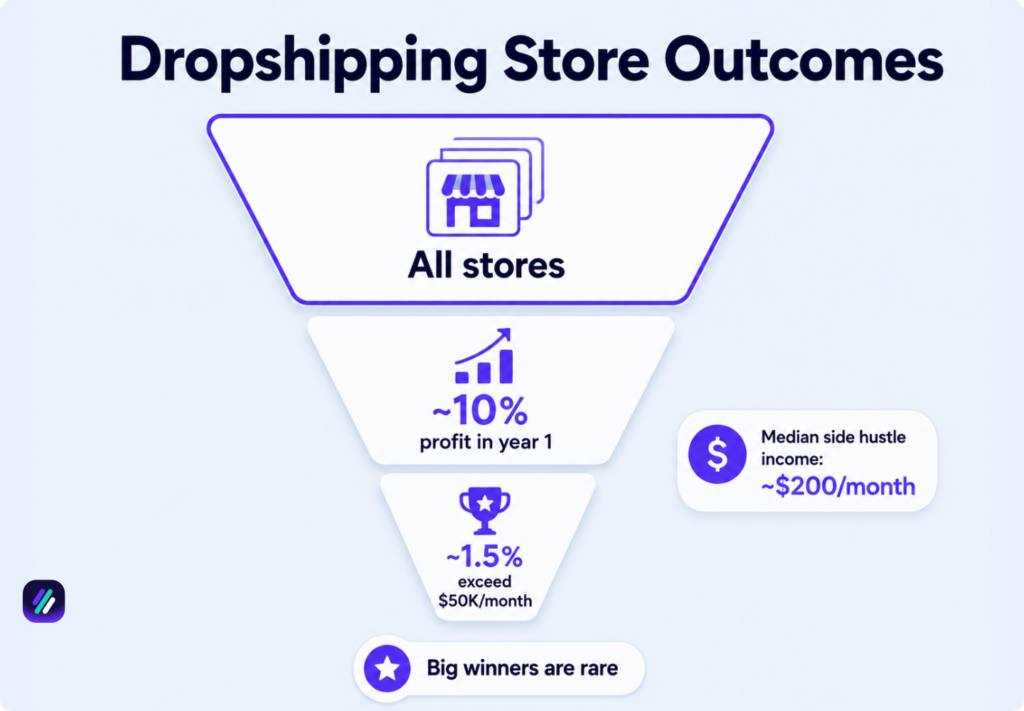
So you should treat earnings as bands tied to where you are, not an average to expect.
The $1,000 to $5,000 a month range that gets quoted everywhere is the range for sellers who actually reach profitability, which most do not in their first year.
By that same ZIK data, margins typically land around 20% to 30% per sale, so revenue and profit are very different conversations.
| Phase | Marketplace track | Storefront track |
|---|---|---|
| Testing (early months) | Often break-even or a small loss while validating | Usually a loss, since ads run ahead of profit |
| Early profit | Modest, reinvested into more products | Modest, once a winning product clears its ad cost |
| Reaching profitability | The lower band, if a product proves out | The lower band, with a higher ceiling if traffic scales |
| Top performers | A minority, capped by the platform | The small group that exceeds $50k a month |
What separates the stores that earn from the ones that stall comes down to a few decisive levers:
- Niche and product selection: validating demand before you list does more for your earnings than any later optimization. Most failures are bad-product problems wearing a marketing costume.
- Testing speed: the faster and cheaper you can test, kill, and relist, the sooner you find the product that actually works.
- Ad efficiency: on the storefront track, your cost per acquisition versus your margin is the whole game. Thin margins plus expensive clicks is how stores die profitable on paper and broke in the bank.
I hate to break it to you, but there is no version of this where the money is both fast and certain.
The realistic promise is that a methodical side hustler can build a modest, growing income over many months, not a fortune by next quarter.
I am not selling you a get-rich-quick scheme!
Common Mistakes That Kill a Part-Time Dropshipping Business
Most part-time dropshipping businesses do not die from one big disaster, but they die from a handful of small, avoidable habits repeated until the money runs out, which is part of why so few stores survive their first year.
However, the good news is that the common killers are predictable, so you can sidestep them on purpose.
The single most expensive habit is skipping validation, and people fall for a product they saw in someone else’s ad, list it without checking demand, and then blame “saturation” when it flops.
But because the product was never tested against actual buyer data, it never had a chance.
Close behind it is impatience with testing.
A side hustler with limited hours feels every wasted evening, so they kill a product after a few clicks, switch to a new one, and never let any single test gather enough data to teach them anything.
And there are many more, so here are the others that quietly do the most damage:
- Ignoring supplier reliability: one slow or flaky supplier generates late deliveries, refunds, and bad reviews that follow your account around.
- Treating customer service as optional: a day-late reply on a side hustle is still a day-late reply to the buyer, and platforms remember.
- Competing only on price: undercutting is the easiest move and the fastest way to erase your already-thin margin.
- Spending on ads before the listing converts: paid traffic to a weak page just buys you expensive proof that the page is weak.
- Quitting at the exact wrong moment: many sellers stop right when the data is finally clear enough to act on.
None of these requires talent to avoid. They require patience and a willingness to make decisions from data instead of feelings, which is the whole skill underneath dropshipping.
Dropshipping Side Hustle Alternatives Worth Comparing
Dropshipping is one of several low-overhead side hustles, and the smart move is to know where it sits rather than assuming it is the only door.
The table below lines up the main ecommerce alternatives on the factors that matter to someone fitting this around a job.
Where a clean, sourced figure does not exist, the cell is qualitative on purpose, because inventing a number would be worse than admitting the range is wide.
| Model | Best for | Starter budget | Time to first dollar | Weekly hours | Ceiling | Primary risk |
|---|---|---|---|---|---|---|
| Dropshipping side hustle | Low-overhead product selling | ~$500 to $2,000 | Variable | Moderate | Moderate | Picking the wrong product |
| Print-on-demand | Design-led, no inventory | Low | Variable | Low to moderate | Lower, thin margins | Margins squeezed by product cost |
| Affiliate marketing | Content creators with an audience | Low | Slow | Variable | High but slow to reach | Traffic dependence |
| Freelancing | Selling an existing skill | Very low | Faster | High, time-for-money | Capped by your hours | Trading time directly for money |
| Retail arbitrage and reselling | Hands-on bargain hunters | Low to moderate, plus eBay’s ~13.25% fee | Faster | High, sourcing-heavy | Moderate | Sourcing and storage effort |
| Amazon FBA | Higher-budget, more committed sellers | Higher, plus referral fees of 8% to 15% | Slow | Moderate | High | Upfront capital and competition |
| Content creation and digital products | Audience builders | Low | Slow | Variable | High | Slow audience growth |
The honest read is that the fastest-to-cash options, freelancing and reselling, trade your time directly, while the higher-ceiling options, FBA and content, demand more capital or patience.
Dropshipping sits in the middle, which is exactly why it suits a side hustle.
These models also stack well. Content creation can feed a store you already run, an affiliate angle fits naturally inside a niche blog, and reselling can fund the test budget for your first dropshipping products.
If you are weighing the trade-offs seriously, our deeper breakdown of dropshipping alternatives compares them in more detail, alongside our guides on dropshipping vs print on demand, affiliate marketing vs dropshipping, and Amazon FBA vs dropshipping.
Best Tools to Start a Dropshipping Side Hustle
You do not need a wall of subscriptions to start; you need one tool per job done well.
A lean side-hustle stack covers six functions: product research, your storefront, suppliers, automation, marketing, and the AI helpers that speed up the busywork.
The table below maps each function to a couple of options so you can pick what fits your track, not collect logos:
| Function | What it does for you | Tools worth knowing |
|---|---|---|
| Product research | Validate demand before you list | ZIK Analytics, Google Trends, Helium 10 |
| Storefronts | Hosts your store or listings | Shopify, WooCommerce, BigCommerce |
| Suppliers | Sources and ships your products | AliExpress, Spocket, CJ Dropshipping, Zendrop |
| Automation | Handles importing, pricing, and orders | AutoDS, DSers |
| Marketing | Drives and keeps traffic | Meta Ads, TikTok Ads, Google Ads, Klaviyo |
| AI tools | Speeds up listings, copy, and creatives | ChatGPT, Claude, Canva |
A few notes before you start buying. Product research is the one category I would not skip even on a tight budget, because it is the tool that prevents the most expensive mistake, listing something nobody is buying.
Automation matters more once you have volume than on day one, so do not pay for it before you need it. And the AI tools are accelerators, not strategists: they will draft a listing fast, but they will not tell you whether the product sells.
Tool pricing shifts often, so confirm current plans on each provider’s site before you commit. ZIK Analytics, for the record, runs on a $1 trial (7-day), not a free trial.
Start Your Dropshipping Side Hustle with ZIK Analytics
Everything in this guide comes back to one habit: deciding from data instead of hope.
That is the part ZIK Analytics handles for you.
- Use the eBay Product Research Tool to see actual sales, sell-through, and competition on any keyword before you list, so you start with demand you can verify.
- Use the eBay Competitor Research Tool to study a seller already winning in your niche, including their revenue, top products, and sell-through.
- And use the AdSpy Tool to check which ads are already running on a product before you spend a cent testing your own.
That is the difference between a side hustle built on validation and one built on guessing. You can try all three on a $1 trial (7-day) and run your first product check today.
Dropshipping Side Hustle FAQs
A few quick answers to the questions side hustlers ask most before they start.
Is dropshipping worth it as a side hustle?
It is worth it if you treat it as a small business you build over months, not a quick-money scheme. The model fits a side hustle well because you can start small and test before committing cash. The catch is that most stores need patience and genuine work before they profit, so it rewards the methodical far more than the impatient.
How can I make $2000 a month on the side with dropshipping?
There is no guaranteed path, and anyone promising one is selling something. Realistically, hitting that kind of number means finding a validated product with a workable margin, reaching profitability, then reinvesting profit to scale. It usually takes months of testing first, and plenty of sellers never get there. Focus on a proven product and healthy margins before you fixate on a monthly figure.
Is $500 enough to start dropshipping?
It can be, especially on a marketplace where you avoid a monthly subscription and heavy ad spend. A budget that size covers basic tools, a few supplier samples, and a small test. It is tight for a paid-ads storefront, though, where ad budget alone can eat $500 quickly. Start organic if your budget is at the lower end.
Where do most dropshippers fail?
Most fail at product selection and patience. They list products without validating demand, then quit testing before any single product gathers enough data to judge. Supplier reliability and slow customer service do the rest of the damage. Validating demand before listing and giving tests a fair run prevents the majority of early failures.
Is dropshipping passive income?
Not at the start, and rarely fully passive ever. The early months are active work: research, testing, and customer service. It can become semi-passive later with automation and systems, but the “wake up to sales” version skips the long build that makes it possible. Treat it as a business first and a passive asset much later.
Is a dropshipping side hustle legal in the US?
Yes, dropshipping is a legal retail model in the US, as it is in most countries. You are responsible for the usual business basics: sales tax, truthful listings, and consumer protection rules. Requirements vary by country and even by state, so the examples here are the most common ones, not an exhaustive global list. Confirm what applies where you sell.