

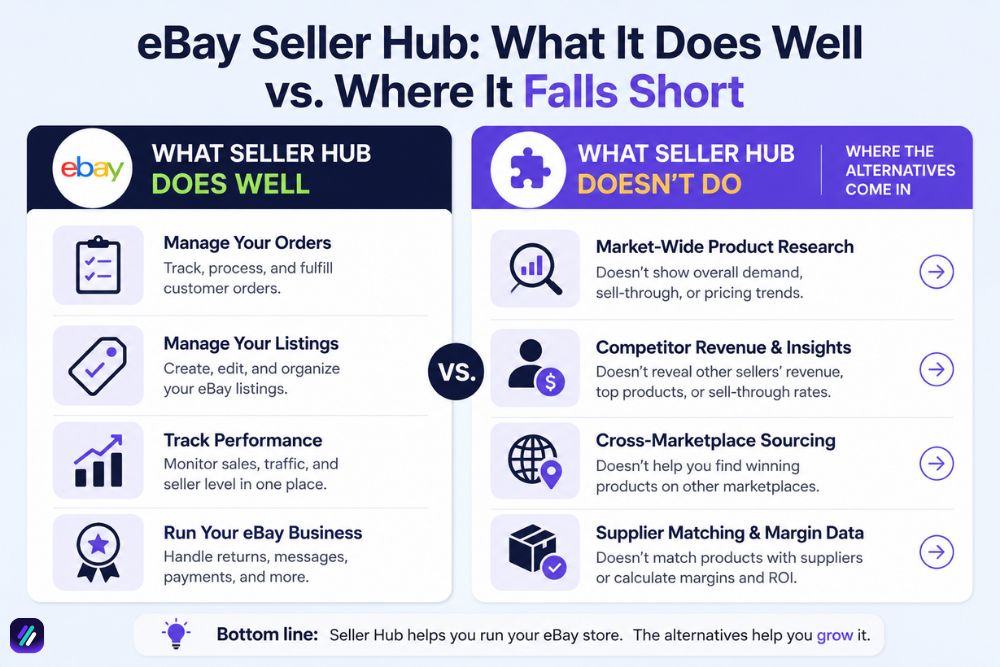
eBay Seller Hub does a solid job of running the store you already have. It shows your orders, your listings, your traffic, and your seller level in one place.
What it will not do is tell you what to sell next, or what your best competitor is banking every month. If you lean on it alone, you end up managing yesterday’s decisions while the profitable products pass you by.
This guide walks through six eBay Seller Hub alternatives that fill those gaps, who each one actually suits, and where each one costs you money.
Key Takeaways
- eBay Seller Hub is a free management dashboard, not a research engine: it organizes your own sales but cannot show you market demand or a rival seller’s numbers.
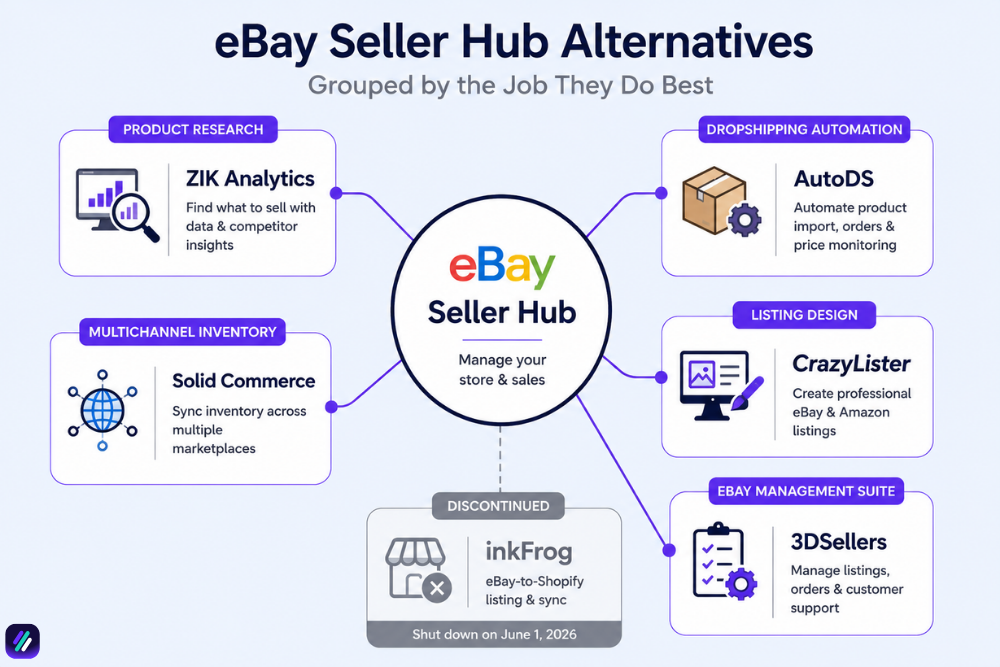
- The strongest alternatives each solve a different job, whether that is eBay product research, listing design, dropshipping automation, multichannel inventory, or all-in-one eBay management.
- ZIK Analytics covers the gap Seller Hub leaves widest, since the eBay product research tool for sellers shows actual sell-through, pricing, and competition on any keyword before you list.
- inkFrog closed for good on June 1, 2026, so any “best alternatives” list that still sells it as a live option is out of date.
- Most sellers do not need to replace Seller Hub at all: the smart play is to run a research or listing tool alongside it, not instead of it.
- Pricing runs from a $1 trial up to enterprise plans, so the right pick depends on your sales volume and which job you are trying to fix.
eBay Seller Hub Alternatives: Comparison Table
Before the deep dives, here is how the six tools stack up on the two questions that matter most: which job each one is built to do, and what it costs to start.
| Alternative | Best for | Pricing & trials |
|---|---|---|
| ZIK Analytics | Deciding what to sell with eBay product and competitor research | $1 trial (7-day), then PRO from $39.90/mo (or $14/mo billed yearly) |
| AutoDS | Hands-off dropshipping with automated ordering and price monitoring | Paid plans from about $26.90/mo, scaling with your product count |
| CrazyLister | Designing professional eBay and Amazon listings without touching code | From around $20/mo billed yearly, with a 7-day trial and 30-day money-back |
| Solid Commerce | High-volume sellers syncing inventory across many marketplaces at once | Enterprise, quote-based pricing in the several-hundred-a-month range |
| inkFrog | Discontinued, formerly eBay-to-Shopify listing and sync | Shut down on June 1, 2026, no longer accepting sellers |
| 3DSellers | Running listings, orders, and customer support from one eBay suite | Tiered by listing volume, Professional plan around $79/mo |
But a quick read of that table tells you these are not six versions of the same product. ZIK sits on the research side, AutoDS automates fulfillment, CrazyLister and 3DSellers handle listings, Solid Commerce scales inventory across channels, and inkFrog is out of the running entirely.
So the better question is less “which is best” and more “which gap am I filling.”
1. ZIK Analytics
Best for: sellers who want Seller Hub to answer the one question it cannot, which is what to actually list next.
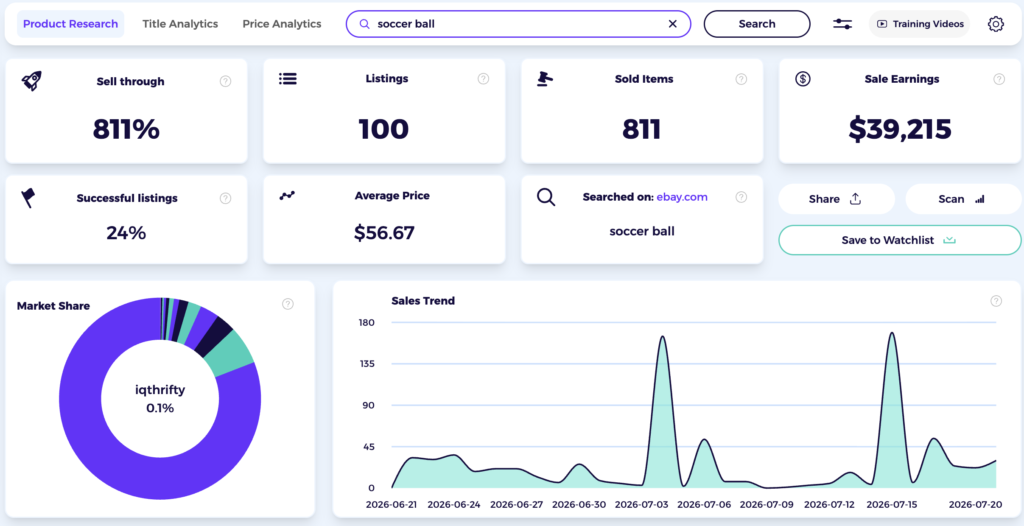
ZIK Analytics is a product research platform built for eBay and Shopify sellers, used by thousands of sellers to find winning products, study competitors, and validate demand before a single listing goes live.
Where Seller Hub reports on the store you already run, ZIK looks outward at the whole market. And that is the difference between optimizing what you have and finding what you are missing.
Key Features
- Actual eBay sales data: the eBay Product Research Tool breaks down sell-through, average price, and total sold for any keyword, so you list against demand instead of a hunch.
- Competitor numbers Seller Hub hides: the eBay competitor research tool reveals any seller’s revenue, top products, and sell-through rate.
- Trend spotting by region: eBay market insights surfaces trending keywords and products, which is useful for seasonal planning.
- Supplier matching for dropshippers, with margin and ROI calculated on each product.
- A deep set of research filters, including one that flags brands likely to get your listing pulled.
Pros
- It answers the “what should I sell” question with data instead of guesswork.
- The competitor figures are hard to get anywhere else on eBay. From our in-house eBay sellers at ZIK, that is the feature people stop guessing without.
- A $1 trial (7-day) lets you test the full toolset before committing.
Cons
- It researches and validates; it does not list, relist, or fulfill orders, so it sits alongside a listing tool rather than replacing one.
- The depth of filters carries a small learning curve in the first week.
- The focus is eBay, Shopify, and supplier marketplaces, so a pure Amazon-first seller gets less from it.
Pricing
The $1 trial (7-day) opens up the full toolset. After that, PRO runs $39.90/mo, or $14/mo if you pay yearly, and PRO+ sits at $59.90/mo (or $20/mo yearly) for higher limits.
2. AutoDS
If your bottleneck is time rather than product ideas, AutoDS is the one to look at. It is a dropshipping automation platform that handles the parts of the job nobody enjoys: importing products, monitoring supplier prices and stock, and auto-ordering when a sale lands.
So for eBay dropshipping specifically, that automation is the whole point. AutoDS watches your supplier, and when the price jumps or the item goes out of stock, it updates or pauses your listing before you lose money on an order you cannot fulfill.
It pulls from Amazon, Walmart, and other sources too, so routes like eBay to Amazon Dropshipping are built in.
Plans start at about $26.90 a month and climb with the number of products you run.
One thing to watch before you buy: AutoDS automates the selling, but it does not do the market research that proves the product was worth selling in the first place. That part still sits with a research tool or with Seller Hub’s own reports.
3. CrazyLister
CrazyLister earns its place for one specific strength: making eBay and Amazon listings look professional without you writing a line of code.
It is a cloud listing tool with a drag-and-drop template editor, a library of more than 200 ready-made designs, and bulk editing so a single change can push across hundreds of listings at once.
For a seller whose listings look plain next to the competition, this is the fix. Of course, good design is not vanity on eBay, because a cleaner, mobile-friendly listing holds attention longer, and attention is half the battle in a crowded search result.
And if listing quality is your weak spot, CrazyLister belongs on your shortlist of best eBay listing software.
Pricing is among the friendliest here, starting near $20 a month on the annual plan, with a 7-day trial and a 30-day money-back guarantee. The trade-off is scope: CrazyLister makes listings look good, it does not research products or manage suppliers.
4. Solid Commerce
Now we move up to the enterprise end of the scale. Solid Commerce is a multichannel platform for sellers who are not just on eBay but on Amazon, Walmart, and Shopify at the same time, and who need one source of truth for inventory and orders.
Its strength is keeping stock and pricing in sync everywhere at once. When you sell an item on Amazon, Solid Commerce can pull the quantity down on your eBay listing automatically, which is the kind of eBay inventory management headache that sinks high-volume sellers trying to do it by hand.
It also handles bulk listing, variation listings, and scheduled auctions.
But that power comes at an enterprise price. Solid Commerce is quote-based and generally lands in the several-hundred-dollars-a-month range, which rules it out for hobby sellers but pays for itself once you are juggling thousands of SKUs across channels. For a small eBay-only seller, though, it is far more tool than the job needs.
5. inkFrog
Here is where this list comes with a warning. inkFrog, the Wix-owned listing and eBay-to-Shopify sync tool that sat on plenty of “best eBay tools” lists for years, shut down for good on June 1, 2026.
Wix emailed customers on April 29 with the news, and there is no acquisition, no replacement product, and no extension coming.
It stays on this list for one reason: a lot of sellers are reading guides exactly like this one looking for inkFrog, and they deserve the truth instead of a dead link.
If you used it, two things matter now. Your live eBay listings are safe, since eBay holds those, not inkFrog. But any photos you hosted on inkFrog’s own servers will vanish once the infrastructure goes dark, so re-hosting those images is the urgent job.
For a replacement, sellers are moving mostly to 3DSellers and CrazyLister, both of which ran migration offers for stranded inkFrog users. So if inkFrog was your listing engine, treat its closure as a prompt to pick a tool you can actually grow on.
6. 3DSellers
3DSellers is the closest thing on this list to a full Seller Hub replacement, because it tries to do everything in one window. It bundles a bulk listing editor, order automation, automated feedback and messaging, and an integrated helpdesk that pulls buyer messages from every channel into one inbox.
So that breadth is the selling point for a busy store. Instead of Seller Hub plus a listing tool plus a separate support inbox, you run a single suite.
It recently added AI features for writing titles and descriptions too, though those sit behind a separate credits add-on rather than the base price. Among the best eBay seller software options, it leans toward sellers who value support and automation over pure research.
Pricing is tiered by how many listings you run, and the Professional plan, which adds multichannel selling, lands around $79 a month. For a one-channel eBay seller who mainly needs better listings, a cheaper tool will do. But for someone drowning in customer messages, the helpdesk alone can justify the cost.
What is eBay Seller Hub?
eBay Seller Hub is eBay’s free central dashboard for running your store, pulling your listings, orders, traffic, marketing, and performance metrics into one place. It is built to manage the business you already have, not to research the one you want.
So you need at least one sale on your account before eBay grants you access, and from there the eBay seller hub organizes everything into tabs: Overview, Listings, Orders, Marketing, Performance, and Research. The Research tab runs on Terapeak, eBay’s own sales data, which covers historical eBay activity but stops at eBay’s own walls.
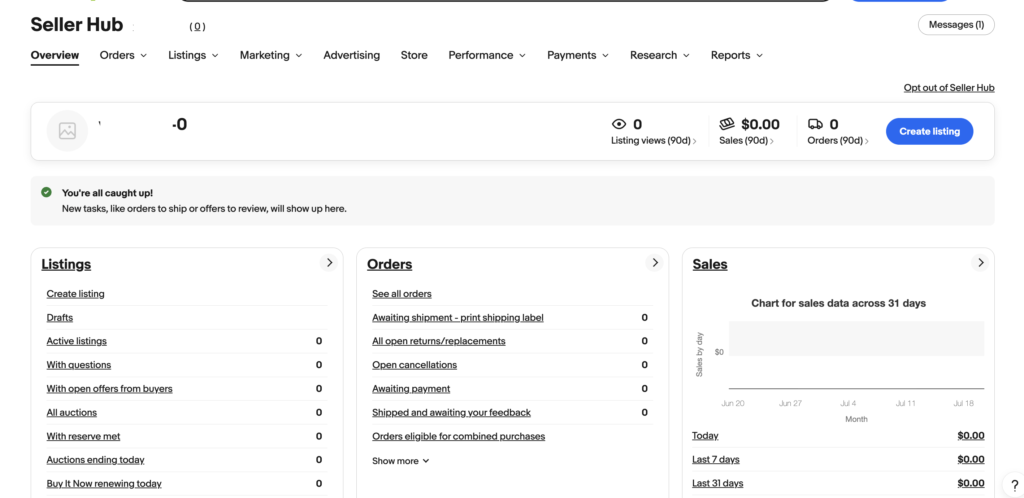
The core dashboard, analytics, and listing tools are free to every seller, as eBay’s official Seller Hub page confirms. Of course, a handful of extras, like Terapeak Sourcing Insights, the Promotions Manager, and store-specific tools, only open up once you pay for an eBay Store subscription.
Limitations of eBay Seller Hub
Seller Hub does its core job well. But the trouble starts when sellers expect it to be a growth tool, because its view stops at the edge of your own account. These are the gaps that push sellers toward the alternatives above:
- It cannot tell you what to sell. Seller Hub only reports on products you already list, with no read on market-wide demand, so finding best selling items on eBay outside your current catalog is simply not a job it can do.
- Competitor insight is thin. You can see your own numbers, but never a rival seller’s revenue, sell-through, or best products, which is the exact blind spot ZIK’s eBay competitor research tool was built to remove.
- Terapeak only looks backward, and only at eBay. The built-in research is historical eBay data with no cross-marketplace sourcing, which is why so many sellers go hunting for Terapeak alternatives.
- Listing design is basic. The native listing tools are functional rather than pretty, and that is the gap CrazyLister and 3DSellers fill.
- No supplier sourcing. For dropshippers, Seller Hub will not match a product to a supplier, calculate your margin, or warn you when an item is protected under eBay VeRO and likely to be pulled.
Seller Hub shows you your own slice, but eBay moves nearly $80 billion in sales across 135 million active buyers, and none of that wider demand surfaces in your dashboard.
So from our in-house eBay sellers at ZIK, the pattern is consistent: Seller Hub keeps the lights on, but the sellers who actually grow are the ones pairing it with proper product and competitor research.
It also will not coach you on winning eBay Cassini, eBay’s search algorithm, where placement is decided by demand signals Seller Hub never surfaces.
Find Best Selling eBay Products with ZIK Analytics
Every one of these eBay Seller Hub alternatives fixes a piece of the puzzle, but the gap Seller Hub leaves widest is knowing what to sell and who you are up against. That is the part ZIK Analytics is built to handle for you:
- Use the ZIK eBay product research tool to see actual sell-through, pricing, and competition on any keyword before you commit to a listing.
- Use the eBay competitor research tool to pull any rival seller’s revenue, top products, and sell-through rate, the numbers Seller Hub keeps hidden.
- Use eBay market insights to catch trending keywords and products by region while demand is still climbing.
So you do not have to swap out Seller Hub to get any of this. The move is to run ZIK alongside it, start a $1 trial (7-day), and let actual sales data, not guesswork, decide your next listing.
eBay Seller Hub Alternatives FAQs
A few questions come up again and again when sellers start shopping for a Seller Hub alternative.
Is there a free alternative to eBay Seller Hub?
Not a complete one, but you can get close. ZIK Analytics offers a $1 trial (7-day) to test full product and competitor research, and its free eBay Chrome Extension shows sold history right inside eBay. Most paid alternatives also run their own trials, so you can test several before paying for anything.
Which eBay Seller Hub alternative is best for product research?
ZIK Analytics is the strongest pick for research. Seller Hub and its built-in Terapeak data only look backward at eBay, while ZIK shows live sell-through, pricing, competition, and a rival seller’s actual revenue. If your actual question is “what should I list next,” that is the gap it closes.
Do I need to replace eBay Seller Hub completely?
No, and most sellers should not try. Seller Hub is a solid free dashboard for orders, listings, and performance tracking. The smarter move is to keep it for daily management and add one alternative for the job it does poorly, usually product research or listing design.
What should inkFrog users switch to after the shutdown?
inkFrog closed on June 1, 2026, so its users need a new listing tool now. Most are moving to 3DSellers or CrazyLister, both of which offered migration help. The urgent task is re-hosting any product images that lived on inkFrog’s servers, since those go offline and leave listings blank.
Are paid eBay Seller Hub alternatives worth the money?
It depends on the job you are fixing. A listing tool that lifts your conversion, or a research tool that stops you sourcing dead products, pays for itself fast. A pricey multichannel suite, on the other hand, is wasted money for a small eBay-only seller. The rule of thumb is simple: match the tool to your actual bottleneck.