
Most guides on how to start dropshipping on eBay with no money still assume you already have a few hundred dollars set aside for tools, ads, and a course. That gap is where beginners quit before their first sale.
They spend on software and inventory for a business they have not yet validated, then decide that dropshipping does not work.
eBay is different. It is one of the few platforms where you can begin with almost nothing.
In this guide, I will walk you through launching an eBay dropshipping business step by step for free, and show you the one spot where a single dollar saves you weeks of guessing.
Key Takeaways
- You can start eBay dropshipping with no upfront money: eBay lets new sellers list within a monthly limit for free, and selling fees only come out after an item sells.
- The product decides everything. A proven, in-demand item matters far more than a polished store, so most of your early effort should go into research.
- eBay’s written policy allows dropshipping from wholesale suppliers, and what actually keeps your account safe is accurate listings and on-time delivery, whatever your sourcing model.
- ZIK Analytics handles the research: its tools show actual sell-through and competition before you commit to a product, and its free eBay tools cover the no-budget start.
- eBay Promoted Listings charges you only when an item sells, so you can test paid visibility without putting money down first.
- A $1 trial (7-day) unlocks full research access. You can pause it once you have your product shortlist, then restart it when sales are coming in.
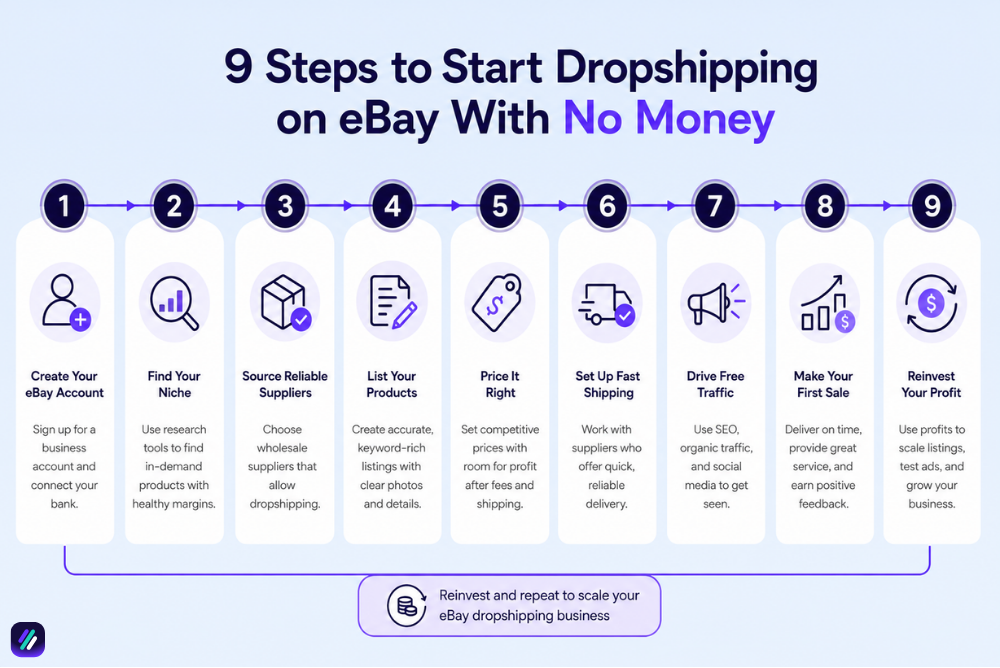
Step 1: Create Your eBay Account
Your first move costs nothing. Opening an eBay account is free, and for a business you plan to grow, choose a business account rather than a personal one during signup, since it lets you register under a company name and unlocks seller tools later.
eBay runs its own managed payments now, so you do not need a separate PayPal account to get paid. You connect a bank account, and eBay deposits your earnings there directly. That alone removes one old barrier that used to trip up beginners.
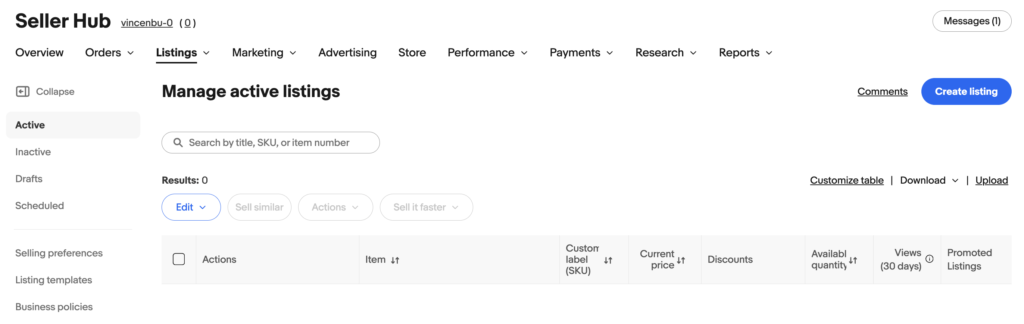
And the steps to set up an eBay account take only a few minutes. Now, verification is the one gate to clear before Step 2, since the research that follows depends on you being a registered seller.
Understand Selling Limits for a New Account
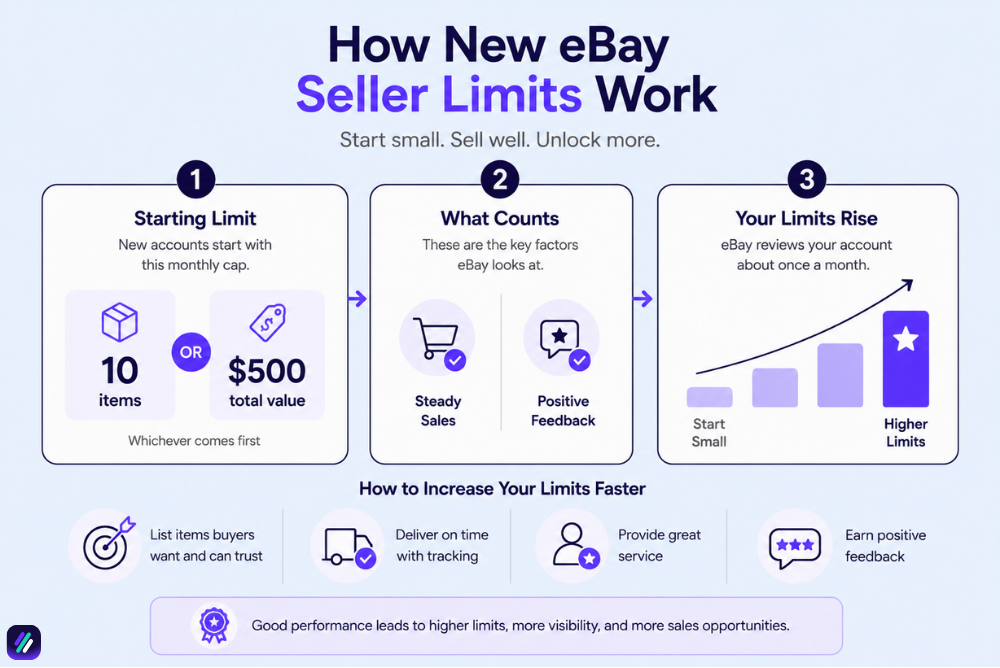
New accounts start with a cap, and knowing it upfront saves you a frustrating surprise. A brand-new seller can list up to 10 items or $500 in total in the first month, whichever ceiling you hit first.
So if you list ten items at $60 each, you reach the $500 value cap well before the item count. eBay reviews your account roughly every month and lifts these limits automatically as you make sales and earn positive feedback.
For a no-money start, this cap is actually helpful. It forces you to be selective and list only products you have validated, which is exactly the discipline that makes dropshipping work. You can push the ceiling faster by keeping sales strong and feedback clean, the two levers that move your eBay selling limits upward.
Step 2: Find Your eBay Dropshipping Niche
Choosing your niche comes before anything else, because the category you pick sets a ceiling on how well everything after it can perform. A good niche has steady buyer demand, healthy margins, and room for a new seller to compete, which is the whole question behind what to dropship on eBay.
The mistake is choosing purely on passion. You want to go where the buyers already are. eBay reported 135 million active buyers and nearly $80 billion in gross merchandise volume (GMV), so demand is rarely the problem. Finding the pocket of that demand you can actually win is the hard part.
This is where research tools earn their place. The eBay product research tool from ZIK Analytics lets you filter any keyword by country, sales, and sell-through, so you can see which niches move volume instead of guessing.
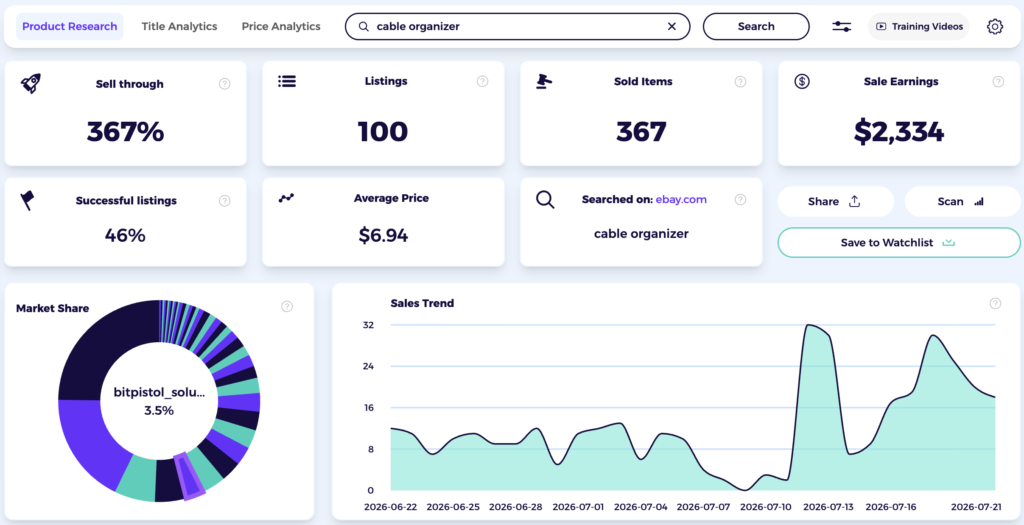
Now, you can do a rougher version of this for free by browsing eBay’s completed listings, which we cover later.
Best-Selling Niches on eBay
Some categories have earned a reputation as reliable ground for new dropshippers. These consistently show strong buyer demand on eBay:
- Auto parts and accessories: buyers search by exact make and model, which rewards accurate listings over flashy ones.
- Home and garden: a huge, evergreen category with year-round demand and endless sub-niches.
- Health and beauty: high repeat-purchase potential, though you should check restrictions before listing.
- Pet supplies stay in demand because owners keep buying in good times and bad.
- Phone and tech accessories: low cost, light to ship, and always refreshing as new devices launch.
- Tools and home improvement attract practical buyers who know what they want and pay for quality.
- Collectibles and hobby items: passionate buyers who will pay a premium for the right piece.
This is just to give you an idea, and if you go into electronics, for example, you will need to weigh higher return rates; if you go into pet supplies, subscription-style repeat buyers change how you price. You can use it to point your research in Step 3, not to make the decision for you.
Step 3: Find Best-Selling Products in That Niche
A niche is a neighborhood; now we go find the specific house. The goal of this step is a shortlist of individual products with proven demand, reasonable competition, and a supplier price that leaves you a margin.
The free way is eBay’s own sold data. You search for a product, filter to completed and sold listings, and you can see what is selling, at what price, and how recently. It is slower and messier than a tool, but it costs nothing, and it works.
For the faster version, the eBay competitor research tool lets you pull up a successful seller in your niche and see their best-performing items, revenue, and sell-through rate.
Reverse-engineering a proven seller is the heart of how to find profitable products to dropship on eBay, and it beats inventing demand from scratch.
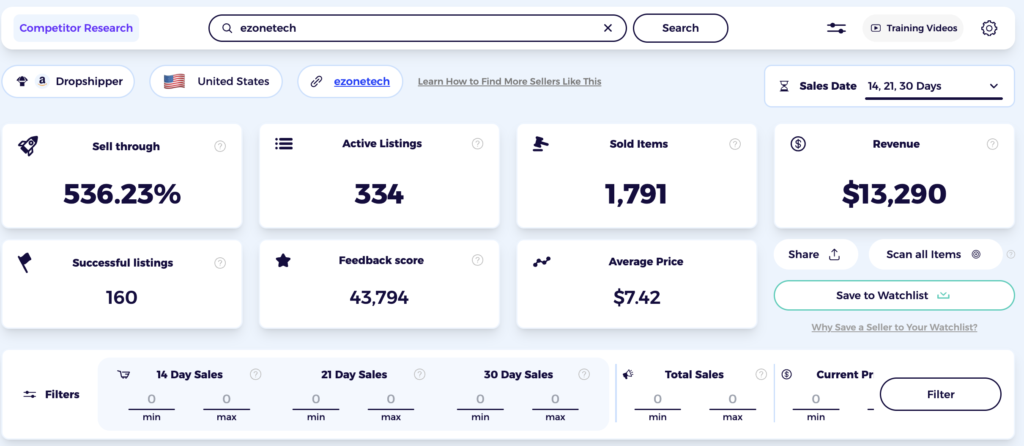
As a rule of thumb, high demand paired with low-to-moderate competition is the sweet spot. A product everyone already sells is a race to the bottom on price.
Step 4: Find and Vet Reliable Suppliers
With a product shortlist from Step 3 in hand, you now need someone to fulfill those orders reliably. Your supplier is the part of the business the customer never sees but always feels.
eBay’s written policy allows dropshipping when you fulfill through a wholesale or manufacturer supplier, so a genuine wholesale source is the cleanest footing. What decides your account health is not the label on the model but whether you deliver accurately and on time.
Plenty of sellers also source from AliExpress, where the trade-off is low cost against longer shipping you have to plan around. That AliExpress to eBay dropshipping path works well as long as you vet delivery speed first.
Vetting suppliers is the step our in-house eBay sellers at ZIK say beginners skip most, and it is behind most first-month refunds. Before you commit to any supplier, check these:
- Shipping time to your buyer’s country: slow delivery is the number one driver of eBay disputes.
- Stock consistency: a supplier who runs out mid-sale turns your listing into a cancellation.
- Their feedback and ratings tell you the track record you are about to inherit.
- Return handling: know who absorbs the cost when an item comes back, because on eBay it starts with you.
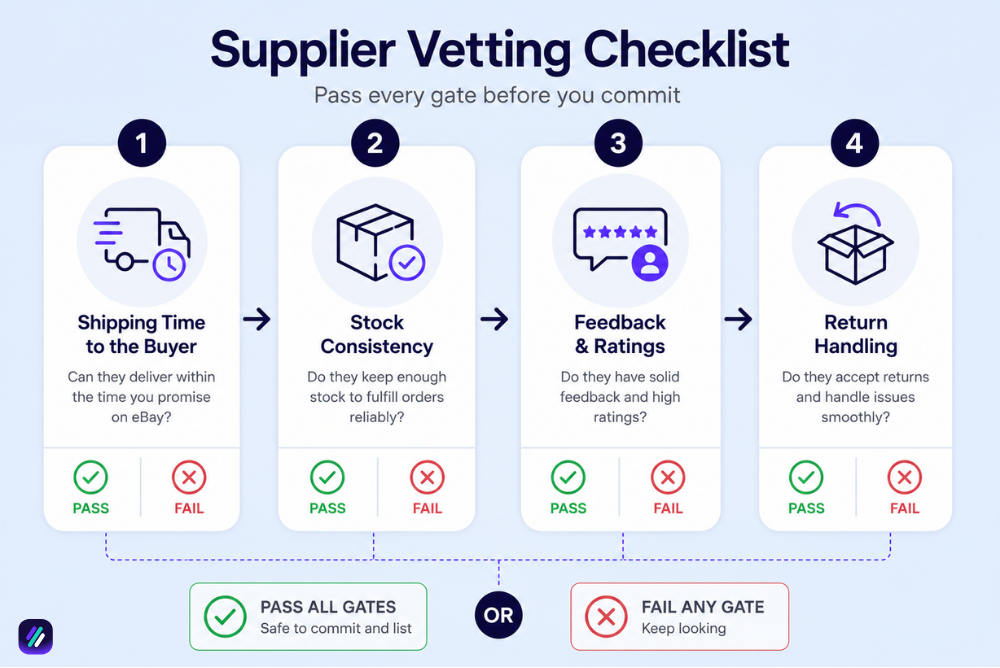
ZIK’s Dropshipping Product Finder does this matching for you: an eBay suppliers finder that pairs your chosen products with supplier options and works out the margin and ROI (return on investment) on each.
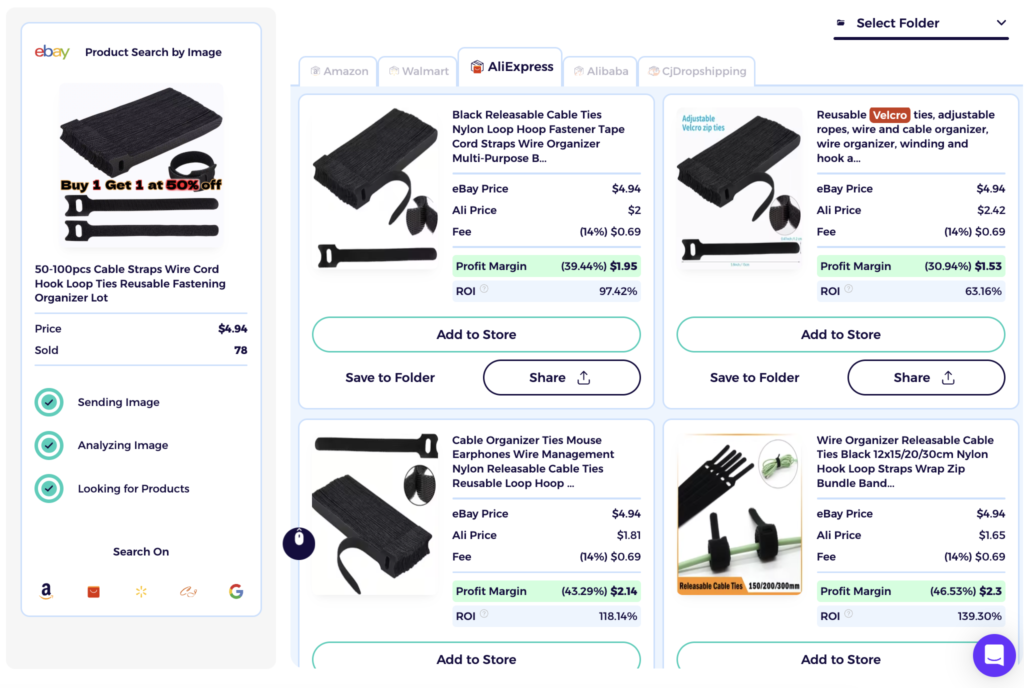
That saves a lot of manual price-checking. For overseas sourcing, remember that shipping speed is the one variable that makes or breaks your rating.
Step 5: Create Your Store
You do not need a paid eBay Store subscription to start selling, and skipping it keeps this free. A basic seller account lists items right away; a Store subscription only becomes worth it once your volume justifies the lower fees and extra listings.
So what you should set up on day one are your business policies: your payment, shipping, and return terms, as creating clear eBay business policies once and applying them to every listing prevents most buyer disputes before they start.
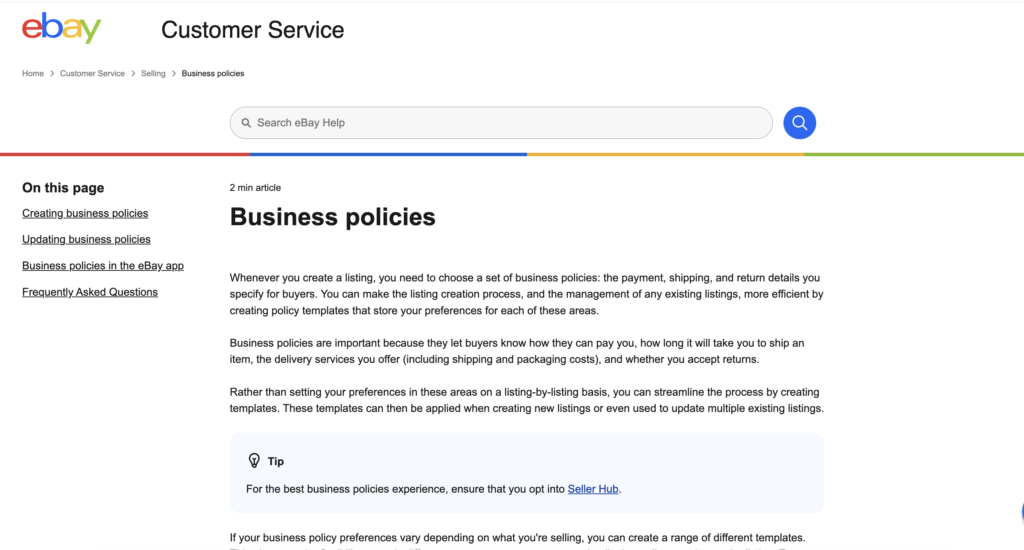
But your shipping policy deserves the most care, because it sets the delivery promise your supplier has to keep.
If your supplier ships in ten days, do not advertise three, so you need to set a handling time you can actually meet, which is where beginners lose their first buyers, and doing it the right way protects your seller rating from day one.
Step 6: Building eBay Listings
Your listing is your salesperson, and on eBay the title does most of the talking. eBay’s search engine reads your title to decide when to show your item, so the words you choose there decide how many buyers ever see you.
You get 80 characters, and you want to spend them on the terms buyers actually type: brand, model, key features, size, color. And there is no room for filler like “look” or “wow” that nobody searches.
The free eBay title builder from ZIK Analytics pulls buyer-search data so you can build a title around phrases with proven demand instead of guessing.
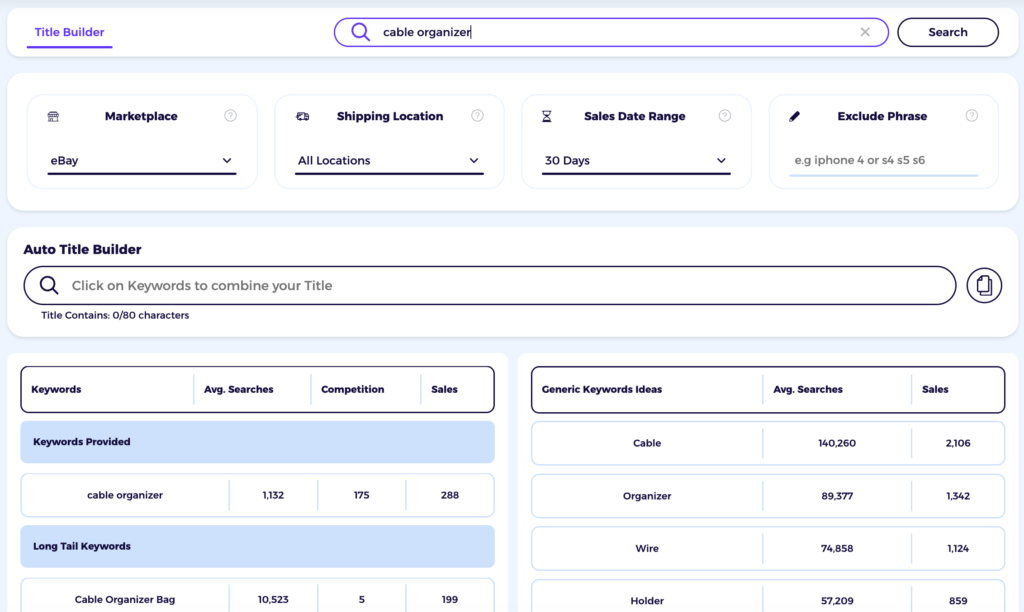
Beyond the title, three things carry a listing:
- Photos: use the supplier’s cleanest images, and add your own where you can to stand out.
- Item specifics: fill in every field eBay offers, because these power filtered search.
- Description: answer the questions a buyer would ask, then answer the ones they forgot.
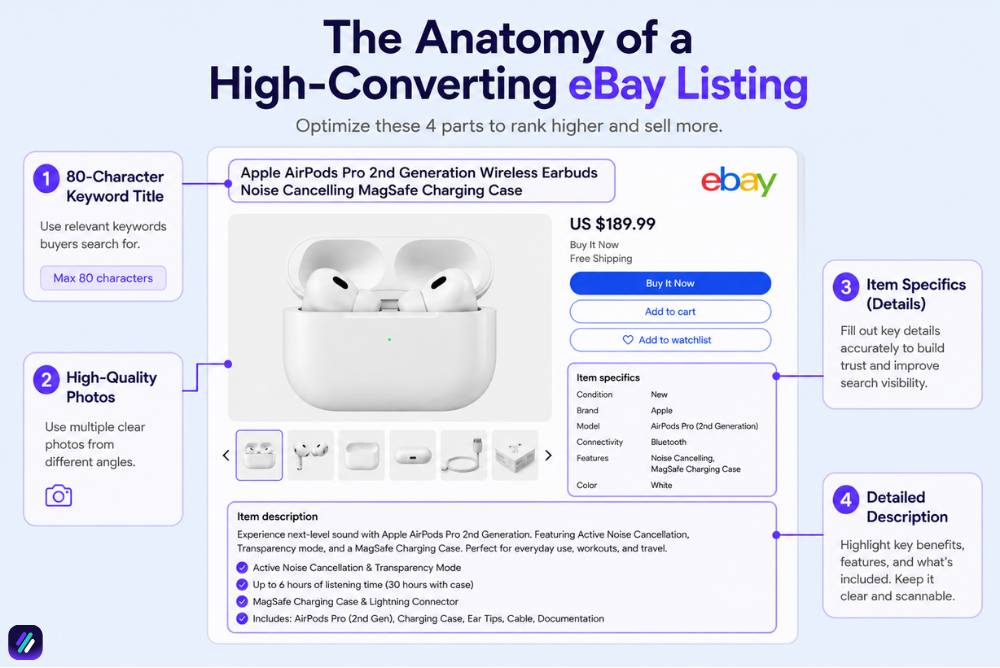
When those three are right, your listing works while you sleep. Our guide to eBay listing optimization covers the finer points once your basics are solid.
Step 7: Test eBay Promoted Listings
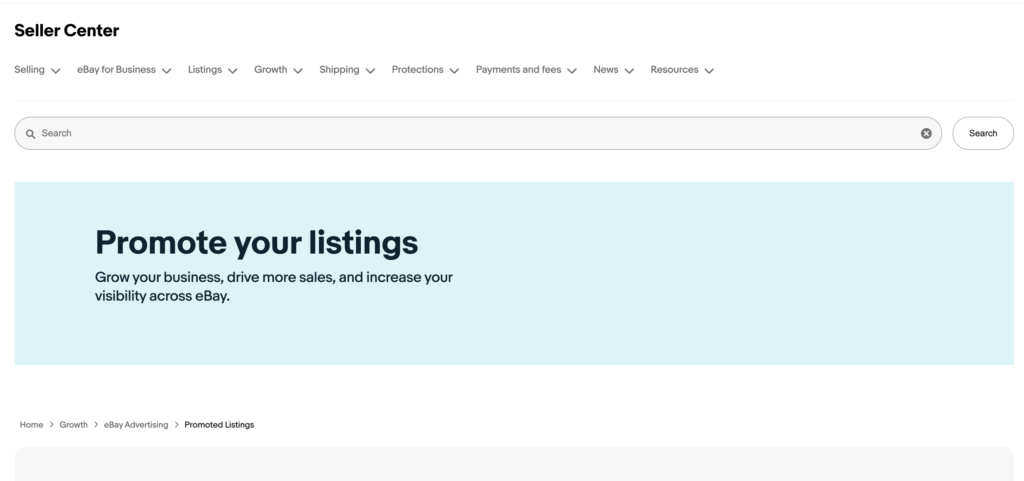
Promoted Listings fits a no-money start better than most people expect. eBay Promoted Listings Standard runs on a cost-per-sale model: you set an ad rate, a small percentage of the sale, and you are charged only when the item sells through an attributed click.
So instead of paying for clicks or impressions with money you do not have, you agree to share a slice of a sale that would not have happened otherwise. That makes it one of the lowest-risk ways to buy visibility as a beginner.
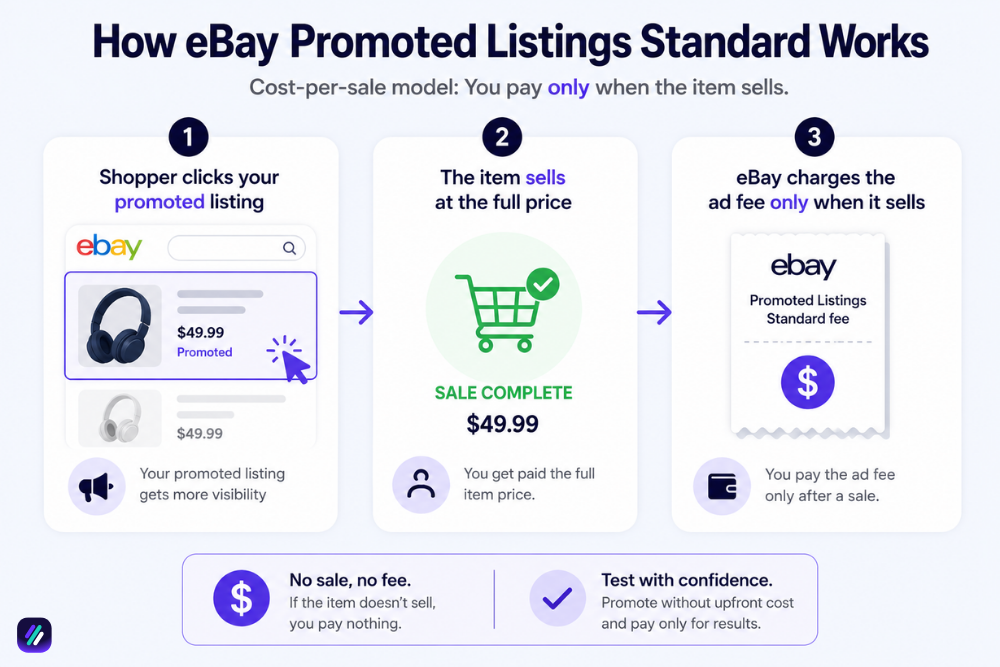
You can start at a low single-digit ad rate, and raise it only on listings that already convert, which is the safe way to run eBay promoted listings. That said, promotion amplifies a good listing; it does not rescue a bad one.
If a product is not selling on its own, you need to fix the listing or the price before you spend a cent promoting it.
Step 8: Correctly Process Your First Orders
The moment a sale comes in, the clock starts, and your handling of these first orders shapes your entire seller reputation. When a buyer purchases, you order the item from your supplier, ship it to your buyer’s address, and add the tracking number to the eBay order.
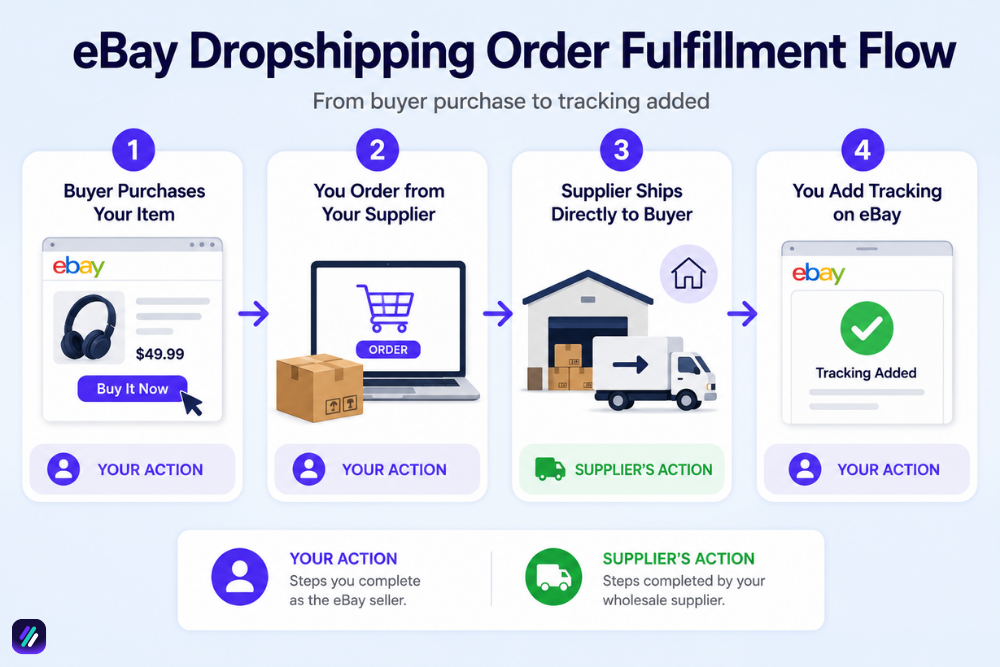
Two habits matter more than any other here. Adding tracking every time protects you in a dispute and reassures the buyer, and you also have to ship within the handling time you promised in Step 5, since late delivery is what our team at ZIK Analytics sees sink more new accounts than anything else.
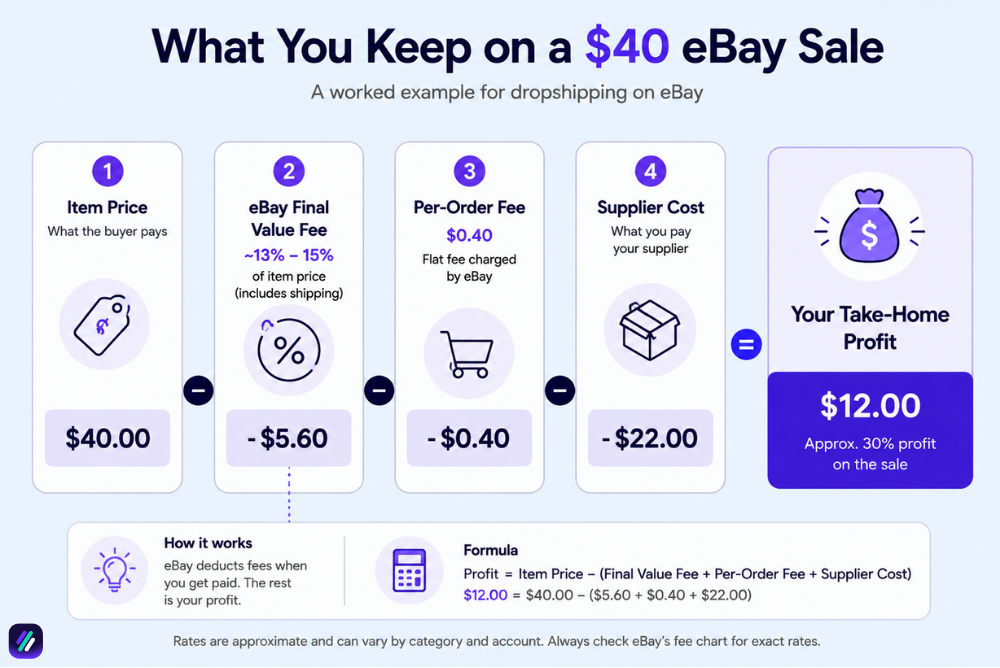
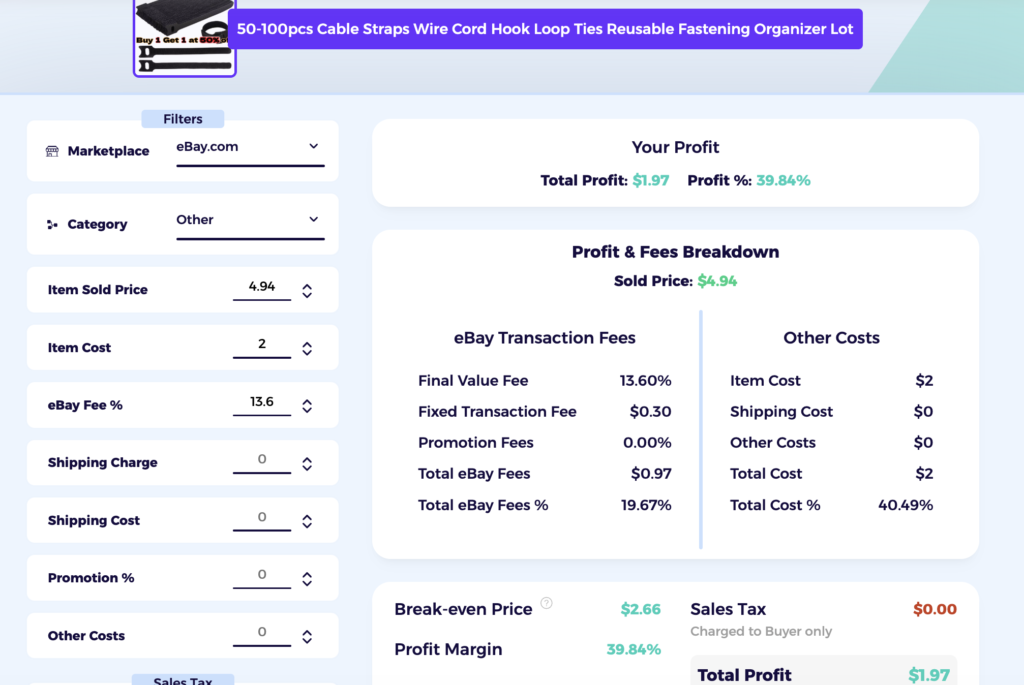
Now, this is also the moment fees appear. eBay’s final value fee runs roughly 13% to 15% of the sale depending on the category, plus a small per-order fee, and it comes out of your payout automatically.
So before you set a price, run the numbers through the eBay fee calculator so a sale you thought was profitable does not turn into a loss you did not see coming.
Step 9: Reinvest Profit in Scaling Your eBay Store
Now the flywheel starts turning. Once your first sales clear, the smartest move is to put that profit back in before you touch it, because early reinvestment is what turns a trickle of orders into steady income.
I have to be straight with you here: at this stage, dropshipping is not passive. You are building the business by hand, and almost everything still depends on your direct input. If you were hoping for the lazy version, this part will test you.
The money has a sensible order to follow:
- More validated products: widen your catalog with items you have researched, not random additions.
- A Store subscription: once volume is steady, the lower fees and extra listings start paying for themselves.
- Better tools and promotion: put money into research access and into promoted listings that are already converting.
So scaling is mostly repetition done well. As we covered across Steps 2 and 3, it always comes back to finding the next proven product, then listing it properly.
Start eBay Dropshipping With ZIK Analytics for $1
Everything in this guide comes back to one habit: deciding from data instead of hope. And that is the part ZIK Analytics takes off your plate, so you can put the full toolkit to work for a week for a single dollar:
- Use the eBay product research tool to see actual sales, sell-through, and competition on any keyword before you commit to a product.
- Use the eBay competitor research tool to pull up a winning seller in your niche and reverse-engineer their best items.
- Use the Dropshipping Product Finder, ZIK’s eBay suppliers finder, to match those products to suppliers with margin and ROI worked out.
So the move that fits a no-money start is simple: take the $1 trial (7-day), do all your heavy research that week, then pause it. You restart it when your store is making sales and the subscription pays for itself.
You can try ZIK Analytics for $1 and let the data pick your first product.
How to Find Winning Dropshipping Products on eBay Without Paying for Tools
A paid tool speeds this up, but you do not need one to get your first product. So if your budget is at zero, these methods cost nothing but your time and still get you to a validated shortlist.
Method 1: Checking eBay Sold Listings
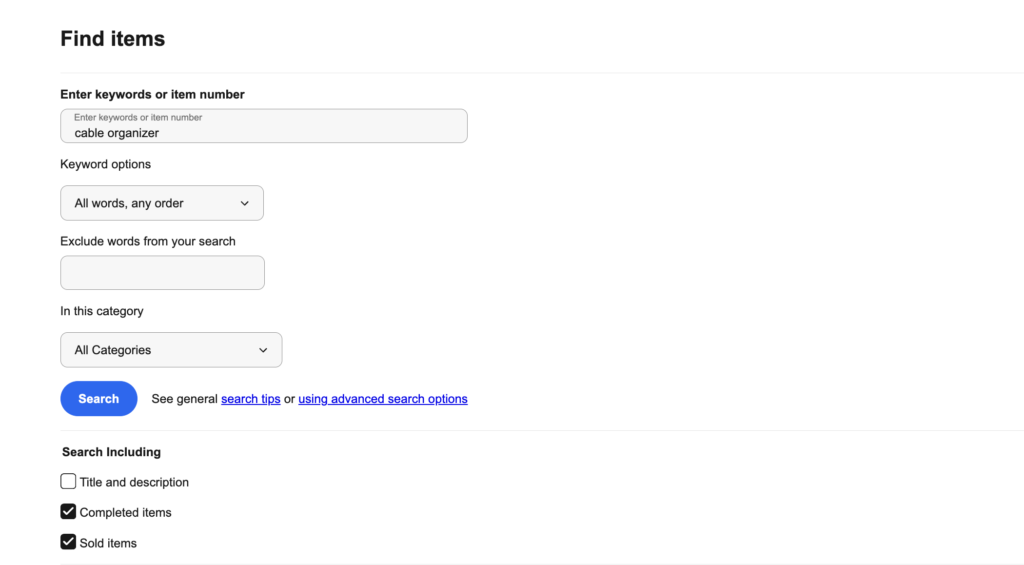
eBay hands you a demand database for free, and most beginners never open it. You search any product, filter to sold listings, and eBay shows you what sold, at what price, and how recently.
A green sold price next to a run of recent dates means live demand. A page with almost no sold results means you would be walking into a dead market.
Filtering to sold results is the whole skill behind how to find sold items on eBay, and it is the strongest free signal on the platform.
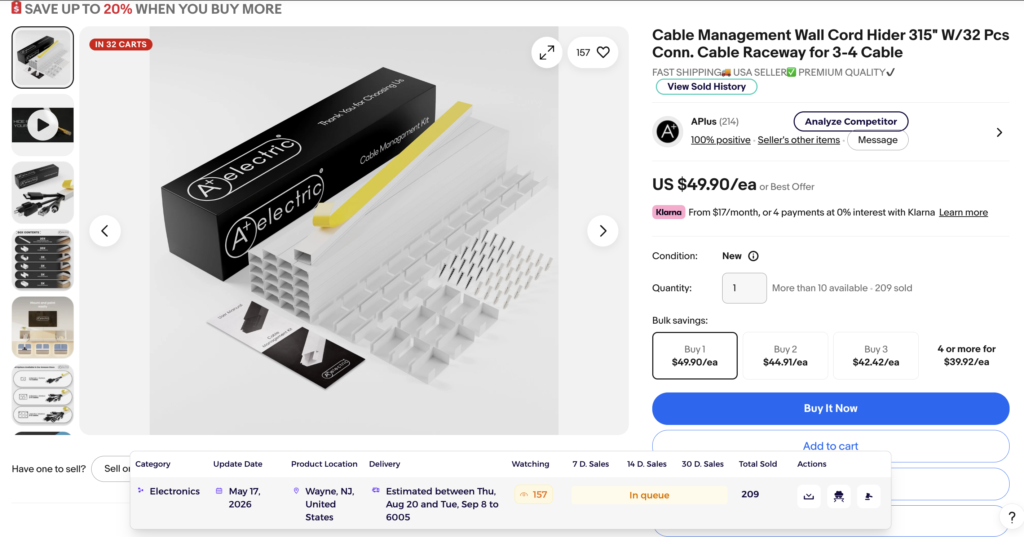
To make it faster, the free ZIK Analytics eBay chrome extension drops sold-history and competitor data straight onto the eBay page as you browse, with no separate login or purchase required.
Method 2: Using Terapeak in eBay
Terapeak is eBay’s own research tool, and it is included free with your seller account inside Seller Hub. It draws on eBay’s actual sales data, so you are researching the same marketplace you sell on.
You can look up a product and see sold prices, total sales, and demand trends over time, then sort by what performed best. For a tool you already own the day you register, it is a strong free option.
Keep in mind it covers eBay only, so pair it with the demand signals in the next method for a fuller picture.
Method 3: Spotting Demand on Google Trends and Social Media
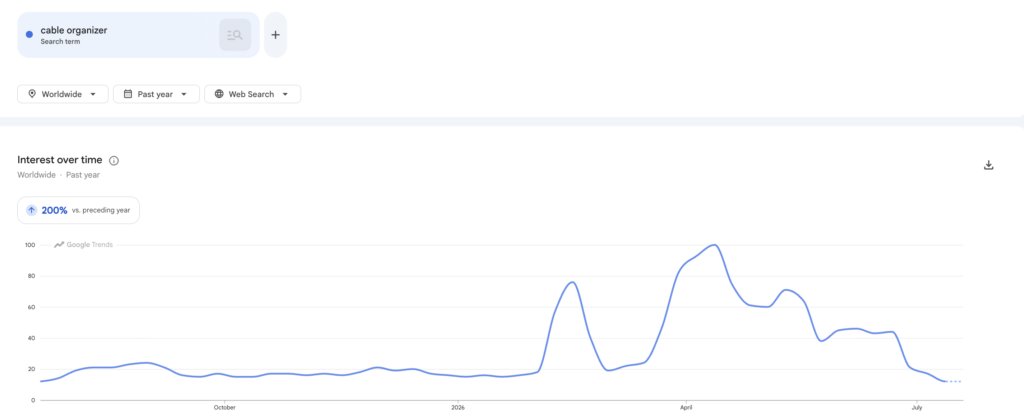
Sometimes demand shows up outside eBay before it shows up inside it. Google Trends is free and tells you whether interest in a product is rising, steady, or fading, which helps you avoid a niche on its way down.
Social platforms fill in the other half. A product going viral on TikTok often sparks a wave of eBay searches days later. The same pattern shows up in Facebook groups, where a trending item spreads fast.
For example, a kitchen gadget blowing up on social video is your cue to check its sold listings on eBay right away. None of this costs a cent, and together these free signals get you surprisingly close to what a paid tool would tell you.
Method 4: ZIK Analytics $1 Trial for 1 Week
The free methods work, but they are slow, and slow has a cost when you are trying to launch. This is the honest middle path between free and expensive.
You came here for the no-money route, so let me be clear about what a single dollar buys. The eBay dropshipping software from ZIK gives you a full week of everything: product research, competitor spying, supplier matching, and title data, all in one place.
The strategy is simple. You take the $1 trial (7-day), spend that week doing every scrap of research you can, and build a product-and-supplier shortlist to last a month or more.
Then you pause the subscription. You have spent one dollar and walked away with the exact data that separates sellers who guess from sellers who know. You restart it later, out of profit, when your store can afford it.
How to Make Money on eBay With No Product
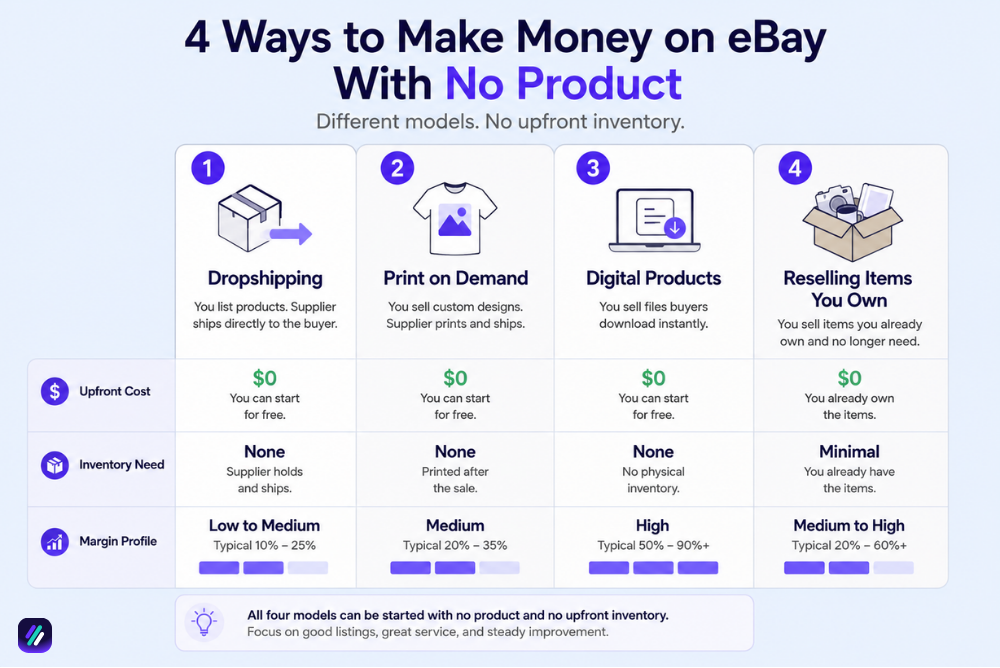
Dropshipping is the most direct answer to how to make money on eBay with no product, but it is not the only one. So if you would rather not hold inventory, eBay supports several models where you never buy stock in advance.
Method 1: Dropshipping
This is the model the whole guide is built around, so it needs little repeating. You list an item, a buyer orders, your supplier ships it, and you keep the difference. You never hold stock, and your only ongoing cost is the time you put into research and customer service.
The appeal is the low barrier; the catch is thin margins and your reliance on the supplier. Done with proper research, it is a legitimate way to build income from zero, which is why it earns the bulk of this article.
Method 2: Print on Demand
Print on demand (POD) lets you sell custom-designed products, such as shirts, mugs, and posters, without printing anything yourself. A partner prints and ships each item only after a buyer orders it, so you carry no inventory and no upfront cost beyond your designs.
The demand is there and climbing: the global print-on-demand market is projected to reach around $57.5 billion by 2033. Your edge is the design and the niche, not the product itself, so this suits anyone with a bit of creative taste or a sharp read on what a specific audience wants.
Method 3: Selling Digital Products and Downloads
Digital products come closest to pure margin, because there is no unit cost at all. These are e-books, templates, printables, and guides you create once and sell again and again.
eBay does allow this, but under specific rules you have to follow. For most sellers, digital items must be listed in the Everything Else, Information Products category using the classified ad format.
eBay also does not permit instant automated downloads, so you deliver the file manually, usually by email, and you have to own the intellectual property (IP) you are selling. With those rules met, it is a legitimate zero-inventory income stream.
Method 4: Reselling Items You Already Own (or Others Don’t Want)
Before you source a single product, look around your own home. Reselling things you no longer use is the fastest possible way to start on eBay with literally zero investment, and it teaches you the whole selling process on low stakes.
The market backs it up: US online resale is projected to reach $40 billion by 2029. Once you have cleared your own clutter, you can source cheaply from garage sales, thrift stores, and clearance racks. Our guide to reselling on eBay covers where to find stock that still leaves a profit.
Common eBay Dropshipping Mistakes Beginners Make
Knowing the traps ahead of time is cheaper than learning them from a suspended account. Most new sellers stumble on the same handful of avoidable errors, so here are the ones to watch:
- Skipping product research: listing on a hunch instead of proven sold data is the root of most failures.
- Choosing suppliers on price alone: the cheapest supplier with slow shipping costs you far more in disputes.
- Overpromising delivery times wrecks the seller rating you depend on faster than almost anything else.
- Ignoring fees when pricing: a “profitable” sale can turn into a loss once the final value fee lands.
- Copying a competitor’s title word for word leaves you competing on the same terms and winning on none.
- Forgetting to add tracking: no tracking means no protection when a buyer opens a dispute.
- Poor customer communication: a slow or cold reply turns a small problem into negative feedback.
- Listing branded or restricted items: VeRO (Verified Rights Owner) takedowns are avoidable if you check first.
- Sourcing from another retailer and shipping a box with its branding is a written-policy breach waiting to happen.
- Scaling a broken system: adding listings to a store with bad processes just multiplies the problems.
- Quitting after week one: treating the first slow days as failure instead of the normal build-up curve.
Our in-house sellers keep coming back to one habit that prevents most of this: solve the customer’s experience first, and the account metrics take care of themselves.
That said, if your niche has quirks, adjust the list to fit, since electronics sellers, for example, fight higher return rates while collectibles sellers fight authenticity disputes.
Conclusion
Starting eBay dropshipping with no money is less about finding a secret and more about refusing to spend before you have proof.
Every step here, from validating a product in eBay’s sold listings to promoting only what already converts, is built to keep your risk near zero while you learn what sells.
And the sellers who make it researched patiently, delivered reliably, and reinvested their first profit instead of their savings. Spending the most at the start was never the deciding factor. You can absolutely be one of them.
So start with what is free, prove the model with a few early sales, and let one dollar of research do the work guesswork never could. Your first sale is closer than the price of entry suggests.
How to Start Dropshipping on eBay With No Money FAQs
A few quick answers to the questions new sellers ask most about starting with no budget.
Can I start eBay dropshipping with $0?
Yes. Opening an eBay account is free; new sellers can list within a monthly limit at no cost, and eBay’s fees only come out after an item sells. You can research products using eBay’s free sold listings and Terapeak, so your only genuine investment at the start is your time and effort.
How to make $5000 a month on eBay with dropshipping?
There is no fixed formula, and anyone promising an exact figure is guessing. Reaching that level usually means a portfolio of well-researched products, healthy margins after fees, reliable suppliers, and steady reinvestment over months. It comes from volume and repetition, not one lucky product, so treat any income claim you see as a ceiling, not a promise.
Can you dropship on eBay from AliExpress?
Many sellers do. The key is meeting eBay’s requirements: accurate listings, delivery within your stated handling time, and packages that do not arrive with another retailer’s branding or invoices. Long shipping times are the main risk with overseas suppliers, so vet delivery speed carefully and set honest handling times to protect your rating.
Is $100 enough to start dropshipping on eBay?
More than enough, and you will not need most of it up front. Since listing is free and fees come out after sales, $100 gives you a comfortable buffer for a research tool, a few test orders, and a small promoted-listings budget. Many sellers start with far less and reinvest their earliest profits instead.
How much can you make dropshipping on eBay per month?
It varies widely, from nothing in a slow first month to a full-time income for established sellers. Your earnings depend on your product research, your margins after eBay’s fees, and how consistently you list and reinvest. Beginners should expect a modest start and focus on proving the model before chasing a monthly number.