
Most sellers treat an eBay suspension like bad weather, something that strikes at random and ruins the day. It rarely works that way.
Accounts get restricted for patterns eBay watches every single month, and by the time that warning email lands, the marks are already sitting on your record. Losing the account usually means losing the income with it.
So here is what this guide actually covers. I am going to show you how to dropship on eBay without getting banned, from the policy nobody reads to the seller habits that keep you safe for the long haul.
Is Dropshipping Allowed On eBay?
Yes, dropshipping is allowed on eBay, but only one version of it. Sourcing from a wholesale supplier is fine. Listing an item and then buying it from another retailer like Amazon or Walmart to ship straight to your buyer is not.
That single distinction is where most new dropshippers trip. eBay’s official drop shipping policy permits selling products you source from a wholesale supplier you have an agreement with, and it prohibits the retail-arbitrage version where you list first, then order from a store or marketplace that posts directly to your customer.
The reason comes down to the buyer, not the business model. However you source, the policy holds you responsible for safe delivery inside your stated handling time and for the buyer’s experience from click to doorstep.
A wholesale supplier you genuinely have a relationship with can deliver on that. A retail order dropped from a marketplace box you never see often cannot.
So do not read this as dropshipping being a grey-market trick. Done properly, eBay dropshipping is a legitimate business inside a market that Grand View Research valued at $464.4 billion and expects to pass $2.18 trillion by 2033.
eBay itself ended the year with 135 million active buyers, so it has every reason to guard that experience. Follow the version eBay allows and you are working with the platform instead of tiptoeing around it.
Why eBay Dropshipping Accounts Get Banned Or Restricted
Almost no one gets banned for the word “dropshipper.” They get banned for the buyer experience that careless dropshipping produces, and eBay measures that experience constantly.
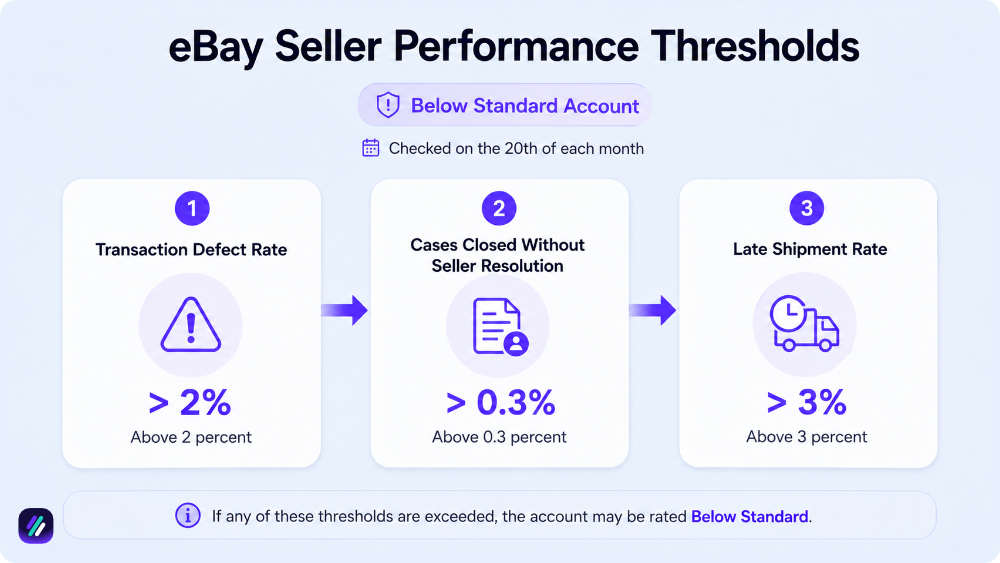
eBay reviews every seller on the 20th of each month and scores them against its seller performance standards. A transaction defect rate above 2%, or cases closed without your resolution above 0.3%, drops an account to Below Standard, and eBay separately expects late shipments to stay under 3%.
Two separate forces put an account at risk, and dropshippers tend to run into both:
- Performance defects: late shipments, cancellations, and cases closed without your resolution pile up faster when you do not hold the stock or control the courier.
- Hard policy tripwires: intellectual-property complaints, prohibited items, and the retail-arbitrage sourcing the eBay dropshipping policy forbids can each trigger action on their own.
The first bucket is a slow bleed. Your metrics drift below standard, your listings lose visibility, and eventually eBay caps or suspends your selling. The second bucket is a trapdoor. One complaint or one banned listing can bring a restriction with no gentle warning first.
The encouraging part is that both buckets sit almost entirely inside your control. A dropshipper who ships on time, answers buyers quickly, sources cleanly, and lists carefully looks identical to any other healthy seller in eBay’s data. The rest of this guide is about staying in that lane.
What Actually Gets Your eBay Account Banned
The policies above stay abstract until you see them as the specific behaviors eBay penalizes. Five patterns cause the large majority of dropshipping suspensions, and every one of them is preventable once you know what eBay is counting.
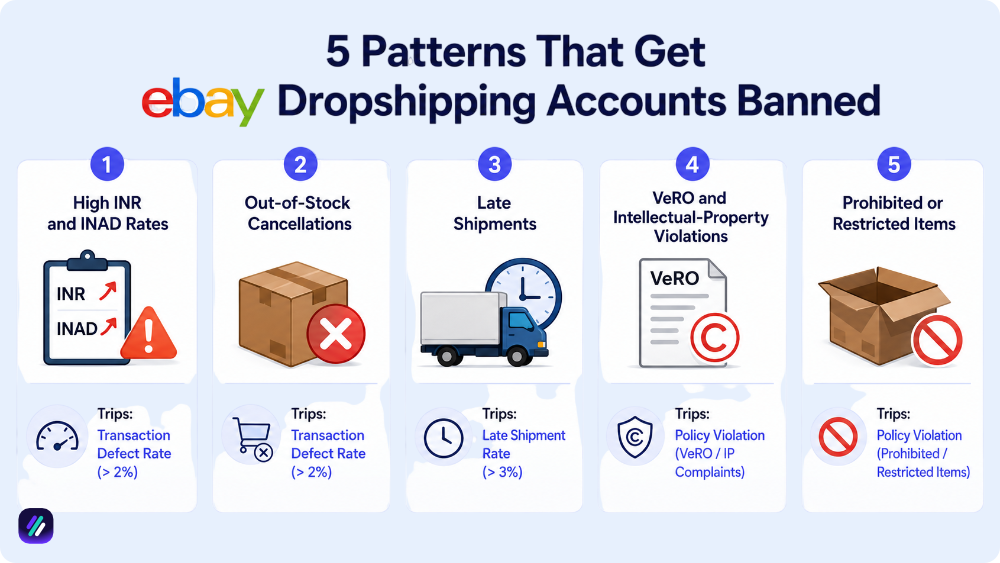
High Item Not Received (INR) and Item Not As Described (INAD) rates
These two claims are the fastest way to wreck a young account. An Item Not Received (INR) case opens when tracking does not show delivery in time, and an Item Not As Described (INAD) case opens when what arrives does not match your listing.
Both can be filed under the eBay Money Back Guarantee, and when eBay refunds the buyer and takes the money back from you, the case counts as closed without your resolution, one of the metrics that defines a Below Standard account.
Dropshippers are exposed here because long supplier shipping times invite INR claims and generic supplier photos invite INAD disputes. And not every claim is even honest: around 61% of payment disputes are now friendly fraud, where a buyer claims an item never arrived just to keep it for free.
You cannot stop every false claim, but you can control the two things that protect you when eBay reviews the case. You upload valid tracking before the estimated delivery date, and you describe items accurately, down to the flaws.
A clear, generous eBay return policy helps too, because a buyer who can simply return an item is far less likely to open a formal not-as-described case.
Cancelling orders for out-of-stock items (defect generation)
Running out of stock is the classic dropshipping trap, and cancelling the sale is worse than it looks. Every seller-initiated cancellation for an out-of-stock item is logged as a transaction defect, and defects are the single metric most likely to push you Below Standard.
The math is brutal for small sellers. With the 2% defect ceiling, a shop doing 50 orders a month is already at the edge after a single out-of-stock cancellation. A supplier who sells through while your listing stays live can hand you three or four in one week.
The fix is inventory discipline, not faster apologies. You keep a stock buffer, and you pause or end listings the moment a supplier runs low.
When a cancellation is unavoidable, you fall back on how to cancel order on eBay as seller using the “buyer requested” reason only when it is actually true, never as a way to dodge a defect.
Late shipments and missed handling times
Handling time is the promise you make at checkout, and eBay treats a broken promise as a defect. Your late shipment rate climbs whenever tracking is not accepted by the carrier and scanned before the estimated delivery window, and eBay wants that rate under 3% for a healthy account.
Dropshippers get burned here because the clock starts when the buyer pays, not when the supplier gets around to it. If you list a two-day handling time but your supplier takes four days to dispatch, you are late on paper even when the item eventually arrives fine.
Two habits keep you safe. You set a handling time you can hit on your supplier’s slowest day rather than their best, and you make sure valid tracking uploads early. This is why it pays to know exactly how long do eBay sellers have to ship under each setting before you commit to one.
VeRO and intellectual-property violations
This is the trapdoor that catches sellers who never thought they broke a rule. Through the Verified Rights Owner (VeRO) program, any brand can report a listing that uses its trademark, product photos, or copyrighted text, and eBay removes that listing immediately, usually with no warning to you first.
The danger for dropshippers is that supplier catalogs are full of branded images and brand names dropped into titles for search traffic. If you copy a supplier’s listing wholesale, you can inherit their infringement without realizing it.
A first VeRO strike is a warning and a pulled listing, and repeated strikes escalate to timed selling restrictions and then permanent suspension.
The habit that protects you is owning your own content. You write your own titles and descriptions, you use only photos you or your supplier are licensed to use, and you keep brand names out of listings for generic products.
Listing prohibited or restricted items early in an account’s life
New accounts have the least room for error, and prohibited items are the fastest way to burn through it. eBay’s prohibited and restricted items policy bans some categories outright and gates others behind seller requirements, and a violation can bring a warning, a restriction, or a suspension depending on the item.
Some of the most profitable-looking supplier products sit in exactly these gated categories. eBay’s products with eligibility requirements can require at least 90 days of active selling, 100 or more transactions, and $1,000 or more in sales before you may list them at all.
A brand-new dropshipper who lists them anyway looks like a risk account on day one. The safe move early on is to stay in plain, unrestricted categories while your history builds.
You check any product against eBay’s prohibited and restricted list before you import it, and you treat your first 90 days as the time to prove reliability rather than to chase the riskiest margins.
How Does eBay Know You Are Dropshipping?
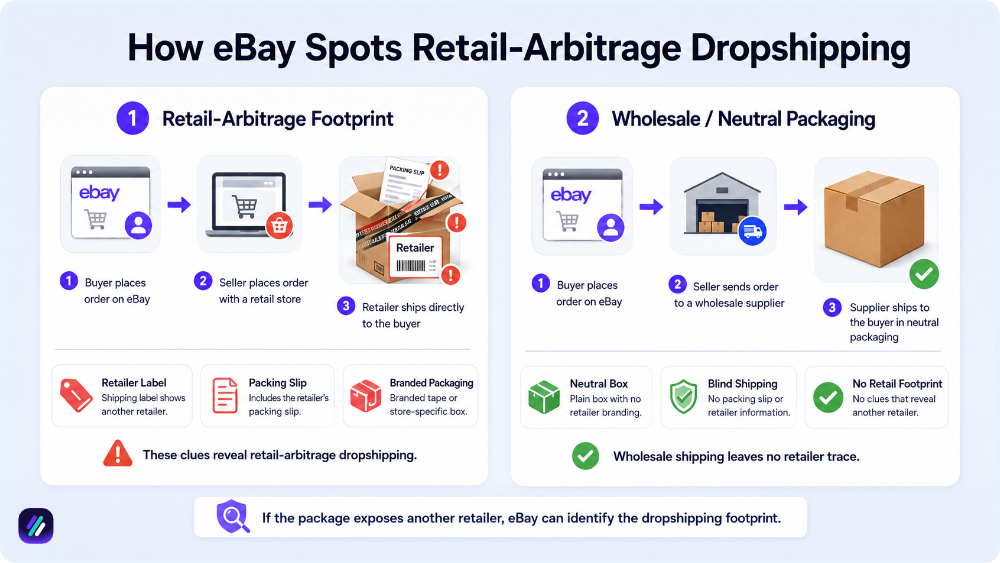
eBay knows because the evidence rides along with every order. Tracking numbers that trace back to Amazon or Walmart, third-party packing slips, mismatched ship-from locations, and buyers asking why their parcel came from another store all flag an account for review.
None of these signals is secret detective work. They are the ordinary footprints of retail-arbitrage sourcing, and eBay’s systems and its buyers both notice them.
The most common giveaway is the delivery itself. The riskiest version is Amazon to eBay dropshipping, where a Prime label or a retailer’s packing slip rides along in the box, and the buyer sees immediately that the order did not come from you.
A run of “why did this arrive from Walmart” messages is a pattern eBay can corroborate in minutes.
This is exactly why the sourcing model matters less than how you run it. A wholesale supplier who ships in neutral or your own packaging leaves none of these footprints, because the fulfillment belongs to your business.
Trying to disguise retail-arbitrage sourcing is a losing game, while running the model eBay already permits leaves nothing to disguise in the first place.
How to Warm Up a New eBay Account Before You Scale
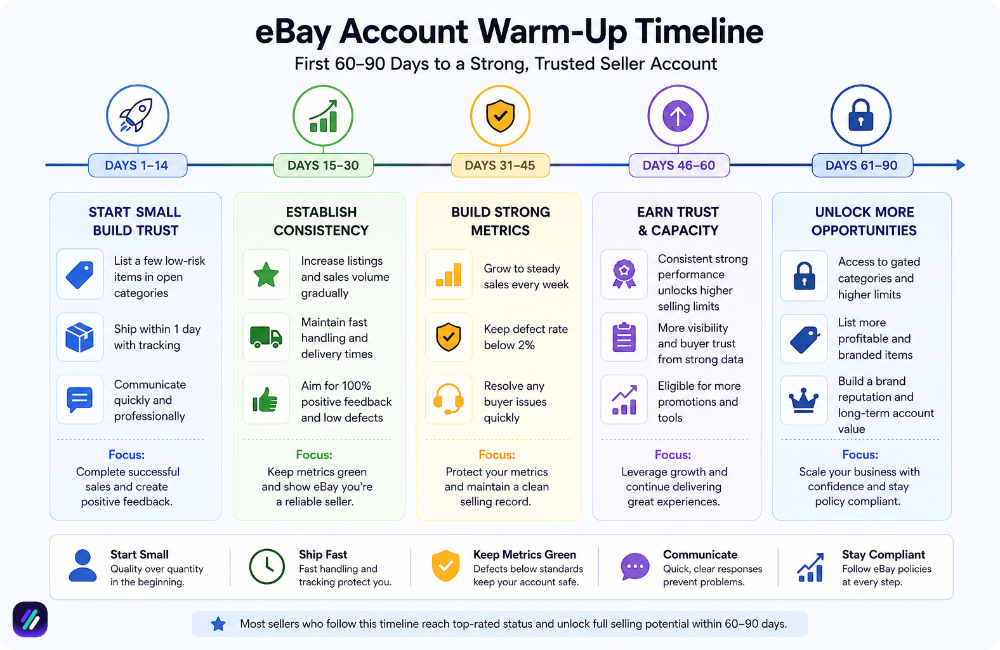
The fastest way to lose a new account is to treat it like an established one on day one. New accounts start with modest selling limits and thin trust, and eBay watches early behavior closely for exactly the fraud and quality risks its limits exist to catch.
Our in-house eBay sellers keep coming back to one habit: they never launch a new account at full speed. A warm-up period builds the track record that later earns higher eBay selling limits, better visibility, and access to gated categories. A sane warm-up looks like this:
- Start small and sell through: a handful of low-risk items and genuine, completed transactions matter more than raw volume in week one.
- Ship fast on easy wins: early orders are your cheapest chance to bank on-time deliveries and the feedback that cushions later mistakes.
- Raise limits by earning them: strong metrics are what get your limits lifted, so let performance set the pace instead of impatience.
- Keep it to one account: stacking multiple eBay accounts to dodge limits is itself a suspension risk, and it splits the trust you are trying to build.
It also helps to model a compliant seller instead of guessing. With the eBay competitor research tool, you can study an established dropshipper in your niche, see the sell-through and volume they run, and copy the pace they scaled at rather than inventing your own.
A patient first 60 to 90 days is the foundation that lets you scale later without tripping a single alarm, and it is the cheapest insurance you will ever buy on eBay.
How to Choose Suppliers That Keep You Compliant
Your supplier decides most of your ban risk before a single order comes in. They control shipping speed, stock reliability, packaging, and product authenticity, which are exactly the levers behind late shipments, cancellations, INR claims, and VeRO strikes.
Pick well, and compliance gets easy. Pick on price alone, and you inherit every one of their problems. A compliant supplier for eBay dropshipping tends to share a few traits:
- Genuine wholesale terms: they sell to you as a business, not a retail customer, which is the sourcing eBay’s policy actually permits.
- Fast, trackable dispatch: they ship within a window you can promise and provide tracking eBay’s carriers will scan.
- Consistent stock: they hold enough inventory that you are not cancelling sales the moment something trends.
- Neutral packaging: they leave no other retailer’s branding, invoices, or Prime labels in the box.
- Clean, licensed products: they sell genuine goods and do not push you toward branded photos or trademarked titles.
Vetting for this is the step beginners skip most, which, from what our dropshipping team at ZIK keeps seeing, is where the early suspensions actually come from. You order test units yourself, you time the delivery, and you check the packaging before you ever point paying buyers at a supplier.
This is also where a research layer earns its keep. ZIK’s Dropshipping Product Finder works as an eBay suppliers finder that matches any product you want to sell to sources on Amazon, Walmart, AliExpress, or Alibaba and shows the margin on each, so you compare suppliers on delivery and profit together.
Building a shortlist of reliable eBay dropshipping suppliers is slower than importing the first catalog you find, and it is the difference between a business and a suspension waiting to happen.
How to Avoid VeRO and Intellectual-Property Violations
A VeRO strike feels random, but it almost never is. It comes from putting a brand’s trademark, photos, or copy into your listing, and the fix is to stop borrowing brand assets you do not have the right to use. Get this right and the whole category of intellectual-property suspensions drops off your risk list.
The practical rules are short and worth following without exception:
- Write your own listings: original titles and descriptions cannot infringe a copyright the way a copied supplier block can.
- Use only photos you can use: your own images, or ones a supplier has explicitly licensed to you, never a brand’s product shots pulled off Google.
- Keep brand names out of generic listings: a title for a generic product should never borrow “AirPods” or “Nike” to catch searches, which is textbook trademark misuse.
- Know the touchy brands: some rights owners police eBay VeRO reports aggressively, so if a category is full of protected brands, tread carefully or avoid it.
- Sell genuine goods: counterfeits are an instant, non-negotiable suspension, well beyond an ordinary VeRO strike.
If a listing does get pulled, you take it seriously the first time. You remove anything questionable across your other listings before a pattern forms, because eBay’s tolerance drops sharply with each repeat. One strike is a lesson; a habit is a closed account.
Use Product Research to Pick Low-Ban-Risk Items
Product research is usually sold as a way to find winners. For a dropshipper trying to stay on eBay, it is also your first and best filter for ban risk.
The item you choose decides how likely you are to face an INR claim, a VeRO strike, a cancellation, or a return before you have sold a single unit. The safest products to dropship on eBay share a profile:
- Generic and unbranded: no trademarks or brand photos to trigger VeRO, so the whole IP risk category drops away.
- Light and simple to ship: low weight and low fragility mean fewer damaged-in-transit INAD claims and cheaper, faster delivery.
- Low return rate by nature: practical, one-size items beat sized apparel or electronics that get returned or disputed constantly.
- Reliably in stock: a product your supplier keeps deep inventory on is a product you will not be cancelling next week.
- Steady but not saturated demand: enough buyers to sell through, without a thousand competitors racing to the bottom on a listing that invites complaints.
Categories that look tempting but raise risk early are the usual suspects: branded electronics, anything fragile, licensed or trademarked goods, and high-dispute apparel. They are not off-limits forever, but they are a poor place to build your first 90 days of history.
This is where research data does double duty. With the eBay product research tool, you can see actual sell-through, competition, and price on any keyword, then filter out the branded and VeRO-flagged items that carry the most risk. Demand validation and ban avoidance happen in the same step.
Reading hard eBay product research data beats guessing which niche is safe, and it is the honest version of “do your research” that most guides wave at without ever explaining.
What to Do If Your eBay Account Is Flagged or Suspended
If a warning or restriction lands, what you do in the first day matters more than the mistake that caused it. eBay’s actions escalate with repetition and with silence, so a fast, honest response is your best route back to full selling.
You read the notice carefully to find the exact policy cited, because the fix for a VeRO strike is nothing like the fix for a defect-rate restriction. Then you act on it:
- Fix the root cause first: the infringing listing, the open case, or the failing metric gets corrected before you appeal anything.
- Appeal with evidence, not emotion: supplier invoices, tracking, and a clear account of what you changed carry far more weight than frustration.
- Do not open a second account: a “stealth” account to escape a restriction is one of the surest ways to make a temporary problem permanent.
- Stabilize before you scale again: low volume and clean metrics come first, growth second.
In our experience at ZIK, the sellers who recover fastest are the ones who treat the first warning as the deadline, not the third.
A restriction is often reversible, and even a suspended account can sometimes be reinstated on appeal, but the odds fall every time you ignore a notice or try to sidestep it.
If you are staring at a Below Standard rating specifically, there is a clear path to how to fix Below Standard on eBay that starts with the metric eBay flagged, not with a new account.
Best Tips to Not Get Banned on eBay
Most of this guide comes down to a handful of habits. Keep these in front of you, and the ban risk that ends most dropshipping accounts never gets a foothold:
- Ship on time, every time: your handling-time clock starts when the buyer pays, so promise a window you can hit on your supplier’s slowest day.
- Upload valid tracking early: tracking scanned before the estimated delivery date is what protects you from an INR claim, honest or not.
- Never cancel for stock you should have had: buffer inventory and quick listing pauses keep seller-initiated cancellations off your record.
- Own every word and image in your listings: original titles, descriptions, and licensed photos keep you clear of VeRO entirely.
- Stay out of restricted categories early: unrestricted, generic products let your history build before you touch gated or high-dispute items.
- Answer buyers fast: a quick, human reply often resolves an issue before it becomes a case closed without your resolution.
- Vet suppliers before buyers see them: test orders, timed deliveries, and neutral-packaging checks catch the problems that later become defects.
- Scale at the pace your metrics allow: everything you do to increase eBay seller rating compounds when you push for more volume, so let performance set your ceiling.
- Keep it to one clean account: one well-run account beats several fragile ones, and it is the version eBay rewards with trust.
No list like this is ever complete, because the risk shifts with your niche. If you sell electronics, add a plain damaged-in-transit and warranty disclaimer so a dead-on-arrival unit becomes a return instead of an INAD case.
If you sell anything with sizing, like apparel or shoes, publish a precise measurement chart, because sizing is the single most common reason those items come back as not-as-described. The specific tripwires change; the habit of designing your listing to prevent the complaint does not.
Conclusion
The whole point of learning how to dropship on eBay without getting banned is simpler than it sounds: be the kind of seller eBay has no reason to touch. That means delivering on time, describing items honestly, sourcing cleanly, and listing nothing that borrows a brand it should not.
Every metric eBay watches rewards that seller, and every policy tripwire in this guide is one a careful operator simply never steps on.
The dropshippers who last are rarely the ones chasing the hottest saturated product on day one. They are the ones who treated their first 90 days as a track record worth protecting, then scaled a clean account into serious volume.
Build that reputation early and eBay stops being a threat hanging over your business. It becomes what it is for every good seller: 135 million buyers, and a platform with every reason to keep you selling to them.
Find Winning eBay Dropshipping Products with ZIK Analytics
Every habit in this guide points back to one thing: choosing the right products and selling them like a professional. That is the part ZIK Analytics is built to make easy:
- Use the ZIK software for eBay product research to check actual sell-through, competition, and price on any keyword, and screen out the branded and risky items before you ever list them.
- Use the eBay competitor research tool to study established, compliant sellers in your niche and model the pace they scaled at.
- Use the Dropshipping Product Finder to match winning products to reliable suppliers, with the margin on each in one eBay suppliers finder view.
Pick low-risk products, source them cleanly, and sell them the way eBay rewards. You can start your $1 trial (7-day) and see what is actually selling before you list a thing.
How to Dropship on eBay Without Getting Banned FAQs
A few quick answers to the questions dropshippers ask most about staying on the right side of eBay:
Does eBay ban you for dropshipping?
No, eBay does not ban dropshipping itself. It bans the seller behavior that bad dropshipping causes: late shipments, cancellations, item-not-received cases, and intellectual-property violations. Dropshipping from a wholesale supplier is explicitly allowed. Buying from another retailer that ships directly to your buyer is not, and that version is what most often leads to a suspension.
How to not get caught dropshipping on eBay?
The honest framing is not to hide it, but to dropship the way eBay permits so there is nothing to catch. You source from wholesale suppliers who ship in neutral packaging, keep no other retailer’s branding in the box, write your own listings, and deliver inside your handling time. Do that and “getting caught” stops being a concern, because you are simply following the policy.
Is dropshipping allowed on eBay?
Yes, it is allowed. eBay permits dropshipping when you fulfill orders through a wholesale supplier and stay responsible for delivery and buyer satisfaction, which is the core of the does eBay allow dropshipping rules. Listing an item and then buying it from another retailer that ships directly to your buyer is the one version that is not allowed.
Can you get banned on eBay for dropshipping?
Yes, but almost always because of how it is done rather than the model itself. Accounts get restricted or banned when defects pile up, when handling times slip, when VeRO complaints hit, or when a seller uses retail arbitrage against policy. A dropshipper who delivers on time, describes items accurately, and sources from wholesale suppliers carries the same low risk as any other seller.
Can I make $1000 a month on eBay with dropshipping?
Yes, $1,000 a month is a realistic early target, though it takes disciplined product research and clean selling rather than luck. Most of it comes down to margin and volume: enough winning products at a workable profit, sold through an account healthy enough to keep scaling. The sellers who hit it consistently are the ones who protected their account from day one instead of chasing fast, risky growth.