
If you ask whether dropshipping on eBay is worth it, you tend to get two stories. One is a YouTube thumbnail promising a five-figure month, while the other says the marketplace is dead and the margins are long gone.
If you choose to believe the first, you can burn months chasing a fantasy, and if you believe the second, you walk past a marketplace where tens of thousands of sellers are making it work. Either way, you bet your own time and money on somebody else’s highlight reel.
So in this guide, I’ll give you the honest, data-backed version: whether is dropshipping on eBay worth it, when it is not, and how to tell which answer fits you.
Key Takeaways
- The honest answer: eBay dropshipping is worth it as a low-cost way to learn product research and earn at least a good side income, not as a shortcut to a fast full-time wage.
- You are not buying traffic: eBay hands you a built-in audience of active buyers, so unlike a standalone store, you are not paying to get found on day one.
- Thin margins are the ceiling, not demand: the squeeze comes from low-ticket prices, fees, and competition, so operations and margin discipline decide who survives.
- Budget and patience matter most: in a ZIK Analytics survey, sellers spent roughly $250 to $400 a month to start, and most needed three to six months to land consistent winners.
- Data beats gut: the sellers who make it pick products from sales data, and the eBay product research tool shows actual sales, sell-through, and competition before you list a thing.
So, Is Dropshipping on eBay Worth It?
Yes, for the right person. eBay dropshipping is worth it as a low-risk way to learn what sells and earn a steady side income, but it rewards patient, data-driven sellers and slowly drains anyone expecting fast, passive, full-time money.
The case in favor starts with scale. eBay has 136 million active buyers and moved roughly $79.6 billion in goods last year.
That means you are listening to demand that already exists rather than paying to manufacture it. It is the core reason eBay dropshipping keeps pulling in beginners, and why the lazy “is dropshipping a scam” verdict misses the point. The model is legitimate, the demand is genuine, and people do build income from it.
And many reasons make eBay one of the easiest places to start dropshipping:
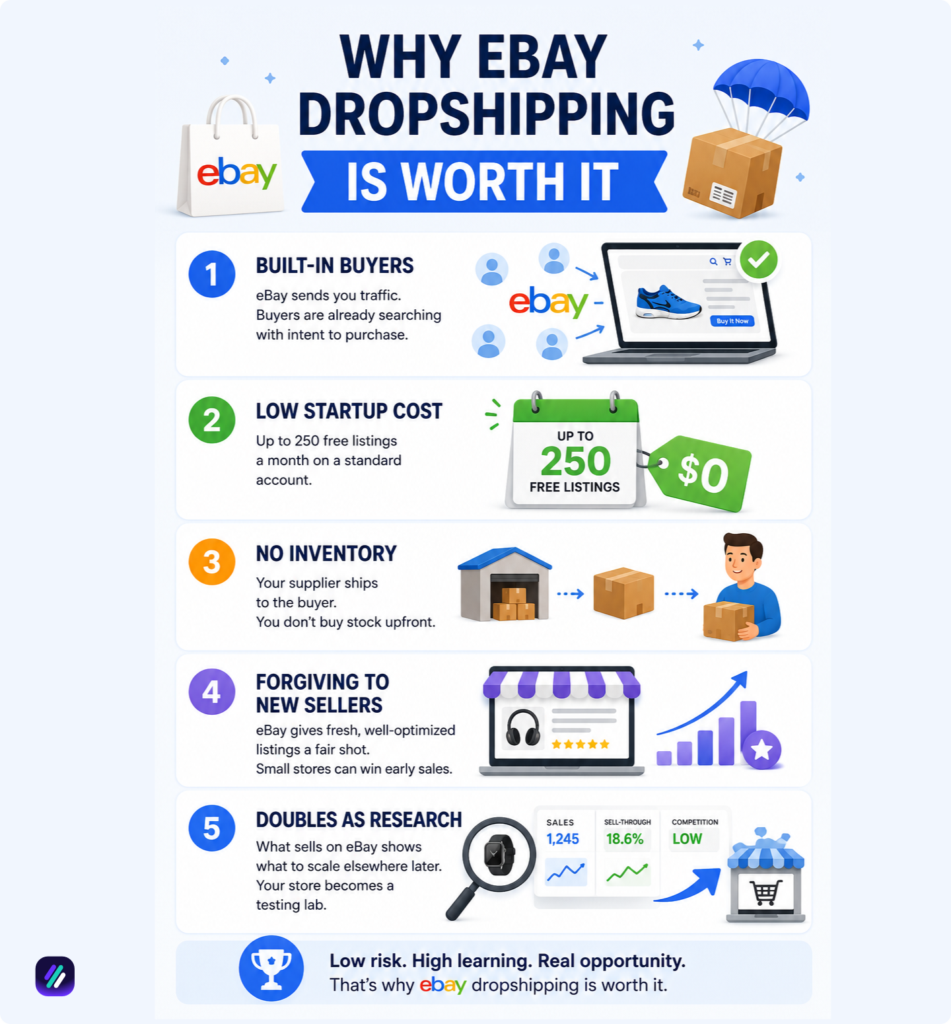
- Built-in buyers: eBay sends you traffic. Buyers arrive already searching with intent to purchase, so you compete on listings, not on ad budgets.
- Low startup cost: you get up to 250 free listings a month on a standard account, so you can test products without paying listing fees upfront.
- No inventory: your supplier ships to the buyer, so you are not laying out cash for stock that might never sell.
- Forgiving to new sellers: eBay tends to give fresh, well-optimized listings a fair shot, so even a small store can pick up early sales.
- It doubles as research: what sells on eBay tells you what to scale elsewhere later, so a modest store earns its keep as a testing lab.
None of that makes it free money, though, and two things have to be right before any of it matters.
The first is the rules. eBay says they only allow dropshipping from wholesaler suppliers; however, in majority cases eBay has no problem with any dropshipping or arbitrage as long as your product listings are true, you provide a great customer experience, and products are as described, so the eBay dropshipping policy is very flexible as long as you’re a good seller.
Of course, eBay spells the penalties out plainly on its dropshipping policy page, from demoted listings all the way to account suspension, but as we said, they’re totally chill with any dropshipping model as long as you deliver what was promised to the customer.
The second is cost, and the eBay dropshipping ground is shifting under sellers right now as eBay changed how Promoted Listings are charged in early 2026, opening a 30-day window where almost any later purchase can trigger an ad fee.
A second change tightens the screws on weaker sellers.
For example, accounts stuck at Below Standard for four months or more will face an extra 7% final value fee.
Additionally, eBay is also rolling out AI seller tools, like one-click replies to payment disputes, that make the platform easier to run.
With that being said, eBay dropshipping has plenty of chances for you, but you must come in with an honest mind to deliver the right products and customer service.
Click to download your free eBook and jumpstart eBay dropshipping todayShould You Start eBay Dropshipping?
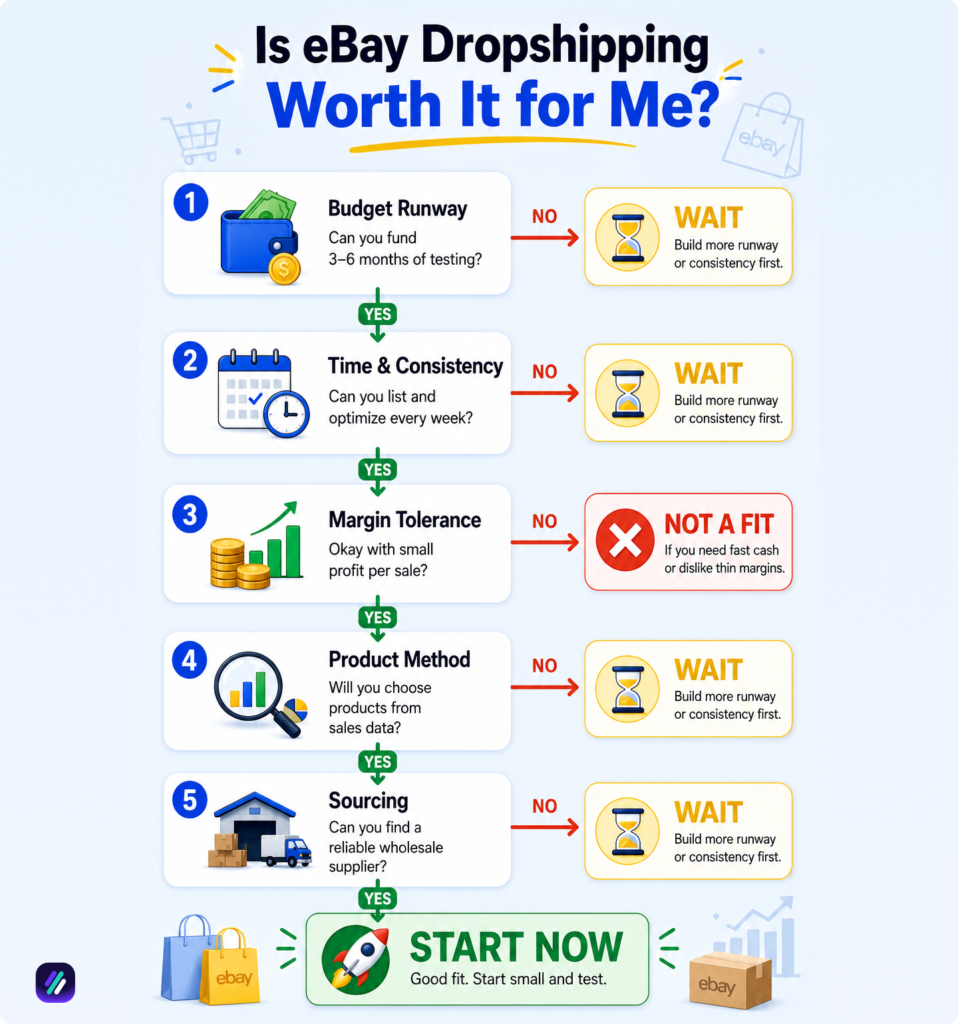
You should start eBay dropshipping if you can fund a few months of testing, commit consistent time, and pick products from data. If your budget is tight or you need money fast, it is worth waiting until those pieces are in place.
Worth it in general and worth it for you are two different questions, and only the second one pays your bills.
Whether this model fits comes down to a handful of honest yes-or-no answers about your money, your time, and how you choose products.
Before you commit a cent, run through these five questions:
| The question to ask yourself | Lean toward yes if | Lean toward no, or wait, if |
|---|---|---|
| Budget and runway | You can fund three to six months of testing without needing the profit to live on | Next month’s rent depends on this paying off |
| Time and consistency | You can list and optimize a little every week | You want to set it up once and walk away |
| Margin tolerance | You are fine earning small amounts per sale and winning on volume | You expect a fat profit on every single order |
| Product method | You will choose items from sales data | You plan to list what you personally like and hope |
| Sourcing | You can find a reliable wholesale supplier who ships on time | Your only plan is to buy from another retailer after each sale |
Now look at where your answers landed. If most of them sit in the middle column, eBay dropshipping is very likely worth it for you. Two of these questions decide the outcome more than the rest, so let us take the budget and product method head-on.
Question 1: Can You Fund Three to Six Months Before You Profit?
If you can set aside a few hundred dollars a month and stay patient for three to six months, the answer is yes. eBay dropshipping rarely pays meaningful money in month one, and most sellers who quit do so before their runway runs out.
The slow start is partly structural, as new eBay accounts come with low eBay selling limits, so you physically cannot list hundreds of products on day one.
The algorithm also needs a track record before it trusts you; thus, that early stretch, while the account matures, is exactly where most people give up.
So treat the first few months as paid tuition rather than a paycheck.
From our in-house eBay sellers at ZIK, the people who succeed are almost always the ones who budgeted for a learning period instead of expecting profit to cover costs immediately.
But if you need this to replace your income by week three, the math will break your motivation long before it breaks your bank.
Question 2: Will You Choose Products From Data, Not Guesswork?
This is the single biggest predictor of whether eBay dropshipping works for you. Sellers who validate demand before listing consistently beat the ones who list what they personally like, because the market decides what sells, not your taste.
The difference shows up fast. When you check a product before listing, you want three things lined up: genuine demand, competition you can realistically beat, and enough margin left after fees. Guessing skips all three and hopes for the best.
Based on our dropshipping team at ZIK Analytics, the sellers who validate demand first are the ones still standing a year later.
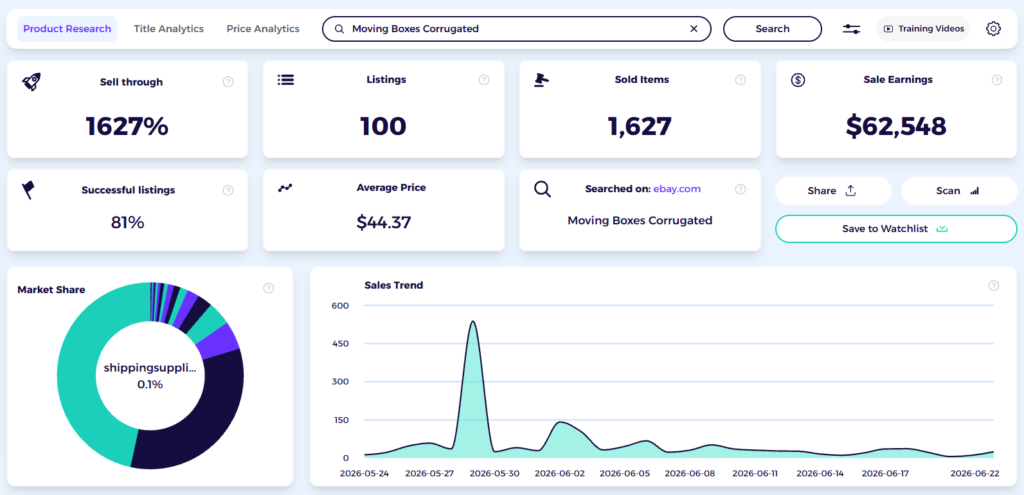
This is the moment a research tool earns its keep, and with the eBay product research tool, you can see actual sold counts and sell-through on any keyword.
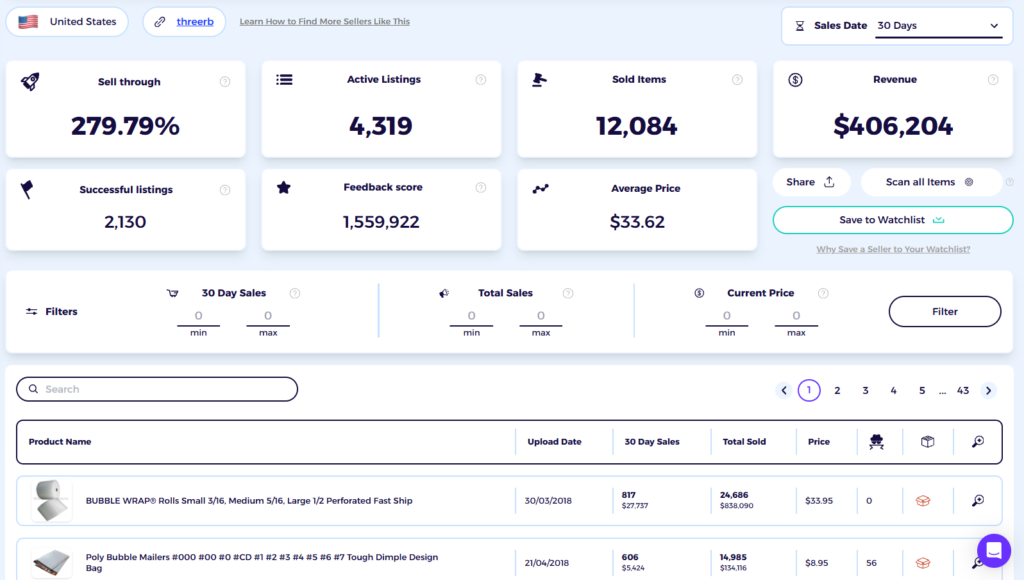
And the eBay competitor research tool lets you reverse-engineer what the top sellers in your niche are actually moving.
That is the whole game behind learning how to find profitable products to dropship on eBay: you stop asking “do I like this?” and start asking “is it already selling?”
Is eBay Dropshipping Profitable? How to Calculate the Actual Margin
eBay dropshipping does make money, but only on thin margins. A single sale rarely makes you rich; the money comes from volume, and the only way to know what you keep is to subtract every fee from the sale price first.
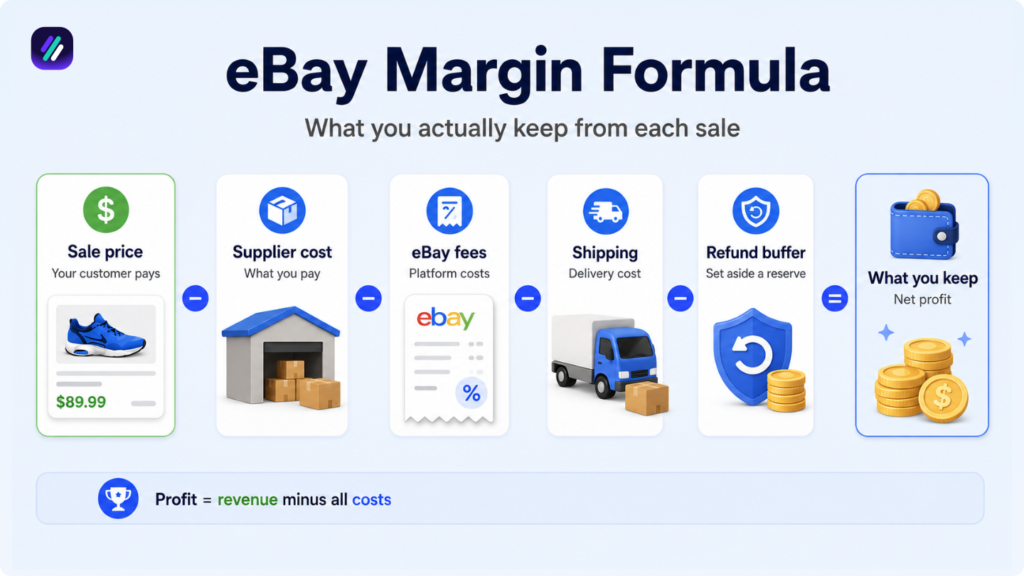
Across the industry, eBay dropshipping net margins tend to land around 20% to 30%, and that is on a well-chosen product. To find your actual number, you have to account for every line that eBay and your supplier take out:
- Final value fee: about 13.6% of the total sale for most categories, plus $0.30 to $0.40 per order. This is your biggest platform cost.
- Payment processing: there is no separate PayPal bill anymore, because eBay now handles payments directly and folds processing into that final value fee.
- Promoted listings: an ad rate you choose, and after the January 2026 change, it can be charged on sales within a 30-day window, so it bites harder than it used to.
- Shipping: “free shipping” is free only to the buyer. If you cover it, it comes straight out of your margin.
- Returns reserve: refunds, lost parcels, and the occasional bad supplier are a cost of doing business, so set a few percent of revenue aside for them.
You can run any product through an eBay fee calculator before you list it, then price it based on the number you keep, not the sticker price.
Sale price -supplier cost – eBay fees – shipping – a refund buffer = what you actually keep.
How Much Can You Earn Dropshipping on eBay?
Per sale, the profit is small. On a typical low-ticket eBay item, you might net a dollar or two after every cost, so the income comes from selling that product many times, not from a fat markup on any single order.
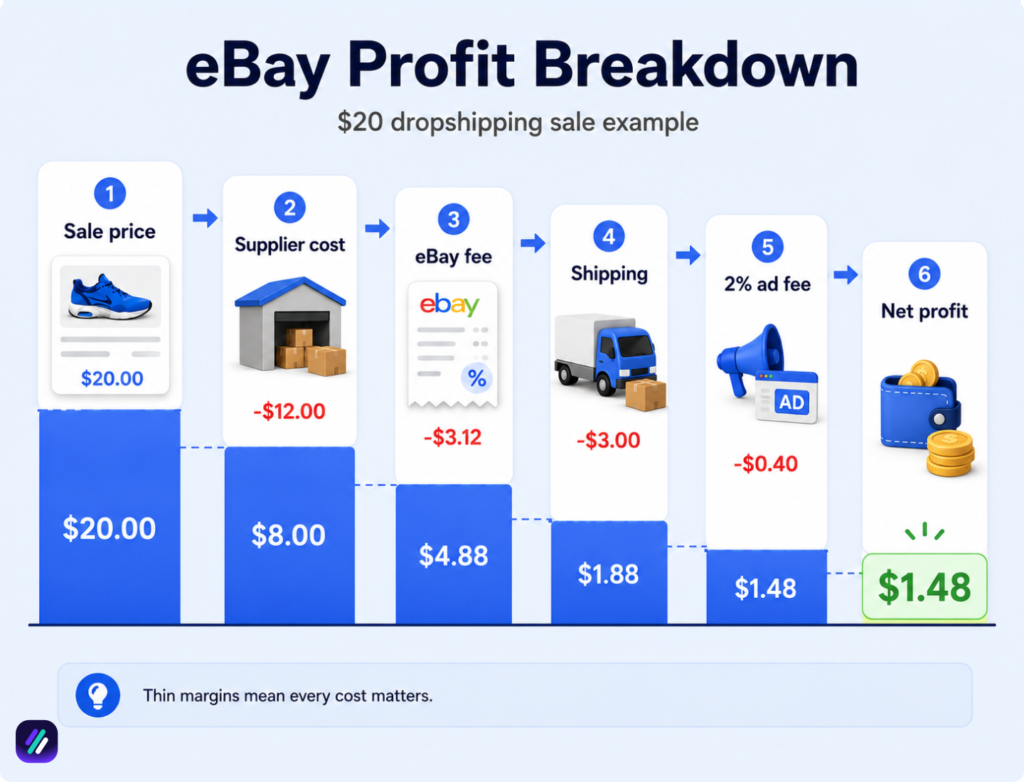
Competitors love to quote a margin percentage, but almost none of them show you the subtraction. On a $20 product, the math looks like this:
- Sale price: $20.00
- Supplier cost, what you pay your wholesaler (example): $12.00
- eBay final value fee at about 13.6% plus a $0.40 order fee: roughly $3.12
- Shipping you cover (example): $3.00
- Promoted listings at a modest 2% rate: about $0.40
- What you actually keep: roughly $1.48
That is around a 7% margin on this example. It only climbs when you raise the price, cut the supplier cost, drop the ad spend, or price the shipping into the listing.
Each line item below shows what it takes and how to defend your margin against it:
| Cost line item | What it takes | How to protect your margin |
|---|---|---|
| Final value fee | About 13.6% of the sale plus $0.30 to $0.40 per order | Price it in, and never list at a number that pretends it does not exist |
| Supplier cost | The single biggest chunk of most items | Negotiate, or pick suppliers that leave room to mark up |
| Shipping | Eats the margin whenever you offer it free | Bake it into the price, or choose light, cheap-to-post items |
| Promoted listings | An ad rate you set, now charged across a 30-day window | Use it sparingly, because it drains thin margins quickly |
| Returns reserve | Refunds and lost items you have to absorb | Hold back a few percent of revenue as a buffer |
So low margins, not low demand, are the number one reason beginners quit, and at first, a dollar a sale feels pointless until you are doing it forty times a day, which is the difference between a hobby and a business.
eBay Dropshipping Success Stories
Numbers on a page are easy to argue with, so two sellers make the case better than any benchmark can.
Both started where you are now, and you can find more in our roundup of eBay dropshipping success stories.
Michael: From a UK Day Job to 10 to 15 Sales a Day
From UNPROFITABLE to 400+ Sales/Month | eBay Dropshipping Case Study
Michael works in social care in the UK and started eBay dropshipping on the side, as a dad looking for a bit of extra stability.
In a ZIK Analytics case study interview, he describes signing up on the $1 trial without really knowing what he was getting into, then building up to 10 to 15 sales a day within his first few months.
What is striking is how unglamorous his bestseller is: a collagen balm that sells for around £8 with roughly £1 of profit, moving about four times a day.
Like I said, a small margin, steady volume, exactly the pattern the math predicts.
He credits a simple routine of leaning on trending products and the seasonal calendar inside eBay Market Insights, then validating each item with product and competitor research before listing.
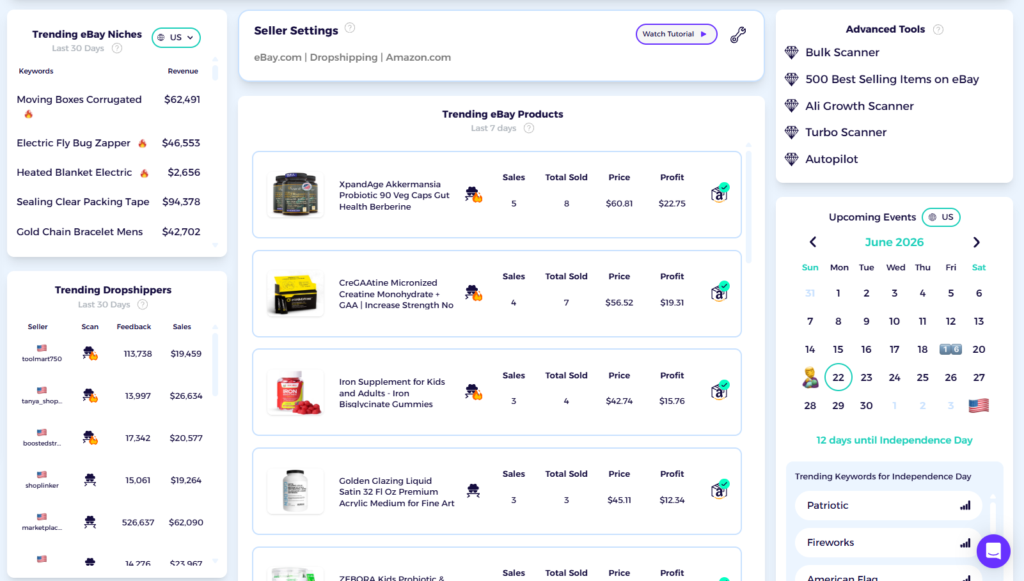
He also connected an automation tool, AutoDS, early on to handle the repetitive work.
His advice for anyone overthinking it was blunt: just start, because once you have the data and a couple of validated products, eBay tends to favor new sellers who list what the market is already buying.
Paul Lipsky: When eBay Dropshipping Becomes a Career
Inside the Mind of 8-Figure Dropshipper Paul J. Lipsky | eBay, Amazon, Shopify, Dropshipping
Paul J Lipsky is an eBay dropshipping educator and YouTuber who runs the Dropshipping Titans community. He is worth pointing to for a reason beyond any single income figure.
He is an example of someone who turned eBay dropshipping into an ongoing teaching business. The lesson is not “you will become a famous YouTuber.”
It is that the skills you build doing this, eBay product research, listing optimization, and supplier management, are transferable and durable, so even if your store stays a side income, the research muscle you develop is the part that lasts.
How Long Does eBay Dropshipping Take to Make Money?
Most sellers need three to six months to find products that sell consistently. In a ZIK Analytics survey of 1,235 eBay dropshippers, the first sale often came within a month, but steady, repeatable winners took most of them three to six months of testing.
That same survey breaks the early timeline into rough stages, which helps you set expectations before you start:
| Stage | Typical time | Why does it take that long |
|---|---|---|
| Product research setup | 3 to 5 days | Learning the tools and pulling your first shortlist of candidates |
| Vetting a reliable supplier | 5 to 14 days | Testing eBay dropshipping suppliers for price, stock, and shipping speed |
| Setting up the store | 2 to 5 days | Account, policies, and your first optimized listings on eBay |
| First sale after listing | 14 to 30 days | Giving listings time to gain visibility and reviews |
| Consistent winning products | 3 to 6 months | Testing enough products to find the few that reliably convert |
What actually moves that timeline is demand, competition, margin, supplier reliability, and listing quality.
For example, if you find a product people already search for, with few strong competitors and a supplier who ships on time, you can land sales fast.
From our in-house eBay sellers at ZIK, the people who quit early almost always quit during the supplier and testing phase, right before the work starts to compound.
Keep in mind that this is not instant income, and most beginners earn little while they are still learning what converts.
How Much Do You Need to Start eBay Dropshipping?
You can realistically start eBay dropshipping on about $250 to $400 a month. In a ZIK Analytics survey of 891 users, that was the minimum to cover tools, test products, and basic costs, while $500 to $1,000 a month gave sellers a more comfortable runway.
The budget is less about a big upfront sum and more about a steady monthly flow for testing.
The money goes to five places, with research deliberately at the top because it decides everything downstream:
| Where the money goes | What it covers | Notes |
|---|---|---|
| Product research tool | ZIK Analytics, to find and validate products before you list | From about $19 a month, and the smartest place to put your budget is |
| Test product budget | Buying the first orders from your supplier so that listings stay live | Usually, the largest starter costs, so keep it to a few products at a time |
| eBay fees | Final value fees on each sale, plus an optional store | These scale with sales, so they are a cost of success |
| Shipping | Delivery if you offer free shipping | Bake it into the price and choose light items to keep it low |
| Promoted listings | A small ad budget for early visibility | Optional at first, add it once a product proves itself |
Good eBay dropshipping software is the one line I would never cut, because guessing on products wastes far more money than a subscription ever costs, as everything else can start small and scale only when a product earns it.
How Much Can You Make from eBay Dropshipping?
Beginner income on eBay is modest at first. A realistic new seller earns somewhere between a couple of hundred and a couple of thousand dollars a month, and only after finding products that convert, because the beginner-friendly pool is dominated by low-ticket, crowded items.
In our ZIK marketplace, data makes the ceiling concrete. In the pool of products that fit a roughly $300 beginner budget on eBay.com, the average item sells for about $16.57 and moves around 6.93 times in 30 days.
That works out to roughly $108.84 in 30-day revenue per listing, spread across more than 43,000 sellers.
So there is clear demand, but most beginner-fit products are low revenue per listing and heavily contested.
The model is also unmistakably active. ZIK data flags more than 205,000 eBay items with an Amazon dropshipping signal and tens of thousands more tied to Walmart.
That tells you two things at once: the model clearly works, and it is crowded enough to compress beginner profit.
You can see the wider picture in ZIK’s dropshipping statistics.
So here is a realistic ladder for what you might earn as you find your footing:
- Month one: break-even to a few hundred dollars while you test and learn.
- Early consistency: $200 to $800 a month once a few products reliably convert.
- Stronger execution: $1,000 to $3,000 a month after better selection, more listings, and reinvested cash flow.
- High-income claims: possible for experienced sellers, but not the normal beginner outcome.
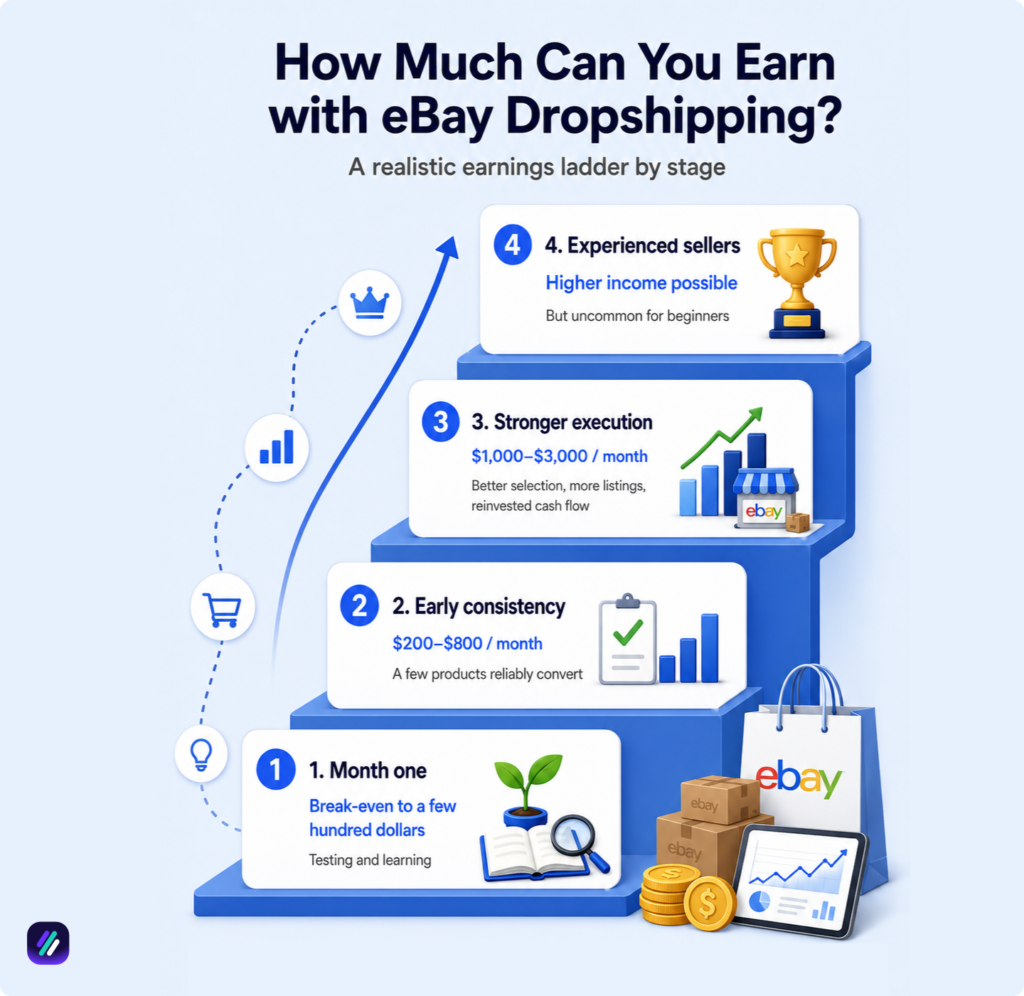
A simple way to read your own progress: under 10 sales a month is basically negligible profit, 10 to 50 sales is small but genuine side income, and 50-plus sales with a decent spread is where it starts to feel like a business.
My confidence on the demand side is high because it comes from marketplace data. It is lower on exact take-home pay, since that still depends on your supplier cost, fees, and refunds.
However, the upside opens up once you stop chasing one magic product and build a repeatable testing system.
eBay Dropshipping vs Shopify and Amazon: Which Is Worth It?
If your goal is to test products cheaply and start earning fast, eBay wins. But if your goal is to build a long-term brand, Shopify and Amazon each make a stronger home.
Most searchers weighing this are mostly asking where their first dollar comes from. So the honest answer depends on whether you want borrowed traffic now or owned traffic later.
The three platforms stack up like this on what actually affects a dropshipper:
| Factor | eBay dropshipping | Shopify dropshipping | Amazon dropshipping |
|---|---|---|---|
| Where does traffic come from | Built-in buyers already searching to purchase | You drive your own traffic with ads and content | Built-in marketplace, but you fight for the Buy Box |
| Startup cost | Lowest, with up to 250 free listings a month | A plan from about $39 a month, plus payment fees | A Pro plan around $39.99 a month plus referral fees |
| Selling fees | About 13.6% final value fee plus a per-order fee | About 2.9% plus 30 cents per transaction | Roughly 8% to 15% referral fee by category |
| Competition | High on low-ticket items | High, but you control the storefront | Very high, with strict rules on dropshipping |
| Brand control | Minimal, since eBay owns the customer | Full, since the store and customer are yours | Minimal, since Amazon owns the customer |
Keep in mind that these are structurally different. eBay and Amazon are marketplaces that lend you traffic for a per-sale cut, while Shopify is a store you own but must drive yourself.
For most beginners, the smart play is to use eBay as the testing ground, since it is the cheapest place to learn what sells. That tradeoff between borrowed and owned traffic is the heart of the eBay vs Shopify dropshipping decision. You prove demand on eBay first, then build the brand on Shopify once you know what people buy.
Click to download your free eBook and jumpstart eBay dropshipping todayConclusion
eBay dropshipping in 2026 and 2027 sits in the honest middle between the hype and the skeptics: a legitimate, low-cost way into ecommerce that rewards patience and punishes guesswork.
That is a far more useful answer than a flat yes or no in my opinion
The platform is getting more competitive as ad costs rise and fees tighten on weak performers.
So the gap between sellers who decide from data and sellers who decide from hope is only going to widen.
If you take one thing from all of this, let it be the order of operations: validate demand, do the margin math, source from a proper supplier, then list.
Whether dropshipping on eBay is worth it for you depends less on the platform and more on whether you treat the first few months as the cost of learning a skill that pays off for years.
So start small, measure everything, and let the data tell you when to scale.
Research Your eBay Dropshipping Products With ZIK Analytics
Everything in this guide comes back to one habit: deciding from data instead of hope. That is the part ZIK Analytics is built to handle for you:
- Use the eBay product research tool to see actual sales, sell-through, and competition on any keyword before you list.
- Use the eBay competitor research tool to reverse-engineer what the top eBay sellers in your niche are really moving.
- Use the eBay suppliers finder to match a product to a supplier and check your margin before you commit to a listing.
Together, that workflow means you stop gambling on products and start picking them. You can try it on a $1 trial (7-day) and see what is selling before you risk a cent on a listing.
Is Dropshipping on eBay Worth It FAQs
A few quick answers to the questions sellers ask most before they start.
Is it okay to dropship on eBay?
Yes, with one condition. eBay allows dropshipping when you fulfill orders through a wholesale supplier you have an agreement. What it prohibits is listing an item and then buying it from another retailer that ships directly to your buyer, which is the retail-arbitrage version of the model and can get your account restricted.
Can I make $10,000 a month dropshipping on eBay?
It is possible but uncommon, and not a realistic first-year target for most beginners. Hitting $10,000 a month usually takes a large catalog of validated products, strong suppliers, and reinvested profit over time. It is the result of consistently learning how to scale winning eBay items, not a starting point.
How much does eBay take from a $100 sale?
On a typical $100 sale, eBay takes about $14: roughly 13.6% as the final value fee plus a $0.40 per-order fee for most categories. The exact rate varies by category and rises if you run promoted listings, so price every product from what you keep after fees, not the headline amount.
Is $1,000 enough to start dropshipping on eBay?
Yes, $1,000 is a comfortable starting budget. Most sellers can begin on $250 to $400 a month, so $1,000 gives you a healthy cushion for a research tool, test-product orders, and a small promoted-listings budget. The trick is to spread it across several months of testing rather than across a single product.