
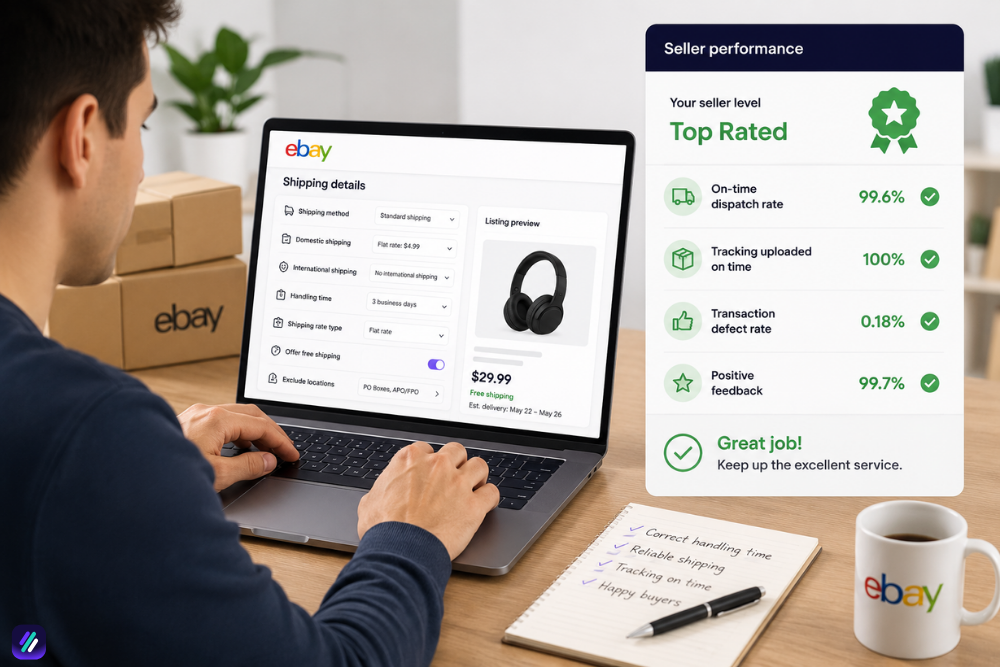
Most dropshippers set up eBay shipping in ninety seconds. They copy whatever the supplier lists, pick a handling time that sounds fast, tick free shipping because a competitor did, and hit publish.
That one careless setup is where the trouble starts. A handling time you cannot hit, an unrealistic delivery date, or a shipping type that clashes with your supplier’s reality steadily adds late marks and defects until eBay starts throttling your visibility.
In this guide, I am going to show you how to set up shipping on eBay for dropshipping the right way, from the settings that decide your risk to a policy you can publish without gambling your account.
Key Takeaways
- eBay allows dropshipping from wholesale suppliers, and in practice plenty of sellers source from marketplaces like Amazon without trouble, as long as they deliver like a good seller.
- Handling time is the single most important shipping setting for a dropshipper, because the clock starts the moment the buyer pays, not when your supplier gets around to shipping.
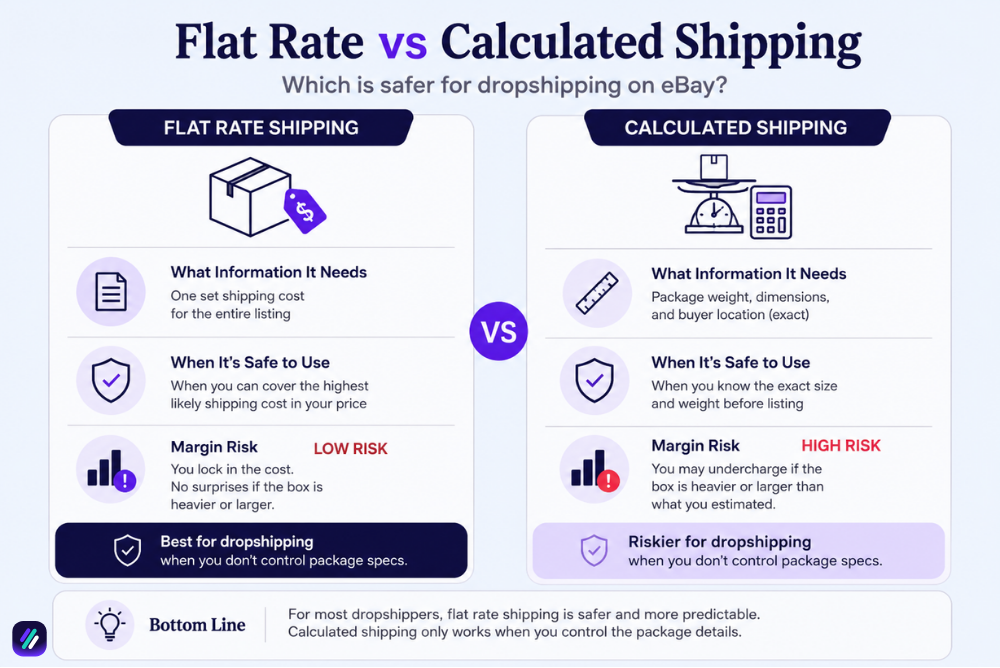
- Flat rate shipping is usually safer than calculated for dropshipping, since you rarely control the exact weight and dimensions your supplier puts in the box.
- Free shipping only works when you build the cost into your price. Promising it blind is how a healthy margin disappears.
- Conservative handling times and smart shipping exclusions head off the delays and regions that cause most Item Not Received cases.
- ZIK Analytics helps you pick light, low-return products that are cheap and quick to ship, so your shipping settings work with the product instead of against it.
Is Dropshipping Allowed on eBay?
Yes. eBay allows dropshipping when you source from a wholesale supplier you have an agreement with. Its written policy is stricter about buying from another retailer to ship directly, but in practice eBay judges you on delivery and buyer experience, not your supplier.
eBay’s official drop shipping policy says it plainly: you can dropship from a wholesale supplier, and you stay responsible for safe delivery inside your stated handling time and for the buyer’s satisfaction. The version it warns against is listing an item you do not hold, then buying it from another retailer that posts straight to your customer.
But most guides leave this part out. Plenty of sellers run marketplace sourcing every day without a single issue, and that includes our own in-house dropshippers at ZIK. The deciding factor is never the logo on the box, it is whether the buyer gets what they ordered, on time, described accurately.
A lot of forum posts warn that customers panic when an eBay order arrives in an Amazon box. Two things are worth knowing there. eBay sellers are allowed to sell their own Amazon-sourced inventory, and buyers rarely care who shipped it as long as the item is right and turns up when promised.
So do not treat eBay dropshipping as a loophole you have to hide. Whether you run a wholesale account or an Amazon to eBay dropshipping workflow, your shipping setup is what keeps you compliant. Dialing in that setup, inside the lines of the eBay dropshipping policy, is what this guide is about.
None of this is a fringe move, either. Done properly, it is a legitimate business inside a market projected to reach $1.25 trillion by 2030.
What Shipping Settings Matter Most for eBay Dropshipping?
For a dropshipper, four settings carry almost all the risk: your shipping type, your handling time, your delivery date, and your excluded locations. When those four match your supplier’s actual speed, you avoid most late-shipment and Item Not Received problems before they start.
When you open the shipping section of an eBay listing, you are really setting a handful of fields that together become a promise to the buyer:
- Shipping service: standard, freight, or local pickup, plus the specific carrier and speed you commit to.
- Domestic shipping: the cost and method for buyers in your own country, where most of your orders will land.
- International shipping: whether you post abroad yourself, hand it to eBay’s program, or switch it off entirely.
- Handling time: the business days between payment and dispatch, which sets the delivery date buyers see at checkout.
- Flat or calculated: whether every buyer pays one fixed rate or a rate worked out from weight and distance.
- Free shipping: offering delivery at “no cost” by baking the shipping cost into your item price.
- Excluded locations: the regions, countries, and PO boxes you decide not to ship to.
- Tracking upload: adding a valid tracking number before the estimated delivery date passes.
- Return address and returns: where returns go, and who pays for them when they happen.
That list is the common core, not the whole panel. If you sell fragile items like glassware, package dimensions and insurance settings start to matter too; if you move heavy furniture, freight and a longer handling window jump to the front.
The three choices below cause the most avoidable damage, so they are worth slowing down on.
Shipping Method: Standard, Freight, or Local Pickup
Standard shipping is the right home for almost every dropshipping order. It covers the small-to-medium parcels most suppliers dispatch, and it plugs straight into the tracking and delivery estimates eBay wants to see.
Freight only enters the picture for large or heavy goods, think furniture or bulky equipment, where a normal courier will not do. For that niche, it is essential, but for most sellers it never comes up.
Local pickup is the one to skip. It tells the buyer they can collect in person, which you cannot honor when the item lives in a supplier’s warehouse three states away. Offering it by accident is a quick route to a confused buyer and a cancelled sale.
Flat Rate vs Calculated Shipping
Flat rate charges every buyer the same fixed amount, no matter their weight, box size, or distance. Calculated shipping asks eBay to work the cost out per order from the package’s weight and dimensions and the buyer’s location.
For dropshipping, flat rate usually wins. Calculated shipping is only accurate when you know the exact weight and dimensions your supplier ships, and most of the time you do not. If you feed it a guess, you either overcharge buyers or eat the shortfall yourself.
Flat rate keeps the number predictable, protects your margin, and reads cleanly to buyers. Now and then a heavy item makes calculated worth the effort, but the default that keeps you out of trouble is a flat rate you have checked against your supplier’s actual postage.
Free Shipping vs Buyer-Paid Shipping
Free shipping is a pricing decision dressed up as a gift. The postage still costs something, so “free” simply means you have folded it into the item price instead of charging it separately. Done with a margin buffer, it is a strong lever, because eBay buyers filter and favor free-shipping listings.
Buyer-paid shipping keeps the postage visible as a line item, which can make your headline price look lower, but a surprise cost at checkout loses as many sales as it saves.
Whichever you pick, the rule is the same: know your true eBay shipping fees and supplier postage first, then decide where the cost sits. Free shipping only ruins a margin when it is promised before the math is done.
How to Set Up Shipping on eBay for Dropshipping Step by Step
With the key settings clear, here is the order in which to configure them. Each step feeds the next, so work through them in sequence rather than jumping straight to publish.
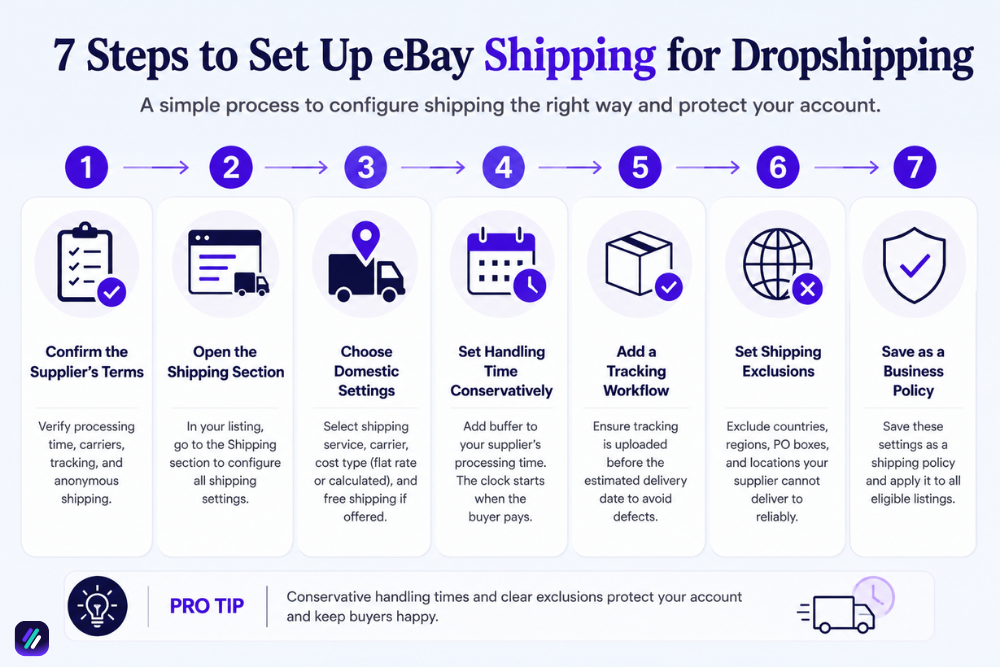
Step 1: Confirm Your Supplier’s Shipping Terms First
Before you touch a single eBay field, get the truth from your supplier. Every setting you choose later is a promise built on their actual performance, so guessing here poisons everything downstream.
You need to pin down four things: their genuine dispatch time on a slow day, the carrier they use, whether that carrier provides tracking eBay will recognize, and which countries they actually cover. A supplier who ships in two days from real stock is a different animal from one that “usually” ships in “about a week.”
This is also where a research layer earns its keep. ZIK’s Dropshipping Product Finder works as an eBay suppliers finder that matches any product to sources on Amazon, Walmart, AliExpress, or Alibaba and shows the margin on each.
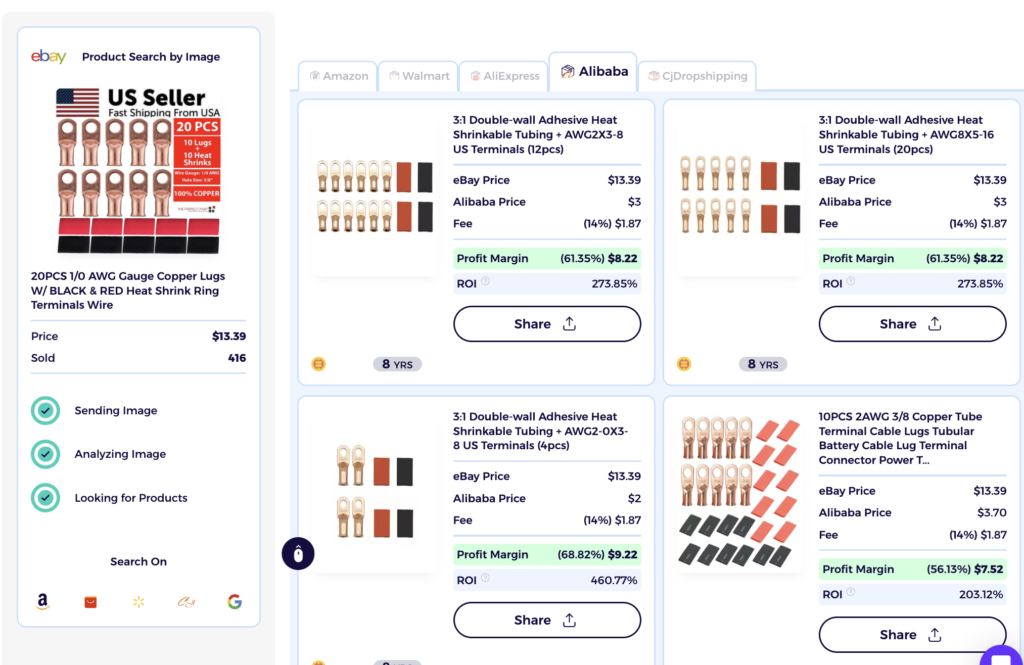
So you compare suppliers on delivery speed and profit in one view. Building a shortlist of reliable eBay dropshipping suppliers this way beats importing the first catalog you find.
Step 2: Open the eBay Listing Shipping Section
Now we move to eBay itself. Inside the listing form, or the advanced listing tool in Seller Hub, scroll to the shipping section, which sits below the price and item details.
This is the panel that holds every field we just discussed: service, cost, handling time, and the more options link that opens exclusions and international settings.
If you plan to reuse these choices across many listings, and as a dropshipper you should, eBay also lets you save them as a business policy, which we come back to in Step 7.
Before you move on, read what the buyer will see here, not just what you are entering. The estimated delivery date eBay generates from these fields is the promise your whole account is measured against.
Step 3: Choose Domestic Shipping Settings
Domestic orders are where most of your volume lives, so set these deliberately. You pick a standard, trackable service, and enter the flat rate you settled on earlier rather than a calculated quote you cannot verify.
The flat rate has to match your supplier’s actual postage from Step 1. If their shipping costs you four dollars, a flat rate that ignores that number is a margin leak on every single sale. You build the cost in, then decide whether the buyer sees it as free shipping or a separate charge.
The service level has to stay honest, too. A cheap, slow economy service paired with an optimistic delivery date is a defect waiting to happen, while a slightly pricier trackable option often pays for itself in cases you never have to fight.
Step 4: Set Handling Time Conservatively
Handling time is the setting that ends the most dropshipping accounts, so this is the one to get right. It is the single setting I would beg a new seller to slow down on.
eBay defines it as the business days between the buyer’s payment and the carrier’s acceptance scan, which means your clock starts the instant money lands, not when your supplier feels like dispatching.
You set it to your supplier’s slowest realistic day, not their best. If they usually ship in two days but occasionally take four, a two-day handling time makes you late on paper even when the item arrives fine. That gap becomes a late shipment mark, and enough of them drag an account toward Below Standard.
The stakes are concrete. eBay’s seller performance standards allow no more than 2% of your transactions to carry a defect, and it checks that on the 20th of every month.
A padded handling time you can always beat is cheap insurance, which is why it pays to know exactly how long do eBay sellers have to ship before you commit.
Step 5: Add Tracking Workflow
Tracking is what turns a delivery dispute into a non-event, so decide how you will get it before you list. For every order, you need a valid tracking number from an eBay-recognized carrier, uploaded before the estimated delivery date passes.
The catch for dropshippers is that the tracking comes from your supplier, not from you. So you confirm they hand over tracking automatically, and build a routine, manual or automated, to attach it to the eBay order the same day it dispatches.
Tracking that scans on time is your main protection when a buyer claims an item never arrived.
That protection holds up: eBay’s seller protection rules side with sellers who ship on time and provide tracking that shows movement. Without it, even an honest delivery can turn into a refund you cannot contest.
Step 6: Use Shipping Exclusions for Risky Regions
Not every order is worth taking. The excluded locations setting, tucked under the shipping section’s extra options, lets you refuse regions your supplier serves slowly or not at all, plus PO boxes and remote territories that invite delays.
You can think of it as pre-screening your risk. If your supplier’s tracking goes dark once a parcel leaves the mainland, excluding those far-flung regions removes your most likely late deliveries and Item Not Received claims before a buyer ever clicks buy.
You keep the list tight and intentional, though. You are not trying to block the world, just the specific places where your supplier’s delivery falls apart. A short, deliberate exclusion list protects your metrics without starving your listings of buyers.
Step 7: Save as a Business Policy
Once the settings from Steps 3 through 6 are dialed in, save them so you never rebuild them by hand again. eBay lets you store shipping, payment, and return settings as reusable eBay business policies you can attach to any listing in one click.
For a dropshipper running dozens of listings, this is what keeps your promises consistent. One saved shipping policy means every listing carries the same handling time, service, and exclusions, so a good setup does not decay the moment you list in a hurry.
If you work with more than one supplier at different speeds, build a separate policy for each rather than forcing them all under one. As we covered in Step 4, the handling time only works when it matches the supplier actually fulfilling that order.
Recommended Shipping Policy Setup for Dropshipping on eBay
If you want a safe default to start from, here is a configuration that holds up on a typical dropshipping listing. You can treat it as a sensible baseline, then adjust to your supplier and niche.
This is how the core settings shake out, and why each one lands where it does:
| Setting | Recommended for dropshipping | Why it protects you |
|---|---|---|
| Shipping type | Flat rate | You rarely know the exact weight and dimensions a supplier ships, so a fixed rate avoids surprise costs and quote errors. |
| Handling time | Your supplier’s slowest dispatch day, never their best | The late clock starts at payment, so promising your best case is exactly how defects appear on your record. |
| Domestic delivery | A standard, trackable service | Tracking that scans before the estimated date is your main defense against Item Not Received claims. |
| Excluded locations | Slow-delivery regions and PO boxes | Cutting the places your supplier serves badly removes your most likely late deliveries before they happen. |
| Returns | Accepted, 30 days | A clear return path stops small problems from hardening into not-as-described cases and defects. |
None of this is exotic. It is the boring, repeatable setup that a careful seller uses on every listing, and boring is precisely what keeps a dropshipping account alive. For the wording buyers actually read, a tidy dropshipping shipping policy built on these settings does most of the reassurance for you.
How to Price Shipping Without Killing Your Profit Margin
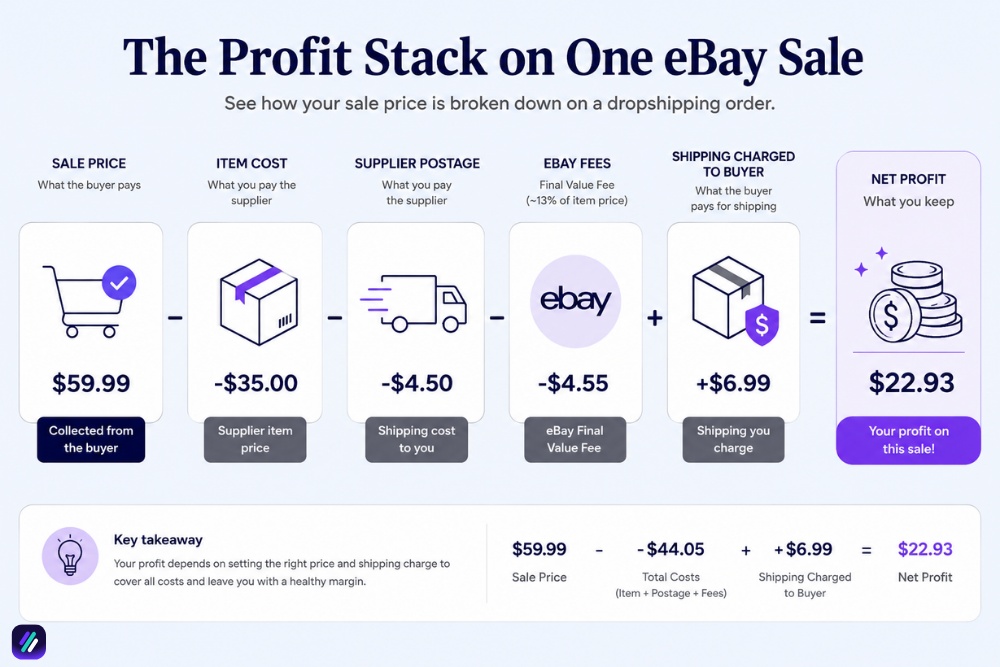
Shipping decides whether a “winning” product actually makes money. Before you set a rate, add up the full stack on a sale: your item cost, the supplier’s postage, eBay’s final value fee, and whatever you charge the buyer for delivery.
The mistake is treating shipping as separate from profit. If you offer free shipping but forget the four dollars of postage in your cost, you have handed that margin straight back on every order. You build the full delivery cost into your price first, then check what is left.
So it pays to run the numbers before you commit, not after. A quick pass through the eBay fee calculator shows your net payout once fees and postage come out, so you price from what you keep rather than what you charge.
How to Handle International Shipping for Dropshipping
International orders can double your market or double your headaches, so choose your approach on purpose rather than leaving eBay’s default in place. As a dropshipper, you have three sane options, and the right one depends on your supplier.
- Ship it yourself: only realistic if your supplier reliably posts abroad with tracking. For most dropshippers, cross-border delivery is too slow and too opaque to promise safely.
- Use eBay International Shipping: you post the item only to eBay’s domestic hub, and eBay handles the international leg, customs, and duties from there. It removes the hardest, riskiest part of the journey from your plate.
- Turn it off: excluding international buyers entirely is a perfectly valid start while you get your domestic setup clean.
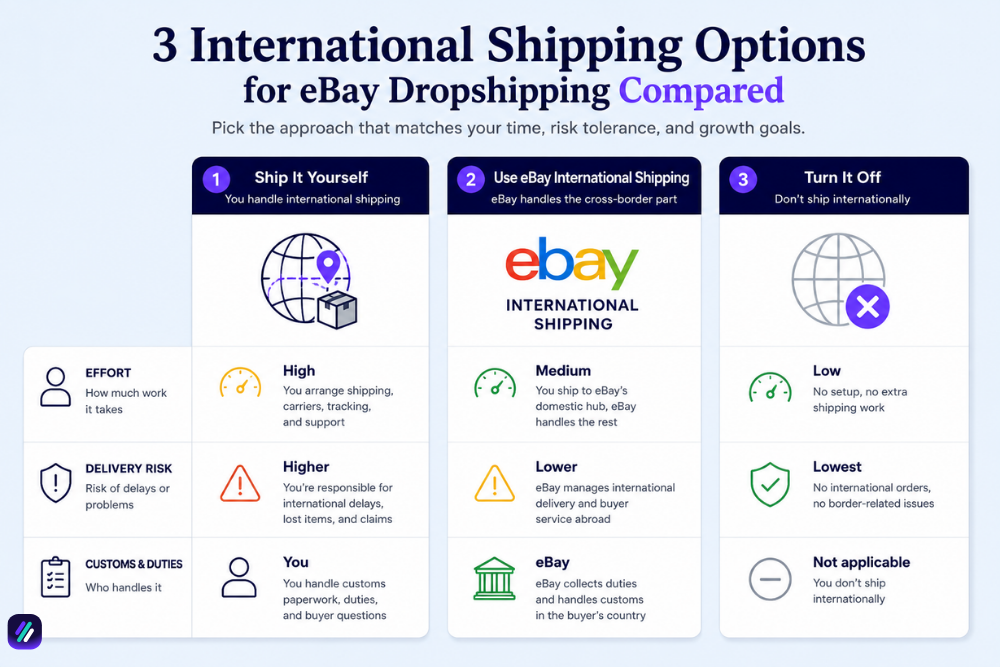
So for beginners, eBay’s own program is usually the smart middle path, because the eBay international shipping program means you are only ever responsible for a short domestic hop.
That said, switching on worldwide shipping through a supplier who struggles to deliver across town is asking for trouble. Your international promise has to match what your supplier can actually support, and let eBay carry the parts you cannot.
Common eBay Dropshipping Shipping Problems
Even a clean setup meets friction, so it helps to recognize the usual failure points before they cost you. Most dropshipping shipping problems trace back to the gap between what you promised and what your supplier delivered.
- Supplier runs out of stock: you cancel, and every seller-initiated cancellation logs as a defect, the metric most likely to push you Below Standard.
- Dispatch runs late: the item ships, but past your handling time, so it counts against you even when the buyer is happy.
- Tracking does not scan: a number that never updates leaves you exposed to an Item Not Received claim you cannot defend.
- Wrong or misdescribed item: generic supplier photos and vague titles invite not-as-described cases when the parcel does not match the listing.
Our in-house sellers keep coming back to one habit here: they solve these upstream, at the supplier and product stage, rather than firefighting each case.
Now, when a claim does open, eBay’s Money Back Guarantee refunds a buyer who does not receive an item unless your tracking shows delivery. That makes the tracking discipline from Step 5 what settles most disputes in your favor.
Common Shipping Setup Mistakes Dropshippers Make on eBay
The problems above usually start as setup mistakes, and the same few show up again and again. The list below is a checklist of what not to do:
- Setting handling time too short: a fast-sounding window you cannot hit on your supplier’s slow day is the fastest way to collect late marks.
- Offering expedited shipping with no proof: promising two-day delivery you have never actually tested from your supplier is a defect you scheduled in advance.
- Using one policy for every supplier: different suppliers ship at different speeds, so a single shared handling time will always be wrong for someone.
- Forgetting excluded locations: leaving every region open ships your worst delivery times straight to the buyers most likely to complain.
- Ignoring carrier tracking compatibility: if your supplier’s carrier will not scan into eBay’s system, your tracking protection simply does not exist.
- Promising free shipping with no margin buffer: “free” that you never priced in bleeds profit on every order until the product looks like a loser.
- Sourcing from suppliers who break policy: a supplier who stuffs the box with another retailer’s invoices hands the buyer a reason to distrust the order.
So most of these trace back to setting shipping in a vacuum. The exact tripwires shift with what you sell: a fragile-goods seller has to add breakage and insurance to this list, while a high-value seller should weigh signature-on-delivery to fend off Item Not Received claims.
Still, the fix underneath them all is product choice. Choosing items that are light, cheap to post, and reliably in stock removes half of these mistakes before you begin, and the eBay product research tool lets you screen for exactly that kind of item while you check demand and competition in the same pass.
Supplier Checklist Before You Publish an eBay Dropshipping Listing
Your supplier decides most of your shipping risk before an order ever comes in, so vet them properly before a paying buyer is on the line. You run every prospective supplier through this list, and treat a “no” on the top items as a hard stop:
- Does the supplier allow resale? Selling their goods on eBay has to be permitted, not a gray area you are hoping goes unnoticed.
- Do you have an agreement or clear permission? A documented wholesale relationship is the sourcing eBay’s policy actually favors, so the right legal agreements for eBay dropshipping business are worth setting up early.
- Is the item actually in stock? Deep, reliable inventory is what saves you from the out-of-stock cancellations that generate defects.
- What is their real processing time? You need the honest slow-day number, since that is what your handling time has to survive.
- What is the delivery range? This is how long parcels actually take to reach buyers, not just their dispatch time.
- Which carrier do they use, and does it scan into eBay? Tracking only protects you if eBay recognizes the carrier.
- What countries and regions do they cover? This tells you exactly which locations to exclude and where international shipping is safe.
- What is the return process? A workable return path keeps small issues from becoming not-as-described cases.
- Are invoices and packing slips buyer-safe? Neutral packaging with no rival retailer’s branding keeps the buyer’s experience clean.
- Is the product low-risk for damage or returns? Light, sturdy, one-size items dispute far less than fragile or sized goods.
Remember, no checklist is ever complete, because the risks shift with your niche. If you sell apparel or shoes, a precise sizing chart is essential, since sizing drives most of those returns; electronics need a supplier who handles dead-on-arrival units, so a fault becomes a return, not a dispute.
Vetting for all of this is the step that, from what our team keeps seeing, separates the sellers who last from the ones who churn.
Conclusion
Setting up eBay shipping for dropshipping really comes down to one honest promise: the delivery date a buyer sees, and building every setting so your supplier can keep it.
But the sellers who get restricted are almost never the ones with a boring, conservative shipping setup. They are the ones who promised two-day delivery on a supplier’s four-day reality and hoped the gap would not show.
So start slow and safe. A padded handling time, a flat rate you have checked, tight exclusions, and tracking that scans on time will feel almost too cautious. That caution is exactly what lets you scale a clean account later, instead of rebuilding a suspended one from scratch.
Find Best-Selling eBay Products for Dropshipping with ZIK Analytics
A flawless shipping setup still needs the right product underneath it. That is the part ZIK Analytics is built to make easy:
- Use the eBay product research tool to check actual sell-through, competition, and price on any keyword, and favor light, low-return items that are simple to ship on time.
- Use the eBay competitor research tool to study an established dropshipper’s sell-through and volume, then match your handling promises to a pace you can sustain.
- Use the Dropshipping Product Finder to match winning products to reliable suppliers, with the margin on each source in one eBay suppliers finder view.
With those three handled, your shipping settings almost look after themselves. You can start your $1 trial (7-day) and see what is actually selling before you list a thing.
How to Set Up Shipping on eBay for Dropshipping FAQs
A few quick answers to the questions dropshippers ask most about eBay shipping:
Can I do dropshipping through eBay?
Yes. eBay allows dropshipping when you source from a wholesale supplier and stay responsible for delivery and buyer satisfaction, which is the heart of the does eBay allow dropshipping rules. Many sellers also source from marketplaces successfully, and the deciding factor is being a reliable seller who delivers what was promised, on time.
Can I offer free shipping when dropshipping on eBay?
Yes, and eBay buyers tend to prefer it. The key is that free shipping is not really free: you build the postage cost into your item price. As long as you know your supplier’s shipping cost and add a margin buffer first, free shipping is a strong lever rather than a quiet loss on every order.
What shipping method should I choose for eBay dropshipping?
A standard, trackable service on a flat rate suits most dropshipping orders. Standard shipping handles typical parcels and feeds eBay the tracking and delivery estimates it wants, while a flat rate keeps your cost predictable when you do not control the exact package weight. Freight is best kept for large items, and local pickup is worth avoiding entirely.
Who pays for return shipping on eBay?
It depends on the reason. If an item arrives damaged, faulty, or not as described, the seller pays return shipping. For a change-of-mind return, who pays follows your listing’s eBay return policy, so many dropshippers set clear terms up front. Either way, accurate listings and reliable shipping are what keep returns rare in the first place.