
eBay dropshipping in Germany means listing products on eBay.de, selling to German buyers in euros, and having a wholesale supplier ship the order straight to them. It is legal, and eBay permits it, but it sits on top of a compliance stack no other eBay marketplace asks for.
At ZIK Analytics, we look at eBay.de listing and sales data every day, so this guide gives you the practical version: the rules, the fees, and the suppliers that actually work.
Why eBay Dropshipping in Germany?
Germany is one of Europe’s largest e-commerce markets, with B2C online goods sales sitting north of €80 billion. For a dropshipper, the pull is simple. eBay.de is one of the few marketplaces where a seller from outside the country can list and compete without building a brand first.
It matters more here than on eBay.com because the barrier that scares casual sellers off, the paperwork, is exactly what keeps listing competition thinner in several categories. You are trading effort at the setup stage for less crowding later.
Here is the case for the German market, with the catch attached to each point:
- Market maturity: eBay.de is second only to Amazon.de among German marketplaces, ahead of Otto and Kaufland.de. The audience is already there, so you plug into demand instead of buying it.
- Buyer expectations: German shoppers want fast domestic delivery, clear pricing, and a stated returns process. That rewards suppliers who warehouse inside the EU and punishes anyone shipping slowly from Asia.
- The compliance moat: registration, packaging, and tax rules filter out the tourists. Once you get them right, you sit in a less contested field.
- A door into the EU: selling from a German base, the One Stop Shop (OSS) scheme lets you handle VAT across the rest of the EU through a single return.
eBay is often the fastest entry point for dropshipping in germany, precisely because you compete for the sale rather than for an audience.
From our in-house eBay sellers at ZIK, the categories where competition on eBay.de stays thinnest tend to be the ones where the compliance homework puts everyone else off. That is the whole trade in one sentence.
How eBay Dropshipping Germany Works
On the surface it looks like any other dropshipping flow. A buyer on eBay.de pays you in euros, you pass the order to your supplier, and the supplier ships directly to the buyer.
You are the seller of record, which is the legal term for the party the customer is buying from, and in German this direct-ship model is called Streckengeschäft.
Underneath, the obligations do not travel with the parcel. This is where new sellers get caught. VAT, packaging licensing, and product liability each land on a different party than you might assume, and none of them care who physically posts the box.
Here is who carries what once a sale happens on eBay.de:
| Obligation | Who carries it | Governing rule |
|---|---|---|
| VAT charged on the sale | You, as the seller of record | German Umsatzsteuer, reported through OSS for cross-border EU sales |
| Packaging registration and licensing | You or whichever party first places filled packaging on the German market | Verpackungsgesetz (VerpackG) |
| Product safety and liability | You, or an EU-based responsible person for the goods | GPSR, Regulation (EU) 2023/988 |
| Delivery, tracking, and customer service | You, never the supplier in the buyer’s eyes | eBay seller performance policy |
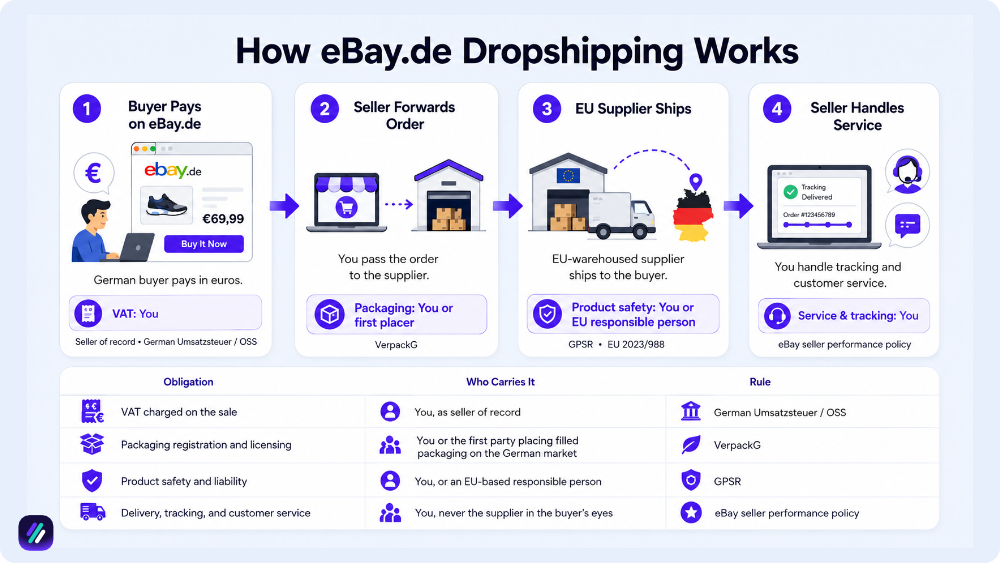
The one variable that decides whether the model works is supplier location, not supplier price. A cheaper factory in China that ships in three weeks will wreck your delivery metrics and your margins under the 2026 customs rules, both of which we get to below.
An EU-warehoused supplier costs more per unit and keeps you compliant and on time.
Is Dropshipping on eBay.de Legal in 2026?
Yes, with conditions. Dropshipping is legal under German law and eBay permits it, but two separate questions get tangled: whether German law allows it, and whether eBay’s own policy allows how you source. You can be fully legal and still have eBay restrict your account.
German law comes first. There is no rule against dropshipping. It is treated as a normal commercial activity, which means it triggers business registration and tax obligations, but the model itself is permitted.
Now eBay’s policy, which is the stricter of the two. eBay’s dropshipping policy is written around sourcing from a wholesale supplier, and fulfilling orders from a genuine wholesaler is allowed.
Listing an item and then buying it from another retailer or marketplace that ships to your customer, which is retail arbitrage, sits outside that written policy. An Amazon.de or AliExpress account agreement does not satisfy eBay’s wholesale-supplier requirement.
That said, most guides get one thing wrong here. What actually gets German accounts actioned is seller behavior, not the sourcing label: inaccurate listings, slow or failed delivery, and poor buyer experience. eBay’s written policy lists consequences for violations, and they escalate:
- Listing removal, usually the first and quietest signal
- Reduced visibility in search results
- Selling restrictions on your account
- Loss of seller protections
- Suspension in the worst cases
The takeaway is not “arbitrage is banned.” Plenty of sellers run Amazon-to-eBay and eBay-to-eBay models successfully. The deciding factor is whether you deliver what you promised, on time, described accurately.
You want to read the fine print in the eBay dropshipping policy before you pick a sourcing model, then build around being the reliable seller rather than the cheap one.
Can you dropship on eBay.de without living in Germany?
Yes. You do not need to live in Germany to sell on eBay.de, but the obligations that attach to you shift. Non-EU sellers face VAT registration requirements on EU marketplaces, the packaging evidence rule still applies to your account, and in practice an EU-warehoused supplier becomes close to mandatory to meet German delivery expectations.
Two things to sort before your first listing:
- VAT identity: you will likely need a German VAT number (USt-IdNr) and, once you sell across borders inside the EU, OSS registration. Marketplaces are liable for collecting VAT in some non-EU seller cases, so eBay will ask for your details.
- Where your stock sits: shipping from outside the European Economic Area (EWR) means long transit times and, from mid-2026, extra customs cost on low-value parcels. An EU warehouse solves both at once.
What Is the VeRI Program?
VeRI stands for Verifiziertes Rechteinhaber-Programm, eBay Germany’s version of the global VeRO (Verified Rights Owner) program. It lets brand and rights holders report listings they believe infringe their intellectual property.
The naming difference matters, because reports run through a German-specific process and carry a follow-on risk that does not exist in most other markets.
A rights holder files what eBay calls a NOCI (Notice of Claimed Infringement), and eBay acts fast. Here is the sequence once a report lands on one of your listings:
- eBay removes the reported listing, often within hours and before you can respond.
- eBay notifies you of the claimed infringement and the reporting party.
- Under the German VeRI process, your eBay-registered contact details are passed to the complainant.
- With your name and address in hand, the rights holder can send an Abmahnung, a formal cease-and-desist letter that usually demands a signed Unterlassungserklärung and carries legal costs.
That third step is the one English-language competitors miss. Because eBay hands over your data, an eBay VeRI report can turn into a bill from a law firm within days.
There is also the parallel-import trap. Genuine branded goods sourced from outside the European Economic Area can still infringe under German trade mark law (MarkenG), because the rights holder never consented to those specific units entering the EU market.
Avoiding VeRI trouble is mostly about restraint. If you have ever wondered why eBay vero reports feel so one-sided, this checklist is why staying clear of them is easier than fighting one:
- No brand names in your titles unless you are an authorized dealer or the item is a genuine compatible accessory
- No supplier images you have no license to use
- No “in the style of [brand]” comparisons, which invite trade mark complaints
- No branded goods imported from outside the EEA unless you can prove the rights holder consented to EU sale
Follow those four and VeRI moves from a live threat to a box you have already ticked before you ever list.
How to Start Dropshipping on eBay Germany in 8 Steps
The order of these steps is deliberate. In Germany the legal setup comes before your first listing, because sequencing errors, listing before you have registered or filed packaging evidence, are exactly what get new accounts blocked.
Work through them in order and you clear the compliance gates before eBay ever looks at you. Research still drives everything, so we will treat Step 5 as the engine even though the paperwork comes first.
Step 1: Register a business before you register the eBay account
Germany treats dropshipping as a commercial activity, so trade registration comes first, not after you make a sale. You register a Gewerbe at your local Gewerbeamt, a process called Gewerbeanmeldung, and you receive a Gewerbeschein (trade license) in return.
The fee is small and set by the city, around €15 to €65 depending on where you live.
Registration is not the end of the paperwork, it is the trigger for more. Here is what follows automatically:
- The Gewerbeamt notifies the Finanzamt (tax office), which sends you a tax questionnaire (Fragebogen zur steuerlichen Erfassung).
- You are registered with the local IHK (Chamber of Commerce), which may carry a small annual fee.
- Once you complete the tax questionnaire, the Finanzamt issues your Steuernummer.
You want this done before anything else, because as we will see in Step 4, eBay can block your listings without the registrations that flow from here.
Step 2: Choose a business structure (Einzelunternehmen, UG, or GmbH)
Most first-year dropshippers register as an Einzelunternehmen (sole trader), because it is free to set up and simple to run. The trade-off is liability. As a sole trader your personal assets are exposed, and under GPSR product-liability rules that exposure is larger than beginners expect once you are the importer of record.
The two limited-liability options are the UG and the GmbH. Here is how the three compare on what actually matters day to day:
| Structure | Liability | Setup cost class | Accounting burden |
|---|---|---|---|
| Einzelunternehmen | Unlimited, personal assets at risk | Lowest, just the Gewerbeanmeldung | Light, simple bookkeeping |
| UG (haftungsbeschränkt) | Limited to company assets | Low, from €1 share capital | Medium, must retain profit as reserve |
| GmbH | Limited to company assets | Higher, €25,000 minimum capital | Heaviest, full commercial accounts |
The UG is the popular middle path. It caps your liability like a GmbH but starts at one euro of capital, on the condition that you hold back 25% of annual profit as a reserve until it reaches €25,000.
If product liability worries you, that reserve requirement is a fair price for sleeping at night.
Step 3: Handle VAT and the Kleinunternehmerregelung decision
You have to decide before your first sale whether to opt into the Kleinunternehmerregelung, the small-business VAT exemption under §19 UStG. Under the exemption you do not charge VAT on sales, but you also lose the input-tax deduction (Vorsteuerabzug) on the VAT you pay for stock and fees.
For a scaling dropshipper buying inventory with 19% VAT baked in, that lost deduction usually costs more than the exemption saves.
The thresholds rose on 1 January 2025. You qualify if prior-year turnover stayed under €25,000 and current-year turnover stays under €100,000; cross the in-year limit and the exemption ends immediately. Several competing articles still quote the old €22,000 figure, so check the source.
Which way to lean:
- Take the exemption if: you are testing small, selling mostly to private German buyers, and buying little stock with VAT on it.
- Stay in standard VAT if: you buy inventory at volume, want the Vorsteuerabzug back, or plan to scale past the thresholds this year.
A margin detail almost nobody covers: a valid USt-IdNr on file shifts VAT on eBay’s own fees to reverse charge, which lifts what you keep. And once you sell across EU borders, the €10,000 EU-wide distance-selling threshold triggers OSS registration for VAT in the buyer’s country.
Step 4: Sort packaging compliance before you list (LUCID and VerpackG)
This is the single most misunderstood requirement on the German SERP. Under the Verpackungsgesetz (VerpackG), anyone who first places filled packaging on the German market, the Erstinverkehrbringer, must register in the LUCID register run by the Zentrale Stelle Verpackungsregister (ZSVR) and license that packaging with a dual system (duales System).
Miss that and eBay.de blocks your listings, since the marketplace must see packaging evidence on file. Who actually holds the obligation depends on who ships, so work through it as an if/then:
- If your EU supplier ships the packaged goods into Germany, that supplier is generally the first party placing the packaging on the market, not you.
- If you file evidence to satisfy eBay’s marketplace check, you record your supplier’s LUCID number and system-participation proof, clearly attributed to the supplier, never claimed as your own.
- If you ship yourself, use multiple senders, or work with a non-EU supplier who never registered, you become the obligated party and must register in your own name.
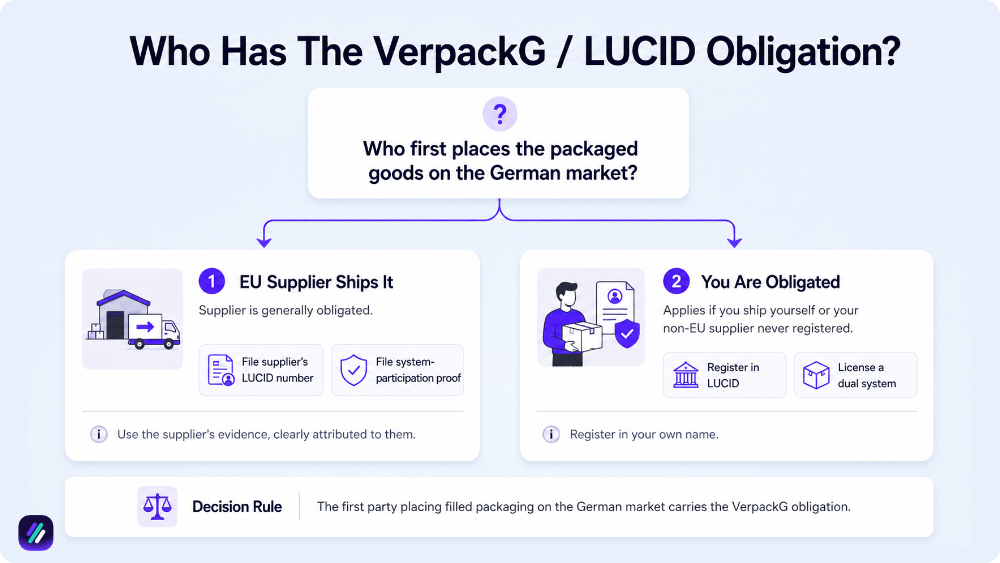
The safest move is to confirm your supplier’s LUCID registration in writing before you list. This, from what our dropshipping team at ZIK keeps seeing, is the step beginners skip and then scramble to fix after eBay freezes their listings.
Step 5: Run product research with a Germany-aware tool
Your research has to target eBay.de sold listings, not eBay.com or eBay.co.uk. Category demand, price bands, and seasonality all diverge across marketplaces, so a product that flies in the US can sit dead in Germany.
What you are hunting for is a specific combination: genuine sell-through, a manageable competitor count, a price ceiling that survives the fees, and an item you can source from an EU warehouse.
A workable research pass looks like this:
- Filter to the eBay.de marketplace and pull sold listings, not active ones, so you see genuine demand rather than hopeful inventory.
- Read the sell-through rate, where a healthy band means listings are converting, not just sitting.
- Count the competitors already ranking, and be honest about whether you can break in.
- Check the price ceiling after fees, then confirm the item exists at an EU supplier before you commit.
The ZIK online eBay product research tool is built for exactly this: filter by country, sales, revenue, and competition to see what is actually selling on eBay.de instead of guessing.
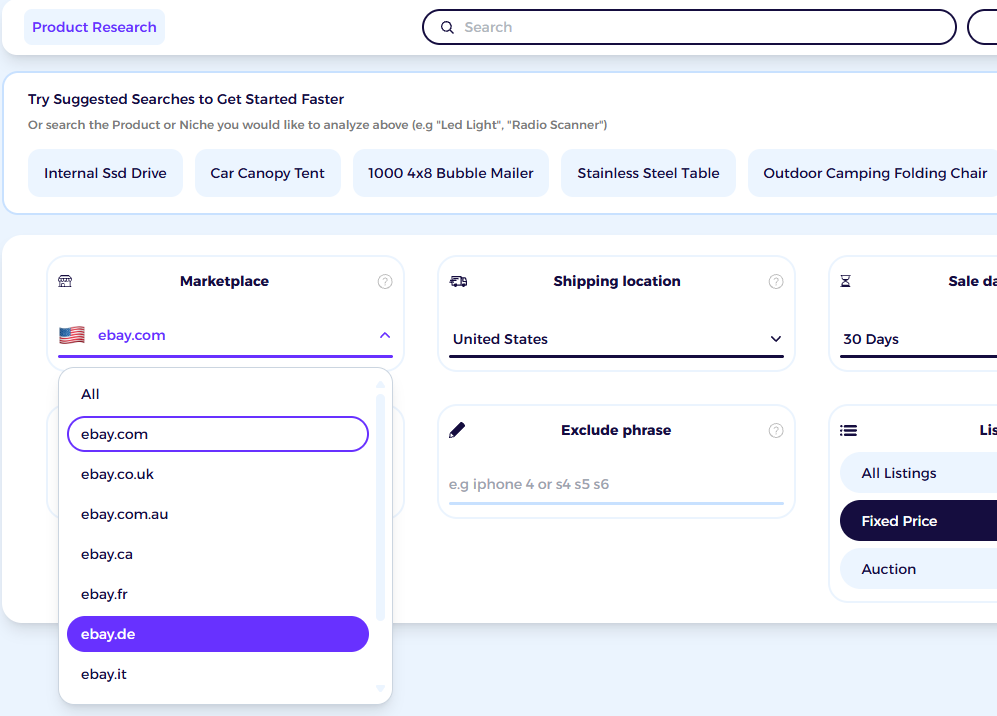
This is the engine the other seven steps feed, so it earns the extra minutes. Skip it and you are optimizing compliance for a product nobody in Germany wants.
Step 6: Vet German and EU dropshipping suppliers
A supplier has to pass three tests at once, which is why most fail at least one. They must be a genuine wholesaler, ship from inside the EU to hit German delivery expectations, and evidence their own compliance.
Price is the fourth question, not the first.
Every candidate has to clear this checklist before you list their products:
- The wholesale test: a true wholesale source, as eBay’s policy requires, not a retail store you are buying from?
- The EU-warehouse test: do they hold stock inside the EU? This matters more now than a year ago, because of the 2026 customs change on parcels from outside the bloc.
- The compliance test: can they show a LUCID number, system-participation proof, CE marking, and an EU-based responsible person for GPSR?
- The packaging test: neutral packaging, no third-party retail invoices in the box, nothing that reveals where the item came from.
The only reliable verification is ordering a sample yourself and inspecting what turns up. To match found products to suppliers and margins, the dropshipping product research tool puts supplier options and ROI side by side.
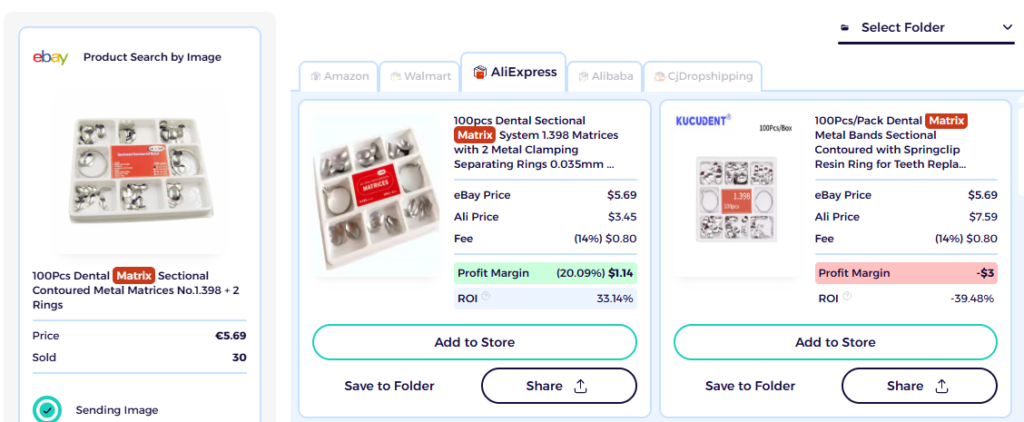
For a shortlist built around EU stock, our roundup of german dropshipping suppliers is a faster starting point than cold-searching wholesalers one by one.
Step 7: Set eBay.de business policies, shipping, and returns
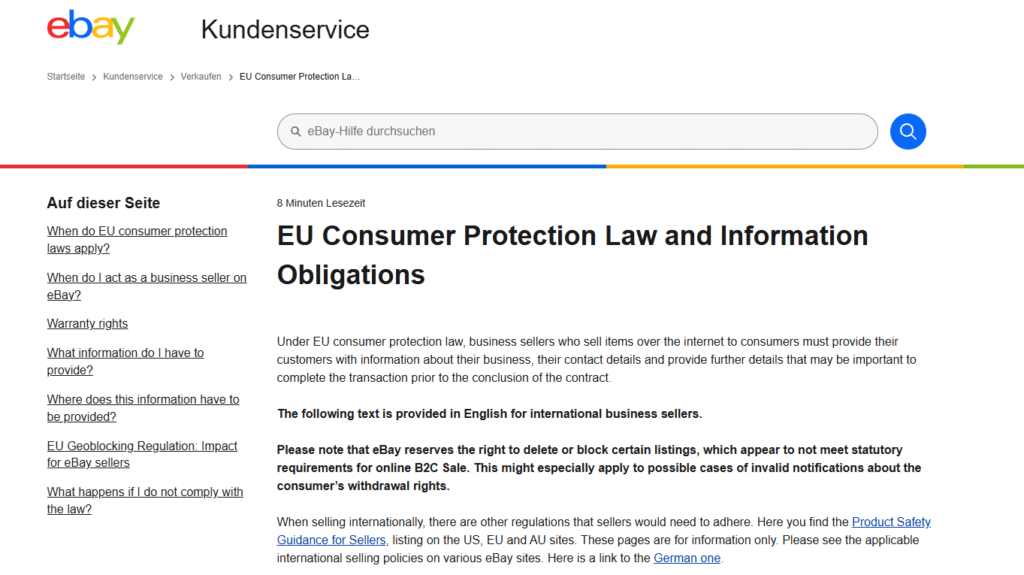
German consumer law gives buyers a statutory 14-day right of withdrawal (Widerrufsrecht) on distance sales under §355 BGB, and you cannot opt out of it.
Your eBay returns policy has to accommodate that period at minimum, and if you fail to inform buyers of the right correctly, it can extend to a year. Your job is to build policies that meet the law, not fight it.
You set these up in your eBay.de business policies before you go live:
- Handling time: keep it short and truthful, because it feeds directly into search placement and buyer trust.
- Tracking upload: upload tracking for every order, since German buyers expect visibility and eBay measures it.
- Carrier choice: DHL, Hermes, and DPD are the carriers German buyers recognize and trust.
- Returns: honor the 14-day Widerrufsrecht as your floor, stated plainly.
- Legal notices: your Impressum (legal-identity disclosure) and Widerrufsbelehrung (withdrawal instructions) must appear on your seller profile, not just on a standalone website.
That Impressum point trips people up, because the obligation applies to marketplace seller profiles too, not only standalone shops. Getting your eBay business policies right once saves a stack of disputes later.
Step 8: Scale with eBay Anzeigen and automation
Once a listing has proven sell-through, two levers scale it: promoted placement and listing automation. You should not reach for either before you have a product that already sells, because paid visibility on a weak listing just loses money faster.
Promoted placement. eBay’s promoted listings, branded eBay Anzeigen in Germany, push proven items higher in search for a percentage of the sale. You start low, measure the return, and only raise spend on listings that convert without help.
The mechanics behind eBay promoted listings reward items that already have momentum, so treat ads as an amplifier, not a rescue.
Automation, carefully. Repricing and stock-sync tools reduce risk by keeping your listings accurate, which is what protects your account. But automation wired to a retail source is what trips eBay’s arbitrage detection, so the tool choice matters.
Purpose-built dropshipping automation software that keeps prices and stock in sync is the safe use. Anything that auto-buys from a retailer after each sale is the risky one that the tool vendors selling it will never warn you about.
Optimizing Listings for eBay’s Cassini Algorithm in Germany
Cassini, eBay’s search engine, ranks eBay.de listings on the same core signals as any other eBay market: relevance, sell-through, listing quality, seller performance, and delivery speed.
What changes in Germany is the keyword layer and the buyer expectations feeding those signals. The mechanics stay the same, so the edge comes from tuning the German-specific inputs rather than learning a new algorithm.
Here are the signals that decide where your listing lands, and where German sellers can gain ground:
- Relevance: the title and item specifics have to match how German buyers actually search, which is rarely a direct translation of an English title.
- Sell-through: listings that convert get shown more, so demand validation upfront feeds ranking later.
- Item specifics (Artikelmerkmale): complete specifics improve both ranking and filter eligibility, and German buyers filter heavily.
- Seller performance and delivery: short handling time and uploaded tracking push you up, because Cassini reads them as buyer-safety signals.
Building a German title is where most foreign sellers underperform. German compound nouns and umlaut variants do not survive machine translation, so the word buyers type may differ from the literal translation of your English keyword. A workflow that holds up:
- Pull the top-selling German titles for your product and note the exact terms buyers respond to.
- Include both the umlaut spelling and its transliteration (for example the “ue” form of “ü”), since buyers type both.
- Front-load the specific noun a German buyer searches, then fill the remaining characters with high-value modifiers.
- Test titles against eBay.de sold-listing keyword data, not a Google keyword planner, because Cassini and Google reward different terms.
The free eBay title builder constructs eBay-ready titles from actual buyer-search data rather than guesswork. Paired with the ranking mechanics in our guide to eBay cassini and the practical steps in eBay listing optimization, it closes most of the gap on sellers who simply translated their US listings.
The wider fundamentals of listing on eBay still apply, just in German.
German Rules and Tax Requirements for Dropshipping on eBay.de
This is the reference block to work through before you scale. Every obligation below has a one-line meaning, who it applies to, and where you handle it, so you can audit your own setup against it. It is deliberately dense, because a table you can scan beats five sections you have to reread.
Here is the compliance stack for dropshipping on eBay.de in one view:
| Obligation | What it means | Who it applies to | Where you handle it |
|---|---|---|---|
| Trade and tax registration | Register the business, then get a Steuernummer | Every seller | Gewerbeamt, then Finanzamt |
| VAT (Umsatzsteuer) | Charge and report VAT; OSS for cross-border EU B2C, IOSS for imported consignments | Sellers over the Kleinunternehmer thresholds, and cross-border sellers | Finanzamt; Bundeszentralamt für Steuern for OSS |
| Packaging (VerpackG) | LUCID registration plus dual-system licensing | The party first placing filled packaging on the market | ZSVR (LUCID register) |
| Product safety (GPSR) | CE marking where required, plus an EU responsible person | Importers and sellers of non-EU goods | Self-managed; keep the evidence on file |
| Consumer law | 14-day Widerrufsrecht, Impressum, AGB, data protection under DSGVO | Every seller to consumers | Your eBay seller profile and policies |
| Customs (Zoll) | Duty on low-value imports from outside the EU | Anyone importing goods that ship from outside the EU | Applied at import |
The customs row is the one that rewrites the math for 2026, and almost nothing else on this topic mentions it yet.
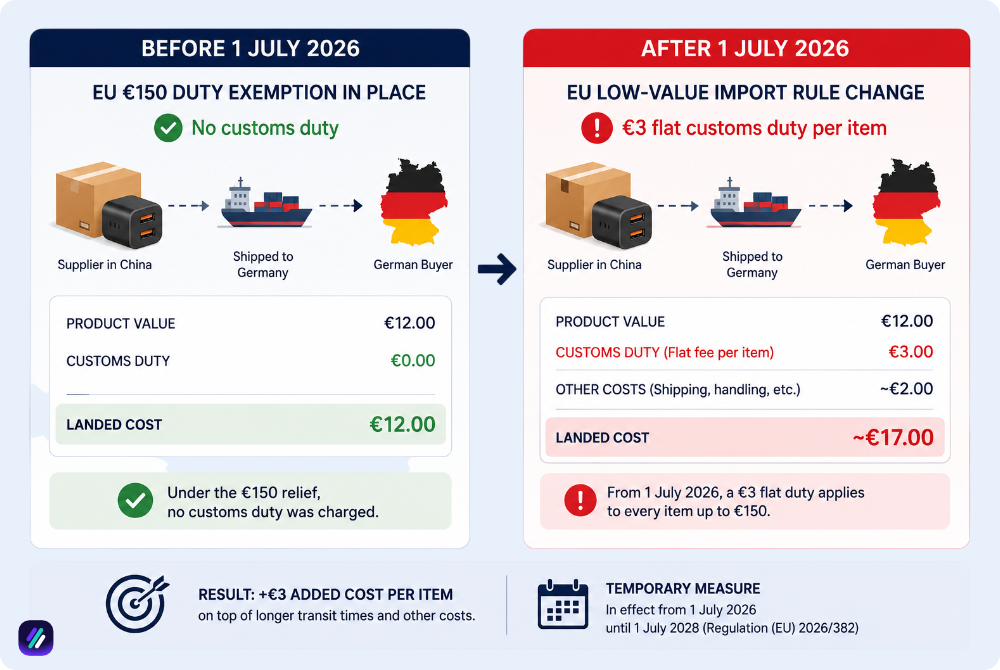
From 1 July 2026, the EU has abolished the €150 duty exemption and applies a temporary flat customs duty of €3 per item on consignments up to €150 imported from outside the EU, running until 1 July 2028 under Council Regulation (EU) 2026/382.
For a seller whose supplier ships a €12 gadget direct from China, that €3 is added cost on every unit, on top of longer transit. That is precisely why EU-warehoused sourcing moved from a nice-to-have to the whole model.
One more item is on the horizon. Germany is phasing in mandatory e-invoicing (XRechnung format) for business transactions, so keep clean records from day one.
These are the most common and highest-impact requirements for eBay.de dropshipping, not exhaustive legal advice; confirm your own situation with a German Steuerberater (tax adviser) or a Fachanwalt (specialist lawyer) before you commit capital.
eBay Germany vs eBay UK for Dropshipping: Which Is Better?
Neither is universally better. The deciding variable is where you are established as a seller and where your supplier warehouses stock. eBay.de rewards a seller with EU-based supply and an appetite for compliance; eBay.co.uk suits an English-first seller who wants a lighter setup and no language barrier.
Post-Brexit, the two markets are separate regimes rather than one European field, so a like-for-like comparison beats a pros-and-cons list. This is how they stack up on the dimensions that decide it:
| Dimension | eBay Germany (eBay.de) | eBay UK (eBay.co.uk) |
|---|---|---|
| Compliance burden | Heavier: VerpackG/LUCID plus GPSR responsible person | Lighter on packaging; UKCA and UK product rules apply |
| VAT and EU reach | OSS lets you reach the whole EU from a German base | Serves the UK; EU sales face import friction |
| Fees | Flat per-category commission from July 2026, with a 5% used rate | Category final value fees, no equivalent used-item discount |
| Language | German titles and support required | English throughout, lower setup effort |
| Competition | Thinner in compliance-heavy categories | Deeper in most English-language categories |
| Cross-border reach | Strong into the EU, weaker into the post-Brexit UK | Strong domestically, added friction into the EU |
The pick comes down to your base. If you are established in the EU, or your suppliers warehouse inside it, eBay.de is the stronger long-term home because the OSS scheme turns one listing into EU-wide reach and the compliance moat keeps rivals out.
If you are an English-first seller with UK-based or global supply and you want to launch faster, eBay.co.uk lowers the barrier, and you can layer Germany on later. The decision rule is simple: follow your warehouse, and choose dropshipping eBay UK only when your stock actually sits in Britain.
eBay Germany Seller Fees in 2026
eBay.de fees have four moving parts: a category selling commission (Verkaufsprovision) charged on the full transaction total, a fixed fee per order, an insertion fee (Angebotsgebühr) once your free monthly listings run out, and optional costs for an eBay Shop subscription or promotion.
The nuance that catches people is that the commission is calculated on item price plus shipping plus VAT, not on the item price alone, so shipping-heavy items cost more in fees than sellers expect.
The German structure was restructured in 2026, which makes most existing fee articles wrong. Here is the current anatomy:
| Fee | What it is | Current level |
|---|---|---|
| Verkaufsprovision (final value fee) | Category commission on item + shipping + VAT | Flat per-category rate, roughly 7% to 14%, from 1 July 2026 |
| Reduced re-commerce rate | Lower commission on used and refurbished items | 5% |
| Fixed per-order fee | Flat charge added to every order | €0.35, rising to €0.45 on orders over €10 |
| Angebotsgebühr (insertion fee) | Per listing after the monthly free allowance | Small per-listing fee once the allowance is used |
| eBay Shop subscription | Optional store tiers that cut per-listing costs | Varies by tier; worth it above a break-even listing volume |
| Promoted listings (eBay Anzeigen) | Optional ad fee you set as a percentage of the sale | You choose the rate |
The move away from tiered commission toward flat category rates, plus the reduced 5% rate for used and refurbished (“Re-Commerce”) conditions, opens a strategic angle no competitor has written yet: refurbished and used sourcing is now a fee-advantaged category on eBay.de.
If your USt-IdNr is on file, reverse charge changes how VAT applies to these fees, which nudges your net up.
Here is a worked example on a €30 sale (shipping included), assuming an item in an 11% category and a standard-VAT seller:
- Sale price including shipping: €30.00
- Final value fee at 11%: about €3.30
- Fixed per-order fee: €0.45
- Supplier cost, EU-warehoused: €14.00
- Shipping label: €4.50
- Return reserve set aside at 5%: €1.50
That leaves roughly €6.25 before VAT, and 19% VAT on the sale takes a further bite unless you are on the Kleinunternehmer scheme.
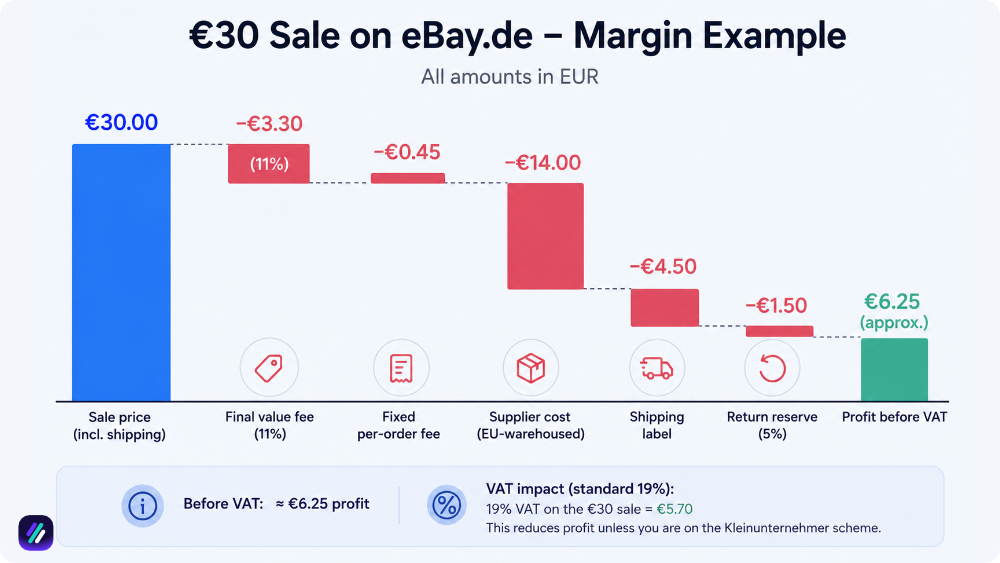
The lesson is that low-priced items get eaten by the fixed fee and the reserve, so price points that clear those costs are where the margin lives. You can run your own product through an eBay fees calculator from ZIK before you list it, so the number you see is take-home, not turnover.
Best German Dropshipping Suppliers for eBay in 2026
Your supplier shortlist comes down to one question: who holds stock in an EU warehouse and can evidence packaging and product-safety compliance, not who has the biggest catalog.
A huge catalog that ships from China fails the two tests that matter most on eBay.de in 2026, delivery speed and the new customs cost, so judge suppliers against eBay policy fit rather than catalog size.
The main supplier types compare like this on what decides eBay.de viability:
| Supplier | Warehouse | eBay policy fit | What to confirm before listing |
|---|---|---|---|
| BigBuy | EU (Spain and other EU hubs) | Strong, built as a wholesale dropship source | LUCID number and GPSR responsible person |
| vidaXL | EU warehouses | Good, dedicated dropshipping program | Packaging registration and CE documents |
| Costway | EU (home and garden stock) | Wholesale-style, EU-stocked lines | CE marking and responsible person |
| Printful / Printify | EU production | Strong, made-to-order print on demand | Made-to-order sidesteps some VeRI and packaging risk |
| CJ Dropshipping | Global, some EU warehouses | Only viable if you restrict to EU stock | That the specific SKU ships from an EU warehouse |
| AliExpress / DHGate | China | Weak: retail source, slow, now customs-hit | Generally avoid for eBay.de fulfillment now |
The pattern is clear. EU-warehoused platforms like BigBuy and vidaXL, and made-to-order print-on-demand providers, satisfy both the delivery expectation and the compliance evidence eBay.de effectively requires.
China-direct sourcing from AliExpress or DHGate is now structurally harder, because the €3-per-item customs charge and long transit times undercut the low unit price that was the only reason to use them.
A hybrid model works too: prove a product first, push it into an EU warehouse, then list it. Our in-house sellers keep coming back to one habit here, which is to order the sample before you trust the listing, every time.
For a wider EU shortlist, our guide to european dropshipping suppliers is a good next filter. Honest scope: we have not independently verified every supplier’s current LUCID status, so confirm it in writing yourself.
The red flags are the same across all of them, namely retail-branded packaging, no CE documentation, no EU responsible person, and no packaging registration.
What to Dropship on eBay Germany
The categories that work are the ones that clear four filters at once, which is why “sell anything” advice fails on eBay.de. Think of it as a four-filter test rather than a product list, because the winning items change but the filter does not.
Every product idea should pass all four gates:
- EU sourcing available: can you buy it from an EU-warehoused supplier, so delivery is fast and the customs charge does not apply?
- Price above the fee drag: does the price point clear the fixed per-order fee and return reserve with margin left?
- No VeRI exposure: is it free of brand-rights complications, so a rights holder cannot file a report?
- Sell-through on eBay.de specifically: does German sold-listing data support demand, not US or UK data?
Categories that tend to satisfy the filters share a logic: home and garden goods that ship from EU furniture and homeware warehouses, car and motorcycle parts sold by fitment rather than brand, hobby and craft supplies, and pet accessories. Each is EU-sourceable, priced above the fee drag, and rarely brand-restricted.
Seasonality follows the German calendar too, so plan around Weihnachten, back-to-school, and regional events rather than US holidays. The eBay market insights tool surfaces trending German keywords and products in real time, which is how you catch a season before it peaks.
The categories to avoid are just as defined:
- Branded electronics, where VeRI reports and parallel-import rules are a minefield
- Anything needing CE certification you cannot evidence
- Age-restricted and hazardous goods, which add compliance you do not want early
- High-return fashion, since German fashion returns run around a third of orders, among the highest in Europe, and every return erodes your margin and metrics
Before you commit to any category, check who already dominates it with the eBay competitor research tool, which shows any eBay.de seller’s revenue, sold items, and best products.
The last step is to validate demand against eBay.de sold data before you decide. The full framework in what to dropship on eBay applies here, filtered through the German lens above.
Find eBay Best Selling Items in Germany with ZIK Analytics
Sourcing and listing are the parts everyone talks about. The harder problem on eBay.de is finding sold-listing data scoped to the German marketplace, when most tools default to eBay.com. That is the part ZIK Analytics handles for you, at each stage of the workflow above:
- Use the tool for eBay product research from ZIK to see actual sales, sell-through, and competition on any keyword, filtered to eBay.de before you list.
- Use the eBay competitor research tool to see any German seller’s revenue, sold items, and top products, so you know who you are up against.
- Use eBay market insights to catch trending German keywords and seasonal demand while it is still building.
Everything in this guide comes back to deciding from data instead of guessing which US winner might work in Germany. See what is actually selling on eBay.de, then list with a plan. You can start your $1 trial and run your first German product search today.
eBay Germany Dropshipping FAQs
Quick answers to the questions German eBay dropshippers ask most often.
Is dropshipping allowed on eBay Germany?
Yes, when you source from a wholesale supplier or already own the inventory. Buying an item from a retailer such as Amazon.de after the sale is retail arbitrage and sits outside eBay’s written policy. In practice, what actually protects your account is accurate listings and reliable, on-time delivery, so build around being a dependable seller.
Do I need a Gewerbeanmeldung to dropship on eBay.de?
Yes. Dropshipping is a commercial activity under German law, so you must register a Gewerbe at your local Gewerbeamt before your first sale. That registration automatically notifies the Finanzamt, which sends a tax questionnaire and issues your Steuernummer, and it registers you with the local IHK. You handle it before you list.
Do I need a LUCID number to sell on eBay Germany?
eBay requires packaging evidence on file for sellers shipping to German consumers. A pure drop shipper is generally not the obligated producer under the Verpackungsgesetz, since the party first placing filled packaging on the market usually is. You still must file that party’s LUCID number and system-participation proof, clearly attributed to them, not claimed as your own.
Can I dropship on eBay.de from outside Germany?
Yes. Non-EU sellers face VAT registration requirements on German marketplaces, and the packaging evidence obligation still applies to your account. The bigger practical constraint is delivery, since an EU-warehoused supplier is close to mandatory for meeting German delivery expectations and avoiding the customs charge on parcels from outside the EU.
Do I need to speak German to sell on eBay Germany?
Not fluently, but your listing titles, item specifics, and customer messages must be in correct German. Machine translation underperforms in Cassini because German compound nouns and umlaut variants do not translate cleanly, and buyers filter on item specifics. A native speaker should review your listing copy and message templates.
Which supplier is best for dropshipping in Germany?
There is no single best supplier. The right one holds stock in an EU warehouse, meets eBay’s wholesale requirement, and can evidence packaging registration and product-safety compliance. You run every candidate through those three tests, order a sample to verify, and confirm their LUCID status in writing before listing their products.
Is eBay dropshipping still profitable in Germany?
It can be, but the math is tighter than it was. The selling commission applies to the full transaction total, the fixed per-order fee eats low-priced items, and from July 2026 the €3-per-item customs charge on low-value non-EU imports raises landed costs. Profitability now depends on EU sourcing and a price point that clears the fees.
Why do so many eBay dropshippers fail in Germany?
Three recurring causes. First, retail-arbitrage sourcing paired with slow delivery that breaches buyer expectations and damages seller performance. Second, compliance gaps that trigger listing blocks or an Abmahnung. Third, chasing US or UK winners that have no demand on eBay.de. When you fix the sourcing, the compliance, and the research, most of the failure modes disappear.