
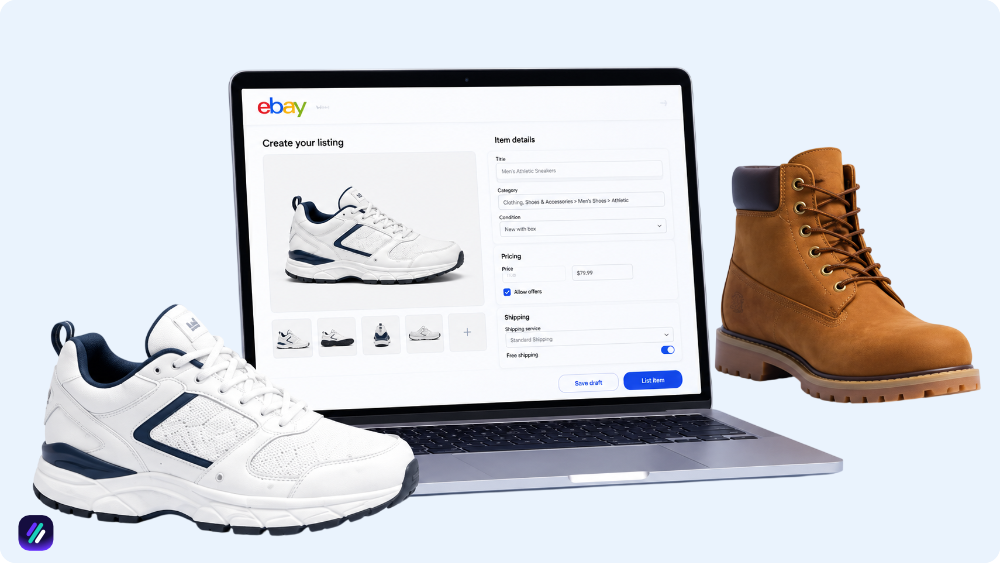
Most people who sell shoes on eBay treat it like clearing out a closet. They snap one dim photo, guess a price from what other listings ask, and wait, and wait, aaand wait.
The pairs actually worth money get underpriced, sizing mistakes turn into returns, and the listing sinks where nobody scrolls.
In this guide, I’ll show you how to sell shoes on eBay the way sellers who move steady volume do, such as sorting and grading honestly, pricing from sold data, listing so buyers find you, and knowing which pairs are worth your time.
Key Takeaways
- Sorting and honest condition grading is where the money hides. The difference between a $90 pair and a $9 pair is usually the few details you read off the shoe and how truthfully you describe the wear.
- Price from sold listings, never from what other sellers are asking. The eBay Product Research Tool from ZIK Analytics shows actual sales, sell-through, and the price band buyers really pay on any shoe keyword before you list.
- Sneakers and boots carry the heaviest demand and the biggest revenue, while accessories like shoelaces and shoe care sell in huge volume at low prices. Those are two very different businesses.
- Branded sneakers sold at $100 or more usually run through eBay’s Authenticity Guarantee, which inspects the pair before it reaches the buyer, and those sneakers get a lower 8% selling fee instead of the standard rate.
- Shipping wrecks more shoe profit than fees do. The right box, not a folded mailer, is what stops crushed toe boxes and “not as described” returns.
- Most other shoes use eBay’s standard final value fee of around 13.5%, so you build that cut into your price before listing, not after the payout lands lighter than you expected.

Step 1: Create Your eBay Account and Set Up Payments
Every sale starts with an account that will not seize up the moment orders arrive. A personal eBay account is enough to begin, and you move up to a business account later, once volume grows and you want cleaner tax records and stronger selling tools.
New accounts come with eBay selling limits, usually a capped number of listings and a total value that eBay raises as you build a track record. That cap is normal, not a punishment, so you start by listing your best pairs instead of dumping fifty at once.
Also, payments run through eBay directly now and pay out to your linked bank, so PayPal is no longer the requirement it once was. You verify your bank before you list, because an unverified account can hold those first payouts for days.
Getting that groundwork right, from identity verification to the bank checks, saves you the headaches that hit sellers who rush past it.
Step 2: Sort, Clean, and Identify the Shoes You Want to Sell
Before a single pair goes live, you need to sort them properly. This unglamorous hour decides most of your profit, because a shoe you misjudge here is either money left on the table or a return waiting to happen.
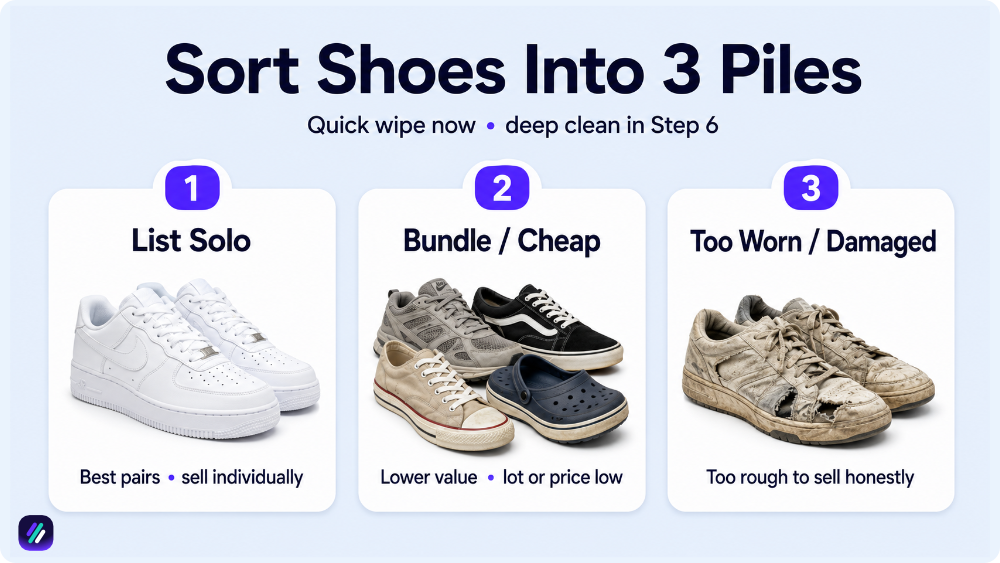
Three piles make the job fast. Pairs worth listing on their own, lower-value pairs to bundle or move cheaply, and anything too worn or damaged to sell honestly go their separate ways. A quick wipe now tells you which pile a pair belongs in; the proper cleaning comes later in Step 6.
Check the Size Tag, Model Name, and Style Code
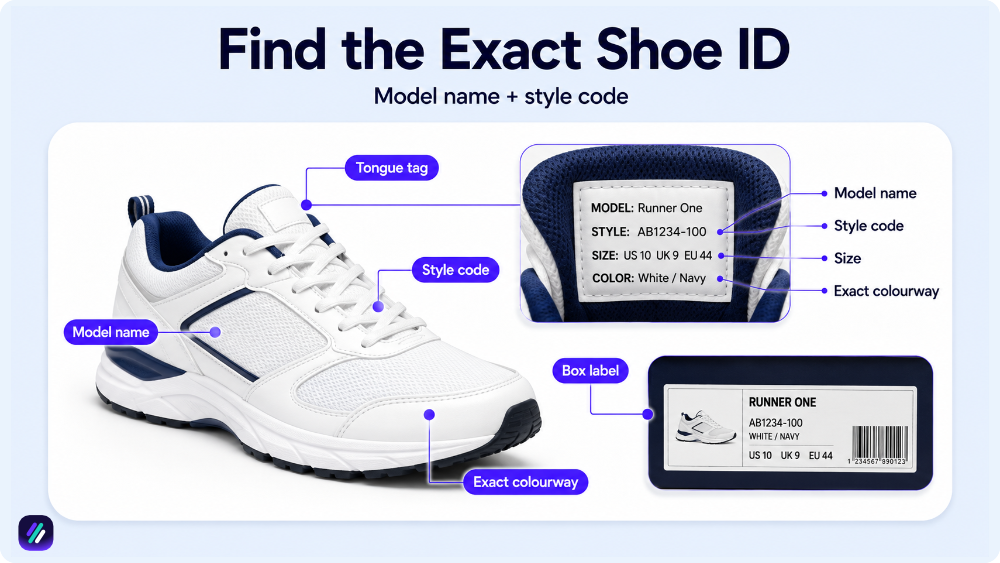
Every shoe carries its own ID, and reading it off the shoe beats guessing from memory. The size tag inside the tongue or along the insole gives you US, UK, and EU sizing, which you list exactly, because a half-size error is the single most common cause of shoe returns.
In fact, wrong sizing and poor fit account for roughly 40% to 50% of all returns in apparel and footwear.
The model name and the style code, usually printed on the box label and stamped inside the tongue, pin down the exact release. That code is what lets a buyer hunting for one specific colourway land on your pair instead of a lookalike.
Grade the Shoe Condition Honestly
Condition is the figure buyers scrutinise most, so you grade it the way a skeptical buyer would, not the way you hope it looks such as new in box, new without box, used-excellent, and used-with-flaws are the bands that matter, and the gap between two of them is a serious chunk of the price.
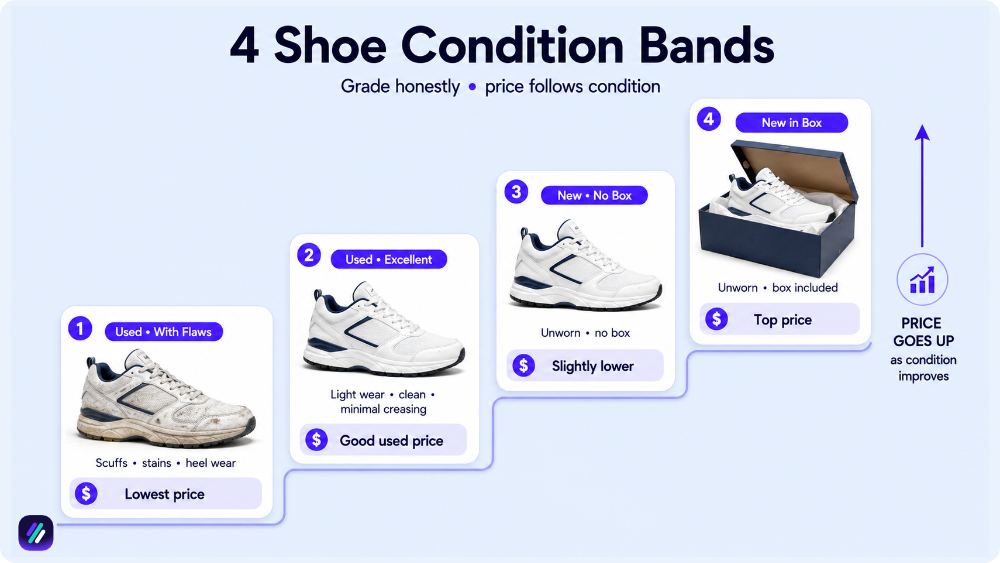
Unfortunately, the costliest beginner habit is rounding condition up. From our in-house eBay sellers at ZIK, a pair described better than it arrives becomes a “not as described” case that costs you the sale and a defect on your account.
In fact, around 22% of sellers return products because they do not match the description or photos.
So you note every crease, scuff, and worn sole plainly, because the photos will show it anyway.
Step 3: Research Shoe Prices Using Sold Listings and Comps
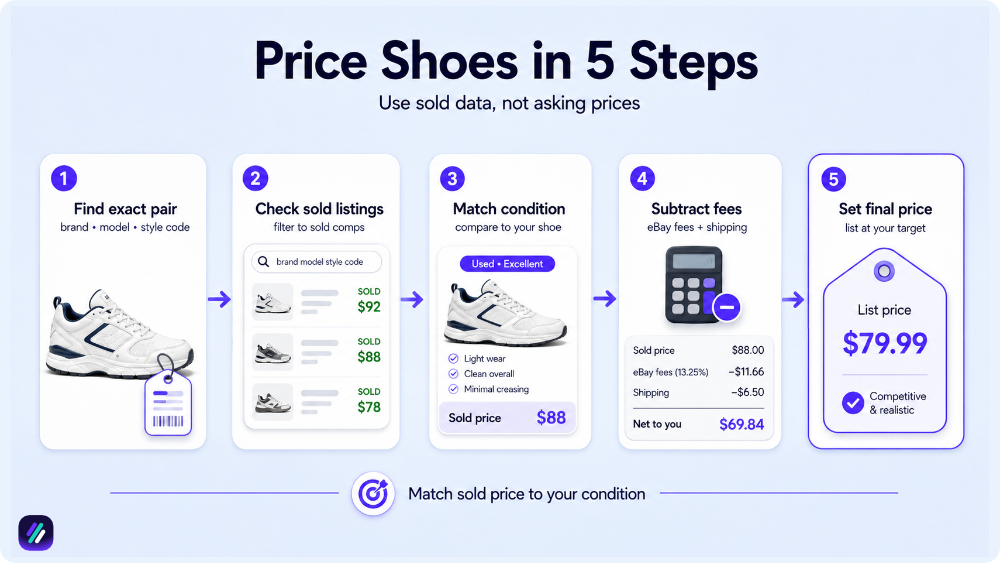
The rule is easy to say and hard to resist breaking: you price from what shoes have already sold for, never from what other sellers are asking.
A pair listed at $80 that never sells tells you nothing, while a pair that sold three times this week at $34 is the market telling you how much it is actually worth, so don’t try to beat the market.
So your core move is sold-listings research, and it is the one habit that separates informed sellers from hopeful ones.
On eBay, you search for the exact shoe, then filter to sold items to see genuine closing prices and dates.
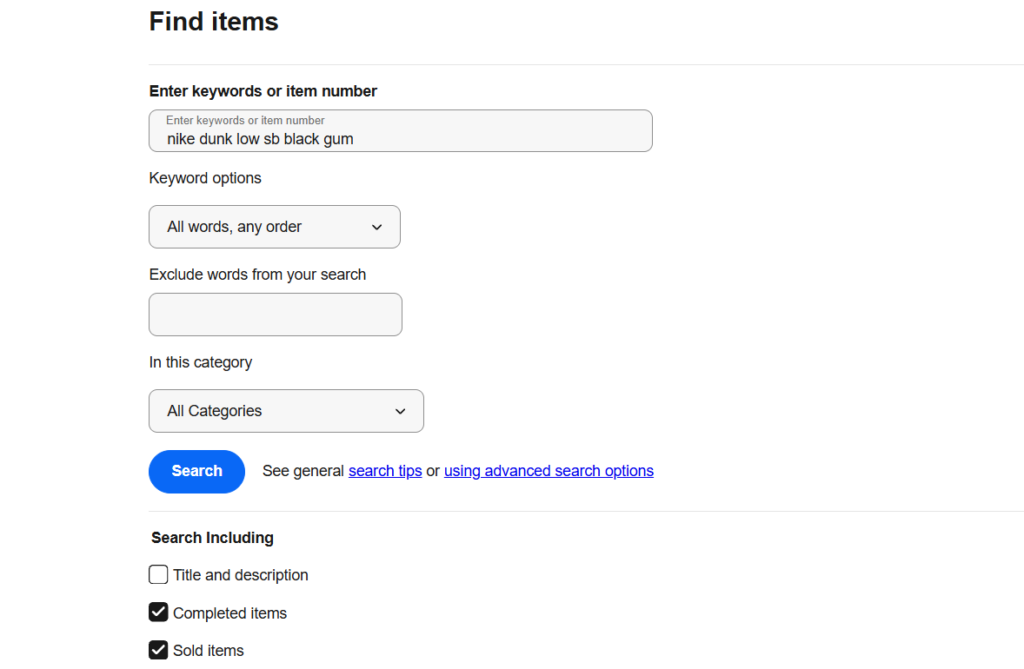
Pulling how to find sold items on eBay into a routine before every listing is what keeps your prices anchored to reality.
A few habits keep that pricing honest:
- Recent sales over old ones: sneaker and seasonal prices swing with releases and weather, so a comp from six months ago can be badly out of date.
- Like-for-like condition: a new-in-box sold price is the wrong anchor for a creased used pair, so you adjust down honestly when yours is rougher.
- Size matters to price: a common men’s 9 to 11 often sells for less than the same shoe in a hard-to-find size, because scarcity sets the ceiling.
Use ZIK Analytics to Validate Demand Before Listing
Sold listings tell you the price; demand data tells you whether the pair will move at all.
To check fast while you browse, the free eBay chrome extension from ZIK pulls sold history and competitor data straight onto the eBay listing page.

For the deeper read before you commit, the eBay product research tool shows actual sales, sell-through, and the price band buyers really pay on any shoe keyword, so you anchor to verified demand instead of a number you wished into being.
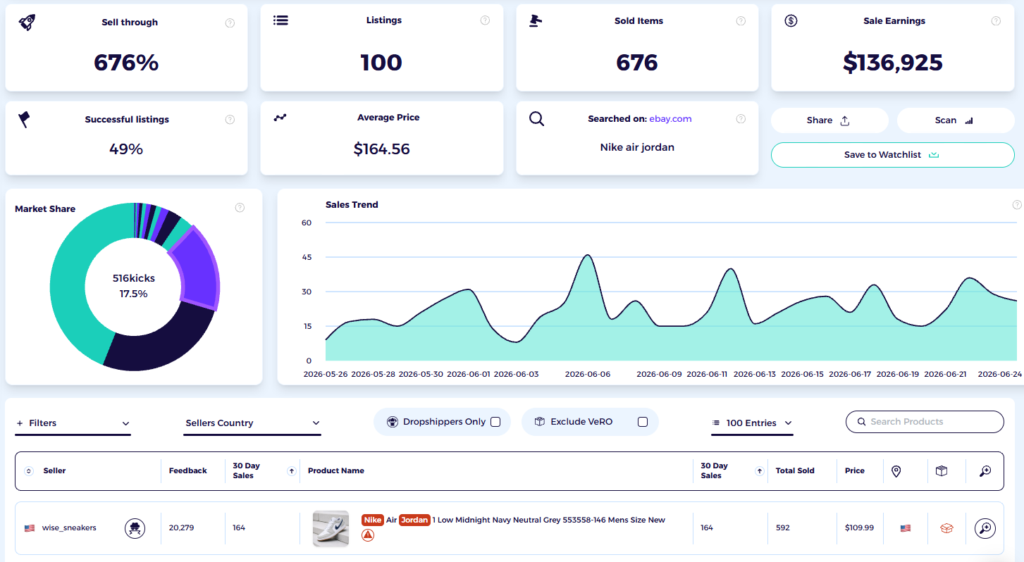
That is the difference between listing a pair you assume will sell and one the data says already does.
Step 4: Calculate Profit Before You List
So you have a price the market supports from your Step 3 research. Before that pair goes live, you run the margin, because a sale that loses money without you noticing is worse than no sale at all.
The math is simple once you lay it out. Your take-home is:
Sold price – what you paid for the shoes – eBay’s fees, – shipping – packaging = profit
A pair that “sells for $40” can net you closer to $25 by the time the cut and the box come out, and if you paid $20 to source it, that is a slim five dollars of profit.
That slim margin is exactly why you source better and price with open eyes. We cover the exact fee numbers in Step 12, but you do the rough subtraction now, on every pair, before you ever hit the list.
The sellers who skip this step are the ones who stay busy and broke, but not you, my friend!
Step 5: Check Whether the Shoes Qualify for eBay Authenticity Guarantee
If you are listing branded sneakers, eBay often steps in before your buyer ever sees the pair.
Through Authenticity Guarantee, eligible sneakers, generally those listed at $100 or more, ship first to a professional authenticator who inspects the pair, attaches a verification tag, and then forwards it to the buyer.
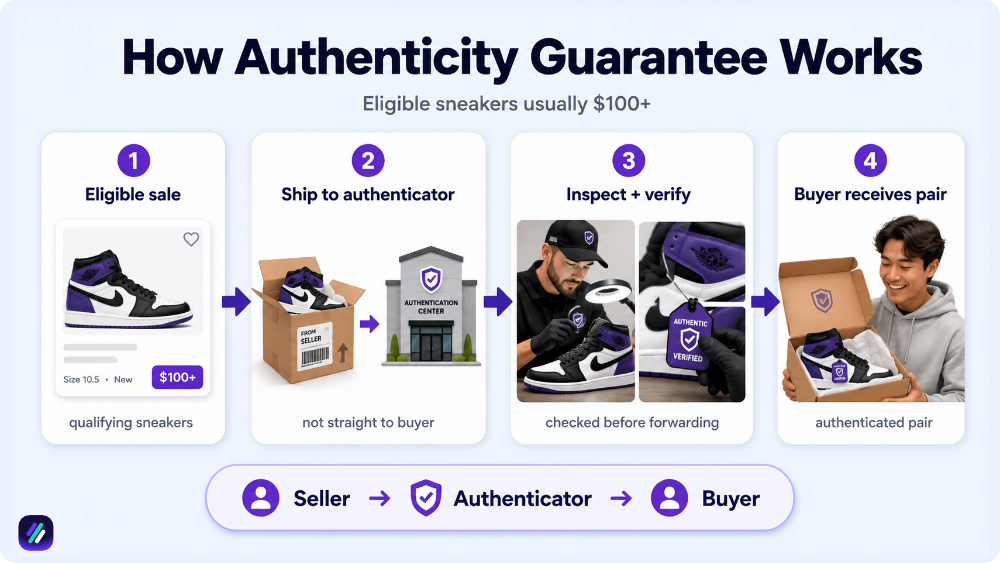
This matters for two reasons. It is free to you as the seller, and the badge builds the trust that gets a $200 sneaker sold in the first place.
The program covers eligible sneakers, though not every shoe, so most boots, sandals, and lower-priced pairs ship the normal way to the buyer.
One thing you should know: eBay has been moving toward dynamic thresholds, with the floor dipping toward $75 on some models, so the exact trigger can vary by brand and price.
Our full breakdown of the eBay authenticity guarantee walks through which items qualify and what the process feels like end-to-end.
How to Avoid Authentication Problems
The authenticator is checking that the pair matches your listing exactly, so your job is to give them nothing to flag.
That means you photograph the genuine pair you will actually ship, never a stock image, and you describe flaws openly rather than hiding them behind flattering angles.
Counterfeits are the hard line. Listing a fake, even unknowingly, runs straight into eBay’s eBay VeRO program and risks removal or account action, so when you resell sneakers you did not buy new yourself, you verify the pair is genuine before it ever goes up.
Step 6: Clean, Inspect, and Prep Shoes Before Listing
A clean pair of photographs ships fewer returns and earns a higher price, so the prep you do here pays for itself. The goal is to present the shoe at its honest best, not to disguise its condition.
For most pairs, a soft brush, a damp cloth, and a mild cleaner lift the surface dirt, while a magic-eraser type sponge handles scuffed midsoles.
You deodorise the insides, replace tired laces with fresh ones, and stuff the toe box with paper so the shoe holds its shape in photos and in transit.
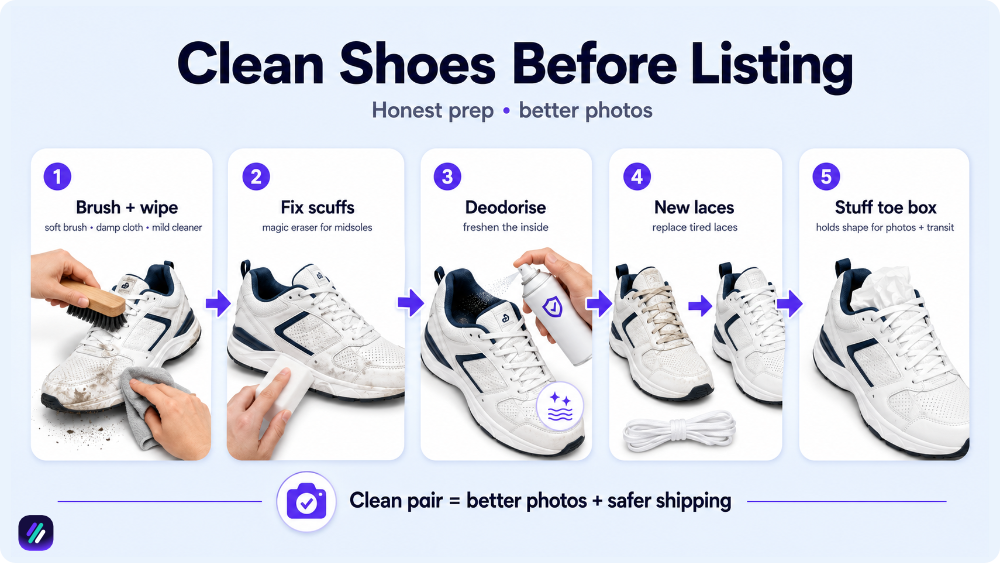
Inspection is the other half of this step. You check soles for separation, eyelets for tearing, and heels for collapse, then note anything you cannot fix so it goes into the listing honestly. A flaw you disclose is a fair sale; a flaw the buyer discovers is a refund and a dent in your rating.
Step 7: Create a Shoe Listing on eBay
A shoe listing is a small sales page, and most of its work is done by two things buyers never consciously notice: the item specifics and the title. Getting those right means eBay surfaces your pair to the people already searching for it.
Three things make or break the listing itself:
- The right category and condition: the correct shoe category, plus the accurate condition band from Step 2, puts your pair in front of the buyers actually looking for it.
- Complete item specifics: brand, model, US size, colour, and style are all power-filtered search, so a blank field hides your shoe where buyers never scroll.
- An honest description: the condition stated plainly, with any flaw the photos show, is what keeps a “not as described” case from landing after the sale.
Fill out Shoe Item Specifics Completely
Item specifics are not busywork; they are how eBay’s search decides whether to show your shoe at all. Most buyers filter by brand, size, colour, style, and department, and every box you leave empty is a filter that quietly excludes your listing, causing you to lose the chance of a sale.
So you fill in every field eBay offers, even the ones that feel obvious.
For example, a shopper narrowing to “Nike, US 10, white, running” should find your pair in that exact slice, because that shopper is the one ready to buy.
How to Write a Shoe Listing Title That Gets Found
Your 80 characters are prime real estate, built from the exact words a buyer types: brand, model, style code, size, colour, and condition.
Something like “Nike Air Max 90 Mens 10 White Triple Leather Running Shoe FN1234 New” tells both eBay and the buyer precisely what they are looking at.
To find the terms buyers actually search, the eBay keyword tool from ZIK pulls high-demand keywords and long-tail phrases from genuine sales data, so every one of those characters earns its place instead of holding filler.
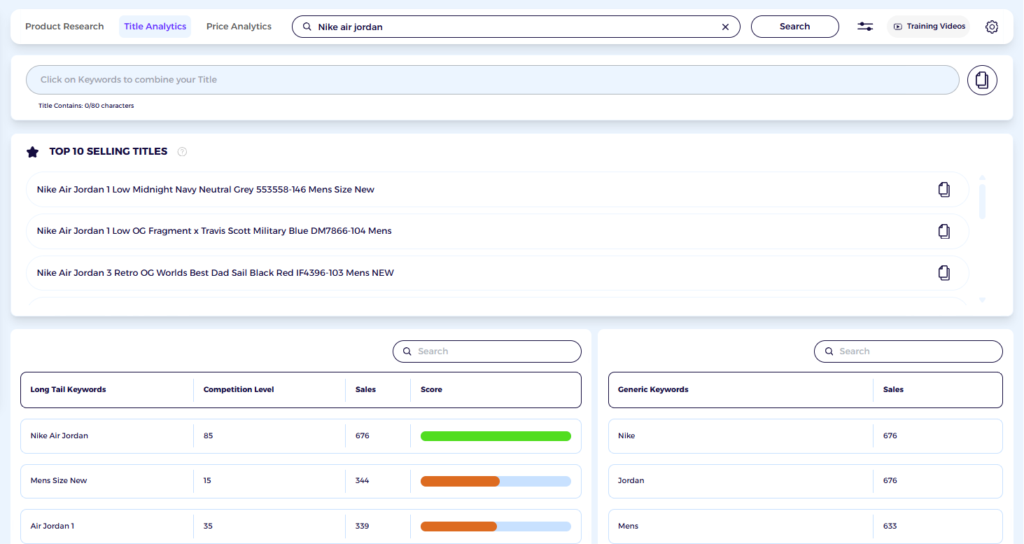
You always want to fill the title with searched terms, not adjectives like “amazing,” which is what gets a shoe seen.
How to Photograph Shoes That Sell
Good photos are not decoration on a shoe listing; they are the listing. A buyer cannot pick the pair up, so your pictures are the only proof of condition they get, and weak ones cost you both sales and returns.
A reliable shot list for any pair worth more than a few dollars covers the angles buyers judge:
- Both shoes together, top and side, on a plain background in bright daylight.
- The soles, which show wear honestly, reassure buyers that the pair is not blown out.
- The label and size tag, so the buyer can confirm the model and size for themselves.
- Every flaw, shown openly, is a scuff you photograph, which is a fair sale, while a hidden one is a refund.
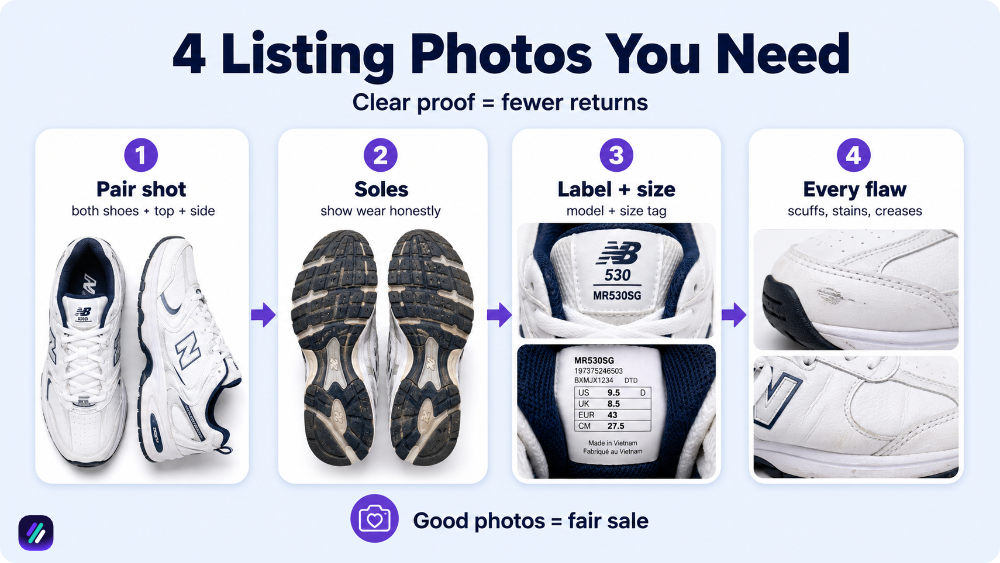
Remember, nailing the lighting and angles in how to take pictures for eBay is one of the cheapest ways you can build trust with a shoe buyer.
Step 8: Choose Auction vs Buy It Now for Your Shoes
The format you pick is one of the biggest levers on your final price, so you choose it per pair rather than by habit.
Buy It Now suits shoes with a known, steady market price and gives you control, while auctions suit scarce, hyped, or hard-to-price pairs where competing bidders do the pricing for you.
The logic follows demand. A common running shoe in a mid-size already has a settled price, so an auction just risks selling it cheaply on a quiet day.
But a rare collaboration sneaker or a deadstock vintage pair benefits from auction heat, where two determined collectors push the number well past what you would have dared to ask.
Here is how the two formats compare on what actually matters to a shoe seller:
| Factor | Auction | Buy It Now |
|---|---|---|
| Best for | Rare, hyped, deadstock, or hard-to-price pairs | Common shoes with a known sold price |
| Price control | The market sets it, which can run high or low | You set it from sold comps |
| Speed | Fixed end date, often seven days | Sells whenever a buyer is ready |
| Main risk | Selling under value on a slow day | Sitting unsold if priced above the market |
If you do run auctions, you end them on a weekend evening when the most bidders are watching, and start the price low to pull early bids in.
It comes down to choosing right between eBay buy it now vs auction per pair, not by reflex, which is what protects your final number.
Step 9: Ship Shoes Safely and Cheaply
Shipping is where a clean sale turns into a five-star review or a refund, and shoes are unforgiving because a crushed toe box in transit is a damaged shoe on arrival, so matching the packaging to the value of the pair heads off almost every problem.
You ship shoes in a proper box, not the original shoe box alone, and never a thin poly mailer that lets the pair fold.
The original box goes inside a shipping box so it arrives as a sellable collectible rather than a battered one, which matters most on sneakers where the box is part of the value.
For weight, shoes are light but bulky, so you compare carriers, because dimensional pricing can make the cheaper-looking option the expensive one.
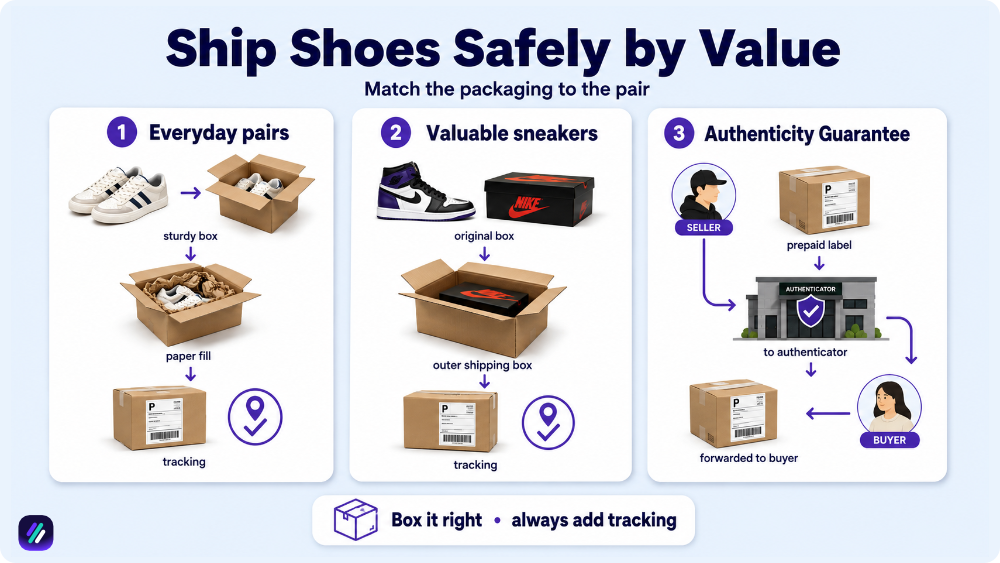
Matching the service to the pair, which is the core of how to ship on eBay, keeps cheap shipping from turning into a damaged-shoe refund. You also need to add tracking on everything and pack as if the carrier will be careless, because sometimes they are.
How Authenticity Guarantee Shipping Works
When a sneaker sells through the Authenticity Guarantee, the route changes. Instead of shipping straight to the buyer, you send the pair to eBay’s authenticator using the prepaid label eBay provides, and they forward it on after the inspection clears.
This adds a step but removes a worry. The buyer cannot later claim the pair was fake because a third party verified it, and the final value fee on the shipping portion is waived on those orders, so the extra handling does not cost you margin.
Step 10: Manage Payouts and Taxes
eBay handles your money in-house now, so once a buyer pays, the funds clear and are paid out to your linked bank on eBay’s schedule, usually within a couple of business days of the sale confirmation.
So knowing the payout timing keeps you calm when a first sale’s funds sit pending for a day or two rather than landing instantly.
Taxes are the part beginners ignore until it bites. As the saying goes, there are only two things in life that are certain and one of them is paying taxes.
In the US, a payment platform has to send you a Form 1099-K once your sales pass $20,000 and 200 transactions in a calendar year, after the lower phased-in thresholds were repealed.
Two things hold true regardless of the form, though. Your shoe income is taxable whether or not a 1099-K is ever issued, and some US states set their own lower reporting thresholds, so you may receive one below the federal figure.
Tax rules also vary by country, so treat this as the US case rather than a global rulebook, and keep simple records of what you paid and what you sold so your tax picture stays clean at year-end.
Download this eBook now and learn how to sell on eBay like a pro.Step 11: Handle Returns, Customer Service, and Avoid Scams
Most shoe returns are avoidable, and they trace back to two things: a listing that oversold the condition, or sizing the buyer misjudged, as I have already pointed out.
When you fix the first upstream with honest grading and clear photos, most of the friction never starts.
When a genuine issue does land, a fast, calm refund handled under the eBay return policy protects your account far more than winning the argument does.
Shoes also attract a few specific scams, so a little caution prevents costly losses:
- The swap return: a buyer returns a worn or different pair and claims it is the one you sent. Photographing the exact pair you ship, with any unique marks visible, is your defence.
- The “arrived damaged” claim on a careless pack job: sturdy boxing plus tracking settles most of these in your favour.
- The too-good buyer: You should be wary of a brand-new account paying top dollar with an unusual shipping request, and ship only to the verified address on the order.
When you handle the honest problems quickly and guard against the dishonest ones, returns stay a cost of doing business rather than a threat to your account.
Step 12: Know Your eBay Shoe Fees and Profit Margins
Before you celebrate a sale, you should know what eBay keeps, because the cut is bigger than most beginners expect.
For most shoes sold without a store, the standard final value fee is around 13.5% of the total sale, plus a per-order fee of $0.30 on orders of $10 or less and $0.40 above that, per the eBay fee schedule. That percentage applies to the item, shipping, and tax combined.
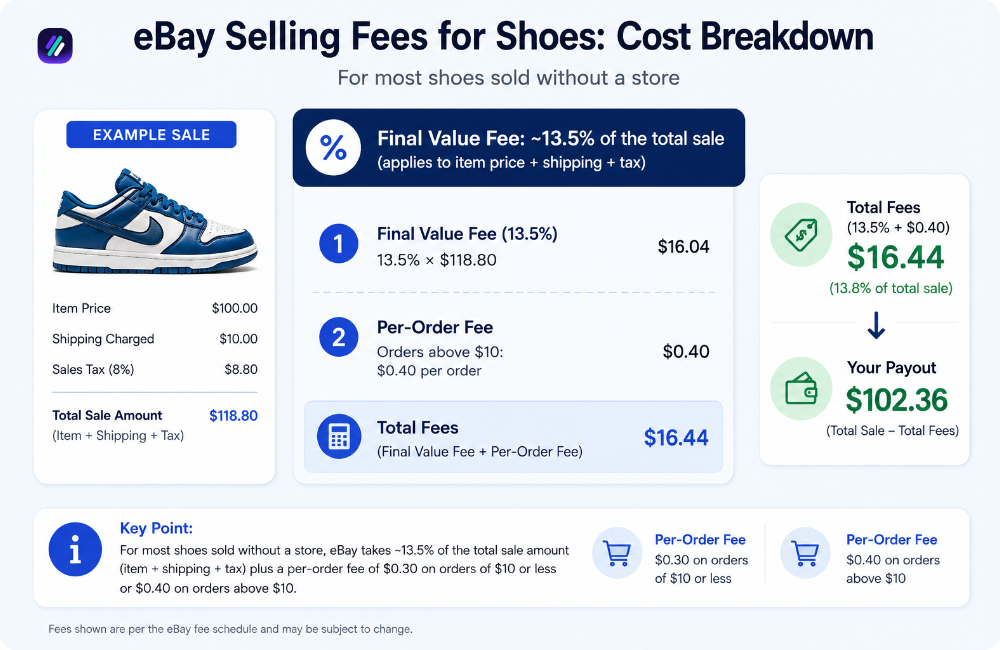
Sneakers are the exception worth knowing. Pairs sold at $100 or more carry a reduced 8% final value fee for sellers without a store, and the per-order fee is waived on athletic sneakers at $150 and up.
So a branded sneaker often keeps more of its sale price than a cheaper everyday shoe does.
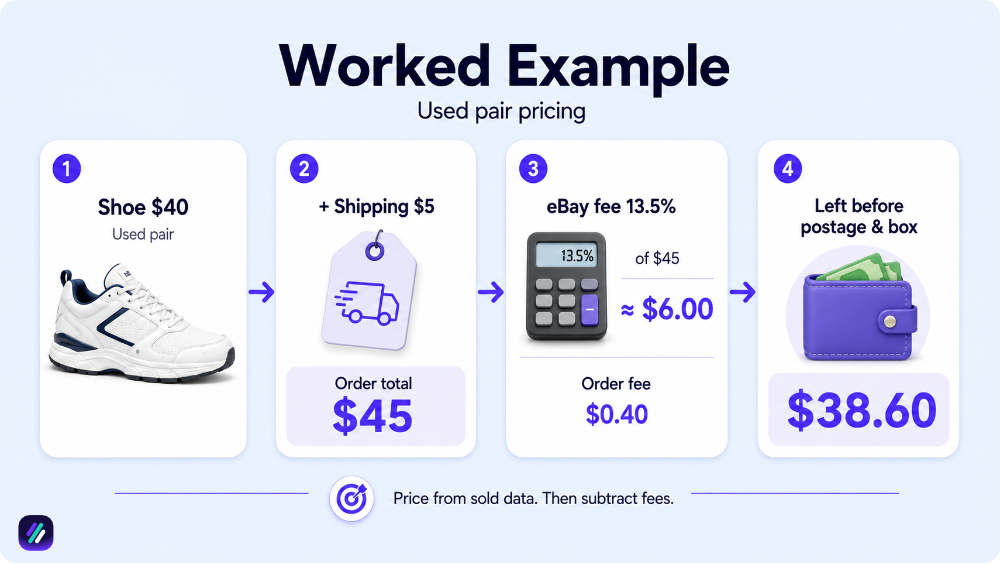
A worked example makes it concrete: say you sell a used pair for $40 with $5 shipping. At the standard rate, eBay takes roughly 13.5% of $45, about $6, plus the $0.40 order fee, leaving near $38.60 before your own postage and box.
Running the numbers first removes the guesswork, and ZIK’s eBay fee calculator shows your net payout and margin before you commit to a price. Fees vary by marketplace and country, so you confirm your region’s current rate.
Step 13: Source More Shoes to Sell
Your margin is decided before you list, in what you pay to source, so this is the half of the business that actually sets your profit.
The goal is simple to say and harder to do: buy shoes below their eBay sold price, which means going where pairs are mispriced rather than buying at retail and hoping.
The sourcing channels that work for shoe resellers are these:
- Thrift stores and outlets: the classic hunting ground, where a $5 pair of barely-worn branded shoes can resell many times over once you know the sold price.
- Liquidation pallets and clearance: end-of-season and returns pallets move branded footwear cheaply, though you sort carefully for condition and odd sizes.
- Your own closet and local listings: Facebook Marketplace and estate sales surface undervalued pairs, and a lot priced as one lump often hides a single pair worth more than the whole.
- Retail arbitrage: outlet and sale-rack discounts on current models can clear a margin once you factor in fees.
One distinction matters here. This is reselling, where you hold the actual stock and control the condition, not eBay dropshipping, and that hands-on control is exactly what protects you from condition disputes on shoes.
From our in-house sellers at ZIK, the resellers who profit are the ones who never pay retail and walk away from any pair they cannot price from sold data and make a profit after all the fees and costs.
Step 14: Open an eBay Store to Cut Fees and Scale
Once you are selling shoes every week, the math on an eBay Store starts to tilt in your favour. A store subscription lowers your final value fee percentage and hands you a block of free listings each month, so past a certain volume, the monthly cost pays for itself.
The decision for you is a simple break-even. If the fee savings plus the free listings outweigh the subscription at your current sales pace, a store earns its keep, but if you sell a handful of pairs a month, it does not yet. The right tier depends on your volume, so you weigh how much an eBay store costs against your monthly sales before subscribing.
A store also adds better tools: bulk listing, vacation settings, and a branded storefront that makes a serious shoe seller look like one.
As we always say, for most sellers, the right moment to subscribe is when listing fees and the standard rate start to feel like a tax on growth.
Step 15: Promote Your Listings and Drive Traffic
A great listing nobody sees still earns nothing, so once your shoes are live and priced, getting them in front of more buyers is the next lever to pull. In a category as busy as footwear, visibility is half the battle.
eBay’s own promoted listings push your shoes higher in search for a small percentage of the sale, and even a modest ad rate can be the difference between a sale this week and a pair that sits. Beyond paid placement, a few free moves drive steady traffic:
- Send offers to eBay watchers, since a shoe sitting on someone’s watchlist often just needs a small nudge to close.
- Run markdown sales on slower stock to refresh interest and clear space for fresh inventory.
- List consistently, because a steady drip of new pairs signals an active seller and keeps your store in front of repeat buyers.
Driving traffic to single pairs follows the same playbook as promoting the whole store, where consistency beats any single clever trick.
Step 16: Become a Top-Rated Seller and Scale with Tools
Top-Rated Seller status is not a vanity badge; it lowers your fees and lifts you in search, which compounds every month it holds.
eBay awards it to sellers who hit a sales-and-transaction minimum, upload tracking on time, and keep their defect and late-shipment rates low. Those same habits are what lift the eBay seller rating that buyers actually judge you on.
Consistently delivering great service also helps you avoid negative feedback, which can affect buyer confidence and your seller performance. Learn how long negative feedback stays on eBay so you know what to expect if you receive one and how to recover from it.
So, for you to scale past that point is two things:
- Reinvesting profit into better inventory
- Removing yourself from the repetitive grind.
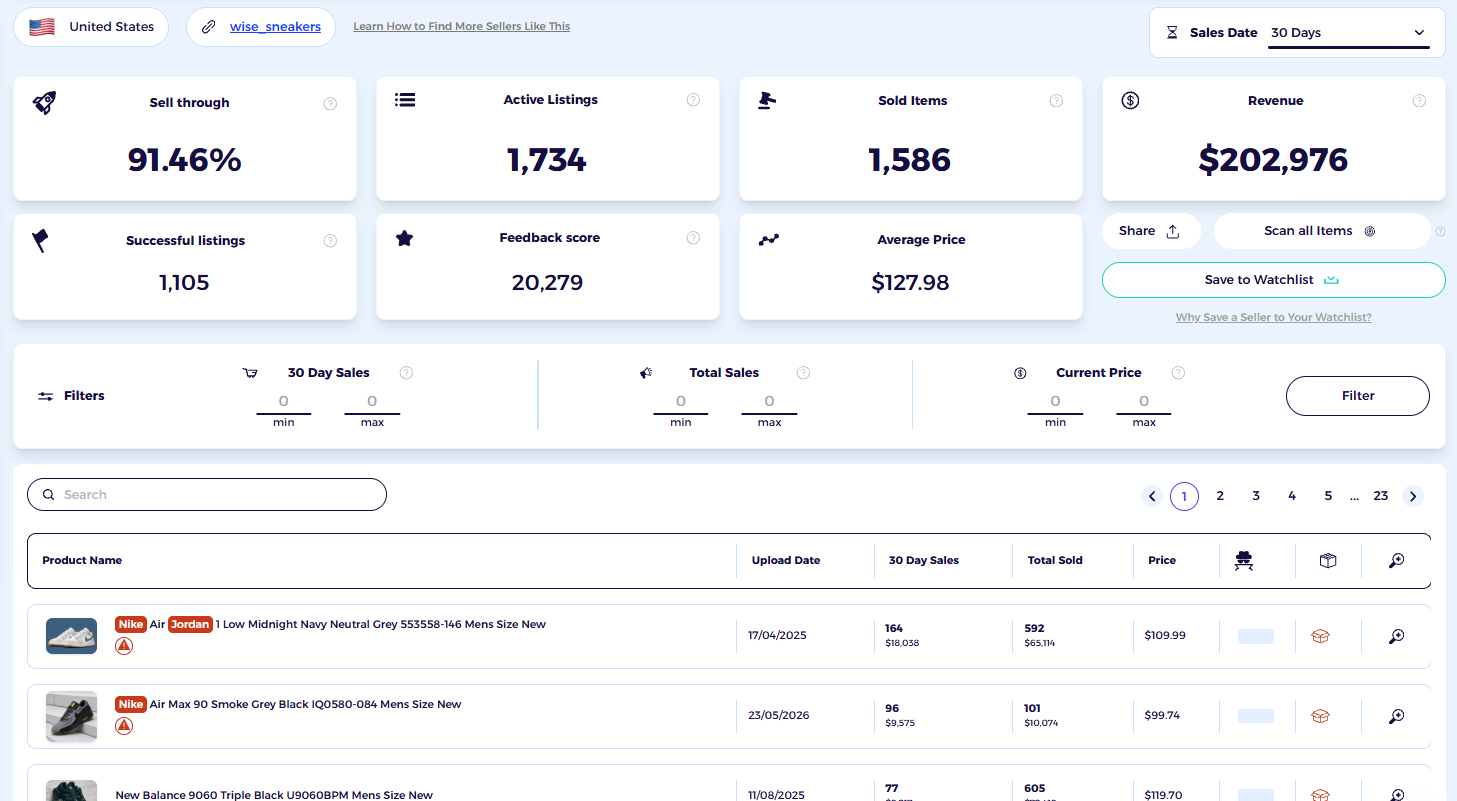
A smart move is studying the sellers already dominating your niche. With the eBay competitor research tool, you can pull a top shoe seller’s revenue, best-selling items, and sell-through rate, then borrow what clearly works.
As you broaden beyond shoes into other profitable inventory, automated sourcing tools like ZIK Autopilot scan supplier catalogs and return supplier-matched winning products with the margin already calculated.
That kind of dropshipping automation software buys back the hours manual research eats, so your time goes to the decisions that move the needle and scaling profit that turns into a side hustle or even a full-time business.
Best Shoes and Accessories to Sell on eBay
The shoes selling best on eBay are not random thrift hauls, they are the categories buyers search for by name and the accessories they reorder without thinking.
These figures come from ZIK’s sample of eBay sales data, so treat them as directional benchmarks of where demand sits rather than a full census; the genuine market runs larger.
Here is how the three biggest footwear categories stack up:
| Shoe type | Live listings | Sales in 30 days | 30-day revenue | The read |
|---|---|---|---|---|
| Sneakers | More than 230,000 | Close to 40,000 pairs | Around $2.3 million | Hottest demand and momentum, but the most crowded |
| Boots | Over 210,000 | Roughly 34,000 pairs | About $2.15 million | Highest average price near $100, best margin room, but seasonal |
| Sandals and clogs | Over 160,000 | About 26,000 pairs | Close to $1 million | In season right now, lower price means faster, cheaper testing |
Across the broad “shoes” search, ZIK shows more than half a million live listings and over 100,000 pairs sold in a month, worth close to $5 million, with a median selling price around $35.
That works out to roughly one sale for every five listings each month, so the demand is clearly there, but the field is crowded. In plain terms, this is a strong niche on a busy battlefield, and the sellers who win pick a lane and prove it against sold data.
Sneakers
Sneakers are the clearest demand in the data and the most competitive lane on the list. The external picture backs it up: Circana reports running was the standout in US footwear early in 2026, with double-digit dollar and unit growth, so athletic and running pairs are riding genuine momentum.
The catch is brand risk. Branded footwear draws strict scrutiny under eBay’s intellectual property policy, so generic low-margin pairs are rough unless you have clean used inventory, liquidation, or outlet stock. Running and athletic pairs in the $25 to $80 resale band are the most forgiving place for a beginner to start.
Sandals and Clogs
Sandals are timed perfectly for right now, and the season is exactly why they are worth a look. Circana found sandals grew in both dollars and units early in 2026, led by slides and flip-flops, which lines up with the steady eBay sales the data shows.
The trade-offs are real, though. The selling window is shorter than sneakers, and ultra-generic flip-flops are easy to source but too thin on margin to bother with. You target clogs, sport sandals, and comfort slides instead, where a recognisable style carries a price.
Boots
Boots carry the best margin room of the three, with the highest average price near $100, but the timing needs a clear head. The AlixPartners spring footwear survey found work shoes and boots dropped 16% in purchase intent, one of the hardest-hit categories heading into the warm months.
Boots are still a strong bet, just a Q3 and Q4 one rather than a summer one. If you are buying ahead for autumn and winter, work, western, Chelsea, and hiking boots are where the higher ticket prices live. If you need sales this week, you start with sneakers or sandals and build your boot inventory for the season ahead.
Shoe Care and Repair
Shoe care products are the quiet winner that dodges most of the drama of branded footwear: they replenish, solve a problem, and carry almost no authenticity risk. In the ZIK samples, a boot and shoe cream polish shows around 17,200 sold and a shoe shine brush over 1,000, which is steady, unglamorous demand.
The drag is the low ticket price, so you make it work by bundling: polish, brush, and applicator together, or kits aimed at a specific material like leather or suede. It is a margin-through-volume game, not a flip.
Shoelaces
Shoelaces are one of the strongest repeated signals in the whole shoe category, and for good reason: tiny shipping cost, almost no breakage, easy variation listings, and zero sizing returns. The ZIK samples show flat athletic laces with over 46,000 sold on a single top title and round hiking laces close behind.
The only real drag is the low order value, so you sell in multipacks and by use case, sneaker, hiking and work boot, no-tie, and kids, rather than one lonely pair at a time. Stacked into bundles, the volume does the work.
Chelsea and Casual Utility Boots
Chelsea and casual utility boots sit in a comfortable middle: better price room than cheap sneakers and accessories, broader appeal than fashion heels, and easier year-round sales than trend-led footwear. A sampled men’s leather Chelsea and chukka listing shows over 2,500 sold, which points to durable everyday demand.
You position these as comfort, work, and casual crossover rather than fashion, because that is how the buyers who actually convert are searching. Generic dress-shoe quality varies a lot, so you stick to recognisable styles and honest condition.
Non-Slip Work Shoes
Non-slip work shoes have something most footwear niches lack: clear buyer intent and repeat demand from restaurant, kitchen, and service workers who need them. The demand is not a fad, either. A CDC NIOSH study found slip-resistant shoes cut slipping injuries among food-service workers by 67%, which is exactly why this stays a steady, practical category.
In the ZIK samples, oil-resistant kitchen work shoes show roughly 1,400 to 1,500 sold per top title, so the lane moves. You test two or three evergreen styles first, black slip-on, oil-resistant, men’s 8 to 12, before widening out.
Those seven cover the live demand, but they are not the whole universe of what sells. If you lean toward kids’ shoes, fast growth and outgrown pairs create constant turnover, and if you go niche with cleats or specialist dance and climbing shoes, smaller but devoted buyer pools will pay up for the right size.
Why eBay Is the Best Place to Sell Shoes
eBay is the default place to sell shoes because the buyers are already there in enormous numbers and the sold-price data is public, so you tap existing demand instead of building an audience from scratch. A well-listed pair sits in front of more shoe shoppers than any local shop could reach.
The scale is the first reason. eBay reports about $79.6 billion in annual sales volume, and footwear is one of its busiest everyday categories, which is why the demand benchmarks earlier in this guide hold up.
The open sold-price history is the second reason, and it is the one that rewards a careful seller.
Because every closed sale is visible, the seller who studies how to sell on eBay properly and prices from genuine data has a built-in edge over the one guessing, which is the whole argument of this guide.
What Kinds of Shoes Can You Sell on eBay?
You can sell nearly any footwear on eBay: new and used sneakers, boots, sandals, heels, flats, work shoes, and shoe accessories, in any condition as long as it is clean and honestly described. The hard limit is authenticity, since counterfeits and unauthorized replicas are banned.
Most sellers come to shoes holding one of a few types, and knowing which you have shapes how you list it. The broad categories that move on eBay break down like this:
- New and deadstock shoes: unworn pairs, with or without the box, that command the top prices, especially sneakers.
- Used shoes: by far the largest pool, where honest condition grading is everything and a clean used pair still sells well.
- Branded sneakers: the highest-demand and highest-scrutiny slice, where Authenticity Guarantee and IP rules come into play.
- Accessories and care: laces, insoles, polish, and shoe trees, lower ticket but steady and low-risk.
Used shoes are explicitly allowed, which surprises some beginners, so a cleaned and accurately described worn pair is a legitimate listing.
The line you do not cross is counterfeits: fakes, unauthorized replicas, and pairs using a brand’s trademark deceptively get pulled fast.
Download this eBook now and learn how to sell on eBay like a pro.Is It Worth Selling Shoes on eBay?
Yes, selling shoes on eBay is worth it, as long as you treat it as a sourcing-and-pricing game, not a lottery. Demand is large and constant, but the field is crowded, so the sellers who profit buy below sold price and list from data.
The demand is not in doubt. The ZIK benchmarks across sneakers, boots, and sandals point to tens of thousands of pairs changing hands every month and millions in sales, even on a sample of the full marketplace. That is a live market with money moving, not a graveyard of hopeful listings.
The competition shows up in those same numbers. Roughly one in five listings sells in a month on the broad search, which tells you demand is steady but spread thin across a busy field.
I’ll be straight with you, because the get-rich version of this is everywhere and it is wrong: you do not win by listing whatever you have and waiting. The profit is made before the sale, in what you pay to source and how accurately you price. Get those two right and shoes are a strong category to build on.
Best Tips to Sell Shoes Faster and for More Money
A handful of small habits, none of them a step on their own, separate sellers who move shoes quickly from those who watch them sit. These are the polish on top of a solid process:
- Build a feedback base first. List cheap, fast, well-packed pairs early so your higher-value listings carry the trust a buyer needs before spending serious money on a sneaker.
- Write the buyer’s search terms into the title and specifics, not just the obvious ones, since the long-tail phrase is often where a less-competed sale hides.
- Price a hair under the last sold comp. Buyers sorting low-to-high reward the listing that just undercuts the field, and the few cents you give up buy you speed.
- Bundle slow stock into themed lots, like a set of kids’ shoes by size or a pile of laces by type, which moves far faster than the pieces alone.
- Answer questions within hours, because on a hesitant higher-value buyer, a quick, knowledgeable reply is often what closes the sale.
- Refresh stale listings with “sell similar” so a pair that has sat for weeks gets fresh search standing instead of sinking out of sight.
Find Best-Selling Shoes on eBay with ZIK Analytics
Every smart decision in this guide comes back to one habit: deciding from genuine sales data instead of hope. That is the part ZIK Analytics handles for you:
- The eBay product research tool shows actual sales, sell-through, and the price band on any shoe keyword before you list.
- The eBay competitor research tool lets you study a shoe seller who already dominates your niche, including their revenue and best sellers.
- The eBay keyword tool builds your 80-character title from the terms shoe buyers actually search.
That is the difference between a shoe business built on verified demand and one built on guessing. You can try all three on a $1 trial (7-day) and run your first sold-data check today.
How to Sell Shoes on eBay: Frequently Asked Questions
A few quick answers to the questions shoe sellers ask most before they list.
What percentage does eBay take for shoes?
For most shoes sold without a store, eBay’s standard final value fee is around 13.5% of the total sale, plus a per-order fee of $0.30 on orders of $10 or less and $0.40 above that. The percentage applies to the item, shipping, and tax combined. Sneakers sold at $100 or more are the exception, carrying a reduced 8% fee, and rates vary by marketplace.
Is it hard to sell shoes on eBay?
It is not hard to start, but it is competitive to do well. Listing a pair takes minutes, yet standing out in a category with hundreds of thousands of live listings takes honest grading, a searchable title, and prices pulled from sold data. The mechanics are easy; the discipline of sourcing cheap and pricing accurately is what takes practice.
What is the downside of selling shoes on eBay?
The main downsides are competition, fees, and returns. The field is crowded, eBay takes its cut on every sale, and sizing or condition mistakes lead to “not as described” cases that hurt your seller rating. Branded sneakers also carry authenticity risk. None of these are dealbreakers, but they are why careful listing and accurate sizing matter so much.
What shoes sell the most on eBay?
Sneakers sell the most by volume and revenue, with running and athletic pairs riding strong current demand, followed by boots and then sandals. Accessories like shoelaces and shoe care also sell in surprising volume at low prices. The pairs that move fastest are the ones buyers search for by brand and model, not generic unbranded shoes.
Can I make $1000 a month selling shoes on eBay?
Yes, but it is realistic rather than passive. Reaching $1,000 a month means consistent sourcing below market, steady listing, and accurate pricing, not a single lucky flip. Most sellers get there by reinvesting early profits into more inventory and tracking what actually sells, using a tool like the eBay Product Research Tool to focus on pairs with proven demand.
Should I sell my shoes new or used?
Both sell well, so it comes down to what you can source profitably. New and deadstock pairs command the highest prices, especially sneakers, but used shoes are by far the largest market and can be very profitable when you grade honestly and price from sold comps. A clean, accurately described used pair often sells faster than an overpriced new one.
Is eBay good for shoes?
Yes, eBay is one of the best places to sell shoes thanks to its enormous buyer base and open sold-price data across every shoe type and price point. You can sell new, used, common, or rare pairs and find genuine demand for almost any of them. For reach and pricing transparency, it is hard to beat for a footwear seller.
How much will eBay take from a $100 sale?
It depends on the shoe. On a standard $100 shoe sale without a store, eBay takes around 13.5% plus the $0.40 order fee, roughly $13.90, leaving about $86. On a $100 sneaker that qualifies for the reduced 8% sneaker rate, eBay takes closer to $8.40, leaving near $91.60 before your shipping and packaging costs.