
Most people with a longbox in the closet have no idea which comics are worth serious money and which are worth a dollar.
So they tip the whole box into one bargain listing, price it on their sentiment, and the few genuine keys get buried under filler nobody searches for. The box sits for weeks, or a sharp buyer scoops the good books for the price of the bad ones.
In this guide, I will show you how to sell comics on eBay the way steady sellers do it: sorting and grading, pricing from sold listings, listing and shipping so nothing arrives bent, and knowing which books move.

Key Takeaways
- Sorting is the most essential step in getting value out of your comics. Reading the publisher, the issue number, and the key-issue status of every book is what separates an $80 comic from the 80-cent reading copy next to it.
- Price from sold listings, never from asking prices. A book listed at $50 that never sells tells you nothing; one that sold three times this week at $14 is the market talking.
- ZIK Analytics lets you see what comics are actually selling, at what sell-through, and against how much competition before you ever create a listing, so you anchor to genuine demand instead of a hopeful number.
- eBay’s final value fee on comics runs about 13.25% of the total sale, plus a small per-order charge, and you want that built into your price before you list your product.
- Grading only pays off on genuine and high-grade comics. A grading fee on a $10 book turns a small profit into a guaranteed loss.
- The comics moving fastest are collected editions, manga sets, current superhero singles, and sought-after variants that buyers search for by name, not random mixed boxes.
Step 1: Create Your eBay Account and Set Up Payments
So let’s say you have decided the comics you have are worth selling rather than hoarding. The first thing you need to do is to create an eBay seller account to learn how to sell on eBay.
A personal account is fine to begin with, and you can switch to a business account later, once volume grows and you want cleaner tax records and better selling tools.
Since new accounts come with eBay selling limits, expect a capped number of listings at first and raise it as you build a track record. That is standard for every eBay seller that just starting.
Payments run through eBay directly now and are paid out to your linked bank account. Since PayPal is no longer the required payout channel, you should link and verify your bank before you list, because an unverified account can hold up your first payouts.
Step 2: Sort, Organize, and Identify the Comics You Want to Sell
Before a single comic goes live, you need to sort the cheap ones from the “sought-after” editions. It’s very important because a book you misjudge here is money you either leave on the table or waste listing one at a time.
The good news is that a comic tells you almost everything about itself if you know where to look.
How to Identify the Issue Number, Publisher, and Key-Issue Status
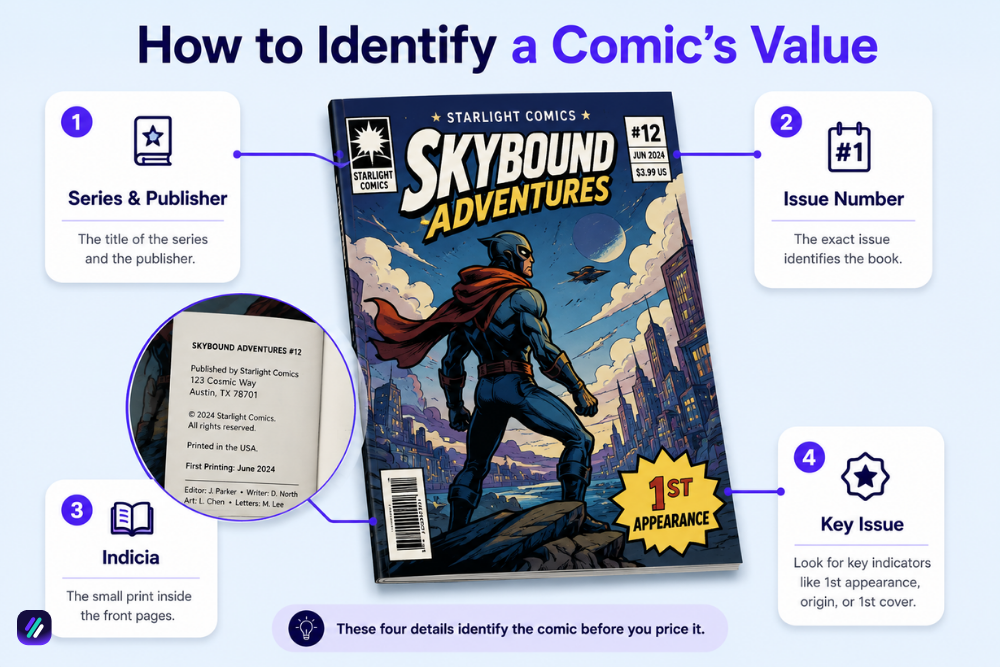
Three things place a comic and start to set its value, and all three are printed right on the book.
The cover and the indicia (the small print block inside the front pages) give you the series title, the publisher, and the exact issue number, so you know whether you are holding Amazing Spider-Man #300 or a reprint.
The fourth indication is the one that moves prices the most: key-issue status. A key is a book that matters to collectors, like a first appearance, a first cover, an origin, or a major death, and those sell for multiples of a regular issue from the same run.
You confirm a key-issue status by searching the exact series and issue number and reading what the sold listings call it. If buyers are paying up for “1st appearance” or “1st cover,” you might have a key, and you list it on its own rather than buried in a lot.
Separate Raw Comics, Graded Comics, and Comic Lots
With the books identified, you split them into groups that each sell differently.
The typical raw comic is ungraded, sold on the way you just described it; a graded comic has been inspected and scored by a third party; and a lot is a bundle of lower-value books sold together. Here is a simple way to triage a collection:
| Pile | What goes in it | What to do with it |
|---|---|---|
| Key singles | First appearances, hot keys, high-grade moderns, sought-after variants | Research and list each one on its own |
| Sellable singles | Mid-value books with steady, ordinary demand | List individually or group into small runs |
| Graded slabs | Anything already in a CGC or CBCS holder | List with the cert number and ship in a rigid box |
| Bulk | Low-value commons, reading copies, and damaged books | Sell by the lot, never one by one |
Once each book has a pile, you know roughly what you are holding. Pricing the key and sellable piles is what we tackle in Step 3, and it is where most of the profit is won or lost.
How to Assess Comic Condition (Grade) Honestly
Condition is the other half of value, and comics are graded on a 10-point scale from Poor up through Good, Fine, Very Fine, and Near Mint to a perfect Gem Mint. Buyers observe closely, because a Near Mint copy and a Very Good copy of the same issue are priced differently.
The defects that affect grade are spine ticks, stress lines, color-breaking creases, corner wear, off-centre staples, and yellowed or brittle pages. You should describe every flaw the photos show, plainly, rather than rounding your own grade up.
You handle each book by the edges from the start, and an honest grade is what keeps a “not as described” case from landing in your messages after the sale.
Step 3: Research Comic Values Using Sold Listings and Comps
Now that your piles are sorted, it’s time to start pricing and get the value out of your comics. The rule is easy to say and hard to resist breaking: price from what comics have already sold for, never from what other sellers are asking.
An unsold listing at $50 is a wish. A book that sold three times this week at $14 is the market talking back to you.
So your move is researching eBay sold listings. On eBay itself, search for the exact series and issue, then filter the results to sold items to see actual closing prices and dates.
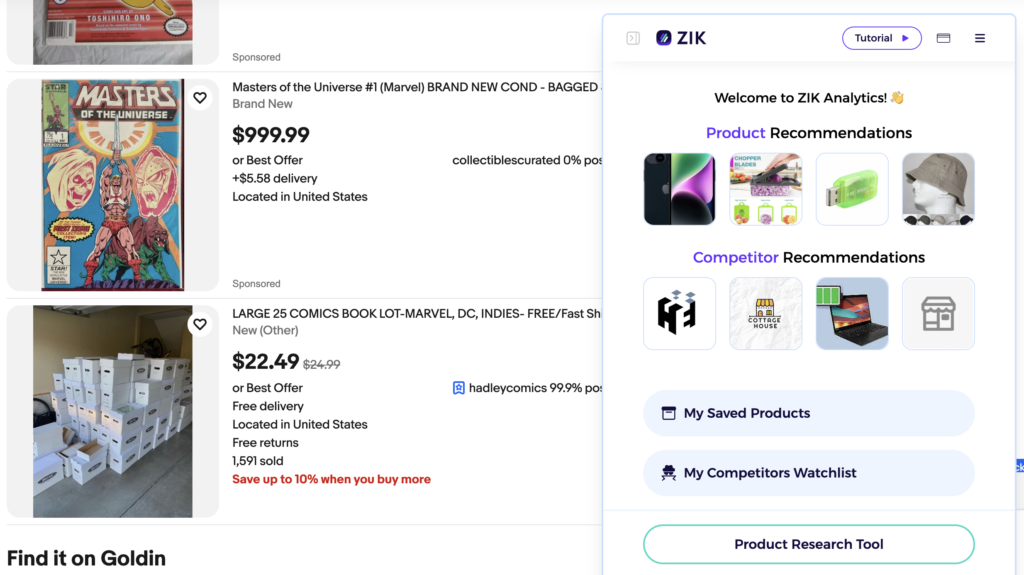
To check faster while you browse, the free eBay chrome extension from ZIK pulls sold history and competitor data straight onto the listing page.
A few habits keep your pricing honest:
- Recent sales over old ones: comic prices swing with movie news, deaths, and reprints, so a comp from six months ago can be badly out of date.
- Like-for-like grade: a Near Mint sold price is the wrong anchor for a creased copy, so adjust down honestly when yours is rougher.
- Fees before the final number: with eBay taking its cut on every sale, a book that “sells for $20” nets you noticeably less, which we break down in Step 13.
Those three habits turn your prices from guesses into decisions.
Use ZIK Analytics to Validate Demand Before Listing
Sold comps tell you the price of one book. What they do not tell you is whether a whole category is worth your time, and that is the question to answer before you source more of it.
With the eBay product research tool, you can search any comic keyword and see the actual sales, the sell-through rate, the price band buyers really pay, and how much competition you are up against.
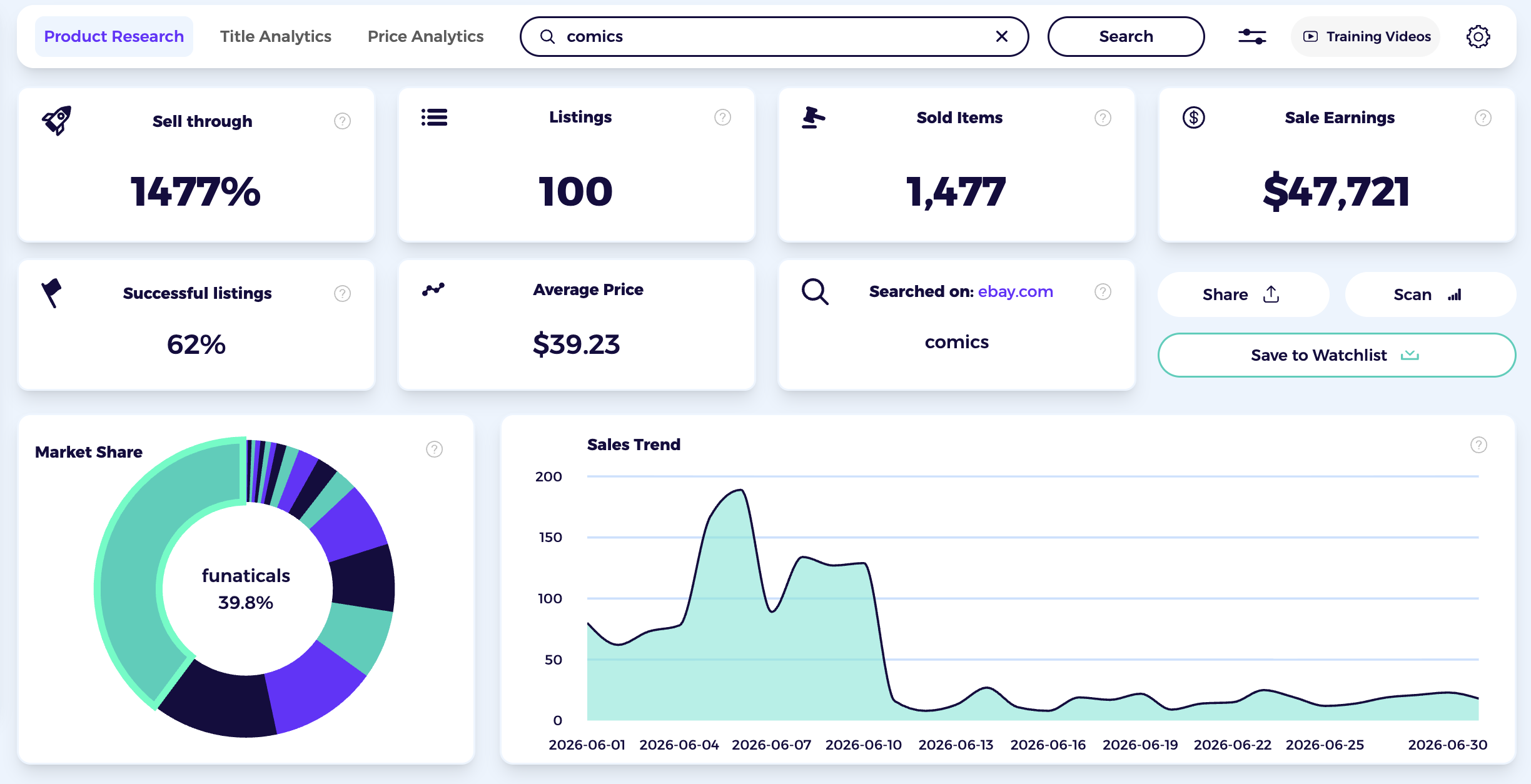
You commit to a verified demand that way, instead of stocking up on a title that looks hot but barely moves. That distinction matters most when you are deciding what to buy more of, which is exactly what Step 14 on sourcing comes back to.
Step 4: Decide Whether to Sell Individually, as a Run, or as a Bulk Lot
Now that your sold-listing research from Step 3 tells you what each book is worth, it’s time to decide on how to sell your comics, whether by individual or by bundle.
A genuine key earns the most on its own, where its title and grade get full attention, while a stack of commons can be valued more when bundled, where the convenience is the product.
When to List Comics Individually
You list a comic on its own when it can stand out on an individual listing: keys and first appearances, high-grade moderns, scarce variants, and anything a buyer would type a specific name to find. Each one deserves its own title, its own photos, and a price pulled from its own sold comps.
When to Sell Comics in Lots
Lots are how you make slow commons and reading copies sold without listing them one at a time. The idea is to give the lot a theme a buyer can picture using, a single character, one series, or one era, rather than a random mixed box.
From our in-house eBay sellers at ZIK, grouping a lot by character or publisher moves it far faster than dumping everything into one generic pile. A “50 Batman comics” lot sells; a “50 assorted comics” lot mostly sits.
Step 5: Calculate Your Profit Before You List
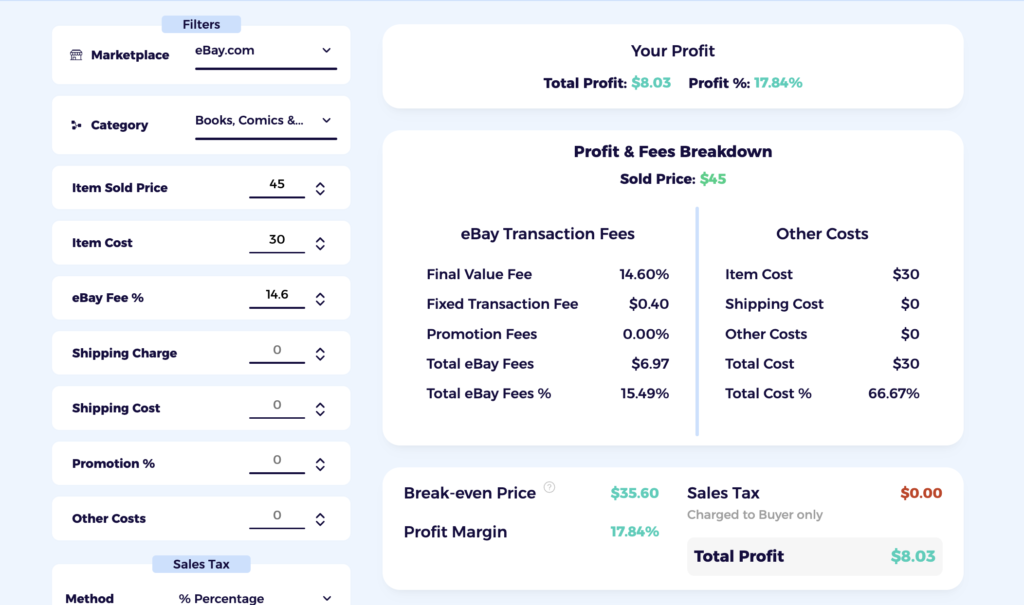
Before you start deciding on a listing price for your comics, run the math, because there are still fees to be aware of. Your profit is what is left after eBay’s fees, your shipping cost, your bag-and-board supplies, and whatever you paid for the book in the first place.
So here’s the general formula:
Net profit = sale price − eBay fees (about 13.25% + per-order fee) − shipping − supplies − what you paid for the comic.
Running that before you list is what stops you from “selling” a $6 book for a 40-cent loss once postage and a mailer come out. ZIK’s eBay fee calculator shows your net payout and margin on a sale before you commit to a price, so you can set a floor you will not regret.
Step 6: Decide Whether to Grade Your Comics (CGC, CBCS, or Raw)
Grading is where beginners get lost, so they end up paying random and unauthorized people to grade their comics.
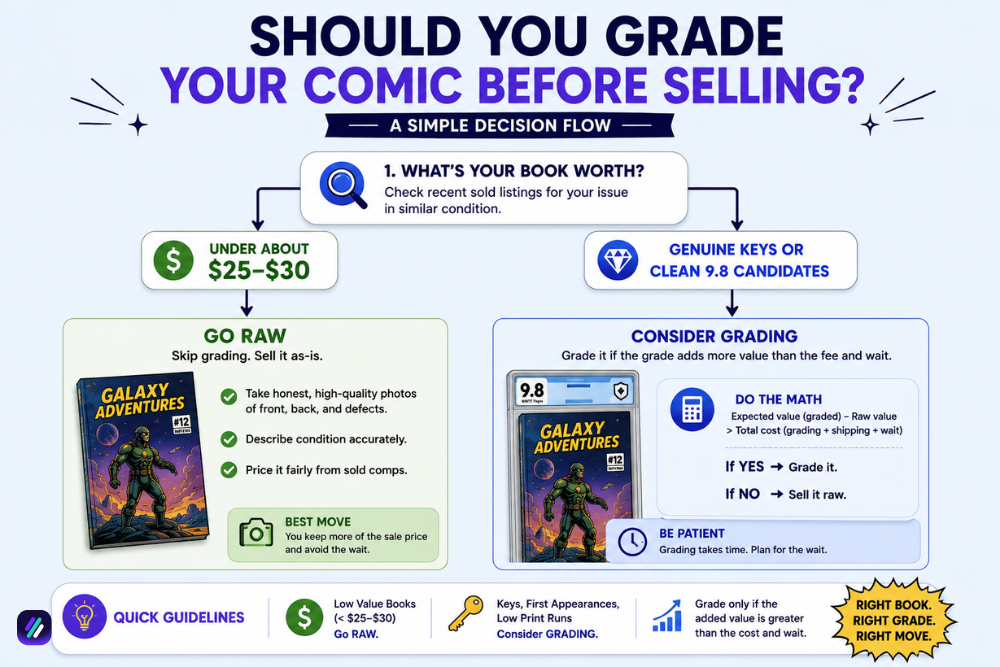
The two main companies, CGC and CBCS, seal a book in a tamper-evident holder and assign it a numeric grade. That grade makes the buyer trust more.
The cost is what decides it. CGC’s modern grading starts around $30 per book and climbs once you add pressing, shipping, and a membership, so all in, you are often looking at $50 to $65 on a small batch.
On a $10 comic, that fee erases the profit and freezes your cash for weeks.
On a genuine key or a clean 9.8 candidate, the same fee can pay for itself several times over, because a high grade reassures buyers who would never trust a raw listing at that price.
CGC has also made larger modern submissions easier with a Modern Bulk tier that lowers the per-book cost when you send in volume.
How CGC Expert Review on eBay Works and How to Avoid Scams
For higher-value books, eBay and CGC run an Expert Review service that adds a layer without a full grading turnaround. A CGC expert reviews your listing photos and gives a preliminary opinion.
The Authenticity Review costs $5 per item and returns Likely Genuine, Likely Not Genuine, or Inconclusive, while the Authenticity and Grade Review costs $10 and adds a preliminary grade range. The fee even comes back as a voucher toward full CGC grading.
Comics attract a few specific scams, so a little caution saves you costly losses. Restored, trimmed, or resealed books sometimes get sold as untouched, and counterfeit slabs do exist.
When you resell a graded comic, you should check the cert number on the grader’s own site before listing it, and photograph the actual book so a “switched item” return cannot stick.
Step 7: Bag, Board, and Protect Your Comics Before Listing
Any damage that a product receives during storage can surely affect the price, so the moment you decide to sell, you protect it.
Every book goes into an acid-free bag with a backing board behind it, which keeps the cover flat and the corners from bending in storage and in transit.
You must keep the books upright, out of direct sunlight, and away from damp, because heat and humidity are what turn a Near Mint copy into a warped one. For your better books, mylar sleeves cost more, but slow yellowing is far better than standard poly bags.
All of these procedures are cheap. A 30-cent bag and board protect a grade that might be worth fifty times that.
Step 8: Create a Comic Listing on eBay
Two things do most of the work in a comic listing: the title and the item specifics. Getting those right means eBay assigns your book to the exact people already searching for it, and getting them wrong hides even a great comic where nobody looks.
Fill Out Comic Item Specifics Completely
Every field eBay offers, including the publisher, the series title, the issue number, and the publishing period, allows you to get scooped out during a filtered search. A blank field removes your book from every buyer who filters by that detail. So you have to fill them all, even the optional ones.
How to Write a Comic Listing Title That Gets Found
Your title is built from the exact words a collector types. Something like “Amazing Spider-Man 300 1st Todd McFarlane Venom Cover VF/NM” tells eBay and the buyer precisely what it is, and it doesn’t need a lot of explanation.
To find the terms buyers actually use, the eBay keyword tool from ZIK pulls high-demand keywords and long-tail phrases out of genuine sales data, so your 80-character title is built on what sells rather than on instinct.
You want every word to provide value with a searched term, not filler like “rare” and “L@@K.”
How to Photograph or Scan Comics That Sell
On a comic listing, your photos are the proof of condition, since the buyer cannot hold the book. A reliable shot list covers the front cover straight on and sharp, the back cover, the spine, and a close-up of any defect you mentioned in the description.
For graded books, you shoot the slab front and back so the label and cert number read clearly.
Shooting the actual comic in bright, even light is very easy, and you can sell your product through this, and nailing the basics in how to take pictures for eBay pays off on every listing after this one.
Step 9: Choose Auction vs Buy It Now (and Best Offer) for Your Comics
With your listing built in Step 8, the selling format is the next big lever on your final price.
Buy It Now suits books with a settled market price and hands you control; auctions suit scarce or hard-to-price keys where bidding does the work, and Best Offer sits in the middle for mid-value books where a little negotiation closes the sale.
Here is how the three compare on what matters:
| Format | Best for | The trade-off |
|---|---|---|
| Buy It Now | Commons, runs, and any book with a known sold price | Sits unsold if you price above the market |
| Auction | Rare keys, hot first appearances, and graded slabs | The market sets the price, which can run low on a quiet day |
| Best Offer | Mid-value singles where buyers like to haggle | You field lowball offers and decide where to hold the line |
But the format is only half the call. If you do run auctions, end them in the evening on a weekend when the most bidders are watching, and start the price low to pull early bids in.
Choosing well between eBay buy it now vs auction per book is what protects your final price and profit.
Step 10: Ship Comics Safely and Cheaply
Shipping is where a clean sale turns into a five-star review or a refund, because a corner bent in transit is a damaged book on arrival. The rule is to pack so the comic cannot move and cannot bend, then match the service to the value.
For a raw single, you bag and board the book, sandwich it between two pieces of rigid cardboard taped into a no-bend mailer, and send it tracked.
For heavier lots, a sturdy box with the books bundled and padded keeps the stack from shifting, and tracking protects you if a buyer claims it never arrived.
Matching the packing to the value, which is the heart of how to ship on eBay, is what keeps cheap shipping from turning into an expensive refund. You pack as if the carrier will be careless, because sometimes they are.
How to Ship Graded (Slabbed) Comics Safely
A slab is rigid until it is not, and the holders crack under pressure or a sharp drop. You wrap the slab in bubble wrap, suspend it so it does not slide, and ship it in a box, never a soft envelope.
For higher-ticket graded books, add insurance and signature confirmation so you are covered in a dispute. A cracked slab often means a regrade and a serious drop in value, so the extra padding is the cheapest part of the sale.
Step 11: Manage Payouts and Taxes
eBay handles your money in-house now, so once a buyer pays, the funds clear and are paid out to your linked bank on eBay’s schedule, usually within a couple of business days of the sale confirmation.
Taxes are the part beginners ignore until it bites. In the US, a payment platform only has to send you a Form 1099-K once your sales pass $20,000 and 200 transactions in a year, after the lower phased-in thresholds were repealed.
Two things matter regardless of the form, though. Your comic income is taxable whether or not a 1099-K is ever issued, and some US states set their own lower reporting thresholds, so you may receive one below the federal limit.
Tax rules vary by country, so the figures here are for the US case and not an exhaustive global list. It pays to keep simple records of what you paid for books and what you sold them for, because that cost basis is what keeps your tax bill fair.
Step 12: Handle Returns, Customer Service, and Avoid Scams
Most comic returns are avoidable, and they trace back to two things: a listing that oversold the condition, or packaging that allowed the book to be damaged. Fix both upstream, and most of the friction disappears before it ever reaches your messages.
When a genuine issue does land, a fast, calm refund handled under the eBay return policy protects your account far more than winning the argument does. Comics also attract a few specific scams worth guarding against:
- The switched-book return: a buyer claims the comic arrived damaged, then returns a worse copy. Photographing the exact book you ship, with a slab’s cert number visible, is your proof.
- The empty-package or item-not-received claim: tracking on everything, plus signature confirmation on higher-ticket sales, settles these in your favour.
- The counterfeit or restored book: eBay’s counterfeit item policy bans unauthorized reprints outright, and unknowingly listing a restored book as untouched invites a case, so describe the condition exactly.
Step 13: Know Your eBay Comic Fees and Profit Margins
eBay takes a cut of every sale, so you want to know the number before you price a single book.
For most sellers without a store subscription, the final value fee on comics is about 13.25% of the total sale, plus a per-order fee of $0.30 on orders of $10 or less and $0.40 on orders above $10. That percentage applies to the item price, the shipping, and the tax combined.
A worked example makes it concrete. On a $40 comic with $5 shipping, eBay takes roughly 13.25% of $45, about $5.96, plus the $0.40 per-order fee, leaving you with $38.64 before your own mailer and postage.
A seller who prices as if that cut does not exist watches the profit slip away on every sale. Fees and rates also vary by category and by eBay marketplace, so confirm your region’s current rate, and if your volume climbs, the eBay Store subscription in Step 15 lowers that percentage.
Step 14: Source More Comics to Sell
Your margin is decided before you list, in what you pay to source, so this is half of the business that actually sets your profit. Buy comics below their eBay sold price, which means going where collections are mispriced instead of paying retail and hoping.
The sourcing channels that work for comic resellers are these:
- Local collections: estate sales, Facebook Marketplace, and garage sales are where undervalued longboxes surface, and a box priced as a lump sum often hides keys worth more than the whole.
- Comic shops and conventions: dollar bins and back-issue walls let you cherry-pick, and a good con can fill gaps in the runs you are building.
- Bulk lots to break: a cheap mixed lot can be split into keys, sellable singles, and bulk, with the keys often covering the entire cost of the lot.
One distinction matters here: this is reselling, not eBay dropshipping. You hold the actual books, control the condition, and ship them yourself, which is exactly what protects you from the condition disputes that sink careless comic sellers.
Download this eBook now and learn how to sell on eBay like a pro.Step 15: Open an eBay Store to Cut Fees and Scale
Once you are selling comics every week, the math on an eBay Store flips in your favour. A store subscription lowers your final value fee percentage and hands you a block of free listings each month, so the monthly cost starts paying for itself past a certain volume.
If the fee savings plus the free listings outweigh the subscription cost at your current sales pace, a store is worth it; if you sell a handful of books a month, then it’s not worth subscribing. You can weigh how much is an eBay store costs against your monthly sales before you subscribe.
A store also adds better tools: bulk listing, vacation settings, and a branded storefront that makes a serious comic seller look the part. For most sellers, the right moment is when listing fees and the standard rate start to feel like a tax on growth.
Step 16: Promote Your Listings and Drive Traffic
A great listing nobody sees still earns nothing, so once your comics are live and priced, getting them in front of more buyers is the next lever to pull.
eBay’s own Promoted Listings push your books higher in search for a percentage of the sale, and in a category as deep as comics, a modest ad rate can be the difference between a sale this week and a book that just sits.
Beyond paid placement, a few free strategies drive steady traffic to your listings:
- Send offers to watchers, since a comic sitting on someone’s watchlist often just needs a small nudge to close.
- Run markdown sales on slower stock to refresh interest and clear shelf space for new inventory.
- Cross-promote your own listings so a buyer looking at one book sees your others, which lifts your average order value.
Step 17: Become a Top-Rated Seller and Scale with Tools
Top Rated Seller status gives you a massive boost when selling on eBay. It lowers your fees and lifts you in search, and both compound over time.
eBay awards it to sellers who hit a sales-and-transaction minimum, upload tracking on time, and keep their defect and late-shipment rates low.
The habits that earn the badge also increase your eBay seller rating, the score eBay actually judges you on, so they are worth building early rather than chasing later.
A smart move at this stage is studying the sellers already dominating your niche. With the eBay competitor research tool, you can pull a top comic seller’s revenue, best-selling books, and sell-through rate, then borrow what works for your own listings.

Best Comics to Sell on eBay
The comics moving best on eBay right now are the ones buyers search for by name: collected editions, manga sets, current superhero singles, and sought-after variants, not random mixed boxes.
Here is how the strongest categories stack up, by demand and price point, so you can prioritize what to source.
Omnibus editions and premium collected hardcovers
ZIK data scores omnibus and premium hardcover editions the highest in this list, on the back of strong buyer intent, higher price points, and steady movement in the samples.
Buyers happily pay up for a sealed or like-new omnibus that collects a whole run in one volume.
Books like the Ultimate Spider-Man Omnibus, the Justice League New 52 Omnibus, or a Batman Golden Age Omnibus do best when they are pristine. The safest plays are recognisable runs from Batman, Spider-Man, X-Men, and Justice League.
Manga sets and longer manga runs
Manga sets are great in the wider market, as retailers surveyed by ICv2 expected manga to be the top growth category for 2026. Complete English sets and longer runs are the sweet spot.
The Bleach 1-74 sets, Dragon Ball volumes, an Attack on Titan Colossal Edition, or a 10-plus volume starter bundle all move well. Because manga sits alongside graphic novels in the same buying habit, the listing instincts from how to sell books on eBay carry straight over.
Current hot superhero single issues
The broad superhero bucket is your biggest demand pool, full of active Batman, Spider-Man, X-Men, and Action Comics singles. The market backdrop favours it too, with ICv2 naming DC’s Absolute Batman wave a major traffic driver in the direct market.
New books tied to hot runs, relaunches, and recent reprints are where the fastest action sits. An Absolute Batman later printing, a current Amazing Spider-Man cover-select issue, or a buzzed-about first issue all fit the pattern.
Variant covers and incentive covers
Collectors pay for scarcity, art, and cover choice, and “cover select” issues, store exclusives, and sketch-style variants move steadily. This works best when the character is already liquid.
A Skottie Young variant or a store exclusive on a Batman or Spider-Man book sells faster than a variant of a title nobody is chasing. Recognisable artist plus a Marvel or DC headliner plus clean condition is the combination that performs.
Themed comic lots
Lots remove decision friction for buyers and let you turn lower-value singles into cash fast. The whole trick is to theme them by character, publisher, or era, instead of shipping a random mixed box.
A Green Lantern lot or a Harley Quinn-themed bundle is something a buyer can picture owning. An unsorted “100 assorted comics” pile is a much harder sell.
Trade paperbacks and Epic Collections
Trade paperbacks (TPBs) and Marvel’s Epic Collections are among the most consistent sellers because buyers love a complete arc without omnibus pricing. A Moon Knight Epic Collection, an X-Factor volume, a stack of Hellblazer trades, or a Nightwing collected edition all give a reader the whole story in one affordable book.
Marvel Epic Collections, DC classics, and horror or fantasy runs are the reliable performers here.
Free Comic Book Day books and promo issues
This is a seasonal micro-opportunity, and the timing is right: Free Comic Book Day (FCBD) 2026 officially took place on May 2, 2026. Promo issues, previews, and first appearances tied to the event sell best while it is still fresh.
A FCBD 2026 LEGO Batman tie-in or a Sonic the Hedgehog FCBD issue is worth listing quickly rather than sitting on.
Key vintage issues and first appearances
This is the highest-upside category and the one that demands the most expertise. Vintage keys like a Silver Surfer #10, a Shogun Warriors #1, or an Incredible Hulk #180 reach the top prices.
They also carry the most risk, since misjudging grade, restoration, or a key’s demand is an expensive mistake. You go deep here only if you can identify keys accurately and photograph defects honestly.
Graded comics
Grading creates trust and can widen your buyer pool, which is why CGC-slabbed books like a modern 9.8 or a vintage key sell with less friction than a raw copy at the same price.
CGC also made bulk modern submissions easier with a Modern Bulk tier, which helps sellers who move larger quantities of newer books.
Modern 9.8 candidates, key first appearances, and premium variants are the books most worth the slab.
Complete runs and story arcs
Buyers love convenience, especially for bingeable storylines and reading runs, so a clean set of consecutive issues often sells for more than the same books scattered.
A partial Walking Dead run, a numbered Batman or Spider-Man arc, or a sequential Transformers bundle reads as one purchase rather than a hunt.
The sweet spot is a 5-to-20-issue arc with clean numbering stated plainly in the title.
All-ages / YA graphic novels
This is a stable, giftable category, and the market context stays favourable: adult graphic novel sales rose 9.2% in Circana BookScan reporting, with the broader graphic novel category still a major share of comics sales.
Series like Dog Man, Wings of Fire, Raina Telgemeier’s books, and the Baby-Sitters Club graphic novels move best in bundles of two to five in very good or better condition.
Compact / digest editions of major classics
This one is more of a medium-term trend play. Publishers have leaned into smaller-format, lower-price collected editions to reach manga-style and bookstore buyers, and DC’s Compact Comics line is one example of that shift.
Recognisable evergreen stories that newer readers already know, such as Batman: Hush, All-Star Superman, or Watchmen in compact form, are the ones worth stocking.
These are where the live demand sits, but they are not the only comics that sell. You pick the category that matches your sourcing edge, then prove it against sold data before you go deep.
What I Would Avoid or Handle Carefully
Not every comic is worth the effort, and a few are margin traps in disguise. Before you commit shelf space, these are the categories to be careful with:
- Random unsorted junk lots are hard to title, hard to photograph, and lower the trust your store is trying to build.
- Comic-adjacent merch disguised as comics pulls figures, trading cards, and supplies into a broad search, so list it in its own category rather than mixing with your comic listings.
- High-dollar vintage without grading knowledge is too easy to misprice, both up and down, until you have learned keys and restoration.
- Heavy-IP modern books, if you are thinking true dropshipping, have great sell-through but genuine condition-control and account-health risk, which is why this guide treats comics as inventory you own.
Why eBay Is the Best Place to Sell Comics
eBay is the default home for selling comics. Buyers here are already in enormous numbers, and the sold-listing history is public, so you tap into existing demand instead of building an audience from scratch.
The scale is the first reason. eBay reports more than 135 million active buyers worldwide and nearly $80 billion in annual sales, and comics are one of its deepest collectible categories. No local shop or Facebook group puts your book in front of that kind of audience.
Of course, eBay is not the only venue, so it helps to know where each one wins. Here is how eBay compares to the live-selling app Whatnot and a general resale app like Mercari:
| Platform | Best for | The trade-off |
|---|---|---|
| eBay | Any comic, any price, with the biggest buyer pool and open sold-price data | Competition is heavy, and fees apply to every sale |
| Whatnot | Live auction selling, breaks, and fast-moving modern books | You sell live on camera, on a schedule, not at your own pace |
| Mercari | Quick, low-fee sales of mid-value books to casual buyers | Smaller collector audience and weaker price discovery |
What Kinds of Comics Can You Sell on eBay?
You can sell almost any comic on eBay: modern singles, vintage keys, variants, graded slabs, omnibuses, manga, and bulk lots, in any condition from Gem Mint to a reading copy. The one hard limit is authenticity, since counterfeit and unauthorized reprints are banned.
Most sellers come to comics holding one of a few types, and knowing which you have shapes how you list it. The broad categories that move on eBay break down like this:
- Modern and current singles: new and recent issues, including the variants and cover-select books collectors chase week to week.
- Vintage and key issues: older books and first appearances, where grade and authenticity matter most.
- Collected editions: trade paperbacks, Epic Collections, omnibuses, and manga sets, sold as complete stories.
- Graded slabs and lots: CGC or CBCS books at one end, themed bulk bundles at the other.
Is It Worth Selling Comics on eBay?
Yes, selling comics on eBay is worth it, as long as you treat it as a sourcing-and-pricing game, not a lottery. The market is large and growing, but competition is serious, so the sellers who profit buy below the sold price and list from data.
The demand is not in doubt. Comics and graphic novel sales in the US and Canada reached $2.2 billion, a new high, with comic-shop sales alone climbing close to a billion dollars. That is a deep, active market, and eBay sits right in the middle of it, which eBay statistics put in context against the wider marketplace.
I hate to break it to you, but the get-rich version of this is everywhere, and it is wrong. You do not win by listing whatever you have and waiting. The profit is made before the sale, in what you pay to source a book and how accurately you price it.
From our in-house eBay sellers at ZIK, the beginners who stall are almost always the ones who priced on hope instead of on what comics had actually sold for.
Best Tips to Sell Comics Faster and for More Money
A handful of small habits separate sellers who move comics quickly from those who watch them sit. These are the polish on top of a solid process:
- Build a feedback base first. List cheap, fast, well-packed books early so your higher-value listings carry the trust a buyer needs before spending serious money.
- Mine the title and item specifics. Write the buyer’s actual search terms into both, since the long-tail phrase is often where a less-competed sale hides.
- Bundle slow commons into themed lots. One character, one series, or one era sells far better than a random pile nobody can picture using.
- Price a hair under the last sold comp. Buyers sort low-to-high reward the listing that just undercuts the field, and the few cents you give up buy you speed.
- Answer questions within hours. For a hesitant high-value buyer, a quick, knowledgeable reply is often the thing that closes the sale.
- Refresh stale listings. Using “sell similar” on a book that has sat for weeks gives it fresh search standing instead of letting it fade down the results.
Find Best-Selling Comics on eBay with ZIK Analytics
Every smart decision in this guide comes back to one habit: deciding from genuine sales data instead of from hope. That is the part ZIK Analytics handles for you:
- Use the eBay product research tool to see the actual sales, sell-through, and price band on any comic keyword before you list.
- Use the eBay competitor research tool to study a comic seller who already dominates your niche, from their revenue down to their best sellers.
- Use the ZIK Bulk Scanner inside ZIK’s eBay dropshipping software to scan a whole store at once when you scale from your own collection into sourcing inventory in volume.
So that is the difference between a comic business built on verified demand and one built on guessing. You can try all three on a $1 trial (7-day) and run your first sold-data check today.
How to Sell Comics on eBay FAQs
A few quick answers to the questions comic sellers ask most before they list.
How hard is it to sell comics on eBay?
It is not hard to list a comic, but it is competitive to sell one well. The mechanics, an account, a title, photos, and shipping, take an afternoon to learn. The skill that actually pays is sorting and pricing from sold data, and that is what separates a steady seller from a longbox that never moves.
How much does eBay take for comics?
For most sellers without a store, eBay’s final value fee on comics is about 13.25% of the total sale, plus a per-order fee of $0.30 on orders of $10 or less and $0.40 above that. The percentage applies to the item, the shipping, and the tax combined, and an eBay Store subscription lowers it once your volume grows.
How much will eBay take from a $100 comic sale?
On a $100 comic, eBay’s roughly 13.25% final value fee works out to about $13.25, plus the $0.40 per-order fee, so around $13.65 in total before your shipping and supplies. You should build that into your price up front, and a quick run through an eBay fee calculator shows your exact net payout before you list.
Do you need to grade comics before selling them?
No, most comics sell perfectly well raw, with honest photos and an accurate condition description. Grading only pays off on genuine keys and high-grade modern books, where a CGC or CBCS slab adds more value than its cost. For a book worth a few dollars, the grading fee would erase the profit entirely.
Where is the best place to sell comics online?
eBay is the best all-around choice for most sellers because it has the largest buyer base and open sold-price data across every type of comic and price point. Live apps like Whatnot suit breaks and fast modern selling, but for reach and pricing transparency on keys, vintage, and graded books, eBay is hard to beat.
Are comics worth reselling?
Yes, when you source below market and price from sold data. The comics market is large and growing, but it rewards buying cheap and pricing accurately rather than luck. Sellers who treat it as a data-driven sourcing game, focusing on keys, collected editions, and books with proven demand, consistently outperform those who list on hope and wait.
Should I sell comics individually or in bulk lots?
You sell keys, high-grade moderns, and sought-after variants individually, where their title and grade earn full value. Bundle low-value commons and reading copies into themed lots by character, series, or era, where the convenience is what sells. The fastest way to decide is to check an item’s sold comps: if a single barely clears your fees, it belongs in a lot.