
Wondering how to sell baseball cards on eBay? Maybe you have boxes of cards you collected over the years or inherited from family, or you want a side hustle that earns online. Either way, the first question is not how to list a card. It is whether your cards are worth listing at all. This guide answers that first, with real numbers from our own index of eBay listings, then walks through the whole process: what your cards are worth, whether grading pays, setting up a store, researching competitors, working out fees, writing listings that sell, shipping cards safely, and scaling once the first ones move.
What Are Your Baseball Cards Actually Worth?
Most baseball cards are worth very little, and knowing that up front saves you weeks of wasted listing time. To put a number on it, we measured every eBay.com listing in our own index whose title contains the phrase “baseball card”: 79,474 listings from 4,469 sellers, in the ZIK Marketplace Index (ZMI), covering 159.9M tracked US eBay listings, pulled 2026-10-24. The baseball-card slice was measured on 2026-10-27.
The median asking price is $2.07, and 67.2% of those listings ask under $5. Only 1.75% ask $250 or more. Across the slice, 27,699 cards sold in the trailing 30 days, and 16.8% of listings recorded at least one sale in that window.
Two caveats so you read those numbers correctly. They are asking prices, not sold prices, and the slice is a title match rather than an eBay category filter, so it leans toward multi-card lots and commons. A single valuable card is usually titled by player, year and set, not “baseball card”. That is the point: the cards that are worth real money look different, and they are a small minority.
Here is how the same index splits by what kind of card it is:
| Listings whose title mentions | Listings | Median asking price | Share with a sale in 30 days |
| “baseball card” | 79,474 | $2.07 | 16.8% |
| “baseball card” and “lot” | 2,908 | $13.75 | 27.5% |
| “baseball” and “rookie” | 31,477 | $6.35 | 35.6% |
| “baseball” and “PSA” | 13,194 | $51.52 | 30.7% |
Source: ZMI, eBay.com listings, measured 2026-10-27. Sales are a trailing 30-day rollup, and the last column is the share of listings that recorded at least one sale, not a card-level sell-through rate.
Read down that table and the decision gets simple. A graded card asks about 25 times the median of the general slice and is nearly twice as likely to record a sale. Rookie-card listings sell at the highest rate of the four. Bulk lots ask more than single commons because a lot bundles the value of many cheap cards into one shipping cost.
So the practical sort is: sell anything genuinely rare, vintage, autographed or already graded as a single listing. Bundle the commons into themed lots rather than listing them one at a time. And for the cards in between, Step 4 covers whether paying to grade is worth it, which on current grading prices is a higher bar than most sellers expect.
Step 1: Create Your eBay Store
The first step you need to take is setting up an eBay seller account and picking a store subscription.
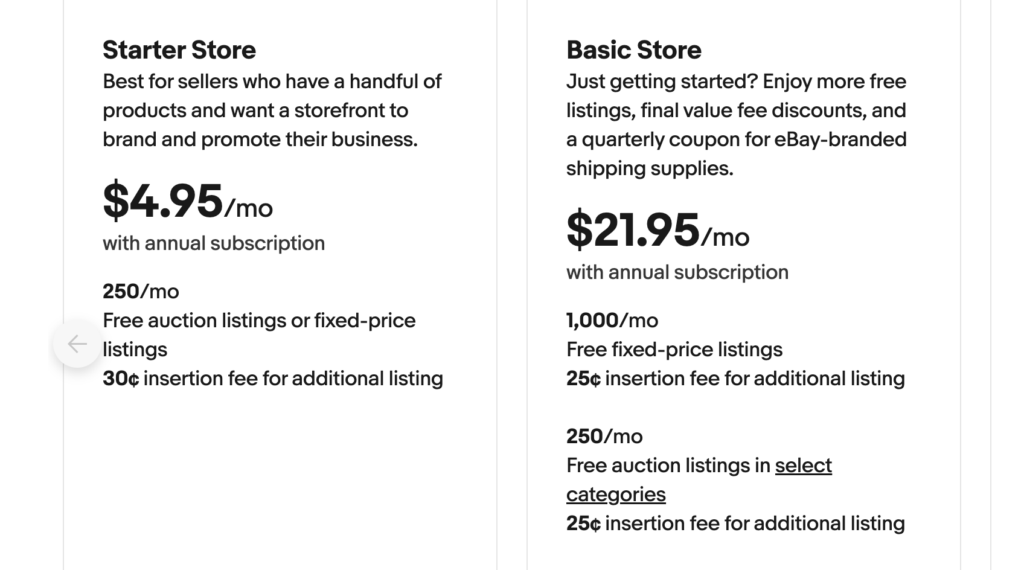
Open eBay’s website and register as a seller if you don’t have an account yet. You’ll need to choose a subscription based on how many cards you plan to list. Starter works if you’re just getting started, whereas Basic or Premium makes sense when you’re listing hundreds of cards each month.
Name your store something clear like “Vintage Baseball Cards” or add “Sports Cards” after your business name. Then, create custom categories like “Rookie Cards,” “Graded Cards,” or “By Player” so buyers can find what they want without scrolling through your entire inventory.
Pro tip: eBay’s app has a “Scan to List” feature that pre-fills card details when you scan a card using your phone’s camera. Use this to save time when you’re listing multiple cards at once.

Step 2: Research Your eBay Competitors
Data from your competitors is quite valuable for understanding which cards sell on eBay and how to price them, and there are several ways to research competitors on eBay.
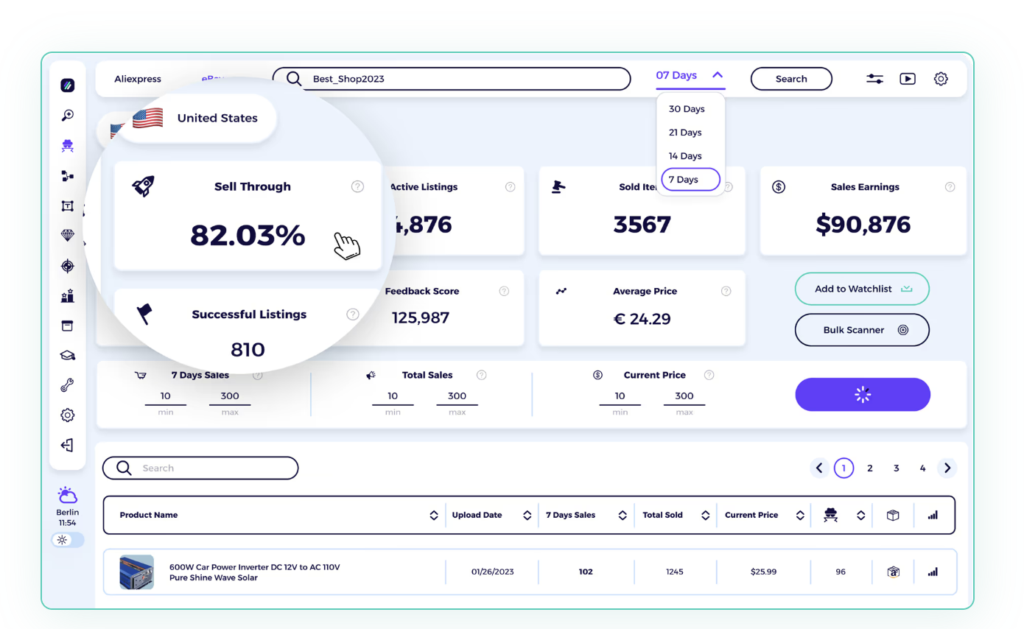
You can use ZIK’s eBay Competitor Research Tool to analyze any seller’s store. Enter their store name and the tool will pull their 30-day revenue, total sales, active listings, and sell-through rate in seconds.
A few things you’ll want to look at:
- Top-selling products – You can sort these by 7, 21, or 30-day sales to see which cards generate the most revenue for them
- Price ranges – Filter the results by price to find cards in your target market and see what collectors are paying
- Sell-through rate – See how much inventory a competitor has sold in a given period. A high sell-through rate suggests that they are pricing the cards correctly and marketing in a way that attracts buyers.
For example, if you’re selling vintage 1980s cards, find a seller who specializes in that era and check which players and sets they list most frequently.
You can also add 3-5 top sellers to your Watchlist and check back weekly. When you notice a seller’s revenue increases after they list specific rookie cards, that indicates where demand is currently the strongest. Track what they add to their inventory and how quickly those items sell.
Step 3: Calculate eBay Profit
Before listing your cards, you’ll want to calculate the fees you’ll pay so that you know exactly how much profit you’ll make on each sale.
eBay’s Main Fees
| Fee Type | Cost |
| Listing fee | First 250 listings a month free, then $0.35 per listing. eBay notes category exclusions apply, and store subscriptions include more free listings |
| Final value fee | 13.25% on the total sale up to $7,500 per item, then 2.35% on the portion above (charged on item price, shipping and sales tax) |
| Per-order fee | $0.30 for orders ≤ $10; $0.40 for orders > $10 |
| Promoted listings | Percentage you set (optional, only if you want to boost visibility) |
How to Calculate Your Profit
You can use ZIK Analytics’ free eBay fee calculator to see your exact fees and profit before you list. Open the calculator page and select your marketplace (eBay.com) and category. For baseball cards, choose “Sports Mem, Cards & Fan Shop.”
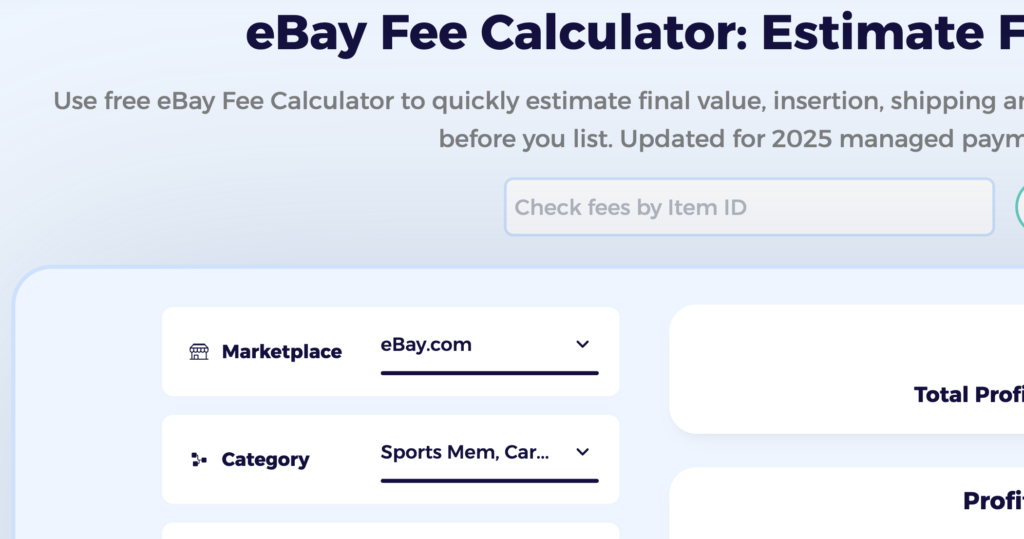
Next, enter the price you want to sell the card for. Then add how much you paid to source the card. If you’re charging the buyer for shipping, enter that amount along with the actual cost of shipping the card. You can also add your promotion percentage if you’re using eBay promoted listings.
The best eBay fees calculator then shows you a full breakdown, including all the fees, break-even price, and total profit.
Quick example: You’re selling a card for $50 and charging $4 for shipping, so eBay collects $54. The final value fee is 13.25% of that $54, which is $7.16, plus a $0.40 per-order fee because the order is over $10. That is $7.56 in eBay fees. You paid $20 for the card and $5 to ship it, so you net $21.44, a 39.7% margin on the $54 collected.
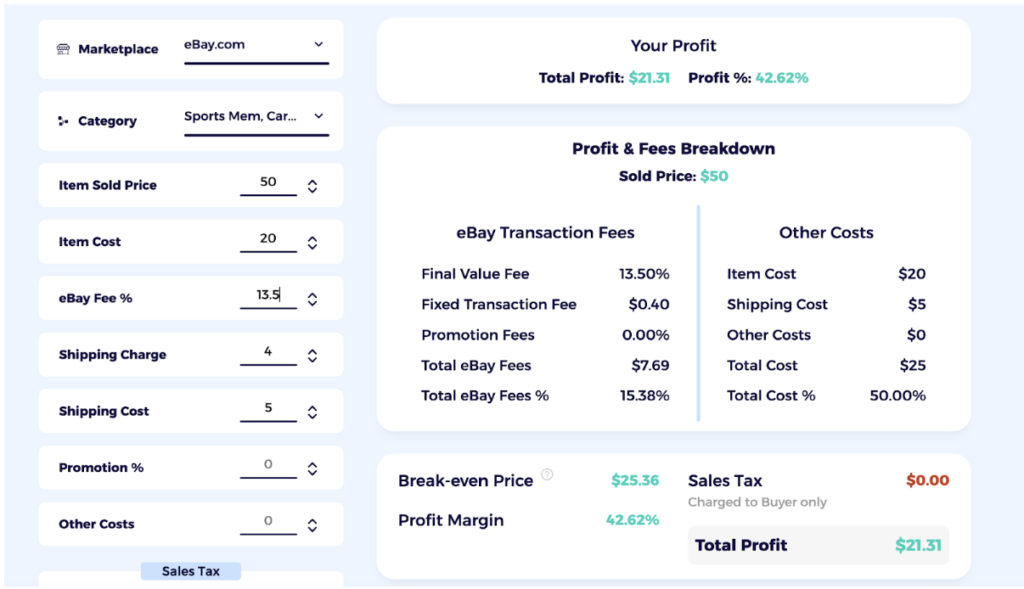
Run these calculations before you list, so you know your margins work. If the profit margin appears too thin, consider adjusting your pricing or exploring alternative cards to sell on eBay.
Step 4: Evaluate Your Baseball Card’s Condition
The condition of your card will determine its grade and what you can charge for it on eBay.
Inspect your card under a bright white LED or natural light. Hold it at an angle (like when you’re checking a phone screen for smudges) to spot scratches, creases, or indentations. You can use a jeweler’s loupe with 10x magnification to check the finer details.
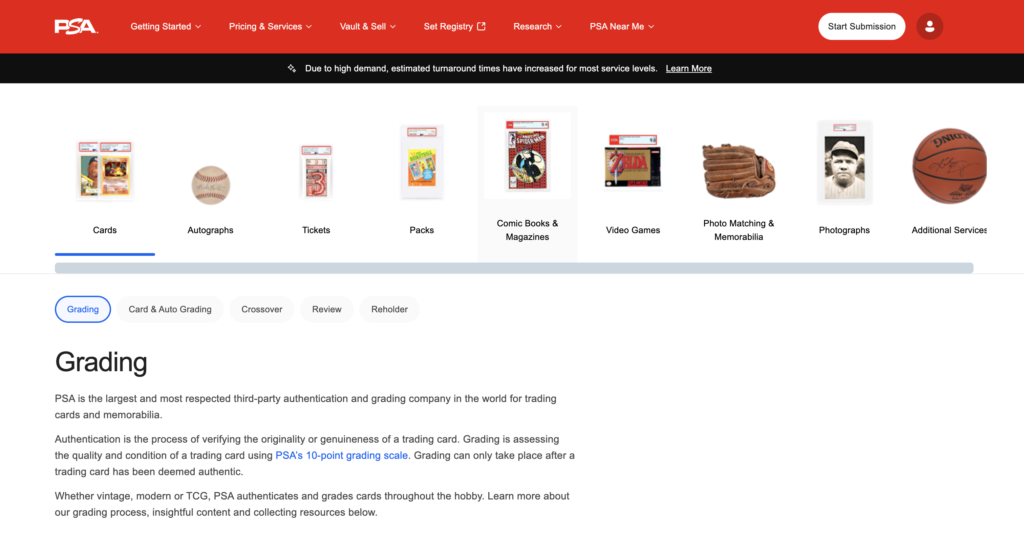
You can also get your cards professionally graded by PSA or Beckett. Grading does lift what a card can ask: in the ZMI slice above, listings whose title mentions PSA carry a median asking price of $51.52 against $2.07 for the general “baseball card” slice, and 30.7% of them recorded a sale in 30 days against 16.8%.
But work out the arithmetic before you send anything off. PSA’s cheap Value tiers were marked “Temporarily Paused” and carried no published price as of October 2026, which left Standard at $59.99 per card, with a 90 to 100 business-day turnaround, as the least expensive service available. Set that against a $2.07 median asking price and the bar is clear: grading only pays on a card you are confident will clear well above $60 after fees, not on a card you hope might. For valuable rookie cards and vintage cards where condition swings the price, it is worth it. For a shoebox of late-1980s commons, it is not. Check the current tiers and prices on PSA’s own site before you commit, because availability moves.
Step 5: Create a Winning eBay Listing
With so many baseball cards listed on eBay, your listing needs to capture attention and provide buyers with the information they’re looking for.
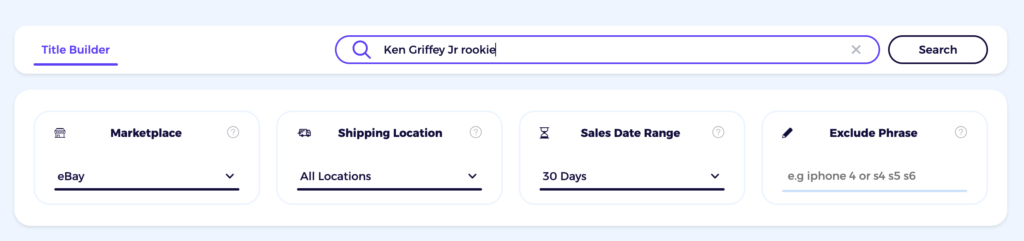
Start by writing a title that matches what buyers are searching for. You can use ZIK’s eBay Title Builder to build your title from keywords with proven search demand. Enter a keyword like “Ken Griffey Jr rookie” and the tool shows you average monthly searches, competition scores, and sales numbers for related terms.
You’ll see two sections: keywords provided (which show your exact search term and its stats) and long-tail keywords (which show related phrases buyers actually search for). On the right, you’ll see generic keyword ideas that work across listings.
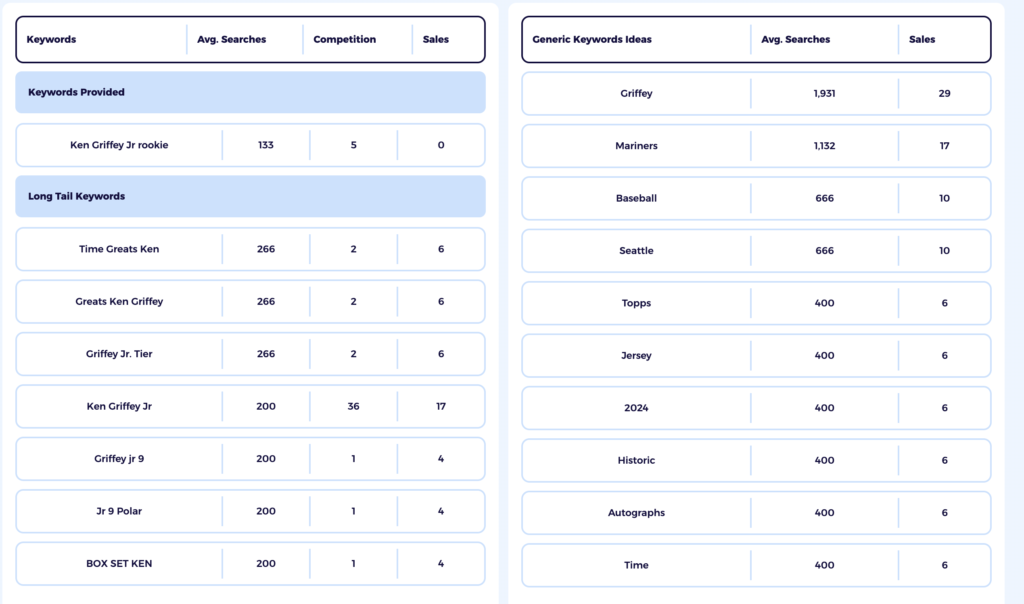
Pick from them in that order of specificity. The player, year, set and card number belong in the title because that is how a collector searches for one exact card. Broad terms are worth the characters only once the specific ones are in, since a title competing on “Baseball” alone is competing with everything.
Click on the keywords you want to include, and they’ll be automatically added to your title at the top. The tool tracks your character count up to eBay’s 80-character limit so you don’t go over.

Next, write a description that includes the player, year, brand, set, card number, and condition. Be honest about any flaws such as corner wear or surface scratches. You should also upload photos showing all four corners (from the front, back, and any damage) so buyers see exactly what they’re getting.
When it comes to choosing how to sell your cards, familiarize yourself with the strengths and weaknesses of listing formats. The Buy It Now format lets you set a fixed price and add “Or Best Offer” for negotiations. This gets you paid faster and works when you know your card’s value. The Auction format starts at a low price and lets buyers bid. Bidding can push prices higher for rare cards, but you risk selling below value if bidding stays weak.
The rule of thumb: use Buy It Now when you can find recent sold listings for the same card in the same condition, because then you already know the price and an auction can only cost you money. Use an auction when you cannot find a comparable sale, or when the card is rare enough that competing bidders are likely to settle the price above where you would have set it. For a graded card with a clear sold history, Buy It Now with “Or Best Offer” is usually the safer choice.
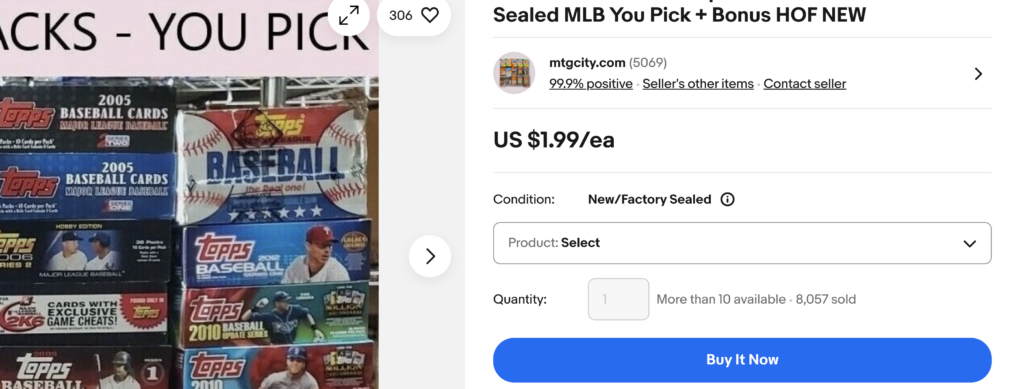
Step 6: Promote Your eBay Listings
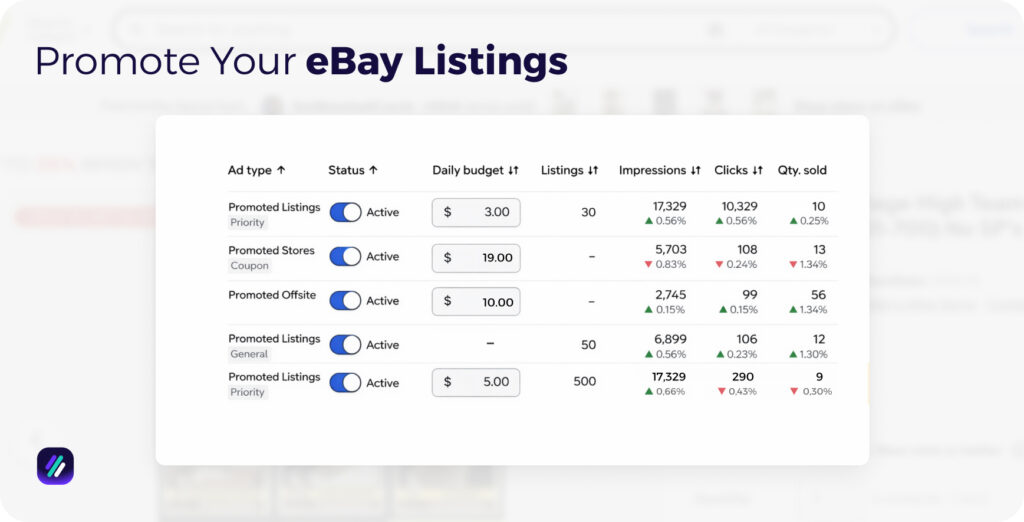
eBay Promoted Listings can push your cards higher in search results. You pay a percentage of the final sale price only when your card sells through a promoted listing.
There are two types of promoted listings: Standard and Advanced.
- Standard promoted listings use your listing title and details to automatically target relevant searches.
- Advanced promoted listings allow you to select specific keywords and set custom bids for each search term.
Most eBay sellers go with the Standard option since it’s easier to set up.
Start from the suggested ad rate eBay shows you when you set the campaign up, which is based on what other sellers are currently bidding in that category, then adjust once you can see what each campaign returns. Do not promote the commons: on a card asking a couple of dollars an ad rate eats the margin entirely. Promote the higher-value cards, rookies, graded cards and vintage, where there is enough margin for the ad to pay for itself.
You can check your campaign performance in eBay’s advertising dashboard. If a card gets clicks but doesn’t sell, your price might be too high. If it’s not getting clicks, try increasing your ad rate or tweaking your title keywords to see if it improves results.
Step 7: Shipping, Packaging & After-Sale Service
How you ship and package the card will have an impact on the customer experience. You want the card to arrive in tip-top shape and avoid any bending or moisture damage during transit.
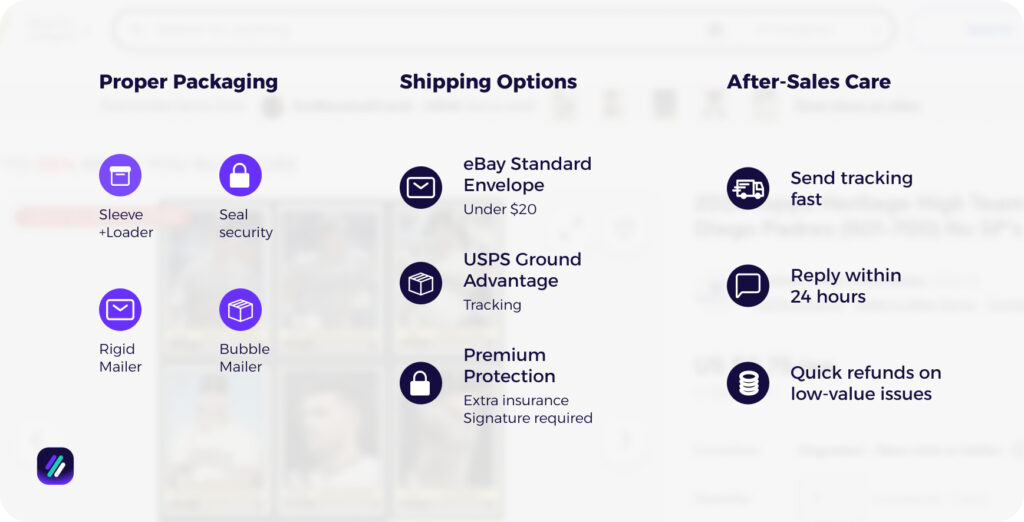
For individual cards, use a penny sleeve to protect the surface from scratches. Then slide the sleeved card into a top loader to keep it rigid during shipping. Seal the top with blue painter’s tape to prevent the card from sliding out (scotch tape leaves residue). Place the top loader in a team bag, then sandwich it between two pieces of cardboard. Insert everything into a bubble mailer, and you’re good to go.
For multiple cards or large lots, you’re better off using storage boxes designed for trading cards. Make sure to fill any empty space with bubble wrap or foam peanuts so the cards don’t shift around. Then place the card storage box inside a sturdy shipping box that can handle the weight during transit.
Shipping baseball cards comes with different options depending on the card’s value. Most sellers go with:
- eBay Standard Envelope for low-value cards: The cheapest route for single commons, at $0.78 for a 1 oz package, $1.07 for 2 oz and $1.36 for 3 oz. Trading cards are an eligible category. It carries integrated but limited tracking, and shipment protection runs up to $20 on a single-item order and up to $50 on a combined one, so treat that as the ceiling on what you should risk in one. Keep the package under 3 oz and a quarter inch thick.
- USPS Ground Advantage for anything more valuable: It includes up to $100 of insurance in the price, provided the shipment carries a USPS tracking barcode, and gives you reliable tracking. Ship the card in a bubble mailer, sandwiched between rigid cardboard, for better protection.
- Additional insurance and signature confirmation for high-value cards: You want to purchase extra insurance beyond the carrier’s standard coverage and require signature confirmation so the package isn’t left unattended.
One more thing changes how you ship the expensive ones. eBay’s Authenticity Guarantee applies to single trading cards, graded or ungraded, priced at $200 and above, and it is free to the seller: eBay covers authentication and the shipping leg on to the buyer. The card goes to PSA, which verifies it is genuine but does not grade or re-grade it, and then on to the buyer. Signature confirmation is required for cards at $750 and above. Sets, lots, decks, boxes and packs are not eligible, which is another reason to break a valuable collection into single listings rather than selling it as one lot. Note the threshold is $200, not the $250 figure that circulates in a lot of summaries.
As for the after-sales service, send tracking numbers quickly and respond to buyer questions within 24 hours. If issues come up, make sure to handle them professionally. For low-value disputes, refunding is often faster than engaging in lengthy negotiations with the buyer.
Note: If you’d rather have someone else handle the logistics while you focus on selling, consider dropshipping on eBay.
Step 8: Scaling, Iteration & Growth
Once you’ve made your first few sales and understand the process, you’ll want to scale up. The key to growing your baseball card business is finding reliable sources for more inventory.
Where to source more baseball cards
Here are some more places you can look into for sourcing baseball cards:
- Estate garage sales are great places to find underpriced baseball cards. People often don’t know the true value of their collections, meaning you can get a variety of cards for a low price.
- Card shows and conventions let you buy directly from other collectors and dealers. The benefit of attending these events is that you can negotiate and inspect cards in person before deciding to make a purchase.
- Online marketplaces like eBay and Facebook Marketplace often list bulk lots and collections. Look for listings where the seller isn’t a collector or appears to be clearing out an inherited collection.
- Local card shops sometimes sell bulk collections or overstock at a discount. Try building relationships with shop owners so they call you first when they want to clear out a large collection.
- Thrift stores and flea markets occasionally sell baseball cards along with other items. You won’t find great cards every time, but when you do, the prices are usually a steal.
As you scale, track which sources give you the best return on investment. Focus your time and money on the sources that consistently deliver cards you can sell for profit. Keep reinvesting your earnings into new inventory, and your business will grow steadily over time.
Click to download the eBook and master eBay product research for winning items.Selling Baseball Cards: Best Practices to Follow
If you want to further improve your chances of selling baseball cards on eBay, here are the steps you should take:
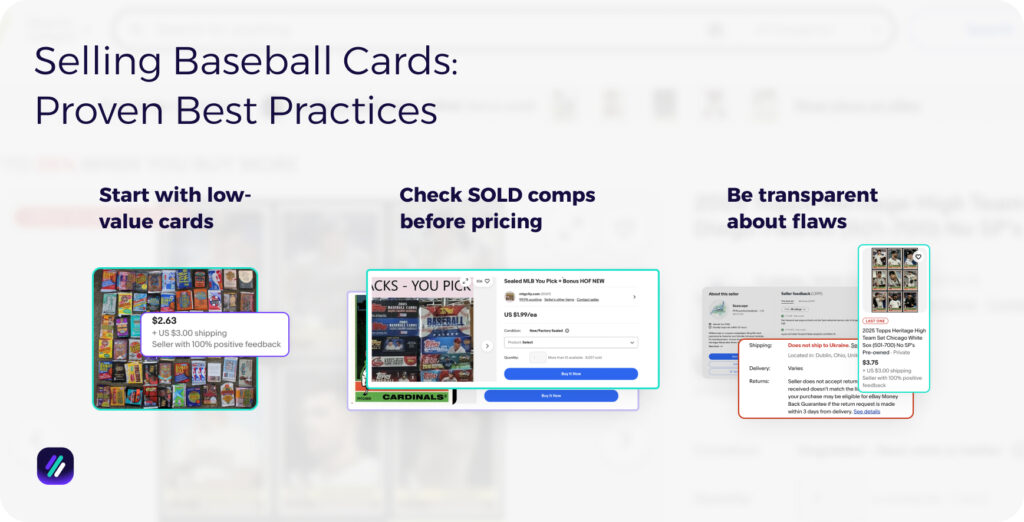
- Start with lower-value cards to build feedback and establish credibility. These can be common base cards or cards featuring less popular players. You can sell these initially to build rapport and switch to higher-value cards later.
- Research current market prices before listing. Go to the sold listing section on eBay and search for the exact same card. Then see what other sellers are charging for it to get a realistic idea of the current price.
- Use high-quality photos and descriptive titles. Use a good-quality smartphone or camera to capture images. Show the card from both the front and back as well as the sides so buyers can see it from all angles. You can also sprinkle in keywords that collectors typically use when searching for baseball cards, such as the player name, the card number, and specific terms like “Rookie Card” or “Autograph”.
- Be honest about the condition and imperfections. If your card has any scratches or wear, make sure to let the buyer know. Transparency goes a long way in helping new eBay sellers build trust with customers.
- Protect every card when shipping. A bent corner in transit turns a good sale into a return and a bad review, and it is the easiest thing on this list to get wrong. Use the packing method in Step 7 on every card, including the cheap ones.
- Send offers to interested buyers and list new cards often. When someone adds one of your cards to their watch list, send them an offer via eBay. Listing new cards often also keeps your store active in eBay’s search results.
Common Mistakes to Avoid When Selling Baseball Cards
Before you start listing your cards, there are a few mistakes you’ll want to watch out for:
- Overpricing based on historical sales data. Historical sales data might show that a card similar to yours was sold at a high price in a certain year. However, buyers tend to look at recent sales when assigning a value to a card. If you keep using past figures as a benchmark for pricing, you’ll end up with listings that attract little to no interest.
- Using poor-quality photos that hide the card’s condition. A blurry or pixelated card image won’t appeal much to the buyer. Clear, well-lit photos, following eBay image requirements, that showcase the actual condition of your card are what will build trust with potential customers.
- Not getting key cards professionally graded. For vintage and other high-value cards, grading by a reputable third-party company is a seal of approval. It confirms that the card hasn’t been altered and helps fetch a higher price for the seller.
- Ignoring eBay fees when calculating profit. If you only count what you paid for the card and guess at the rest, you’ll be in for a surprise when it comes time to calculate your actual profit. Make sure to factor in eBay’s own fees and shipping fees to get a realistic idea of how much you’ll make.
- Not offering a “Make an offer” option on high-value cards. Baseball card buyers have this habit of negotiating on high-value listings. You can switch on offers to hear their bids and potentially accept a price that’s closer to your desired sales figure.
Why is Selling Baseball Cards on eBay a Good Idea?
Selling baseball cards on eBay makes sense given how much collectors spend on the platform every month. The same playbook works if you want to sell sports cards more broadly, or to sell MTG cards on eBay.
The demand is real, it is current, and it is spread out. In the slice measured above, 1,728 different sellers had at least one listing record a sale in the trailing 30 days. That is a market with room for another seller rather than one a handful of big operations have closed off.
The wider hobby has been running hot for a while, too. Card Ladder recorded more than $421 million in hobby-wide sales in August 2025, the highest month on record since it began tracking in January 2010, against $303 million that March.
The market also responds to who is playing well. GemRate data reported by Sports Collectors Daily put just over $13 million of Mickey Mantle cards through the market in the first seven months of 2025, nearly 57 years after his last game, and over $3.82 million of Shohei Ohtani cards in July 2025 alone. Those are 2025 figures, so treat them as the shape of the market rather than today’s prices. As one of the best small items to sell on eBay, baseball cards reward a seller who picks the right cards and prices them off real sold data.
Alternatives to Selling Baseball Cards on eBay
If you’re looking for places to sell baseball cards besides eBay, there are several good options depending on how hands-on you want to be. Popular alternatives include:
- COMC – A full-service option where you ship your cards in, and they handle listing, storage, and shipping for you.
- Alt – A modern marketplace with auctions and fixed-price listings that work well for higher-value cards.
- Whatnot – Allows you to live stream your card collection to an active audience and make sales in real time.
- Instagram – Lets you promote to an existing audience with features like Stories and Reels.
- Facebook Groups/Marketplace – Useful for selling baseball cards locally within your community, with no shipping to arrange.
- CollX – Has a built-in marketplace where you can list and sell your cards.
- MySlabs – A marketplace built specifically for graded and raw cards, aimed at higher-value singles. Check its current fees against eBay’s before you move a card across.
Find and Analyze Best Selling eBay Cards with ZIK Analytics
ZIK Analytics has a suite of tools to help eBay sellers find winning collectibles for their listings.
However, I specifically want to mention the top three tools that make it easy to research competitors and optimize your listings:
- eBay Competitor Research Tool lets you enter any seller’s store name and see eBay sold items and top-performing collectibles. Find out which players and years are selling for your competitors, analyze their pricing strategies, and add successful sellers to your Watchlist to monitor their inventory changes over time.
- eBay Title Builder helps you create optimized titles using keywords buyers are searching for. Enter a term like “Ken Griffey Jr rookie” and see average searches, competition scores, and sales data. Click keywords to build your title up to 80 characters and capture more search traffic from collectors looking for specific items.
- eBay Product Research Tool analyzes what’s ranking in eBay’s search results for any keyword. Search for “1989 Upper Deck” or “PSA 10 rookie” and see which collectibles rank highest, their sell-through rates, and pricing strategies. Filter by price range, condition, and eBay seller location to understand your competition before listing similar items.
You can also save searches and products to folders for quick access when you’re ready to list.
Start your $1 trial (7-day) and find collectibles with proven demand on eBay before you buy inventory.
Frequently Asked Questions About Selling Baseball Cards on eBay
In this section, I’ll answer the frequently asked questions about selling baseball cards on eBay.
What is the most profitable way to sell baseball cards?
The most profitable way to sell baseball cards is to list your high-value cards individually on eBay. Fixed-priced listings work better for these cards as buyers pay more when they don’t have to compete in an auction. For mid-tier cards, selling in themed lots is your best bet.
How much does eBay take when selling cards?
eBay charges a 13.25% final value fee on trading card sales up to $7,500 per item, plus 2.35% on the portion above that, calculated on the item price, shipping and sales tax together. On top of that comes a per-order fee of $0.30 on orders of $10 or less and $0.40 on orders over $10, so most single-card sales pay the $0.30. eBay’s general rule is 250 free listings a month and a $0.35 insertion fee after that, though eBay notes category exclusions apply. Optional upgrades and promoted listings add to the cost.
How to put baseball cards on eBay?
You can put baseball cards on eBay by identifying the card, checking its value in eBay sold listings, and taking high-quality photos. Use the mobile app scanner or desktop tools to list your card, and then add its condition, price, and the shipping method you’ll use.
How to tell if your baseball cards are worth money?
You can tell if your baseball cards are worth money by taking these steps:
- Identify the card: Pin down the five details that decide its value: the player, the year, the brand and set (Topps, Bowman, Upper Deck), the card number, and any variation such as a rookie card, an autograph, a refractor or a serial number
- Look up real prices: Use eBay’s “Sold” filter to see recent sales
- Compare your card: Match it against cards in a similar shape
- Verify value: Use an app or ask a reputable dealer if it seems valuable
Are baseball cards losing value?
Most individual cards are worth very little, and the ones printed in huge quantities in the late 1980s and early 1990s are the clearest example. Nine in ten of the baseball-card listings we measured ask under $45 (ZMI, 2026-10-27). But the hobby as a whole is not shrinking: it set a record sales month in August 2025. So the honest answer is that the market is active while the value is concentrated. Rare vintage, graded and limited cards of star players hold their value; mass-produced commons do not, and never really did.
Is it worth selling my baseball cards?
It is worth selling your baseball cards if you hold anything vintage, rare, graded or in excellent condition, and the price table near the top of this guide is the quickest way to tell. The thing most sellers get wrong is the rest of the box: modern base cards are rarely worth listing one at a time, and bundling them into themed lots both raises the price you can ask and sells more often. Rookie-labelled listings sell at the highest rate of any cut we measured, 35.6% recording a sale in 30 days (ZMI, 2026-10-27), so it is worth pulling those out before you bundle anything.
What baseball cards make the most money?
Baseball cards that make the most money are usually vintage cards of Hall of Famers and ultra-rare modern rookie cards with autographs or low serial numbers. The highest sales come from cards like the 1952 Topps Mickey Mantle, the T206 Honus Wagner, and early Babe Ruth issues. Modern one-of-one cards of stars like Mike Trout or Shohei Ohtani also command a large premium when graded in top condition.
Can you sell baseball cards without grading?
Yes, and for most cards you should. Raw cards sell all the time, and it is fine for low- to mid-value cards or anything unlikely to score a high grade. List them with high-quality photos, describe every flaw honestly, and price them from recent raw sold listings rather than graded ones, which are a different market. Grading is worth paying for only on a card whose value clearly exceeds the fee, and Step 4 sets out what that fee currently is and where the break-even sits.