
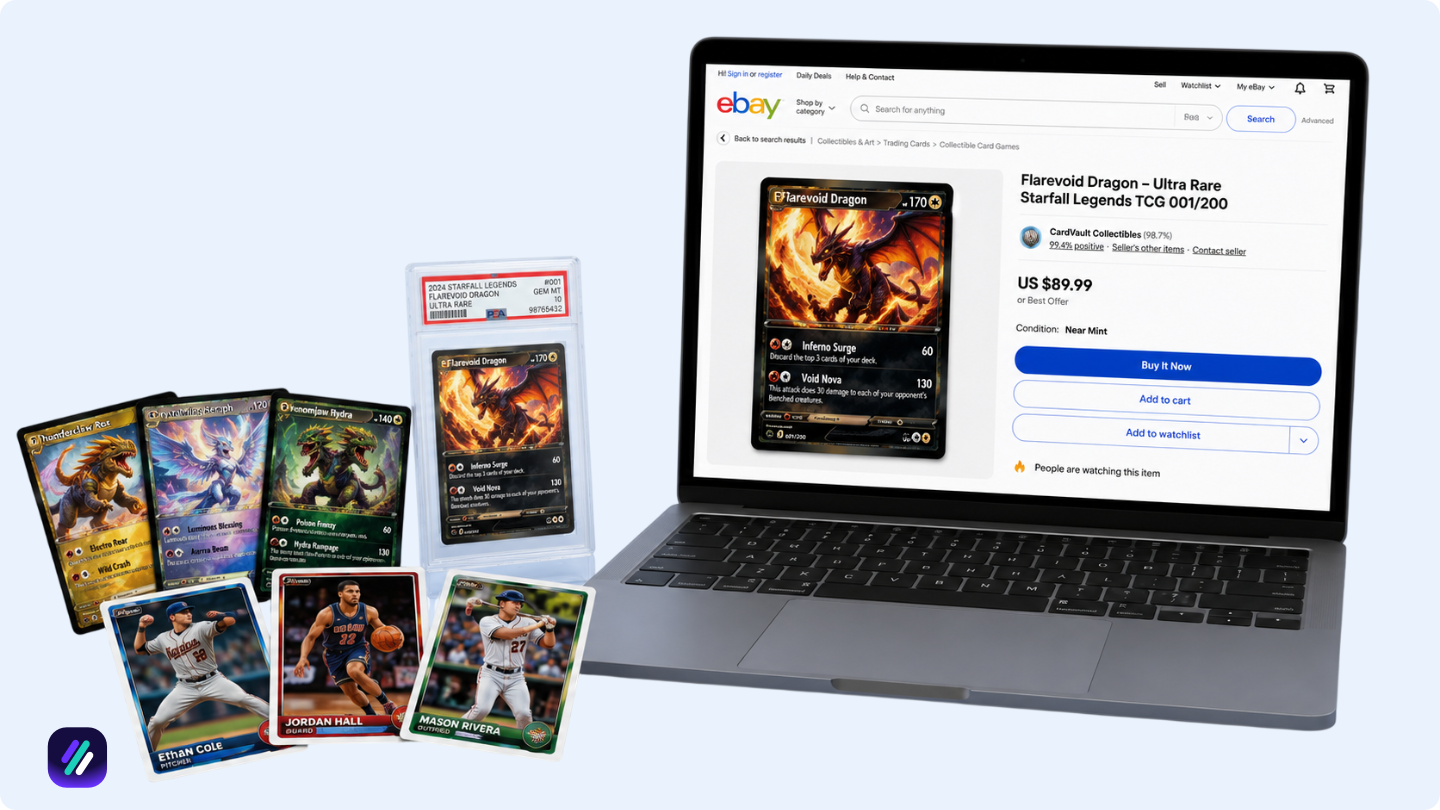
Learning how to sell cards on eBay comes down to one uncomfortable truth: a card is worth exactly what someone recently paid for the same card in the same condition. Not what a price-guide app claims, not last year's hype, and not what you hope. That single idea separates the sellers who clear their collection at fair value from the ones who give cards away, or watch them sit unsold for months.
In this guide I will walk through the whole process: checking what your cards sell for, deciding whether to grade, writing titles buyers can find, pricing against true comps, and packing cards so they arrive safe.
Key Takeaways
- A card is worth what identical copies recently sold for, so every listing should start with actual sold prices. The eBay Product Research Tool inside ZIK Analytics shows sold counts, sell-through rate, and average price for a specific card or niche before you list.
- eBay allows trading cards (sports, Pokemon, and other games), but counterfeit cards and unlicensed reprints are banned and can get your listing pulled.
- Grading is optional. It pays off mainly on high-value cards in strong condition, where a top-graded copy often sells for several times the raw one.
- Selling fees on trading cards run about 13.25% of the sale plus a small per-order fee, so a smart seller builds that into the price instead of being surprised at payout.
- Most damaged-in-transit claims come down to packing. A penny sleeve, a toploader, a rigid mailer, and tracking on anything above a few dollars prevents the majority of problems.
Can You Sell Cards on eBay?
Yes. eBay openly allows trading cards, including sports cards, Pokemon, and other collectible card games, as raw singles, graded slabs, lots, and sealed product. The one hard line is authenticity: counterfeit cards and unlicensed reprints are prohibited and get removed.
That prohibition matters more in cards than in almost any other category, because fakes are everywhere. Reprinted rookies, bootleg Pokemon, and "custom" cards passed off as genuine all cross the line.
If you list a reprint, you have to label it clearly as a reprint in the title and description. Selling a copy as the genuine article is the fastest way to lose your money and your account, and if you are focused on that niche, our full walkthrough of pricing and listing Pokemon cards on eBay also flags the counterfeit risk and when authentication is worth it.
For higher-value cards, eBay runs an authentication program that adds a layer of buyer trust. When you sell an eligible single card above a set price, eBay routes it to a third-party authenticator who inspects it before it reaches the buyer, then forwards it with proof of authentication.
At launch the program covered ungraded singles sold for $750 and up, later expanding to graded, autograph, and relic cards at $250 and up, according to eBay's announcement of the program. That threshold has been lowered since, so you should check eBay's current Authenticity Guarantee page for the figure that applies today. The full mechanics of how it protects both sides of a sale live in our guide to how eBay's authenticity guarantee covers trading cards.
Is It Profitable to Sell Cards on eBay?
Selling cards on eBay can be genuinely profitable, but the category rewards research over luck. Demand concentrates on specific players, sets, and individual cards and it shifts fast, so the sellers who check sold data before listing are the ones who come out ahead.
The wider hobby is large and growing, which is the encouraging backdrop. One industry estimate from Verified Market Research put the sports trading card market at $12.62 billion, with projections reaching $23.08 billion by 2032. You should treat that as a directional signal about demand, not a promise about your shoebox, and ZIK Analytics keeps a running set of eBay statistics worth scanning before you commit to a niche.
Here is the honest part. Demand clusters on a small share of cards, and it moves with seasons, players, and set releases. A rookie can spike after a strong season and cool off just as quickly, while bulk commons are close to worthless individually and only move as big lots.
So profit comes from knowing which of your cards people actually want right now, and at what price, before you spend an evening listing them one by one. Sports collectors will find category-specific angles in our how to sell sports cards on eBay guide, but the research habit below applies to every card you own.
How to Sell Cards on eBay Step by Step
Selling cards well is a sequence, and each step feeds the next. If you skip the research at the start, every later decision, from pricing to whether grading is worth it, turns into a guess.
Step 1: Research what your cards actually sell for
Before anything else, you want to know what identical copies have recently sold for. On eBay itself you can filter search to Sold Items and scan the last few weeks of results. To go faster and see the pattern rather than a handful of anecdotes, the eBay Product Research Tool shows sold items, sell-through rate, average price, and total earnings for a keyword across 7, 14, 21, and 30-day windows. A high sell-through rate means copies are actually moving, while a low one means you may be pricing into a wall.
This is also where you split the collection into tiers: cards worth an individual listing, cards worth grouping into a lot, and bulk that is not worth your time. A deeper walkthrough of reading sales history lives in how to find sold items on eBay. In the next step we will look at who is already winning that demand.
Step 2: See what the top card sellers are doing
Now that you know a card has demand, you want to study who is capturing it. ZIK Analytics' eBay Competitor Research Tool lets you analyze any eBay seller and see their sold items, average price, sell-through rate, and best performers over the last 7 to 30 days. Reviewing a couple of established card sellers shows you the price bands that convert and how often stock turns over in your niche.
One caveat matters here. This view is seller-level, so it tells you how a store performs overall, not the exact item specifics inside each individual listing. You use it to read pricing and velocity, then apply the pattern to your own cards.
Step 3: Grade the condition honestly, or send it out
With research done, you turn to condition. For most raw cards you will describe the condition yourself, and the golden rule is to under-promise.
You should note every flaw a buyer would notice up close: soft corners, edge wear, surface scratches, off-center printing, any crease. Based on our own eBay sellers at ZIK, honest condition notes cause fewer returns than optimistic ones, every single time.
A card described as "near mint" that shows up with a dinged corner earns a return and a sour review. For a small number of high-value cards, professional grading is worth considering, and the next section covers when that math works.
Step 4: Photograph the card and write a title buyers search
Cards live and die on photos. You want to shoot the front and back in bright, even light against a plain background, fill the frame, and capture any flaw clearly so the listing matches the card. Buyers zoom in, so blurry or cropped photos quietly kill trust and sales.
Your title is the other half of getting found. eBay gives you 80 characters, and each one should help a buyer locate the card: player or character, year, set, card number, parallel or variation, and condition or grade. The eBay Title Builder by ZIK pulls the actual search terms buyers use, backed by search and sales data, so you fill those 80 characters with words people type instead of guesses. The broader mechanics of a listing that ranks, from item specifics to description structure, live in our eBay listing optimization guide.
Step 5: Price against the comps and choose a format
As we saw in Step 1, the sold data is the anchor for price too, so you set your number from what buyers actually paid, not the highest active listing you can find. Active listings show what sellers hope for, while sold listings show reality. For cards where value is uncertain or genuinely hot, an auction lets the market set the price and can beat a fixed listing. For steady, known-value cards, a fixed "Buy It Now" near the recent average tends to sell faster with less drama.
Step 6: Pack it properly and ship with tracking
The sale is not finished until the card arrives undamaged. A single bent-corner complaint here can undo the profit on ten clean sales. Shipping has its own section below, because doing it right is what protects your rating.
Should You Grade Your Cards Before Selling?
You should grade a card only when the grade will add more value than the grading costs and the wait. In practice that means a genuinely high-value card in strong condition, not your average common.
Grading is the process of sending a card to a third-party company that authenticates it and assigns a condition score, then seals it in a tamper-evident slab. The four names you will see most often are these:
- PSA is the most widely recognized grader for sports cards and TCGs, and PSA-graded copies tend to command the deepest buyer demand.
- Beckett (BGS) is known for detailed subgrades on centering, corners, edges, and surface.
- SGC has a strong reputation for vintage cards.
- CGC grades cards alongside comics and other collectibles.
Most use a 1 to 10 scale, where a PSA 10 is Gem Mint, a 9 is Mint, and the grades fall from there. A grade removes the buyer's biggest fear, which is condition and authenticity, and a strong grade can multiply value, with the jump from a 9 to a 10 often the steepest of all.
That premium is exactly why grading is not automatic. From our own eBay sellers at ZIK, the pattern holds steady: grading pays off on the cards that are already valuable and visibly clean, and rarely on anything else. It costs money and weeks of turnaround per card, and a card that comes back a 7 can be worth less than the fee you paid. You should grade the cards where condition is clearly excellent and raw value is already high, and sell the rest raw with honest photos. Adjacent collectibles like coins follow the same logic, which our how to sell coins on eBay guide walks through.
How to Price Cards on eBay
Pricing is where sellers leave the most money on the table, in both directions. A price set on hope leaves the card sitting unsold. A price set on impatience hands a flipper your profit.
Every price should anchor to recent sold comps for the exact card, in the exact condition or grade. Before you commit a number, it helps to confirm three things:
- The comps are for the identical card and the same condition or grade, since a raw copy and a PSA 10 are different products with different markets.
- The recent trend is flat or rising, because if the last several sales are drifting down you should price at or below the average to sell before it slides further.
- The format fits the card, so a hot or uncertain card goes to auction to capture momentum, while a steady one sells fine at a fixed price.
One more number belongs in every pricing decision, and that is fees. Selling fees on trading cards run about 13.25% of the total sale up to $7,500, plus a fixed per-order fee of roughly $0.40, according to eBay's selling fees schedule. On a $40 card that is more than $5 gone before shipping, so you should run the math up front with the eBay fee calculator from ZIK Analytics and keep your "profit" honest.
How to Ship Cards on eBay Without Damage
Getting the card to the buyer intact is the step most likely to cost you a return, and it is the easiest to get right with a small routine. Our in-house eBay team treats packing as non-negotiable, because one bent-corner complaint can undo the goodwill of a dozen smooth sales.
The standard safe method for a single card is simple: you slide it into a penny sleeve, put the sleeved card in a rigid toploader or card saver, tape the toploader closed with the card secured inside (never tape the card itself), and sandwich it between pieces of cardboard inside a rigid or bubble mailer.
The right service depends on the card's value, and this table lines up the common choices:
| Card value | Suggested method | Tracking |
|---|---|---|
| Low value (a few dollars) | eBay Standard Envelope | Yes, basic tracking |
| Around $20 or more | Bubble mailer or small box, tracked package | Yes, full tracking |
| High value or graded slab | Tracked package with signature and insurance | Yes, plus insurance |
For inexpensive raw singles, the eBay Standard Envelope is built for exactly this: it carries trading cards up to about 3 ounces and a quarter-inch thick, with a value limit near $20 for a single item, and it includes tracking. eBay adjusts these limits from time to time, so you should confirm the current weight, thickness, and value caps on eBay's help page before you rely on them. Graded slabs are too rigid for it, so those always go in a tracked package.
Anything above roughly $20 deserves a tracked package such as USPS Ground Advantage, and once a card climbs into the hundreds, you should add signature confirmation and insurance. If you are new to postage settings, how to ship on eBay walks through the setup and how eBay shipping costs work explains how postage factors into your margin.
Common Mistakes When Selling Cards on eBay
Most seller pain in this category traces back to a short list of avoidable errors:
- Pricing off active listings, not sold ones. Hopeful asking prices are not market value. Only completed sales tell you what buyers actually pay.
- Overstating condition. Calling a card "mint" when it has a soft corner guarantees returns and dents your feedback. The safer habit is to under-promise and let the photos prove it.
- Weak photos. One dim, cropped picture loses the sale to the seller who shot a sharp front and back. Buyers will not gamble on what they cannot see.
- Grading everything. Sending low-value or average-condition cards to a grader burns fees and months for little or no gain. Selective grading beats blanket grading.
- Cheap, loose packing. A card rattling in a plain envelope arrives bent. That one saved dollar can cost the sale, the return shipping, and the review.
- Ignoring fees in the price. Forgetting the roughly 13.25% plus a per-order fee turns a "profit" into breakeven. Baking fees into the price fixes it.
Conclusion
The sellers who do well with cards are rarely the ones with the rarest inventory. They are the ones with the steadiest habit: sold data before every listing, honest condition notes, findable titles, and packing that never fails. When you build that habit, the feedback compounds, repeat buyers show up, and each sale gets a little easier than the last.
If there is one place to start, make it the research at the front, because a seller who knows what a card is genuinely worth already avoids the two most expensive mistakes in the hobby. The same discipline that works on a common works on a graded rookie, so the skill you build on your first ten listings is the skill that scales. The category fundamentals behind all of it live in how to sell on eBay, a broader set of eBay selling tips sharpens the day-to-day, and a specific niche like how to price and list baseball cards on eBay shows the same method in action.
Sell Cards Smarter with ZIK Analytics
Guesswork is the most expensive habit in this hobby, and genuine data is the cure. Before you list a single card, the eBay Product Research Tool surfaces sold counts, sell-through rate, and average price so you price with evidence, the eBay Competitor Research Tool shows how the top card sellers in your niche actually perform, and the eBay Title Builder turns actual buyer searches into an 80-character title that gets found. Thousands of eBay and Shopify sellers use ZIK to back products buyers already want instead of guessing. You can put it to work on your own collection with a $1 trial (7-day).
Selling Cards on eBay FAQs
A few quick answers to the questions new card sellers ask most often.
Do you have to grade cards to sell them on eBay?
No. Most cards sell raw, described by condition with clear photos. Grading is worth it mainly for high-value cards in strong condition, where a top grade can add several times the card's raw value and outweigh the grading fee and the weeks of waiting it takes.
What are the fees to sell cards on eBay?
Trading cards use eBay's standard selling fee, about 13.25% of the sale up to $7,500, plus a small fixed per-order fee, per eBay's fee schedule. You should factor that in before setting a price, and an eBay fee calculator will show your true payout.
How do you ship cards on eBay safely?
You sleeve the card, put it in a rigid toploader, secure the toploader, and sandwich it between cardboard in a rigid or bubble mailer. The eBay Standard Envelope suits low-value singles, while anything around $20 or more should go in a tracked package, with insurance and signature on high-value cards.
How do I know what my card is worth?
You want recent sold listings for the identical card in the same condition or grade, not active asking prices. Pulling the sold history through the eBay Product Research Tool shows the average selling price and how often copies actually move, which is your true market value.
Can I sell Pokemon and other trading card games on eBay?
Yes. Pokemon, Magic, and other collectible card games sell on eBay as singles and sealed product, and they fall under the same fee and authentication categories as sports cards. The main thing to avoid is listing counterfeit or unlicensed reprints, which are prohibited.