
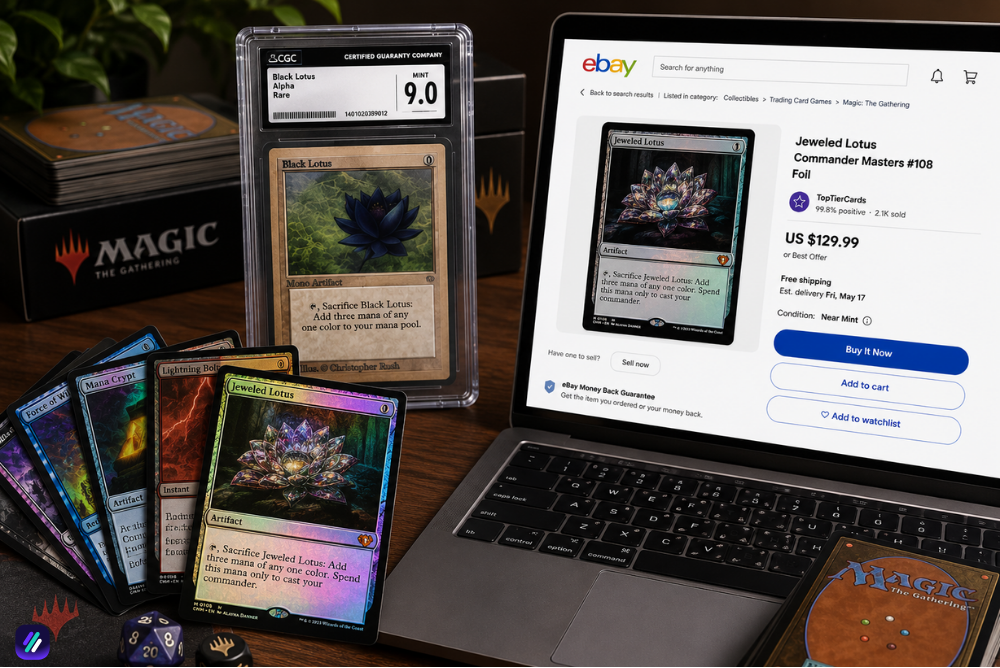
A box of Magic cards almost always holds more value than the average guy assumes, and far less than the hype videos promise.
Most beginners tip the whole pile into one listing, price it on a hunch, and watch the handful of cards that actually mattered get scooped for pennies by a buyer who did the homework they skipped. The valuable singles sink under the generic ones, and the listing sits for weeks.
In this guide, I will walk you through how to sell MTG cards on eBay the way consistent sellers do it: sorting, identifying the exact printing, pricing from sold data, listing properly, shipping safely, and knowing which cards move.
Key Takeaways
- Identification is the step that pays. Two cards with the same name can differ many times over in value depending on set, collector number, foil treatment, and condition, so you read those off the card before you price anything.
- Your prices come from sold listings, never from asking prices. A card listed at $30 that never sells tells you nothing; three copies that sold this week at $9 is the market talking.
- ZIK Analytics shows you the actual sales, sell-through, and competition on any Magic keyword before you ever create a listing, so you anchor to genuine demand instead of a hopeful number.
- eBay’s trading card final value fee is about 13.25% plus a small per-order charge, calculated on the item, shipping, and tax combined. You want that built into your price before you list, not discovered at payout.
- Grading only pays off on genuine chase cards. A grading fee on a $5 coin turns a thin profit into a guaranteed loss.
- Bulk pays well when it is sorted and described honestly, and turns into a complaint magnet the moment it is dressed up as a mystery jackpot.
Step 1: Create Your eBay Account and Set Up Payments
So you have decided the cards are worth listing. Your first move is a seller account that will not trip over itself the moment sales start landing. A personal account is fine to start, and you can switch to a business account later when volume grows and you want cleaner tax handling and stronger selling tools.
New accounts come with selling limits, so expect to begin with a capped number of listings, often around 10 items or $500 a month, whichever you hit first, and raise it as you build a track record. That cap is standard for fresh accounts, and the basics of eBay selling limits explain how to lift it.
Payments now run directly through eBay and are paid out to your linked bank account, so PayPal is no longer required. You should link and verify your bank account before you list, because a new account can be subject to payout holds for the first stretch.
Setting your return policy and getting the groundwork of how to sell on eBay right, from identity verification to those starter limits, is the foundation that every step after this assumes.
Step 2: Sort, Identify, and Decide Which MTG Cards to Sell
Before a single card goes live, sort it first. This is the tedious part that nobody shows, and it decides most of your profit, because a card you misjudge here is money you either leave on the table or waste listing one at a time. It is the heart of selling Magic cards on eBay.
MGT punishes lazy sorting harder than most card games, because two copies of the same card name can be worth a dollar or fifty depending on the edition, the foil treatment, the frame, and the wear. So your first pass splits the collection into clear piles before you value anything.
| Pile | What goes in it | What to do with it |
|---|---|---|
| Chase singles | Reserved List cards, old rares, premium foils, Secret Lair drops, serialized and graded cards | Research and list each one on its own |
| Sellable singles and playsets | Near-mint Commander and Modern staples with steady demand | List individually or as four-card playsets |
| Sealed product | Booster boxes, Collector Boosters, Commander decks, bundles | List separately, condition of the wrap matters |
| Bulk | Low-value commons, uncommons, played duplicates, lands | Group into lots, never list one by one |
Our in-house eBay sellers keep coming back to one habit: separate the obviously valuable cards from the bulk first, before you ever open a price tool, so your attention goes where the money is. Now that the piles exist, the next move is reading each card precisely, which is where Magic gets technical.
How to identify the exact MTG card version
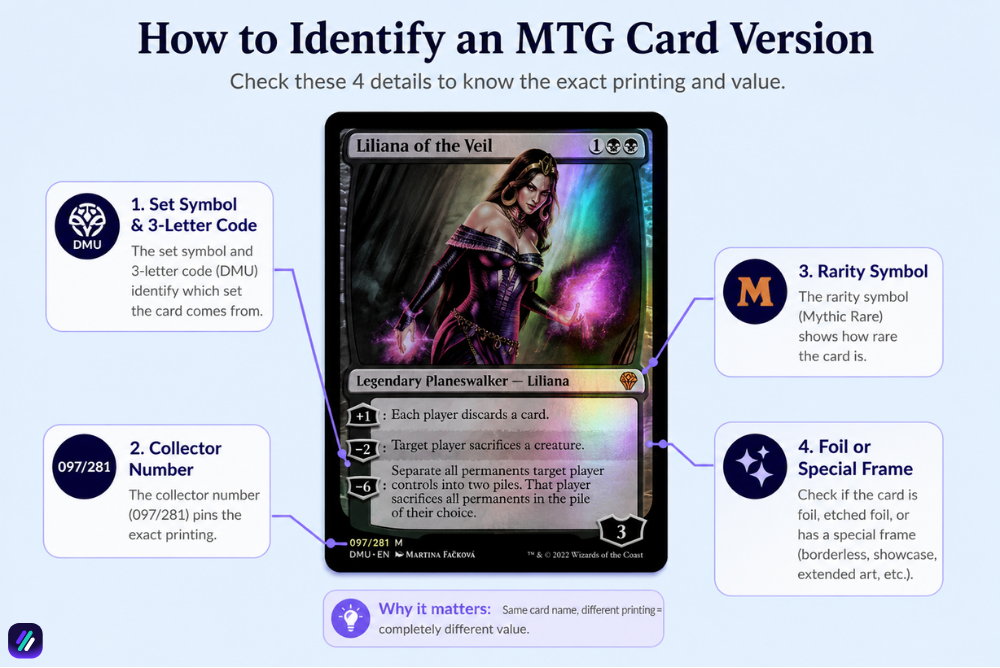
The exact printing decides the price, so you confirm it card by card rather than trusting the name. A reprinted staple from a recent set and its original printing can sit at completely different values, and a foil can multiply the price of an otherwise common card.
You can run each card you care about through a short identification routine:
- Card name and set: read the name, then find the set symbol and the three-letter set code printed near the bottom.
- Collector number and rarity: the collector number (like 125/281) pins the exact printing, and the rarity symbol colour marks common, uncommon, rare, or mythic.
- Finish and frame: confirm non-foil, foil, or etched foil, plus any special frame such as borderless, showcase, extended art, or retro.
- Special status: flag promos, Secret Lair printings, Commander-deck exclusives, and anything that looks serialized or misprinted for deeper research.
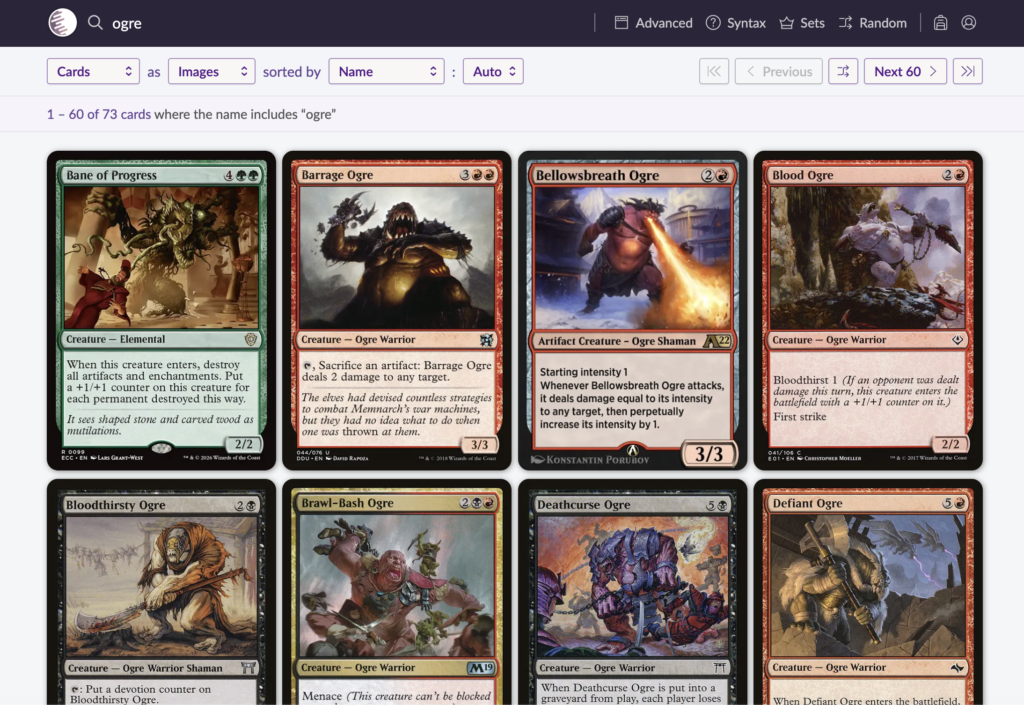
When you are unsure, cross-check against a database before pricing. Wizards runs the official Gatherer database, and most sellers lean on Scryfall, a third-party search engine that shows every printing with high-resolution images, so you can match your card to the exact version you will list.
Which Magic cards are worth selling individually?
List a card on its own when it clears a few dollars after fees and shipping: Commander and Modern staples, scarce or Reserved List cards, desirable foils, graded cards, and collector pieces. Everything cheaper belongs in a lot, where one good listing moves what fifty tiny listings never would.
The line is mostly about your time and eBay’s cut. A 75-cent common technically sells, but once you subtract the final value fee, the envelope, and the ten minutes you spent listing it, you are at a loss.
So the cards that earn an individual listing are the ones with both demand and enough value to survive the costs. Commander staples, tournament-relevant Modern and Legacy cards, premium foils, and older scarce printings all qualify. Low-value rares, lands, tokens, draft leftovers, and duplicate playsets are lot material, and treating them that way protects your hourly rate.
How to handle bulk MTG cards
Bulk is the part most guides wave away, but sorted bulk is a genuine income stream. The trick is honesty about what bulk actually is: low-demand commons, uncommons, low-value rares, and unsorted duplicates that nobody hunts by name.
You sell it in formats buyers already search for: 100, 500, and 1,000-card lots, color-sorted lots, rare-only lots, land lots, and Commander starter lots. Each format answers a different buyer need, and naming it clearly in the title is half the sale.
One warning matters here: avoid the “guaranteed value” and “random mystery” framing unless every claim is literally true, because inflated lot listings are the fastest route to a not-as-described case and a damaged feedback score.
Step 3: Check Condition Before Pricing Your MTG Cards
Condition sets both your price and Magic players inspect it closely because wear shows on these cards. The same Commander staple in Near Mint and in Heavily Played can sell for double the gap a beginner expects, so you grade honestly before you ever look at comps.
Magic uses a familiar condition ladder, and you should learn to read it on sight:
- Near Mint: sharp corners, clean edges, a flawless surface, fresh from a sleeve.
- Lightly Played: minor edge wear or slight whitening, still a clean card in a sleeve.
- Moderately Played: noticeable wear, light scratches, some whitening, but no major damage.
- Heavily Played: heavy wear, creasing, scuffing, clearly used but intact.
- Damaged: bends, water damage, tears, ink, or anything structural.
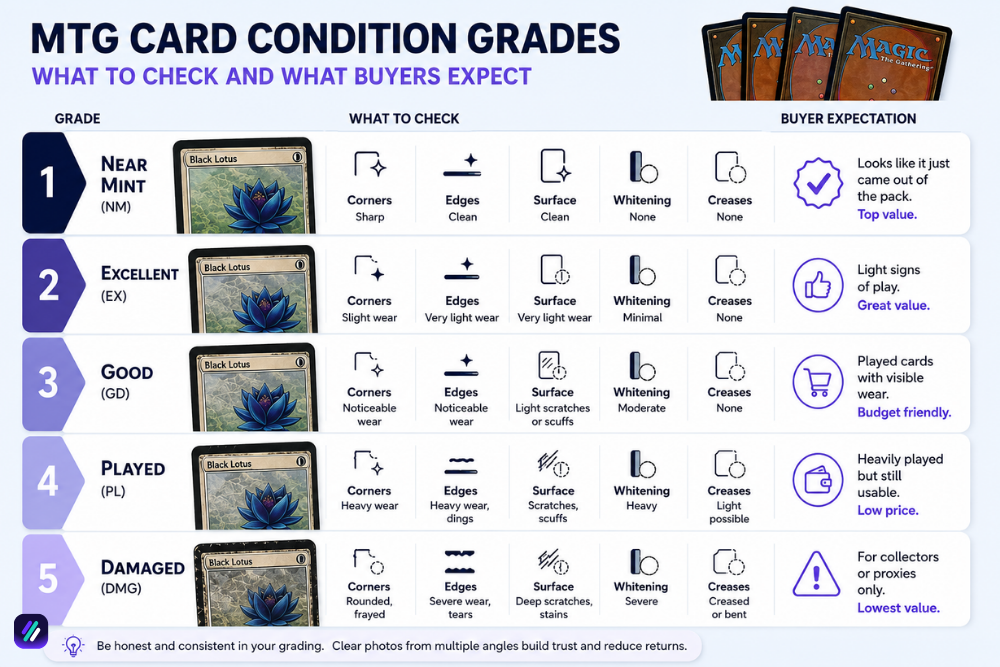
When you inspect a card, you tilt it under good light and check corners, edges, surface scratches, whitening, bends, creases, and shuffle wear. Of course, tournament-played cards still sell, and plenty of Commander buyers want cheap played copies, as long as your description matches what arrives.
That said, the safer mistake is grading conservatively. A good card that can be graded lower is safer for your seller reputation than a mediocre card graded higher. You might lose out on some money, but overinflating the card status will result in huge complaints and bad ratings.
Raw condition vs professional grading
Sell most Magic cards raw. Professional grading only makes sense on vintage, Reserved List, serialized, or iconic high-value cards where a strong grade clearly adds more than the fee and the wait. On a normal playable single, grading is a guaranteed loss.
The math is what decides it. Grading at a service like PSA starts around $80 per card at its currently open tiers, with weeks of turnaround, and even budget graders like CGC start near $15, so a $6 Commander staple cannot carry the cost.
On a genuine Alpha, Beta, or Power Nine card, a high grade can multiply the price and reassure buyers who would never trust a raw listing at that level.
From our team at ZIK, the most expensive beginner mistake in MTG is paying to grade a sentimental card that the market does not actually go a long way in terms of value.
Step 4: Price MTG Cards Using eBay Sold Listings and Market Comps
Now that your cards are sorted and graded, pricing is the skill that decides your take-home. The rule is simple to say and hard to obey: price from what cards have already sold for, never from what other sellers are asking. This is the core of selling Magic cards on eBay profitably.
An unsold listing at $40 is hopeless, especially when left for long. A card that sold three times this week at $11 is the market answering you directly, and that is the number you anchor to.
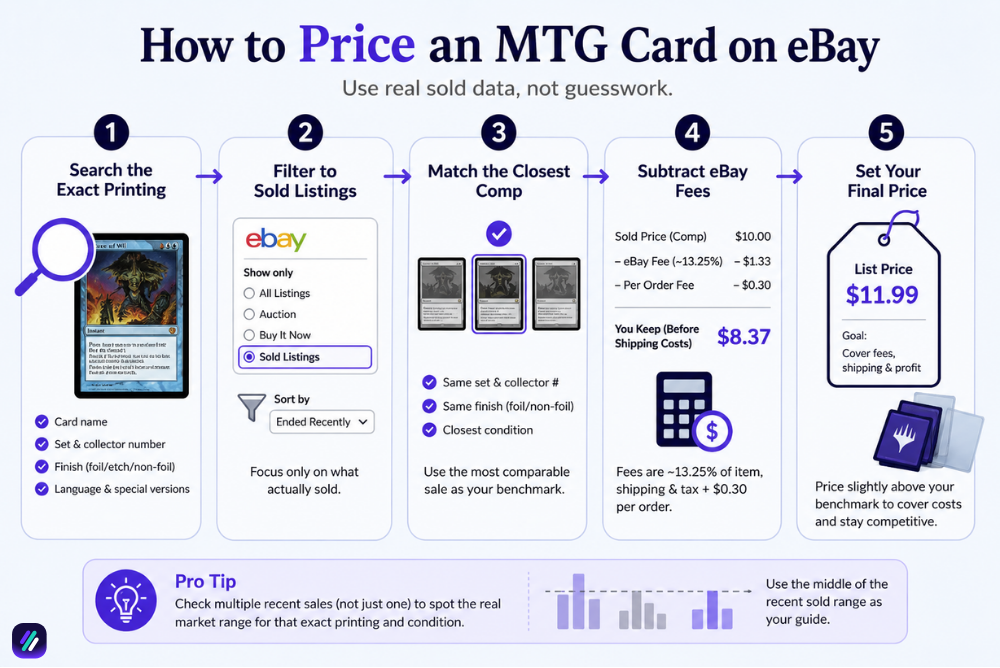
Your main eBay move is sold-listings research. On eBay, you search for the exact card, then filter to sold and completed items to see genuine closing prices and dates. To check faster while you browse, the free eBay Chrome extension from ZIK pulls sold history and competitor data straight onto the listing page.
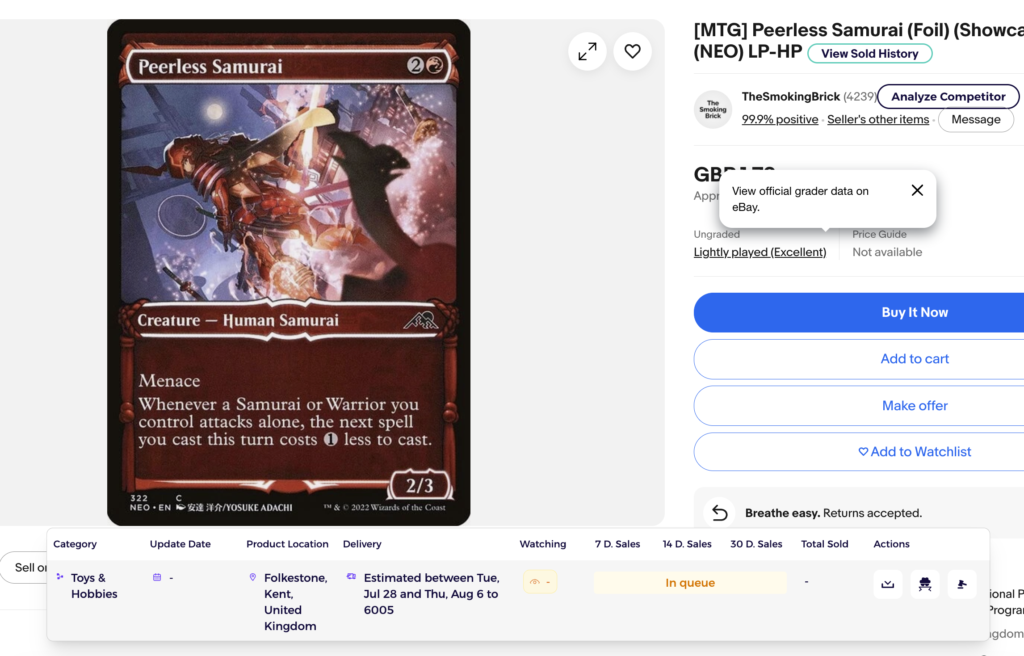
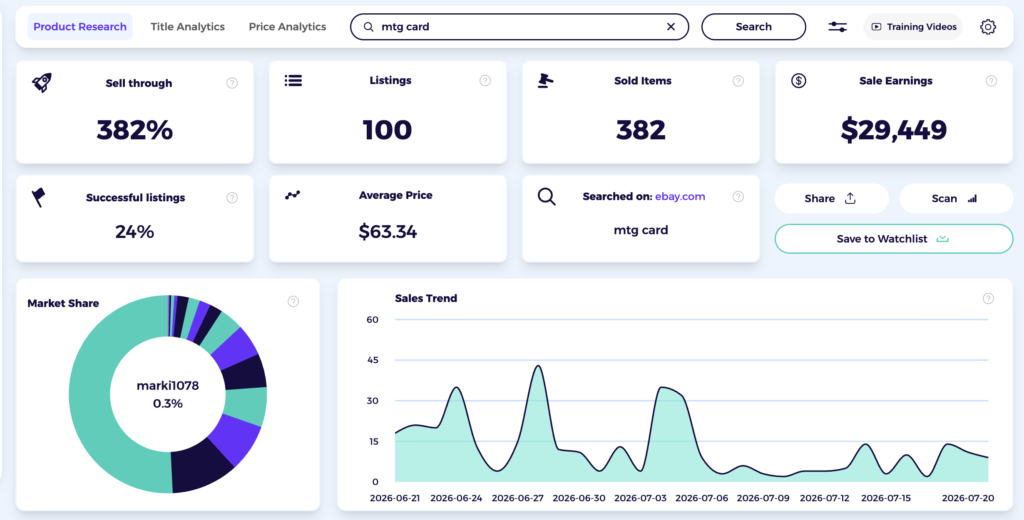
For deeper research before you commit, the eBay product research tool shows the actual sales, sell-through rate, and the price band buyers really pay on any Magic keyword. You anchor to verified demand that way, instead of a number you hoped was right.
It also pays to cross-check a specialist reference like TCGplayer Market Price. The gap between eBay sold comps and that specialist market tells you where the genuine demand sits.
How to use eBay sold listings for Magic cards
Sold comps only help if you match like for like, because Magic listings hide a dozen variables in one card name. A sloppy search blends a foil borderless mythic with its bulk reprint and hands you a useless average.
So you tighten the search every time:
- Search the exact printing, card name, plus set code or collector number, not just the name.
- Filter to Sold and Completed items to see genuine closing prices, then sort by most recent.
- Match the variables, condition, foil status, language, and grade before you trust a comp.
- Ignore the outliers; a single odd sale that does not match your exact version is noise, not a price.
A handful of recent, matched sales beats a long list of loose ones. With three or four genuine comps for your exact card, the price sets itself.
When MTG card prices change quickly
Magic prices move faster than most collectibles, and a comp from six months ago can be badly out of date. Demand swings on deck tech, Commander hype, tournament results, bans and unbans, spoilers, and reprints, so you price from recent sales, not from what a card was worth last year.
Reprints deserve special caution. When a sought-after card gets reprinted in a new set, the price of the common versions usually drops, while original printings or premium treatments can hold value differently. Remember that the card in your hand might be the version that just lost half its price, or the one that kept it, and only the exact-printing comps tell you which.
Step 5: Create an eBay Listing for MTG Cards
With your price set, the listing itself does most of its work through two things buyers never consciously notice: the title and the item specifics. Get those right, and eBay surfaces your card to the exact people already searching for it.
Three things make or break the listing:
- The right category and item specifics: list under Collectible Card Games, then fill every field eBay offers, game, card name, set, rarity, finish, language, and condition, because each blank field hides your card from a filtered search.
- An honest condition description: state the condition plainly and name any flaw the photos show, which is what prevents a not-as-described case after the sale.
- A clean, accurate title: no keyword spam, and never claim “mint” unless the card is professionally graded or genuinely flawless.
Honest, fully specified listings also keep your returns low and your feedback clean as your volume grows, which matters more than winning any single sale.
How to write an MTG card title that gets found
Your title is built from the exact parts a Magic buyer types into search. You stack the card name, set, collector number, finish, condition, and grade where it applies, filling the 80 characters with searched terms rather than filler.
A few reliable formulas cover most cards:
- Raw single: Card Name, Set Name or Code, #Collector Number, Foil or Non-Foil, Condition, MTG.
- Graded card: Card Name, Set, Grading Company, Grade, Foil or Non-Foil, MTG.
- Bulk lot: MTG, Quantity Card Lot, Rares or Foils or Lands or Colors, Magic The Gathering.
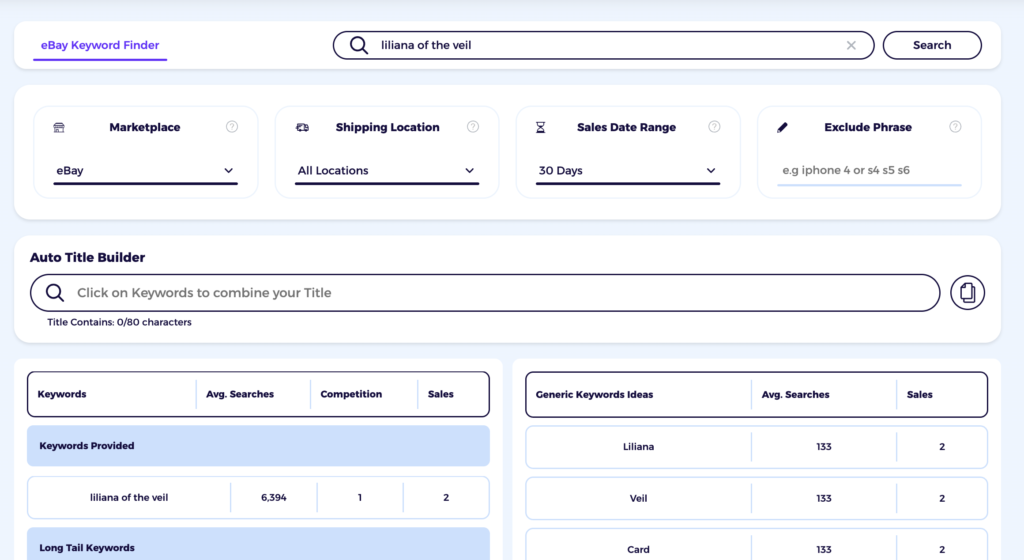
To find the terms buyers actually use, the eBay keyword tool from ZIK pulls high-demand keywords and long-tail phrases out of genuine sales data, so your title is built on what sells rather than on instinct. A title like “Sheoldred the Apocalypse Dominaria United 107/281 NM MTG” tells eBay and the buyer exactly what they are looking at.
How to photograph Magic cards for eBay
On a card listing, the photos do the selling because a buyer cannot hold the card, and your pictures are the only proof of condition they get. Weak photos cost you both sales and disputes.
A reliable shot list covers any card worth more than a few dollars:
- The full front, straight on, and sharp enough to read the text and catch the foil pattern.
- The full back, which shows centering and any edge whitening.
- Close-ups of corners and edges on higher-value cards, where condition lives or dies.
- Any flaw shown openly, because a scratch you disclose is a fair sale, while a hidden one is a refund waiting to happen.
You shoot the actual card on a plain background in bright, even light, never a stock image, and you watch for glare on foils. Nailing the lighting and angles in how to take pictures for eBay is one of the cheapest trusts you can build.
MTG listing description template
A good description is short, specific, and repeatable, so you build it once and reuse it. It removes the questions that otherwise land in your messages and the doubts that otherwise become returns.
You save that structure as a template and swap only the specifics from card to card.
Every description covers the same six points:
- The exact card and version, name, set, collector number, and finish.
- The condition, stated in plain Magic terms, is Near Mint down to Damaged.
- Any flaws, named openly, even when the photos already show them.
- Shipping and handling, the method, protection, and dispatch time.
- What is included: the single card, the playset, or the full lot contents?
- A photo disclaimer, confirming the buyer receives the actual card pictured unless the listing clearly states otherwise.
Step 6: Choose Auction vs Buy It Now for MTG Cards
The format you choose is one of the biggest levers on your final price, so you pick it per card rather than by habit. Buy It Now suits cards with a settled market price and hands you control, while auctions suit scarce, hot, or hard-to-price cards where competitive bidding does the work for you.
Here is how the two formats compare on what actually matters:
| Factor | Auction | Buy It Now |
|---|---|---|
| Best for | Rare, vintage, graded, signed, or hard-to-price cards | Staples and sealed product with known comps |
| Price control | The market sets it, which can run high or low | You set it from sold comps |
| Speed | Fixed end date, often seven days | Sells whenever a buyer is ready |
| Main risk | Selling under value on a quiet day | Sitting unsold if priced above the market |
But the format is only half the decision. If you do run auctions, you end them in the evening on a weekend when the most bidders are watching, and you start the price low to pull early bids in.
Best Offer is the useful middle ground, letting buyers negotiate on cards with moderate demand. Choosing well between eBay buy it now vs auction per card, not by reflex, is what protects your final price.
When to use Buy It Now for Magic cards
Buy It Now is the right call whenever the price is already known, which covers most of what you will sell. The buyer can purchase on impulse, and you are not gambling on bidding turnout.
You reach for it on Modern and Commander staples with clear sold comps, sealed product with stable pricing, fixed-quantity bulk lots, and any lower-risk card where price certainty matters more than chasing a high. For the bulk of a typical collection, this is the format that moves cards steadily.
When to use an auction for MTG cards
Auctions earn their keep when you genuinely cannot pin a price, because the card is too scarce or too hot for clean comps. Letting two determined collectors push the number up often beats anything you would have dared to set.
That points to a short list: rare vintage cards, graded Alpha, Beta, and Unlimited printings, signed cards, misprints, artist proofs, serialized cards, and full collections where the value is hard to total. On those, a well-timed seven-day auction can outperform a fixed price by a wide margin.
Step 7: Ship MTG Cards Safely and Cheaply
With Magic cards, shipping is where a clean sale turns into a five-star review or a refund, because a bent corner in transit is a damaged card on arrival. You match the packaging to the value of the card, which heads off almost every problem before it starts.
The principle is simple: the more a card is worth, the more protection and tracking it earns.
A penny sleeve plus a top loader is the floor for any card, and the ceiling is a rigid mailer with signature confirmation. Getting the match right is the core of how to ship on eBay for collectibles.
You also avoid two specific killers: tape touching the card itself, and loose cards shifting inside an oversized package. Both ruin cards that left your house in perfect shape.
Shipping cheap MTG singles
For low-value singles, just protect it without spending more on postage than the card is worth. A penny sleeve, a top loader or semi-rigid holder, and a plain envelope are the standard build.
The eBay Standard Envelope service is built exactly for this: tracked, low-cost mailing for raw cards, capped at around a quarter-inch thick and three ounces, with shipping protection designed for cards under roughly $20. You keep the card flat, dry, and away from tape, and you add tracking once the card’s value makes a lost-package claim worth covering.
Shipping bulk MTG lots and collections
Lots and collections shift the problem from bending to movement, since a loose stack of cards turns into a rattling mess in transit. You pack them tightly and track them.
A reliable routine keeps bulk arriving intact:
- Sort and band the cards into rows or stacks so they cannot slide.
- Use a deck box, storage box, or team bags sized close to the card count.
- Fill the empty space with padding so nothing shifts in the package.
- Ship tracked, and on a high-value collection, photograph the packed box before it closes as seller protection.
That last habit, a quick photo of the packed collection, has settled more disputes in our sellers’ favor than any message ever has.
Step 8: Know eBay Fees, Shipping Costs, and Profit Margins
Before you celebrate a sale, you need to know what eBay keeps, because the sale price is not the profit.
For most sellers without a store, the trading card final value fee is about 13.25% of the total sale, plus a per-order fee of $0.30 on orders of $10 or less and $0.40 above that, per the eBay fee schedule. That percentage applies to the item price, the shipping, and the tax combined.
The cards that lose money are the cheap ones, where fixed costs eat the whole margin. Controlling that is most of the difference in selling Magic cards on eBay at a profit rather than a loss, so you set a minimum price below which a single goes into a lot instead.
Worked example: selling a Magic card on eBay
A worked example makes the math concrete. A common case is a Commander staple sold for $20 with $1 shipping charged to the buyer.
The numbers break down like this:
- Gross: $20 item plus $1 shipping, so $21 total.
- Final value fee: about 13.25% of $21, roughly $2.78.
- Per-order fee: $0.40, since the order is over $10.
- Net before your costs: around $17.82.
- After packaging and postage: subtract a penny sleeve, top loader, and an envelope at roughly $1.30, leaving close to $16.50.
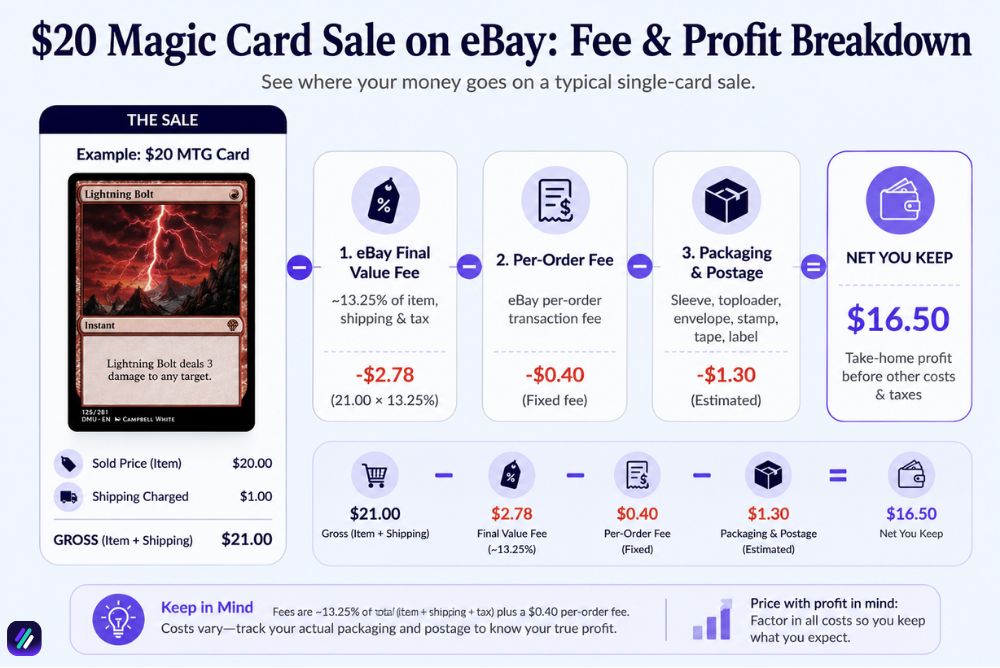
So a card that “sold for $20” actually nets you near $16.50 before you account for what you paid to source it. To run those numbers without the mental math, the eBay fee calculator from ZIK shows your net payout and margin before you commit to a price.
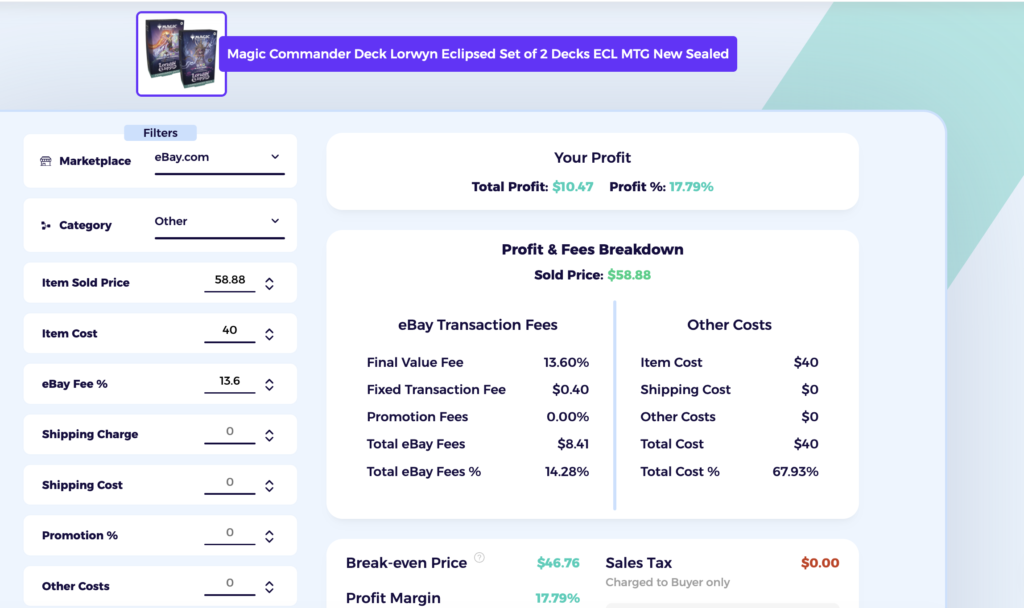
Keep in mind that fees vary by eBay marketplace and country, so confirm your region’s current rate.
When a Magic card is too cheap to list alone
A single is too cheap to list alone when the fees, the envelope, and your time wipe out the profit, which usually hits somewhere around the $2 to $3 mark for raw commons. Below that, you are working for free and inviting disputes over cards nobody should be shipping individually.
The fix is to bundle. Low-value singles become playsets, color lots, rarity lots, or Commander starter lots, and one clean lot listing earns more than twenty tiny ones ever could. You set a personal floor; anything under it goes into a lot, and you never look back.
Step 9: Manage Customer Service, Returns, and Avoid MTG Selling Scams
Most Magic card returns are avoidable, and they trace back to two things: a listing that oversold the condition, or packaging that let the card move. Fix both upstream and most of the friction never reaches your messages.
When a genuine issue does land, a fast, calm refund handled under the eBay return policy protects your account far more than winning the argument does. Cards also attract a few specific scams, so a little caution saves you costly losses:
- The switched-card return: a buyer claims the card arrived damaged or fake, then returns a worse copy. Photographing the exact card you ship, with serial or grading details visible, is your defense.
- The empty-package claim: tracking on anything of value, plus signature confirmation on higher-ticket sales, settles these in your favor.
- The too-good buyer: be wary of a brand-new account paying top dollar with an unusual shipping request, and ship only to the verified address on the order.
Describing cards accurately, shipping on time, and keeping packing photos for expensive items is also how you steadily raise the seller rating eBay judges you on.
Proxies, counterfeits, and reprints
This is the one area where a beginner mistake can get your account suspended, so it deserves genuine care. eBay’s counterfeit item policy bans unauthorized reprints and fakes outright, and listing one, even unknowingly, risks removal or account action.
A few rules keep you safe:
- Never sell a counterfeit as genuine. If you suspect a card is fake, you do not relist it.
- Be careful with proxies and playtest cards. Unofficial cards can only be sold when clearly labeled as non-genuine, never as the cards they imitate.
- Disclose commemorative reproductions. Products like the 30th Anniversary Edition reproduce famous cards but are not tournament-legal originals, and the listing must say so.
- Identify legal reprints exactly. A genuine reprint is fine to sell, as long as you name the exact set and version so nobody mistakes it for the original.
Step 10: Best MTG Cards and Products to Sell on eBay
A quick honesty note before the categories: “best” in Magic shifts with the metagame, reprints, and the release calendar, so treat this as where durable demand tends to sit, not a hot-card tip sheet. Selling Magic: The Gathering cards on eBay rewards sellers who track categories, then validate the specific card against sold data before sourcing it.
Here is how the strongest categories compare on the dimensions that decide your approach:
| Category | Why it sells | Best listing format | Main risk |
|---|---|---|---|
| Commander staples | Casual EDH demand spans thousands of decks | Singles and playsets, Buy It Now | Reprints cutting the price |
| Reserved List and vintage | Permanent scarcity, collector demand | Single listings, often auction | Authentication and high buy-in |
| Sealed product | Stable pricing, gift and investment buyers | Single listings, Buy It Now | Ties up capital, rides hype |
| Bulk and collections | Constant demand from players restocking | Sorted lots | Thin margins, shipping weight |
Commander staples
Commander, or EDH, is the most popular casual format in Magic, and that single fact drives demand for a huge spread of cards. Mana rocks, dual and utility lands, tutors, removal, and popular legendary creatures all sell steadily because thousands of players are constantly building and upgrading decks.
The catch is reprints. A staple that gets reprinted in a Commander set often softens in price, so you check recent comps on the exact printing rather than assuming last year’s value still holds.
Reserved List and vintage MTG cards
Older scarce cards are where the highest prices and the highest risk both live. The Reserved List is Wizards’ standing promise never to reprint certain cards in functionally identical form, which keeps printings like dual lands and the Power Nine permanently scarce and valuable.
Exact edition and condition matter enormously here; authentication is critical, and counterfeiting of marquee cards is a serious problem. When comparable sales are thin, an auction often finds the genuine market price better than a fixed listing.
Sealed Magic: The Gathering products
Sealed product is more of a revenue play than a volume one, and it draws both players and collectors. Booster boxes, Collector Boosters, Commander decks, bundles, and Secret Lair drops all hold reasonably stable pricing, and recent sets like Final Fantasy and Edge of Eternities show how a strong release pulls sealed demand.
Two cautions apply. The condition of the shrink wrap and box matters to buyers, and sealed ties up far more capital than singles, so the margin has to survive fees and shipping before you commit.
Bulk lots and full collections
Bulk and full collections move volume rather than headline prices, and there is steady demand from players restocking and from resellers hunting for hidden value. You sort by color, rarity, set, or playable category wherever you can, because a themed lot always outsells a random pile.
Honesty is the whole game in this category. You state clearly whether lands, tokens, foils, rares, or duplicates are included, and you skip the exaggerated “valuable cards inside” claims that turn into disputes.
Step 11: Source More MTG Cards to Sell on eBay
Once you have sold through your own cards, your margin is decided before you list, based on what you pay to source. The goal is straightforward and harder than it sounds: buy Magic cards below their eBay sold price, which means going where collections are mispriced instead of buying at retail and hoping.
The sourcing channels that work for Magic resellers are these:
- Personal collections and friends, the cheapest inventory you will ever get.
- Local game stores and card shows, where you can cherry-pick and build supplier relationships.
- Facebook groups, estate sales, and garage sales, where binders are priced as a lump sum, often hide singles worth more than the whole.
- Collection buyouts and bulk purchases, which scale fastest but demand the most due diligence.
One distinction matters here. This is reselling, where you hold the actual stock, control condition, and ship it yourself, not eBay dropshipping, which works poorly for cards because authenticity and condition are everything. You start with small test buys before scaling, and the instincts that surface the best things to resell on eBay apply directly to Magic.
How to evaluate an MTG collection before buying it
A fast valuation routine keeps you from overpaying, because most collections look more valuable than they are at a glance. You triage before you offer.
You work through it in order:
- Scan the binders first for the obvious chase cards and premium foils.
- Separate sealed product, which often carries more value than the singles.
- Hunt for the keepers, older sets, foils, rares, mythics, lands, and Commander staples.
- Estimate bulk conservatively, because the long tail is worth less than it looks.
- Cost in your time, the hours to sort and list are a genuine part of the price.
Step 12: Promote MTG Listings and Increase eBay Sales
Getting your listings seen is the lever after pricing, and it starts free before it ever costs money. Accurate titles, complete item specifics, and clean photos do more for visibility than any ad, so you fix those before you pay to promote anything.
A few moves drive steady traffic:
- Add Best Offer on cards with moderate demand to let buyers negotiate into a sale.
- Use eBay promoted listings carefully on competitive singles and sealed products, where a modest ad rate earns extra visibility in a crowded category.
- Refresh stale listings when comps move, so a card that has sat for weeks regains fresh search standing.
- Send offers to watchers on eBay, since a card on someone’s watchlist often just needs a small nudge.
Combined shipping for MTG buyers
Magic buyers rarely buy one card, which makes combined shipping one of the easiest ways to lift your average order value. A collector building a deck will happily add three more singles if the shipping does not punish them for it.
You set up clear combined-shipping rules, or you offer it on request, and you say so plainly in your listings. Walking buyers through how to combine shipping on eBay in your terms turns a one-card sale into a four-card order more often than you would expect.
Step 13: Open an eBay Store If You Plan to Scale MTG Sales
Once you are selling Magic cards every week, the math on an eBay Store starts to favor you. A store subscription lowers your final value fee percentage and hands you a block of free listings each month, so past a certain volume, the monthly cost pays for itself.
If the fee savings plus the free listings outweigh the subscription cost at your current sales pace, a store is worth it; if you sell a handful of cards a month, it is not yet. The right tier depends on your volume, so you weigh how much an eBay store costs against your monthly sales before subscribing.
A store also adds practical tools: store categories built around your inventory, like Commander staples, lands, foils, sealed product, and bulk lots, plus bulk listing and a branded storefront that makes a serious card seller look the part.
Step 14: Scale with Tools, Data, and Reinvestment
Scaling a Magic card business comes down to two moves: reinvesting profit into better inventory, and replacing guesswork with data. The sellers who grow fastest treat their early profits as sourcing capital, and they validate demand before they buy.
A smart habit at this stage is studying the sellers already dominating your niche. With the eBay competitor research tool you can pull a top Magic seller’s revenue, best-selling items, and sell-through rate, then borrow what works for your own listings. Doing that analysis regularly is how good sellers stay a step ahead of the category.
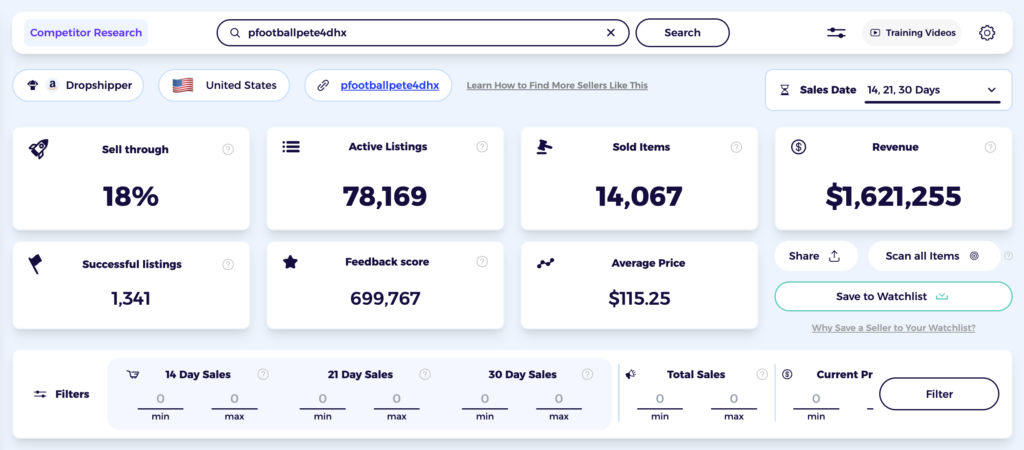
The same data discipline guides your sourcing. Before you buy a pallet of sealed product or a collection of Commander singles, you check whether the demand, average price, and competition support the spend rather than trusting a hunch. You reinvest gradually, keep cash flow under control, and let the numbers decide what you scale into next.
Best Selling Magic Cards and Sets on eBay
The strongest Magic angles on eBay right now cluster around current-set singles and sealed product that buyers already search for by name, plus the evergreen Commander staples that thousands of decks keep demanding.
The exact winners shift with every set release, so the actual skill is reading live demand before you source.
Because the outline for this guide ships without live ZIK marketplace figures, the categories below are ranked by durability of demand and confidence, with the specific metrics left for you to pull fresh, which the final section shows you how to do. The honest framing matters: Magic demand is great, but it moves with the release calendar, so a category that is hot today can soften after a big reprint.
The eight angles below run roughly from the safest, highest-volume plays down to the high-value, high-risk niches. Each one carries a confidence read, why it works, the main risk, and your next action, so you can match it to your stock and your appetite.
Category 1: MTG singles and set-pick “you pick” listings
Confidence here is high because singles are the backbone of the Magic secondary market. Players hunt specific cards by name, and a deep “you pick” or set-pick listing lets one page serve dozens of buyers building toward the same deck.
The format rewards catalogue depth and accurate pricing more than any single chase card. The main risk is the admin load of managing a large pick list, and the next action is to validate which singles in your stock actually carry steady sell-through before you build the page.
Category 2: Staple playsets (Commander and Modern)
Confidence is high for genuine staples. Constructed and Commander players often need four copies, so a clean Near Mint playset of a format staple sells faster than four separate singles and lifts your average order value.
Demand concentrates on tournament-relevant and high-inclusion cards. The risk is reprints flattening a staple’s price overnight, so the next action is to confirm the card is still played and still scarce on recent comps before listing a full playset.
Category 3: Sealed boosters and boxes (Play / Set / Collector)
Confidence is medium to high, weighted toward revenue rather than volume. Play Boosters, Set Boosters, Collector Boosters, and full boxes draw players, gift buyers, and speculators, and pricing is more stable than singles.
The trade-off is steep: sealed ties up significant capital and rides hype cycles. The next action is to check that a box’s current comps leave margin after fees and heavier shipping before you buy a case to flip.
Category 4: Commander precon decks
Confidence is medium. Preconstructed Commander decks sell well to new and casual players who want a ready-to-play deck, and certain out-of-print precons appreciate as their reprinted staples climb. Demand is steady but rarely explosive.
The main risk is that current-year precons are widely available and thin on margin, so the next action is to focus on sold-out or older decks where scarcity has started to lift the price.
Category 5: Secret Lair and limited drops
Confidence is medium, with genuine upside on the right drop. Secret Lair products are limited-window releases, so once a drop sells out, sealed copies and their singles can climb on scarcity and art demand. The risk is that not every drop appreciates, and some sit flat. The next action is to track which past drops actually held or grew in sold comps, and to treat speculation on a live drop as the gamble it is.
Category 6: Bulk and mixed Magic lots
Confidence is high for steady, thin-margin turnover. There is constant demand from players restocking commons and from resellers hunting value, and sorted lots reliably move. This is volume work, not headline prices.
The risk is shipping weight eroding margin and disputes over vague contents, so the next action is to sort lots by color, set, or rarity and describe them precisely, which both raises the price and cuts complaints.
Category 7: Graded MTG slabs
Confidence is medium and niche. Graded slabs from PSA, BGS, or CGC carry a premium for high-grade vintage, iconic, and serialized cards, and the slab itself reassures cautious buyers.
The trade-off is the grading cost and the fact that grading only pays on genuinely valuable cards. The next action is to grade selectively, only where a strong grade clearly clears the fee and turnaround, and to verify the cert before reselling someone else’s slab.
Category 8: Vintage and Reserved List singles
Confidence is high on demand and high on risk together. Reserved List cards and vintage staples reach the top prices on the platform because they cannot be reprinted, but they demand authentication knowledge and a larger buy-in.
Counterfeiting is a genuine threat at this level. The next action is to build genuine identification and authentication skills, often by starting with the single-card discipline in how to sell cards on eBay, before you put serious money into vintage.
Is eBay a Good Place to Sell Magic: The Gathering Cards?
Yes, eBay is one of the best places to sell Magic cards, especially graded, sealed, vintage, and collection listings. Its buyer pool and open sold-price history are unmatched, though it charges fees and takes more listing effort than a quick buy-and-sell sale.
Selling Magic: The Gathering cards on eBay makes the most sense when you want reach and pricing control.
The scale is the first reason. eBay reports more than 130 million active buyers worldwide and around $79.6 billion in annual sales, and trading cards are one of its busiest collectible categories.
No local game store or Facebook group puts your card in front of that kind of audience, and that public sold-price history is exactly why eBay comps are so reliable.
Of course, eBay is not the only venue, so it helps to know where each one wins. Here is how eBay compares to the main alternatives for Magic sellers:
| Platform | Best for | The trade-off |
|---|---|---|
| eBay | Any card, any price, with the biggest buyer pool and open sold-price data | Heavy competition and fees on every sale |
| TCGplayer | Singles for active players who shop by exact card | Weaker reach for sealed, graded, and collection listings |
| Card Kingdom buy list | Speed and low effort when you just want cash | Pays below retail resale value |
| Local game store | Instant local sales with no shipping | Lowest payout, store needs the inventory |
eBay vs TCGplayer for MTG sellers
TCGplayer is the specialist marketplace most Magic buyers know for chasing specific singles, and its Market Price is the reference most sellers use to value cards. For straightforward singles to active players, it is fast and familiar.
Where eBay pulls ahead is everything outside the standard single: graded cards, sealed product, collections, vintage and Reserved List cards, misprints, signed cards, and auctions for hard-to-price items. The smart play is to use both, treating TCGplayer prices as a valuation reference and eBay sold comps as the genuine signal of eBay demand.
eBay vs Buy list services
Buy list services like Card Kingdom buy your cards directly at posted prices, which is the fastest, lowest-effort way to turn cards into cash. You skip photos, shipping, and customer service entirely, and you accept a lower payout in exchange.
The decision rule is simple. You buy low-margin volume and cards you just want gone, and you sell high-value or differentiated cards on eBay, where the pricing control and bigger audience earn you more. Most serious sellers do both, sorting each card into the channel that pays best for the effort involved.
What Kinds of MTG Cards Can You Sell on eBay?
You can sell almost any genuine Magic card or product on eBay: raw singles, foils, playsets, bulk lots, sealed boosters and boxes, Commander decks, Secret Lair drops, and graded slabs. The one hard limit is authenticity, since counterfeits and unauthorized reprints are banned.
Most sellers come to Magic holding one of a few formats, and knowing which you have shapes how you list it. The listing formats that move on eBay break down like this:
| Card or product type | Typical listing format | Example title |
|---|---|---|
| Raw single | Buy It Now, one card | Sheoldred the Apocalypse DMU 107 NM MTG |
| Foil or special treatment | Buy It Now or auction | Atraxa Phyrexia Borderless Foil MTG |
| Playset (four-of) | Buy It Now, set of 4 | Lightning Bolt x4 Playset Modern MTG |
| Bulk or themed lot | Buy It Now, fixed quantity | MTG 500 Card Lot Rares and Foils |
| Sealed product | Buy It Now, single item | MTG Edge of Eternities Collector Booster Box |
| Graded slab | Auction or Buy It Now | Black Lotus CE PSA 8 MTG |
Tokens, promos, and oddities have their own dedicated buyers too, much as a near-mint raw copy and a graded version of the same card are simply two listings aimed at two different buyers. The sourcing and identification instincts here carry across collectibles, whether you are listing Magic singles, sealed boxes, or graded slabs.
Is It Worth Selling Magic Cards on eBay?
Yes, selling Magic cards on eBay is worth it when you treat it as a sourcing-and-pricing game rather than a lottery.
Demand is large, and competition is serious, so the sellers who profit are the ones who buy below the sold price and list from data, not the ones who dump a collection and hope.
Magic sits inside a thriving collectibles market, and for adjacent scale, Grand View Research values the sports trading cards market at about $13.5 billion, projected to reach $24.7 billion by 2033, with the broader trading card hobby riding the same collector wave.
But the competition lives in those same numbers, and this is where beginners lose money. A bulk rares box and a binder of Commander and Modern staples are completely different businesses, and only the second reliably pays.
So the path to worth-it is narrow but clear:
- It is worth it when you have staples, foils, sealed product, vintage, or sortable bulk, and you price from sold comps.
- Skip it when you are holding low-value commons with no sorting time, where a single bulk sale or a buy list is smarter.
- It is rarely worth it to list sub-$2 singles one at a time, no matter how many you have.
I hate to break it to you, but the get-rich version of this is everywhere, and it is wrong. The profit is made before the sale, in what you pay to source and how accurately you price, which is the discipline this whole guide is built around.
Find Best-Selling MTG Cards on eBay with ZIK Analytics
Every smart decision in this guide comes back to one habit: deciding from genuine sales data instead of hope. That is the part ZIK Analytics handles for you:
- Use the eBay product research tool to see the actual sales, sell-through, and price band on any Magic keyword, from Commander staples to sealed boxes, before you list.
- Use the eBay competitor research tool to study a top Magic seller who already dominates your niche, from their revenue down to their best-selling cards.
- Use ZIK’s Amazon to eBay dropshipping software to source profitable inventory beyond cards, with the margin already worked out for you.
That is the difference between a card business built on verified demand and one built on guessing. You can try all three on a $1 trial (7-day) and run your first sold-data check on a Magic card today.
How to Sell MTG Cards on eBay FAQs
A few quick answers to the questions Magic sellers ask most before they list.
Is it better to sell MTG cards on eBay or TCGPlayer?
It depends on the card. TCGplayer is usually better for standard singles sold to active players, while eBay wins for graded cards, sealed product, vintage, collections, and auctions of hard-to-price items. Many sellers use both, treating TCGplayer Market Price as a valuation reference and eBay sold comps as the genuine signal of eBay demand.
What percentage does eBay take on a $500 sale of MTG Cards?
For most sellers without a store, eBay’s trading card final value fee is about 13.25% of the total sale, so on a $500 sale that is roughly $66, plus a $0.40 per-order fee. The percentage applies to the item, shipping, and tax combined, and a store subscription or marketplace differences can change it.
How much money can you make selling MTG cards on eBay?
It varies widely with your inventory and effort. Sellers offloading a personal collection might make a few hundred dollars, while consistent resellers who source below market and reinvest can build steady monthly income. The realistic path is buying cards below sold price and pricing accurately, which you can validate with the eBay Product Research Tool before sourcing.
Do I need a business license to sell MTG cards on eBay?
Casual selling of your own collection usually does not require a license, but selling regularly for profit can make you a business in your tax authority’s eyes. Your income is taxable regardless of whether you receive a 1099-K form, and license rules vary by location, so this is general information rather than legal advice and worth confirming with a local professional.
What condition should I list my Magic cards as?
You list with Magic’s standard ladder, from Near Mint through Lightly Played, Moderately Played, and Heavily Played down to Damaged, and you grade conservatively. You inspect corners, edges, surface, and whitening under good light, and when you are torn between two grades, you pick the lower one. An accurately described played card sells fine, while an oversold one invites a not-as-described return.
Is eBay Standard Envelope safe for shipping Magic cards?
Yes, for low-value raw cards under roughly $20, it is a safe, tracked, low-cost option built for exactly this. You still sleeve and top-load the card and keep it under the quarter-inch thickness and three-ounce weight limits. For valuable, graded, or sealed items, you step up to a bubble mailer or rigid mailer with full tracking and, where it fits, signature confirmation.