
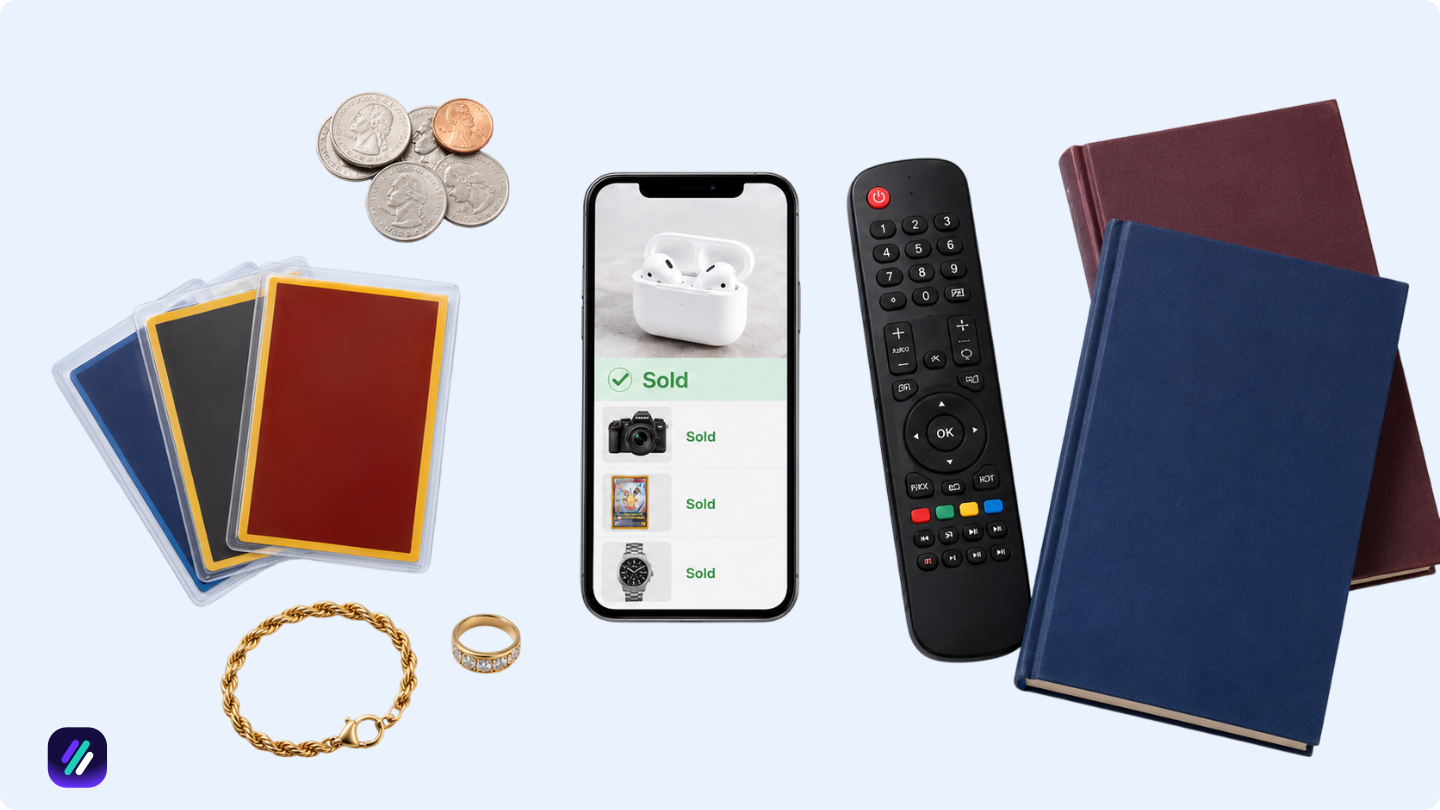
Most new sellers assume the money on eBay lives in big, expensive items, so they skip right past the small stuff.
However, that instinct could be expensive for you.
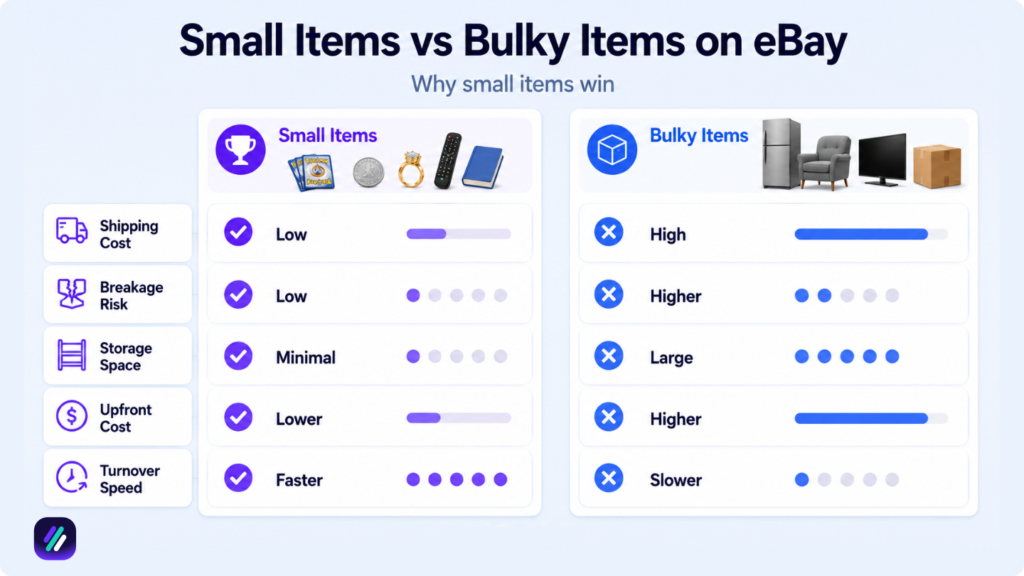
Bulky items chew through your margin in shipping, storage, and breakage long before a sale clears, and they tie up cash you could be turning over three times as fast.
The best small items to sell on eBay flip that math.
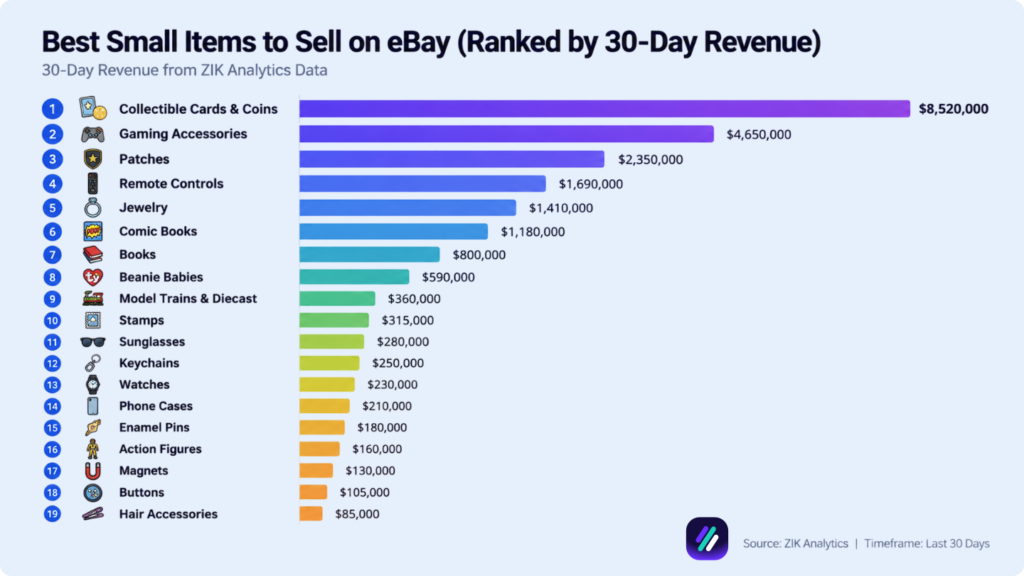
In this guide, we’ll walk you through 19 small items to sell on eBay that sell well, backed by our own eBay sales data, plus how to research them, where to source them, and which ones to leave on the shelf.
Key Takeaways
- Small items win on margin, not headline price. Lower shipping, storage, and breakage costs mean more of each sale stays with you, and your inventory turns over far faster than it would on bulky goods.
- Demand decides everything, not how clever an item feels. Categories like coins, collectible cards, and jewelry move enormous volume every month, while plenty of “cool” items barely sell at all.
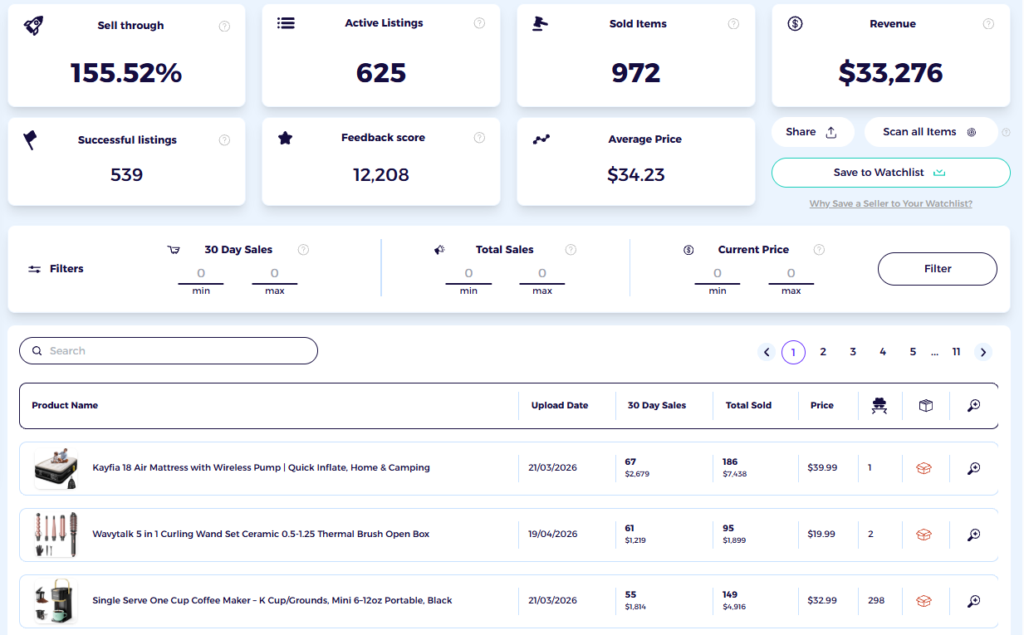
- Before buying a single unit, the eBay product research tool from ZIK Analytics shows actual sales, sell-through, and competition on any keyword, so you stock what already sells instead of guessing.
- Competition is the price of demand. The biggest categories also carry the most sellers, so winning usually means picking a tight sub-niche rather than chasing the broad keyword.
- Sourcing sets your margin before you ever list. Thrift stores, estate sales, liquidation lots, and your own declutter pile all beat buying at retail and hoping.
- Some small items are traps. Cheap goods with expensive shipping, fragile glassware, and counterfeit-risk branded items cost more than they earn.

What Makes the Best Small Items to Sell on eBay?
The best small items to sell on eBay share four traits: proven buyer demand, competition you can realistically beat, a healthy margin after fees and shipping, and a sourcing channel you can repeat. When those four line up, the item nearly sells itself.
Here is how I weigh each small item before committing a single dollar to inventory:
| Criterion | What to check | Why does it decide on the sale |
|---|---|---|
| Demand | Units sold and sell-through over the last 30 days, not just how many listings are active | Steady sales are demand you tap into, not demand you have to create from scratch |
| Competition | How many sellers and listings already chase the same keyword | Heavy competition is fine if you niche down; broad and crowded is where new sellers drown |
| Margin | Sale price minus eBay fees, postage, and your cost per unit | A $12 item that costs $9 all-in to fulfill is busywork dressed up as a business |
| Sourcing | Whether you can restock the item cheaply and repeatedly | A one-off lucky find is a sale; a repeatable source is income |
So those four traits are exactly how the broader best-selling items on eBay lists get built, large or small.
And the good news for beginners is that small items make every one of them easier to test cheaply. With that in mind, here are the 19 categories that pass the test right now.
1. Beanie Babies
Beanie Babies sound like a punchline from 1998, and most of them really are worth nothing. The exception is the part that matters: a steady collector market still moves the right pieces.
Our internal ZIK data shows around 34,000 sales and roughly $590,000 in 30-day revenue across the niche, at about a 16% sell-through, with far less listing pressure than books or coins.
What actually sells is selective, so this is a knowledgeable-collector lane, not an easy flip-everything play. Retired tags, first-generation bears, clean-condition rares, and authenticated lots are the pieces buyers chase.
You can source them cheaply through thrift store flipping, estate sales, and the declutter piles of people who forgot they owned them.
But you should be aware of the pricing, as a lot of Beanie listings carry made-up asking prices that never sell, so anchor to actual sold data and treat the inflated numbers as noise.
2. Old Model Trains, Cars, and Diecast
Old model trains, diecast cars, and slot-car parts are a quieter market than the headline categories, but the buyers are loyal, and they pay for the right pieces. ZIK shows roughly 8,400 sales and about $360,000 in 30-day revenue across the niche, which is healthy for how specialized it is.
The money sits in brand and scale. Lionel and Märklin trains, vintage Hot Wheels Redlines, Dinky and Corgi diecast, and complete boxed sets all command a premium, and collectors care about completeness above almost everything. An item with its original box and inserts can be worth several times as much as a loose one.
Estate sales, downsizing seniors, and forgotten toy boxes are where these surface cheaply. The honest downside is knowledge: this niche rewards people who can tell a reproduction from an original, and punishes anyone who misdescribes a repaint as factory-original.
3. Books
If you want the friendliest place for a beginner to start, books are it. They are easy to find, easy to grade, and far less rule-heavy than coins or jewelry. ZIK shows around 33,000 sales and about $800,000 in 30-day revenue, which is broad, steady demand rather than a one-off spike.
Books also carry a logistics edge that most categories don’t. Eligible media ships cheaply through USPS Media Mail, which starts at $4.47, though packages are subject to inspection and can’t include advertising. That keeps your postage low on exactly the items buyers expect to be affordable.
Knowing how to sell books on eBay profitably comes down to bundles and specifics, not random paperbacks such as textbooks, niche nonfiction, children’s lots, series sets, and signed or collectible editions. Competition is heavy, with well over 200,000 active listings, so the curated copies win.
4. Coins
Coins are the biggest market on this entire list, and the strongest by sell-through. ZIK shows roughly 148,000 sales and north of $13 million in 30-day revenue, with the best sell-through here at about 21%, so demand is not the question.
Collector attention is clearly alive today, with the U.S. Mint actively selling its 2026 American Eagle silver proof, a special “1776 to 2026” semiquincentennial issue.
Most of the profit in how to sell coins on eBay is in the grading calls and clean photos of both faces, which is exactly where beginners lose money. Bullion, graded key dates, error coins, world coins, and clean circulated sets all sell, and you can source from inherited collections and estate sales.
The trade-off is rules. eBay requires approved graders for graded coins and bans replica coins, and US law under the Hobby Protection Act requires imitation coins to be marked COPY. Those are US and eBay.com specifics that vary by marketplace and country, so verify everything and stay away from anything questionable.
5. Consumer Electronics
Consumer electronics are tempting and dangerous in equal measure, which is why I rank them with care.
The demand is solid, and ZIK shows about 12,600 sales and roughly $256,000 in 30-day revenue across small-electronics keywords. The trouble is returns and counterfeits, which hit this category harder than almost any other.
The safest lane is small, testable, brand-name gear: wired earbuds, chargers and cables, retro handhelds, smartwatches, and refurbished accessories you can power on and confirm before listing.
Refurbished items with original brand names move faster than generics, because buyers trust a tested, known brand over an unknown one.
Open-box returns, liquidation lots, and upgrades people are offloading are your sourcing grounds. The risk here is dead-on-arrival stock and battery items, so test every unit and describe flaws honestly.
6. Vintage Pencils
Vintage pencils sound like a joke, and I was skeptical too, until the numbers changed my mind. This is one of the lowest-competition pockets on the whole list: ZIK shows about 11,700 sales and roughly $148,000 in 30-day revenue against only about 2,300 listings, which is a rare ratio of demand to supply.
Collectors chase very specific things here. Eberhard Faber Blackwing 602s, vintage Eagle and Dixon mechanical pencils, advertising pencils, and sealed new-old-stock boxes all sell, and a single Blackwing can fetch far more than a whole modern pack.
Estate sales, old office and school closures, and the backs of desk drawers are where these turn up. The downside is thin volume and niche knowledge, so treat it as a sharp add-on niche for someone who enjoys the hunt, not a category you build a whole store around.
7. Premium Tools
Premium hand tools are one of the strongest blends of demand and margin on this list. Used and vintage tools from trusted brands hold their value because tradespeople and collectors both want them, and ZIK shows around 20,000 sales and about $600,000 in 30-day revenue. That is serious money for items that fit in a padded envelope.
The brands carry the price. Snap-on, Starrett, vintage Stanley planes, Klein, and discontinued specialty tools are what buyers pay up for, so condition and authenticity matter more than volume here.
Garage sales, estate sales, retiring tradespeople, and liquidations are full of these. The honest risk is counterfeits of premium brands and mistaking a modern import for vintage, so learn the maker’s marks before you spend serious money on inventory.
8. Stationery and Office Supplies
Staying in the everyday-supplies lane, stationery and office gear are steady, unglamorous earners.
People restock pens, planners, label makers, and craft supplies constantly, and discontinued or imported lines create the scarcity that drives eBay prices. ZIK shows roughly 30,000 sales and about $400,000 in 30-day revenue.
What sells well is specific and often discontinued: Japanese pens and planners, washi tape, fountain pens, label-maker refills, and bundled craft-supply lots. Buyers in this space love a niche, so a curated themed bundle outperforms a random box every time.
Store closeouts, liquidation, and bulk craft destashing are reliable sources. The downside is that broad commodity stationery races to the bottom on price, so the margin lives in discontinued, imported, or bundled items, not the same pens every big-box store already carries.
9. Remote Controls
The demand for replacement remote controls is not close: ZIK shows around 110,000 sales and roughly $4 million in 30-day revenue. It is a near-perfect small-item profile too, since remotes are light, easy to store, and cheap to ship.
Replacement need is constant, because remotes get lost, dropped, and chewed by the dog every single day (talking from personal experience here)
What sells is model-specific. Authentic OEM remotes for Samsung, LG, Roku, Sony, and cable boxes, tested and matched to exact models, beat generic “fits everything” listings by a mile, and reliable universal remotes round out the niche.
Broken-set teardowns, liquidation, and thrift electronics bins are where you find them. Competition is heavy, north of 380,000 listings, and brand accuracy is a policy line, so only use a brand name when the remote is genuine or specifically compatible, and describe that fit precisely.
10. Jewelry
Few small items match jewelry for year-round demand, and it never waits for a season. ZIK shows around 174,000 sales and roughly $3.3 million in 30-day revenue, which holds up in late June just as well as it does in December. That makes it a category you can build on rather than ride in spikes.
The demand is strong, but so is the competition: well over a million listings mean “jewelry” as a broad keyword is a place new sellers drown. Most of the selling jewelry on eBay successfully is niching down fast into fashion jewelry, sterling pieces, body jewelry, or storage and displays.
Estate sales, downsizing, and wholesale fashion lots keep you stocked. eBay also runs an authenticity guarantee for qualifying jewelry, so accurate metal and stone descriptions matter on higher-value pieces.
Download this eBook now and learn how to sell on eBay like a pro.11. Holiday Ornaments
Holiday ornaments are an honest seasonal play, and the timing math matters more than the raw demand. Even in an off-season, June read, ZIK shows about 16,000 sales and roughly $318,000 in 30-day revenue, which is respectable for a category that lives mostly in Q4.
Demand concentrates hard around the holidays, with the NRF expecting US holiday sales to top $1 trillion across November and December.
What sells is collectible and branded: Hallmark Keepsake ornaments, Christopher Radko, vintage glass, Department 56, and themed sets. Collectors complete series, so a single missing-from-a-set ornament can sell for surprisingly high.
You can source year-round from after-Christmas clearance, estate sales, and storage-unit finds, then list ahead of the season. The catch is obvious, since sell-through drops sharply after December, so buy cheap off-season and don’t get stuck holding stock you can only move three months a year.
If you’d rather avoid holding seasonal inventory, selling Christmas dropshipping products lets you take advantage of holiday demand without buying stock upfront. It’s a practical way to test trending ornament styles and other festive items before committing to larger purchases.
12. Sports Memorabilia
Sports memorabilia is the box of old programs, signed balls, and team pennants sitting in someone’s garage, and it sells well whenever it is authentic. ZIK shows around 17,000 sales and roughly $310,000 in 30-day revenue, spread across a wide range of price points.
The money is in provenance. Autographed items with certification, vintage programs and ticket stubs, team-issued gear, and pieces tied to notable players or moments all command a premium that unverified items never will.
Estate sales, retiring fans, and local collections are the sourcing grounds. The risk that defines this niche is forgery, so certificates of authenticity, photo-matching, and a careful eye are non-negotiable. When in doubt, it is safer to pass than to list something you can’t stand behind.
13. Children’s Toys
Children’s toys move a remarkable amount of volume because parents replace, complete, and hunt for them constantly. ZIK shows about 20,000 sales and roughly $730,000 in 30-day revenue, one of the higher revenue figures for its size on this list. Nostalgia and scarcity both drive it.
The winners are specific. Retired LEGO sets, discontinued action figures, vintage toys, plush from popular franchises, and complete sets with all their pieces lead the way, and sealed or complete-in-box items can sell for multiples of a loose one. That rewards careful sorting.
Your own kids’ outgrown toys, garage sales, thrift stores, and liquidation keep costs low. The pitfalls are safety and authenticity, so avoid recalled items and counterfeit branded toys, check age and small-parts compliance, and clean everything before it ships.
14. Mobile Accessories
Mobile accessories are the category I’d approach with the most caution, even though the market behind them is enormous. The global mobile accessories market is valued at $105.45 billion, heading toward $189.92 billion by 2033, and ZIK shows around 157,000 sales and roughly $3.6 million in 30-day eBay revenue.
So the demand is not in doubt.
The danger is brand and compatibility risk. This space is wall-to-wall with phone brands, accessory brands, and generic lookalikes, and eBay’s counterfeit and IP rules are strict about using a brand name when an item is not genuine or specifically compatible.
The way to win is to go narrow: specific model-fit cases, tested charging gear, screen protectors for exact devices, and clearly labeled compatible parts. You can source from wholesale and liquidation, avoid anything that imitates a brand, and treat precise compatibility claims as the whole game.
15. Hair Accessories
You will not get rich on a single hair clip, but the category adds up fast across a wide, repeat-buying audience. ZIK shows around 30,000 sales and roughly $335,000 in 30-day revenue.
The broader hair accessories market sits near $23.4 billion, with about 8% annual growth toward 2033, so this is an active everyday category, not a fad.
What sells is unbranded and bundled: claw clips, scrunchies, headbands, barrettes, bridal and occasion pieces, and multi-packs. Trend-led looks move fast, so bundles and current styles outperform single basic clips.
Supply here is plentiful, which cuts both ways. If you go the dropshipping route, you can match these to suppliers fast through tools that surface dropshipping products, but plentiful supply also means generic me-too listings race to the bottom. eBay’s VeRO program lets brands pull infringing copies, so compete on selection, not knockoffs.
16. Small Home Goods
Alongside accessories, small home goods are a broad, dependable category that benefits from constant household demand. People always need kitchen gadgets, organizers, décor, and replacement parts, and the small, shippable end of this market fits eBay perfectly. ZIK shows about 37,000 sales and roughly $378,000 in 30-day revenue.
What sells is practical and specific: discontinued kitchen tools, replacement parts for popular appliances, vintage Pyrex and Corningware, storage items, and small décor. Replacement parts are an underrated pocket, because a buyer hunting one specific lid or attachment will pay well and has few alternatives.
Thrift stores, estate sales, clearance, and liquidation keep you stocked. The downside is shipping fragility on glass and ceramics, so reserve those for items valuable enough to justify careful packing and lean toward unbreakable, lightweight goods when you are starting out.
17. Gaming Accessories
Gaming accessories ride a strong industry tailwind, and the spending behind them is huge.
US consumer spending on video games reached $60.7 billion, and the global gaming accessories market sits around $6.57 billion, projected to reach $10.07 billion by 2030. ZIK shows around 190,000 sales and roughly $4.2 million in 30-day eBay revenue, at about a 17% sell-through.
What sells is controllers, charging docks, headsets, retro-console accessories, and replacement parts for current and past generations. Retro and discontinued accessories are an especially strong pocket, because official supply has dried up, but demand has not.
Liquidation, trade-ins, and broken-console teardowns for usable parts are reliable sources. The main risk is brand and IP exposure, since gaming niches run into trademarked compatibility claims fast, so describe what an accessory actually fits and skip anything that imitates a first-party brand.
18. Collectible Cards
Collectible cards on eBay are the single biggest market on this list, and the easiest to grow into a serious business. ZIK shows more than 420,000 sales and roughly $5.8 million in 30-day revenue, and almost everyone niches down into a lane: Magic: The Gathering, sports cards, Pokémon, Yu-Gi-Oh, and vintage non-sport cards.
What sells is modern singles in a choose-your-card format, graded chase cards, sealed product, and complete vintage sets. The repeatable money is usually in mid-priced singles that sell daily, not the occasional grail you list once a year.
Collection buyouts, local listings, bulk lots you break down, and prerelease product all feed the inventory. Whether you focus on how to sell Pokémon cards on eBay or how to sell baseball cards on eBay, the playbook is the same: price from sold data, grade only the chase cards, and ship everything rigid.
The risk is counterfeits of marquee cards, so authenticate anything expensive before you list it.
19. Patches
Patches look like a throwaway category until you see the volume, which is enormous. ZIK shows around 253,000 sales and roughly $4.4 million in 30-day revenue across the broad keyword. The catch is that “patches” covers wildly different things, from embroidered and morale patches to iron-on appliqués, nicotine patches, and even patch cables and tire-repair kits.
What sells for resellers is the embroidered side: military and unit patches, scout and achievement patches, biker and brand patches, and custom embroidered designs. Vintage and authentic unit patches in particular carry strong collector value.
This space has heavy supplier and dropship signals, which make it a fierce dropshipping and commodity niche where generic listings undercut each other constantly. So the win is the collectible and vintage end, plus accurate sub-category labeling, so your morale patches don’t get buried next to the nicotine ones.
Honorable Mentions
Nineteen categories is a starting map, not the whole territory. Plenty of other small items move well, and the right one for you depends on what you can source. A few more are worth a look:
- Pocket knives and multitools: Steady collector and everyday-carry demand, though you have to follow eBay’s rules on bladed items closely.
- Keychains and enamel pins: Cheap to ship and collectible, especially licensed or limited-run designs that fans actively hunt.
- Pinback and campaign buttons: Vintage political and advertising buttons have a small but devoted collector base.
- Media like CDs, DVDs, vinyl, and games: Media Mail eligible and easy to source, with vinyl and retro games leading the way.
- Sewing patterns and craft supplies: Lightweight, niche, and often discontinued, which is exactly where eBay prices climb.
And the list keeps going. If you lean vintage, your edge is spotting first editions and original packaging; if you lean modern commodity, your edge is bundling and current trends. The category matters less than whether you can buy it cheaply and sell it repeatedly.
How to Research Small Items to Sell on eBay Before You Buy
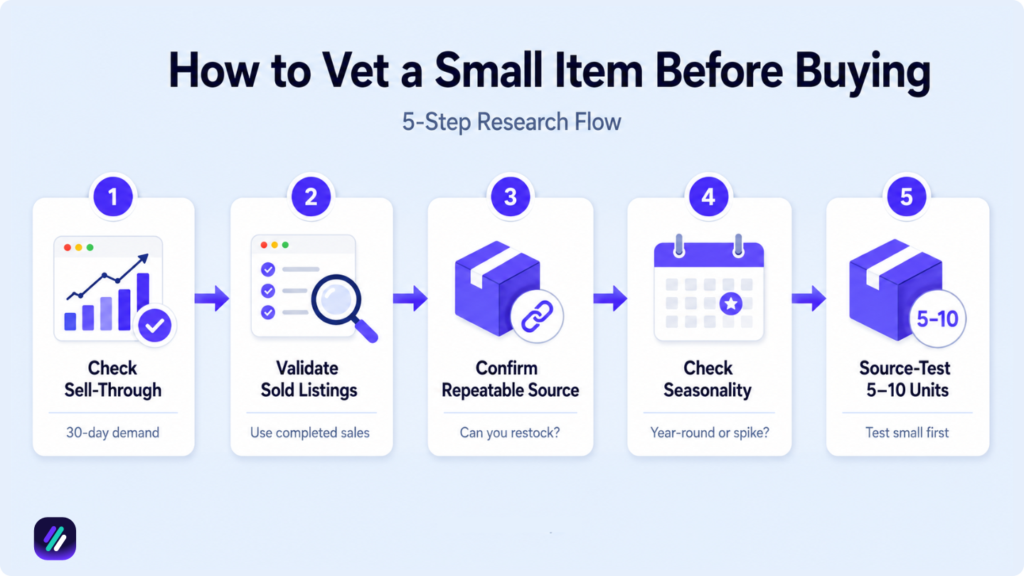
Every item on this list started as a number, not a hunch. Before you spend a dollar on inventory, a quick research routine tells you whether a small item is worth stocking. Here is the exact sequence I use:
- Sell-through rate comes first. A category can show high asking prices and still barely sell, so pull the units sold and sell-through over the last 30 days and read actual movement, not wishful listings.
- Completed listings are your proof. On eBay, filter to sold items to see what actually closed and at what price recently. For deeper reads, the eBay product research tool shows actual sales, sell-through, and competition on any keyword.
- Sourcing has to be repeatable. A product only works if you can restock it, so confirm you can buy it cheaply and often through thrift, liquidation, wholesale, or reliable dropshipping suppliers before you commit.
- Seasonality changes the math. Some items sell all year, and others spike and die, so check whether demand is steady or concentrated in a few months before you buy in.
- A small source-test beats a big bet. You buy five to ten units first, list them, and let actual sales confirm the research before you put serious money behind it.
Doing this kind of eBay product research every single time is the habit that separates the sellers who profit from the ones who guess. From our in-house eBay sellers at ZIK, the people who last are the ones who treat every buy as a test, never a gamble.
Small Items to Avoid on eBay
Not every small item is worth your time, and a few will cost you more than they earn. I would steer clear of these:
- Cheap items with expensive shipping: A $4 item that costs $8 to post is a category you can’t win, because the postage eats the entire sale.
- Fragile glassware and ceramics: Breakage in transit turns a profit into a refund plus a feedback hit, so leave these to specialists with proper packing systems.
- Generic phone cases: The market is bottomless and undifferentiated, so you end up competing only on being the cheapest, which nobody wins for long.
- Expired cosmetics and supplements: These carry safety and policy problems and can get your listings pulled, full stop.
- Electronics with built-in batteries: Lithium batteries add shipping restrictions and dead-on-arrival risk that thin margins simply can’t absorb.
- Counterfeit-risk branded goods: Anything where you can’t verify authenticity invites VeRO takedowns and account trouble, and no margin is worth that.
When in doubt, the test is simple: if the shipping, the risk, or the competition is bigger than the margin, skip it and move on.
Benefits of Selling Small Items on eBay
The appeal of small items isn’t only that they’re easy to find. They fix a lot of the problems that sink new sellers in their first year:
- Lower postage protects your margin: Light items ship cheap, and on the small end, you can often use eBay’s lowest-cost services, so keeping eBay shipping fees down is straightforward.
- Less breakage, fewer refunds: Small, sturdy items survive transit better than bulky or fragile ones, which means fewer “arrived damaged” cases against you.
- Lower upfront cost per unit: You can build up inventory for very little, which lets beginners learn the ropes without risking much.
- Faster inventory turnover: Cheaper items sell more often, so your cash cycles back to you quickly instead of sitting on a shelf for months.
- Easy to store and source: A whole inventory can live in a closet, and small items turn up everywhere, from thrift stores to your own cupboards.
- Simple, consistent shipping: Once you have a packing routine, small items are quick to process, and getting comfortable with how to ship on eBay takes days, not months.
- Quick to photograph and list in batches: Uniform small items let you shoot and list many at once, which is how volume sellers actually move.
None of this is the full list of upsides, and it shifts with what you sell. If you focus on collectibles, add the bonus that condition-graded items build buyer trust over time; if you sell replacement parts, the bigger benefit is near-zero competition on the exact part someone urgently needs.
eBay Selling Tips for Small Items
Small-item selling rewards a handful of habits, and most sellers learn them the slow way. From our in-house team at ZIK, these are the ones that compound:
- Weight first, not after the sale: Knowing the exact weight before you list means your shipping price is right the first time, instead of a surprise that eats the margin.
- The cheapest eligible service wins: For light items, options like eBay Standard Envelope keep postage tiny, and running an eBay fee calculator before you price shows your true take-home.
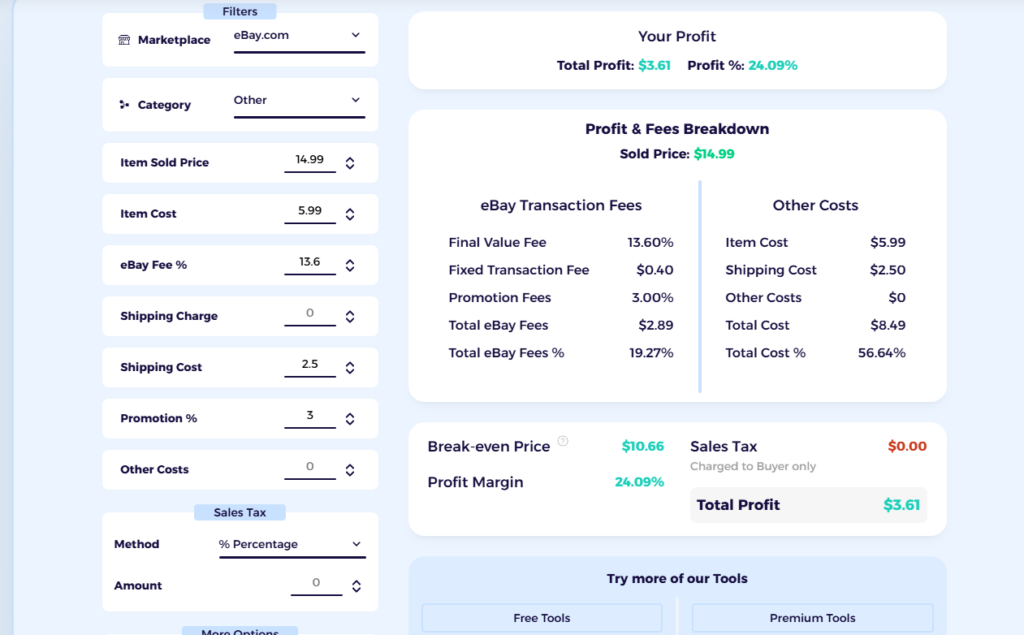
- Velocity over vanity on price: A slightly lower price that sells today beats a hopeful one that sits for a month, since eBay rewards listings that actually move.
- Depth before breadth: Going deep in two or three niches beats spreading thin, because expertise compounds into faster sourcing and sharper pricing.
- A batch workflow saves hours: A simple template plus shooting and listing in batches turns listing from a chore into a fast routine.
- Your true cost, fully counted: That means sourcing, fees, packaging, and postage, not just what you paid, so you know your true margin per sale.
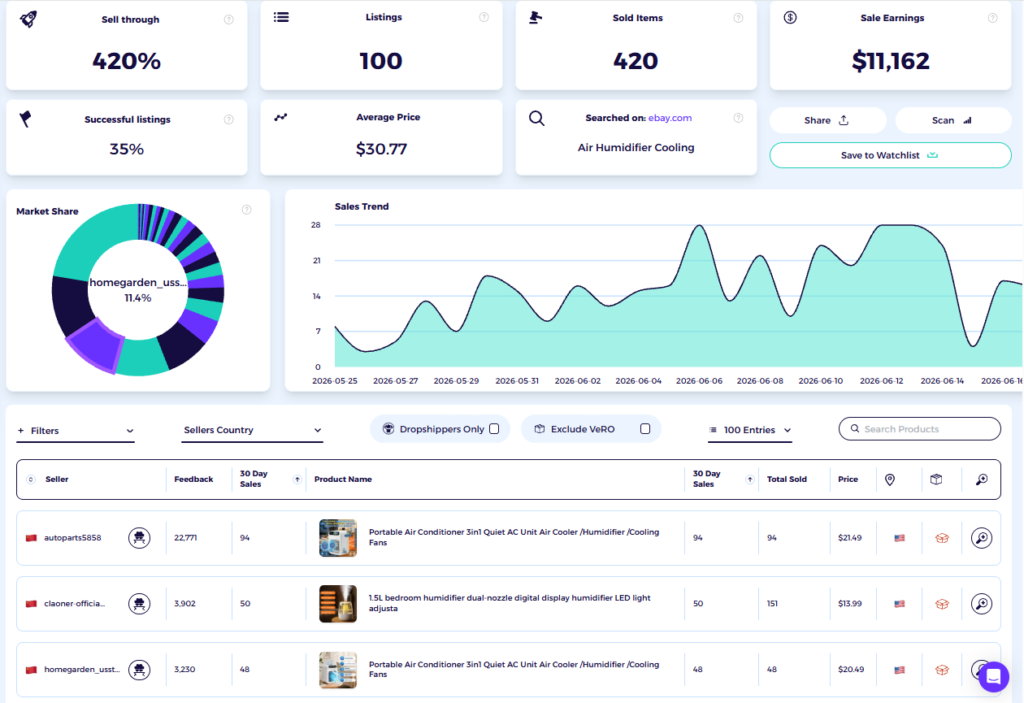
- Top sellers are free research: With the eBay competitor research tool, you can study a leading seller’s revenue, best sellers, and sell-through, then borrow what works.
- Combined shipping lifts order value: Bundling multiple small items into one order raises your average sale and saves the buyer money at the same time.
Used together, these habits tilt the small-item math in your favor, since profit here is a game of inches repeated across hundreds of sales.
Find Best-Selling Small Items on eBay with ZIK Analytics
Every pick in this guide came back to one habit: deciding from actual eBay sales data instead of a hunch. That is the part ZIK Analytics handles for you:
- Use the eBay product research tool to see actual sales, sell-through, and competition on any small-item keyword before you buy a single unit.
- The eBay bulk scanner runs a competitor’s whole store and matches every item they sell to a supplier in one pass.
- The eBay competitor research tool shows a top small-item seller’s revenue and best sellers, so you can see what is working in your niche right now.
Put together, they turn “I think this might sell” into “I know this sells.” You can try all three on a $1 trial (7-day) and run your first sold-data check today.
Small Items to Sell on eBay FAQs
A few quick answers to what small-item sellers ask most before they list.
What small items can I sell quickly on eBay?
Small items with proven daily demand sell fastest: collectible cards, coins, jewelry, replacement remotes, and books all move quickly because buyers are already searching for them. The trick is checking sell-through before you buy, so you stock categories with proven turnover. Anything light, in demand, and accurately described tends to sell within days.
What’s the easiest thing to buy and sell on eBay?
Books are the easiest entry point. They are cheap and everywhere to source, simple to grade, ship affordably through Media Mail, and carry fewer listing rules than coins or jewelry. You won’t get rich on a single paperback, but bundles, textbooks, and collectible editions build steady, low-risk income while you learn the platform.
How much does it cost to ship a small item on eBay?
For light items, shipping can be very cheap. eBay Standard Envelope covers thin items like cards and stamps for around a dollar, while small parcels in a padded mailer typically run a few dollars through eBay’s discounted labels. It pays to weigh the item first and pick the cheapest eligible service, since postage is where small-item margins are won or lost.
What is the minimum profitable price for a small item on eBay?
There is no fixed floor, but once you subtract eBay fees, postage, and your cost, an item under about $8 to $10 rarely leaves enough profit to be worth the handling. The exception is volume: if you source very cheaply and ship for almost nothing, lower-priced items can work. You want to run the numbers before you list, not after.
Can you sell items under $10 on eBay profitably?
Yes, but only when your costs are low. Cards in a plain envelope, small accessories, and lightweight parts can profit under $10 if sourcing is cheap and postage is minimal. The margin comes from volume and low fulfillment cost, so the model only works when you keep handling fast and shipping cheap.
What small items have the highest profit margin on eBay?
The highest margins usually come from items you source far below resale: thrifted books and tools, estate-sale jewelry and coins, and collectible cards bought in bulk lots and broken into singles. Replacement parts and discontinued items also carry strong margins because buyers have few alternatives. High margin follows cheap, repeatable sourcing more than any single category.