
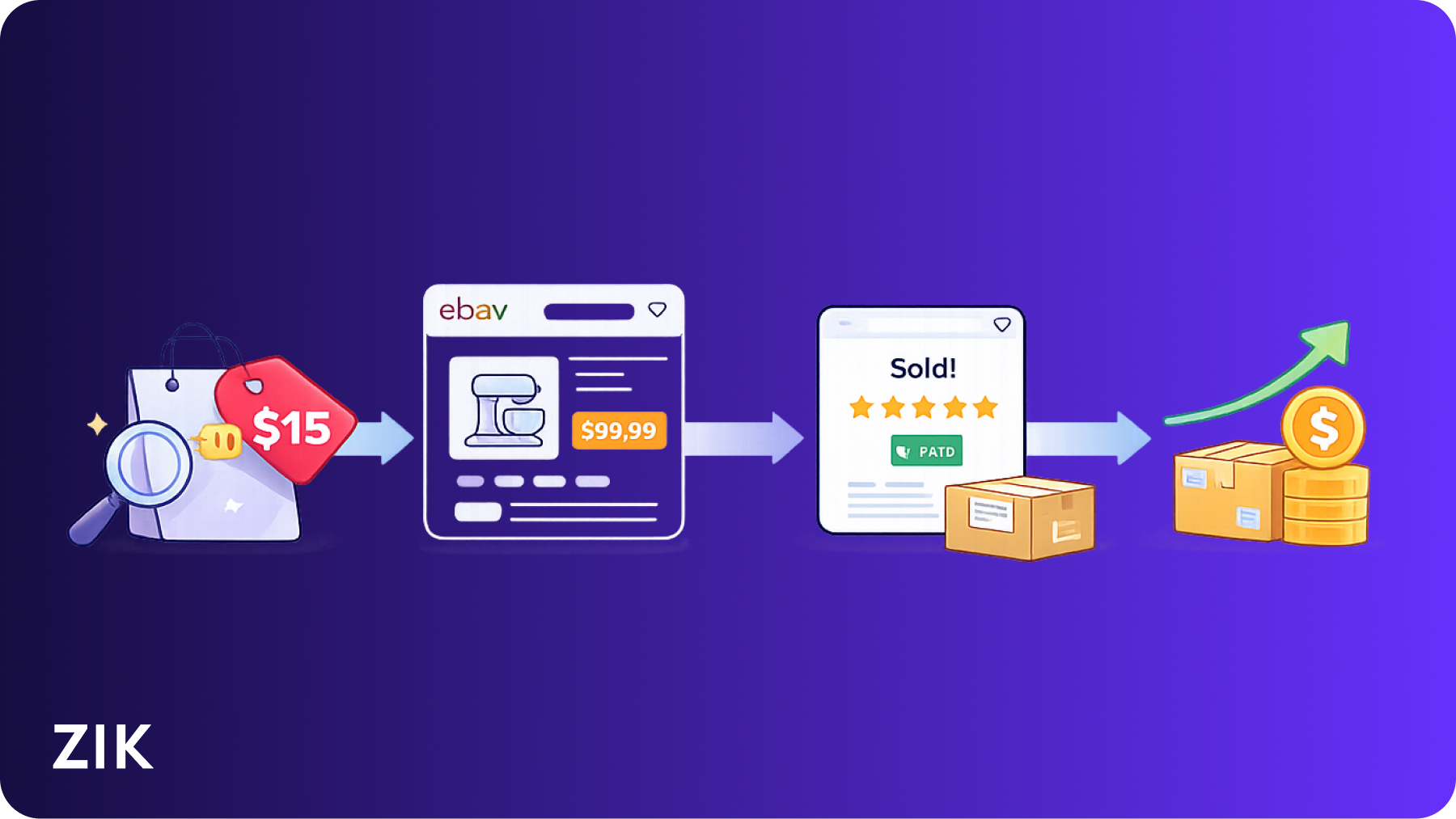
Imagine buying a clearance item for $15, listing it on eBay for $39.99, and walking away with roughly $14 in profit after fees and shipping costs.
That simple transaction is eBay arbitrage: finding products priced lower in one marketplace and reselling them for more on eBay.
The challenge is that many beginners jump into deals without checking demand, calculating fees, or understanding eBay’s rules, turning what looks like easy money into costly mistakes.
This guide takes a different approach. You’ll learn all five eBay arbitrage models, see how each fits within eBay’s current policies, and use real profit calculations to determine whether an opportunity is actually worth pursuing before you spend a dollar.
What is eBay Arbitrage?
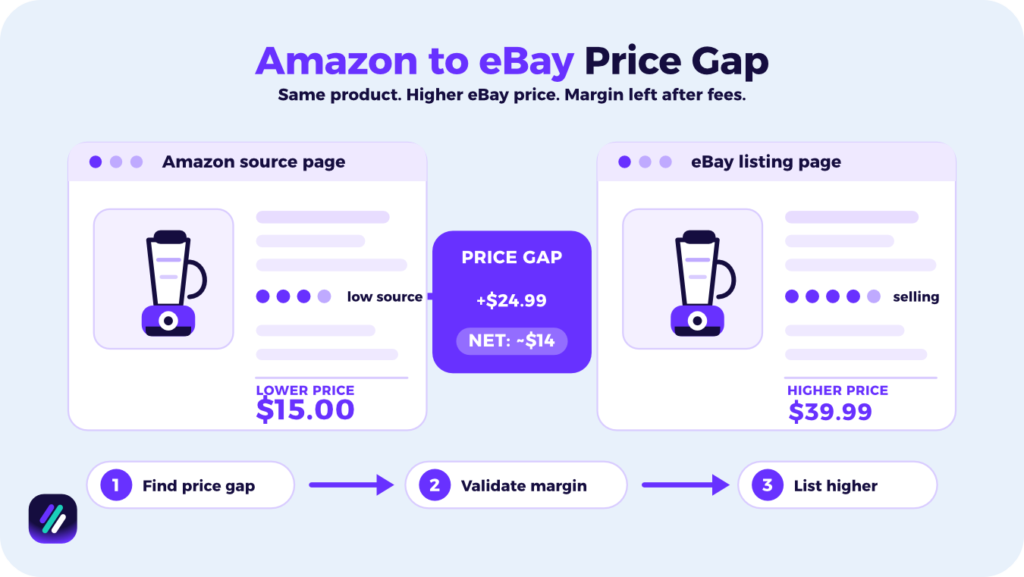
eBay arbitrage is the practice of buying a product at a lower price from one source and reselling it on eBay at a profit.
Basically, you’re searching for a price gap between two channels, validated before you buy, and then you sell it. For example, you buy from Amazon to eBay arbitrage.
However, reselling is the broader category, covering garage-sale flips, thrift finds, and inherited inventory, while arbitrage is the disciplined subset that exploits a known price difference to make a profit.
To reduce fulfillment risks, many sellers use eBay fulfillment services to handle storage, packing, and shipping on their behalf. This can improve delivery consistency and free up time to focus on sourcing profitable arbitrage opportunities.
You can run five distinct arbitrage models on eBay, each with its own sourcing pipeline and risk profile.
Different Types of eBay Arbitrage Models
Now, there are several ways to run eBay arbitrage, and they are not all equal.
Some models are beginner-friendly because you buy the item first, inspect it, list it, and ship it yourself to your customer, while others are more advanced because they depend on supplier reliability, marketplace rules, or fast-moving price gaps.
The biggest difference is inventory control in these types. If you physically hold the product, you control photos, condition, packaging, and shipping speed.
However, if you rely on another supplier to fulfill the order, your risk goes up because you are still responsible for safe delivery, accurate item details, and the buyer experience.
That matters especially with Amazon-to-eBay models as eBay allows dropshipping when you fulfill orders directly from a wholesale supplier, but it does not allow listing an item on eBay and then buying it from another retailer or marketplace that ships directly to your buyer.
But in most cases, eBay dropshippers and sellers are doing this, and customers in very rare cases are complaining that they receive the item from Amazon or Walmart, or from anywhere else.
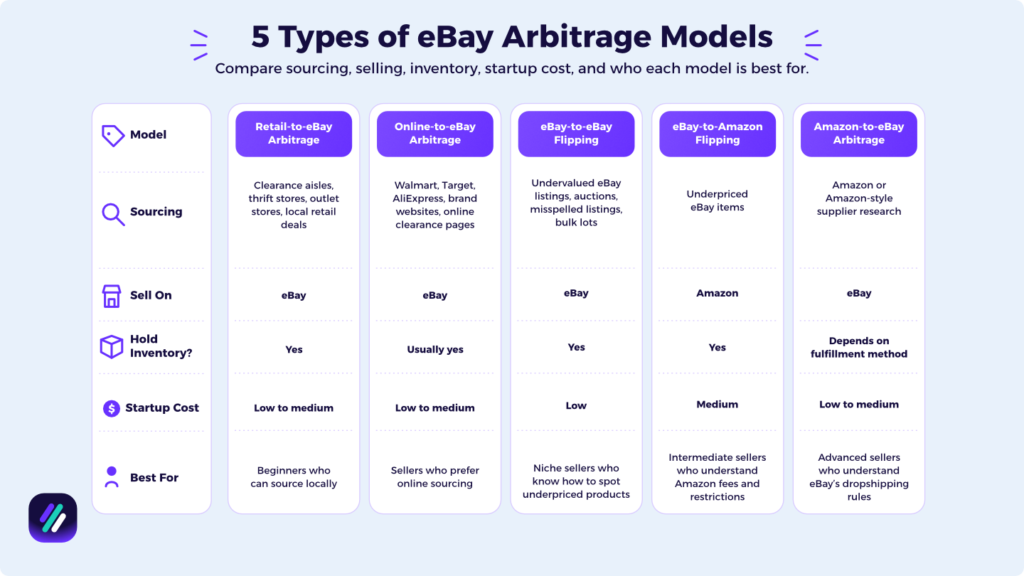
| Model | Sourcing | Sell On | Hold Inventory? | Startup Cost | Best for |
| Retail-to-eBay arbitrage | Clearance aisles, thrift stores, outlet stores, local retail deals | eBay | Yes | Low to medium | Beginners who can source locally |
| Online-to-eBay arbitrage | Walmart, Target, AliExpress, brand websites, online clearance pages | eBay | Usually yes | Low to medium | Sellers who prefer online sourcing |
| eBay-to-eBay flipping | Undervalued eBay listings, auctions, misspelled listings, bulk lots | eBay | Yes | Low | Niche sellers who know how to spot underpriced products |
| eBay-to-Amazon flipping | Underpriced eBay items | Amazon | Yes | Medium | Intermediate sellers who understand Amazon fees and restrictions |
| Amazon-to-eBay arbitrage | Amazon or Amazon-style supplier research | eBay | Depends on fulfillment method | Low to medium | Advanced sellers who understand eBay’s dropshipping rules |
For most beginners, retail-to-eBay and online-to-eBay arbitrage are the safest starting points as you buy the product first, check the condition, create your own listing, and ship the item yourself. If you want a deeper sourcing breakdown, check our Retail Arbitrage Sourcing Guide.
That gives you more control and fewer surprises.
Amazon-to-eBay and other marketplace-to-marketplace models are generally easy too, IF you’re using the right tools to find for you, such as ZIK Analytics.
And because it’s Amazon fulfillment, the shipping is usually pretty easy, especially with a Prime subscription.
eBay-to-eBay flipping can work too, but it rewards category knowledge. You need to recognize when a seller has underpriced an item, used poor photos, written a weak title, or listed a bundle that could be split into smaller listings.
How eBay Arbitrage Works
As I already said, eBay arbitrage works by finding the same product selling for different prices in different places.
Your job is to spot that price gap, confirm that people are actually buying the product on eBay, then list it with enough margin left after fees, shipping, and packaging, and pocket the sweet profit.
For example, you find a brand-name kitchen gadget at Walmart clearance for $8, and you check eBay and see the same item selling for $24.99 with strong demand. You can then buy it, photograph it, list it on eBay, and when it sells, you ship it to the buyer.
After eBay fees, shipping, and packaging, you pocket roughly $10 to $12 in profit.
The basic process looks like this:
- Find a price gap
- Validate demand
- Buy/dropship the product
- List it on eBay
- Ship it to a customer
- Keep the change

That flow stays mostly the same whether you source from retail stores, online retailers, eBay auctions, or supplier catalogs. Wherever it is from, it’s about finding products that sell lower at one place and higher in another.
One thing to point out is that the step most beginners skip is validation.
They see a discount, assume it is profitable, and buy the item before checking sold listings, sell-through rate, competition, or true fees.
And that is how you end up with a shelf full of “good deals” nobody wants.
Is eBay Arbitrage Legal?
Yes, eBay arbitrage is legal in the US and UK when you are reselling legitimate products that you own or have the right to sell.
In the US, this is generally supported by the first-sale doctrine, which allows the owner of a lawfully made copy of a physical product to resell or dispose of that specific item without needing permission from the copyright owner. Meaning if you legally buy Adidas sneakers, you can sell them.
In the UK, the same idea is usually discussed as exhaustion of intellectual property rights, where the rights holder’s control over a product is limited after it has been placed on the market with permission.
That means standard retail arbitrage, thrift flipping, clearance flipping, eBay-to-eBay flipping, and most inventory-based resale models are not illegal just because you are buying low and selling higher.
Of course, you’re not allowed to deal in counterfeit goods, stolen goods, unsafe products, restricted brands, misleading listings, or products they do not actually have the right to sell.
Is eBay Arbitrage Profitable in 2026
Yes, eBay arbitrage can be profitable in 2026, but it depends on three things: sourcing discipline, fee awareness, and product selection.
The model works when you consistently find products with a real price gap, validate that buyers are already purchasing them on eBay, and leave enough margin after item cost, eBay fees, shipping, packaging, ads, and returns, which is not always an easy task.
With that said, the demand side is still strong. eBay reported 136 million active buyers, over $11 billion in revenue, and total gross merchandise volume reached almost $80 billion (basically, how much is the total worth of all sold products on eBay for a year)

Additionally, sustainable living and the second-hand market are consistently growing. The Global Secondhand Apparel Market is projected to expand from USD 198.64 Billion in 2025 to USD 485.97 Billion by 2031, achieving a compound annual growth rate (CAGR) of 16.08%, as reported by Yahoo.

Furthermore, another report says the US secondhand market grew nearly 4x faster than the broader apparel market
And from our own data at ZIK, we see tens of thousands of eBay sellers making 3 to 5 figures monthly using arbitrage-style product research and sourcing workflows.
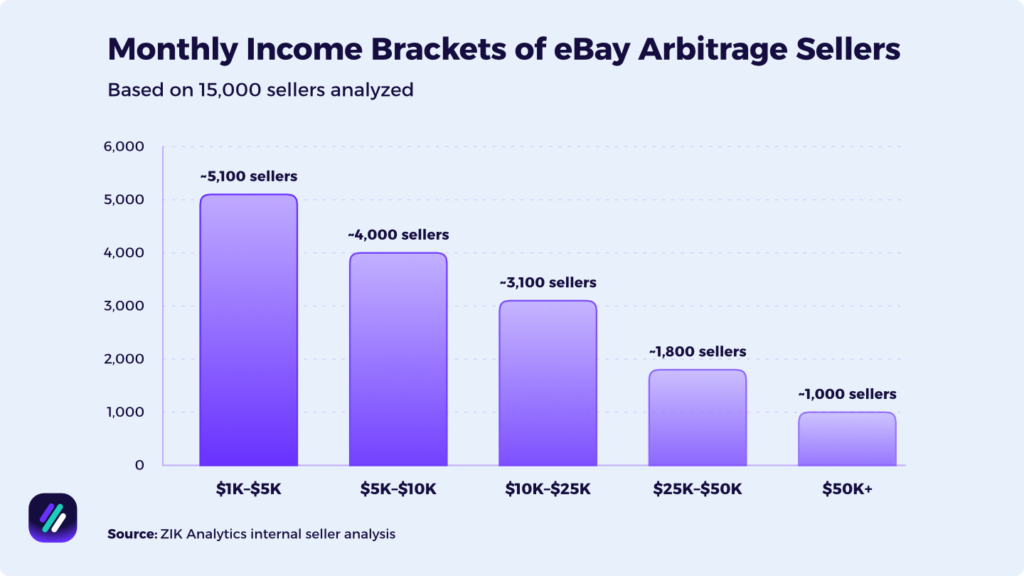
So yes, eBay arbitrage is profitable in 2026.
But the sellers who win are not the ones buying anything with a clearance sticker. They are the ones who validate demand first, calculate true profit before buying, and focus on products that move fast enough to keep cash flowing.
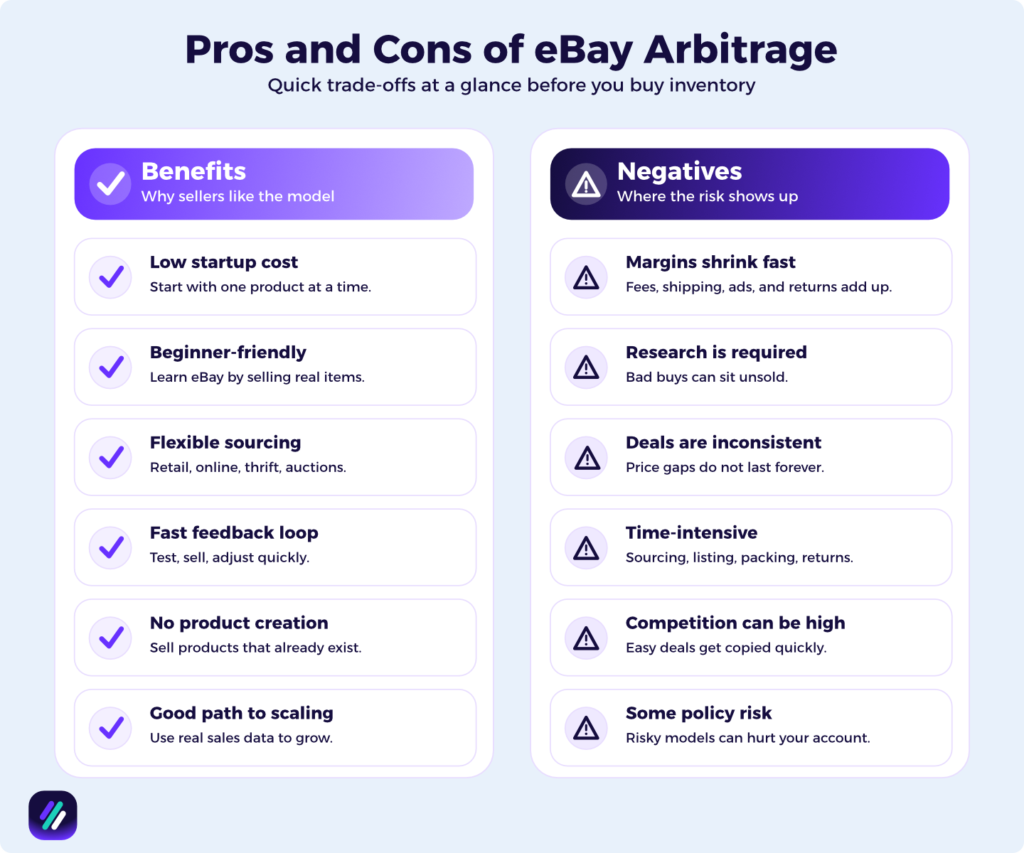
Pros and Cons of eBay Arbitrage
One thing to say is that eBay arbitrage is one of the easiest resale models to start because you do not need to create a product, build a brand, or buy large wholesale orders upfront.
But it is still a real business model with full income potential and not just “find cheap stuff and list it higher.”
| Benefits | Negatives |
| Low startup cost: You can start with a small budget and buy one product at a time instead of committing to bulk inventory. | Margins can disappear fast: eBay fees, shipping, packaging, promoted listings, and returns can turn a good-looking deal into a weak flip. |
| Beginner-friendly: You learn how eBay works by selling real products, handling orders, testing prices, and dealing with buyers. | Product research is mandatory: If you skip demand validation, you can easily end up with inventory that looks profitable but does not sell. |
| Flexible sourcing: You can source from retail stores, online retailers, clearance pages, thrift stores, eBay auctions, or supplier catalogs. | Sourcing is inconsistent: Clearance deals, underpriced listings, and price gaps do not stay available forever. You need a repeatable research process. |
| Fast feedback loop: You can test products quickly, see what sells, and adjust your sourcing strategy without waiting months. | It can be time-intensive: Finding products, checking prices, taking photos, creating listings, packing orders, and handling returns all take time. |
| No product development needed: You are selling products that already exist and often already have demand on eBay. | Competition can be high: If a product is easy to find and easy to list, other sellers may copy the same opportunity and push prices down. |
| Good stepping stone to scaling: Arbitrage helps you understand pricing, sell-through, shipping, and buyer behavior before moving into wholesale or larger operations. | Some models carry policy risk: Marketplace-to-marketplace dropshipping, branded products, restricted categories, and poor fulfillment can put your listings or account at risk. |
Really, the main advantage is the control of how you start the business, unlike typical businesses.
You can start small, learn the numbers, and build from actual sales data instead of guessing.
But the main downside is if you make a mistake in your math or are just lazy and do a proper calculation, it often will cost you money.
How to Start with eBay Arbitrage
Now, we’re coming to the best part, and that’s how you can get started with eBay arbitrage.
As I said, eBay arbitrage is simple, but doing it profitably takes structure.
Your goal is not just to find cheap products with the hope of reselling them at a markup price, but to have a repeatable process for finding price gaps, validating demand, calculating profit, listing properly, and shipping without creating customer service problems.
With that being said, here is the process to get you started!
Step 1: Set Up Your eBay Seller Account
Before you can start selling anything, you obviously need your eBay seller account that’s set up properly.
You can usually start by creating an eBay account, going to the selling area, and listing your first item. During that process, eBay may ask you to confirm personal details, connect a payout method, verify your identity, and set up basic selling preferences.
We have an entire video on how to do this:
How To Setup Your eBay Seller Account In Minutes (Step-by-Step)
Of course, this can vary by country.
For example, seller fees, private seller rules, delivery flows, tax reporting, and business account requirements are not identical in the US, UK, EU, Australia, or other supported markets.
In the UK, eBay has made major seller-fee and delivery changes for private sellers in recent years, which shows why sellers should always check the rules for their own local eBay site before building their arbitrage workflow. (Source)
So here are the main things you should consider regardless of what country you will be selling in:
- Correct eBay account type: A personal account may be enough for casual selling, but frequent arbitrage sellers may need a business account depending on their country and selling volume.
- Verified identity and contact details: eBay may need this for trust, payouts, account security, and compliance.
- Payout method: You need a connected payout method so eBay can send your earnings after sales clear.
- Shipping settings: Handling time, shipping services, tracking, and delivery costs affect both profit and seller performance.
- eBay Return policy: Clear returns reduce disputes and help buyers understand what happens if there is a problem.
Now, if you’re anything close to me, you will want to rush this process to start making cash. BUT do not rush this!
Our in-house experts all agree that a messy account setup can hurt you later when you start listing more products, especially if your shipping settings are wrong or your return policy does not match how you actually operate.
Also, start slowly, methodically, to not lose money and really learn the skill of arbitrage selling.
Step 2: Choose Your Arbitrage Model
The next step is to choose the arbitrage model that fits your budget, time, and risk tolerance.
We already covered the main options: retail-to-eBay, online-to-eBay, eBay-to-eBay flipping, eBay-to-Amazon arbitrage, and Amazon-to-eBay arbitrage.
If you are new, start with a model where you have the least investment risk, which is marketplace-to-eBay arbitrage, such as Amazon to eBay or Walmart to eBay models, as those are very safe in terms of starting with a minimum budget.
Of course, then you can also do a model where you control the inventory. Retail-to-eBay and online-to-eBay, because you can inspect the product, take your own photos, and ship it yourself, to expand and increase your profit.
It’s more time-consuming, but you can find some really good and rare deals, like discontinued items for $0.01 that were forgotten to be taken off the shelf.
Step 3: Research Products to Sell on eBay
In this step, you actually learn what you should be arbitrating and what should stay on the shelf of the store, and most importantly, save yourself a ton of money.
Before you buy anything, you want to know four things: is it selling, what price is it selling for, how much competition is there, and can you source it cheaply enough to leave profit after fees?
Here are three simple ways to research products without turning this into a full tutorial.
Way 1: Finding Cheaper Products on Amazon/Walmart with ZIK Analytics
One of the easiest ways to research arbitrage products is to compare what is already selling on eBay against supplier prices on Amazon or Walmart. ZIK is useful here because it connects product research, competitor data, supplier matching, and profit research in one workflow.
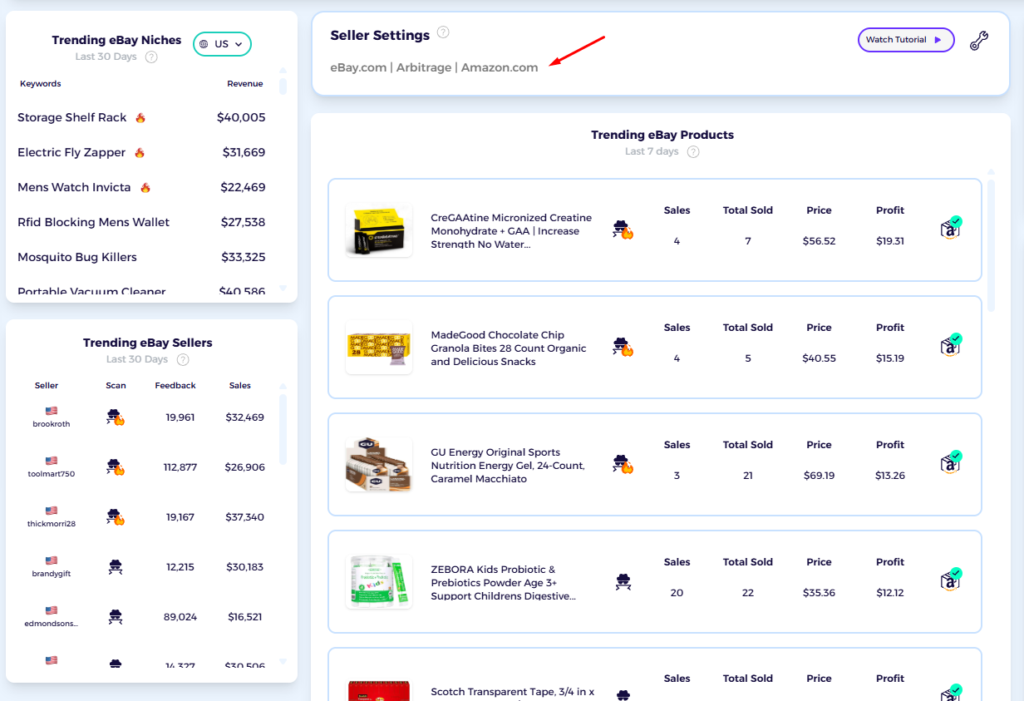
For example, with ZIK’s eBay market insights tool, you get daily updates on trending products, keywords, and even sellers.
Before you trust the data, make sure your marketplace, category, seller location, and product filters match the type of eBay store you are building. Otherwise, you might research products that do not fit your market.
Or another way to use ZIK Analytics for eBay arbitrage is to use the eBay Product Explorer to find products by keyword, category, sales range, revenue range, price range, supplier source, and fulfillment method.
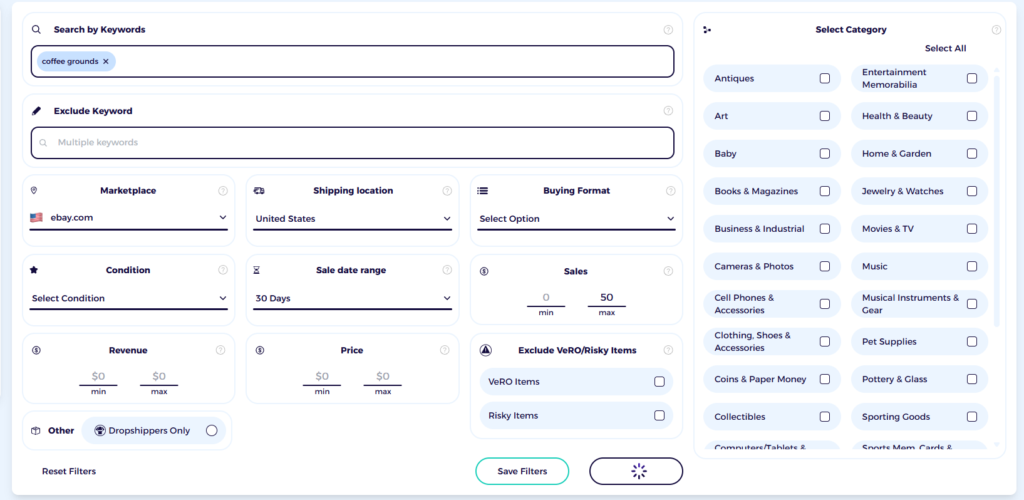
This is where you can look for products already selling on eBay, then narrow them down to items that may have supplier matches from Amazon, Walmart, AliExpress, Alibaba, or CJ Dropshipping.
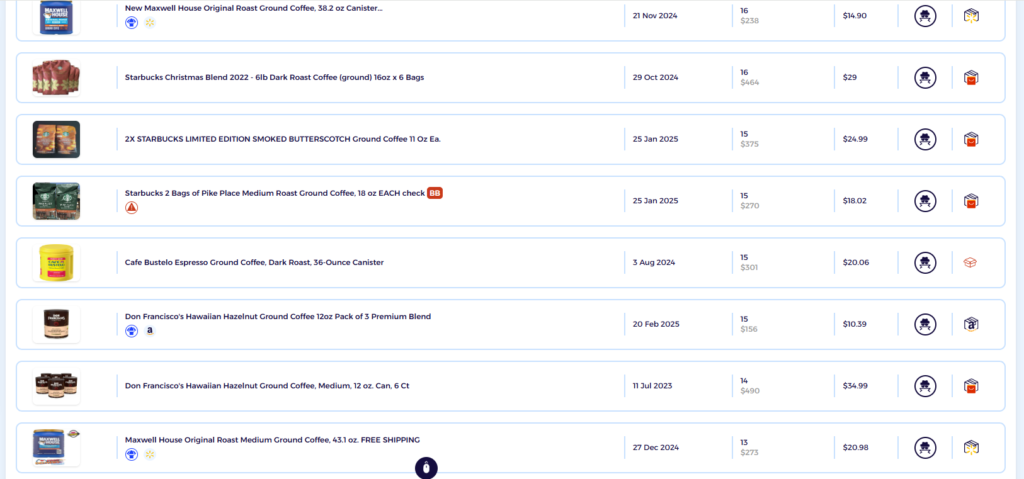
Lastly, you can validate all the products using the ZIK eBay product research tool, where you can check sales volume, average selling price, sell-through rate, competition, shipping location, and listing type.
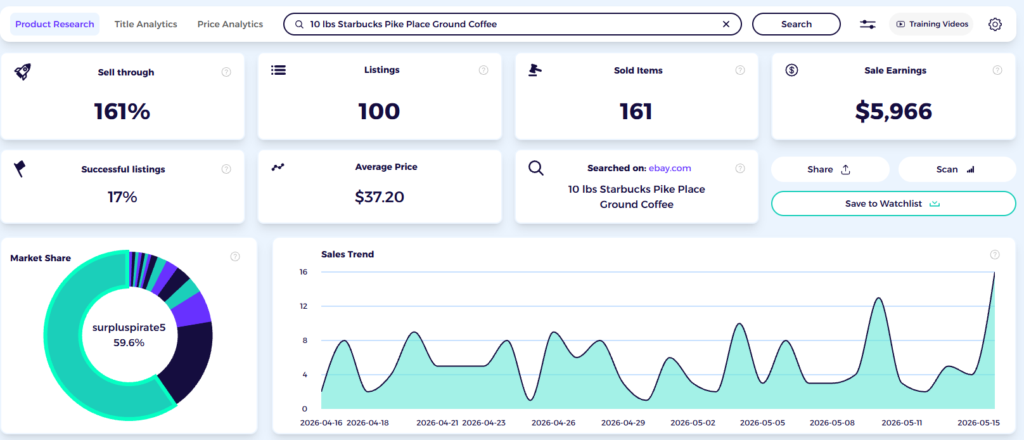
Remember, the goal is not just to find a cheaper product. The goal is to find a cheaper product that already has buyer demand on eBay.
Way 2: Use eBay Sold Listings to Validate Demand
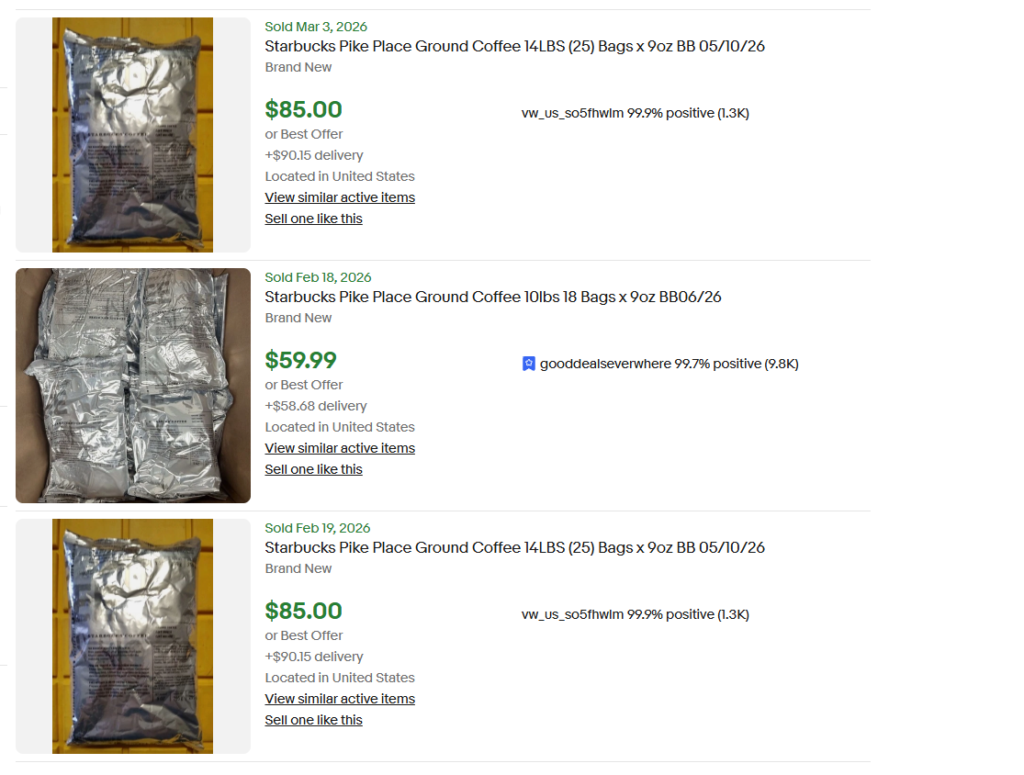
You can also research products manually by checking eBay sold listings. Search for the product, filter by sold items, and look at what buyers actually paid recently.
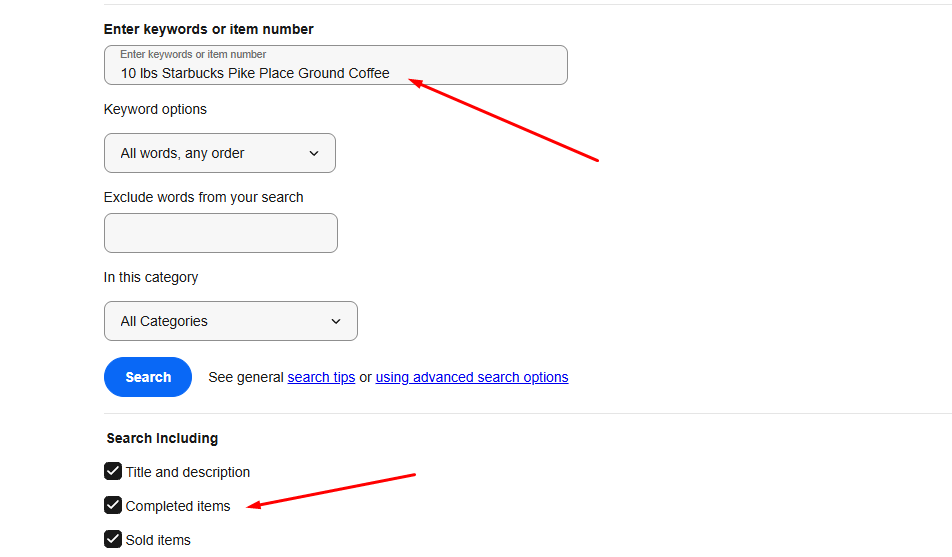
That gives you the result of all the sold items for the search keyword and how much and when people bought them. If the purchases are made a month apart, then it clearly is not a winning product for arbitrage.
And with the ZIK Analytics free eBay Chrome extension, you can open any product listing and then “View Sold History”. If you have a paid account, you can also get sales data for the product.

And here you will get the eBay sold history of the eBay listing.
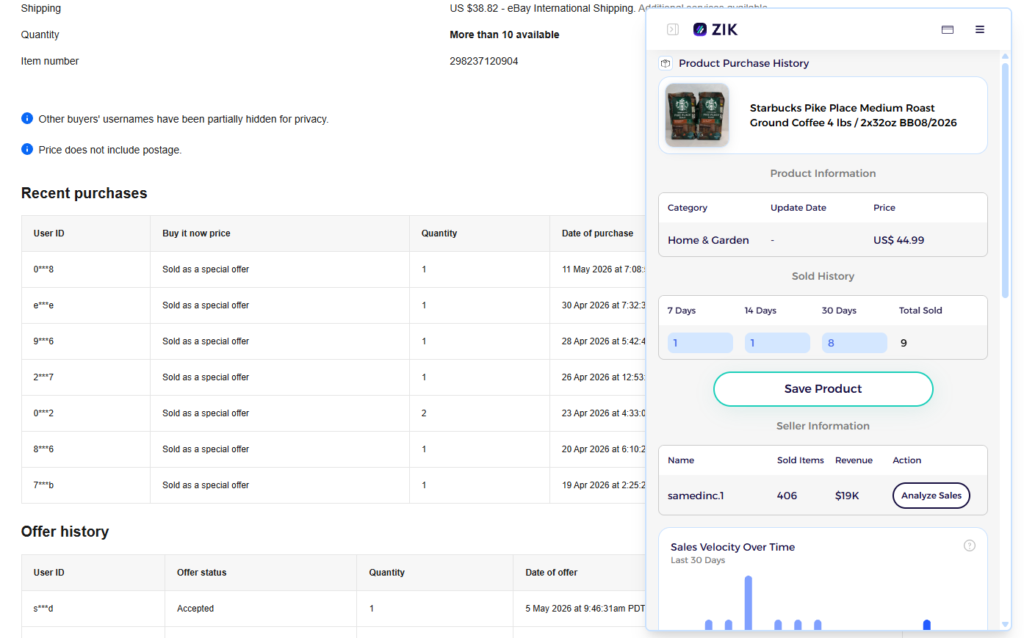
Look for products with repeated recent sales, consistent pricing, and listings that are not dominated by huge sellers. If only one seller is making sales and everyone else is stuck, that is usually a warning sign.
Way 3: Research Competitors and Similar Products
Another good way to find arbitrage ideas is to study sellers who are already doing well in your category.
Look at their best-selling products, pricing, shipping setup, listing titles, photos, and product variations.
Again, with ZIK’s free Chrome extension, you can do the research much faster. (With the paid plan, you get a sorted table of the competitor’s best-selling products)
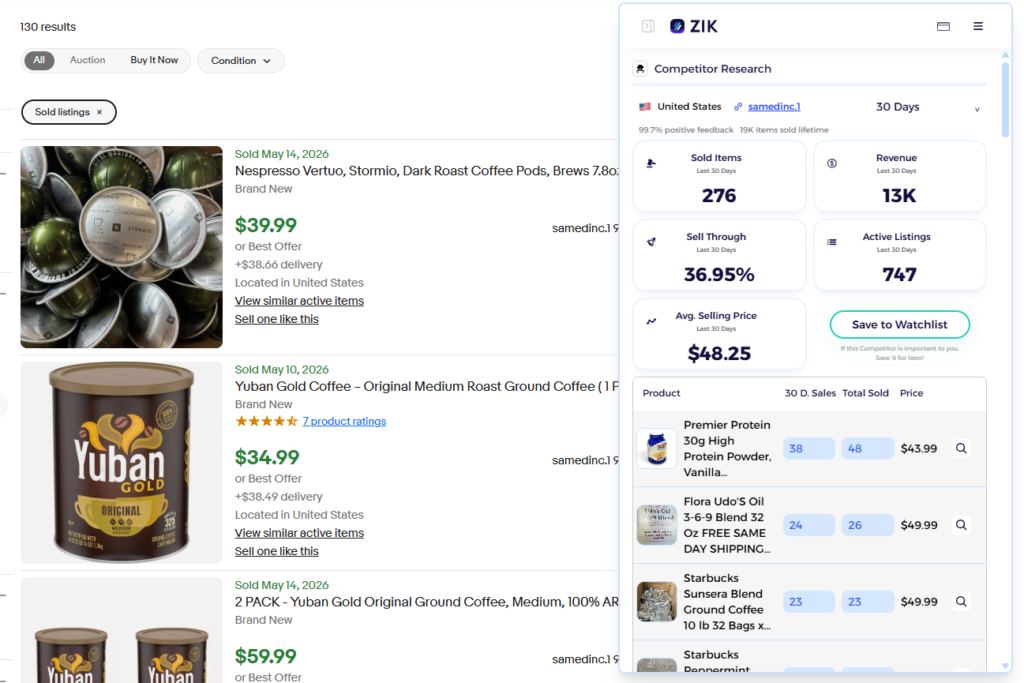
You can also use this method for eBay-to-eBay flipping. Look for listings with weak titles, poor photos, misspellings, auctions, or bundles that could be relisted better. Just make sure there is enough margin after eBay shipping and fees before you buy.
And of course, you can use these methods for any products you find online or in retail stores. The goal is to verify that those products sell on eBay in order for you to invest in them for you.
Step 4: Calculate Your True Profit Margins
Now, here is where most people lose their money. Before you buy any arbitrage product, calculate the real profit first, as eBay fees are not based only on the item price.
A simple formula looks like this:
Selling price + shipping charged – product cost – shipping cost – eBay fees – ad fees – other costs = net profit
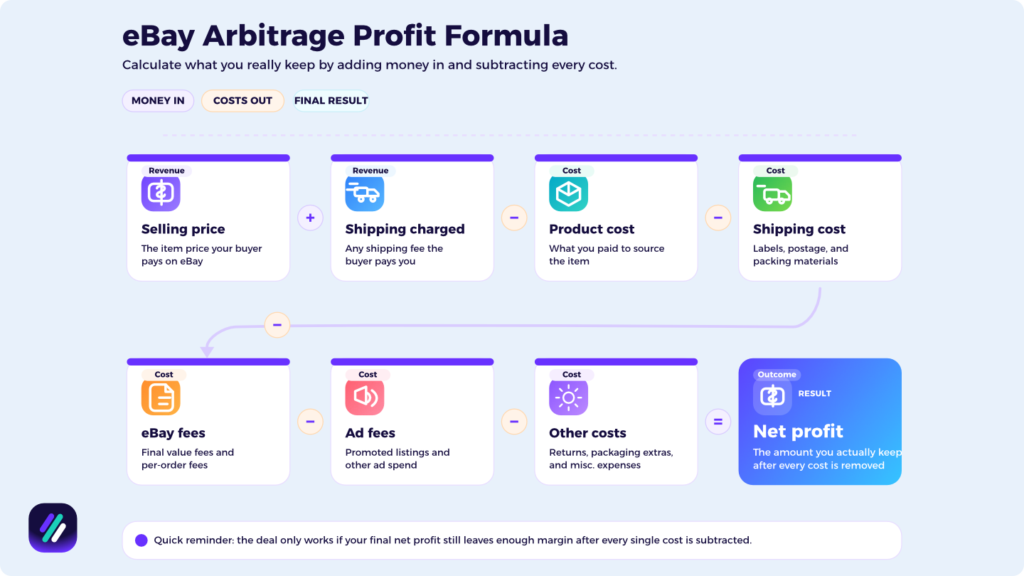
To simplify this for you, we have developed an eBay fee calculator that we continuously update based on eBay’s latest changes, as our own in-house sellers and dropshippers are using it for their own stores.

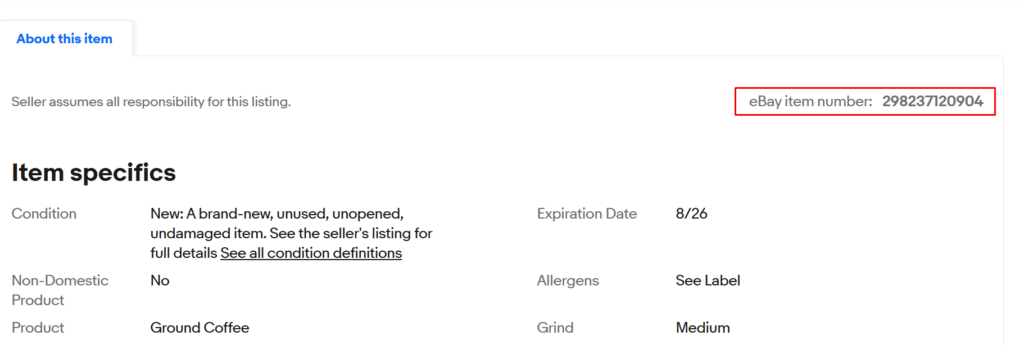
You can also put the eBay item ID in there so it quickly fills in the information for you that you can find in the Item specifics.
And like this, you have prefilled the eBay calculator.
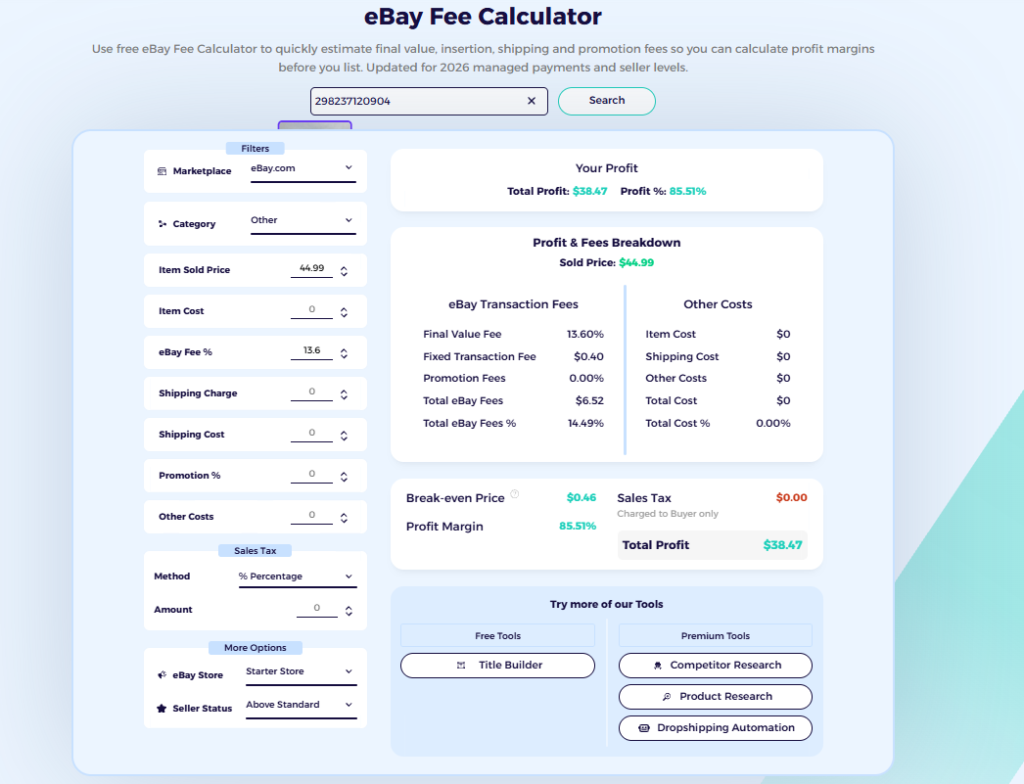
And now you just need to adjust certain things like shipping charges or cost, the eBay promoted listings %, etc.
Of course, you can also use it on any other item outside of eBay. This is meant for you to calculate the selling on eBay, regardless of where you source your products.
Step 5: List and Optimize Your eBay Listing
Now, we have a product; the next step is to make sure that people can find it, like it, and trust it, so they buy it.
And don’t worry, it’s easier than it actually sounds.
- Title: Use clear, keyword-rich wording that matches how buyers search. Avoid keyword stuffing or irrelevant terms.
- Photos: Use sharp, well-lit images from multiple angles. If you hold the product yourself, take your own photos so buyers can see the real condition. If you’re sourcing, you can use from the supplier, but if there is big competition, you might want to differentiate yourself.
- Item specifics: Fill in as many relevant details as possible, including brand, size, model, color, type, condition, and compatibility where needed.
- Description: Keep it clear and honest. Mention what is included, product condition, defects, measurements, and anything the buyer should know before ordering.
- Pricing: Price based on sold listings, competitor data, shipping costs, and your required profit margin, not just the lowest active listing.
I would also recommend that you use the Promoted Listings feature. eBay only takes the fee when you actually sell the product. So, it’s really a win-win situation for both sites!
Start with 3%-5%. Don’t follow the eBay greedy suggestion!
Step 6: Ship, Track, and Manage Customer Service
And now is the time to almost celebrate! You made your first sale!
Theoretically, but by following the steps above, you will get it.
So, once the item sells, your job is to deliver it quickly, safely, and with tracking.
You need to use proper packaging, choose a shipping carrier that fits the item size and weight, and upload tracking as soon as possible to calm the buyer.
Do not rely on buying labels and boxes directly at the post office as your main workflow.
It is usually too expensive for commercial selling, and it adds unnecessary time to every order.
Instead, use eBay shipping labels or another discounted shipping solution so you can compare rates, print labels, and keep tracking organized.
And for returns, keep the process simple.
We recommend responding quickly, staying professional, and protecting yourself with accurate photos, clear descriptions, and tracking, as good customer service helps your seller account, reduces disputes, and makes scaling much easier.
Step 7: Scale Your Store
Lastly, it is to put everything you have learned and make even more money by scaling what works and leaving behind what doesn’t.
This means:
- Use ZIK to find more products with similar demand, margins, and competition levels.
- Research competitors who are already selling successfully in your category.
- List more products consistently instead of waiting for one “perfect” item.
- Expand into 2 to 3 related categories, not random unrelated niches.
- Reinvest profits into faster-moving inventory.
- Track your best sellers, average profit per item, sell-through rate, and return rate.
- Improve old listings with better titles, photos, item specifics, and pricing.
- Use ZIK’s product research tools to spot new opportunities before competitors flood the market.
- Build simple workflows for sourcing, listing, shipping, and customer service.
- Focus on products that sell repeatedly, not one-off lucky flips.
Best Product Categories for eBay Arbitrage
In general, almost any category is good for arbitrage, from selling sports cards, Pokémon cards, electronics, baby items, clothes, sports and fitness, to hobbies, professional, and anything in between.
And of course the data about eBay growth and even eBay’s move to acquire Depop also show how seriously the platform is treating secondhand fashion and recommerce demand.
However, for beginners, we can recommend the following eBay product categories:
Trading cards and collectibles
According to ZIK Product Research, selling cards on eBay showed roughly 7,000 sold items, around $175,000 in sales earnings, and average selling prices in the $20 to $30 range across the sampled eBay data.
Public eBay marketplace data also supports this category, with eBay’s recent sales growth helped by collectibles such as trading cards, coins, toys, action figures, and comic books.
Examples include Pokémon cards, sports cards, coins, action figures, comics, sealed collectibles, and limited-edition items.
If you want to focus specifically on comic books, our guide on selling comics on eBay covers how to identify valuable issues, price them correctly, and create listings that attract collectors. It also explains how to package and ship comics safely to help prevent damage in transit.
Consumer electronics and accessories
According to ZIK Product Research, this category showed roughly 2,000 sold items, around $115,000 in sales earnings, and an average selling price close to $60 across the sampled eBay data.
Public eBay marketplace data also supports electronics as a strong category, with eBay reporting category strength in electronics alongside collectibles, motors, and fashion.
Examples include headphones, chargers, adapters, routers, calculators, camera accessories, and smart home accessories.
Clothing, shoes, and accessories
According to ZIK Product Research, this category showed roughly 50,000 sold items, around $1.5 million in sales earnings, and average selling prices around the $30 range across the sampled eBay data.
Public resale data also supports this category, with eBay’s Depop acquisition showing its push into secondhand fashion and younger resale buyers.
Shoes remain one of the strongest-performing segments within this category, thanks to consistent demand for both new and pre-owned footwear. If you’re planning to sell shoes on eBay, understanding buyer expectations and listing best practices can help you compete more effectively.
Examples include sneakers, jackets, vintage clothing, dropshipping handbags, belts, watches, and branded accessories.
Home and kitchen products
According to ZIK Product Research, this category showed roughly 2,000 sold items, around $20,000 in sales earnings, and average selling prices around the $10 to $15 range across the sampled eBay data.
This category is beginner-friendly because many items are easy to source from clearance shelves and online deals.
Examples include kitchen gadgets, small appliances, replacement parts, filters, storage products, and household accessories.
Baby and kids products
According to ZIK Product Research, this category showed roughly 900 sold items, around $20,000 in sales earnings, and average selling prices around the $20 range across the sampled eBay data.
It can work well because parents often look for deals, but sellers should avoid recalled, expired, unsafe, or highly regulated products.
Examples include baby clothes, toys, nursery accessories, feeding items, stroller accessories, and kids’ bundles.
Toys
According to ZIK Product Research, this category showed roughly 10,000 sold items, around $100,000 in sales earnings, and average selling prices around the $10 range across the sampled eBay data.
Public eBay data also supports toy demand, with eBay’s recent growth helped by collectibles such as toys, action figures, trading cards, coins, and comic books.
Examples include LEGO sets, action figures, plush toys, board games, dolls, educational toys, and collectible toy lines.
Sports and fitness products
According to ZIK Product Research, this category showed roughly 7,000 sold items, around $170,000 in sales earnings, and average selling prices around the $20 to $25 range across the sampled eBay data.
This category is good for arbitrage when products are compact, branded, and easy to ship.
Examples include resistance bands, gloves, balls, protective gear, yoga accessories, fitness trackers, and smaller workout accessories.
Hobbies, crafts, and professional tools
According to ZIK Product Research, this category showed roughly 3,500 sold items, around $145,000 in sales earnings, with some hobby and specialist products reaching much higher average prices. This is a strong category if you already understand the niche, because buyers often search for very specific tools, materials, models, or parts.
Examples include sewing supplies, craft tools, art supplies, photography accessories, music gear, model kits, DIY tools, and specialty equipment.
Lastly, I would like to point out that selling items on eBay that you know well makes the process significantly easier! It gives you the experience in the condition, pricing, and target audience that will greatly improve your chances of selling on eBay.
eBay Arbitrage Tips and Best Practices
Here, we have compiled the best eBay arbitrage tips, practices, and methods to help you on your journey.
These tips are sourced from our in-house experts, from Reddit, arbitrage forums, and experts, and vetted to help you get started the right way:
- Always calculate fees before buying
- Hunt misspelled listings for eBay-to-eBay flips
- Source on a schedule
- Diversify across 2-3 categories
- Ship fast and with tracking
- Photograph everything yourself whenever you can
- Build toward Top Rated Seller status
- Look for poorly photographed listings you can relist better
- Search for weak titles missing brand names, model numbers, or keywords
- Watch auctions ending at bad times
- Look for bulk lots you can split into individual listings
- Source on a schedule instead of randomly
- Create saved searches for your best niches
- Diversify across 2 to 3 categories
- Start with categories you already understand
- Avoid products you cannot confidently inspect or explain
- Check sell-through before buying
- Avoid slow-moving inventory, even if the margin looks good
- Do not compete only on the lowest price
- Factor packaging into every product’s cost
- Avoid oversized items unless the profit is worth the shipping
- Ship fast and always use tracking
- Do not buy labels and boxes at the post office as your main workflow
- Photograph everything yourself whenever you can
- Show flaws clearly in your photos
- Fill out item specifics properly
- Use keyword-rich titles without keyword stuffing
- Keep descriptions honest and simple
- Test small before buying multiples
- Track every product’s cost, sale price, fees, shipping, and net profit
- Reinvest into products that actually sell
- Build toward Top Rated Seller status
- Respond to buyers quickly
- Avoid risky brands, counterfeits, recalled items, and restricted products
- Keep proof of purchase for higher-risk branded products
- Review returns to find listing mistakes
- Scale repeatable winners, not one-off lucky finds
And that’s the most important tip we have for you. Some that we have already talked about, while others are totally new.
I genuinely hope that this section will give you the confidence to get started, so you can start building perhaps a new life.
eBay Arbitrage vs. Dropshipping vs. Wholesale
eBay arbitrage is not the only way to sell online. It sits between dropshipping and wholesale: easier to start than wholesale, more hands-on than dropshipping, and usually less scalable than both.
But let me break it down for you, what exactly are the differences:
| Factor | Arbitrage | Dropshipping | Wholesale |
| Inventory Required? | Usually yes, especially for retail and online arbitrage | No, supplier ships directly to the buyer | Yes, usually bought in bulk |
| Startup Cost | Low to medium | Low | Medium to high |
| Scalability | Moderate, limited by sourcing time and available deals | High, but depends on supplier reliability and automation | High, once supplier relationships and cash flow are in place |
| Profit Margins | Moderate, often strong on good flips | Lower to moderate because competition can be high | Stronger at scale because of bulk pricing |
| Compliance Risk | Low to medium, depending on products and sourcing method | Low to medium, especially with marketplace-to-marketplace fulfillment | Low, assuming products are legitimate and supplier-approved |
| Labour intensive | High, because sourcing, listing, shipping, and customer service are hands-on | Medium, because stock monitoring and customer service still matter | Medium, because buying, storage, prep, and logistics need structure |
| Best For | Beginners, side hustlers, and sellers learning eBay product research | Sellers who want volume and are comfortable managing suppliers, policies, and automation. | Sellers are ready to invest more capital and build a long-term e-commerce operation |
For many, arbitrage is often the best starting point as it’s usually very safe, as you’re in control of the entire process from finding, researching, sourcing, listing, and selling.
It’s more time-intensive, but it also teaches you the entire process of online selling, giving you a great opportunity to move into dropshipping.
Best eBay Arbitrage Tools and Software
Now, to make eBay arbitrage more scalable, faster, easier, and more profitable for you, there are useful tools that you should check it out:
| Tool Type | Recommended Tools | How It Helps |
| Product research | ZIK Analytics, Terapeak | Helps you validate demand, check sold data, estimate competition, review average selling prices, and avoid products with weak sell-through. ZIK is best for deeper product validation, while Terapeak is eBay’s built-in research option. |
| Supplier and price comparison | ZIK Analytics Item Finder, Tactical Arbitrage, BuyBotPro, | Helps you compare product prices across suppliers, spot price gaps, and find items that may be cheaper on Amazon, Walmart, CJ Dropshipping, or other sources. |
| Repricing and monitoring | Easync, Repricer | Useful for Amazon-to-eBay models where sellers need to monitor supplier price changes, stock changes, and listing updates more closely. |
| In-store scanning | eBay app barcode scanner, Amazon Seller app | Helps retail arbitrage sellers scan products in stores and quickly compare demand, pricing, and potential resale value. |
| Fee and profit calculators | ZIK eBay Fee Calculator | Helps you calculate eBay fees, shipping costs, promotion costs, break-even price, profit margin, and estimated net profit before buying inventory. |
| Listing optimization | ZIK eBay Title Builder | Helps you create keyword-rich eBay titles based on buyer search behavior, so your listings have a better chance of getting found. |
For most sellers, the most important tools are product research, fee calculation, and eBay listing optimization because if you can validate demand, calculate profit correctly, and create better eBay listings, you can already avoid most beginner arbitrage mistakes.
Find Winning eBay Arbitrage Products with ZIK Analytics
If you want to make eBay arbitrage less random, ZIK Analytics helps you find products based on real marketplace data instead of guesswork.
With ZIK, you can validate demand, check competition, compare prices, and estimate profit before you buy or list anything. So, that means fewer bad buys, better product decisions, and a clearer path to scaling your eBay store.
- Amazon to eBay arbitrage software: Find products selling on eBay, compare them with Amazon supplier prices, and check whether the margin makes sense.
- Walmart to eBay dropshipping software: Scan winning products on eBay, then find the products on the Walmart site so you can start sellingthem.
- software for eBay product research: Analyze sales volume, sell-through rate, average selling price, competitors, and product demand.
- eBay product explorer: Discover product ideas by category, keyword, sales range, price range, supplier source, and fulfillment method.
Additionally, ZIK can help you find arbitrage products from Walmart, Amazon, and CJ Dropshipping, giving you more sourcing options when building your product pipeline.
eBay Arbitrage FAQs
And the very last section is where I answer the most commonly asked questions about eBay arbitrage:
Is arbitrage allowed on eBay?
Yes, eBay arbitrage is allowed when you sell legitimate products, describe them accurately, and deliver good service. Inventory-based arbitrage is the safest route. Dropshipping-style arbitrage is common too, but eBay’s policy treats wholesale-supplier fulfillment differently from retailer or marketplace fulfillment.
Is arbitrage just reselling?
Yes, eBay arbitrage is allowed when you sell legitimate products, describe them accurately, and deliver good service. Inventory-based arbitrage is the safest route. Dropshipping-style arbitrage is common too, but eBay’s policy treats wholesale-supplier fulfillment differently from retailer or marketplace fulfillment.
Can you get banned from eBay for arbitrage?
You usually do not get banned for arbitrage itself. The risk comes from policy violations, fake products, poor fulfillment, late shipping, bad tracking, or misleading listings. If you sell legitimate products, describe them accurately, and provide good service, the risk is much lower.
What is the best product to flip on eBay?
The best product to flip is one with proven demand, enough margin after fees and shipping, and a price gap you can repeat. Good beginner options include trading cards, collectibles, shoes, electronics, toys, kitchen items, and products you already understand well.
How much money can you make with eBay arbitrage?
It depends on your sourcing, margins, sell-through rate, and how much eBay inventory you can manage. Some sellers make side income, while experienced sellers can build 3-5-figure monthly stores. The key is tracking net profit, not just sales.
Can I make $1000 a month on eBay with arbitrage?
Yes, it is possible. For example, you need around 100 sales at $10 profit, 50 sales at $20 profit, or 25 sales at $40 profit. The hard part is finding repeatable products that sell consistently after all costs.