
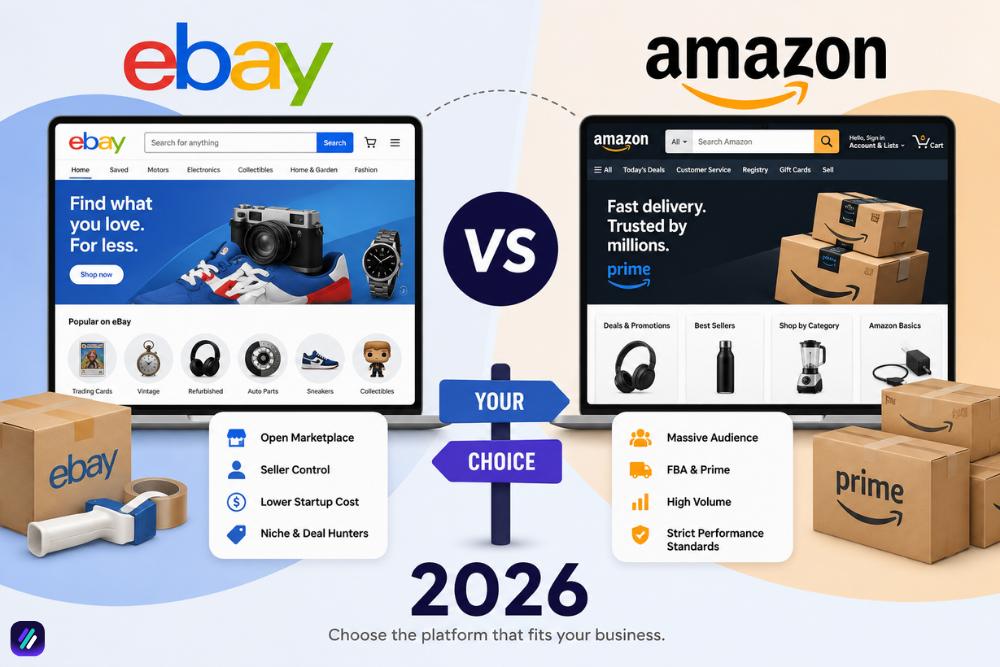
Picking between eBay vs Amazon feels like it should be a quick decision, until the wrong choice starts eating your margin. Plenty of sellers commit to one platform, list products that were never going to move there, and blame themselves when the problem was fit.
The cost is rarely obvious. You lose months of listing effort, pay fees that do not match your product, and compete in the wrong pond while a better-fit platform sits one signup away.
In this guide, I will show you how eBay and Amazon differ for sellers, what each one takes from a sale, and how to choose the platform that fits what you sell.
eBay vs Amazon: Comparison Table
Now, before the deep dive, here is the shape of the whole comparison. Keep in mind that a single row can hide a lot of nuance, which the sections after the table unpack.
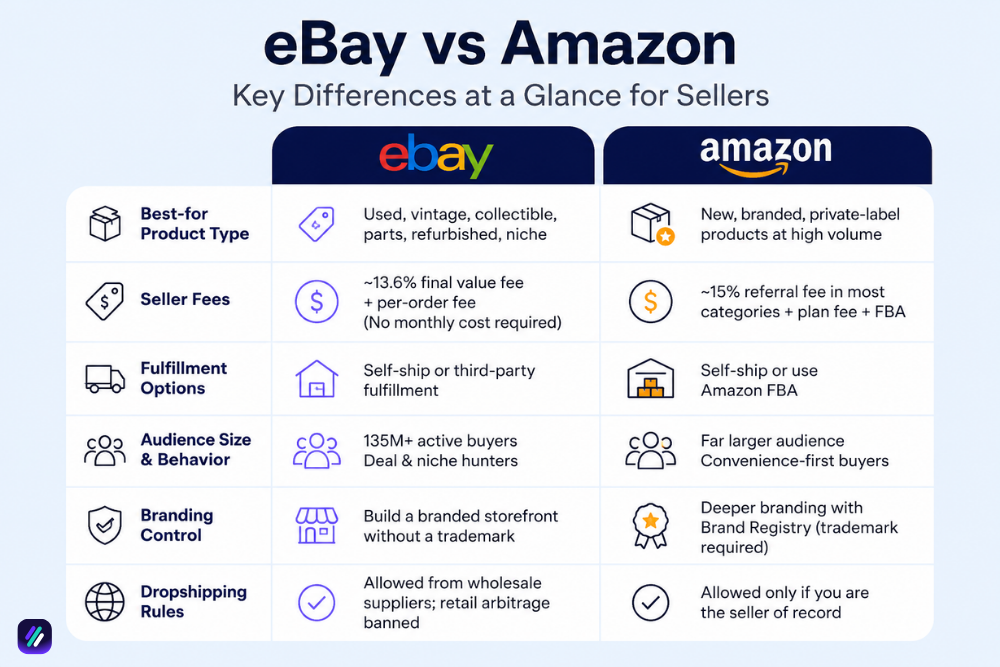
Here is how eBay and Amazon compare across the 18 factors that most affect what you keep and how fast you sell:
| Comparison Points | eBay | Amazon |
|---|---|---|
| Best for | Used, vintage, collectible, parts, and mid-volume niche sellers | New, branded, private-label products sold at high volume |
| Business model | Open marketplace with seller-branded storefronts and your own listing | Shared catalog where sellers often compete for one product page |
| Beginner-friendly | Easier start; list almost anything within minutes | Steeper setup with category approvals and stricter compliance |
| Competitiveness | Dense in popular niches, but you keep your own listing | Extremely dense, often fighting for a single buy box |
| Seller fees | About 13.6% final value fee plus a per-order fee, no monthly cost required | Around 15% referral in most categories, plus a plan fee and FBA |
| Seller responsibilities | Shipping, returns, and customer service on your terms | The same, plus tighter performance metrics and policy compliance |
| Seller control, branding, and customer relationships | Build a storefront and brand identity without a trademark | Deeper branding gated behind Brand Registry and a registered trademark |
| Fulfillment options | Self-ship or third-party; no native warehouse network | Self-ship or hand it to Amazon’s FBA warehouse network |
| Risks | Account holds, feedback damage, VeRO takedowns | Suspensions, buy box loss, competing against Amazon itself |
| Marketing and promotional options | Promoted Listings, coupons, sales, and offers to watchers | Sponsored ads that are close to mandatory in busy categories |
| Authenticity and guarantees | Authenticity Guarantee on watches, sneakers, handbags, and cards | Brand Registry plus strict counterfeit enforcement and gated categories |
| Buyer privileges | Money Back Guarantee, though buyers hunt for deals | Generous returns culture and Prime-driven expectations |
| Audience size and buyer behavior | 135 million active buyers, deal and niche hunters | Far larger traffic, convenience-first default buyers |
| Listing optimization | Cassini favors titles, item specifics, and sell-through | A9 favors keywords, conversion, reviews, and price |
| Best-fit product categories | Collectibles, auto parts, refurbished, hard-to-find items | Consumables, private label, mainstream new goods |
| Startup cost and barrier to entry | Low, with an optional store subscription | Higher, with plan fees and possible FBA inventory upfront |
| Future-proof | Steady niche and reseller demand with less hype | Massive scale, but rising fees and denser competition |
| Dropshipping | Allowed from wholesale suppliers; retail arbitrage banned | Allowed only if you are the seller of record |
So treat this as your map. Even the fee row shifts once a store subscription or FBA enters the picture, and the higher eBay store levels can cut final value fees notably.
Is eBay or Amazon Better for Selling?
eBay is the better starting point for used, niche, and lower-volume sellers who want control and low fixed costs. Amazon wins for new, branded products you can sell at scale, so match the platform to your product, not the reverse.
The right call depends on what you sell and how you want to run things, so here is a quick way to place yourself.
eBay is the better fit if:
- You sell used, refurbished, vintage, or collectible items that Amazon restricts or buries.
- You want to build a branded storefront and keep a direct relationship with buyers.
- You are starting lean and want to avoid monthly plan fees and heavy upfront inventory.
- Your margins are thin, so the lower total fee on a straight sale actually matters.
Amazon is the better fit if:
- You sell new, branded, or private-label products with steady, repeatable demand.
- You want Amazon’s FBA network to store, pack, and ship on your behalf.
- You can handle stricter compliance, category approvals, and performance metrics.
- You are chasing volume and Prime-driven convenience buyers.
Running both makes sense if:
- You have the operational capacity to run two fee structures and two sets of policies.
- Your catalog spans both mainstream new goods and niche or used items.
- You want to diversify so one suspension or algorithm change does not sink you.
One caveat before you commit: platform economics shift with your exact category, price point, shipping weight, return rate, and ad cost. The gap in ebay vs amazon selling fees is only one input, and it is rarely the one that decides your profit.
Main Differences Between eBay and Amazon for Sellers
The table gives you the shape of it. Below, each factor gets the detail behind the one-liner, with both platforms judged on the same terms.
Best For
eBay shines for used, refurbished, vintage, and collectible goods, plus parts and hard-to-find items that buyers actively hunt for. It rewards sellers who know a niche well and want to move mid-volume without a warehouse.
Amazon is built for new, branded, and private-label products sold at volume. If your item has a barcode, repeatable demand, and room to compete on price and reviews, Amazon’s buyer base is tough to beat.
Business Model
eBay runs as an open marketplace where you keep your own listing, your own storefront, and a direct line to the buyer. Amazon runs as a shared catalog, where many sellers often compete for the same product page and the same buy box.
That one difference shapes almost everything downstream. On eBay you are building a store; on Amazon you are usually renting a slot inside Amazon’s store. Neither is wrong, but they suit different temperaments.
Beginner-Friendliness
eBay is the gentler on-ramp. You can list almost anything in minutes, and the rules are forgiving enough that a first-timer can make a sale in their first week.
Amazon asks more upfront. Category approvals, stricter compliance, and a less forgiving policy engine make the learning curve steeper, though the payoff at scale can be larger.
Competitiveness
Both platforms are crowded, but the crowding feels different. On eBay, popular niches are packed, yet you still control your own listing and can win on service, titles, and sell-through. On Amazon, you often fight for a single buy box, sometimes against Amazon’s own house brands, so price and reviews carry more weight.
Keep in mind that a bigger audience does not mean easier sales. More buyers almost always means more sellers chasing them.
Seller Fees
This is where a lot of sellers guess instead of calculating. eBay’s standard final value fee is 13.6% of the total sale including shipping and tax, plus a per-order fee of $0.30 on orders of $10 or less or $0.40 above that, with no required monthly cost.
Amazon charges a referral fee near 15% in most categories, plus either $0.99 per item or a $39.99 monthly Professional plan, and FBA fulfillment on top when Amazon ships for you.
On referral and final-value fees alone, the two land close. Amazon’s total bite grows once the plan and FBA stack up, while eBay’s shrinks if you subscribe to a store.
Seller Responsibilities
On both platforms, the seller owns shipping, returns, and customer service, and the buyer rarely cares which marketplace they bought from. The difference is tolerance. eBay gives you more room to handle problems your own way. Amazon holds you to tighter performance metrics, and slipping on late shipments or defect rates can cost you the buy box or your account.
Seller Control, Branding, and Customer Relationships
eBay lets you build a branded storefront, customize listings, and market to past buyers, all without owning a trademark. You get a genuine relationship with your customer.
Amazon keeps the customer relationship largely to itself. Deeper branding, A+ content, and storefronts sit behind Brand Registry, which requires a registered trademark. You reach scale, but the buyer is Amazon’s first.
Fulfillment Options
eBay leaves fulfillment to you, whether you self-ship or use a third-party service, and there is no native warehouse network. Amazon’s edge here is structural. With FBA (Fulfillment by Amazon), you send inventory in and Amazon handles storage, packing, shipping, and most customer service, which also unlocks Prime eligibility.
The trade is control for convenience. FBA fees add up and you lose some visibility, but for high-volume sellers it removes the logistics headache almost entirely.
Risks
Every platform has a way to ruin your week. On eBay, the risks are account holds, feedback damage, and VeRO (Verified Rights Owner) takedowns when you list a branded item a rights holder polices. On Amazon, the bigger threats are sudden suspensions, losing the buy box overnight, and competing directly against Amazon when it decides your product is worth selling itself.
Marketing and Promotional Options
eBay gives you Promoted Listings, coupons, markdown sales, and offers to watchers, plus store newsletters for repeat buyers. Much of it is optional, so you can grow on organic sell-through alone.
Amazon leans harder on paid reach. Sponsored Products and Sponsored Brands are close to mandatory in competitive categories, and deals or coupons help, but expect advertising to be a standing line in your budget.
Authenticity and Guarantees
This is a genuine divergence, and it matters if you sell anything premium. eBay’s Authenticity Guarantee provides free authentication on watches from $2,000, sneakers from $75, and handbags from $500, along with trading cards and jewelry, with the item inspected before it reaches the buyer.
Amazon leans on Brand Registry and aggressive counterfeit enforcement, which protects brand owners but is available only to sellers with a registered trademark.
So eBay reassures buyers on high-value used goods, while Amazon protects brands that own their IP (intellectual property).
Buyer Privileges
Buyers on both platforms are protected, but they behave differently. eBay’s Money Back Guarantee covers not-as-described and non-delivery cases, and its shoppers often arrive hunting for a deal or a rare find. Amazon’s return culture is famously generous, and Prime has trained buyers to expect fast, free shipping and near-frictionless refunds. That generosity is great for buyers and a cost you carry as the seller.
Audience Size and Buyer Behavior
Here is where raw numbers get quoted out of context. eBay reported 135 million active buyers and enabled nearly $80 billion in GMV (gross merchandise volume) across 2.5 billion live listings.
Amazon is far larger, with $716.9 billion in net sales and the heaviest traffic in e-commerce. But bigger is not easier: more than 60% of Amazon units come from third-party sellers, so you are competing against millions of them, and sometimes Amazon itself.
Where that demand actually sits by category is easier to read in eBay’s own eBay statistics than in a single headline figure.
Listing Optimization
Ranking works differently on each. eBay’s Cassini algorithm rewards keyword-rich titles, complete item specifics, competitive pricing, and strong sell-through, so eBay listing optimization is mostly about relevance and conversion signals. Amazon’s A9 leans on keywords in the title and backend, conversion rate, review volume, and price, with advertising feeding visibility. Both reward listings that convert; they just read the signals in their own way.
Best-Fit Product Categories
eBay: collectibles, trading cards, auto parts, refurbished electronics, vintage fashion, and the long tail of hard-to-find items. If a product is used, rare, or niche, eBay buyers are already searching for it.
Amazon: consumables, private-label goods, mainstream electronics, and anything new that sells predictably at volume. You should watch return-prone categories like apparel on both platforms, since returns eat margin fastest there.
Startup Cost and Barrier to Entry
eBay wins on getting started cheaply. You can open an account and list for free up to a monthly allotment, with a store subscription optional once volume justifies it. Amazon’s barrier is higher: the Professional plan runs $39.99 a month, and if you use FBA you are buying and shipping inventory in before your first sale. For a beginner testing the water, eBay’s lower stakes are hard to argue with.
Future-Proofing
Neither platform is going anywhere, but they age differently. eBay has steady, almost boring demand from resellers and niche buyers, with less hype and less volatility. Amazon offers enormous scale, but rising fees, denser competition, and its habit of competing with its own sellers are genuine long-term pressures. You should pick based on where you can defend a margin, not on which logo feels bigger.
Dropshipping
This one has the clearest rulebook, and breaking it gets accounts closed. eBay allows dropshipping when you fulfill from a wholesale supplier, but bans listing an item and buying it from another retailer that ships straight to your buyer, which is retail arbitrage.
Amazon allows dropshipping only if you are the seller of record: your name on every packing slip, supplier identifiers removed, and returns handled by you. Same word, two very different sets of rules.
Should You Sell on eBay and Amazon at the Same Time?
Selling on both can work, but only once one platform already runs smoothly on its own. Two marketplaces mean two fee structures, two policy engines, and two support queues, so splitting your focus too early usually means doing both badly.
The case for multichannel gets strong once you have the capacity for it:
- It spreads risk, so a suspension or algorithm shift on one platform does not erase your income.
- It lets a mixed catalog find its home, with niche and used goods on eBay and new, branded lines on Amazon.
- It captures buyers who loyally shop one platform and never touch the other.
Splitting focus too early, from what our team at ZIK keeps seeing, is the most common way beginners stall out before either store is stable.
The dropshipping rules are where multichannel sellers get tripped up. eBay’s dropshipping policy permits wholesale-supplier fulfillment but bans retail arbitrage, while Amazon demands you be the seller of record on every order. A sourcing method that is fine on one platform can be a suspension risk on the other, so you cannot simply copy your process across.
So if you are weighing the move, the pros and cons of selling on Amazon are worth a hard look before you commit inventory to a second storefront.
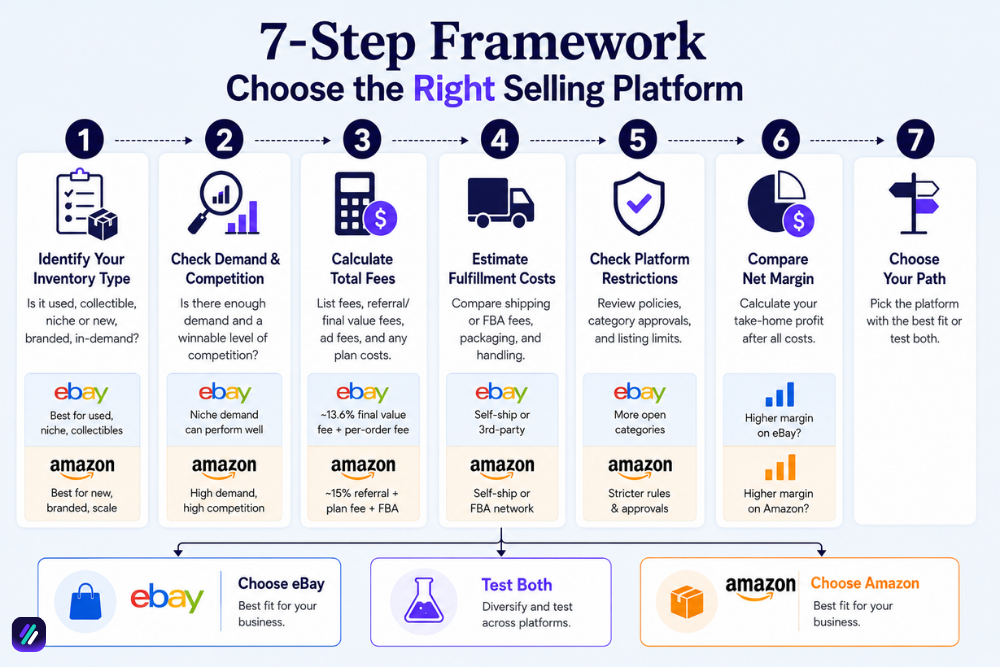
Step-by-Step Decision Framework: eBay or Amazon?
If the comparison still feels abstract, this is the sequence I use to settle it for a specific product. Each step builds on the last, so work them in order.
Step 1: Identify Your Inventory Type
You start with what you actually have to sell, because it eliminates half the debate immediately. New, branded, barcoded products lean Amazon. Used, refurbished, vintage, or one-off items lean eBay, since Amazon restricts or buries much of that. If your inventory is mixed, note which items fall on which side, and we will come back to that split in the final step.
Step 2: Check Demand and Competition
Once you know what you are selling, confirm that buyers actually want it and gauge how crowded the field is. This is where research tools earn their keep.
The online eBay product research tool from ZIK shows actual sales, sell-through, and price data by keyword, so you can see whether demand exists before you list. To size up the field, the eBay competitor research tool reveals how established sellers in your niche perform, from revenue to sold volume.
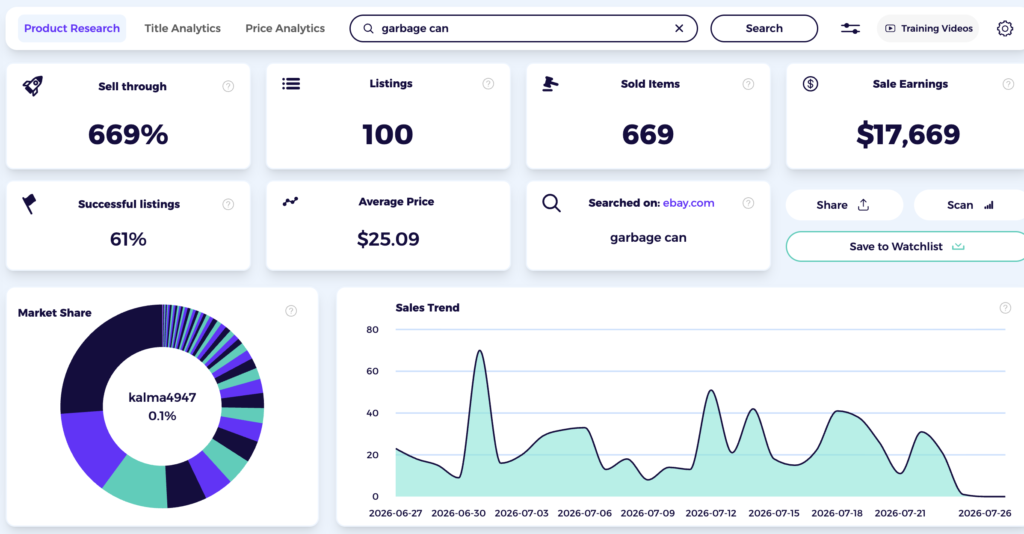
From our in-house eBay sellers at ZIK, the ones who skip this step are usually the ones who later wonder why a “great” product just sits there.
Step 3: Calculate Total Fees
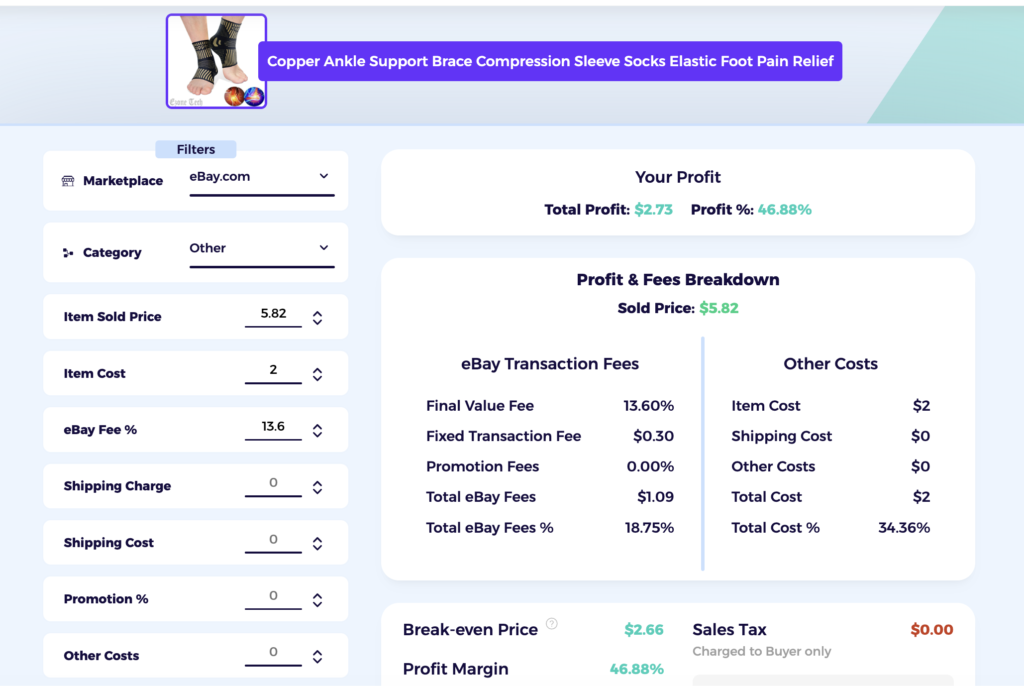
With demand confirmed, run the full fee math for each platform, not the headline rate. On eBay, budget the 13.6% final value fee plus the $0.30 to $0.40 per-order fee. On Amazon, budget the roughly 15% referral fee, plus $0.99 per item or $39.99 a month, plus FBA if you use it. A quick pass through the calculator for eBay fees turns those percentages into an actual dollar figure for your price point. The platform with the lower headline fee is not always the one that keeps you more.
Step 4: Estimate Fulfillment Costs
Fees are only half the cost of getting an order out the door. On eBay, you pay for postage and packaging yourself, which is predictable but hands-on. On Amazon, FBA rolls storage and shipping into per-unit fees that vary by size and weight, so a light item can be cheap to fulfill while a bulky one erodes your margin fast.
The FBA revenue calculator is the fastest way to see what Amazon’s network would cost you per unit before you ship anything in.
Step 5: Check Platform Restrictions
Before you commit, confirm your product and your sourcing method are both allowed. Some categories need approval on Amazon, and gated brands can block you entirely. On eBay, watch for VeRO takedowns on branded goods and the dropshipping rule that bans retail arbitrage. As we saw in the differences above, a sourcing model that is fine on one platform can get you suspended on the other, so this check is not optional.
Step 6: Compare Net Margin
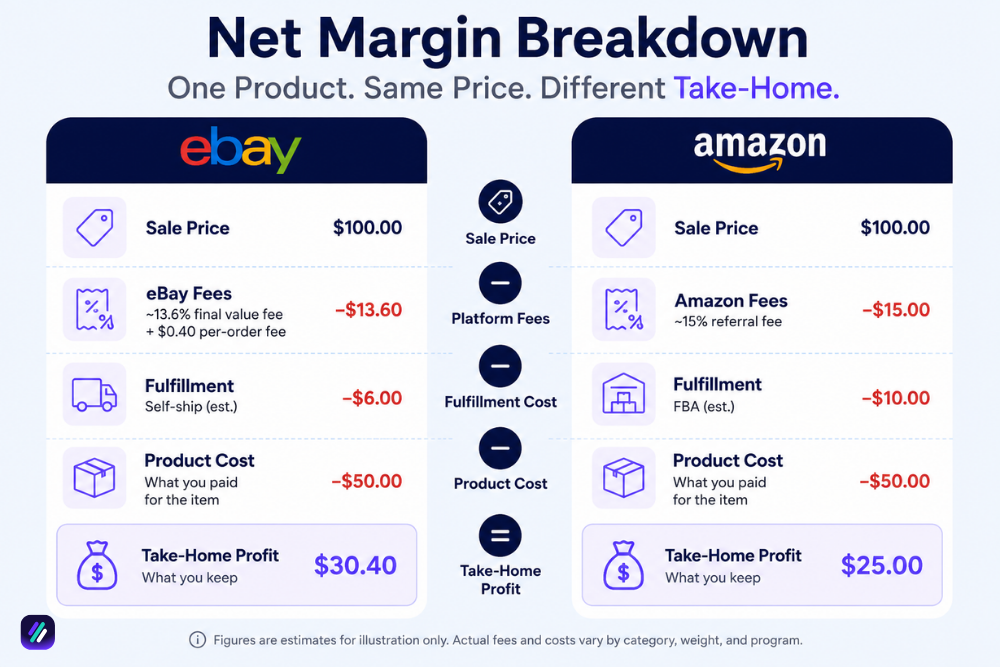
Now put it together: sale price, minus fees from Step 3, minus fulfillment from Step 4, minus product cost, equals what you actually keep. You then run the same math for that product on both platforms.
The eBay competitor research tool helps you check the price the market will bear, so your margin math starts from a realistic sale price rather than a hopeful one. A product can be profitable on one platform, and a loss-maker on the other, and net margin is the number that tells you which.
Step 7: Choose a Platform or Test Both
You now have a defensible answer: the platform with the healthier net margin and the better fit for your inventory wins. If your catalog is split across both sides, this is where the mixed-inventory note from Step 1 pays off. You can start on the stronger platform, prove the process, then expand to the second once the first runs without you babysitting it. Testing both at once is a capacity decision, not a default.
Common Mistakes Sellers Make When Choosing eBay or Amazon
Most bad platform choices come down to mistakes made while deciding, not to eBay or Amazon themselves. These are the ones I see most:
- Chasing the bigger audience: Amazon’s traffic looks irresistible until you realize you are competing against millions of sellers, and sometimes Amazon, for the same buyer.
- Comparing headline fees only: the 13.6% versus 15% gap tells you almost nothing once FBA, plan fees, and shipping enter the math.
- Ignoring fulfillment costs: a low fee on a bulky, heavy item can still lose money after FBA or postage.
- Underestimating returns and customer service: consumers are expected to return about 15.8% of merchandise, and online purchases run near 19.3%, with apparel closer to one in four. Every one of those returns lands on you to process and refund.
- Misreading the dropshipping rules: eBay bans retail arbitrage, and Amazon demands seller-of-record status. Copying a sourcing method across platforms gets accounts closed.
- Skipping product research: listing on a hunch instead of demand data is the fastest route to a dead listing on either platform.
- Forcing used goods onto Amazon: Amazon restricts or buries much of what eBay buyers actively search for.
- Expecting Amazon branding for free: deeper branding sits behind Brand Registry and a registered trademark, not a fresh seller account.
- Overlooking Prime expectations: Amazon buyers expect fast, free shipping, and matching that on your own can erase your margin.
- Treating a store subscription as a cost, not a lever: on eBay, the right store tier can cut final value fees enough to change which platform wins.
- Launching on both at once: running two fee structures and two policy engines before either is stable usually means doing both badly.
- Picking on vibe instead of net margin: the platform that keeps more of your money after every cost is the right one, even when the other carries a bigger logo.
Remember, if you sell fragile or oversized items, add breakage and dimensional-weight surcharges to that list. If you sell apparel, size-driven returns deserve their own line in your margin math.
So none of these are fatal on their own. Stacked together, though, they are why sellers end up blaming the platform when the process was the actual problem.
Conclusion
If you take one thing from all this, let it be that the eBay vs Amazon choice is a means, not the decision itself. The decision is your product, your margin, and how much operational weight you can carry. eBay rewards sellers who want control, low fixed costs, and a home for niche or used goods. Amazon rewards those who can feed a high-volume machine and handle its stricter rules. Both are genuine businesses, and both are still worth building on this year.
That said, I would not pick on reputation alone. So run the numbers on a specific product, start where the margin is defensible, and expand only when the first platform runs without constant attention. If you are still deciding what to list, studying the current best selling items on ebay is a grounded place to begin, because demand data beats a gut feeling every time.
Find Winning Products to Sell on eBay with ZIK Analytics
Everything above comes back to one habit: deciding from data instead of guesswork. That is the part ZIK Analytics handles for you:
- Use the eBay product research tool to see actual sales, sell-through, and competition on any keyword before you commit to a product.
- Use the eBay competitor research tool to break down how top sellers in your niche earn, from revenue to their best-selling items.
- Use the Amazon to eBay dropshipping software to match winning products to suppliers and work out your margin in a click.
Whichever platform you land on, the sellers who win are the ones who choose from evidence. Start your $1 trial (7-day) and see what is actually selling before you list a thing.
eBay vs Amazon FAQs
A few quick answers to the questions sellers ask most when weighing the two platforms.
What are the disadvantages of eBay?
eBay’s main drawbacks are its deal-hunting buyers, who often compress your prices, and its smaller scale next to Amazon. You also carry feedback and VeRO takedown risk on branded items, and you handle shipping, returns, and customer service yourself, with no native warehouse network to lean on.
What are the disadvantages of Amazon?
Amazon’s disadvantages start with steeper costs, since a referral fee near 15% stacks on top of a monthly plan and FBA fulfillment. Competition is dense, sometimes against Amazon itself, and you fight for a single buy box. Its policy engine is stricter too, so suspensions come faster, and deeper branding sits behind Brand Registry.
What are the benefits of eBay?
eBay’s biggest benefits are a low barrier to entry and genuine seller control. You can open an account cheaply, build a branded storefront without owning a trademark, and keep a direct line to buyers. It is strong for used, vintage, and collectible goods, and its lower single-sale fee helps when your margins are thin.
What are the benefits of Amazon?
Amazon’s advantages come down to reach and infrastructure. It has the heaviest traffic in e-commerce, so a proven product can sell at high volume. FBA stores, packs, and ships for you and adds Prime eligibility, and the platform suits new, branded, and private-label goods that sell predictably. Scale is the payoff for its stricter rules.
How much do Amazon and eBay take from a $100 sale?
On a straight $100 sale in a standard category, eBay takes about $14: a 13.6% final value fee plus the roughly $0.40 per-order fee. Amazon takes about $15 in referral fees at the common 15% rate, plus its plan cost and FBA fulfillment if Amazon ships for you. Close on paper, but Amazon’s total grows once fulfillment is added.
Do more people shop on Amazon or eBay?
More people shop on Amazon. It draws roughly 4.5 times eBay’s traffic and hundreds of billions in net sales, making it the most-visited e-commerce site in the world. eBay is still the number two marketplace by traffic, though, with 135 million active buyers. A bigger audience means more competition, not automatically more sales for you.
Is it better to sell on Amazon or eBay?
For most sellers, eBay is better for used, niche, and lower-volume items, while Amazon is better for new, branded products sold at scale. Neither wins outright. The right call comes down to your product and the margin you can defend after fees and fulfillment, so run the math before you decide.
Want to know about some other platforms that you can sell on other than eBay?
eBay VS:
- AliExpress
- Amazon
- Bonanza
- Craigslist
- Depop
- eBid
- Etsy
- Facebook Marketplace
- Goat
- Gumtree
- Mercari
- OfferUp
- Poshmark
- Vinted
- Stockx
- Truegether
- Wish