
Selling coins is a hobby for some and a steady source of income for others.
But even when it is something in between, getting the most out of your collection means knowing where and how to sell.
eBay offers the largest customer base for coins online, with millions of active collectors searching for specific dates, grades, and mint marks every day.
Below, I walk you through every step that you need to take to start selling coins on eBay, from setting up your account to pricing, grading, and making your first sale.
The short version: to sell a coin on eBay, register and verify a seller account, check that you meet eBay’s selling requirements for collectible coins, price the coin against completed Sold listings for the same date, mint mark and grade, then list it with photos of both faces and an honest condition. A coin selling at $20 or less can go by eBay standard envelope; anything dearer needs a tracked parcel service. eBay’s fee on a non-bullion coin is 13.25% of the total amount of the sale up to $7,500.
Key Takeaways:
- Coin listings on eBay.com sold through at 18.8% over the last 30 days, against 9.7% for the tracked US marketplace as a whole, so coins move at roughly twice the rate of the average listing.
- American Silver Eagles are the single biggest earner among coins, taking $667,741 across 1,552 sales in that window.
- Ancient coins and mint-error coins sell far less than their reputation suggests, which is the clearest case for checking demand with ZIK Analytics before you buy inventory.
- Only an eBay-approved grading company’s grade can appear in your listing, and eBay names eight of them.
- Ungraded coins have to be listed below $2,500, and selling collectible coins at all can require a trading history you may not have yet.
- Your listing title’s first 40 characters carry the most weight in search, so lead with the year, mint mark, series, and grade every time.
Why eBay Is the Best Place to Sell Coins Online?
eBay is the best place to sell coins online because coins change hands there about twice as fast as everything else on the site. According to the ZIK Marketplace Index (ZMI), covering 159.9M tracked US eBay listings, pulled 2026-10-23, coin listings on eBay.com sold through at 18.8% over the previous 30 days, against 9.7% for every tracked US eBay listing measured the same way.
Sell-through here means the units sold in 30 days divided by the active listings ZMI tracks in that slice, applied identically at both levels. The coin figure covers coins only: it is eBay’s Coins & Paper Money category with bullion bars and banknotes filtered out, because the category’s biggest earners by revenue are gold and silver bars rather than coins.
That makes coins the fastest-moving collectibles category in the index, by a wide margin over the categories a coin seller would otherwise consider. Over the same 30 days, Sports Mem, Cards & Fan Shop sold through at 5.8%, Collectibles & Art at 5.5%, and Entertainment Memorabilia at 3.2%.
The category is deep, too. ZMI tracks 88,848 active coin listings in eBay’s Coins & Paper Money category.
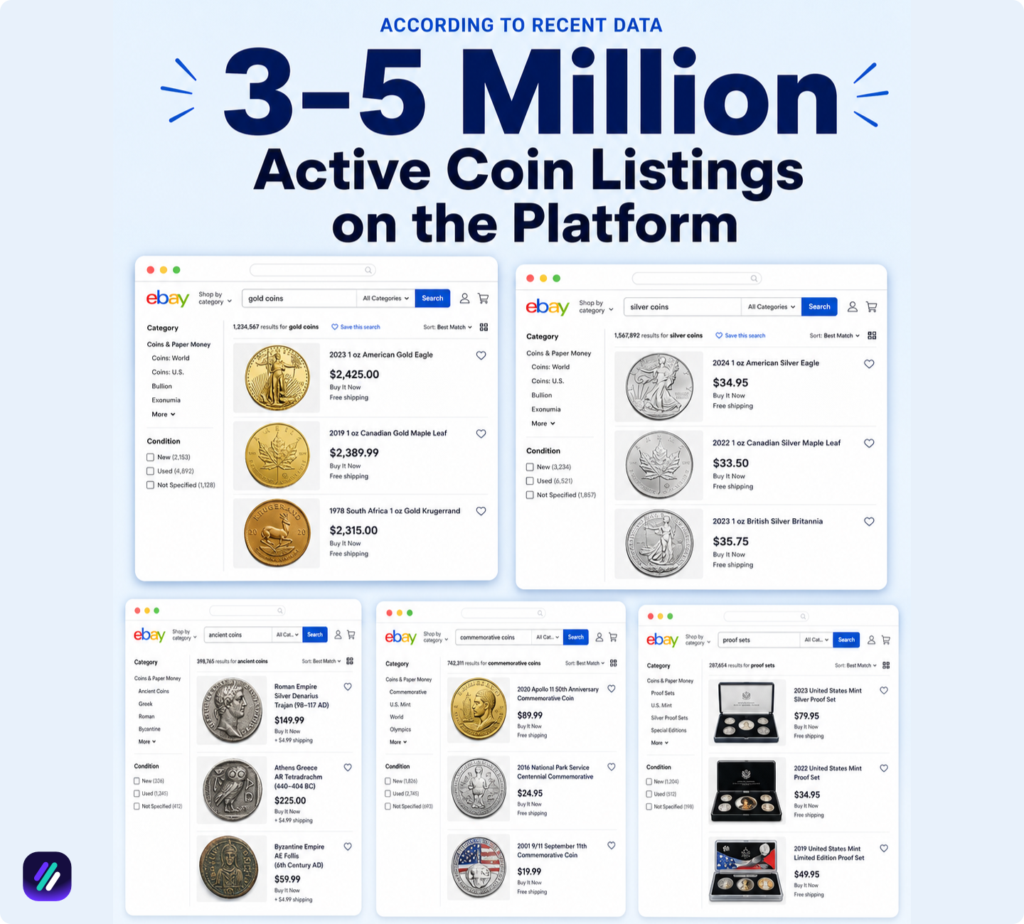
Those coins sold for real money: 16,687 of them changed hands on eBay.com in 30 days for $3,434,124, an average of $205.80 a sale. Be careful how you read the seller side of that, though. ZMI saw 253 active coin sellers in the window, and earnings among them are concentrated rather than typical: the largest took $1,892,505 in the month, while the tenth largest took $12,523. Treat the top of that range as what an established bullion and coin dealer does, not as a starting point.
eBay also gives you several tools to maximize the appeal of your listings, and your coins sit inside a global collectibles market put at $602.4 billion for 2026.
Bonus read: Best-selling items on eBay
How to Start Selling Coins on eBay: Step-by-Step
Now that you know eBay is the best platform for selling coins online, here are the steps you can take to get started on this platform.
Step 1: Select the eBay Country Marketplace Where You Will Sell
Sell on eBay.com if you have the choice, because that is where the coin demand sits. Of the 269.9M eBay listings ZMI tracks across every eBay site, 159.9M are on eBay.com, and every coin figure in this guide comes from that marketplace.
eBay is officially available in many countries worldwide, but that does not mean you should sell on any eBay site you feel is suitable for your business.
Other eBay sites are far smaller in the index: Germany, the largest of the European sites ZMI reports on its own, holds 19.2M tracked listings. If you want to compare the marketplaces more broadly, our eBay statistics roundup covers them. For coins specifically, starting on eBay.com gives you the deepest pool of active collectors on the platform.
Step 2: Find Winning Coins Selling on eBay
Once you’ve chosen a country marketplace, you need to identify the high-demand coins to list on eBay.
Using ZIK Analytics’ eBay Product Research tool is a great way to handle this. By entering specific keywords such as “Silver Eagles or “Pre-1933 Gold,” you can see exactly which listings are topping the search results.
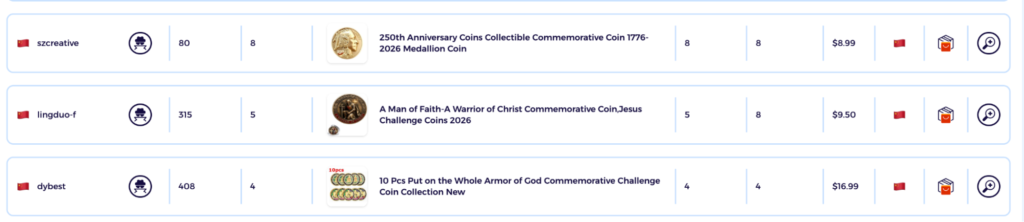
The tool provides key metrics like sell-through rates, average pricing, and total units sold over the last 7 to 30 days.
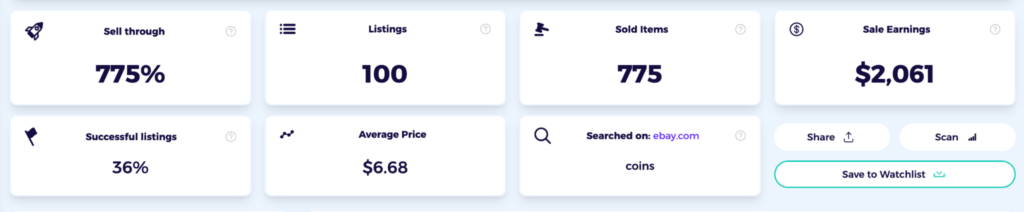
If you spot a particular mint mark or year that’s consistently moving at high volumes, that’s a clear signal to prioritize those coins for your inventory.
Step 3: Create Your eBay Account
Before you can list your first coin, you need to create and verify your eBay seller account.
Head over to eBay, click Register, and choose between a Personal or Business eBay account.
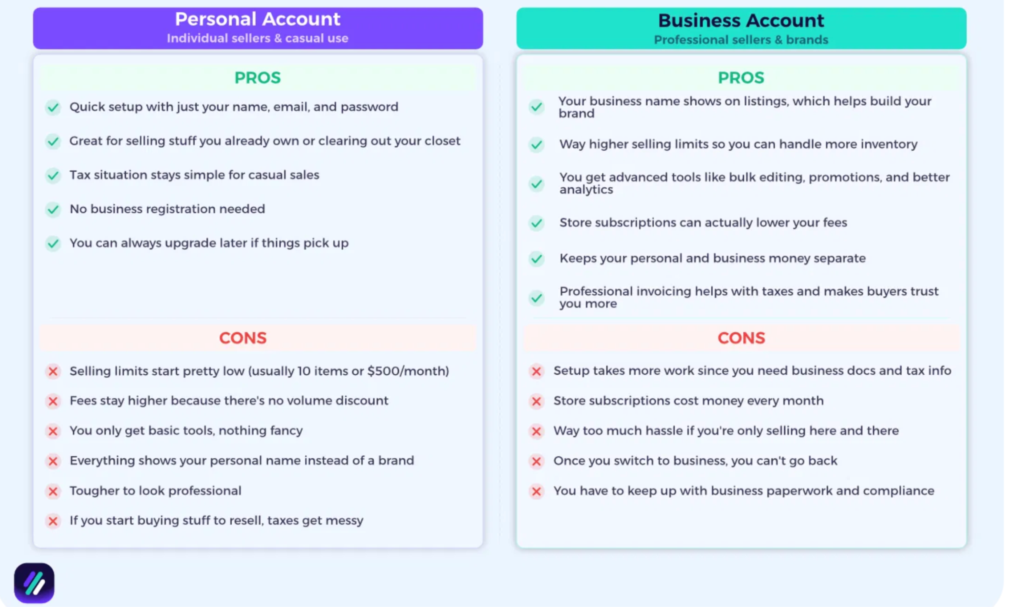
A personal account works fine if you are a casual seller, but if you are running a numismatic business or selling on behalf of an estate, go ahead and select Business.
Next, go to the Sell tab and link a checking account for payouts. Once done, eBay will send two small deposits within two to four days to verify your bank.
You also need to make sure the name on your eBay account matches your government ID and bank account exactly, as any mismatch can delay your payouts.
Plus, if you can make three to five small purchases before listing your first coin, the positive feedback helps build buyer trust from the start.
There is one gate worth checking before you buy any inventory. Collectible coins sit on eBay’s list of products with eligibility requirements, which means some sellers need pre-approval. eBay says those products “may be sold only by sellers who meet some or all of the following requirements”, and the first on its list is a seller with “an established history of active selling for at least 90 days, with 100 or more transactions and $1,000 or more in sales in the last 12 months”. The rest of the list covers an Above Standard or Top Rated account, a verified identity, and compliance with eBay’s policies.
Two things to note about that. It is triggered by the product category rather than by how much your coin is worth, so a cheap coin does not get you around it. And eBay words it as “some or all”, so it is applied at eBay’s discretion rather than as a fixed checklist. If you are starting from a new account, plan on building that history with other items first.
Step 4: Create Your Policies Pages
This step involves creating your policy pages, which tell buyers how you ship, handle returns, and collect payment.
These pages are required by eBay for every active listing, and the settings you choose directly affect your search visibility and buyer trust.
Here are the key pages you need to create:
Shipping policy: This page tells buyers how long it takes you to pack and ship a coin after payment. Setting it up requires choosing a handling time and a shipping method. One to two business days is the standard expectation for handling time, but check with your supplier first to see how long they take to dispatch. Which service you pick depends on what the coin sells for, which Step 11 covers in detail.
Example:
Shipping: $0.99 eBay Standard Envelope (or Free Shipping)
Handling time: 1 business day
Ships to: United States
Helpful read: How to ship on eBay
eBay Return policy: The return policy dictates the terms under which buyers can send a coin back. Having this in place is important since eBay’s Money Back Guarantee applies to every sale regardless of whether you accept returns or not. Consider giving buyers a 30-day return window and stating that coins must be returned in their original, unopened holder in order to qualify for a refund.
Example:
Returns: 30 days; buyer pays for return shipping.
Condition: Returns accepted only if the item is in the original unopened package
Payment policy: The payment policy sets the payment terms for your buyers. The main setting to configure here is immediate payment for Buy It Now listings, which prevents non-paying buyers from locking up your inventory. Your bank account details for payouts are handled separately under your eBay account settings.
Example:
Payment: Immediate payment required.
To set all three of these up, go to My eBay, select Account, then Business Policies, and create a separate policy for each one.
Step 5: Connect Your Payment Processor
After creating your policies, make sure to connect a payment method so eBay knows where to send your earnings.
If you are based in the US, you can link a checking account directly through My eBay, under Account, then Payments. Make sure the name on your bank account matches your eBay account exactly.
For sellers outside the US, the payout method depends on your country. If you are in the UK, Canada, Australia, or the EU, you can link a local bank account directly. If you are based elsewhere, such as in South Asia, eBay typically requires a Payoneer account instead.
Keep in mind that Payoneer’s ID verification can take two to four weeks before you can start selling.
Step 6: Import Your Coins into Your eBay Store
With payments set up, you are ready to bring your coin inventory into your eBay store.
Getting your listings live requires you to import your coins into Seller Hub, which you can do individually or in bulk using a CSV file.
For individual listings:
- Go to Seller Hub and click Create Listing
- Fill in your coin details, upload photos, and publish
For bulk imports:
- Go to Seller Hub, select Reports, then Upload
- Download eBay’s listing template
- Fill in your coin details including titles, prices, and photo URLs
- Upload the file and click List to eBay
You can also use the bulk method to make quick price adjustments across your entire inventory when coin prices shift.
Step 7: Grading Your Coins
Grading is how you tell a buyer what they are getting, and eBay treats a graded coin and a raw coin as two different listings with two different rule sets.
Professional grading runs on a 1 to 70 scale, where a 1 means the coin is barely recognizable and a 70 means it is in perfect, untouched condition. A grading service authenticates the coin and seals it in a hard plastic holder with that number on the label.
You can only put a numeric grade in your listing if an eBay-approved company assigned it. eBay’s Collectible currency policy says listings for graded coins and currency “must have been graded by an eBay-approved company such as NGC, PCGS, ANACS, ICG, PMG, CAC, ICCS or Legacy Currency Grading”. That is eight companies, not the two most people name, and the policy also sets out what a grader has to do to qualify: at least 50,000 pre-1956 coins graded, and at least three numismatic experts on staff.
For a raw coin, eBay asks for something simpler than a number. Its Coin Condition Guidelines sort raw coins into four condition groups: Uncirculated, Extremely Fine to About Uncirculated, Fine to Very Fine, and Below Fine. eBay’s rule for choosing between them is that “the most significant issue will determine the overall condition of the coin”, and it adds that sellers “will not be penalized for assigning a condition that is lower than the coin’s true condition”. So when you are unsure, grade down.
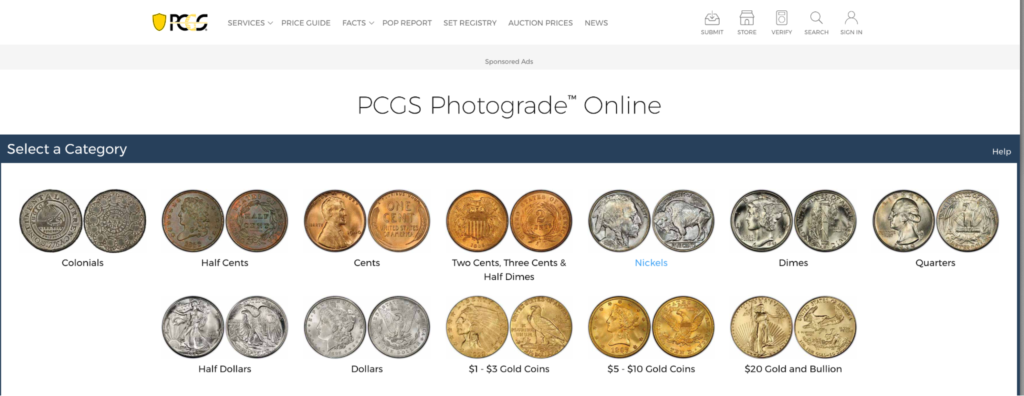
There are free tools you can use to judge a coin yourself. PCGS and NGC both offer online grading guides, and a basic jeweler’s loupe with good lighting is all you need to get started.
Authentication matters most on your dearest coins. The eBay Authenticity Guarantee covers single raw US coins and single graded US and World coins listed or sold at $500 or more, excluding tax and shipping. eBay pays for the authentication, the coin is authenticated on its way through rather than going straight to the buyer, and anything at $1,500 and above travels on with a signature required. Note what it is not: eBay states the programme “does not include grading services”.
Should you clean a coin before selling it?
No, and the reason is a listing rule rather than a ban. eBay does not prohibit cleaning a coin anywhere in its coin policies. What it does is count cleaning against the coin’s condition: its condition guidelines list cleaning alongside scratches, corrosion, rim damage and discoloration as an issue that determines the grade, and they ask sellers to “clearly disclose any damage or notable issues, such as scratches, cleaning, rim damage, or corrosion, in the item description”.
Read together, that means a cleaned coin is perfectly sellable, but it is worth less and you have to say so. Selling one as untouched is the disclosure failure that turns into a return.
Step 8: Pricing Your Coins and Calculating eBay Fees
Determining the right price for your coins requires some research and assessing what similar coins have sold for recently.
You can start by searching eBay for your exact coin and filtering by Sold Listings to see what others paid. Check mint marks and condition to understand the range. Cross-referencing with PCGS or NGC population reports can also help you confirm whether your coin is worth more than others in the same grade.
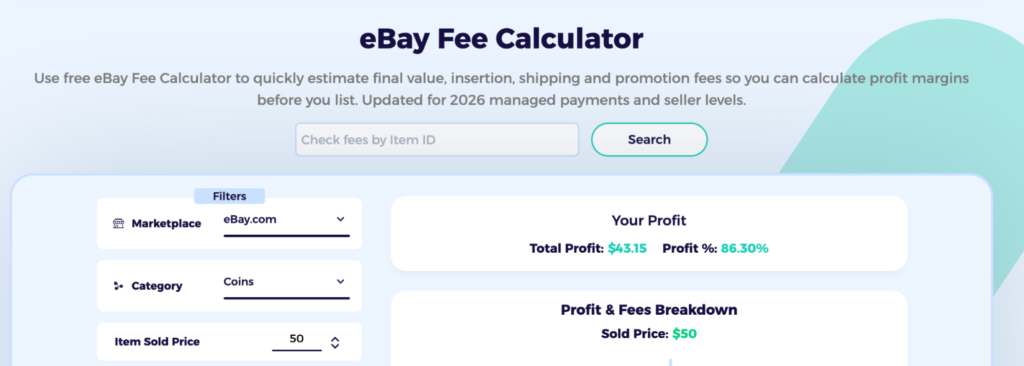
After settling on a figure, verify your margin using an eBay fees calculator like ZIK’s. eBay charges 13.25% on the total sale amount, including shipping and tax, meaning your actual take-home can be lower than the sale price suggests.
That headline rate needs three qualifications, and they matter once your coins get expensive. On eBay’s current fee schedule, Coins & Paper Money other than Bullion is charged at 13.25% of the total amount of the sale up to $7,500 per item, and 2.35% on the portion above $7,500. Bullion is a separate row at 13.6% up to $7,500 and 7% above it. On top of the percentage there is a per-order fee: $0.30 on orders of $10.00 or less, and $0.40 on orders over $10.00.
What “the total amount of the sale” covers is the part that catches new sellers out. In eBay’s words, it “includes the item price, any handling charges, any shipping costs collected from the buyer (some exceptions apply), sales tax, and any other applicable fees”. Free shipping does not avoid the fee, it just moves where the money sits.
There is also an international fee of 1.65% of the total amount of the sale, and it is conditional rather than automatic. eBay does not charge it if your registered address is in the US and you offer eBay International Shipping on the eligible listing. Without that, it applies when either the delivery address or the buyer’s own registered address is outside the US.
If you plan to use Promoted Listings, factor that percentage in before finalizing your price so it does not catch you off guard after the sale.
Step 9: Optimize Your eBay Listings with SEO
Optimizing your eBay coin listings comes down to making it easy for the right buyer to find you.
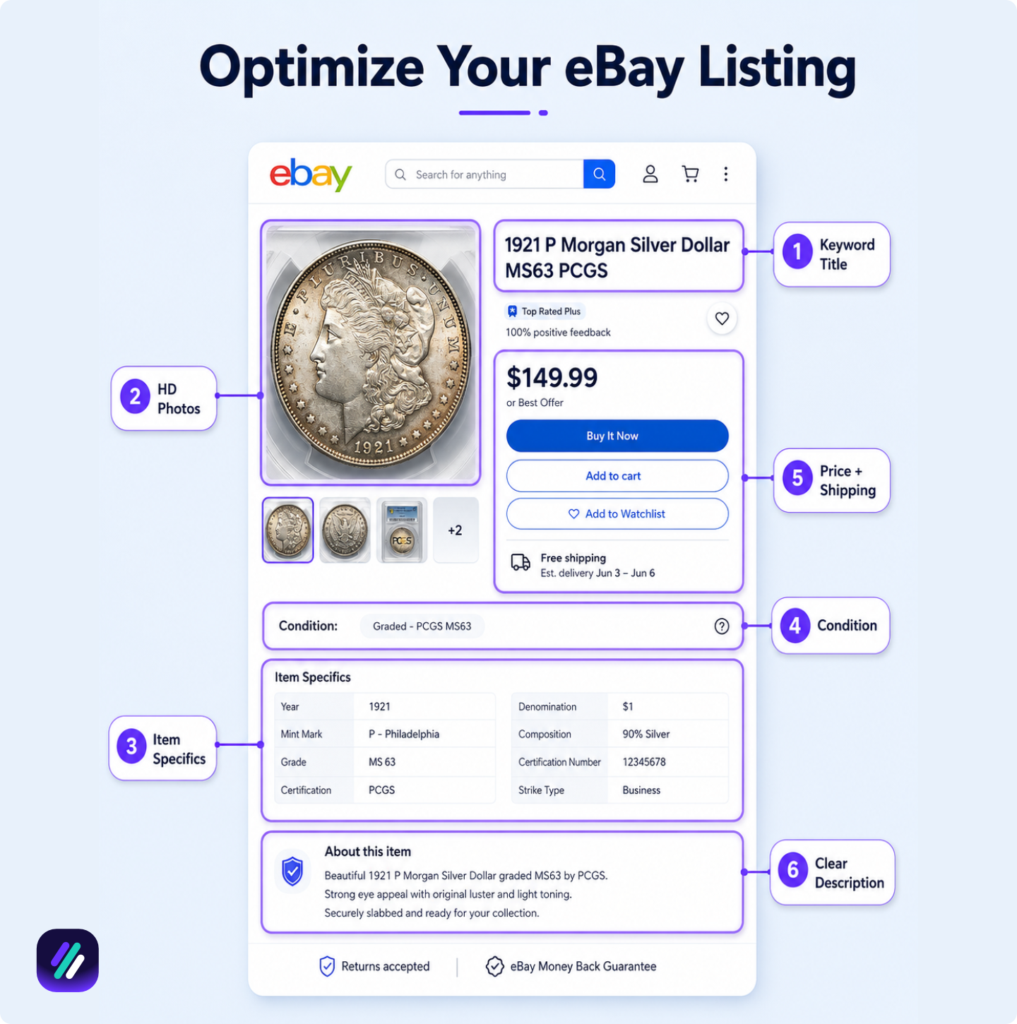
The first thing to get right is your title. Think of it as the most valuable real estate in your listing, since eBay’s Cassini algorithm reads left to right and weighs the first 40 characters the most. A title like “1921 P Morgan Silver Dollar MS63 BU Slabbed PCGS” will always outperform something that doesn’t include relevant eBay keywords.
From there:
- Fill out every Item Specifics field you can, as this is the main ranking factor for filtered searches
- Write a description of at least 200 words covering the coin’s history, condition, and any known defects
- Use bullet points in your description since most buyers browse on mobile
- Add 6 to 24 high-resolution photos of both sides, the mint mark, and the edge under soft, diffused lighting
Note that eBay requires photos of the front and back of the actual coin for ungraded listings, and stock photos are not allowed, so that last point is a rule and not just good practice.
You should also consider offering free shipping by building the cost into your price, as many buyers filter for it and it can give your listing an edge in search results.
Step 10: Using eBay Promoted Listings
Promoted Listings is an eBay marketing feature that places your coin in sponsored spots across search results.
eBay’s own description of what it buys you is deliberately unquantified: it gives your listings “general access to ad placements so you can reach more buyers”. Treat any specific percentage uplift you see quoted elsewhere with suspicion, because eBay does not publish one, and results vary by category and price.
To create a promoted listing:
- Go to Seller Hub, select Marketing, then Advertising Dashboard
- Click Create New Campaign and select Promoted Listings Standard
- Choose the listings you want to promote and set your ad rate
- Launch the campaign
The thing to keep in mind is that you only pay the ad fee when the coin sells, so set your own rate deliberately rather than accepting eBay’s suggestion, and check it against the margin you worked out in Step 8.
Step 11: Pack and Ship Your Coins
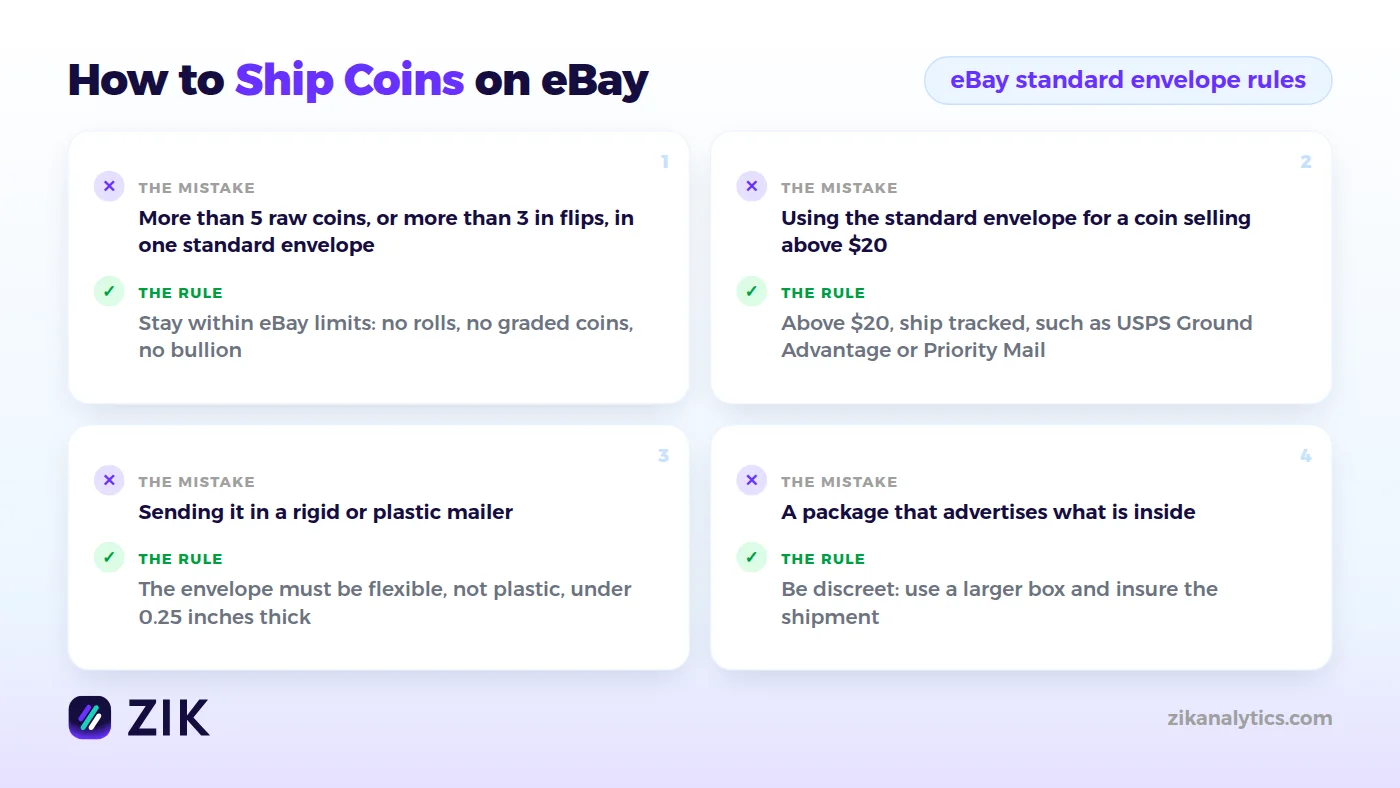
Ship a coin flat, protected, and tracked. Which service you are allowed to use comes down to one number: eBay standard envelope is the cheap route for a coin selling at $20 or less, and above that you need a tracked parcel service, because the envelope is not eligible.
eBay publishes limits for coins specifically. On the eBay standard envelope help page, the Coin & paper money rules are:
- No more than 5 raw coins or pieces of paper money
- No more than 3 coins in plastic flips
- No rolls of coins
- No graded coins or paper money
- No bullion
On top of those, every eligible item has a maximum $20 selling price not including tax, the envelope has to weigh up to 3 oz, and it has to measure no smaller than 3.5 by 5 inches and no larger than 6.125 by 11.5 inches. Postage runs $0.82 at 1 oz, $1.11 at 2 oz and $1.40 at 3 oz, and each shipment carries $20 of shipping protection on a single order, up to $50 on a combined one.
Two of the envelope requirements rule out the packaging most people reach for first. The thickness has to be uniform, under 0.25 inches at every point, and eBay specifies that the envelope must not be too rigid and must be “NOT enclosed or made of any plastic material”. A rigid mailer or a poly mailer is therefore not a valid eBay standard envelope shipment, and sending one risks it coming back to you or reaching the buyer with postage due.
Above $20, move to a tracked service such as USPS Ground Advantage or Priority Mail. eBay’s own packing guidance for coins is brief and worth following exactly: “Be discreet. Use a larger box that will travel easily”, and “Make sure to insure your shipment appropriately”. Being discreet matters more with coins than with most categories, because a package that advertises bullion is a package worth stealing.
One honest caveat: beyond those lines, eBay does not publish holder-level packing instructions for coins. Advice you will read about non-PVC flips, 2×2 cardboard holders and moisture bags is seller practice rather than eBay policy, so treat it as experience worth borrowing and not as a rule you can be penalized against. And if your coin falls under the Authenticity Guarantee thresholds in Step 7, the authentication leg handles the journey to the buyer for you.
Best eBay Coins Suppliers
There are several places to source coins for your eBay store. Here are the best options:
- Bullion dealers: These are large, reputable sellers who maintain their own eBay stores alongside their websites. Some examples include APMEX and Liberty Coin. Bullion dealers let you buy authenticated, slabbed coins at competitive prices.
- Local coin shops and coin shows: If you’re looking for junk silver and raw coins, there’s no better source than local shops. You can inspect each piece before buying and build relationships with dealers who may offer better prices over time.
- Estate sales and unsearched lots: These carry more risk but offer the highest potential margins, particularly when buying from families who may not know the value of what they have.
What Types are Best Selling Coins on eBay
The best-selling coins on eBay are bullion coins, graded coins and circulated silver, in that order. Below are the coin types that earned the most on eBay.com over the 30 days to 2026-10-23, measured on ZMI’s coins-only slice and ranked by revenue rather than by units, because ranking by units puts low-value pieces on top that nobody would choose to stock. The last section is the exception: a famous type that barely sells, included because knowing what not to buy is worth as much as knowing what to buy.
American Silver Eagles
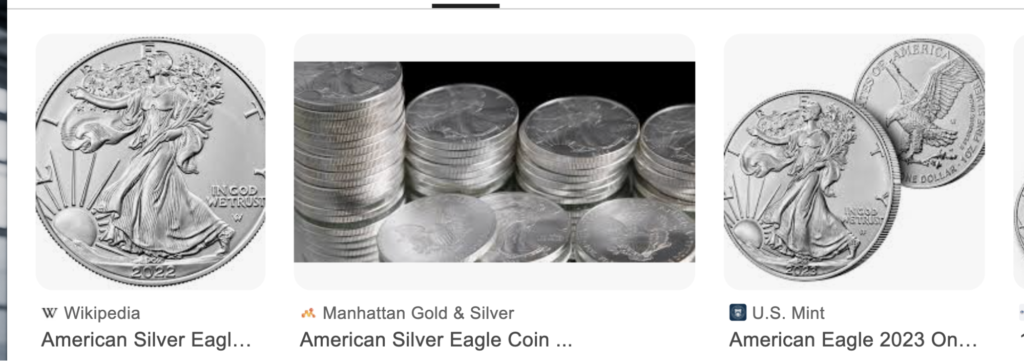
The biggest earner by a clear margin: $667,741 across 1,552 sales, at an average sold price of $430.25. That average is high because the listings doing the work are multiples rather than single coins. A “Roll of 20” at $1,308.17 took $350,590 on its own, with a lot of 100 at $6,566.61 and a tube of 20 at $1,398.20 next behind it.
Both silver stackers and coin collectors buy them, and graded examples in MS69 or MS70 condition also sell above spot. If you can source rolls rather than singles, this is the type to start with.
American Gold Eagles and Gold Buffalos
Gold is where the revenue per sale lives. American Gold Eagles took $641,249 across 350 sales, an average of $1,832.14 each, and American Gold Buffalos took $387,779 across 112 sales at an average of $3,462.31. A single “1 oz American Gold Eagle $50 Coin (Random Year)” listing took $412,282 of that Gold Eagle total.
The catch is capital: you are tying up thousands of dollars per coin, and the fee schedule treats bullion differently, as Step 8 covers. One thing to watch when you research this type is that gold-plated “tribute” pieces sit in the same search results at under $20, so check what you are actually buying.
Graded Coins in PCGS and NGC Slabs
Coins whose titles name PCGS or NGC took $141,535 across 1,416 sales, at a far more approachable average of $99.95 and a median list price of $65. This is the type with the most listings behind it, which tells you the market is deep and competitive at the same time.
The grade is doing the selling here. A buyer paying $100 for a slabbed coin is paying for someone else’s authentication, which is exactly what Step 7’s rules are about.
Pre-1965 Junk Silver
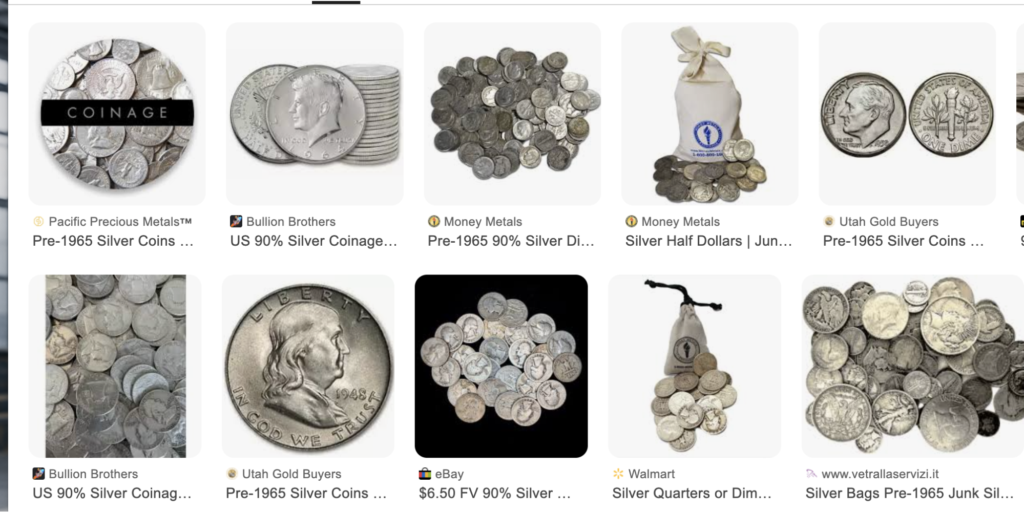
Dimes, quarters, and half dollars dated 1964 or earlier contain 90% silver and sell primarily for their metal content. They took $137,014 across 1,102 sales at an average of $124.33.
Most buyers in this category care more about total silver weight than condition, making it one of the more straightforward coin types to sell on eBay. The listings that work are face-value lots: a $10 face roll of Washington quarters at $422.33, a Walking Liberty half roll at $431.41, and a $1 face mixed lot at $44.95 that sold 341 times.
Morgan and Peace Silver Dollars
The best entry point on this list. Morgan and Peace dollars took $79,028 across 1,550 sales at an average of $50.99, with a median list price of $33.47. Volume at a price a beginner can afford to hold.
What moves is honestly described circulated stock rather than anything rare: “1878 – 1904 $1 Morgan Silver Dollar Extra Fine XF” at $60.64, the same series graded Very Good to Very Fine at $57.03, and even culls at $50.34. Grade them conservatively and they sell.
Modern Commemorative and Error Coins
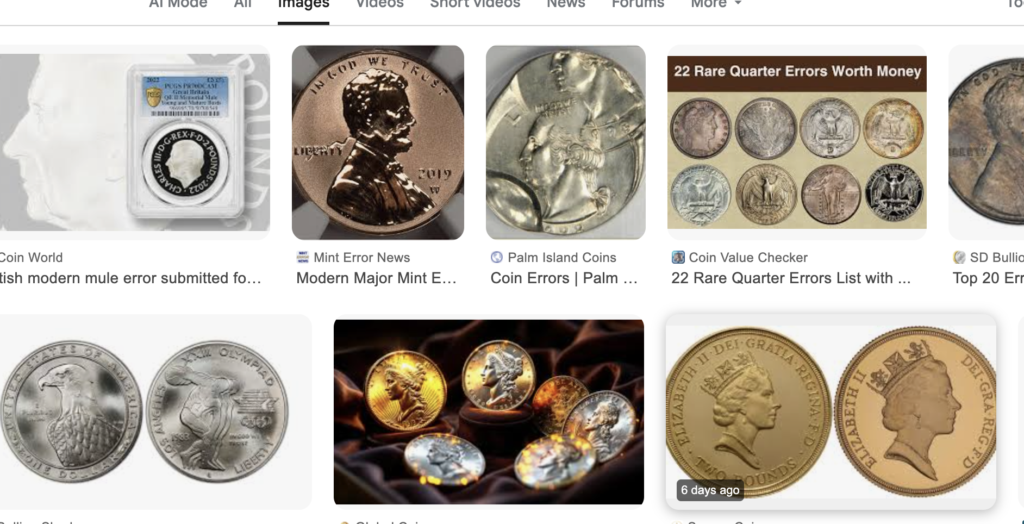
Commemoratives work, and they are carried by the gold ones: the type took $46,709 across 261 sales, and a “$5 US Mint Commemorative Gold Coin” at $1,046.60 accounts for $34,538 of it. A limited-edition issue with real collector demand can sell well above face value.
Error coins are a different story, and this is where our data contradicts a lot of advice. ZMI tracks 893 coin listings mentioning an error, a doubled die or an off-center strike, and across the last 30 days they recorded zero sales between them. Mint errors are a collector’s prize and a terrible inventory plan: the ones worth real money are rare enough that you will not find them reliably, and the rest do not move.
US Mint Proof Sets
A steady, low-ticket type: $15,944 across 380 sales at an average of $41.96. The sellers that work are complete sets with their original packaging, like a 2010-S Mint proof set with COA and box at $32.99 or a 2023-S clad proof set at $54.95.
Proof sets are easy to source from estate buys and easy to describe accurately, which makes them a good way to build the selling history Step 3 talks about.
Ancient Coins
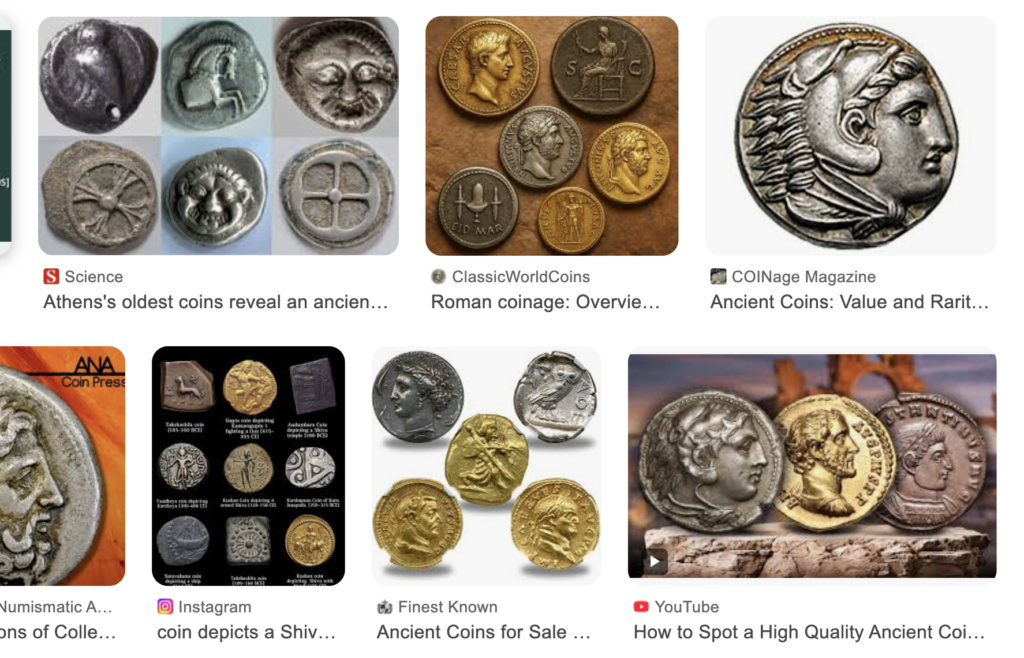
Ancient coins carry centuries of history and a passionate buyer base, and they are the one type on this list I would steer a new seller away from. ZMI tracks 718 listings matching ancient, Roman, Greek or Byzantine coins, and over 30 days they took $384 across 15 sales. The Byzantine slice alone holds 646 tracked listings and recorded nothing at all.
Look at what did sell and the picture gets clearer: the three biggest earners in that slice were a coin album, a lot of widow’s mites mounted on modern Israeli coins, and a bottle of bronze restoration fluid. The accessories outsold the coins. Buyers for budget Roman and Greek pieces exist, but they are thin on eBay, and this is a type to sell into a specialist venue rather than a general marketplace.
Find Best Selling Coins on eBay with ZIK Analytics
ZIK Analytics has a suite of eBay seller tools to help you research coins and analyze what’s selling on the platform.
However, I want to highlight three tools that make product research and eBay competitor analysis easier:
- eBay Product Research Tool shows you which coin listings are ranking highest in search results based on sales volume. Search keywords and filter by price to identify items with strong demand.
- eBay Competitor Research Tool lets you analyze successful coin sellers. Enter their username to see monthly revenue, sold items, and top-performing listings. Track them over time to spot new inventory and pricing strategies.
- ZIK’s Calculator for eBay Fees helps you estimate profit margins before listing. Enter your item cost and selling price to see fees and net profit, ensuring you’re pricing coins competitively.
You can also use the 500 Best Selling eBay Items tool to see what’s trending in the collectibles category in real time.
Start your ZIK Analytics $1 trial today and research coins with tools built for eBay sellers.
FAQs: How to Sell Coins on eBay
In this section, I’ll answer the questions people frequently ask about selling coins on eBay.
What are the rules for selling coins on eBay?
eBay’s coin rules come from its Collectible currency policy, and these are the five that change how you list:
- You should never list a replica, counterfeit, or plated coin as authentic, as eBay prohibits these outright.
- A grade can only appear in your title or description if an eBay-approved service assigned it, and a listing for an ungraded coin must not name a non-approved grading company, show a numeric grade or an estimated value, or picture the coin in a graded holder where the grade is visible.
- Ungraded coins and raw currency must have a starting, reserve, or Buy It Now price of less than $2,500.
- Current, exchangeable, ungraded currency from any country is capped separately: it “cannot exceed $1,000 in value, whether in a single listing or in a combination of multiple listings”. That is a cap on what you have on sale, not just on one listing’s price.
- You should include honest disclosures of any defects, and an ungraded listing must carry photos of the front and back of the actual coin, with stock photos not allowed.
The separate eligibility requirement for collectible coins is covered in Step 3, and it is the one that stops most new accounts before any of the above matters.
How much does eBay charge to sell coins?
eBay takes 13.25% of what a non-bullion coin sells for, up to a $7,500 cap per item, plus a small per-order charge. Bullion is billed at its own rate. Step 8 sets out the bands, the bullion row, the per-order amounts and the international fee, together with eBay’s definition of the amount all of it is calculated on.
What coins sell the most on eBay?
American Silver Eagles sell the most on eBay, whether you count money or pieces. They lead every other coin type on both revenue and units sold over the 30 days to 2026-10-23, and they do it through multi-coin rolls and tubes rather than single coins.
Their lead on pieces is narrow, though. Morgan and Peace silver dollars sold almost exactly as many coins, at about an eighth of the price per sale, and slabbed PCGS and NGC coins come next. Gold bullion coins are the opposite trade: far more money per sale, on much smaller numbers. The full ranking with what each type took is in the section above.
How do you ship coins on eBay?
You ship coins in a flat, non-rigid, non-plastic envelope by eBay standard envelope when the coin sells for $20 or less, and in a discreet, insured, tracked parcel when it sells for more. The envelope service caps you at five raw coins, bars graded coins and bullion outright, and will not take rolls. Step 11 has eBay’s full rule list, the postage rates and the size limits.
How do I find out what my old coins are worth?
Search eBay for your exact coin by year, mint mark and series, then filter to Sold Listings, because what buyers actually paid is the only price that tells you anything. A guide price is a starting point; a completed sale is evidence.
Two things change the answer a lot. Condition moves the price more than age does on most coins, so compare against sales in the same condition group rather than against the best example you can find. And if the coin might be worth hundreds, a grade from one of eBay’s approved services is often what gets you the higher price, as Step 7 explains.
Is eBay the best way to turn coins into cash quickly?
Not always, and it depends on what you have. A local coin shop pays you the same day and pays below retail, while eBay reaches collectors willing to pay retail but takes a listing period, a fee and a shipping step to get there. For common circulated silver sold by weight, the local route often nets about the same once you account for both.
eBay wins when the specific coin matters: a date, a mint mark or a grade that a collector will pay a premium for is exactly what a general buyer will not. Check completed sales for your coin first, subtract the fees from Step 8 and the postage from Step 11, and compare that against the offer in front of you.
What other items can I sell on eBay?
Wondering what to sell on eBay? We have a few detailed guides that can help you on your way!